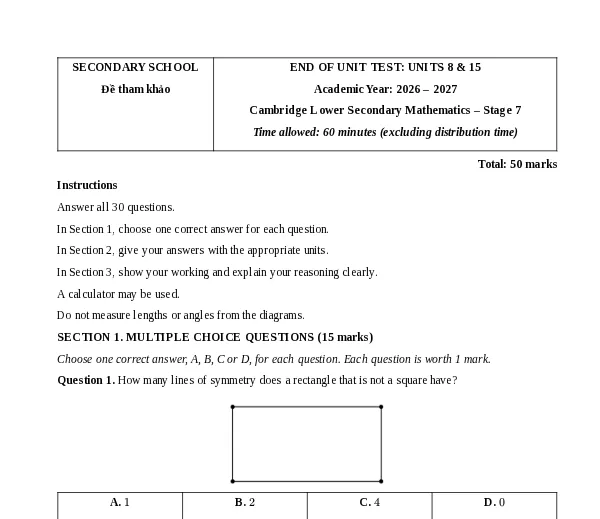
SECONDARY SCHOOL
Đề tham khảo
CAMBRIDGE MATHEMATICS 7
UNITS 8 AND 15 — COMPREHENSIVE ASSESSMENT
Paper B — Academic Year 2026–2027
Time allowed: 150 minutes
Total: 100 marks
INSTRUCTIONS
Answer all 30 questions.
Section I contains 10 multiple-choice questions worth 20 marks.
Section II contains 10 written-response questions worth 40 marks.
Section III contains 5 explanation questions worth 15 marks.
Section IV contains 5 reasoning questions worth 25 marks.
Choose one answer for each multiple-choice question.
For all other questions, show your calculations and explain your reasoning when requested.
Include appropriate units in every measurement answer.
A ruler, a pencil and a calculator may be used. Use squared paper for nets and views where appropriate.
Diagrams are not necessarily drawn to scale. When considering symmetry, ignore vertex labels and dimension labels.
The order of rotational symmetry is the number of times a shape fits exactly onto itself during one complete turn, including its final position.
Illustrations for the written-response questions are provided in the illustrated solutions after the assessment.
SECTION I. MULTIPLE-CHOICE QUESTIONS — 20 MARKS
Choose the correct answer. Each question is worth 2 marks.
Question 1 (2 marks). The outline below is a rectangle that is not a square. Which statement describes its symmetry?
[Hình vẽ]
A. One line of symmetry and rotational symmetry of order 2.
B. Two lines of symmetry and rotational symmetry of order 2.
C. Two lines of symmetry and rotational symmetry of order 4.
D. Four lines of symmetry and rotational symmetry of order 4.
Question 2 (2 marks). The circle has centre . Points , , and lie on the circle, and passes through . Which labelled segment is a chord but not a diameter?
[Hình vẽ]
A.
B.
C.
D.
Question 3 (2 marks). The outline below is a regular hexagon. What is the smallest positive angle through which it can be rotated about its centre to fit exactly onto itself?
[Hình vẽ]
A.
B.
C.
D.
Question 4 (2 marks). Triangles and are congruent, with corresponding vertices in the order shown by . Given that cm, cm and cm, what is the length of ?
[Hình vẽ]
A. cm
B. cm
C. cm
D. cm
Question 5 (2 marks). The solid shown is a tetrahedron. How many faces, vertices and edges does it have?
[Hình vẽ]
A. 4 faces, 4 vertices and 6 edges.
B. 4 faces, 6 vertices and 4 edges.
C. 5 faces, 6 vertices and 9 edges.
D. 6 faces, 8 vertices and 12 edges.
Question 6 (2 marks). A cylinder stands upright on a horizontal table. What shape is its top view?
[Hình vẽ]
A. A triangle.
B. A circle.
C. A rectangle.
D. A regular hexagon.
Question 7 (2 marks). Square has side length m. What is its area in square centimetres?
[Hình vẽ]
A. cm²
B. cm²
C. cm²
D. cm²
Question 8 (2 marks). In triangle , cm and the perpendicular height cm. What is the area of the triangle?
[Hình vẽ]
A. cm²
B. cm²
C. cm²
D. cm²
Question 9 (2 marks). A cuboid has length cm, width cm and height cm. What is its volume?
[Hình vẽ]
A. cm³
B. cm³
C. cm³
D. cm³
Question 10 (2 marks). A cube has side length cm. What is its total surface area?
[Hình vẽ]
A. cm²
B. cm²
C. cm²
D. cm²
SECTION II. WRITTEN-RESPONSE AND PRACTICAL QUESTIONS — 40 MARKS
Show your working. Each question is worth 4 marks.
Question 1 (4 marks). Draw a square with side length cm.
a) Draw all its lines of symmetry. (2 marks)
b) State its order of rotational symmetry and its smallest positive angle of rotational symmetry. (2 marks)
Question 2 (4 marks). Draw a circle with centre and radius cm. Draw a diameter and a chord that does not pass through .
a) State the length of . (1 mark)
b) Explain why is a chord but not a diameter. (1 mark)
c) Draw a tangent at . Mark the angle between the tangent and , and state its size. (2 marks)
Question 3 (4 marks). Sketch a regular octagon.
a) State how many equal sides and equal angles it has. (1 mark)
b) State its number of lines of symmetry. (1 mark)
c) State its order of rotational symmetry. (1 mark)
d) Explain what makes it a regular polygon, rather than simply an eight-sided polygon. (1 mark)
Question 4 (4 marks). Triangles and are congruent, with corresponding vertices given by . Triangle is right-angled at , and cm, cm and cm.
a) State the lengths of , and . (1 mark)
b) State the size of . (1 mark)
c) Calculate the perimeter of triangle . (1 mark)
d) Calculate the area of triangle . (1 mark)
Question 5 (4 marks). A cuboid rests on a horizontal table. Its front face is cm wide and cm high. The cuboid extends cm from front to back.
a) Draw and label its front view. (1 mark)
b) Draw and label its top view. (1 mark)
c) Draw and label its right-side view. (1 mark)
d) State the number of faces, vertices and edges of the cuboid. (1 mark)
Question 6 (4 marks). A rectangular card is cm long and mm wide.
a) Calculate its area in square millimetres. (1 mark)
b) Convert this area to square centimetres. (1 mark)
c) Convert m² to square centimetres. (1 mark)
d) Convert mm² to square centimetres. (1 mark)
Question 7 (4 marks). A rectangular field is m long and m wide.
a) Calculate its area in square metres. (1 mark)
b) Express its area in hectares. (1 mark)
c) The field is divided into two parts in the ratio . Calculate the area of the larger part in hectares and in square metres. (2 marks)
Question 8 (4 marks). A sign is made from a rectangle with a triangle attached along its entire top edge. The rectangle is cm wide and cm high. The triangle has base cm and perpendicular height cm. A rectangular opening measuring cm by cm is cut entirely inside the rectangular part.
a) Calculate the area of the rectangular part before the opening is cut. (1 mark)
b) Calculate the area of the triangular part. (1 mark)
c) Calculate the remaining area of the sign after the opening is cut. (2 marks)
Question 9 (4 marks). A closed cuboid-shaped box has length cm, width cm and height mm.
a) Convert the height to centimetres. (1 mark)
b) Calculate the volume of the box in cubic centimetres. (1 mark)
c) Calculate its total surface area in square centimetres. (2 marks)
Question 10 (4 marks). A cube is made by folding a net of six congruent squares. Each square has side length cm.
a) Draw one possible net of the cube. (2 marks)
b) Calculate the total surface area of the cube. (1 mark)
c) Calculate the volume of the cube. (1 mark)
SECTION III. EXPLANATION AND JUSTIFICATION — 15 MARKS
Give clear mathematical explanations. Each question is worth 3 marks.
Question 1 (3 marks). Two equilateral triangles have side lengths cm and cm respectively.
A student says, “Both triangles have three angles of , so they must be congruent.”
Is the student correct? Explain what congruence requires and use the given measurements to support your answer.
Question 2 (3 marks). Rectangle measures cm by cm. Rectangle measures cm by cm.
A student says, “The rectangles have the same perimeter, so they must be congruent and have the same area.”
Calculate their perimeters and areas. Explain why the conclusion is incorrect.
Question 3 (3 marks). In triangle , cm, cm and the perpendicular height from to is cm.
A student writes:
Identify the mistake, explain which measurement should be used, and calculate the correct area with its unit.
Question 4 (3 marks). A square panel has side length m, so its area is m².
A student says, “To change square metres to square centimetres, I multiply by . Therefore, the area is cm².”
Explain why the conversion factor is incorrect and find the correct area in square centimetres.
Question 5 (3 marks). Cube has side length cm. Cube has side length cm.
A student says, “The side length has doubled, so both the volume and the total surface area have doubled.”
Calculate the volume and total surface area of each cube. Explain the actual multiplication factor for each quantity.
SECTION IV. REASONING AND DEDUCTION — 25 MARKS
Show a complete chain of reasoning. Each question is worth 5 marks.
Question 1 (5 marks). Nine congruent square tiles form a square. Five tiles are dark and four are white.
The arrangement must have rotational symmetry of order 4, and tile colours must match after rotation.
a) Explain why the centre tile must be dark. (1 mark)
b) Draw the two possible colour arrangements. (2 marks)
c) State the number of lines of symmetry of each arrangement. (1 mark)
d) Explain why there are no other possible arrangements. (1 mark)
Question 2 (5 marks). A right prism has two congruent regular polygonal bases and rectangular side faces. It has 18 edges.
a) Determine the number of sides of each base. Explain how you use the edge count. (2 marks)
b) Name the prism and state its number of faces and vertices. (1 mark)
c) State the number of lines of symmetry of one base and its smallest positive angle of rotational symmetry. (2 marks)
Question 3 (5 marks). A rectangular site measures m by m. A rectangle measuring m by m is removed from its top-right corner, leaving an L-shaped site.
The land costs 2500 dollars per hectare. A fence around the entire boundary of the remaining site costs 8 dollars per metre. A buyer has a total budget of 130 000 dollars.
a) Calculate the area of the remaining site in hectares. (2 marks)
b) Calculate the total length of fence required. (1 mark)
c) Determine whether the budget covers both the land and the fence. State the amount left over or the shortfall. (2 marks)
Question 4 (5 marks). An open-top tank is a cuboid with length m, width m and height m. Ignore the thickness of its walls.
Only the outside of its base and four walls will be painted. The tank needs two coats of paint.
One litre of paint covers m² for one coat. Paint is sold only in -litre tins costing 18 dollars each. Assume there is no paint wastage.
a) Calculate the volume of the tank in cubic metres. (1 mark)
b) Calculate the outside area to be painted for one coat. (2 marks)
c) Calculate the minimum number of tins required for two coats and the total cost. (2 marks)
Question 5 (5 marks). A solid metal model consists of a cuboid measuring cm by cm by cm and a cube of side length cm attached on top.
The cube stands at one corner of the cuboid’s top face. Its entire bottom face is in contact with the cuboid. There are no gaps or overlaps.
a) Calculate the volume of the complete model. (1 mark)
b) Calculate its total exposed surface area. Explain how the contact area is treated. (2 marks)
c) The model is melted down and recast into cubes of side length cm. Assuming no metal is lost, calculate how many complete cubes can be made. (2 marks)
--------- END OF ASSESSMENT ---------
Student name: ................................................ Candidate number: ........................
ANSWER KEY AND ILLUSTRATED SOLUTIONS
The illustrations below accompany the written-response questions. Alternative correct drawings, methods and explanations are acceptable.
SECTION I. MULTIPLE-CHOICE ANSWERS
Question 1: B. A non-square rectangle has two lines of symmetry, through the midpoints of opposite sides, and rotational symmetry of order 2.
Question 2: C. Both endpoints of lie on the circle, but does not pass through the centre.
Question 3: C. The smallest positive rotation is .
Question 4: C. Side corresponds to , so cm.
Question 5: A. A tetrahedron has 4 triangular faces, 4 vertices and 6 edges.
Question 6: B. Viewed vertically from above, an upright cylinder has a circular outline.
Question 7: C. The side length is cm, so the area is cm².
Question 8: B. The area is cm².
Question 9: C. The volume is cm³.
Question 10: D. The total surface area is cm².
SECTION II. WRITTEN-RESPONSE AND PRACTICAL SOLUTIONS
Question 1
[Hình vẽ]
a) The four lines of symmetry are the two diagonals and the two lines joining the midpoints of opposite sides.
b) The order of rotational symmetry is 4.
The smallest positive angle of rotational symmetry is:
Question 2
[Hình vẽ]
a) The diameter is twice the radius:
Therefore, cm.
b) Segment joins two points on the circle, so it is a chord. It does not pass through , so it is not a diameter.
c) The tangent at is perpendicular to radius . The angle is .
Question 3
[Hình vẽ]
a) It has 8 equal sides and 8 equal interior angles.
b) It has 8 lines of symmetry.
c) Its order of rotational symmetry is 8.
d) A regular polygon has all sides equal and all interior angles equal. Having eight sides alone does not guarantee either property.
Question 4
[Hình vẽ]
a) Corresponding sides are equal:
All three lengths are in centimetres.
b) Angle corresponds to angle , so .
c) The perimeter is:
The perimeter is cm.
d) The two perpendicular sides are and :
The area is cm².
Question 5
[Hình vẽ]
a) The front view is a rectangle measuring cm by cm.
b) The top view is a rectangle measuring cm by cm.
c) The right-side view is a rectangle measuring cm by cm.
d) A cuboid has 6 faces, 8 vertices and 12 edges.
Question 6
[Hình vẽ]
The card has length cm and width mm.
a) Convert the length first: cm mm.
The area is mm².
b) Since cm² mm²:
The area is cm².
c) Since m² cm²:
Therefore, m² cm².
d)
Therefore, mm² cm².
Question 7
[Hình vẽ]
Here m and m. The division shown gives areas in the ratio .
a)
The field has area m².
b)
The area is ha.
c) There are equal ratio parts. The larger portion contains three parts:
The larger portion is ha, or m².
Question 8
[Hình vẽ]
The rectangle is cm by cm, the triangular height is cm, and the opening is cm by cm.
a)
The rectangular part has area cm².
b)
The triangular part has area cm².
c) The opening has area cm².
The remaining area is cm².
Question 9
[Hình vẽ]
a) The height is cm.
b)
The volume is cm³.
c)
The total surface area is cm².
Question 10
[Hình vẽ]
a) One valid net is shown. It contains six squares that fold to form the six faces without overlapping.
b)
The total surface area is cm².
c)
The volume is cm³.
SECTION III. EXPLANATION AND JUSTIFICATION SOLUTIONS
Question 1
[Hình vẽ]
The student is incorrect.
Congruent shapes must have the same shape and the same size. Their corresponding sides and angles must be equal.
Although both equilateral triangles have angles of , their corresponding sides measure cm and cm. Their sizes differ, so they are not congruent.
Question 2
[Hình vẽ]
The left rectangle measures cm by cm. The right rectangle measures cm by cm.
Their perimeters are:
Both perimeters are cm.
Their areas are:
Their areas are cm² and cm².
Equal perimeters do not imply congruence or equal areas. The rectangles have different side lengths and different areas.
Question 3
[Hình vẽ]
The student used the sloping side cm as the height.
The height corresponding to base must be perpendicular to . The correct height is cm.
Therefore:
The correct area is cm².
Question 4
[Hình vẽ]
The side length is m, which is cm.
A square metre contains square centimetres. The linear conversion factor must be squared:
Therefore:
The correct area is cm².
This also agrees with cm².
Question 5
[Hình vẽ]
Cube :
Its volume is cm³ and its total surface area is cm².
Cube :
Its volume is cm³ and its total surface area is cm².
The volume multiplication factor is:
The surface-area multiplication factor is:
Doubling every length multiplies volume by 8 and surface area by 4, not by 2.
SECTION IV. REASONING AND DEDUCTION SOLUTIONS
Question 1
[Hình vẽ]
a) A quarter-turn leaves the centre tile in the same position.
The four corner positions cycle through one another, so they must all have the same colour. The four edge-middle positions also cycle through one another and must all have the same colour.
Dark tiles outside the centre therefore occur in groups of four. Since there are five dark tiles, the centre must be dark.
b) The other four dark tiles must occupy either all four corners or all four edge-middle positions. These give the two patterns shown.
c) Each arrangement has 4 lines of symmetry: one horizontal, one vertical and two diagonal.
d) Once the centre is dark, exactly four dark tiles remain. Rotational symmetry requires them to fill one complete group of four positions. There are only two such groups, so there are no other arrangements.
Question 2
[Hình vẽ]
a) Let each base have sides.
The two bases contribute edges, and there are edges joining corresponding vertices. Therefore:
Each base has 6 sides.
b) The solid is a hexagonal prism.
It has faces and vertices.
c) A regular hexagonal base has 6 lines of symmetry.
Its smallest positive angle of rotational symmetry is:
Question 3
[Hình vẽ]
The original rectangle has dimensions m by m. The removed corner measures m by m.
a) The remaining area is:
The area is m².
In hectares:
The remaining site has area ha.
b) The boundary lengths, in metres, are:
Therefore:
The fence must be m long.
Removing the corner does not change the total perimeter: the removed outer lengths are replaced by equal inner lengths.
c) The land cost is:
The fence cost is:
The combined cost is:
The budget is sufficient, with:
The buyer has 2600 dollars left over.
Question 4
[Hình vẽ]
a)
The tank volume is m³.
b) The outside base has area:
Its area is m².
The four outside walls have total area:
Their area is m².
There is no top to paint, so:
The area is m².
c) Two coats require coverage of:
This is m² of single-coat coverage.
The paint required is:
The tank requires litres.
The number of tins must be a whole number:
Therefore, 7 tins are required.
The total cost is:
The paint costs 126 dollars.
Question 5
[Hình vẽ]
a) The cuboid volume is:
The cube volume is:
Therefore:
The total volume is cm³.
b) The full surface area of the cuboid is:
This is cm².
The full surface area of the cube is:
This is cm².
The contact area is cm². It is counted once on the cuboid and once on the cube, but neither contact surface is exposed.
Therefore:
The total exposed surface area is cm².
c) Each new cube has volume:
This is cm³.
The number of complete cubes is:
Therefore, 56 complete cubes can be made.