TRƯỜNG THPT …
TỔ NGOẠI NGỮ
Đề ôn tập
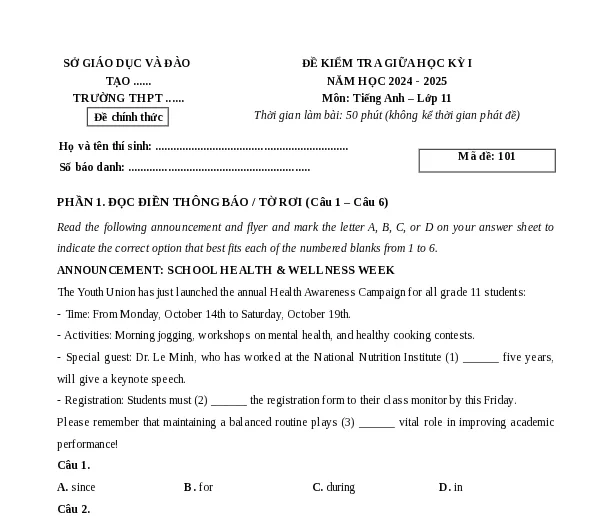
ĐỀ ÔN THI TỐT NGHIỆP THPT
Môn: Tiếng Anh – Lớp 11
Thời gian làm bài: 90 phút (không kể thời gian phát đề)
Họ và tên thí sinh: ................................................................ Số báo danh: ............................................................ | Mã đề: 101 |
PHẦN I. TỪ VỰNG VÀ NGỮ PHÁP (Câu 1 – 24)
Mark the letter A, B, C, or D to indicate the correct answer to each of the following questions.
Câu 1. The exhibition of future cities ______ really interesting, so I visited it twice.
A. looked
B. was looked
C. looked like
D. was looking
Câu 2. Since the pedestrian zone was created, the city centre ______ much quieter.
A. became
B. is becoming
C. become
D. has become
Câu 3. The air in the suburbs ______ fresher than that in the city centre.
A. seems
B. is seemed
C. seems like
D. seeming
Câu 4. The vegetables grown in the roof garden ______ really fresh.
A. are tasting
B. are tasted
C. tasting
D. taste
Câu 5. The government's plan ______ very practical to most city dwellers.
A. seems
B. is seemed
C. seeming
D. seem
Câu 6. Despite the heavy rain, the streets ______ clean and tidy this morning.
A. remained
B. were remained
C. remaining
D. remainly
Câu 7. I ______ that living in a smart city is a good choice for young people.
A. am thinking
B. am thought
C. think
D. thinking
Câu 8. My uncle ______ a small flat in the urban centre, but he wants to move to the suburbs.
A. is having
B. have
C. is had
D. has
Câu 9. This smart sensor ______ to the city's traffic control system.
A. is belonging
B. belong
C. belongs
D. is belonged
Câu 10. Nobody ______ how to solve the pollution problem in this area yet.
A. is knowing
B. know
C. is known
D. knows
Câu 11. I ______ what you mean, but I don't agree with you.
A. am understanding
B. am understood
C. understand
D. understands
Câu 12. My sister ______ classical music to pop music.
A. is preferring
B. prefer
C. is preferred
D. prefers
Câu 13. We ______ of moving to a smart city in the north of the country next year.
A. are thinking
B. think
C. thinks
D. are thought
Câu 14. The children ______ a great time at the exhibition of future cities.
A. have
B. is having
C. has
D. are having
Câu 15. Nam ______ a girl from his neighbourhood, and they often go cycling together.
A. sees
B. is seeing
C. is seen
D. see
Câu 16. Why ______ the soup? Is there something wrong with it?
A. do you taste
B. you taste
C. are you tasted
D. are you tasting
Câu 17. People living in crowded cities often feel ______ because of the noise and pollution.
A. unhappily
B. unhappy
C. unhappiness
D. unhappyly
Câu 18. The manager looked ______ at the workers who arrived late.
A. angry
B. anger
C. angrier
D. angrily
Câu 19. The new underground system is operating ______ than the old bus network.
A. more efficient
B. more efficiently
C. efficiency
D. most efficiently
Câu 20. The plan to build a smart city sounds ______, but we need to consider its cost.
A. interestingly
B. interest
C. interested
D. interesting
Câu 21. The government is trying to make the city more ______.
A. sustain
B. sustainable
C. sustainably
D. sustainability
Câu 22. Smart sensors help the city operate more ______.
A. efficient
B. efficiency
C. efficiently
D. inefficient
Câu 23. Air ______ is a serious problem in many big cities.
A. pollute
B. polluted
C. pollution
D. pollutant
Câu 24. The new residential area is very ______ because it has a lot of green space.
A. live
B. living
C. liveable
D. lively
PHẦN II. SẮP XẾP CÂU THÀNH ĐOẠN HỘI THOẠI (Câu 25 – 31)
Mark the letter A, B, C, or D to indicate the correct order of the sentences to make a complete conversation.
Câu 25.
a. Yes, it does. It's a model of a green city.
b. Wow, this model looks amazing. Does it show a city of the future?
c. More than half of it is green space, so there will be less pollution.
d. Really? How much of the city is green?
e. That sounds like a great place to live.
A. b – a – d – c – e
B. b – d – a – c – e
C. a – b – d – c – e
D. b – a – c – d – e
Câu 26.
a. I think people will use electric buses and trams instead of private cars.
b. So there will be fewer traffic jams, right?
c. What do you think transport will be like in the cities of the future?
d. Exactly. And the air will be much cleaner too.
e. That's good news for city dwellers.
A. c – a – d – b – e
B. c – a – b – d – e
C. a – c – b – d – e
D. c – b – a – d – e
Câu 27.
a. I'm not really sure about it. Cameras everywhere might be a problem.
b. Do you think living in a smart city is always convenient?
c. You're right. But smart sensors can also help the city save energy.
d. What do you mean?
e. Well, people may lose their privacy because they are watched all the time.
A. b – d – a – e – c
B. a – b – d – e – c
C. b – a – d – e – c
D. b – a – e – d – c
Câu 28.
a. Great. Can I book a parking space on the app before I arrive?
b. Sure. First, you need to download the Parking.sg app.
c. Yes, you can. You can also extend your booking if you stay longer.
d. Could you show me how to use this smart parking app?
e. That's convenient. Thanks a lot.
f. No problem. Let me know if you need any help.
A. d – b – c – a – e – f
B. d – b – a – c – e – f
C. b – d – a – c – e – f
D. d – a – b – c – f – e
Câu 29.
a. Really? What are they doing to solve it?
b. The city has planted thousands of trees and built more cycle paths.
c. Have you noticed how polluted the air in our city is?
d. Yes, I have. But I think the local government is trying to improve the situation.
e. That's a good start. I hope the air will get cleaner soon.
f. So do I. We should also use public transport more often.
A. c – d – b – a – e – f
B. c – d – a – e – b – f
C. d – c – a – b – f – e
D. c – d – a – b – e – f
Câu 30.
a. I see. So the sensors collect information and send it to the control centre.
b. Exactly. And street lights turn off automatically when the streets are empty.
c. That's amazing. It must save a lot of energy.
d. Have you read about the new smart street infrastructure in Singapore?
e. Yes, I have. It uses sensors to check traffic and waste bins.
f. It does. I wish our city had a system like that.
A. d – e – a – b – c – f
B. d – e – b – a – c – f
C. d – a – e – b – c – f
D. e – d – a – b – c – f
Câu 31.
a. Not really. I'd prefer a quieter place with more green space.
b. Would you like to live in a city like this in the future?
c. That's a good point. Future cities should be both smart and sustainable.
d. Why not? It has high-rise buildings and modern infrastructure.
e. I agree. In my opinion, a liveable city must be good for both people and the environment.
f. Well, I think a smart city can also be green if it uses renewable energy.
A. b – d – a – f – c – e
B. b – a – f – d – c – e
C. b – a – d – c – f – e
D. b – a – d – f – c – e
PHẦN III. TÌM LỖI SAI (Câu 32 – 39)
Mark the letter A, B, C, or D to indicate the underlined part that needs correction in each of the following questions.
Câu 32. The urban lifestyle seems more excitingly to young people.
A. The
B. seems
C. excitingly
D. to
Câu 33. The museum looks beauty from a distance.
A. The
B. looks
C. beauty
D. from
Câu 34. Widening the road sounds a good solve to traffic problems in the area.
A. Widening
B. sounds
C. solve
D. in
Câu 35. I am knowing the answer to this question.
A. am knowing
B. the
C. to
D. this
Câu 36. The soup is tasting delicious today.
A. is tasting
B. delicious
C. today
D. The
Câu 37. The city is seeming more modern with the new skyscrapers.
A. is seeming
B. more
C. with
D. new
Câu 38. People in high-rise buildings must to obey the safety rules.
A. People
B. must to
C. the
D. rules
Câu 39. The new urban area looks beautifully at night.
A. new
B. looks beautifully
C. at
D. night
PHẦN IV. VIẾT LẠI CÂU (Câu 40 – 51)
Mark the letter A, B, C, or D to indicate the sentence that is closest in meaning to each of the following questions.
Câu 40. It seems that city dwellers are worried about their privacy. (seem)
A. City dwellers seem to be worried about their privacy.
B. City dwellers seem being worried about their privacy.
C. City dwellers are seemed to be worried about their privacy.
D. City dwellers seem worriedly about their privacy.
Câu 41. The exhibition of future cities is very interesting to me. (find)
A. I find the exhibition of future cities is very interesting.
B. I find the exhibition of future cities very interesting.
C. I am found the exhibition of future cities very interesting.
D. I find the exhibition of future cities very interested.
Câu 42. My father is considering buying an electric car. (thinking)
A. My father is thinking to buy an electric car.
B. My father is thinking of buy an electric car.
C. My father is thinking of buying an electric car.
D. My father is thinking about to buy an electric car.
Câu 43. He owns three flats in the urban centre. (has)
A. He is having three flats in the urban centre.
B. He is owned three flats in the urban centre.
C. He has been owning three flats in the urban centre.
D. He has three flats in the urban centre.
Câu 44. The streets are cleaner now because the government has limited private vehicles. (become)
A. The streets have become cleaner since the government limited private vehicles.
B. The streets became cleaner since the government has limited private vehicles.
C. The streets have became cleaner since the government limited private vehicles.
D. The streets have been become cleaner since the government limited private vehicles.
Câu 45. She prefers public transport to private vehicles. (like)
A. She likes public transport best than private vehicles.
B. She likes public transport better than private vehicles.
C. She likes public transport as much as private vehicles.
D. She likes public transport more better than private vehicles.
Câu 46. Because smart technologies are expensive, not many cities can build them. (Because of)
A. Because of smart technologies are expensive, not many cities can build them.
B. Because the high cost of smart technologies, not many cities can build them.
C. Because of the high cost of smart technologies, not many cities can build them.
D. Because of smart technologies expensive, not many cities can build them.
Câu 47. Although the streets were crowded, the air was fresh. (Despite)
A. Despite the streets were crowded, the air was fresh.
B. Despite of the crowded streets, the air was fresh.
C. Despite the streets crowded, the air was fresh.
D. Despite the crowded streets, the air was fresh.
Câu 48. It is thought that smart sensors help the city operate more efficiently. (thought)
A. Smart sensors are thought helping the city operate more efficiently.
B. Smart sensors are thought to help the city operate more efficiently.
C. Smart sensors think to help the city operate more efficiently.
D. Smart sensors are thought to helping the city operate more efficiently.
Câu 49. It is necessary for people in high-rise buildings to obey the safety rules. (have to)
A. People in high-rise buildings don't have to obey the safety rules.
B. People in high-rise buildings mustn't obey the safety rules.
C. People in high-rise buildings have to obey the safety rules.
D. People in high-rise buildings should not obey the safety rules.
Câu 50. It is not necessary for you to wear a uniform at the weekend. (don't have to)
A. You mustn't wear a uniform at the weekend.
B. You shouldn't wear a uniform at the weekend.
C. You have to wear a uniform at the weekend.
D. You don't have to wear a uniform at the weekend.
Câu 51. The exhibition was so interesting that we visited it twice. (such)
A. It was such interesting an exhibition that we visited it twice.
B. It was so an interesting exhibition that we visited it twice.
C. It was such an interesting exhibition that we visited it twice.
D. It was such an interesting exhibition so we visited it twice.
PHẦN V. ĐỌC HIỂU (Câu 52 – 59)
Read the following passage and mark the letter A, B, C, or D to indicate the correct answer to each of the questions.
By 2050, the world's population is expected to reach 10 billion, and nearly 70 per cent of these people will live in cities. The cities of the future will be "smarter" and more sustainable to cope with a growing population and improve people's lives.
A smart city is a modern urban area that uses a range of technologies to provide services, solve problems, and support people better. New technologies can help save time by predicting changes in traffic and warning people of possible traffic jams. They also help cities operate more efficiently. For example, street lights can turn off when the streets are empty, and sensors can inform waste collection teams when the bins are full. These smart technologies will help save energy, reduce air pollution, and fight climate change.
Cities in the future will also be sustainable. They will include a lot of green space and become home to more plants and animals. Making room for biodiversity and nature can be done in various ways including underground and rooftop farming, green roofs, and roof gardens. As people will care more about the environment, most cities will use renewable and clean energy. Modern infrastructure will also be more eco-friendly. Computer-controlled transport systems like electric buses and trains will produce less greenhouse gas emissions. In addition, more pedestrian zones for walking and cycle paths will be made available for people in all neighbourhoods.
These features will make future cities more liveable and will provide a high quality of life to city dwellers.
Câu 52. Which of the following is the best title for the passage?
A. The Advantages of Living in Big Cities
B. Characteristics of Future Cities
C. How to Reduce Air Pollution
D. The Population Boom in 2050
Câu 53. According to the passage, what percentage of the world's population will live in cities by 2050?
A. About 50%
B. Nearly 70%
C. Over 80%
D. Exactly 10%
Câu 54. The word "cope with" in paragraph 1 is closest in meaning to ______.
A. deal with
B. give up
C. look after
D. turn down
Câu 55. According to paragraph 2, smart technologies can help cities in all of the following ways EXCEPT ______.
A. saving time by predicting traffic changes
B. warning people of possible traffic jams
C. informing waste collection teams when bins are full
D. replacing all human workers in public services
Câu 56. The word "They" in paragraph 3 refers to ______.
A. future cities
B. plants and animals
C. green spaces
D. city dwellers
Câu 57. Which of the following is NOT mentioned as a way to make room for biodiversity and nature?
A. Underground farming
B. Rooftop farming
C. Green roofs
D. Building more skyscrapers
Câu 58. According to the passage, computer-controlled transport systems will ______.
A. produce less greenhouse gas emissions
B. increase the number of private vehicles
C. replace all pedestrian zones
D. use more fossil fuel
Câu 59. The word "liveable" in the last paragraph is closest in meaning to ______.
A. suitable for farming
B. nice to live in
C. good for the environment
D. expensive to live in
--------- HẾT ---------
Thí sinh không được sử dụng tài liệu. Cán bộ coi thi không giải thích gì thêm.
TRƯỜNG THPT …
TỔ NGOẠI NGỮ
Hướng dẫn chấm
ĐÁP ÁN VÀ GIẢI THÍCH CHI TIẾT
Môn: Tiếng Anh – Lớp 11
Unit 3: Cities of the Future (Global Success)
A. HƯỚNG DẪN CHUNG
Mỗi câu trả lời đúng được tính điểm như nhau. Phần viết lại câu chấp nhận các phương án đúng ngữ pháp khác nếu giữ nguyên nghĩa và dùng đúng từ gợi ý. Phần sắp xếp hội thoại chấp nhận phương án có thứ tự đúng hoàn toàn; nếu học sinh chọn phương án sai thứ tự từ hai lượt lời trở lên thì không được điểm.
B. ĐÁP ÁN VÀ GIẢI THÍCH CHI TIẾT
PHẦN I. TỪ VỰNG VÀ NGỮ PHÁP
Câu 1 – A (looked). Giải thích: look + tính từ (linking verb chỉ ấn tượng); was looked sai vì look ở đây không dùng bị động, looked like cần danh từ phía sau. Dịch: Triển lãm về các thành phố tương lai trông thật thú vị nên tôi đã đến xem hai lần.
Câu 2 – D (has become). Giải thích: Since + S + V (quá khứ đơn), S + have/has + V3/ed; has become + tính từ so sánh hơn quieter. Dịch: Kể từ khi khu đi bộ được tạo ra, trung tâm thành phố đã trở nên yên tĩnh hơn nhiều.
Câu 3 – A (seems). Giải thích: seem + tính từ, là động từ chỉ trạng thái nên không chia tiếp diễn và không dùng bị động. Dịch: Không khí ở vùng ngoại ô có vẻ trong lành hơn không khí ở trung tâm thành phố.
Câu 4 – D (taste). Giải thích: taste là linking verb chỉ giác quan, đi với tính từ fresh; chủ ngữ vegetables số nhiều nên dùng taste (không tiếp diễn). Dịch: Rau trồng trong vườn trên mái nhà có vị rất tươi ngon.
Câu 5 – A (seems). Giải thích: seem + tính từ (practical); chủ ngữ plan số ít nên dùng seems. Dịch: Kế hoạch của chính phủ có vẻ rất thực tế đối với hầu hết cư dân thành phố.
Câu 6 – A (remained). Giải thích: remain + tính từ = vẫn giữ nguyên trạng thái; remain là nội động từ, không dùng bị động. Dịch: Dù mưa to, sáng nay đường phố vẫn sạch sẽ và ngăn nắp.
Câu 7 – C (think). Giải thích: think = tin rằng, là động từ chỉ trạng thái nên chia hiện tại đơn, không dùng tiếp diễn. Dịch: Tôi nghĩ rằng sống ở một thành phố thông minh là lựa chọn tốt cho người trẻ.
Câu 8 – D (has). Giải thích: have = sở hữu, là động từ chỉ trạng thái nên dùng hiện tại đơn has (chủ ngữ số ít). Dịch: Chú tôi có một căn hộ nhỏ ở trung tâm đô thị nhưng ông muốn chuyển ra ngoại ô.
Câu 9 – C (belongs). Giải thích: belong to = thuộc về, là động từ chỉ trạng thái, không chia tiếp diễn và không dùng bị động. Dịch: Cảm biến thông minh này thuộc hệ thống điều khiển giao thông của thành phố.
Câu 10 – D (knows). Giải thích: know là động từ chỉ trạng thái nên chia hiện tại đơn; nobody đi với động từ số ít. Dịch: Chưa ai biết cách giải quyết vấn đề ô nhiễm ở khu vực này.
Câu 11 – C (understand). Giải thích: understand là động từ chỉ trạng thái, không dùng ở thể tiếp diễn. Dịch: Tôi hiểu ý bạn nhưng tôi không đồng ý với bạn.
Câu 12 – D (prefers). Giải thích: prefer là động từ chỉ cảm xúc, không dùng tiếp diễn; my sister số ít nên dùng prefers. Dịch: Chị tôi thích nhạc cổ điển hơn nhạc pop.
Câu 13 – A (are thinking). Giải thích: be thinking of / about + V-ing = đang cân nhắc, đây là trường hợp động từ chỉ trạng thái được dùng ở thể tiếp diễn với nghĩa hành động. Dịch: Chúng tôi đang cân nhắc chuyển đến một thành phố thông minh ở miền Bắc vào năm tới.
Câu 14 – D (are having). Giải thích: have a good time = đang có khoảng thời gian vui vẻ, là trải nghiệm nên dùng thể tiếp diễn are having. Dịch: Bọn trẻ đang có khoảng thời gian tuyệt vời ở triển lãm các thành phố tương lai.
Câu 15 – B (is seeing). Giải thích: be seeing someone = đang hẹn hò với ai, nghĩa hành động nên dùng tiếp diễn. Dịch: Nam đang hẹn hò với một cô gái trong khu phố và họ thường đạp xe cùng nhau.
Câu 16 – D (are you tasting). Giải thích: be tasting = đang nếm thử (hành động), khác với taste = có vị (trạng thái). Dịch: Sao bạn lại đang nếm món súp vậy? Có vấn đề gì à?
Câu 17 – B (unhappy). Giải thích: feel + tính từ (linking verb chỉ cảm xúc); unhappily là trạng từ, không đứng sau feel ở đây. Dịch: Người sống ở các thành phố đông đúc thường cảm thấy không vui vì tiếng ồn và ô nhiễm.
Câu 18 – D (angrily). Giải thích: look at ở đây là động từ thường chỉ hành động nhìn, nên bổ nghĩa bằng trạng từ angrily, không dùng tính từ. Dịch: Người quản lý giận dữ nhìn những công nhân đến muộn.
Câu 19 – B (more efficiently). Giải thích: bổ nghĩa cho động từ thường operate phải dùng trạng từ; có than nên dùng so sánh hơn more efficiently. Dịch: Hệ thống tàu điện ngầm mới đang vận hành hiệu quả hơn mạng lưới xe buýt cũ.
Câu 20 – D (interesting). Giải thích: sound + tính từ (linking verb); interesting miêu tả bản thân sự vật, phù hợp với chủ ngữ the plan. Dịch: Kế hoạch xây dựng một thành phố thông minh nghe có vẻ thú vị, nhưng chúng ta cần cân nhắc chi phí.
Câu 21 – B (sustainable). Giải thích: sau more cần tính từ; sustain → sustainable (bền vững). Dịch: Chính phủ đang cố gắng làm cho thành phố trở nên bền vững hơn.
Câu 22 – C (efficiently). Giải thích: bổ nghĩa cho động từ thường operate cần trạng từ; efficient → efficiently. Dịch: Các cảm biến thông minh giúp thành phố vận hành hiệu quả hơn.
Câu 23 – C (pollution). Giải thích: trước động từ is và sau cụm danh từ Air cần một danh từ ghép; pollute → pollution (sự ô nhiễm). Dịch: Ô nhiễm không khí là một vấn đề nghiêm trọng ở nhiều thành phố lớn.
Câu 24 – C (liveable). Giải thích: sau very cần tính từ; live → liveable (đáng sống). Dịch: Khu dân cư mới rất đáng sống vì có nhiều không gian xanh.
PHẦN II. SẮP XẾP CÂU THÀNH ĐOẠN HỘI THOẠI
Câu 25 – A (b – a – d – c – e). Giải thích: câu b mở đầu bằng lời khen và câu hỏi Yes/No Does it show…?; câu a trả lời trực tiếp Yes, it does; câu d hỏi tiếp How much of the city is green?; câu c trả lời bằng số liệu More than half…; câu e kết lại bằng lời bình That sounds like a great place to live. Dịch: "Mô hình này trông tuyệt thật. Nó thể hiện một thành phố của tương lai phải không?" – "Đúng vậy. Đó là mô hình thành phố xanh." – "Thật à? Bao nhiêu phần của thành phố là cây xanh?" – "Hơn một nửa là không gian xanh, nên sẽ ít ô nhiễm hơn." – "Nghe như một nơi tuyệt vời để sống."
Câu 26 – B (c – a – b – d – e). Giải thích: câu c là câu hỏi mở đầu về phương tiện giao thông tương lai; câu a trả lời bằng dự đoán people will use electric buses and trams; câu b hỏi lại để xác nhận So there will be fewer traffic jams, right?; câu d xác nhận Exactly rồi bổ sung ý về không khí; câu e kết thúc bằng nhận xét. Dịch: "Bạn nghĩ giao thông ở các thành phố tương lai sẽ thế nào?" – "Tôi nghĩ người ta sẽ dùng xe buýt điện và tàu điện thay vì xe riêng." – "Vậy sẽ ít tắc đường hơn phải không?" – "Chính xác. Và không khí cũng sẽ sạch hơn nhiều." – "Đó là tin tốt cho cư dân thành phố."
Câu 27 – C (b – a – d – e – c). Giải thích: câu b là câu hỏi khởi đầu về sự tiện lợi của thành phố thông minh; câu a trả lời có dè dặt I'm not really sure about it; câu d hỏi lại What do you mean? để yêu cầu giải thích; câu e giải thích về quyền riêng tư; câu c là lời đáp lại bằng từ nối But nêu mặt tích cực. Dịch: "Bạn có nghĩ sống ở thành phố thông minh lúc nào cũng tiện không?" – "Tôi không chắc lắm. Camera khắp nơi có thể là vấn đề." – "Ý bạn là gì?" – "À, người dân có thể mất quyền riêng tư vì lúc nào cũng bị theo dõi." – "Bạn nói đúng. Nhưng cảm biến thông minh cũng giúp thành phố tiết kiệm năng lượng."
Câu 28 – B (d – b – a – c – e – f). Giải thích: câu d là lời nhờ giúp đỡ Could you show me…?; câu b hồi đáp Sure. First, you need to…; câu a hỏi tiếp Can I book a parking space…?; câu c trả lời Yes, you can…; câu e cảm ơn; câu f đáp lại lời cảm ơn. Dịch: "Bạn có thể chỉ mình cách dùng ứng dụng đỗ xe thông minh này không?" – "Được chứ. Đầu tiên bạn cần tải ứng dụng Parking.sg." – "Tuyệt. Mình có thể đặt chỗ đỗ xe trên ứng dụng trước khi đến không?" – "Được. Bạn còn có thể gia hạn đặt chỗ nếu ở lâu hơn." – "Tiện thật. Cảm ơn nhiều." – "Không có gì. Cần gì cứ nói mình."
Câu 29 – D (c – d – a – b – e – f). Giải thích: câu c hỏi Have you noticed…?; câu d trả lời Yes, I have. But…; câu a hỏi tiếp What are they doing to solve it?; câu b nêu việc cụ thể planted thousands of trees and built more cycle paths; câu e nhận xét That's a good start; câu f hưởng ứng So do I và bổ sung ý. Dịch: "Bạn có để ý không khí thành phố mình ô nhiễm thế nào không?" – "Có chứ. Nhưng mình nghĩ chính quyền địa phương đang cố cải thiện." – "Thật à? Họ đang làm gì?" – "Thành phố đã trồng hàng nghìn cây và làm thêm nhiều đường xe đạp." – "Đó là khởi đầu tốt. Mong không khí sớm sạch hơn." – "Mình cũng vậy. Chúng ta cũng nên dùng giao thông công cộng nhiều hơn."
Câu 30 – A (d – e – a – b – c – f). Giải thích: câu d mở đầu bằng câu hỏi Have you read about…?; câu e trả lời Yes, I have; câu a dùng I see. So… để tóm lại thông tin; câu b bổ sung bằng Exactly. And…; câu c bình luận That's amazing; câu f kết lại It does. I wish…. Dịch: "Bạn đã đọc về hệ thống hạ tầng đường phố thông minh mới ở Singapore chưa?" – "Rồi. Nó dùng cảm biến để kiểm tra giao thông và thùng rác." – "Mình hiểu. Vậy cảm biến thu thập thông tin rồi gửi về trung tâm điều khiển." – "Chính xác. Và đèn đường tự tắt khi đường vắng." – "Hay thật. Chắc tiết kiệm được nhiều năng lượng." – "Đúng vậy. Ước gì thành phố mình cũng có hệ thống như thế."
Câu 31 – D (b – a – d – f – c – e). Giải thích: câu b mở đầu bằng câu hỏi Would you like to live…?; câu a trả lời Not really; câu d hỏi lại Why not?; câu f giải thích Well, I think…; câu c tiếp nhận That's a good point; câu e kết lại bằng I agree và ý kiến cá nhân. Dịch: "Bạn có muốn sống ở một thành phố như thế này trong tương lai không?" – "Không hẳn. Mình thích một nơi yên tĩnh hơn với nhiều cây xanh." – "Sao lại không? Nó có nhiều tòa nhà cao tầng và hạ tầng hiện đại mà." – "À, mình nghĩ thành phố thông minh cũng có thể xanh nếu dùng năng lượng tái tạo." – "Đó là ý hay. Thành phố tương lai nên vừa thông minh vừa bền vững." – "Mình đồng ý. Theo mình, một thành phố đáng sống phải tốt cho cả con người và môi trường."
PHẦN III. TÌM LỖI SAI
Câu 32 – C (excitingly → exciting). Giải thích: sau linking verb seems phải dùng tính từ, không dùng trạng từ. Dịch: Lối sống đô thị có vẻ hấp dẫn hơn đối với người trẻ.
Câu 33 – C (beauty → beautiful). Giải thích: sau linking verb looks phải dùng tính từ; beauty là danh từ. Dịch: Bảo tàng trông rất đẹp từ xa.
Câu 34 – C (solve → solution). Giải thích: sau tính từ good cần danh từ; solve (động từ) → solution (giải pháp). Dịch: Mở rộng con đường nghe có vẻ là một giải pháp tốt cho vấn đề giao thông trong khu vực.
Câu 35 – A (am knowing → know). Giải thích: know là động từ chỉ trạng thái, không dùng ở thể tiếp diễn. Dịch: Tôi biết câu trả lời cho câu hỏi này.
Câu 36 – A (is tasting → tastes). Giải thích: ở đây taste = có vị (trạng thái), dùng hiện tại đơn; chỉ khi nghĩa "đang nếm thử" mới dùng tiếp diễn. Dịch: Hôm nay món súp có vị rất ngon.
Câu 37 – A (is seeming → seems). Giải thích: seem là động từ chỉ trạng thái, không dùng ở thể tiếp diễn. Dịch: Thành phố có vẻ hiện đại hơn với những tòa nhà chọc trời mới.
Câu 38 – B (must to → must). Giải thích: sau động từ khuyết thiếu must là động từ nguyên mẫu không "to". Dịch: Người sống trong các tòa nhà cao tầng phải tuân thủ các quy định an toàn.
Câu 39 – B (looks beautifully → looks beautiful). Giải thích: look + tính từ (linking verb) khi miêu tả vẻ ngoài; beautifully là trạng từ. Dịch: Khu đô thị mới trông rất đẹp vào ban đêm.
PHẦN IV. VIẾT LẠI CÂU
Câu 40 – A. Giải thích: It seems that + mệnh đề = S + seem + to-infinitive; seem không dùng bị động, không đi với V-ing hay trạng từ. Dịch: Cư dân thành phố có vẻ lo lắng về sự riêng tư của mình.
Câu 41 – B. Giải thích: find + O + tính từ (tính từ miêu tả sự vật là interesting, không dùng interested cho vật). Dịch: Tôi thấy triển lãm về các thành phố tương lai rất thú vị.
Câu 42 – C. Giải thích: be thinking of / about + V-ing = đang cân nhắc làm gì; sau giới từ phải dùng V-ing. Dịch: Bố tôi đang cân nhắc mua một chiếc ô tô điện.
Câu 43 – D. Giải thích: own = have (sở hữu), dùng hiện tại đơn vì là động từ chỉ trạng thái, không chia tiếp diễn, không dùng bị động. Dịch: Ông ấy có ba căn hộ ở trung tâm đô thị.
Câu 44 – A. Giải thích: become + tính từ so sánh hơn diễn tả sự thay đổi; mệnh đề since dùng quá khứ đơn, mệnh đề chính dùng hiện tại hoàn thành have become. Dịch: Đường phố đã trở nên sạch hơn kể từ khi chính phủ hạn chế phương tiện cá nhân.
Câu 45 – B. Giải thích: prefer A to B = like A better than B; best không dùng với so sánh hai đối tượng, more better sai vì lặp so sánh. Dịch: Cô ấy thích giao thông công cộng hơn phương tiện cá nhân.
Câu 46 – C. Giải thích: Because + mệnh đề = Because of + cụm danh từ; sau because of không được có mệnh đề. Dịch: Vì công nghệ thông minh đắt đỏ nên không nhiều thành phố có thể xây dựng chúng.
Câu 47 – D. Giải thích: Although + mệnh đề = Despite + cụm danh từ (không có of, không giữ mệnh đề sau despite). Dịch: Dù đường phố đông đúc, không khí vẫn trong lành.
Câu 48 – B. Giải thích: It is thought that + mệnh đề = S + be thought + to-infinitive. Dịch: Các cảm biến thông minh được cho là giúp thành phố vận hành hiệu quả hơn.
Câu 49 – C. Giải thích: It is necessary for O to do sth = S + have to + V (sự cần thiết khách quan). Dịch: Người sống trong các tòa nhà cao tầng phải tuân thủ các quy định an toàn.
Câu 50 – D. Giải thích: It is not necessary = don't have to (không cần thiết), khác với mustn't (không được phép). Dịch: Bạn không cần mặc đồng phục vào cuối tuần.
Câu 51 – C. Giải thích: so + tính từ + that = such + (a/an) + tính từ + danh từ + that; trật tự such an interesting exhibition mới đúng. Dịch: Buổi triển lãm thú vị đến mức chúng tôi đã đến xem hai lần.
PHẦN V. ĐỌC HIỂU
Câu 52 – B (Characteristics of Future Cities). Giải thích: bài đọc trình bày đặc điểm của thành phố tương lai (thông minh và bền vững), nên tiêu đề phù hợp nhất là "Characteristics of Future Cities". Dịch: Đặc điểm của các thành phố tương lai.
Câu 53 – B (Nearly 70%). Giải thích: thông tin ở đoạn 1: "nearly 70 per cent of these people will live in cities". Dịch: Gần 70% dân số thế giới sẽ sống ở thành phố vào năm 2050.
Câu 54 – A (deal with). Giải thích: cope with = đối phó, xử lý = deal with. Dịch: đối phó với dân số tăng.
Câu 55 – D (replacing all human workers in public services). Giải thích: đoạn 2 nêu các lợi ích A, B, C; không có thông tin về việc thay thế toàn bộ lao động bằng máy. Dịch: thay thế toàn bộ người lao động trong dịch vụ công.
Câu 56 – A (future cities). Giải thích: "They" thay cho "Cities in the future" ở câu trước. Dịch: Các thành phố tương lai sẽ có nhiều không gian xanh.
Câu 57 – D (Building more skyscrapers). Giải thích: đoạn 3 kể underground farming, rooftop farming, green roofs, roof gardens; không có "building more skyscrapers". Dịch: xây thêm nhiều tòa nhà chọc trời.
Câu 58 – A (produce less greenhouse gas emissions). Giải thích: đoạn 3: "Computer-controlled transport systems ... will produce less greenhouse gas emissions". Dịch: thải ra ít khí thải nhà kính hơn.
Câu 59 – B (nice to live in). Giải thích: liveable = đáng sống = nice to live in. Dịch: đáng sống.