TRƯỜNG THPT ....................
TỔ TIẾNG ANH
Đề chính thức
ĐỀ KIỂM TRA ĐỊNH KỲ (45 PHÚT) – NĂM HỌC 2024 - 2025
Môn: Tiếng Anh – Lớp 11
(Unit 3: Cities of the future – Sách Global Success)
Thời gian làm bài: 45 phút (Không kể thời gian phát đề)
Họ và tên thí sinh: ................................................................ Số báo danh: ........................
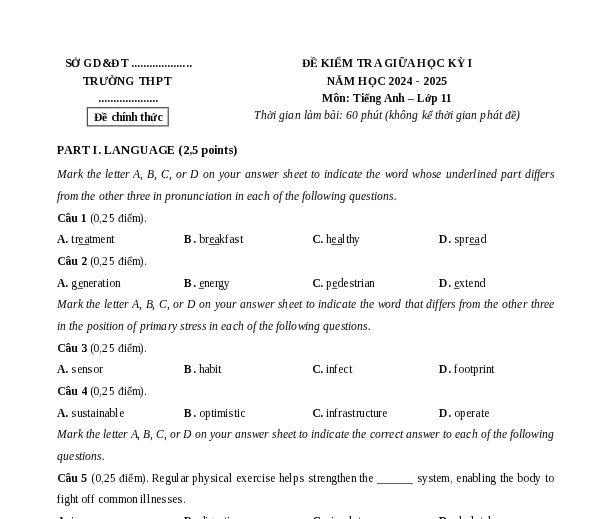
Mark the letter A, B, C, or D on your answer sheet to indicate the word whose underlined part differs from the other three in pronunciation in each of the following questions.
Câu 1.
A. city
B. liveable
C. sustain
D. public
Câu 2.
A. change
B. space
C. sustainable
D. traffic
Mark the letter A, B, C, or D on your answer sheet to indicate the word that differs from the other three in the position of primary stress in each of the following questions.
Câu 3.
A. sensor
B. modern
C. urban
D. replace
Câu 4.
A. pedestrian
B. infrastructure
C. environment
D. inhabitant
Mark the letter A, B, C, or D on your answer sheet to indicate the correct answer to each of the following questions.
Câu 5. The air quality in smart cities ______ fresh and clean thanks to rooftop gardens and electric buses.
A. smells
B. is smelling
C. are smelling
D. smell
Câu 6. Listen! The city planner ______ about the new underground transport network right now.
A. talks
B. is talking
C. was talking
D. talk
Câu 7. Why ______ the soup, Mark? It is already cooked by the chef.
A. do you taste
B. are you tasting
C. have you tasted
D. will you taste
Câu 8. The newly designed high-rise buildings look modern, but the local residents ______ they lack green spaces.
A. are feeling
B. feel
C. were feeling
D. is feeling
Câu 9. I ______ that installing AI-controlled traffic lights will reduce traffic congestion in our city.
A. am believing
B. believe
C. was believing
D. have been believing
Câu 10. These urban streets appear ______ at night because of the energy-efficient smart lighting system.
A. brightly
B. brightness
C. bright
D. more brightly
Câu 11. The local government is currently ______ the possibility of replacing private vehicles with autonomous buses.
A. considering
B. consider
C. considers
D. considered
Câu 12. High-tech sensors help detect water leaks early, which makes city operation more ______.
A. efficiency
B. efficiently
C. efficient
D. inefficiently
Câu 13. Cities of the future will focus on green spaces to make them more ______ for all generations.
A. liveable
B. danger
C. pollutant
D. crowded
Câu 14. Urban planners want to turn this shopping street into a ______ zone where no vehicles are allowed.
A. highway
B. pedestrian
C. skyscraper
D. facility
Mark the letter A, B, C, or D on your answer sheet to indicate the word(s) CLOSEST in meaning to the underlined word(s) in each of the following questions.
Câu 15. Modern technology helps smart cities use energy more efficiently and cut carbon emissions.
A. productively
B. wastefully
C. slowly
D. expensively
Câu 16. Building vertical farms is a sustainable solution to feed growing urban populations without harming nature.
A. temporary
B. eco-friendly
C. harmful
D. destructive
Mark the letter A, B, C, or D on your answer sheet to indicate the word(s) OPPOSITE in meaning to the underlined word(s) in each of the following questions.
Câu 17. The expansion of green parks makes the downtown area much more liveable for city dwellers.
A. uninhabitable
B. enjoyable
C. comfortable
D. pleasant
Câu 18. Poor urban planning will inevitably worsen air pollution and cause serious health issues.
A. destroy
B. improve
C. damage
D. increase
Mark the letter A, B, C, or D on your answer sheet to indicate the option that best completes each of the following exchanges.
Câu 19. Lan and Nam are talking about futuristic cities.
Lan: "Do you think driverless cars will be common by 2050?"
Nam: "_______. They will help prevent accidents caused by human errors."
A. I doubt it very much
B. That sounds impossible
C. I totally agree with you
D. I don't think that is true
Câu 20. Peter is asking an architect about green buildings.
Peter: "Could you explain how rooftop gardens help reduce heat?"
Architect: "_______"
A. Plants absorb sunlight and cool down the air naturally.
B. I don't like planting trees on rooftops.
C. Yes, smart cities are very expensive to build.
D. You can take the elevator to the top floor.
Read the following passage and mark the letter A, B, C, or D on your answer sheet to indicate the correct word or phrase that best fits each of the numbered blanks from 21 to 25.
A smart city is an urban area that uses different types of electronic methods and sensors to collect data. Insights gained from that data are used to manage assets, resources and services (21) ______; in return, that data is used to improve operations across the city. This includes data collected from citizens, devices, buildings and assets that is processed and analysed to monitor and manage traffic and transportation systems, (22) ______ plants, utilities, water supply networks, waste, crime detection, information systems, schools, libraries, hospitals, and other community services.
Smart city technology allows city officials to interact directly with both community and city (23) ______ and to monitor what is happening in the city and how the city is evolving. The city will become more (24) ______ to challenges than with a simple transactional relationship between citizens and service providers. Furthermore, smart cities aim to reduce environmental impacts by (25) ______ renewable energy and reducing carbon footprint.
Câu 21.
A. efficient
B. efficiently
C. efficiency
D. inefficiency
Câu 22.
A. power
B. electric
C. energy
D. light
Câu 23.
A. inhabitant
B. infrastructure
C. pedestrian
D. cycle
Câu 24.
A. respond
B. response
C. responsive
D. responsibly
Câu 25.
A. promoting
B. destroying
C. banning
D. wasting
Read the following passage and mark the letter A, B, C, or D on your answer sheet to indicate the correct answer to each of the questions from 26 to 30.
Future cities are expected to transform completely how human beings live, work, and interact with the environment. With over two-thirds of the world's population projected to reside in urban areas by 2050, municipal authorities are adopting innovative urban planning models. One prominent feature of these upcoming metropolitan areas is the development of 15-minute cities, where daily necessities like grocery stores, healthcare centers, and schools are reachable within a short walk or bicycle ride from any residence.
In addition to walkable layouts, sustainability remains at the core of future urban architecture. Buildings are no longer just concrete structures; they are being designed as vertical forests covered with thousands of trees and shrubs. These green exteriors help purify the air, absorb harmful carbon dioxide, and lower city temperatures during intense heatwaves. Renewable energy sources, particularly solar panels and wind turbines installed directly on skyscrapers, will generate clean electricity to power urban facilities.
Another critical pillar is the widespread application of Artificial Intelligence (AI) and the Internet of Things (IoT). Connected sensors will continuously track public infrastructure, managing clean water distribution and forecasting electrical grid failures before they occur. Commuting will also become effortless with autonomous electric transit networks, which minimize traffic congestion and eliminate greenhouse gas emissions. Ultimately, the city of tomorrow promises not only high-tech convenience but also a healthy, sustainable ecosystem for its dwellers.
Câu 26. What is the best title for the passage?
A. The Negative Impacts of Urbanisation
B. The Evolution and Features of Future Cities
C. How Artificial Intelligence Replaces Human Labor
D. Renewable Energy in Rural Areas
Câu 27. According to paragraph 1, what is the main concept of a "15-minute city"?
A. Residents must travel at least 15 minutes by car to buy essential items.
B. Public transport is available every 15 minutes throughout the day.
C. Essential services and amenities can be reached within a 15-minute walk or bike ride.
D. People only need to work 15 minutes each day due to smart technology.
Câu 28. The word purify in paragraph 2 is closest in meaning to ______.
A. pollute
B. clean
C. warm
D. heat
Câu 29. The word they in paragraph 3 refers to ______.
A. connected sensors
B. public infrastructure
C. water distributions
D. electrical grid failures
Câu 30. According to the passage, which of the following is NOT mentioned as a feature of future cities?
A. Vertical forests that help absorb carbon dioxide.
B. Driverless electric transit networks that reduce traffic jams.
C. Complete ban on all electronic and digital devices.
D. Sensors tracking public utilities and infrastructure.
--------- HẾT ---------
ĐÁP ÁN VÀ HƯỚNG DẪN CHẤM
A. BẢNG ĐÁP ÁN (Mỗi câu đúng 0,33 điểm – Tổng 10,0 điểm)
Câu | Đáp án | Câu | Đáp án | Câu | Đáp án | Câu | Đáp án | Câu | Đáp án | Câu | Đáp án |
|---|---|---|---|---|---|---|---|---|---|---|---|
1 | C | 6 | B | 11 | A | 16 | B | 21 | B | 26 | B |
2 | D | 7 | B | 12 | C | 17 | A | 22 | A | 27 | C |
3 | D | 8 | B | 13 | A | 18 | B | 23 | B | 28 | B |
4 | B | 9 | B | 14 | B | 19 | C | 24 | C | 29 | D |
5 | A | 10 | C | 15 | A | 20 | A | 25 | A | 30 | C |
B. HƯỚNG DẪN GIẢI CHI TIẾT CÁC CÂU NGỮ PHÁP TRỌNG TÂM
- Câu 5: smells là linking verb diễn tả tính chất/cảm giác ("có mùi như thế nào"), không dùng ở thì tiếp diễn, chủ ngữ số ít The air quality chia động từ thêm -s.
- Câu 6: is talking là action verb chỉ hành động nói diễn ra ngay tại thời điểm nói ("right now", có từ cảm thán "Listen!").
- Câu 7: taste dùng ở tiếp diễn (are you tasting) khi mang nghĩa hành động chủ ý "nếm thử thức ăn", khác với nghĩa linking verb "có vị".
- Câu 8: feel ở đây là động từ trạng thái mang nghĩa "tin rằng, cho rằng" (= believe/think), đi với mệnh đề that, chia thì hiện tại đơn.
- Câu 9: believe là động từ chỉ quan điểm, niềm tin (stative verb), không chia ở các thì tiếp diễn.
- Câu 10: appear đóng vai trò là linking verb mang nghĩa "trông có vẻ", theo sau phải là một tính từ (bright).
- Câu 11: consider mang nghĩa "cân nhắc, xem xét một khả năng" (hành động của tư duy đang diễn ra) có thể chia ở thì tiếp diễn (is currently considering).
- Câu 12: Cấu trúc make something + adjective: make city operation more efficient.
BẢNG THỐNG KÊ TỪ VỰNG UNIT 3 – TIẾNG ANH 11 (GLOBAL SUCCESS)
(Thống kê từ vựng Unit 3: Cities of the future đã sử dụng trong đề thi)
STT | Từ vựng / Cụm từ | Từ loại | Nghĩa tiếng Việt | Xuất hiện trong đề | Mục trong SGK Unit 3 | Trang SGK |
|---|---|---|---|---|---|---|
1 | liveable | adj | đáng sống | Câu 1, 13, 17 | Getting Started / Language | Tr. 28, 29 |
2 | sustainable | adj | bền vững | Câu 2, 16, bài đọc | Language / Reading | Tr. 29, 31 |
3 | sensor | n | cảm biến | Câu 3, 12, bài đọc | Getting Started / Reading | Tr. 28, 31 |
4 | urban | adj | (thuộc) đô thị | Câu 3, 10, 16, 18 | Getting Started / Reading | Tr. 28, 31 |
5 | pedestrian | n / adj | người đi bộ / dành cho người đi bộ | Câu 4, 14, 23 | Getting Started / Reading | Tr. 28, 31 |
6 | infrastructure | n | cơ sở hạ tầng | Câu 4, 23, bài đọc | Reading / Communication | Tr. 31, 35 |
7 | inhabitant | n | cư dân | Câu 4, 23 | Reading | Tr. 31 |
8 | green space | n phr | không gian xanh | Câu 8, 13 | Getting Started / Speaking | Tr. 28, 32 |
9 | traffic congestion | n phr | ùn tắc giao thông | Câu 9, bài đọc | Reading | Tr. 31 |
10 | autonomous | adj | tự hành, tự động | Câu 11, bài đọc | Reading / Looking Back | Tr. 31, 36 |
11 | efficient / efficiently | adj / adv | hiệu quả | Câu 12, 15, 21 | Language / Reading | Tr. 29, 31 |
12 | skyscraper | n | tòa nhà chọc trời | Câu 14, bài đọc | Getting Started / Reading | Tr. 28, 31 |
13 | carbon emission | n phr | khí thải các-bon | Câu 15, 25 | Reading / Writing | Tr. 31, 34 |
14 | vertical farm | n phr | nông trại thẳng đứng | Câu 16 | Reading / Looking Back | Tr. 31, 36 |
15 | city dweller | n phr | cư dân thành phố | Câu 17, bài đọc | Reading | Tr. 31 |
16 | driverless car | n phr | xe không người lái | Câu 19 | Speaking / Communication | Tr. 32, 35 |
17 | rooftop garden | n phr | vườn trên sân thượng | Câu 5, 20 | Getting Started / Speaking | Tr. 28, 32 |
18 | power plant | n phr | nhà máy điện | Câu 22 | Listening | Tr. 33 |
19 | renewable energy | n phr | năng lượng tái tạo | Câu 25, bài đọc | Reading / Writing | Tr. 31, 34 |
20 | carbon footprint | n phr | dấu chân các-bon | Câu 25 | Language / Writing | Tr. 29, 34 |