SỞ GD&ĐT …
TRƯỜNG THPT …
Đề cương ôn tập
ĐỀ CƯƠNG ÔN TẬP GIỮA HỌC KỲ I
NĂM HỌC 2026 – 2027
Môn: Tiếng Anh – Lớp 11 (Chương trình mới)
Phạm vi kiến thức: Unit 1 – Unit 3
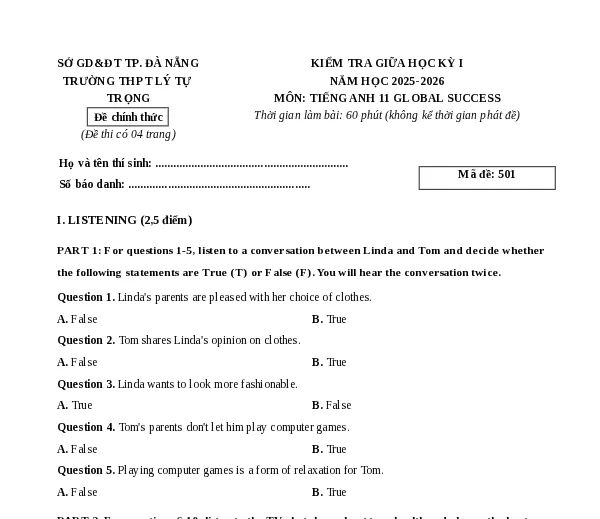
PART I. LISTENING
Listen to a talk about the secret to longevity in Okinawa, Japan. Mark the letter A, B, C or D to indicate the correct answer to each of the following questions. You will hear the recording twice.
Câu 1. What is Okinawa well known for around the world?
A. Having the most modern medical facilities
B. Having one of the highest life expectancies
C. Having the highest number of fast food restaurants
D. Having the largest population in Japan
Câu 2. Which of the following forms the main part of the traditional Okinawan diet?
A. Red meat and dairy products
B. Processed food and sugary desserts
C. Fresh vegetables, tofu, and sweet potatoes
D. White bread and deep-fried seafood
Câu 3. The cultural principle "Hara Hachi Bu" encourages people to ______.
A. eat until they are about 80% full
B. skip dinner twice a week
C. exercise at least 80 minutes every day
D. drink eight glasses of water before each meal
Câu 4. Aside from a healthy diet, what is another crucial factor contributing to their long lives?
A. Relying heavily on dietary supplements
B. Strong community bonds and daily physical activity
C. Living in luxurious smart apartments
D. Working long hours without taking holidays
Câu 5. What is the main message of the talk?
A. Living long depends entirely on our genetics.
B. Traditional medicine is superior to modern treatments.
C. Simple daily habits, balanced nutrition, and social connections enhance longevity.
D. People should move to Okinawa to cure chronic illnesses.
Listen to an interview with an urban planner about Songdo Smart City. Mark the letter A, B, C or D to indicate the correct answer to each of the following questions. You will hear the recording twice.
Câu 6. Why was Songdo designed as a smart city from its inception?
A. To reduce traffic congestion and environmental pollution
B. To build the world's tallest commercial skyscrapers
C. To replace the capital city of South Korea
D. To attract tourists interested in historic landmarks
Câu 7. How is domestic waste collected and handled in Songdo?
A. By traditional garbage trucks operating during the night
B. Through an underground pneumatic tube system directly to processing plants
C. Residents have to burn their own trash in private incinerators
D. By automated robots collecting garbage door-to-door
Câu 8. What role do digital sensors play throughout the city?
A. Tracking the personal shopping habits of all residents
B. Monitoring traffic flow, energy consumption, and public safety in real time
C. Regulating the prices of goods in supermarkets automatically
D. Restricting private vehicles from entering residential areas
Câu 9. What percentage of Songdo's total area is dedicated to green spaces and public parks?
A. About 15%
B. About 25%
C. About 40%
D. More than 70%
Câu 10. According to the urban planner, what is the key challenge modern smart cities still face?
A. High construction costs and ensuring human-centered social interactions
B. The lack of computer programmers and technicians
C. Residents refusing to use smartphones and the internet
D. Extreme weather events damaging underground networks
PART II. VOCABULARY AND GRAMMAR
1. Multiple Choice Questions
Mark the letter A, B, C or D to indicate the correct answer to each of the following questions.
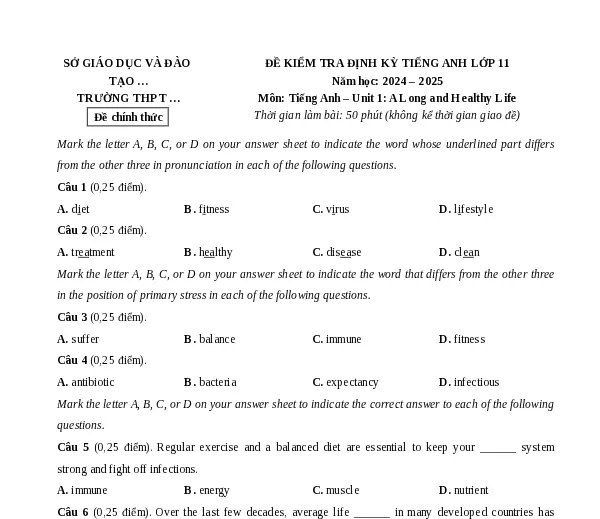
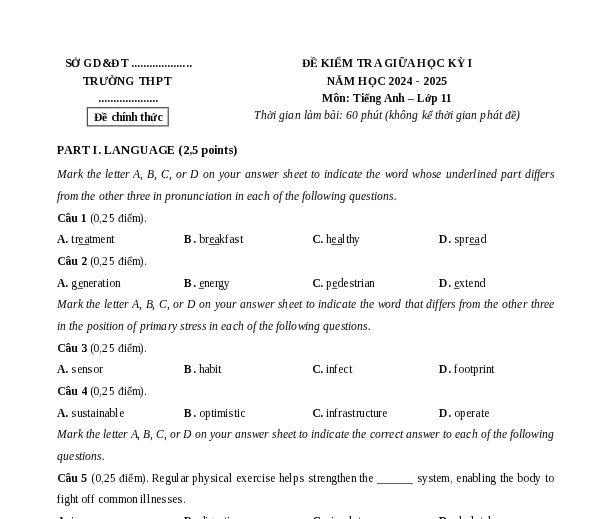
Câu 11. Regular physical exercise helps to strengthen your ______ system, making you less likely to catch common colds and infections.
A. circulatory
B. immune
C. digestive
D. nervous
Câu 12. Many teenagers often experience ______ with their parents regarding curfews and career choices.
A. agreements
B. sympathy
C. conflicts
D. interactions
Câu 13. In a smart city, artificial intelligence and network ______ allow municipal authorities to monitor water leaks and traffic jams instantly.
A. sensors
B. emissions
C. nutrients
D. generations
Câu 14. Living in an extended family can be rewarding, but it may lead to a ______ gap between grandparents and grandchildren.
A. technology
B. generation
C. cultural
D. knowledge
Câu 15. To build a ______ city, architects must focus on renewable energy, green roofs, and eco-friendly public transportation.
A. congested
B. polluted
C. sustainable
D. traditional
Câu 16. You ______ stay up late playing video games if you want to be alert and energetic for tomorrow's examination.
A. shouldn't
B. must
C. ought to
D. have to
Câu 17. According to school regulations, all students ______ wear their uniform and carry student ID cards on Mondays.
A. might
B. must
C. should
D. ought
Câu 18. You ______ take an umbrella; the weather forecast says it will be sunny and clear all afternoon.
A. mustn't
B. don't have to
C. shouldn't
D. can't
Câu 19. This soup ______ delicious. What special ingredients did you put into the broth?
A. smells
B. is smelling
C. was smelled
D. smell
Câu 20. Why ______ your coffee so carefully? Is there something wrong with it?
A. do you smell
B. are you smelling
C. does it smell
D. have you smelled
Câu 21. Mai ______ upset yesterday because her parents did not allow her to attend the overnight camping trip.
A. seemed
B. is seeming
C. was seeming
D. has seemed
Câu 22. Nam ______ to the gym three times a week since he realized the importance of physical fitness.
A. went
B. goes
C. has gone
D. is going
Câu 23. My grandfather ______ up smoking five years ago, and his health has significantly improved ever since.
A. has given
B. gives
C. gave
D. was giving
Câu 24. Urban planners are trying to make modern high-rise apartments more ______ so that people can enjoy clean air and natural sunlight.
A. liveable
B. polluted
C. crowded
D. expensive
Câu 25. Parents ______ impose their own dreams on their children; instead, they should listen and offer guidance.
A. must
B. ought not to
C. have to
D. should
Câu 26. You ______ park your vehicle here. It is strictly prohibited by law.
A. needn't
B. don't have to
C. mustn't
D. shouldn't
Câu 27. The chicken salad tastes ______, but the dressing is a little too sour for my liking.
A. wonderfully
B. freshness
C. wonderful
D. wondered
Câu 28. Scientists have not found an effective cure for this infectious disease ______.
A. already
B. yet
C. since
D. ago
Câu 29. Smart grids in future cities will help reduce greenhouse gas ______ by distributing electricity more efficiently.
A. footprints
B. emissions
C. pollutants
D. resources
Câu 30. Living in a ______ family with just parents and children often gives individuals more personal freedom compared to an extended one.
A. single
B. multi-generational
C. nuclear
D. blended
2. Closest in Meaning
Mark the letter A, B, C or D to indicate the word(s) CLOSEST in meaning to the underlined word(s) in each of the following questions.
Câu 31. Despite reaching the age of eighty-five, my grandmother is still as fit as a fiddle thanks to daily morning walks and a balanced diet.
A. very healthy and active
B. musically talented
C. seriously ill
D. extremely exhausted
Câu 32. Doctors advised him to cut down on sweetened beverages and oily snacks to improve his cardiovascular health.
A. give up completely
B. reduce the amount of
C. increase the consumption of
D. pay more attention to
Câu 33. Fortunately, my parents and I see eye to eye on most important decisions regarding my future education and career path.
A. strongly disagree
B. share the same opinion
C. have heated arguments
D. avoid talking about
Câu 34. Instead of choosing a medical career, Lan decided to follow in her mother's footsteps and become a dedicated high school teacher.
A. oppose her mother's wishes
B. walk behind her mother
C. pursue the same profession as her mother
D. depend financially on her mother
Câu 35. Architects are designing eco-friendly skyscrapers equipped with solar panels and rainwater collection systems to protect the environment.
A. environmentally harmless
B. overly expensive
C. culturally traditional
D. heavily congested
3. Opposite in Meaning
Mark the letter A, B, C or D to indicate the word(s) OPPOSITE in meaning to the underlined word(s) in each of the following questions.
Câu 36. Leading a sedentary lifestyle with hours spent glued to the computer screen increases the danger of chronic health issues.
A. peaceful and quiet
B. stressful and busy
C. highly active and dynamic
D. unhealthy and inactive
Câu 37. Although grandfather is in his seventies, he has an open-minded attitude and always welcomes new technology and unconventional ideas.
A. conservative and narrow-minded
B. progressive and modern
C. generous and kind
D. curious and energetic
Câu 38. Open communication and active listening during family meals help bridge the gap between different generations.
A. reduce the difference
B. widen the distance
C. resolve the dispute
D. connect people together
Câu 39. With severe air pollution, terrible traffic jams, and soaring crime rates, this megacity has become almost unliveable for ordinary citizens.
A. overcrowded
B. inhabitant
C. sustainable and pleasant to live in
D. industrial and modern
Câu 40. Solar power and wind energy are abundant, renewable resources that can replace fossil fuels in sustainable future cities.
A. clean and green
B. finite and exhaustible
C. unlimited and reusable
D. reliable and accessible
PART III. READING
1. Cloze Tests
Read the following passage and mark the letter A, B, C or D to indicate the correct word or phrase that best fits each of the numbered blanks from 41 to 45.
In order to maintain good health and prevent lifestyle-related illnesses, having a balanced diet is of paramount importance. Nutritionists strongly recommend that people should (41) ______ the consumption of processed foods, refined sugars, and saturated fats. Instead, meals should feature an abundance of leafy greens, fresh seasonal fruits, whole grains, and lean proteins. In addition to a wholesome diet, regular physical exercise plays an equally vital role. Engaging in moderate activities, such as brisk walking, swimming, or cycling for at least 30 minutes a day, will significantly (42) ______ your cardiovascular health and mood. Moreover, getting adequate sleep is essential, as the body repairs damaged tissues and restores energy reserves (43) ______ the night. Chronic sleep deprivation can weaken the immune defense and raise stress hormones. Finally, people (44) ______ learn to manage emotional strain through meditation or recreational hobbies. When individuals adopt these healthy habits consistently, they will undoubtedly achieve higher energy levels and increase their overall life (45) ______.
Câu 41.
A. cut down on
B. take care of
C. look forward to
D. put up with
Câu 42.
A. worsen
B. boost
C. damage
D. ignore
Câu 43.
A. during
B. while
C. between
D. throughout
Câu 44.
A. must not
B. ought to
C. needn't
D. might not
Câu 45.
A. expectation
B. expectancy
C. exception
D. exhibition
Read the following passage and mark the letter A, B, C or D to indicate the correct word or phrase that best fits each of the numbered blanks from 46 to 50.
The generation gap refers to the differences in opinions, values, and cultural tastes between younger people and their elders. One of the main reasons behind this phenomenon is the rapid development of digital (46) ______. Teenagers today grow up with smartphones, social media platforms, and online communication, which shapes their worldview differently from that of their parents. Consequently, parents often find it difficult to understand their children's online interests, while youngsters may view their parents' traditional advice as out of date. To bridge this gap, both sides (47) ______ make a conscious effort to communicate openly and respectfully. Parents should listen to their children without jumping to immediate conclusions or being overly critical. At the same time, children need to show (48) ______ for their parents' life experiences and practical wisdom. Family meals and weekend activities provide an ideal setting (49) ______ family members can bond and share thoughts. Ultimately, mutual understanding and empathy are the most powerful tools to resolve domestic (50) ______ and maintain domestic harmony.
Câu 46.
A. technique
B. technology
C. technician
D. technical
Câu 47.
A. have to
B. can't
C. mustn't
D. shouldn't
Câu 48.
A. disrespect
B. respect
C. hesitation
D. complaint
Câu 49.
A. which
B. where
C. whom
D. whose
Câu 50.
A. agreements
B. celebrations
C. conflicts
D. relationships
2. Reading Comprehension
Read the following passage and mark the letter A, B, C or D to indicate the correct answer to each of the questions from 51 to 55.
Family structures and dynamics have undergone profound transformations over recent decades. In traditional societies, extended families—consisting of grandparents, parents, children, and sometimes other relatives living under a single roof—were the norm. In such households, elders held the ultimate decision-making authority, and younger members were expected to conform strictly to established customs. This multi-generational arrangement provided strong social safety nets, mutual financial support, and round-the-clock childcare assistance.
However, the rise of industrialization, urban migration, and modern lifestyles has led to the predominance of nuclear families. Today, young couples increasingly prefer establishing independent households. In these smaller family units, relationships tend to be more democratic and egalitarian. Parents often encourage their children to express individual viewpoints, explore personal interests, and develop critical thinking skills early in life.
Nonetheless, this shift has also introduced distinct challenges. Without the daily presence of grandparents, working parents frequently struggle to balance demanding career commitments with childcare duties. Furthermore, elderly family members may experience loneliness and social isolation when they are left behind in rural hometowns or live alone in separate urban flats.
Bridging the divide between generations requires continuous effort from both sides. While modern youngsters value freedom and technological adaptability, they must recognize that ancestral wisdom and moral values remain timeless. Conversely, older generations need to embrace new perspectives and avoid imposing their past experiences onto an ever-changing world. Open dialogue, regular family visits, and shared leisure activities remain the cornerstone of enduring family unity.
Câu 51. What is the primary focus of the passage?
A. The economic advantages of living in big cities
B. Changes in family structures and the relationships between generations
C. Why traditional extended families are superior to nuclear families
D. The negative influence of technology on teenage psychology
Câu 52. The word they in paragraph 3 refers to ______.
A. modern lifestyles
B. working parents
C. elderly family members
D. childcare duties
Câu 53. According to paragraph 1, what was a key characteristic of traditional extended families?
A. Children were encouraged to make all major financial decisions.
B. Grandparents lived far away from their grandchildren.
C. Family members lived independently in separate apartments.
D. Senior members held the final authority and guided family traditions.
Câu 54. The word democratic in paragraph 2 is closest in meaning to ______.
A. equal and participatory
B. strict and authoritarian
C. disorganized and chaotic
D. secretive and quiet
Câu 55. Which of the following can be inferred from the passage?
A. Nuclear families completely eliminate all generation gaps.
B. Modern working parents never face any difficulties raising children on their own.
C. Maintaining strong intergenerational bonds requires compromise and mutual respect.
D. Elders should always reject modern technology to preserve cultural heritage.
Read the following passage and mark the letter A, B, C or D to indicate the correct answer to each of the questions from 56 to 60.
By the mid-21st century, more than two-thirds of the world's population is projected to reside in urban areas. Rapid urbanization poses enormous strains on housing, clean water supplies, waste disposal, and energy consumption. To tackle these unprecedented crises, city planners and engineers across the globe are pioneering the concept of "smart cities"—urban environments that seamlessly integrate advanced technology into daily life to elevate citizens' quality of life.
At the core of a smart city lies the Internet of Things (IoT). Thousands of wireless sensors are embedded in roadways, street lamps, water pipes, and public buildings. These devices continuously gather real-time data regarding air purity, traffic congestion, and electrical consumption, which is then transmitted to central supercomputers for analysis. For instance, smart traffic lights can automatically adjust their timing based on actual vehicle density, thereby minimizing gridlock and cutting down exhaust emissions.
Environmental sustainability is another defining pillar of future urban centers. Traditional power plants burning fossil fuels are being phased out in favor of solar panels installed on building facades and wind turbines mounted on high-rise rooftops. In addition, innovative cities like Singapore and Copenhagen are designing vertical gardens and urban wetlands to absorb rainwater, mitigate the urban heat island effect, and provide peaceful sanctuaries for residents.
However, constructing smart cities is not without drawbacks. The implementation of high-tech infrastructure demands astronomical financial investments, which many developing nations can hardly afford. Additionally, the widespread collection of citizens' biometric and behavioral data gives rise to pressing concerns regarding cybersecurity and personal privacy. If municipal governments fail to safeguard these networks, the risk of data breaches and systemic blackouts could turn modern urban dreams into digital nightmares.
Câu 56. Which best serves as the most suitable title for the passage?
A. The History of Urban Architecture in the 20th Century
B. Smart Cities: High-Tech Solutions and Future Challenges
C. The Extinction of Natural Habitats due to Concrete Buildings
D. How Cybercriminals Attack Modern Traffic Systems
Câu 57. The word their in paragraph 2 refers to ______.
A. wireless sensors
B. smart traffic lights
C. central supercomputers
D. exhaust emissions
Câu 58. The word astronomical in paragraph 4 is closest in meaning to ______.
A. extremely large
B. very modest
C. easily manageable
D. scientific
Câu 59. According to paragraph 3, how do future cities promote environmental sustainability?
A. By burning cheaper coal to power underground railways
B. By eliminating all public parks to create more residential zones
C. By utilizing renewable energy sources and integrating green spaces
D. By prohibiting private individuals from using electricity after midnight
Câu 60. Which of the following is NOT mentioned in the passage as a concern regarding smart cities?
A. Heavy financial costs required for high-tech infrastructure
B. Potential threats to residents' personal privacy and data security
C. Possible system shutdowns and cyber attacks
D. Severe shortage of fresh food in vertical gardens
PART IV. WRITING
1. Sentence and Paragraph Rearrangement
Mark the letter A, B, C or D to indicate the correct arrangement of the sentences to make a meaningful exchange or paragraph.
Câu 61.
a. Son: Dad, could I stay over at Minh's house tonight to complete our group science project?
b. Dad: That sounds reasonable, but make sure you finish your homework before 10 p.m. and call your mom when you arrive.
c. Dad: Have you finished your chores, and does Minh's mother know about this?
d. Son: Yes, I have washed the dishes, and Minh's mother has already agreed to let us work in their study room.
A. a – c – d – b
B. c – a – d – b
C. a – d – c – b
D. c – d – a – b
Câu 62.
a. In addition, green roofs and vertical gardens help lower ambient temperatures and enhance urban biodiversity.
b. Firstly, smart public transit systems reduce private car usage, resulting in cleaner air and fewer traffic delays.
c. Building eco-friendly cities provides numerous substantial benefits for both the environment and inhabitants.
d. Finally, utilizing solar energy and recycling wastewater significantly cuts down city operational expenses.
e. In conclusion, sustainable cities are essential for creating healthier living conditions for future generations.
A. c – b – a – d – e
B. b – a – d – c – e
C. c – a – b – d – e
D. b – c – a – d – e
Câu 63.
a. Dear Lan, I hope you are having a wonderful and relaxing weekend.
b. If you are free this Saturday afternoon, would you like to join me for a cycling tour around West Lake?
c. Let me know by Friday so that I can prepare some light snacks and water bottles for us.
d. I have recently bought a new bicycle and have been trying to exercise outdoors more often to stay fit.
e. Yours truly, Mai.
A. a – b – d – c – e
B. a – d – b – c – e
C. d – a – b – c – e
D. a – c – d – b – e
2. Sentence Transformation
Rewrite each of the following sentences in such a way that it means exactly the same as the original sentence, using the cues provided.
Câu 64. It is obligatory for every student to submit the biology assignment by 5 p.m. this Friday.
Every student must ..................................................................................................
Câu 65. It is against the rules to use mobile phones during the midterm test.
Students mustn't ....................................................................................................
Câu 66. I strongly advise you to talk openly with your parents about your career aspirations.
You ought to ...........................................................................................................
Câu 67. It is not necessary for you to book the movie tickets in advance because today is a weekday.
You don't have to .................................................................................................
Câu 68. The last time David visited his grandparents was two months ago.
David has not ........................................................................................................
Câu 69. She started working as an urban architect five years ago.
She has worked ....................................................................................................
Câu 70. His explanation about the smart city sensors sounded logical to everyone in the hall.
His explanation seemed ...........................................................................................
Câu 71. It is a good idea for young people to eat more vegetables and cut down on fast food.
Young people should ..............................................................................................
Câu 72. Walking around the bustling streets at night makes him feel completely exhausted.
He feels ..................................................................................................................
Câu 73. My brother hasn't eaten junk food since he suffered from severe stomach pain last year.
The last time my brother ......................................................................................
--------- HẾT ---------
ĐÁP ÁN VÀ HƯỚNG DẪN ÔN TẬP CHI TIẾT
A. AUDIO SCRIPTS (DÀNH CHO GIÁO VIÊN VÀ HỌC SINH TỰ LUYỆN)
Listening Part 1 (Track 01): Secrets to Longevity in Okinawa
"Welcome back to our health and wellness podcast. Today, we turn our attention to the Japanese island of Okinawa, famously known as one of the world's 'Blue Zones'. What makes this small island extraordinary is its population's exceptional life expectancy; Okinawa is home to some of the longest-living and healthiest people on Earth.
Researchers studying Okinawan centenarians have discovered that their remarkable longevity is not purely genetic, but deeply rooted in their daily lifestyle. First and foremost is their diet. Traditional Okinawans consume vast quantities of homegrown vegetables, tofu, seaweed, and purple sweet potatoes, while eating very little red meat, refined sugar, or processed goods. Furthermore, they practice a famous Confucian teaching called 'Hara Hachi Bu', which reminds them to stop eating when their stomachs are about 80 percent full. This prevents overeating and metabolic stress.
Equally important are their strong social support networks, known locally as 'moai'—groups of lifelong friends who support each other emotionally, socially, and financially. Combined with regular, gentle physical activity such as gardening and walking, Okinawans maintain both physical vitality and mental peace well into their nineties and beyond."
Listening Part 2 (Track 02): Songdo Smart City
Interviewer: "Good morning, Dr. Harrison. Could you tell our listeners what makes Songdo in South Korea a pioneer among global smart cities?"
Dr. Harrison: "Good morning. Well, unlike many cities that attempt to modernize existing antique infrastructure, Songdo was built from scratch on reclaimed land with smart technology in mind. The primary goal was to tackle urban congestion and environmental degradation from day one.
One of Songdo’s most famous innovations is its waste management system. You won't see garbage trucks or smelly dumpsters in the streets. Instead, household trash is sucked directly from kitchen chutes through an underground network of pneumatic tubes straight into processing centers, where it is automatically sorted, recycled, or burned for clean energy generation.
Furthermore, digital sensors are omnipresent. They monitor everything from traffic density and road safety to electrical consumption in real time. If a traffic jam begins to develop, computer algorithms modify traffic light cycles to ease vehicle flow immediately.
Importantly, Songdo isn’t just about cold concrete and computers. Approximately 40 percent of the city is dedicated to green parks and canals, encouraging citizens to walk and cycle. However, the project also highlights a major challenge for future urban design: high construction expenditures, and the risk that sterile high-tech spaces might inadvertently hinder spontaneous human connections."
B. BẢNG ĐÁP ÁN TRẮC NGHIỆM (CÂU 1 – 63)
Câu | Đ/A | Câu | Đ/A | Câu | Đ/A | Câu | Đ/A | Câu | Đ/A | Câu | Đ/A | Câu | Đ/A |
|---|---|---|---|---|---|---|---|---|---|---|---|---|---|
1 | B | 10 | A | 19 | A | 28 | B | 37 | A | 46 | B | 55 | C |
2 | C | 11 | B | 20 | B | 29 | B | 38 | B | 47 | A | 56 | B |
3 | A | 12 | C | 21 | A | 30 | C | 39 | C | 48 | B | 57 | B |
4 | B | 13 | A | 22 | C | 31 | A | 40 | B | 49 | B | 58 | A |
5 | C | 14 | B | 23 | C | 32 | B | 41 | A | 50 | C | 59 | C |
6 | A | 15 | C | 24 | A | 33 | B | 42 | B | 51 | B | 60 | D |
7 | B | 16 | A | 25 | B | 34 | C | 43 | A | 52 | C | 61 | A |
8 | B | 17 | B | 26 | C | 35 | A | 44 | B | 53 | D | 62 | A |
9 | C | 18 | B | 27 | C | 36 | C | 45 | B | 54 | A | 63 | B |
C. GIẢI THÍCH CHI TIẾT TỪ ĐỒNG NGHĨA VÀ TRÁI NGHĨA (CÂU 31 – 40)
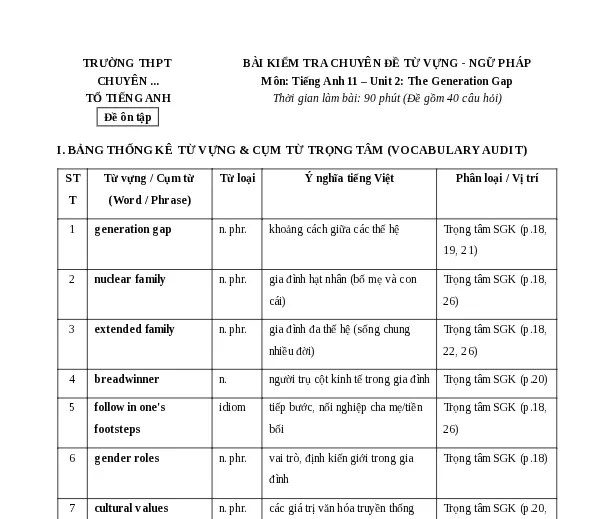
- Câu 31. A. as fit as a fiddle (thành ngữ Unit 1): rất khỏe mạnh, tràn đầy sinh lực (= very healthy and active).
- Câu 32. B. cut down on (cụm động từ Unit 1): cắt giảm, giảm bớt (= reduce the amount of).
- Câu 33. B. see eye to eye on sth (thành ngữ Unit 2): có cùng quan điểm, đồng tình với nhau (= share the same opinion).
- Câu 34. C. follow in sb's footsteps (thành ngữ Unit 2): nối nghiệp, tiếp bước ai làm nghề gì (= pursue the same profession as sb).
- Câu 35. A. eco-friendly (tính từ ghép Unit 3): thân thiện với môi trường (= environmentally harmless).
- Câu 36. C. sedentary lifestyle (cụm từ Unit 1): lối sống ít vận động, thụ động. Trái nghĩa là highly active and dynamic (năng động, vận động nhiều).
- Câu 37. A. open-minded (tính từ Unit 2): cởi mở, sẵn sàng tiếp thu cái mới. Trái nghĩa là conservative and narrow-minded (bảo thủ, hẹp hòi).
- Câu 38. B. bridge the gap (cụm collocation Unit 2): thu hẹp khoảng cách. Trái nghĩa là widen the distance (nới rộng khoảng cách, gia tăng bất đồng).
- Câu 39. C. unliveable (tính từ Unit 3): không thể sinh sống được (do ô nhiễm, tệ nạn). Trái nghĩa là sustainable and pleasant to live in (bền vững và đáng sống).
- Câu 40. B. renewable (tính từ Unit 3): có thể tái tạo được (năng lượng mặt trời, gió). Trái nghĩa là finite and exhaustible (hữu hạn và cạn kiệt, như nhiên liệu hóa thạch).
D. HƯỚNG DẪN CHẤM VÀ ĐÁP ÁN CHI TIẾT TỰ LUẬN VIẾT LẠI CÂU
Câu | Nội dung đáp án chuẩn / Chấp nhận phương án tương đương | Điểm |
|---|---|---|
64 | Every student must submit the biology assignment by 5 p.m. this Friday. | 0,25 |
65 | Students mustn't use mobile phones during the midterm test. | 0,25 |
66 | You ought to talk openly with your parents about your career aspirations. | 0,25 |
67 | You don't have to book the movie tickets in advance because today is a weekday. | 0,25 |
68 | David has not visited his grandparents for two months. | 0,25 |
69 | She has worked as an urban architect for five years. | 0,25 |
70 | His explanation seemed logical to everyone in the hall. | 0,25 |
71 | Young people should eat more vegetables and cut down on fast food. | 0,25 |
72 | He feels completely exhausted walking around the bustling streets at night. | 0,25 |
73 | The last time my brother ate junk food was when he suffered from severe stomach pain last year. | 0,25 |
E. TÓM TẮT TRỌNG TÂM NGỮ PHÁP ĐÃ ÔN TRONG ĐỀ CƯƠNG
1. Modal Verbs (Động từ khuyết thiếu):
- Must: Chỉ sự bắt buộc từ bên trong, quy định luật lệ chặt chẽ.
- Have to: Chỉ sự bắt buộc do ngoại cảnh, nội quy khách quan.
- Mustn't: Chỉ sự cấm đoán tuyệt đối (không được phép làm).
- Don't have to / Needn't: Chỉ sự không cần thiết (không bắt buộc làm).
- Should / Ought to: Dùng để đưa ra lời khuyên hoặc ý kiến nên làm gì.
2. Linking Verbs (Động từ nối / Động từ trạng thái):
- Các động từ như seem, look, smell, taste, feel, sound đi kèm với Tính từ (Adjective), không dùng phó từ khi mô tả bản chất của sự vật.
- Khi smell, taste diễn tả hành động chủ đích (nếm, ngửi), ta chia ở các thì tiếp diễn bình thường (Why are you smelling the soup?).
3. Thì Quá khứ đơn vs. Hiện tại hoàn thành:
- Dấu hiệu chuyển đổi: The last time + S + V2/ed + was + time + ago S + have/has not + V3/ed + for + time.
- Started/Began + V-ing + time + ago S + have/has + V3/ed + for/since...