SỞ GIÁO DỤC VÀ ĐÀO TẠO HÀ NỘI
TRƯỜNG THCS&THPT
NGUYỄN BỈNH KHIÊM – CẦU GIẤY
(Đề thi có 4 trang)
ĐỀ KIỂM TRA GIỮA HỌC KỲ I – KHỐI 11 NĂM HỌC 2026 – 2027
MÔN: Tiếng Anh
Thời gian làm bài: 50 phút (không kể thời gian phát đề)
Họ và tên thí sinh: .............................................................. Số báo danh: ........................ Mã đề: 1108
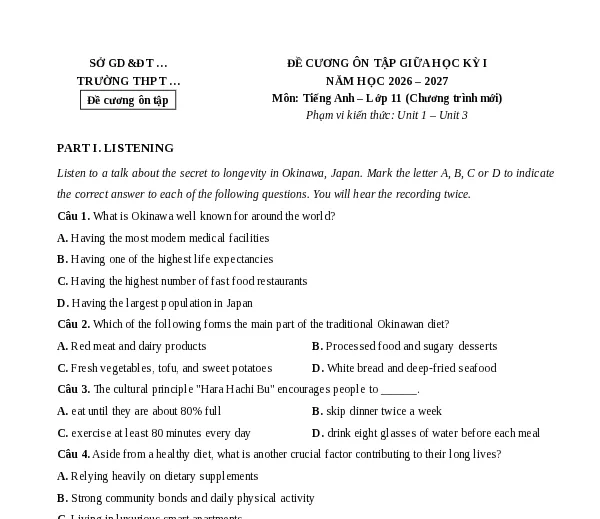
I) Read the following passage and mark A, B, C or D to indicate the option that best fits each blank from 1 to 5.
Three years ago, Cuong often stayed up late scrolling through social media and regularly argued with his parents whenever they tried to limit his screen time. At first, he dismissed their concerns, assuming that a few hours of lost sleep would have little impact on his daily life. However, after constant tiredness began to affect both his concentration and academic performance, (1) ______. Since then, (2) ______, including exercising regularly, putting electronic devices aside before bedtime, and maintaining a more consistent sleep schedule. He has gradually come to understand that (3) ______ simply because his friends remain active online. His parents have also changed their approach, preferring open discussion to imposing strict rules without explanation. At present, (4) ______. Cuong finds the idea (5) ______.
Question 1.
A. he was eventually acknowledging that his parents had raised a reasonable concern
B. he eventually acknowledged that his parents had raised a reasonable concern
C. he had eventually acknowledged that his parents had raised a reasonable concern
D. he has eventually acknowledged that his parents raised a reasonable concern
Question 2.
A. he has developed several healthier habits that have significantly improved his daily routine
B. he was developing several healthier habits while his parents were reconsidering their approach
C. he developed several healthier habits that enabled him to manage his time more effectively
D. he had developed several healthier habits before recognizing the importance of sufficient sleep
Question 3.
A. he should not have remained online so late if he wanted to maintain a healthier daily routine
B. he might not remain online until midnight unless there is something particularly important to discuss
C. he does not have to remain online until midnight merely to keep up with what his friends are doing
D. he must not remain online late at night whenever his friends expect him to respond immediately
Question 4.
A. the whole family are considering whether joining a local cycling group would suit their weekend schedule
B. the whole family is considering whether joining a local cycling group would suit their weekend schedule
C. the whole family have considered whether a local cycling group would provide enough opportunities to exercise
D. the whole family consider whether joining a local cycling group might strengthen their relationships
Question 5.
A. appealed because it could encourage everyone to maintain a healthier and more balanced lifestyle
B. appealing because it combines the benefits of regular physical activity with meaningful family interaction
C. appeal because it offers a practical way for the family to exercise and spend quality time together
D. appealingly because it provides an opportunity to remain physically active without sacrificing family time
II) Read the following passage and mark the letter A, B, C or D on your answer sheet to indicate the best answer to each of the following questions.
HEALTH ACROSS GENERATIONS: MORE IN COMMON THAN WE THINK
People often think that there is a large generation gap in attitudes towards health. Younger adults are often seen as more independent and interested in new fitness trends and technology, while older people are usually connected with more traditional habits. However, these ideas may be too simple. Although different generations may follow different routines, they often share the same basic values, especially the wish to stay healthy and enjoy a good quality of life.
Research into long life provides useful evidence. People living in Blue Zones do not usually depend only on hard exercise programmes. Instead, regular physical activity is a natural part of their daily lives. Walking, gardening and doing household tasks help them stay strong and active as they get older. [I] Their diets also often include healthy plant-based foods, and they usually avoid eating too much. [II] Younger people may work toward the same goals by going to gyms, using fitness apps or following planned diets. [III] However, the main idea is similar: healthy habits over a long period are more important than trends that last only a short time. [IV]
Health is not only about the body. Strong family relationships can provide emotional support, reduce loneliness and improve mental health. Younger family members may share new ideas about exercise or technology, while older relatives can share useful ways of dealing with stress and keeping healthy routines. Such exchanges show that both younger and older people can learn from each other.
However, the media can sometimes make differences between generations seem larger than they really are. Stories about disagreement often attract more attention than stories about cooperation. Understanding what generations have in common and encouraging them to learn from each other may therefore help reduce the generation gap and allow families to live healthier lives together.
Question 6. According to paragraph 1, which of the following is TRUE about different generations?
A. Older adults usually refuse to try new ways of staying healthy.
B. Younger adults care more about quality of life than older people do.
C. Their attitudes towards health are completely different because of their lifestyles.
D. They may use different ways to stay healthy but share similar health goals.
Question 7. According to paragraph 2, everyday activities in Blue Zones can help people ______.
A. get better results than people who exercise in gyms
B. stay strong and active as they get older
C. prevent all health problems related to age
D. avoid the need to think about healthy eating
Question 8. Which of the following is NOT GIVEN in the passage?
A. Regular daily activities can help people stay physically active.
B. Younger family members can share new ideas about health and technology.
C. Older family members are better at dealing with stress than younger people.
D. The media can make differences between generations seem larger.
Question 9. The phrase "a short time" in paragraph 2 is closest in meaning to ______.
A. in a healthy way
B. for a limited period
C. with great difficulty
D. according to a plan
Question 10. Where in paragraph 2 does the following sentence best fit?
"Although their methods may look different, both groups want to stay healthy in the long term."
A. [I]
B. [II]
C. [III]
D. [IV]
Question 11. Which of the following best paraphrases the idea "both younger and older people can learn from each other" in paragraph 3?
A. Differences between generations make it difficult to share useful information.
B. Useful knowledge can be shared in both directions between generations.
C. Each generation should learn how to solve health problems by itself.
D. Younger people are mainly responsible for teaching older relatives about health.
Question 12. The phrase "Such exchanges" in paragraph 3 refers to ______.
A. older relatives spending more time with their families
B. family members trying to keep the same daily routines
C. younger and older family members sharing ideas and experiences
D. younger people using technology to do more exercise
Question 13. Which of the following best summarises paragraph 3?
A. Younger people should spend more time helping older relatives avoid loneliness.
B. Family relationships can support health because different generations can help and learn from one another.
C. Older people can teach younger family members the best ways to manage stress.
D. Technology is the most useful way for different generations to improve their health.
Question 14. Which of the following can be inferred from the passage?
A. Families may become healthier when generations share ideas and learn from each other.
B. Positive media stories can stop disagreements between generations.
C. Traditional ways of staying healthy are more useful than modern methods.
D. People of different generations should use exactly the same methods to stay healthy.
Question 15. Which of the following would be the best title for the passage?
A. Blue Zones: The Best Way to Live a Long Life
B. Modern Health Trends: Why Young People Are Healthier
C. The Generation Gap: Why Families Disagree About Health
D. Healthy Across Generations: Different Ways, Similar Goals
III) Read the passage and mark A, B, C or D to indicate the best answer to each question from 16 to 23.
THE HUMAN SIDE OF A SMART CITY
Cities are increasingly using digital systems to manage transport, energy and public services. Supporters argue that these systems can make urban life more convenient. Real-time travel information, for example, may help commuters choose quicker routes, while sensors can help authorities identify where energy is being wasted. Yet a city does not become smart merely by installing more technology. If residents still face polluted air, unreliable buses or unaffordable accommodation, impressive digital tools may do little to improve their daily lives.
This is especially important when planners decide where to invest. A new transport application may benefit people who already have frequent buses, but residents of an outer neighbourhood may gain more from an additional bus route. Similarly, a high-tech office district can attract attention, while less visible improvements such as safer pavements or additional green space may have a greater effect on quality of life. The best solution therefore depends on the problem a community actually faces.
Public opinion also matters. Younger residents who have grown up with digital services may adapt quickly, whereas some older people may prefer familiar ways of accessing information. It would be a mistake, however, to treat this difference as proof that one generation supports progress and another rejects it. A person who requests a staffed service point may simply want a dependable alternative when an application fails or when a phone is unavailable.
Good planning therefore requires both innovation and judgement. Renewable energy, connected transport and digital public services can contribute to a sustainable city, but technology should support rather than replace essential infrastructure. A truly smart city is one that chooses tools because they solve real problems and ensures that different neighbourhoods can benefit from them.
Question 16. Which of the following best states the main idea of the passage?
A. Digital systems should replace traditional public services as quickly as possible.
B. Future cities should invest mainly in technology used by younger residents.
C. Smart cities should use technology to address real needs and improve life fairly.
D. Public transport is the only infrastructure that determines urban quality of life.
Question 17. The phrase "gain more from" in paragraph 2 is closest in meaning to ______.
A. become dependent on
B. have access to
C. complain more about
D. benefit more from
Question 18. According to paragraph 1, digital tools may have limited value when ______.
A. cities use sensors to monitor energy
B. commuters can choose routes quickly
C. basic urban problems remain unsolved
D. residents have access to travel information
Question 19. The word "this difference" in paragraph 3 refers to the difference in ______.
A. the price of urban accommodation
B. how generations respond to digital services
C. where different neighbourhoods are located
D. how authorities waste energy
Question 20. What can be inferred about investment in an additional bus route for an outer neighbourhood?
A. It is useful only when the neighbourhood already has frequent buses.
B. It may produce less publicity but meet a more urgent need.
C. It will make residents stop using private cars immediately.
D. It is always cheaper than developing a mobile application.
Question 21. Why does the writer mention a person requesting a staffed service point?
A. To prove that digital public services are generally unreliable.
B. To argue that older people cannot learn to use applications.
C. To illustrate that preference for a traditional option may reflect a practical concern.
D. To suggest that every digital service needs two employees.
Question 22. Which of the following can be inferred from paragraph 2?
A. Visible projects usually improve quality of life more than small projects.
B. Green spaces matter only in districts without offices.
C. The value of an urban project should be judged partly by the need it addresses.
D. All neighbourhoods require exactly the same type of investment.
Question 23. Which statement best reflects the writer's viewpoint?
A. Smart-city planning succeeds when residents agree on every new service.
B. The most advanced technology is usually the most sustainable option.
C. A city is smart when technology is selected for usefulness and its benefits are broadly accessible.
D. Technological progress should come before investment in ordinary infrastructure.
IV) Mark A, B, C or D to indicate the best arrangement of utterances or sentences in each question from 24 to 28.
Question 24.
a. Mai: That would be great. I need some books for our history project, but I'm not sure where to look.
b. Librarian: Of course. What kind of materials are you looking for?
c. Mai: Excuse me, could you help me find some materials for a school project?
A. c-b-a
B. c-a-b
C. a-b-c
D. b-c-a
Question 25.
a. Nam: Thanks. That's very kind of you. I've never used this equipment before.
b. Coach: Can I give you a hand with this exercise machine?
c. Coach: Of course. Start by adjusting the seat, and make sure that your back is straight.
d. Nam: Yes, please. I'm not sure how to use it safely.
A. b-a-d-c
B. d-b-a-c
C. b-d-c-a
D. d-c-b-a
Question 26.
a. However, relying on technology alone does not necessarily make a city a better place to live.
b. Smart technology can improve urban life by making transport systems and public services faster and more efficient.
c. Residents still need affordable housing, green spaces and clean air in order to enjoy a good quality of life.
d. Therefore, effective urban planning should balance technological development with the everyday needs of the people who live in the city.
e. For this reason, city planners need to consider social and environmental needs as well as technological progress.
A. a-b-e-c-d
B. b-a-c-e-d
C. b-c-a-e-d
D. c-b-a-d-e
Question 27.
a. After that, avoid checking messages or social media, as these activities can make it harder for your mind to relax.
b. Finally, try to follow the same routine every night, even when you do not have to get up early the next morning.
c. To begin with, work out what time you need to wake up and count backwards to set a reasonable bedtime.
d. Then, give yourself enough time to get seven to eight hours of sleep instead of staying up late to finish unnecessary tasks.
e. Next, reduce the brightness of your phone and put it away at least thirty minutes before going to bed.
A. c-d-e-a-b
B. d-c-e-b-a
C. c-a-e-d-b
D. c-e-d-a-b
Question 28.
a. Lan: That's interesting. What about your grandparents? Have you noticed any differences between their generation and yours?
b. Minh: Definitely. My grandparents prefer talking face to face, while people my age often communicate through social media.
c. Lan: Let's talk about the way different generations communicate. What do you think about it?
d. Minh: I think technology has changed the way young people keep in touch with one another.
A. d-c-b-a
B. a-b-c-d
C. c-d-a-b
D. c-a-d-b
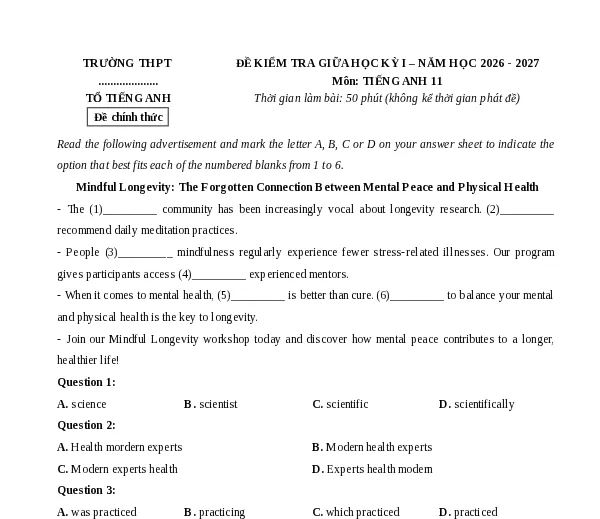
V) Read the following advertisement and mark A, B, C or D to indicate the option that best fits each blank from 29 to 34.
BUILD A ROUTINE THAT LASTS
Busy students often think better health requires a complete lifestyle change. In fact, small steps are easier to maintain. If you have (29) ______ from fatigue for several weeks, start by checking your sleep routine. Try to (30) ______ on sugary drinks and choose water instead. Since our school wellness club opened in August, members (31) ______ noticeable improvements in their energy levels. Weekly activities are designed to improve muscle (32) ______ without demanding extreme workouts. You do not have to train every day, but you (33) ______ stay up late before an early exercise session. Combined with a balanced diet, these habits may contribute to a longer life (34) ______.
Question 29.
A. suffered
B. benefited
C. belonged
D. depended
Question 30.
A. give up
B. grow up
C. cut down
D. go through
Question 31.
A. have reported
B. reported last week
C. are reporting yesterday
D. report in August
Question 32.
A. value
B. strength
C. emission
D. condition
Question 33.
A. shouldn't
B. must
C. don't have to
D. had to
Question 34.
A. expectant
B. expecting
C. expectation
D. expectancy
VI) Read the following leaflet and mark A, B, C or D to indicate the option that best fits each blank from 35 to 40.
Simple Tips for a Happier Family – Different ages, different views, one family!
Respect Different Opinions
Older family members may (35) ______ traditional views, while younger people often have different ideas. Remember that different opinions are completely normal.
Listen Before You Judge
You (36) ______ agree with every family member, but you should listen carefully. If someone wants to share an idea, let them (37) ______ before giving your own opinion.
Stay Calm
During an argument, people may (38) ______ upset or frustrated. Take a short break instead of saying something unkind.
Understand Each Other
Teenagers sometimes (39) ______ that older family members do not understand their lives. Honest conversations can help both generations see things differently.
Build Stronger Family Bonds
Try to (40) ______ your differences rather than allowing them to cause conflict. Respect, patience and open communication can bring generations closer together.
Question 35.
A. build
B. hold
C. receive
D. reduce
Question 36.
A. mustn't
B. had better
C. couldn't
D. don't have to
Question 37.
A. look after
B. speak up
C. calm down
D. listen to
Question 38.
A. do
B. make
C. become
D. take
Question 39.
A. know about
B. are believing
C. believe
D. are knowing
Question 40.
A. acceptable
B. accept
C. acceptably
D. acceptance
------- THE END -------