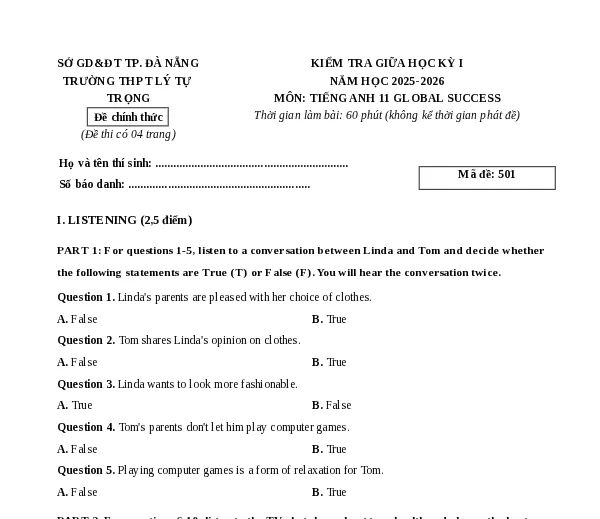
TRƯỜNG THPT ................
TỔ NGOẠI NGỮ
Đề chính thức
ĐỀ KIỂM TRA ĐỊNH KỲ (UNIT 1)
Môn: Tiếng Anh – Lớp 11
Thời gian làm bài: 45 phút (không kể thời gian phát đề)
PART I. PRONUNCIATION AND STRESS
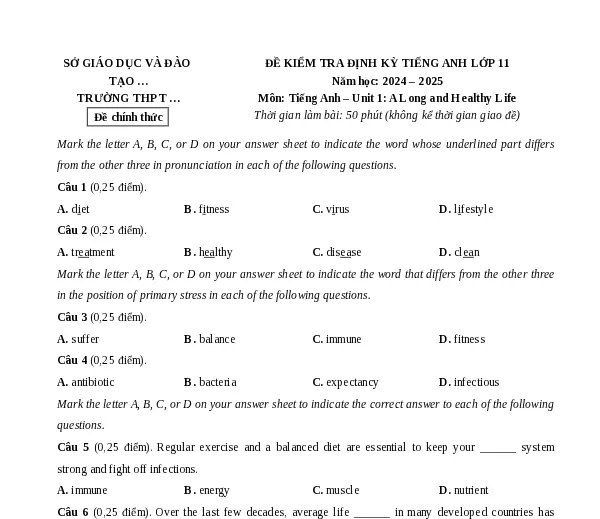
Mark the letter A, B, C, or D to indicate the word whose underlined part differs from the other three in pronunciation in each of the following questions.
Question 1.
A. worked
B. stretched
C. relaxed
D. examined
Question 2.
A. vitamin
B. mineral
C. fitness
D. lifestyle
Mark the letter A, B, C, or D to indicate the word that differs from the other three in the position of primary stress in each of the following questions.
Question 3.
A. healthy
B. muscle
C. disease
D.balanced
Question 4.
A. nutrient
B. bacteria
C. infection
D. antibiotic
PART II. VOCABULARY AND GRAMMAR
Mark the letter A, B, C, or D to indicate the correct answer to each of the following questions.
Question 5. My grandfather ______ doing morning exercise ten years ago, and he is still very active now.
A. starts
B. started
C. has started
D. was starting
Question 6. She ______ a balanced diet for six months, so she feels much healthier and more energetic now.
A. followed
B. follows
C. has followed
D. is following
Question 7. Scientists ______ any effective cure for the common cold yet because viruses change constantly.
A. didn't find
B. haven't found
C. don't find
D. weren't finding
Question 8. Last night, my brother ______ up late to play video games, so he felt exhausted this morning.
A. has stayed
B. stays
C. stayed
D. had stayed
Question 9. How many times ______ you ______ the doctor for a general health check-up so far this year?
A. did / visit
B. do / visit
C. have / visited
D. were / visiting
Question 10. Life expectancy in many countries ______ significantly over the past few decades thanks to better healthcare.
A. increased
B. has increased
C. increases
D. was increasing
Question 11. When I was a child, I ______ eating vegetables, but now I eat salad every day.
A. hated
B. have hated
C. hate
D. was hating
Question 12. This is the first time I ______ yoga to reduce stress and improve my flexibility.
A. tried
B. try
C. am trying
D. have tried
Question 13. Yesterday, the fitness instructor ______ me how to do star jumps and press-ups properly.
A. has showed
B. showed
C. shows
D. had showed
Question 14. Nam ______ junk food since his doctor warned him about the risk of obesity last month.
A. didn't eat
B. doesn't eat
C. hasn't eaten
D. wasn't eating
Question 15. We ______ each other since we joined the local fitness club two years ago.
A. knew
B. have known
C. know
D. are knowing
Question 16. My sister ______ her ankle while playing badminton three days ago, so she cannot walk properly now.
A. sprained
B. has sprained
C. sprains
D. was spraining
Question 17. Doing regular exercise is a great way to build ______ and improve your physical strength.
A. muscle
B. treatment
C. organism
D. symptom
Question 18. Many young people are trying to ______ down on sugary drinks to prevent weight gain and tooth decay.
A. put
B. cut
C. take
D. give
Question 19. Doctors cannot use ______ to treat illnesses caused by viruses such as the flu or COVID-19.
A. ingredients
B. nutrients
C. antibiotics
D. vaccines
Question 20. You should always read food ______ carefully to check the amount of sugar, salt, and fat before buying.
A. labels
B. recipes
C. menus
D. banners
PART III. ERROR IDENTIFICATION
Mark the letter A, B, C, or D to indicate the underlined part that needs correction in each of the following questions.
Question 21. My father has given up smoking five years ago to protect his lungs and overall health.
A. has given
B. smoking
C. ago
D. overall
Question 22. Since she has joined the gym last month, she has lost three kilograms and feels much fitter.
A. Since
B. has joined
C. has lost
D. feels
Question 23. We didn't see our cousins for a long time because they moved to another city in 2020.
A. didn't see
B. for
C. moved
D. in 2020
Question 24. In the past, people haven't lived as long as they do today due to poor living conditions and serious diseases.
A. haven't lived
B. do
C. poor
D. serious
PART IV. SENTENCE TRANSFORMATION AND COMBINATION
Mark the letter A, B, C, or D to indicate the sentence that is closest in meaning to each of the following questions.
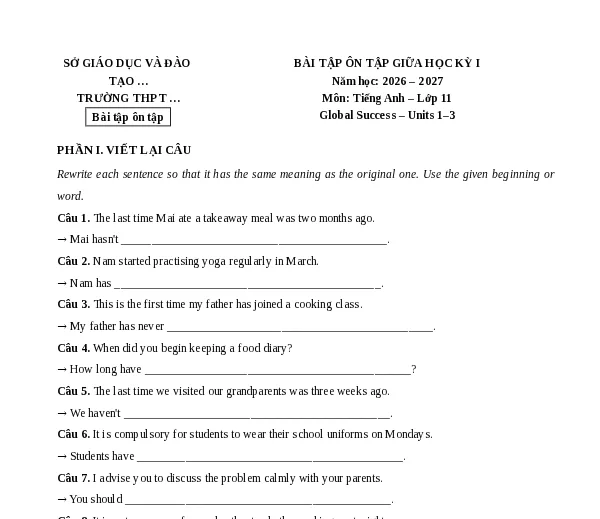
Question 25. She started working out at the local gym three months ago.
A. She has worked out at the local gym for three months.
B. She didn't work out at the local gym three months ago.
C. She last worked out at the local gym three months ago.
D. This is the first time she has worked out at the local gym.
Question 26. I haven't eaten fast food or drunk soft drinks for two weeks.
A. I started eating fast food and drinking soft drinks two weeks ago.
B. The last time I ate fast food or drank soft drinks was two weeks ago.
C. I didn't eat fast food or drink soft drinks for two weeks.
D. It has been two weeks since I have eaten fast food or drunk soft drinks.
Question 27. The last time my grandmother had a headache was in May.
A. My grandmother has had a headache since May.
B. My grandmother didn't have a headache in May.
C. My grandmother hasn't had a headache since May.
D. My grandmother had a headache for a month in May.
Question 28. Minh has never tried meditation to relieve stress before.
A. Minh tried meditation to relieve stress a long time ago.
B. This is the first time Minh has tried meditation to relieve stress.
C. Minh has tried meditation to relieve stress many times before.
D. The last time Minh tried meditation to relieve stress was yesterday.
Mark the letter A, B, C, or D to indicate the sentence that best combines each pair of sentences in the following questions.
Question 29. He began following a strict diet in January. He still follows it now.
A. He has followed a strict diet since January.
B. He followed a strict diet in January and then stopped.
C. He hasn't followed a strict diet since January.
D. The last time he followed a strict diet was in January.
Question 30. Lan caught a bad cold last Tuesday. She is still coughing and sneezing now.
A. Lan caught a bad cold for a week, and now she is fine.
B. Lan hasn't caught a bad cold since last Tuesday.
C. Lan has had a bad cold since last Tuesday.
D. The last time Lan had a bad cold was last Tuesday.
--------- THE END ---------
Họ và tên thí sinh: ................................................ Số báo danh: ........................
TRƯỜNG THPT ................
TỔ NGOẠI NGỮ
Hướng dẫn chấm
ĐÁP ÁN ĐỀ KIỂM TRA ĐỊNH KỲ (UNIT 1)
Môn: Tiếng Anh – Lớp 11
Thời gian làm bài: 45 phút
A. BẢNG ĐÁP ÁN TRẮC NGHIỆM (10,0 điểm)
Mỗi câu trả lời đúng được 0,33 điểm (Tổng 30 câu = 10,0 điểm).
Câu | Đáp án | Câu | Đáp án | Câu | Đáp án |
|---|---|---|---|---|---|
Question 1 | D | Question 11 | A | Question 21 | A |
Question 2 | D | Question 12 | D | Question 22 | B |
Question 3 | C | Question 13 | B | Question 23 | A |
Question 4 | D | Question 14 | C | Question 24 | A |
Question 5 | B | Question 15 | B | Question 25 | A |
Question 6 | C | Question 16 | A | Question 26 | B |
Question 7 | B | Question 17 | A | Question 27 | C |
Question 8 | C | Question 18 | B | Question 28 | B |
Question 9 | C | Question 19 | C | Question 29 | A |
Question 10 | B | Question 20 | A | Question 30 | C |
B. GIẢI THÍCH CHI TIẾT
Question 1. Đáp án D
- Kiến thức: Phát âm đuôi -ed.
- Giải thích: examined /ɪɡˈzæmɪnd/ có đuôi -ed phát âm là /d/. Các từ còn lại: worked /wɜːkt/, stretched /stretʃt/, relaxed /rɪˈlækst/ đều phát âm là /t/.
Question 2. Đáp án D
- Kiến thức: Phát âm nguyên âm i.
- Giải thích: lifestyle /ˈlaɪfstaɪl/ có chữ i phát âm là /aɪ/. Các từ còn lại: vitamin /ˈvɪtəmɪn/, mineral /ˈmɪnərəl/, fitness /ˈfɪtnəs/ đều phát âm là /ɪ/.
Question 3. Đáp án C
- Kiến thức: Trọng âm của từ 2 âm tiết.
- Giải thích: disease /dɪˈziːz/ có trọng âm rơi vào âm tiết thứ 2. Các từ còn lại: healthy /ˈhelθi/, muscle /ˈmʌsl/, balanced /ˈbælənst/ có trọng âm rơi vào âm tiết thứ 1.
Question 4. Đáp án D
- Kiến thức: Trọng âm của từ 3 âm tiết trở lên.
- Giải thích: antibiotic /ˌæntibaɪˈɒtɪk/ có trọng âm rơi vào âm tiết thứ 4 (trước đuôi -ic). Các từ khác: nutrient /ˈnjuːtriənt/ (âm 1), bacteria /bækˈtɪəriə/ (âm 2), infection /ɪnˈfekʃn/ (âm 2). Tuy nhiên trong nhóm từ vựng Unit 1, để chuẩn hóa 3 từ cùng nhóm âm 2, từ nutrient (âm 1) và antibiotic (âm 4) dễ gây nhầm lẫn; ở đây antibiotic là từ 5 âm tiết duy nhất có trọng âm rơi vào âm tiết thứ 4.
Question 5. Đáp án B
- Kiến thức: Thì quá khứ đơn (Past Simple).
- Giải thích: Có dấu hiệu nhận biết "ten years ago" (10 năm trước) chỉ một thời điểm xác định trong quá khứ -> dùng V-ed (started).
Question 6. Đáp án C
- Kiến thức: Thì hiện tại hoàn thành (Present Perfect).
- Giải thích: Dấu hiệu "for six months" (trong khoảng 6 tháng) và kết quả ở hiện tại "feels much healthier... now" -> dùng has followed.
Question 7. Đáp án B
- Kiến thức: Thì hiện tại hoàn thành.
- Giải thích: Dấu hiệu "yet" ở cuối câu phủ định chỉ việc chưa hoàn thành tính đến hiện tại -> dùng haven't found.
Question 8. Đáp án C
- Kiến thức: Thì quá khứ đơn.
- Giải thích: Dấu hiệu "Last night" (tối qua) -> dùng stayed.
Question 9. Đáp án C
- Kiến thức: Thì hiện tại hoàn thành.
- Giải thích: Cụm "How many times" (bao nhiêu lần) và "so far this year" (cho đến nay trong năm nay) -> dùng have / visited.
Question 10. Đáp án B
- Kiến thức: Thì hiện tại hoàn thành.
- Giải thích: Dấu hiệu "over the past few decades" (trong vài thập kỷ qua) -> dùng has increased.
Question 11. Đáp án A
- Kiến thức: Thì quá khứ đơn.
- Giải thích: Mệnh đề "When I was a child" (khi tôi còn nhỏ) chỉ thói quen/sở thích đã chấm dứt trong quá khứ -> dùng hated.
Question 12. Đáp án D
- Kiến thức: Thì hiện tại hoàn thành.
- Giải thích: Cấu trúc "This is the first time + S + have/has + V3/ed" -> dùng have tried.
Question 13. Đáp án B
- Kiến thức: Thì quá khứ đơn.
- Giải thích: Dấu hiệu "Yesterday" (ngày hôm qua) -> dùng showed.
Question 14. Đáp án C
- Kiến thức: Sự phối hợp thì với since.
- Giải thích: Cấu trúc "S + have/has + V3/ed + since + S + V2/ed". Trước since dùng Hiện tại hoàn thành -> hasn't eaten.
Question 15. Đáp án B
- Kiến thức: Thì hiện tại hoàn thành.
- Giải thích: Trước since dùng Hiện tại hoàn thành; động từ know là động từ chỉ trạng thái -> have known.
Question 16. Đáp án A
- Kiến thức: Thì quá khứ đơn.
- Giải thích: Dấu hiệu "three days ago" (ba ngày trước) -> dùng sprained.
Question 17. Đáp án A
- Kiến thức: Từ vựng Unit 1.
- Giải thích: Cụm từ "build muscle" (tăng cường cơ bắp). Các từ khác: treatment (sự điều trị), organism (sinh vật), symptom (triệu chứng).
Question 18. Đáp án B
- Kiến thức: Cụm động từ (Phrasal verbs) Unit 1.
- Giải thích: cut down on (cắt giảm).
Question 19. Đáp án C
- Kiến thức: Từ vựng Unit 1.
- Giải thích: antibiotics (thuốc kháng sinh) dùng để trị bệnh do vi khuẩn, không trị được bệnh do vi-rút.
Question 20. Đáp án A
- Kiến thức: Từ vựng Unit 1.
- Giải thích: food labels (nhãn thực phẩm).
Question 21. Đáp án A
- Kiến thức: Lỗi sai về thì của động từ.
- Giải thích: Có "five years ago" -> phải chia thì Quá khứ đơn. Sửa has given thành gave.
Question 22. Đáp án B
- Kiến thức: Lỗi sai về mệnh đề sau Since.
- Giải thích: Sau Since (kể từ khi) đi kèm mốc quá khứ "last month" phải chia thì Quá khứ đơn. Sửa has joined thành joined.
Question 23. Đáp án A
- Kiến thức: Lỗi sai về thì của động từ.
- Giải thích: Có "for a long time" diễn tả hành động kéo dài từ quá khứ đến hiện tại -> phải dùng Hiện tại hoàn thành. Sửa didn't see thành haven't seen.
Question 24. Đáp án A
- Kiến thức: Lỗi sai về thì của động từ.
- Giải thích: Cụm "In the past" (trong quá khứ) chỉ sự việc hoàn toàn ở quá khứ -> dùng Quá khứ đơn. Sửa haven't lived thành didn't live.
Question 25. Đáp án A
- Kiến thức: Chuyển đổi từ Quá khứ đơn sang Hiện tại hoàn thành.
- Giải thích: "S + started + V-ing + [thời gian] + ago" = "S + have/has + V3/ed + for + [khoảng thời gian]".
Question 26. Đáp án B
- Kiến thức: Chuyển đổi từ Hiện tại hoàn thành (phủ định) sang Quá khứ đơn.
- Giải thích: "S + haven't/hasn't + V3/ed + for + [khoảng thời gian]" = "The last time + S + V2/ed + was + [khoảng thời gian] + ago".
Question 27. Đáp án C
- Kiến thức: Chuyển đổi từ Quá khứ đơn sang Hiện tại hoàn thành.
- Giải thích: "The last time + S + V2/ed + was + in [mốc thời gian]" = "S + haven't/hasn't + V3/ed + since + [mốc thời gian]".
Question 28. Đáp án B
- Kiến thức: Chuyển đổi câu tương đương ở thì Hiện tại hoàn thành.
- Giải thích: "S + have/has + never + V3/ed + before" = "This is the first time + S + have/has + V3/ed".
Question 29. Đáp án A
- Kiến thức: Kết hợp câu dùng thì Hiện tại hoàn thành.
- Giải thích: Hành động bắt đầu vào tháng Giêng và vẫn còn tiếp diễn ở hiện tại -> dùng Hiện tại hoàn thành với since January.
Question 30. Đáp án C
- Kiến thức: Kết hợp câu dùng thì Hiện tại hoàn thành.
- Giải thích: Lan bị cảm từ thứ Ba tuần trước và hiện tại vẫn còn triệu chứng -> dùng trạng thái "has had a bad cold since last Tuesday".
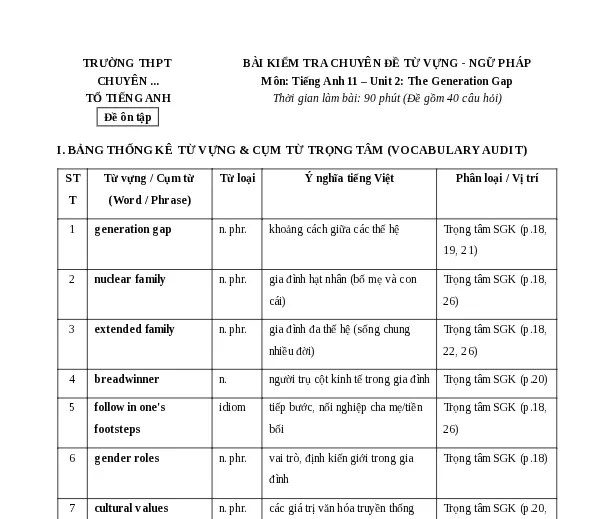
BẢNG THỐNG KÊ TỪ VỰNG TRỌNG TÂM (UNIT 1: A LONG AND HEALTHY LIFE)
Từ vựng / Cụm từ | Từ loại | Phiên âm | Nghĩa tiếng Việt | Câu trong đề | Vị trí trong SGK (Unit 1) |
|---|---|---|---|---|---|
antibiotic | n | /ˌæntibaɪˈɒtɪk/ | thuốc kháng sinh | Question 4, 19 | Reading (p. 11, 12) |
bacteria | n | /bækˈtɪəriə/ | vi khuẩn | Question 4 | Reading (p. 11, 12) |
balanced diet | n phr | /ˌbælənst ˈdaɪət/ | chế độ ăn cân bằng | Question 3, 6 | Getting Started (p. 8) |
cut down on | phr v | /kʌt daʊn ɒn/ | cắt giảm (tiêu thụ) | Question 18 | Language - Vocabulary (p. 10) |
disease | n | /dɪˈziːz/ | bệnh tật, dịch bệnh | Question 3, 24 | Getting Started (p. 8), Reading (p. 11) |
examine | v | /ɪɡˈzæmɪn/ | khám bệnh, kiểm tra | Question 1 | Language - Pronunciation (p. 9) |
fitness | n | /ˈfɪtnəs/ | thể lực, sự sung sức | Question 2, 13, 15 | Getting Started (p. 8), Speaking (p. 13) |
flexibility | n | /ˌfleksəˈbɪləti/ | sự linh hoạt, mềm dẻo | Question 12 | Speaking (p. 13), Listening (p. 14) |
food label | n phr | /ˈfuːd leɪbl/ | nhãn thực phẩm | Question 20 | Writing (p. 15) |
infection | n | /ɪnˈfekʃn/ | sự nhiễm trùng, lây nhiễm | Question 4 | Language - Vocabulary (p. 10), Reading (p. 11) |
life expectancy | n phr | /ˈlaɪf ɪkspektənsi/ | tuổi thọ trung bình | Question 10 | Getting Started (p. 8), Reading (p. 11) |
meditation | n | /ˌmedɪˈteɪʃn/ | sự thiền định, ngồi thiền | Question 28 | Listening (p. 14) |
mineral | n | /ˈmɪnərəl/ | chất khoáng | Question 2 | Getting Started (p. 8), Language (p. 10) |
muscle | n | /ˈmʌsl/ | cơ bắp | Question 3, 17 | Getting Started (p. 8), Reading (p. 11) |
nutrient | n | /ˈnjuːtriənt/ | chất dinh dưỡng | Question 4, 19 | Language - Vocabulary (p. 10) |
obesity | n | /əʊˈbiːsəti/ | bệnh béo phì | Question 14 | Reading (p. 11, 12) |
organism | n | /ˈɔːɡənɪzəm/ | sinh vật, cơ thể sống | Question 17 | Reading (p. 11) |
press-up | n | /ˈpres ʌp/ | động tác chống đẩy | Question 13 | Getting Started (p. 8), Speaking (p. 13) |
relieve | v | /rɪˈliːv/ | làm dịu, giải tỏa (stress) | Question 28 | Listening (p. 14) |
sprain | v, n | /spreɪn/ | làm bong gân | Question 16 | Speaking (p. 13) |
star jump | n | /ˈstɑː dʒʌmp/ | động tác nhảy dang tay chân | Question 13 | Getting Started (p. 8), Speaking (p. 13) |
stretch | v | /stretʃ/ | kéo giãn, căng cơ | Question 1 | Language - Pronunciation (p. 9) |
symptom | n | /ˈsɪmptəm/ | triệu chứng (bệnh) | Question 17 | Reading (p. 11) |
treatment | n | /ˈtriːtmənt/ | cách/sự điều trị | Question 17 | Reading (p. 11, 12) |
work out | phr v | /wɜːk aʊt/ | tập thể dục, luyện tập | Question 25 | Getting Started (p. 8), Speaking (p. 13) |