SỞ GIÁO DỤC VÀ ĐÀO TẠO …
TRƯỜNG THPT …
Đề tham khảo
TÀI LIỆU ÔN TẬP & ĐỀ THI GIỮA HỌC KỲ I
Môn: Tiếng Anh – Lớp 10 (Global Success)
Thời gian làm bài: 50 phút (không kể thời gian phát đề)
PHẦN I. HỆ THỐNG KIẾN THỨC TRỌNG TÂM (UNITS 1 - 3)
1. UNIT 1: FAMILY LIFE
- Ngữ âm (Pronunciation): Các phụ âm kép /br/, /kr/, /tr/ (breadwinner, crash, track, routine, create...).
- Từ vựng cốt lõi & Từ đồng nghĩa - Trái nghĩa:
- breadwinner (n) /ˈbredwɪnə(r)/: người trụ cột kinh tế trong gia đình.
- Synonym: primary earner, family provider.
- Antonym: dependent (người phụ thuộc).
- homemaker (n) /ˈhəʊmmeɪkə(r)/: người nội trợ.
- Synonym: housewife / househusband.
- household chores (n. phr) /ˈhaʊshəʊld tʃɔːz/: việc nhà, công việc vặt.
- Synonym: domestic tasks, household duties.
- gratitude (n) /ˈɡrætɪtjuːd/: lòng biết ơn.
- Synonym: appreciation, thankfulness, gratefulness.
- Antonym: ingratitude, ungratefulness (sự vô ơn).
- strengthen family bonds (collocation): thắt chặt tình cảm gia đình.
- Synonym: foster family relationships, reinforce family ties.
- Antonym: loosen bonds, cause a rift in the family (gây rạn nứt).
- share the household duties (collocation): san sẻ việc nhà.
- Synonym: split/divide chores, pull one's weight.
- Antonym: shirk one's responsibilities (trốn tránh trách nhiệm).
- Từ vựng nâng cao (B2 - C1 - C2):
- close-knit (adj) /ˌkləʊs ˈnɪt/ [B2]: gắn bó khăng khít (a close-knit family).
- nurture (v) /ˈnɜːtʃə(r)/ [B2]: nuôi dưỡng, chăm sóc (nurture strong relationships).
- upbringing (n) /ˈʌpbrɪŋɪŋ/ [B2]: sự nuôi nấng, dạy dỗ thời thơ ấu.
- filial piety (n. phr) /ˌfɪliəl ˈpaɪəti/ [C1]: lòng hiếu thảo.
- dysfunctional (adj) /dɪsˈfʌŋkʃənl/ [C1]: bất hòa, thiếu hòa thuận (a dysfunctional family).
- estrangement (n) /ɪˈstreɪndʒmənt/ [C2]: sự xa lánh, ghẻ lạnh giữa các thành viên.
- reconciliation (n) /ˌrekənsɪliˈeɪʃn/ [C2]: sự hòa giải, hàn gắn mối quan hệ.
- run in the family (idiom) [B2]: có tính di truyền, ăn sâu vào truyền thống gia đình.
- Ngữ pháp (Grammar):
- Thì Hiện tại đơn (Present Simple): diễn tả thói quen, nề nếp sinh hoạt (routines).
- Thì Hiện tại tiếp diễn (Present Continuous): diễn tả hành động đang diễn ra tại thời điểm nói hoặc các thay đổi tạm thời.
2. UNIT 2: HUMANS AND THE ENVIRONMENT
- Ngữ âm (Pronunciation): Các phụ âm kép /kl/, /pl/, /gr/, /pr/ (clean, please, green, practice...).
- Từ vựng cốt lõi & Từ đồng nghĩa - Trái nghĩa:
- carbon footprint (n) /ˈkɑːbən fʊtprɪnt/: lượng phát thải khí nhà kính/carbon.
- Collocation: reduce / minimize / offset one's carbon footprint.
- eco-friendly (adj) /ˌiːkəʊ ˈfrendli/: thân thiện với môi trường.
- Synonym: environmentally friendly, green, earth-friendly.
- Antonym: environmentally hazardous, harmful to the environment.
- sustainable (adj) /səˈsteɪnəbl/: bền vững.
- Synonym: renewable, viable, eco-sound.
- Antonym: unsustainable, depleting (gây cạn kiệt).
- single-use (adj) /ˌsɪŋɡl ˈjuːs/: dùng một lần.
- Synonym: disposable, throwaway.
- Antonym: reusable, refillable, multi-use.
- cut down on (phr. v) /kʌt daʊn ɒn/: cắt giảm.
- Synonym: curtail, reduce, slash.
- Antonym: increase, maximize.
- Từ vựng nâng cao (B2 - C1 - C2):
- biodegradable (adj) /ˌbaɪəʊdɪˈɡreɪdəbl/ [B2]: có thể phân hủy sinh học.
- depletion (n) /dɪˈpliːʃn/ [B2]: sự cạn kiệt (resource depletion).
- environmental degradation (collocation) [C1]: sự suy thoái môi trường.
- greenwashing (n) /ˈɡriːnwɒʃɪŋ/ [C1]: hành vi đánh bóng thương hiệu bằng chiêu trò thân thiện môi trường giả tạo.
- ecological catastrophe (n. phr) [C1]: thảm họa sinh thái.
- carbon offset (n. phr) /ˈkɑːbən ɒfset/ [C2]: tín chỉ / hành động bù trừ lượng khí thải carbon.
- irrevocable damage (collocation) [C2]: tổn hại không thể đảo ngược/cứu vãn.
- Ngữ pháp (Grammar):
- Tương lai đơn với will: quyết định tức thì, dự đoán chủ quan.
- Tương lai gần với be going to: dự định từ trước, dự đoán có căn cứ ở hiện tại.
- Câu bị động (Passive Voice) của các thì tương lai: will be + V3/V-ed / is/are going to be + V3/V-ed.
3. UNIT 3: MUSIC
- Ngữ âm (Pronunciation): Phụ âm cuối và đuôi từ /est/, /ənt/, /eɪʃn/ (contest, talent, decoration...).
- Từ vựng cốt lõi & Từ đồng nghĩa - Trái nghĩa:
- live concert (n) /laɪv ˈkɒnsət/: buổi hòa nhạc biểu diễn trực tiếp.
- Synonym: gig, live show, stage performance.
- acclaimed (adj) /əˈkleɪmd/: được ca ngợi, khen ngợi.
- Synonym: renowned, celebrated, highly regarded.
- Antonym: obscure (vô danh), criticized (bị chê bai).
- catchy (adj) /ˈkætʃi/: hấp dẫn, dễ nhớ (giai điệu).
- Synonym: memorable, infectious, tuneful.
- Antonym: monotonous (đơn điệu), unmemorable, discordant (chói tai).
- release (v) /rɪˈliːs/: phát hành, ra mắt (bài hát, album).
- Synonym: launch, drop, roll out.
- Antonym: withdraw, suppress (thu hồi, ém nhẹm).
- Từ vựng nâng cao (B2 - C1 - C2):
- debut (n, v) /ˈdeɪbjuː/ [B2]: màn ra mắt công chúng lần đầu (debut album / single).
- virtuoso (n) /ˌvɜːtʃuˈəʊsəʊ/ [C1]: bậc thầy, nghệ sĩ điêu luyện về nhạc cụ/âm nhạc.
- resonate with (v. phr) /ˈrezəneɪt wɪð/ [C1]: tạo sự đồng cảm sâu sắc với (lyrics that resonate with listeners).
- meteoric rise to fame (idiom/collocation) [C1]: sự nổi tiếng nhanh chóng như sao băng.
- prodigy (n) /ˈprɒdədʒi/ [C1]: thần đồng (musical prodigy).
- avant-garde (adj) /ˌævɒ̃ ˈɡɑːd/ [C2]: tiên phong, mang tính thử nghiệm và phá cách.
- improvisation (n) /ˌɪmprəvaɪˈzeɪʃn/ [C2]: sự ngẫu hứng, ứng biến trong biểu diễn âm nhạc.
- Ngữ pháp (Grammar):
- Động từ nguyên mẫu có to (to-infinitive) và không to (bare infinitive): want/decide/agree + to-V; make/let + O + bare-V.
- Liên từ kết hợp (Coordinating Conjunctions): for, and, nor, but, or, yet, so (FANBOYS).
PHẦN II. ĐỀ THI MINH HỌA GIỮA HỌC KỲ I (40 CÂU TRẮC NGHIỆM)
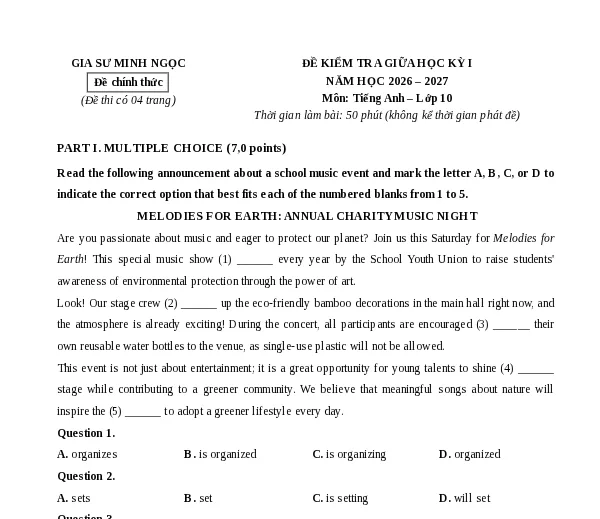
Read the following passage and mark the letter A, B, C or D on your answer sheet to indicate the option that best fits each of the numbered blanks from 1 to 5.
WHY FAMILY MEALS MATTER
A 2023 study brought together 41 earlier reviews about family meals among children and teenagers. It found that many families ate together at least a few days a week. Eating together more often was linked with healthier food, better mental health, healthier weight and better results at school. (1) ______. However, most of the earlier studies only showed that these things were connected. They could not always prove that family meals directly caused the better results.
The researchers also looked at why some families shared meals more often than others. Families with younger children, more free time and a more positive view of family meals usually ate together more often. Although the researchers found several clear patterns, (2) ______ was not exactly the same from one family to another. Studies also used different meanings of the term "family meal". Because they did not all measure family meals in the same way, (3) ______. This variation also made broad conclusions less certain.
The researchers then looked at nine programmes designed to encourage family meals. Four led to a small increase in shared meals. Some improved eating habits or communication, while three had no clear effect. (4) ______. The researchers therefore suggested giving families support that matched their real needs. They also called for clearer ways to measure family meals. (5) ______, their results could be compared more fairly.
(Adapted from Nutrients)
Question 1.
A. The possible benefits went beyond healthy eating.
B. Better schoolwork was the main result of shared meals.
C. Healthy weight depended mainly on eating together.
D. Shared meals were useful only for younger children.
Question 2.
A. families found different ways to plan their meals
B. what helped families eat together more often
C. because families had different daily routines
D. which helped some families plan their meals
Question 3.
A. what each study counted as a family meal
B. although some studies produced similar results
C. the results were not always easy to compare
D. which made several results difficult to compare
Question 4.
A. Changing family habits was not always easy.
B. Every programme produced the same result.
C. Better communication required more family meals.
D. Healthy eating improved in all participating families.
Question 5.
A. What future studies used to measure family meals
B. Future studies used one clear method of measurement
C. Which researchers used to study family meals
D. If future studies used the same clear method
Read the following report and mark the letter A, B, C or D on your answer sheet to indicate the option that best fits each of the numbered blanks from 6 to 11.
THE EVOLUTION OF MUSIC CONSUMPTION
According to recent market reports, digital streaming is currently transforming the global music (6) ______. Today, new songs are frequently (7) ______ on social media before their official release.
Instead of buying physical CDs, many teenagers use karaoke features and prefer to (8) ______ along into the phone's microphone while their favourite tracks play on mobile apps. Even when their music generates a small profit, streaming payments may still be too low to cover rent and everyday expenses, so independent artists may struggle to make a (9) ______ from streaming alone.
Despite the rise of technology, live concerts remain highly (10) ______ among young adults. Therefore, many bands are planning to go (11) ______ tour to connect directly with their loyal fans.
(Adapted from IFPI)
Question 6.
A. commerce
B. company
C. industry
D. platform
Question 7.
A. shared
B. shares
C. sharing
D. share
Question 8.
A. read
B. come
C. play
D. sing
Question 9.
A. profit
B. living
C. income
D. salary
Question 10.
A. popular
B. popularly
C. popularity
D. unpopular
Question 11.
A. in
B. on
C. at
D. by
Read the passage and mark the letter A, B, C or D on your answer sheet to indicate the best answer to each of the following questions from 12 to 19.
Travelling for the Music
For many young Vietnamese people, a concert can now be the main reason for a whole trip. In 2026, this kind of travel became more noticeable as fans planned journeys around live shows and music festivals. Some fans buy a concert ticket first and then arrange transport, accommodation and sightseeing around the event. This gives music a bigger role in travel planning.
Major concert news can quickly increase interest in travelling to a city. Traveloka reported that the announcement of a BIGBANG concert in Hanoi pushed searches for domestic trips to more than four times the normal level. Around an EXO event in Ho Chi Minh City, searches for trips there almost tripled. Because many fans plan to travel at the same time, hotel rooms and transport can fill quickly.
A concert may last only a few hours, but the trip can continue for several days. Fans may add a dinner break, a museum trip, a shopping trip or an extra night to their plans. An extra night gives them more time after the show, especially when a concert ends late. It can turn a short concert visit into a longer travel experience. With that extra time, fans can explore without rushing home. For some fans, seeing a favourite singer in person can feel more special than watching the same performance on a screen.
Big concerts can make a host city much busier for a few days. Large shows can help local businesses, but young travellers still need to plan carefully for the full cost of the trip. Ticket prices, travel costs and accommodation all affect how expensive the journey becomes. Careful planning can help fans keep the whole trip affordable. A simple budget can help them enjoy the music without spending much more than expected.
(Adapted from Traveloka)
Question 12. In paragraph 1, the writer is ______.
A. describing how concert news increases travel interest
B. introducing concerts as a reason for planning a trip
C. showing how concert trips continue beyond the show
D. explaining how big concerts can make cities busier
Question 13. The word noticeable in paragraph 1 mostly means ______.
A. hard to see
B. easy to use
C. easy to see
D. hard to use
Question 14. The word It in paragraph 3 refers to ______.
A. a dinner break
B. a museum trip
C. a shopping trip
D. an extra night
Question 15. The word affordable in paragraph 4 is OPPOSITE in meaning to ______.
A. highly priced
B. fairly priced
C. easy to find
D. often chosen
Question 16. Which of the following best paraphrases the underlined sentence in paragraph 4?
A. Concert trips may support local businesses, while fans need to plan carefully for costs during the concert.
B. Concert trips will support local businesses because fans plan carefully for the full cost of the journey.
C. Concert trips may support local businesses, although fans still need to budget carefully for the whole journey.
D. Concert trips may support local businesses, although fans need to plan the route rather than the total cost.
Question 17. Which of the following statements would the writer NOT agree with?
A. For some fans, the live show is chosen before the rest of the travel plan is completed.
B. Fans can judge the full trip cost before they know the price of accommodation.
C. When many fans travel together, rooms and transport can become harder to find.
D. Seeing a favourite singer live may feel more special than watching on a screen.
Question 18. In which paragraph does the writer mention travel searches rising to over four times normal?
A. Paragraph 4
B. Paragraph 1
C. Paragraph 3
D. Paragraph 2
Question 19. In which paragraph does the writer mention planning to avoid spending more than expected?
A. Paragraph 4
B. Paragraph 2
C. Paragraph 1
D. Paragraph 3
Mark the letter A, B, C or D on your answer sheet to indicate the best arrangement of utterances or sentences to make a cohesive and coherent exchange or text in each of the following questions from 20 to 24.
Question 20.
a. Soft music may help some students feel calm while they study.
b. Many teenagers listen to music while travelling, relaxing, or doing homework.
c. By contrast, loud songs with strong beats can make concentration more difficult.
d. Therefore, students should choose music that suits the task they are doing.
e. The effect of music, however, depends on the situation.
A. a – c – b – e – d
B. b – e – a – c – d
C. c – b – e – a – d
D. e – b – a – c – d
Question 21.
a. Linh: Then I'll set the table, and you can help Dad cook.
b. Nam: Mum will be home late today. Shall we prepare dinner before she arrives?
c. Nam: Good idea. She'll be happy to have some time to rest when she gets home.
A. a – c – b
B. b – c – a
C. a – b – c
D. b – a – c
Question 22.
a. Mai: How can we get more students to join?
b. Long: We can put up posters and explain the plan in each class.
c. Mai: Our class needs a simple activity for Environment Day. Any ideas?
d. Long: We could collect used paper and plastic bottles for recycling.
e. Mai: Great. Let's prepare the boxes and posters tomorrow.
A. c – b – a – d – e
B. a – d – c – b – e
C. a – b – c – d – e
D. c – d – a – b – e
Question 23.
a. After a few weeks, the family noticed that their rubbish bin filled up more slowly than before.
b. One easy change was carrying reusable bags when they went shopping.
c. The Nguyen family wanted to reduce the amount of waste they produced at home.
d. Another step was to stop buying bottled water and use refillable bottles instead.
e. Seeing the change, the children asked their grandparents to try the same habits.
A. b – c – d – a – e
B. c – d – b – e – a
C. c – b – d – a – e
D. b – d – c – e – a
Question 24.
Dear Mr Brown,
a. The evening will include performances by the school band and two student singers.
b. We are pleased to invite you to our School Music Night on 15 November.
c. Finally, please let us know by 5 November if you are able to attend.
d. We hope the event will give students a chance to share their love of music with families and teachers.
e. As our former music teacher, your presence would mean a lot to the students.
Yours sincerely,
Greenwood High School
A. b – e – a – c – d
B. b – a – d – e – c
C. b – c – e – d – a
D. b – d – c – a – e
Read the following passage and mark the letter A, B, C or D on your answer sheet to indicate the option that best fits each of the numbered blanks from 25 to 30.
COOLING DOWN THE NEIGHBOURHOOD
Modern cities often experience high temperatures during the summer months. Concrete buildings absorb heat very easily, making the streets extremely (25) ______ for pedestrians. People in my area had already installed temporary shade shelters at the busiest stops. (26) ______, they decided to cool down the neighbourhood further by planting more trees.
They agreed to start a green campaign and encourage everyone to participate. They transformed an empty parking lot into a shared garden, (27) ______ required a lot of physical work. To keep the plants alive, each family must (28) ______ responsibility for watering them on different days of the week.
After six months, the area looks completely different with fresh air and thick shade. The local people feel genuinely (29) ______ because their hard work has improved their daily lives. Last Friday, while the volunteers (30) ______ the new trees, a television reporter arrived to interview them.
(Adapted from UN-Habitat)
Question 25.
A. uncomfortable
B. exhausted
C. convenient
D. depressed
Question 26.
A. Consequently
B. However
C. Otherwise
D. Furthermore
Question 27.
A. where
B. that
C. it
D. which
Question 28.
A. make
B. do
C. take
D. hold
Question 29.
A. satisfied
B. arrogant
C. disappointed
D. ashamed
Question 30.
A. watered
B. are watering
C. were watering
D. have watered
Read the passage and mark the letter A, B, C or D on your answer sheet to indicate the best answer to each of the following questions from 31 to 40.
On 30 March 2026, more than 3,000 students, together with teachers and guests, gathered at Linh Dam Secondary School for a plastic-waste programme. Recycled models showed how discarded materials could be used again. Organisers stressed a simple contrast: a plastic bag may be used for minutes but remain in the environment for centuries. Students practised identifying plastic symbols and signed waste-reduction commitments. The event linked a long-term environmental problem with choices students make each day.
Plastic is common in a school day. Drinks often come in plastic cups or bottles, while snacks may have several layers of wrapping. One student cannot solve a citywide problem alone, but daily habits still matter. Refillable bottles, lunch boxes and refusing unnecessary bags are practical choices. Schools can place clearly labelled bins in easy-to-reach locations. Repeating low-plastic choices can make them feel more normal. Simple habits are easier to keep when they fit the school day.
Hanoi's plastic-reduction roadmap gives these habits a wider setting. From 1 January 2026, hotels and tourist facilities could no longer use listed single-use plastic items. The city also restricts free distribution of non-biodegradable plastic bags at markets and convenience stores, while wider restrictions on single-use plastics are scheduled for later stages. The roadmap is gradual, with controls beginning at different times. It changes what businesses can provide and what consumers can easily obtain.
Rules alone cannot keep streets and rivers clean. Schools matter because habits practised there can continue at home. [I] Convenient facilities also matter. Clearly labelled bins and refill points can make good choices easier. [II] When this support is missing, students may return to old habits. [III] Environmental education works best when practice and surroundings support each other. [IV]
Most school actions are modest, but small effects can add up. A bottle reused many times can replace repeated purchases of disposable bottles. City rules can reduce the availability of some single-use products, while personal habits can reduce demand. When both change together, low-plastic choices become easier to maintain. Repeated small choices can therefore support wider change when rules and everyday routines reinforce one another.
(Adapted from Hanoi Education)
Question 31. According to paragraph 1, the school event ______.
A. used recycled displays to encourage students to make school projects from discarded plastic.
B. used the plastic-lifespan contrast to compare how long common items remain in nature.
C. used signed commitments to measure how much plastic waste participants had prevented.
D. made a long-term waste problem relevant to students through ordinary daily decisions.
Question 32. Why does the writer mention drinks in plastic cups or bottles and snacks with several layers of wrapping in paragraph 2?
A. To explain why one student's choices cannot solve a citywide waste problem.
B. To illustrate how disposable plastic appears in ordinary school-day purchases.
C. To show why repeated low-plastic choices can become more familiar over time.
D. To clarify why simple habits are easier to keep when they fit the school day.
Question 33. Which of the following is NOT implied in paragraph 2?
A. Common plastic use gives students repeated chances to choose lower-plastic alternatives during the day.
B. Reusable items can prevent some plastic waste before students need to deal with disposal at school.
C. Repeated low-plastic choices may become routine instead of requiring a fresh decision each time.
D. Habits that fit the school day are likely to become harder to continue outside the school setting.
Question 34. The word practical in paragraph 2 is closest in meaning to ______.
A. useful
B. usable
C. formal
D. simple
Question 35. Which of the following best summarises paragraph 3?
A. The roadmap relies on businesses choosing when to change plastic practices across different sectors.
B. The roadmap keeps retail plastic use outside formal controls while restrictions focus on tourism businesses.
C. The roadmap changes business supply and consumer access through controls introduced in stages.
D. The roadmap gives different sectors the same plastic restriction under a common citywide timetable.
Question 36. The word gradual in paragraph 3 is OPPOSITE in meaning to ______.
A. sudden
B. normal
C. regular
D. private
Question 37. Where in the passage does the following sentence best fit?
The first supports correct sorting, while the second makes reuse more convenient.
A. [III]
B. [II]
C. [IV]
D. [I]
Question 38. All of the following are stated in the passage EXCEPT that ______.
A. over 3,000 students, along with teachers and guests, took part in the March programme at Linh Dam.
B. the roadmap restricts free distribution of non-biodegradable plastic bags at markets and convenience stores.
C. environmental routines learned at school can continue to shape students' behaviour later at home.
D. environmental education works best when good practice makes up for weak school surroundings.
Question 39. Which of the following can be inferred from the passage?
A. A small action can matter when repetition lets its effect build over time across many everyday choices.
B. The bottle example suggests repeated reuse offers a similar solution for many kinds of single-use plastic.
C. The supply-and-demand example suggests personal habits depend on city rules covering the same products.
D. Rules and habits need to change at the same pace for low-plastic choices to become easier to maintain.
Question 40. Which of the following could be the best title for the passage?
A. Changing Plastic Habits Every Day
B. School Lessons, Citywide Change
C. Small Daily Choices, Wider Change
D. New Rules for Everyday Plastic Use
--------- HẾT ---------
Họ và tên thí sinh: ................................................ Số báo danh: ........................
SỞ GIÁO DỤC VÀ ĐÀO TẠO …
TRƯỜNG THPT …
Đề chính thức
ĐÁP ÁN & HƯỚNG DẪN GIẢI CHI TIẾT
Môn: Tiếng Anh – Lớp 10 (Giữa học kỳ I)
Thời gian làm bài: 50 phút
HƯỚNG DẪN CHẤM VÀ GIẢI CHI TIẾT
A. BẢNG ĐÁP ÁN NHANH (MỖI CÂU 0,25 ĐIỂM)
Câu | Đ/a | Câu | Đ/a | Câu | Đ/a | Câu | Đ/a | Câu | Đ/a | Câu | Đ/a | Câu | Đ/a | Câu | Đ/a |
|---|---|---|---|---|---|---|---|---|---|---|---|---|---|---|---|
1 | A | 6 | C | 11 | B | 16 | C | 21 | D | 26 | D | 31 | D | 36 | A |
2 | B | 7 | A | 12 | B | 17 | B | 22 | D | 27 | D | 32 | B | 37 | B |
3 | C | 8 | D | 13 | C | 18 | D | 23 | C | 28 | C | 33 | D | 38 | D |
4 | A | 9 | B | 14 | D | 19 | A | 24 | B | 29 | A | 34 | A | 39 | A |
5 | D | 10 | A | 15 | A | 20 | B | 25 | A | 30 | C | 35 | C | 40 | C |
B. GIẢI THÍCH CHI TIẾT TỪNG CÂU
Question 1. Chọn A
- Giải thích: Câu liền trước nêu ra các lợi ích đa dạng như sức khỏe tinh thần, cân nặng, kết quả học tập. Do đó câu điền tiếp theo hợp lý nhất là "The possible benefits went beyond healthy eating" (Những lợi ích tiềm năng vượt xa việc ăn uống lành mạnh đơn thuần).
Question 2. Chọn B
- Giải thích: Cấu trúc mệnh đề danh từ làm chủ ngữ: what + S + V. "what helped families eat together more often was not exactly the same..." (điều giúp các gia đình ăn cùng nhau thường xuyên hơn không hoàn toàn giống nhau giữa các gia đình).
Question 3. Chọn C
- Giải thích: Vế trước có liên từ Because they did not all measure... (mệnh đề trạng ngữ chỉ nguyên nhân), vế sau cần một mệnh đề chính hoàn chỉnh: the results were not always easy to compare (kết quả không phải lúc nào cũng dễ so sánh).
Question 4. Chọn A
- Giải thích: Đoạn văn liệt kê các chương trình chỉ có tác động nhỏ hoặc không có hiệu quả rõ rệt, do đó kết luận "Changing family habits was not always easy" (Thay đổi thói quen gia đình không phải lúc nào cũng dễ dàng) là chuẩn xác nhất.
Question 5. Chọn D
- Giải thích: Vế sau dùng could be compared (câu điều kiện loại 2), vế trước cần mệnh đề điều kiện bắt đầu bằng If: If future studies used the same clear method (Nếu các nghiên cứu tương lai sử dụng cùng một phương pháp rõ ràng).
Question 6. Chọn C
- Giải thích: Cụm danh từ cố định: music industry (ngành công nghiệp âm nhạc).
Question 7. Chọn A
- Giải thích: Dạng bị động ở thì hiện tại đơn: are frequently + V3/V-ed shared.
Question 8. Chọn D
- Giải thích: Cụm từ quen thuộc: sing along (hát theo, hát cùng).
Question 9. Chọn B
- Giải thích: Collocation: make a living (from sth) = kiếm sống (từ việc gì).
Question 10. Chọn A
- Giải thích: Sau động từ nối remain và trạng từ highly cần một tính từ: popular (phổ biến, được yêu thích).
Question 11. Chọn B
- Giải thích: Cụm từ cố định: go on tour = đi lưu diễn.
Question 12. Chọn B
- Giải thích: Đoạn 1 mở đầu: "For many young Vietnamese people, a concert can now be the main reason for a whole trip..." nhằm giới thiệu concert như một động lực chính cho việc đi du lịch.
Question 13. Chọn C
- Giải thích: noticeable (dễ nhận thấy, rõ ràng) đồng nghĩa với easy to see.
Question 14. Chọn D
- Giải thích: Đoạn 3: "An extra night gives them more time... It can turn a short concert visit into a longer travel experience." Đại từ "It" thay thế cho danh từ đứng trước là "an extra night".
Question 15. Chọn A
- Giải thích: affordable (vừa túi tiền, giá cả phải chăng) trái nghĩa với highly priced (đắt đỏ, giá cao).
Question 16. Chọn C
- Giải thích: Câu gốc: "Large shows can help local businesses, but young travellers still need to plan carefully for the full cost of the trip." Phương án C diễn đạt lại chuẩn nghĩa: "Concert trips may support local businesses, although fans still need to budget carefully for the whole journey."
Question 17. Chọn B
- Giải thích: Đoạn 4 nêu "Ticket prices, travel costs and accommodation all affect how expensive the journey becomes", tức là chi phí nơi ở ảnh hưởng lớn đến tổng chi phí. Do đó tác giả không đồng ý với nhận định "Fans có thể đánh giá toàn bộ chi phí trước khi biết giá phòng ở".
Question 18. Chọn D
- Giải thích: Thông tin nằm ở Đoạn 2: "...pushed searches for domestic trips to more than four times the normal level."
Question 19. Chọn A
- Giải thích: Thông tin nằm ở cuối Đoạn 4: "A simple budget can help them enjoy the music without spending much more than expected."
Question 20. Chọn B
- Giải thích: Trình tự logic:
- b: Nêu thói quen nghe nhạc của thanh thiếu niên khi học/thư giãn.
- e: Nêu tác động phụ thuộc vào hoàn cảnh.
- a: Nhạc nhẹ giúp bình tĩnh, tập trung.
- c: Ngược lại, nhạc to/nhịp mạnh gây mất tập trung.
- d: Kết luận khuyên học sinh chọn nhạc phù hợp.
Thứ tự đúng: b – e – a – c – d.
Question 21. Chọn D
- Giải thích: Trình tự đối thoại:
- b: Nam rủ chuẩn bị bữa tối vì mẹ về muộn.
- a: Linh đồng ý và phân chia công việc (dọn bàn / nấu ăn với bố).
- c: Nam khen ý hay vì mẹ sẽ được nghỉ ngơi.
Thứ tự đúng: b – a – c.
Question 22. Chọn D
- Giải thích: Trình tự đối thoại:
- c: Mai hỏi ý tưởng hoạt động cho Ngày Môi trường.
- d: Long đề xuất gom giấy vụn và chai nhựa tái chế.
- a: Mai hỏi cách kêu gọi học sinh tham gia.
- b: Long đề xuất dán poster và vào từng lớp tuyên truyền.
- e: Mai chốt phương án và hẹn chuẩn bị.
Thứ tự đúng: c – d – a – b – e.
Question 23. Chọn C
- Giải thích: Trình tự văn bản tự sự:
- c: Gia đình muốn giảm rác thải tại nhà.
- b: Bước đầu tiên: dùng túi tái sử dụng khi mua sắm.
- d: Bước tiếp theo: ngừng mua nước đóng chai, dùng bình cá nhân.
- a: Sau vài tuần thấy lượng rác giảm rõ rệt.
- e: Thấy hiệu quả, các con rủ ông bà cùng thực hiện.
Thứ tự đúng: c – b – d – a – e.
Question 24. Chọn B
- Giải thích: Cấu trúc thư mời trang trọng:
- b: Lời mời tham dự Đêm nhạc của trường ngày 15/11.
- a: Nội dung chương trình (ban nhạc trường, 2 ca sĩ học sinh).
- d: Mục đích/ý nghĩa sự kiện (chia sẻ tình yêu âm nhạc).
- e: Lý do đặc biệt mời thầy (nguyên là giáo viên âm nhạc).
- c: Đề nghị xác nhận tham dự trước ngày 5/11.
Thứ tự đúng: b – a – d – e – c.
Question 25. Chọn A
- Giải thích: Đường phố hấp thụ nhiệt khiến người đi bộ cảm thấy vô cùng "khó chịu/nóng nực" (uncomfortable).
Question 26. Chọn D
- Giải thích: Furthermore (Hơn nữa/Thêm vào đó), dùng để bổ sung thêm hành động tích cực sau khi đã lắp mái che che nắng.
Question 27. Chọn D
- Giải thích: Dùng đại từ quan hệ which đứng sau dấu phẩy để thay thế cho toàn bộ mệnh đề phía trước (They transformed an empty parking lot into a shared garden).
Question 28. Chọn C
- Giải thích: Cụm cố định: take responsibility for (doing) sth = nhận/chịu trách nhiệm cho việc gì.
Question 29. Chọn A
- Giải thích: Người dân cảm thấy hài lòng/thỏa mãn (satisfied) vì công sức lao động đã cải thiện cuộc sống.
Question 30. Chọn C
- Giải thích: Sự kết hợp thì với liên từ While: một hành động đang diễn ra trong quá khứ (were watering) thì hành động khác cắt ngang (arrived).
Question 31. Chọn D
- Giải thích: Cuối đoạn 1 có câu: "The event linked a long-term environmental problem with choices students make each day." Khớp phương án D.
Question 32. Chọn B
- Giải thích: Tác giả đưa ra cốc nhựa, vỏ bánh kẹo để minh họa cho câu liền trước: "Plastic is common in a school day" (nhựa dùng một lần xuất hiện thường trực trong các món đồ mua hàng ngày ở trường).
Question 33. Chọn D
- Giải thích: Trong đoạn 2 chỉ nói thói quen vừa vặn với ngày học ở trường thì dễ duy trì, và ở đoạn sau nói thói quen ở trường sẽ tiếp tục ở nhà; bài viết KHÔNG hề ngụ ý rằng thói quen sẽ khó duy trì ngoài trường học.
Question 34. Chọn A
- Giải thích: practical (thiết thực, hữu ích) gần nghĩa nhất với useful.
Question 35. Chọn C
- Giải thích: Đoạn 3 nói về lộ trình giảm rác nhựa từng bước của Hà Nội (gradual roadmap), tác động đến cả nguồn cung của doanh nghiệp và sự tiếp cận của người tiêu dùng Tóm tắt chuẩn nhất là C.
Question 36. Chọn A
- Giải thích: gradual (từng bước, dần dần) trái nghĩa với sudden (đột ngột, tức thì).
Question 37. Chọn B
- Giải thích: Câu cần chèn nhắc đến "The first ... while the second...". Câu đứng trước vị trí [II] đề cập đến 2 đối tượng cụ thể: (1) Clearly labelled bins (thùng rác dán nhãn) và (2) refill points (điểm cấp nước rót lại). Do đó đặt vào vị trí [II] là hoàn toàn chuẩn xác.
Question 38. Chọn D
- Giải thích: Đoạn 4 viết: "Environmental education works best when practice and surroundings support each other" (khi thực hành và môi trường xung quanh bổ trợ cho nhau), chứ KHÔNG nói giáo dục hoạt động tốt khi thực hành bù đắp cho cơ sở vật chất yếu kém.
Question 39. Chọn A
- Giải thích: Suy luận từ đoạn cuối: "Most school actions are modest, but small effects can add up... Repeated small choices can therefore support wider change..." Một hành động nhỏ có ý nghĩa lớn khi được lặp đi lặp lại và tích lũy dần theo thời gian.
Question 40. Chọn C
- Giải thích: Tiêu đề bao quát toàn bài từ việc học sinh giảm rác nhựa ở trường đến lộ trình cấp thành phố: "Small Daily Choices, Wider Change" (Những lựa chọn nhỏ hằng ngày tạo nên sự thay đổi rộng lớn).