GIA SƯ MINH NGỌC
Đề chính thức
(Đề thi có 04 trang)
ĐỀ KIỂM TRA GIỮA HỌC KỲ I
NĂM HỌC 2026 – 2027
Môn: Tiếng Anh – Lớp 10
Thời gian làm bài: 50 phút (không kể thời gian phát đề)
PART I. MULTIPLE CHOICE (7,0 points)
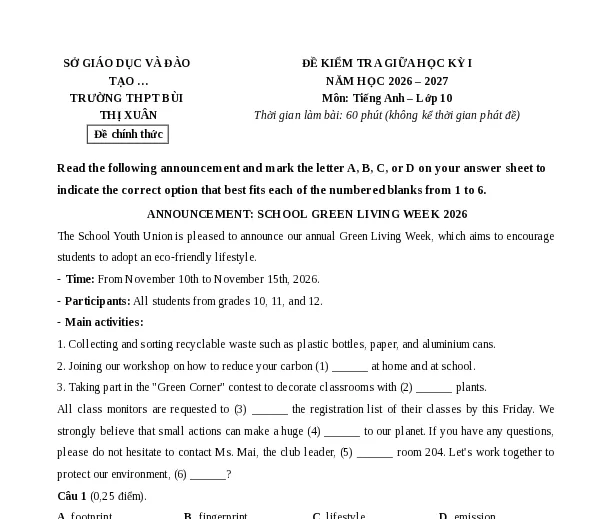
Read the following announcement about a school music event and mark the letter A, B, C, or D to indicate the correct option that best fits each of the numbered blanks from 1 to 5.
MELODIES FOR EARTH: ANNUAL CHARITY MUSIC NIGHT
Are you passionate about music and eager to protect our planet? Join us this Saturday for Melodies for Earth! This special music show (1) ______ every year by the School Youth Union to raise students' awareness of environmental protection through the power of art.
Look! Our stage crew (2) ______ up the eco-friendly bamboo decorations in the main hall right now, and the atmosphere is already exciting! During the concert, all participants are encouraged (3) ______ their own reusable water bottles to the venue, as single-use plastic will not be allowed.
This event is not just about entertainment; it is a great opportunity for young talents to shine (4) ______ stage while contributing to a greener community. We believe that meaningful songs about nature will inspire the (5) ______ to adopt a greener lifestyle every day.
Question 1.
A. organizes
B. is organized
C. is organizing
D. organized
Question 2.
A. sets
B. set
C. is setting
D. will set
Question 3.
A. bring
B. to bring
C. bringing
D. brought
Question 4.
A. in
B. at
C. on
D. for
Question 5.
A. audience
B. instrument
C. single
D. scenery
Read the following leaflet about green living at home and mark the letter A, B, C, or D to indicate the correct option that best fits each of the numbered blanks from 6 to 10.
GREEN HOME, HAPPY FAMILY: SMALL STEPS TO A BETTER PLANET!
Building an eco-friendly lifestyle does not have to start with big campaigns; it begins right inside your home. When family members share household chores and practice green habits together, they not only strengthen family bonds but also reduce their carbon footprint. Here are practical tips your family can follow every day:
- Share the workload: Instead of leaving one person to do all the (6) ______, divide household chores fairly among family members. While one person does the laundry, another can sort household waste into recyclable and organic bins.
- Save energy: Always remember to (7) ______ electrical appliances when they are not in use. Unplugging chargers and switching to energy-saving bulbs can help (8) ______ the amount of electricity your family uses each month.
- Choose safe products: Chemical cleaners can release harmful waste into the water supply. Choose natural, (9) ______ cleaning products made from lemon, vinegar, or baking soda instead.
- Lead by example: Parents should (10) ______ a good example for their children by practicing these green habits regularly.
Question 6.
A. heavy lifting
B. washing-up
C. grocery
D. table manners
Question 7.
A. turn off
B. put off
C. take off
D. give off
Question 8.
A. cut down on
B. look up to
C. get on with
D. take care of
Question 9.
A. eco-friendly
B. energy-wasting
C. man-made
D. single-use
Question 10.
A. make
B. take
C. give
D. set
Mark the letter A, B, C, or D to indicate the best arrangement of utterances or sentences to make a meaningful exchange, letter, or text in each of the following questions from 11 to 14.
Question 11.
a. Nam: I usually do the washing-up, but today my sister is doing it because I have to prepare for my music presentation.
b. Anna: Hi Nam! Are you free to go to the bookshop with me now, or are you busy with your daily chores?
c. Anna: That sounds like a fair division! Let me know when you finish your preparation.
A. a – b – c
B. b – a – c
C. b – c – a
D. c – b – a
Question 12.
a. Mai: Why are you collecting so many old plastic bottles and cardboard boxes, David?
b. David: Really? That's awesome! Our club is also going to plant twenty new trees behind the school library this Sunday.
c. Mai: Count me in! I'll bring my gardening gloves and help your team on Sunday morning.
d. David: I'm going to make handmade flower pots for our school's Green Fair next Monday.
e. Mai: What a creative idea! By the way, I think I will donate my old comic books to the fair's charity booth.
A. a – d – e – b – c
B. a – b – e – d – c
C. d – a – e – b – c
D. a – d – b – e – c
Question 13.
Dear Minh,
a. My parents made me promise to finish my schoolwork and household chores, or they wouldn't let me join the band.
b. How have you been lately? I'm writing to share some exciting news about our school's upcoming talent show.
c. Therefore, I always finish doing the laundry and cleaning my room before going to the music club every afternoon.
d. My friends and I have formed an acoustic band, and we are going to perform a folk song in a modern pop style.
e. Would you like to come and cheer for us this Friday evening? I'll save a front-row seat for you!
Best wishes,
Lan
A. b – a – d – c – e
B. b – d – a – c – e
C. d – b – a – c – e
D. b – d – c – a – e
Question 14.
a. For example, upbeat pop or rock songs can give us more energy when we are doing tiring household chores.
b. Music plays an important role in our daily lives because it is a wonderful way to express human emotions.
c. On the other hand, soft classical melodies help us relax and reduce stress after a busy day at school.
d. Thanks to these great emotional and mental benefits, people of all ages enjoy listening to music every day.
e. Depending on the rhythm and melody, different types of music can affect our mood in different ways.
A. b – e – a – c – d
B. b – a – e – c – d
C. e – b – a – c – d
D. b – e – c – d – a
Read the following passage about a famous TV music show and mark the letter A, B, C, or D to indicate the correct option that best fits each of the numbered blanks from 15 to 18.
Reality television music competitions have become very popular over the past two decades. Among them, Idol is one of the most successful music shows in the world. First created in the United Kingdom in 2001, the program was soon bought and shown in more than forty countries. In Vietnam, the first season of Vietnam Idol (15) ______ and quickly became a favorite show among young audiences.
The show gives ordinary people a great chance to become famous singers. In the early audition rounds, thousands of hopeful contestants try their best (16) ______. Some participants give amazing performances, while others fail to sing well. Only the most talented singers are allowed to move on to the semi-final stages.
What makes the Idol series truly exciting is the role of television viewers. From the semi-finals onwards, the audience can vote for their favorite singers via text messages or online apps, (17) ______. The contestant with the lowest number of votes each week is eliminated from the competition.
This November, a special charity concert of Vietnam Idol (18) ______ to raise money for planting trees in the Central Highlands. Through this event, the organizers hope to encourage young music lovers to take action for a greener environment.
Question 15.
A. broadcast on television in 2007
B. was broadcast on television in 2007
C. is broadcasting on television in 2007
D. will be broadcast on television in 2007
Question 16.
A. to impress the experienced judges with their voices
B. impressing the experienced judges with their voices
C. impress the experienced judges with their voices
D. impressed the experienced judges with their voices
Question 17.
A. because the judges alone decide the winner of the whole season
B. so the public plays an important part in choosing the winner
C. but the viewers cannot watch the live performances on television
D. or the contestants have to write two new songs before the show
Question 18.
A. is going to be held at the National Stadium in Hanoi
B. is going to hold at the National Stadium in Hanoi
C. will hold by the organizers at the National Stadium in Hanoi
D. holds every week at the National Stadium in Hanoi
Read the following passage about the benefits of doing housework for children and mark the letter A, B, C, or D to indicate the best answer to each of the following questions from 19 to 26.
In many modern families, parents often hesitate to give household chores to their children. With busy school schedules, extra classes, and exam pressures, many mothers and fathers believe that kids should focus only on their studies while adults do all the housework. However, family experts argue that keeping children away from housework actually takes away important learning experiences from them.
First of all, doing household tasks teaches young people essential life skills for the future. When children regularly help cook meals, do the laundry, or manage grocery budgets, they gradually become more independent. When they eventually leave home for university or live on their own, they will not feel worried about basic daily tasks. Instead of eating fast food every day or waiting for someone else to clean up their room, they can confidently take care of themselves.
Furthermore, sharing chores builds a deep sense of gratitude and family responsibility. When children sweep the floor, wash the dishes, or put out the rubbish, they realize how much time and effort it takes to keep a home clean and comfortable. As a result, they appreciate their parents' hard work more and learn to do their fair share of work in the family. Working together on weekend cleaning also gives parents and children natural chances to talk, understand each other, and strengthen family bonds.
Finally, doing suitable chores helps children develop good character and teamwork skills. When children learn to tidy up their own toys at a young age, they are more likely to become helpful classmates and reliable colleagues in the future. By helping their family without asking for money, children learn to respect hard work and care about people around them.
Question 19. Which of the following is NOT mentioned in paragraph 2 as a chore that helps children build life skills?
A. Cooking meals
B. Doing the laundry
C. Managing grocery budgets
D. Repairing broken furniture
Question 20. The word "them" in paragraph 1 refers to ______.
A. parents
B. children
C. extra classes
D. family experts
Question 21. The word "gratitude" in paragraph 3 is CLOSEST in meaning to ______.
A. thankfulness
B. sadness
C. laziness
D. carelessness
Question 22. The word "strengthen" in paragraph 3 is OPPOSITE in meaning to ______.
A. build
B. weaken
C. support
D. protect
Question 23. Which of the following best paraphrases the underlined sentence in paragraph 4?
A. Early habits of doing small chores at home help shape children into cooperative and trustworthy people later in life.
B. Children only care about their classmates and colleagues if their parents force them to clean their rooms.
C. If a child does not put away their toys at a young age, they will never pass exams at school.
D. Helpful classmates and reliable colleagues often ask young children to tidy up their own toys at home.
Question 24. Which of the following is TRUE according to the passage?
A. Most family experts advise parents to pay children money every time they finish a chore.
B. Doing housework helps children appreciate the effort their parents put into looking after the home.
C. Studying at school is much less important than doing heavy lifting around the house for teenagers.
D. Children who do housework usually have no time left for extra classes or school exams.
Question 25. In which paragraph does the writer mention the reasons why many parents avoid giving housework to their children?
A. Paragraph 1
B. Paragraph 2
C. Paragraph 3
D. Paragraph 4
Question 26. In which paragraph does the writer discuss how doing chores prepares young people for living away from home?
A. Paragraph 1
B. Paragraph 2
C. Paragraph 3
D. Paragraph 4
Read the following passage about green living and mark the letter A, B, C, or D to indicate the best answer to each of the following questions from 27 to 35.
[I] For decades, rapid industrial growth and the habit of using single-use products have caused serious damage to the natural world. [II] Every year, billions of tons of carbon dioxide are released into the air, while mountains of plastic waste pollute our rivers and oceans. [III] Faced with extreme weather and rising temperatures, people are realizing that adopting a "green lifestyle" is no longer just a personal hobby, but an urgent need for everyone. [IV]
Simply put, green living means making daily choices that conserve natural resources and reduce pollution. One of the easiest places where individuals can make a difference is energy use at home. By replacing old light bulbs with energy-saving LED lights, unplugging electronic devices when not in use, and choosing eco-friendly appliances, a family can greatly reduce its carbon footprint. In addition, choosing green transport—such as cycling, walking, or taking the bus instead of driving private cars—directly reduces air pollution in big cities.
Another important part of green living is changing our shopping habits according to the rule of "Reduce, Reuse, Recycle." However, environmental experts point out that these three actions are not equally effective. Recycling, although useful, still uses a lot of energy and clean water to process old materials. Therefore, the best solution is reducing the number of single-use items we buy from the start and reusing bottles, bags, and clothes whenever possible. Even our food choices matter: cutting down on meat and buying local organic vegetables can lower the environmental cost of producing and transporting food.
Despite these practical steps, some people think that individual actions are too small to solve global pollution. Although governments and large companies must pass strict environmental laws, the daily choices of millions of consumers also have great power. When shoppers refuse to buy products with too much plastic packaging and ask for eco-friendly items, businesses have to change the way they make their goods. In the end, a greener future is built when both individuals and governments work together.
Question 27. Where in paragraph 1 does the following sentence best fit? (câu dưới đây nên được đặt ở vị trí nào trong những vị trí này?)
Modern convenience has come at a high environmental price that future generations will have to pay.
A. [I]
B. [II]
C. [III]
D. [IV]
Question 28. The word "conserve" in paragraph 2 is OPPOSITE in meaning to ______.
A. save
B. waste
C. protect
D. keep
Question 29. According to paragraph 2, which of the following is NOT mentioned as a way to save household energy or reduce city pollution?
A. Using LED lights instead of old light bulbs
B. Unplugging electronic devices when they are not in use
C. Installing solar panels on the roof of every house
D. Travelling by bus, bicycle, or on foot instead of private cars
Question 30. The phrase "these three actions" in paragraph 3 refers to ______.
A. cycling, walking, and taking the bus
B. reducing, reusing, and recycling
C. buying, cooking, and transporting organic food
D. saving energy, water, and natural resources
Question 31. The phrase "cutting down on" in paragraph 3 is CLOSEST in meaning to ______.
A. reducing
B. increasing
C. producing
D. collecting
Question 32. Which of the following best summarizes paragraph 3?
A. Recycling plastic waste is the best way to save energy and clean water in modern cities.
B. Green consumption focuses on reducing waste, reusing items, and making eco-friendly food choices rather than only recycling.
C. People must stop eating meat completely and never buy new clothes if they want to protect the planet.
D. Local farmers play a more important role in protecting the environment than recycling factories.
Question 33. Which of the following is TRUE according to the passage?
A. Recycling old materials does not use any clean water or electrical energy at all.
B. Buying local organic vegetables helps reduce the environmental impact of transporting food.
C. Individual green habits are completely useless unless all factories are closed immediately.
D. Green living is only a short-term fashion trend among young people in big cities.
Question 34. Which of the following best paraphrases the underlined sentence in paragraph 4?
A. Both strict environmental rules from authorities and eco-friendly buying habits from citizens are important for protecting the planet.
B. Governments and big companies should leave environmental protection completely in the hands of ordinary shoppers.
C. Because large companies refuse to follow environmental rules, consumers have no power to change how goods are made.
D. Strict environmental laws are unnecessary as long as shoppers continue to buy organic food in supermarkets.
Question 35. Which of the following can be inferred from the passage?
A. Preventing waste from being created is better for the environment than processing waste after it is thrown away.
B. Public bus systems in big cities have completely stopped air pollution and climate change.
C. Most people in the world have already stopped using single-use plastics and private cars.
D. Industrial growth has slowed down over the past few decades thanks to green lifestyles.
PART II. WRITING (3,0 points)
Rewrite each of the following sentences in such a way that it means almost the same as the original sentence, using the word(s) given at the beginning or in brackets.
Question 36. The local youth union is going to organize a clean-up campaign along the beach this Sunday. (Use Passive Voice)
→ A clean-up campaign ....................................................................................................................................
Question 37. My parents don't allow me to stay up late on weekdays. (Rewrite using the verb let)
→ My parents don't let .......................................................................................................................................
Question 38. Minh wanted to pass the audition for the school music club. He practiced playing the guitar for two hours every day. (Combine the two sentences using so to make a compound sentence)
→ Minh wanted .................................................................................................................................................
Question 39. My mother has already decided to replace all the plastic bags in our kitchen with reusable canvas bags next week. (Rewrite using is going to)
→ My mother is .................................................................................................................................................
Question 40. My father always cooks dinner on weekends, and right now he is preparing a vegetable soup in the kitchen. (Rewrite the first clause using takes responsibility for)
→ My father always takes ..................................................................................................................................
--------- HẾT ---------
Thí sinh không được sử dụng tài liệu. Cán bộ coi thi không giải thích gì thêm.
Chúc các em bình tĩnh, tự tin và làm bài đạt kết quả cao nhất!
Họ và tên thí sinh: ................................................ Số báo danh: ........................
SỞ GIÁO DỤC VÀ ĐÀO TẠO …
TRƯỜNG THPT …
Hướng dẫn chấm chính thức
ĐỀ KIỂM TRA GIỮA HỌC KỲ I
NĂM HỌC 2026 – 2027
Môn: Tiếng Anh – Lớp 10
HƯỚNG DẪN CHẤM VÀ LỜI GIẢI CHI TIẾT
A. HƯỚNG DẪN CHUNG VÀ QUY ĐỔI ĐIỂM
- Thang điểm chuẩn (10,0 điểm):
+ Phần I – Trắc nghiệm (35 câu): Mỗi câu trả lời đúng được 0,2 điểm (35 × 0,2 = 7,0 điểm).
+ Phần II – Tự luận (5 câu): Mỗi câu viết lại đúng ngữ pháp và sát nghĩa câu gốc được 0,6 điểm (5 × 0,6 = 3,0 điểm).
+ (Ghi chú: Nếu tổ chuyên môn áp dụng thang điểm đồng đều cho 40 câu, có thể quy đổi mỗi câu đúng được 0,25 điểm, tổng 40 × 0,25 = 10,0 điểm).
- Nguyên tắc chấm phần Tự luận:
+ Chấp nhận các cách diễn đạt khác nếu đúng ngữ pháp, đúng từ/cấu trúc gợi ý và giữ nguyên nghĩa của câu gốc.
+ Sai chính tả từ 2 lỗi nhỏ hoặc sai 1 lỗi chia thì phụ trong câu trừ nửa số điểm của câu đó (0,3 điểm).
B. BẢNG ĐÁP ÁN TRẮC NGHIỆM (PART I – 7,0 ĐIỂM)
Câu | 1 | 2 | 3 | 4 | 5 | 6 | 7 | 8 | 9 | 10 |
|---|---|---|---|---|---|---|---|---|---|---|
Đáp án | B | C | B | C | A | A | A | A | A | D |
Câu | 11 | 12 | 13 | 14 | 15 | 16 | 17 | 18 | 19 | 20 |
|---|---|---|---|---|---|---|---|---|---|---|
Đáp án | B | A | B | A | B | A | B | A | D | B |
Câu | 21 | 22 | 23 | 24 | 25 | 26 | 27 | 28 | 29 | 30 |
|---|---|---|---|---|---|---|---|---|---|---|
Đáp án | A | B | A | B | A | B | B | B | C | B |
Câu | 31 | 32 | 33 | 34 | 35 |
|---|---|---|---|---|---|
Đáp án | A | B | B | A | A |
Mỗi câu trắc nghiệm trả lời đúng được 0,2 điểm.
C. ĐÁP ÁN VÀ THANG ĐIỂM PHẦN TỰ LUẬN (PART II – 3,0 ĐIỂM)
Câu | Nội dung đáp án | Điểm |
|---|---|---|
36 | A clean-up campaign is going to be organized along the beach by the local youth union this Sunday. | 0,6 |
37 | My parents don't let me stay up late on weekdays. | 0,6 |
38 | Minh wanted to pass the audition for the school music club, so he practiced playing the guitar for two hours every day. | 0,6 |
39 | My mother is going to replace all the plastic bags in our kitchen with reusable canvas bags next week. | 0,6 |
40 | My father always takes responsibility for cooking dinner on weekends, and right now he is preparing a vegetable soup in the kitchen. | 0,6 |
Lưu ý: Chấp nhận các câu trả lời đúng ngữ pháp và sát nghĩa khác.
D. LỜI GIẢI CHI TIẾT VÀ GIẢI THÍCH KIẾN THỨC
PHẦN 1: ĐỌC ĐIỀN THÔNG BÁO (CÂU 1 – 5)
- Câu 1. Chọn B (is organized)
+ Kiến thức: Câu bị động thì Hiện tại đơn (Passive Voice – Unit 2).
+ Giải thích: Chủ ngữ This special music show là sự vật, có dấu hiệu every year và cụm by the School Youth Union → chia bị động Hiện tại đơn: is organized (được tổ chức hằng năm bởi Đoàn trường).
- Câu 2. Chọn C (is setting)
+ Kiến thức: Thì Hiện tại đơn vs. Hiện tại tiếp diễn (Unit 1).
+ Giải thích: Có từ cảm thán Look! ở đầu câu và trạng từ right now ở cuối mệnh đề chỉ hành động đang diễn ra ngay lúc nói → dùng Hiện tại tiếp diễn: is setting.
- Câu 3. Chọn B (to bring)
+ Kiến thức: Động từ nguyên mẫu có to (To-infinitive – Unit 3).
+ Giải thích: Cấu trúc encourage sb to V → dạng bị động be encouraged to V (được khuyến khích làm gì).
- Câu 4. Chọn C (on)
+ Kiến thức: Giới từ / Cụm từ cố định (Unit 3 – Music).
+ Giải thích: Cụm cố định on stage (biểu diễn/tỏa sáng trên sân khấu).
- Câu 5. Chọn A (audience)
+ Kiến thức: Từ vựng chủ đề Âm nhạc (Unit 3 – Music).
+ Giải thích: audience (khán giả); instrument (nhạc cụ); single (đĩa đơn); scenery (phong cảnh). Dịch: Chúng tôi tin rằng những bài hát ý nghĩa về thiên nhiên sẽ truyền cảm hứng cho khán giả sống xanh hơn mỗi ngày.
PHẦN 2: ĐỌC ĐIỀN TỜ RƠI (CÂU 6 – 10)
- Câu 6. Chọn A (heavy lifting)
+ Kiến thức: Từ vựng chủ đề Gia đình (Unit 1 – Family Life).
+ Giải thích: do the heavy lifting (làm các công việc nặng nhọc/vất vả). Dịch: Thay vì để một người phải gánh vác mọi việc nặng nhọc, hãy phân chia việc nhà công bằng giữa các thành viên.
- Câu 7. Chọn A (turn off)
+ Kiến thức: Cụm động từ (Phrasal verbs – Unit 2).
+ Giải thích: turn off (tắt thiết bị điện); put off (trì hoãn); take off (cởi đồ / cất cánh); give off (tỏa ra mùi/nhiệt).
- Câu 8. Chọn A (cut down on)
+ Kiến thức: Cụm động từ (Phrasal verbs – Unit 2).
+ Giải thích: cut down on (cắt giảm); look up to (kính trọng); get on with (hòa hợp với); take care of (chăm sóc). Dịch: Rút phích cắm sạc và chuyển sang bóng đèn tiết kiệm năng lượng có thể giúp cắt giảm lượng điện gia đình tiêu thụ mỗi tháng.
- Câu 9. Chọn A (eco-friendly)
+ Kiến thức: Từ vựng chủ đề Môi trường (Unit 2 – Humans and the Environment).
+ Giải thích: eco-friendly (thân thiện với môi trường), phù hợp ngữ cảnh các sản phẩm tẩy rửa tự nhiên làm từ chanh, giấm hoặc muối nở.
- Câu 10. Chọn D (set)
+ Kiến thức: Cụm từ cố định (Collocation – Unit 1).
+ Giải thích: set a good example for sb (làm tấm gương tốt cho ai noi theo).
PHẦN 3: SẮP XẾP HỘI THOẠI / LÁ THƯ / ĐOẠN VĂN (CÂU 11 – 14)
- Câu 11. Chọn B (b – a – c)
+ Giải thích:
* b: Anna chào Nam và hỏi Nam có rảnh đi hiệu sách không hay đang bận làm việc nhà.
* a: Nam trả lời thường ngày mình rửa bát, nhưng hôm nay chị gái đang làm giúp vì Nam phải chuẩn bị bài thuyết trình âm nhạc.
* c: Anna khen cách phân chia công việc công bằng và dặn Nam nhắn khi chuẩn bị xong.
- Câu 12. Chọn A (a – d – e – b – c)
+ Giải thích:
* a: Mai hỏi lý do David thu gom nhiều chai nhựa và hộp bìa cứng.
* d: David trả lời dự định đã có kế hoạch (I'm going to make...) làm chậu hoa thủ công cho Hội chợ Xanh.
* e: Mai khen ý tưởng sáng tạo và đưa ra quyết định ngay lúc nói (I think I will donate...).
* b: David hào hứng hưởng ứng và kể thêm kế hoạch trồng 20 cây xanh của câu lạc bộ vào Chủ nhật.
* c: Mai xin tham gia cùng vào sáng Chủ nhật.
- Câu 13. Chọn B (b – d – a – c – e)
+ Giải thích:
* b: Mở đầu thư hỏi thăm sức khỏe và báo tin vui về buổi biểu diễn tài năng của trường.
* d: Giới thiệu việc lập ban nhạc acoustic và kế hoạch biểu diễn.
* a: Kể về điều kiện bố mẹ đặt ra (phải hoàn thành việc học và việc nhà nếu không sẽ không cho tham gia).
* c: Kết quả (Therefore) là Lan luôn giặt đồ và dọn phòng xong trước khi đến câu lạc bộ âm nhạc.
* e: Kết thư mời Minh đến cổ vũ vào tối thứ Sáu.
- Câu 14. Chọn A (b – e – a – c – d)
+ Giải thích:
* b: Câu chủ đề giới thiệu vai trò quan trọng của âm nhạc trong việc thể hiện cảm xúc.
* e: Dẫn dắt: Tùy thuộc vào nhịp điệu và giai điệu, các thể loại nhạc khác nhau tác động đến tâm trạng theo những cách khác nhau.
* a: Ví dụ 1 (For example): Nhạc pop/rock sôi động giúp có thêm năng lượng khi làm việc nhà.
* c: Ý đối lập (On the other hand): Nhạc cổ điển nhẹ nhàng giúp thư giãn và giảm căng thẳng sau ngày học bận rộn.
* d: Câu kết luận (Thanks to these great emotional and mental benefits...).
PHẦN 4: ĐỌC ĐIỀN HOÀN THÀNH CÂU (CÂU 15 – 18)
- Câu 15. Chọn B (was broadcast on television in 2007)
+ Kiến thức: Câu bị động thì Quá khứ đơn (Unit 2).
+ Giải thích: Chủ ngữ the first season of Vietnam Idol là sự vật (mùa đầu tiên của chương trình), mốc thời gian in 2007 ở quá khứ và vế sau chia quá khứ đơn (became) → cần động từ chia bị động quá khứ đơn: was broadcast (được phát sóng trên truyền hình vào năm 2007; phân từ hai của broadcast vẫn là broadcast).
- Câu 16. Chọn A (to impress the experienced judges with their voices)
+ Kiến thức: Động từ nguyên mẫu có to chỉ mục đích / đi sau try one's best (Unit 3).
+ Giải thích: Cấu trúc try one's best to V (cố gắng hết sức để làm gì) → chọn to impress the experienced judges with their voices.
- Câu 17. Chọn B (so the public plays an important part in choosing the winner)
+ Kiến thức: Câu ghép với liên từ so (Unit 3).
+ Giải thích: Mệnh đề trước nêu việc khán giả có thể bình chọn cho ca sĩ yêu thích qua tin nhắn hoặc ứng dụng → mệnh đề sau nối bằng liên từ so (vì vậy) để chỉ kết quả hợp lý: công chúng đóng vai trò quan trọng trong việc tìm ra người chiến thắng.
- Câu 18. Chọn A (is going to be held at the National Stadium in Hanoi)
+ Kiến thức: Câu bị động với be going to (Unit 2).
+ Giải thích: Chủ ngữ a special charity concert of Vietnam Idol là sự kiện (được tổ chức) và có thời gian dự kiến cụ thể (This November) → dùng bị động tương lai gần: is going to be held.
PHẦN 5: ĐỌC HIỂU 1 – CHỦ ĐỀ FAMILY LIFE (CÂU 19 – 26)
- Câu 19. Chọn D (Repairing broken furniture)
+ Giải thích: Trong đoạn 2, bài đọc nêu rõ: "cook meals, do the laundry, or manage grocery budgets" (nấu ăn, giặt giũ, quản lý ngân sách đi chợ). Việc sửa chữa đồ đạc bị hỏng (Repairing broken furniture) không được nhắc tới.
- Câu 20. Chọn B (children)
+ Giải thích: Câu cuối đoạn 1: "...keeping children away from housework actually takes away important learning experiences from them." (việc giữ trẻ em tránh xa việc nhà thực chất lại lấy đi những trải nghiệm học tập quan trọng của chúng). Vậy them thay thế cho children.
- Câu 21. Chọn A (thankfulness)
+ Giải thích: gratitude (lòng biết ơn – từ vựng trọng tâm Unit 1) = thankfulness (sự biết ơn). Các từ còn lại: sadness (nỗi buồn), laziness (sự lười biếng), carelessness (sự bất cẩn).
- Câu 22. Chọn B (weaken)
+ Giải thích: strengthen (làm bền chặt, củng cố – cụm strengthen family bonds trong Unit 1) >< weaken (làm suy yếu).
- Câu 23. Chọn A (Early habits of doing small chores at home help shape children into cooperative and trustworthy people later in life.)
+ Giải thích: Câu gạch chân ở đoạn 4: "Khi trẻ học cách tự dọn dẹp đồ chơi từ khi còn nhỏ, chúng sẽ có nhiều khả năng trở thành những người bạn cùng lớp biết giúp đỡ và những đồng nghiệp đáng tin cậy trong tương lai." Đáp án A diễn đạt lại sát nghĩa nhất (helpful ≈ cooperative; reliable ≈ trustworthy).
- Câu 24. Chọn B (Doing housework helps children appreciate the effort their parents put into looking after the home.)
+ Giải thích: Thông tin ở đoạn 3: "When children sweep the floor, wash the dishes, or put out the rubbish, they realize how much time and effort it takes to keep a home clean and comfortable. As a result, they appreciate their parents' hard work more..."
- Câu 25. Chọn A (Paragraph 1)
+ Giải thích: Đoạn 1 nêu lý do nhiều phụ huynh ngại giao việc nhà cho con: "With busy school schedules, extra classes, and exam pressures, many mothers and fathers believe that kids should focus only on their studies..."
- Câu 26. Chọn B (Paragraph 2)
+ Giải thích: Đoạn 2 bàn về việc làm việc nhà trang bị kỹ năng tự lập khi trẻ rời nhà đi học đại học: "When they eventually leave home for university or live on their own, they will not feel worried about basic daily tasks."
PHẦN 6: ĐỌC HIỂU 2 – CHỦ ĐỀ GREEN LIVING (CÂU 27 – 35)
- Câu 27. Chọn B ([II])
+ Giải thích: Câu cần điền: "Sự tiện lợi hiện đại đã phải trả một cái giá đắt về môi trường mà các thế hệ tương lai sẽ phải gánh chịu." Đặt ở vị trí [II] là mạch lạc nhất vì câu trước [II] vừa nhắc tới sự phát triển công nghiệp và thói quen dùng đồ một lần gây hại cho tự nhiên, còn câu ngay sau [II] nêu dẫn chứng cụ thể về cái giá đó (billions of tons of carbon dioxide..., mountains of plastic waste...).
- Câu 28. Chọn B (waste)
+ Giải thích: conserve (bảo tồn, tiết kiệm tài nguyên thiên nhiên) >< waste (lãng phí).
- Câu 29. Chọn C (Installing solar panels on the roof of every house)
+ Giải thích: Đoạn 2 nhắc tới: thay bóng đèn cũ bằng đèn LED tiết kiệm điện (A), rút phích cắm thiết bị điện khi không dùng (B), và đi xe đạp, đi bộ hoặc xe buýt (D). Việc lắp pin mặt trời trên mái mọi ngôi nhà (C) không có trong bài.
- Câu 30. Chọn B (reducing, reusing, and recycling)
+ Giải thích: Câu trước đó ở đoạn 3 viết: "...according to the rule of 'Reduce, Reuse, Recycle.' However, environmental experts point out that these three actions are not equally effective." Vậy these three actions chỉ 3 hành động: giảm thiểu, tái sử dụng và tái chế.
- Câu 31. Chọn A (reducing)
+ Giải thích: Cụm động từ cut down on (cắt giảm – Unit 2) = reduce.
- Câu 32. Chọn B (Green consumption focuses on reducing waste, reusing items, and making eco-friendly food choices rather than only recycling.)
+ Giải thích: Đoạn 3 giải thích vì sao Reduce và Reuse hiệu quả hơn Recycle (do tái chế vẫn tốn nhiều nước và năng lượng), đồng thời đề cập thêm việc chọn thực phẩm xanh (giảm thịt, mua rau hữu cơ địa phương).
- Câu 33. Chọn B (Buying local organic vegetables helps reduce the environmental impact of transporting food.)
+ Giải thích: Cuối đoạn 3 nêu rõ: "...buying local organic vegetables can lower the environmental cost of producing and transporting food."
- Câu 34. Chọn A (Both strict environmental rules from authorities and eco-friendly buying habits from citizens are important for protecting the planet.)
+ Giải thích: Câu gốc đoạn 4: "Mặc dù các chính phủ và công ty lớn phải thông qua các đạo luật môi trường nghiêm ngặt, nhưng lựa chọn hằng ngày của hàng triệu người tiêu dùng cũng có sức mạnh to lớn." Đáp án A diễn đạt lại đầy đủ và chính xác nhất.
- Câu 35. Chọn A (Preventing waste from being created is better for the environment than processing waste after it is thrown away.)
+ Giải thích: Suy luận từ đoạn 3: Tái chế rác (processing old materials) vẫn tốn nhiều điện và nước sạch, nên giải pháp tốt nhất (the best solution) là giảm mua đồ dùng một lần ngay từ đầu (reducing the number of single-use items we buy from the start).
PHẦN TỰ LUẬN: VIẾT LẠI CÂU (CÂU 36 – 40)
- Câu 36 (Bị động với be going to – Unit 2):
+ Cấu trúc: `S + am/is/are + going to + be + Vp2 + (by O) + trạng từ chỉ thời gian`.
+ → A clean-up campaign is going to be organized along the beach by the local youth union this Sunday.
- Câu 37 (Động từ nguyên mẫu không to sau let – Unit 3):
+ Cấu trúc: `allow sb to V` = `let sb V (bare infinitive)`.
+ → My parents don't let me stay up late on weekdays.
- Câu 38 (Câu ghép với liên từ so – Unit 3):
+ Cấu trúc: `Mệnh đề nguyên nhân, so + mệnh đề kết quả`.
+ → Minh wanted to pass the audition for the school music club, so he practiced playing the guitar for two hours every day.
- Câu 39 (Thì tương lai gần be going to diễn tả dự định đã quyết định trước – Unit 2):
+ Cấu trúc: `have/has decided to V` → `am/is/are going to V`.
+ → My mother is going to replace all the plastic bags in our kitchen with reusable canvas bags next week.
- Câu 40 (Cụm từ take responsibility for & Hiện tại đơn/Hiện tại tiếp diễn – Unit 1):
+ Cấu trúc: `take responsibility for + V-ing` (chịu trách nhiệm làm việc gì).
+ → My father always takes responsibility for cooking dinner on weekends, and right now he is preparing a vegetable soup in the kitchen.