SỞ GIÁO DỤC VÀ ĐÀO TẠO …
TRƯỜNG THPT …
Đề chính thức
ĐỀ KIỂM TRA GIỮA HỌC KỲ I
NĂM HỌC 2024 – 2025
Môn: Tiếng Anh – Lớp 10
Thời gian làm bài: 50 phút (không kể thời gian phát đề)
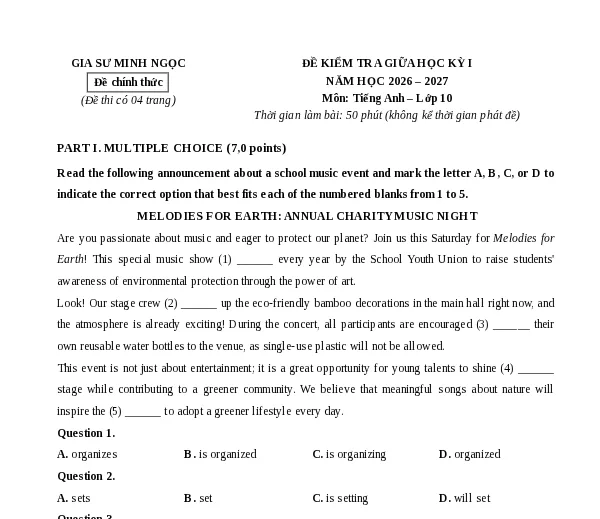
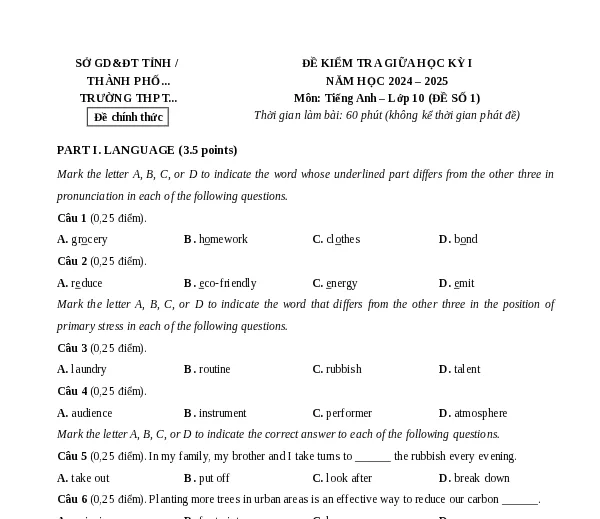
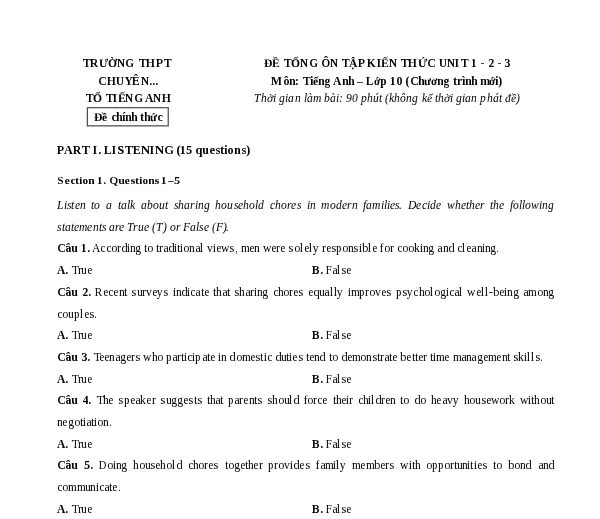
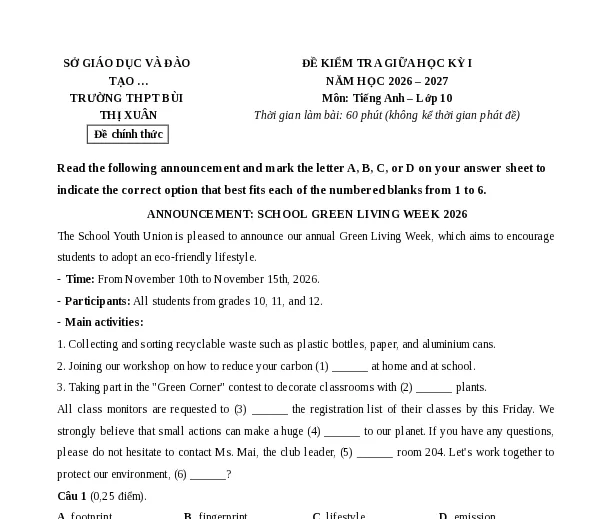
Read the following advertisement and mark the letter A, B, C, or D on your answer sheet to indicate the correct option that best fits each of the numbered blanks from 1 to 6.
JOIN OUR GREEN LIVING WORKSHOP!
Are you eager to create a positive impact on our planet? Sign up today for our community green workshop, where practical skills and inspiration await you!
At the event, participants will discover how to develop (1) ______ habits in everyday life. We will provide you with (2) ______ cloth tote bags so you can immediately reduce single-use plastic waste while shopping. Moreover, several eco-friendly cleaning solutions (3) ______ by local environmentalists during the morning demonstration.
You can also learn how to (4) ______ unnecessary electrical appliances to conserve valuable power. Doing so helps your family (5) ______ money on monthly energy bills while cutting down greenhouse gas emissions.
Hurry up! The workshop (6) ______ place at the Central Youth Centre next Sunday at 8:30 a.m. Register online before Friday to reserve your seat!
Câu 1.
A. sustain
B. sustainability
C. sustainable
D. sustainably
Câu 2.
A. nice reusable shopping
B. reusable nice shopping
C. shopping nice reusable
D. nice shopping reusable
Câu 3.
A. will present
B. are going to be presented
C. were presenting
D. have presented
Câu 4.
A. switch off
B. look for
C. give up
D. put on
Câu 5.
A. spend
B. waste
C. save
D. earn
Câu 6.
A. took
B. was taking
C. takes
D. had taken
Read the following leaflet and mark the letter A, B, C, or D on your answer sheet to indicate the correct option that best fits each of the numbered blanks from 7 to 12.
TEEN VOLUNTEERS: SHARING THE CARING!
Volunteer Club is proud to launch our annual community outreach programme designed for secondary and high school students across the city.
- Meaningful missions: (7) ______ teen member can take part in painting public playgrounds, teaching English to disadvantaged children, or distributing warm meals to the homeless.
- Valuable experience: A significant (8) ______ of our volunteers gain confidence, teamwork skills, and a deeper sense of civic responsibility.
- Commitment: We meet regularly (9) ______ weekends and during major summer holidays.
- Safety and support: (10) ______ high school students often face hectic study schedules, our project coordinators always arrange flexible shifts.
- Personal growth: Engaging in community service fosters genuine (11) ______ and compassion for others who are less fortunate.
- Be a role model: Take action today and (12) ______ an example for your younger peers in the community!
For further details, visit our official webpage at teenvolunteers.org or contact our hotline directly.
Câu 7.
A. Every
B. Other
C. Others
D. Another
Câu 8.
A. amount
B. number
C. deal
D. plenty
Câu 9.
A. at
B. in
C. on
D. by
Câu 10.
A. Because of
B. In spite of
C. Even though
D. Since
Câu 11.
A. sympathy
B. indifference
C. isolation
D. hesitation
Câu 12.
A. hold
B. set
C. pay
D. take
Mark the letter A, B, C, or D on your answer sheet to indicate the correct arrangement of the sentences to make a meaningful exchange, letter, or text in each of the following questions from 13 to 17.
Câu 13.
a. Minh: "Hi, Lan! Have you finished your chores for today yet?"
b. Minh: "That's great! Let's go to the school library together now."
c. Lan: "Yes, I have already washed the dishes and tidied up my room."
A. a – c – b
B. c – a – b
C. b – a – c
D. a – b – c
Câu 14.
a. Tom: "Definitely! Heavy rock is too noisy for me; I prefer acoustic guitar melodies."
b. Tom: "I'm listening to a newly released pop-folk track by an indie band."
c. Sarah: "What genre of music are you listening to, Tom?"
d. Sarah: "Pop-folk? Does it feature gentle acoustic instruments instead of loud electric sounds?"
e. Sarah: "Same here. Soft music helps me unwind after a long day at school."
A. c – b – d – a – e
B. c – d – b – a – e
C. b – c – d – e – a
D. c – a – b – d – e
Câu 15.
a. First and foremost, taking out the rubbish and doing the laundry everyday allows me to appreciate my parents' hard work.
b. Dear David, I am writing to tell you about how sharing household duties has changed my family life for the better.
c. Besides, cooking dinner together on weekends has brought all family members much closer than before.
d. Write back soon and share your own family routine with me!
e. Ultimately, these small daily contributions help me acquire essential independence for my future university life.
A. b – a – c – e – d
B. b – c – a – d – e
C. a – b – c – e – d
D. b – e – a – c – d
Câu 16.
a. In addition, reducing domestic electricity consumption effectively lowers carbon emissions generated by coal-fired power stations.
b. Living a green lifestyle brings substantial benefits to both human well-being and the natural habitat.
c. Consequently, when individuals adopt eco-friendly routines, the entire society moves towards sustainable growth.
d. To begin with, choosing fresh organic vegetables and walking instead of driving noticeably enhances our physical health.
A. b – d – a – c
B. d – a – b – c
C. b – a – d – c
D. d – b – a – c
Câu 17.
a. Therefore, regular exposure to diverse melodies is widely acknowledged as an effective, non-invasive therapeutic intervention.
b. Music plays a multifaceted role in human psychological development and emotional regulation.
c. At the same time, listening to calm instrumental compositions noticeably reduces stress hormones and stabilizes blood pressure.
d. To illustrate, upbeat rhythms can stimulate dopamine release in the brain, instantaneously elevating a person's mood.
e. In contrast, sorrowful lyrics often provide profound comfort by validating listeners' internal grief and feelings of loneliness.
A. b – d – e – c – a
B. b – c – d – e – a
C. d – e – c – b – a
D. b – d – c – e – a
Read the following passage about family life and mark the letter A, B, C, or D on your answer sheet to indicate the correct option that best fits each of the numbered blanks from 18 to 22.
In modern society, the concept of home has evolved beyond a mere physical shelter to become an emotional sanctuary. A balanced family atmosphere is largely maintained when all members actively collaborate in domestic chores. As soon as parents (18) ______, children can offer genuine support by setting the dinner table or sweeping the floor.
Household tasks should never fall entirely upon the shoulders of one person, (19) ______. Many modern parents now choose to involve their teenage children in domestic duties early on. Instead of demanding harsh obedience, parents should never (20) ______, but rather present these tasks as meaningful contributions to the collective well-being of the whole family.
Moreover, teenagers (21) ______ will grow up into confident and self-reliant adults. Sharing responsibilities not only lightens the physical burden on parents, (22) ______. In essence, when duty is intertwined with affection, home truly becomes a warm foundation for personal happiness.
Câu 18.
A. will return home after an exhausting day at work
B. return home after an exhausting day at work
C. having returned home after an exhausting day at work
D. who return home after an exhausting day at work
Câu 19.
A. so that family members can enjoy more leisure time together
B. although everyone in the household is willing to share the workload
C. which leads to a harmonious and peaceful atmosphere at home
D. as an unequal division of labor easily breeds frustration and resentment
Câu 20.
A. force their children to do chores as a punishment
B. encourage their children to take on domestic duties
C. let their children avoid doing daily household tasks
D. praise their children whenever they complete house tasks
Câu 21.
A. whose parents do all the domestic chores for them
B. which prevents them from acquiring essential life skills
C. who actively participate in household chores
D. whom their parents never allow to do housework
Câu 22.
A. because doing chores always consumes too much youthful energy
B. but it also tightens emotional bonds between family members
C. so they become completely dependent on outside domestic services
D. but children might easily lose interest in acquiring academic skills
Read the following passage about music and mark the letter A, B, C, or D on your answer sheet to indicate the correct answer to each of the questions from 23 to 30.
Throughout human history, music has existed as a universal language that transcends geographical boundaries and linguistic barriers. From traditional tribal chanting to sophisticated orchestral symphonies and modern digital tracks, musical expressions have continuously mirrored the cultural evolution of human civilizations.
In recent decades, scientific researchers have devoted substantial attention to investigating the psychological and cognitive impacts of music on the human brain. Neurological studies reveal that listening to melodies activates multiple areas of the brain simultaneously, including regions responsible for memory, motor coordination, and linguistic processing. For instance, when individuals listen to harmonious tunes, the brain releases neurotransmitters like dopamine and serotonin, which foster feelings of pleasure and contentment. Consequently, music therapy has been widely integrated into clinical treatments to mitigate chronic anxiety, alleviate post-operative pain, and accelerate recovery in stroke patients.
Furthermore, music serves as an indispensable tool for social cohesion. Across diverse cultures, communal singing and collective dance rituals have historically reinforced communal solidarity and transmitted oral heritage through generations. In educational settings, children who receive systematic musical training often exhibit superior verbal memory, sharper spatial reasoning, and stronger mathematical aptitude compared to their untrained peers. Learning to master a musical instrument requires disciplined practice and perseverance, which subsequently enhances learners' academic commitment and emotional resilience.
Nevertheless, the rapid proliferation of digital streaming platforms has radically altered how music is consumed in the contemporary era. While listeners now enjoy unprecedented access to millions of songs worldwide, the experience of listening to music has grown increasingly individualistic. People frequently immerse themselves in personal headphones on bustling public transit rather than engaging in collective acoustic experiences. However, whether enjoyed alone in quiet solitude or experienced collectively in a crowded stadium, music retains its unique ability to comfort wounded souls and ignite human imagination.
Source: Adapted from Cambridge Cognitive Science Journal & Cultural Anthropology Series
Câu 23. According to paragraph 2, what happens in the brain when a person listens to harmonious music?
A. The motor coordination centers immediately cease functioning.
B. Neurotransmitters associated with pleasure and satisfaction are produced.
C. The linguistic processing areas become entirely disabled.
D. Stress hormones surge dramatically to stimulate rapid memory retrieval.
Câu 24. The word mitigate in paragraph 2 is closest in meaning to ______.
A. intensify
B. monitor
C. reduce
D. eradicate
Câu 25. The word indispensable in paragraph 3 is opposite in meaning to ______.
A. vital
B. crucial
C. unnecessary
D. permanent
Câu 26. The word their in paragraph 3 refers to ______.
A. generations
B. children
C. musical instruments
D. cultures
Câu 27. Which of the following best paraphrases the bold sentence in paragraph 4?
A. Music only possesses the power to console people and foster creativity when it is performed live in large stadiums.
B. Solitary listening through headphones has entirely destroyed the capacity of music to inspire human emotion and creativity.
C. Regardless of whether it is appreciated individually or in a public crowd, music continues to offer emotional solace and stimulate creativity.
D. People can only unleash their imaginative potential through music if they avoid listening to songs in solitary spaces.
Câu 28. Which of the following statements is TRUE according to the passage?
A. Music therapy has only been implemented in artistic environments rather than clinical contexts.
B. Mastering a musical instrument demands continuous perseverance and can bolster academic discipline.
C. Listening to music activates only a single localized sector within the human neurological system.
D. Communal singing has consistently divided societies rather than fostering social harmony.
Câu 29. What is the primary focus of paragraph 2?
A. The commercial revenue generated by classical orchestras in modern clinics.
B. The specific neurological mechanisms and therapeutic benefits of musical engagement.
C. The historical evolution of tribal rituals in ancient medical institutions.
D. The differences between dopamine and serotonin production during physical exercise.
Câu 30. What can be understood about musical consumption from paragraph 4?
A. Streaming platforms have made music access much more difficult for ordinary consumers.
B. Digital technology has tended to make modern listening habits more isolated and personal.
C. Contemporary listeners exclusively prefer attending live concerts in football stadiums.
D. Headphone usage has been prohibited on most modern public transport networks.
Read the following passage about the environment and mark the letter A, B, C, or D on your answer sheet to indicate the correct answer to each of the questions from 31 to 40.
Plastic pollution has emerged as one of the most pressing ecological crises confronting our planet in the twenty-first century. Since the mass production of synthetic polymers commenced in the mid-twentieth century, billions of tonnes of plastic have been manufactured, the vast majority of which were engineered for single-use consumption. [I] Because conventional plastics are remarkably durable and resistant to natural biodegradation, discarded items can persist in terrestrial and marine environments for hundreds of years. [II]
When plastics enter marine ecosystems, solar ultraviolet radiation and mechanical wave abrasion gradually break them down into microscopic fragments known as microplastics. These tiny particles, often measuring less than five millimeters across, are readily ingested by plankton, fish, and seabirds mistaking them for food. [III] Chemical toxins accumulated on the surfaces of microplastics can penetrate digestive systems, impair reproductive health, and gradually biomagnify up through the food web. Consequently, marine organisms at higher trophic levels, including commercially harvested seafood consumed by humans, become contaminated. [IV]
Addressing this monumental challenge demands comprehensive systemic intervention rather than isolated individual goodwill. While grassroots recycling initiatives and beach cleanups are commendable, they merely treat the superficial symptoms of an escalating crisis. Environmental economists argue that governments must enforce extended producer responsibility legislation, compelling multinational corporations to redesign packaging, transition toward biodegradable substitutes, and finance municipal recycling infrastructure. Furthermore, legally binding international treaties are imperative to curtail the extraction of virgin fossil fuels utilised in plastic manufacturing.
Ultimately, preserving the Earth's biosphere requires humanity to abandon the linear "take-make-dispose" industrial framework in favour of a circular economic model. In a circular economy, materials are continuously recovered, remanufactured, and regenerated, thereby minimising resource depletion and waste discharge. Every citizen, business enterprise, and governing authority must realize that our ecosystem's resilience is finite, and prompt systemic transition is no longer an optional luxury, but an existential necessity.
Source: Adapted from United Nations Environment Programme (UNEP) Technical Assessment Report
Câu 31. Where in the passage does the following sentence best fit?
"Consequently, pristine oceans, remote polar ice caps, and deep oceanic trenches are now heavily contaminated with synthetic debris."
A. [I]
B. [II]
C. [III]
D. [IV]
Câu 32. The word commenced in paragraph 1 is closest in meaning to ______.
A. began
B. collapsed
C. delayed
D. ceased
Câu 33. The word finite in paragraph 4 is opposite in meaning to ______.
A. limited
B. endless
C. fragile
D. modern
Câu 34. The word they in paragraph 3 refers to ______.
A. superficial symptoms
B. environmental economists
C. grassroots recycling initiatives and beach cleanups
D. multinational corporations
Câu 35. According to paragraph 2, what leads to the creation of microplastics in oceanic environments?
A. The direct extraction of virgin fossil fuels by industrial manufacturing plants.
B. Solar ultraviolet radiation along with the mechanical grinding action of ocean waves.
C. The rapid digestion of synthetic polymers by large predatory seabirds.
D. Commercial harvesting of contaminated seafood by offshore fishing fleets.
Câu 36. What is the main idea of the entire passage?
A. The nutritional benefits of consuming marine seafood harvested from deep ocean trenches.
B. The widespread peril of plastic contamination and the urgent need for a systemic circular transition.
C. The economic advantages of single-use plastic packaging for developing countries.
D. The technological difficulties of separating plankton from synthetic debris in polar regions.
Câu 37. Which of the following best summarizes paragraph 3?
A. Beach cleanups have completely resolved the issue of plastic accumulation without governmental assistance.
B. Multinational corporations should be allowed to increase virgin plastic production to support economic prosperity.
C. Resolving the crisis requires systemic measures such as producer accountability and global regulatory treaties.
D. Individual consumer boycotts are sufficient to dismantle global fossil fuel manufacturing infrastructure.
Câu 38. Which of the following is NOT TRUE according to the passage?
A. Conventional plastics naturally degrade into harmless organic nutrients within a few weeks.
B. Toxic substances adhering to microplastics can accumulate across successive levels of the food chain.
C. Marine creatures frequently mistake microscopic plastic fragments for viable nourishment.
D. Virgin fossil fuels represent an essential raw material used in conventional plastic manufacturing.
Câu 39. Which of the following best paraphrases the sentence: "Preserving the Earth's biosphere requires humanity to abandon the linear 'take-make-dispose' industrial framework in favour of a circular economic model."?
A. Protecting our living planet necessitates replacing the wasteful linear industrial system with a restorative circular model.
B. Humanity should discard circular economic theories and maintain the traditional 'take-make-dispose' approach to save resources.
C. The preservation of natural biospheres can only be accomplished if modern industries completely stop producing manufactured goods.
D. Disposing of synthetic products into oceanic systems is the most effective method to establish a sustainable circular economy.
Câu 40. What can be inferred from the final paragraph?
A. Ecological resilience can withstand unlimited industrial contamination without suffering irreversible damage.
B. Systemic ecological reform is an urgent requirement for the long-term survival of human civilization.
C. Only multinational corporations are accountable for restoring planetary environmental balance.
D. Adopting a circular economy will cause severe resource depletion and elevate waste generation.
--------- HẾT ---------
Họ và tên thí sinh: ...................................................................... Số báo danh: ........................
HƯỚNG DẪN CHẤM VÀ ĐÁP ÁN CHI TIẾT
A. BẢNG ĐÁP ÁN (0,25 điểm / câu)
Câu | Đ/án | Câu | Đ/án | Câu | Đ/án | Câu | Đ/án |
|---|---|---|---|---|---|---|---|
1 | C | 11 | A | 21 | D | 31 | B |
2 | A | 12 | B | 22 | A | 32 | A |
3 | B | 13 | A | 23 | B | 33 | B |
4 | A | 14 | A | 24 | C | 34 | C |
5 | C | 15 | A | 25 | C | 35 | B |
6 | C | 16 | A | 26 | B | 36 | B |
7 | A | 17 | D | 27 | C | 37 | C |
8 | B | 18 | A | 28 | B | 38 | A |
9 | C | 19 | B | 29 | B | 39 | A |
10 | D | 20 | A | 30 | B | 40 | B |
B. GIẢI THÍCH CHI TIẾT THEO MA TRẬN
Câu | Mức độ | Kỹ năng / Đơn vị kiến thức | Giải thích chi tiết |
|---|---|---|---|
1 | Nhận biết | Từ loại (Part of speech) | Cần một tính từ đứng trước danh từ "habits". Đáp án C. sustainable (bền vững). Các từ khác: sustain (v), sustainability (n), sustainably (adv). |
2 | Thông hiểu | Trật tự tính từ (OSASCOMP) | Trật tự tính từ: Opinion (nice) + Purpose/Function (reusable) + Noun adjunct (shopping) + Head noun (bags) A. nice reusable shopping. |
3 | Thông hiểu | Câu bị động với "be going to" | Chủ ngữ "cleaning solutions" là vật, ngữ cảnh kế hoạch tương lai bị động: are going to be presented (B). |
4 | Vận dụng | Cụm động từ (Phrasal verb) | switch off = tắt thiết bị điện để tiết kiệm năng lượng (A). Các cụm khác không hợp nghĩa: look for (tìm kiếm), give up (từ bỏ), put on (mặc vào). |
5 | Thông hiểu | Cụm từ cố định (Collocation) | Cụm từ save money (tiết kiệm tiền) chọn C. |
6 | Nhận biết | Thì động từ (Lịch trình sự kiện) | Sự kiện diễn ra theo thời gian biểu/lịch trình cố định dùng thì Hiện tại đơn: takes place (C). |
7 | Nhận biết | Từ hạn định (Determiner) | Đứng trước danh từ đếm được số ít "teen member" chỉ từng cá nhân: A. Every. |
8 | Thông hiểu | Lượng từ (Quantifier) | Đứng trước danh từ đếm được số nhiều "volunteers" dùng a number of (B). amount và deal đi với danh từ không đếm được. |
9 | Nhận biết | Giới từ chỉ thời gian | Đi với "weekends" (chuẩn Anh - Mỹ) dùng giới từ C. on (on weekends). |
10 | Thông hiểu | Liên từ / Mệnh đề chỉ nguyên nhân | Sau chỗ trống là một mệnh đề (S + V) chỉ lý do dùng D. Since (= Because/As). Because of và In spite of đi với danh từ/V-ing. |
11 | Thông hiểu | Từ vựng (Vocabulary) | sympathy (sự đồng cảm, trắc ẩn) đi liền với "compassion" hợp với hoạt động tình nguyện chọn A. |
12 | Vận dụng | Cụm từ cố định (Collocation) | Thành ngữ set an example for somebody (làm gương cho ai) chọn B. set. |
13 | Nhận biết | Sắp xếp hội thoại 3 lượt lời | Minh hỏi thăm việc nhà (a) Lan trả lời đã làm xong (c) Minh rủ đi thư viện (b). Thứ tự: a – c – b (A). |
14 | Thông hiểu | Sắp xếp hội thoại 5 lượt lời | Sarah hỏi thể loại nhạc (c) Tom đáp pop-folk (b) Sarah hỏi về nhạc cụ mộc (d) Tom xác nhận sở thích (a) Sarah đồng tình (e). Thứ tự: c – b – d – a – e (A). |
15 | Thông hiểu | Sắp xếp lá thư | Mở đầu thư (b) Lợi ích thứ nhất (a) Lợi ích thứ hai (c) Đúc kết giá trị tự lập (e) Lời chào kết thư (d). Thứ tự: b – a – c – e – d (A). |
16 | Thông hiểu | Sắp xếp đoạn văn | Câu chủ đề giới thiệu lối sống xanh (b) Ý 1: ăn uống/đi lại (d) Ý 2: tiết kiệm điện (a) Kết luận xã hội (c). Thứ tự: b – d – a – c (A). |
17 | Vận dụng | Sắp xếp đoạn văn | Câu chủ đề về vai trò của âm nhạc (b) Nhạc vui tươi kích thích dopamine (d) Tương phản với nhạc buồn xoa dịu nỗi đau (e) Đồng thời nhạc êm dịu giảm huyết áp (c) Kết luận về liệu pháp âm nhạc (a). Thứ tự: b – d – e – c – a (đáp án A). |
18 | Thông hiểu | Mệnh đề trạng ngữ chỉ thời gian | Trong mệnh đề chỉ thời gian với As soon as, động từ chia ở Hiện tại đơn khi mệnh đề chính diễn tả tương lai/thói quen A. return. |
19 | Thông hiểu | Liên từ kết hợp (FANBOYS) | for đóng vai trò liên từ đẳng lập giải thích lý do (= because) chọn B. for. |
20 | Vận dụng | Cấu trúc động từ | Cấu trúc: make + O + V (bare) (bắt ai làm gì) A. make. Các động từ force, expect, encourage đều đi với to-V. |
21 | Thông hiểu | Mệnh đề quan hệ | Thay thế cho danh từ chỉ người "teenagers" làm chủ ngữ của mệnh đề quan hệ chọn D. who. |
22 | Vận dụng | Ngữ cảnh câu / Cặp liên từ | Cấu trúc sóng đôi not only... but also... và mạch nghĩa tích cực về gắn kết gia đình chọn A. |
23 | Nhận biết | Câu hỏi chi tiết | Đoạn 2: "...the brain releases neurotransmitters like dopamine and serotonin, which foster feelings of pleasure and contentment" chọn B. |
24 | Thông hiểu | Từ đồng nghĩa | mitigate = làm giảm bớt, xoa dịu = reduce (C). |
25 | Vận dụng | Từ trái nghĩa | indispensable = không thể thiếu, thiết yếu unnecessary (không cần thiết) (C). |
26 | Nhận biết | Từ quy chiếu | "...compared to their untrained peers" "their" quy chiếu về "children" được nhắc ở vế trước B. |
27 | Vận dụng | Diễn đạt lại câu (Paraphrase) | Câu gốc khẳng định dù nghe một mình hay nơi đông người, âm nhạc vẫn luôn an ủi tâm hồn và khơi gợi trí tưởng tượng chọn C. |
28 | Vận dụng | Câu hỏi TRUE / NOT TRUE | Đoạn 3: "Learning to master a musical instrument requires disciplined practice and perseverance, which subsequently enhances learners' academic commitment..." B đúng. |
29 | Thông hiểu | Ý chính của đoạn văn | Đoạn 2 tập trung vào tác động thần kinh học và lợi ích trị liệu của âm nhạc chọn B. |
30 | Thông hiểu | Suy luận thông tin đoạn 4 | Đoạn 4: "...the experience of listening to music has grown increasingly individualistic. People frequently immerse themselves in personal headphones..." chọn B. |
31 | Thông hiểu | Chèn câu vào văn bản | Câu chèn nêu kết quả ô nhiễm rác thải nhựa ở các đại dương nguyên sơ, phù hợp nhất sau vị trí [II] khi vừa nói về việc rác nhựa tồn tại hàng trăm năm trong môi trường đất và biển B. |
32 | Thông hiểu | Từ đồng nghĩa | commenced = bắt đầu = began (A). |
33 | Nhận biết | Từ trái nghĩa | finite = có giới hạn endless = vô tận, không giới hạn (B). |
34 | Thông hiểu | Từ quy chiếu | "While grassroots recycling initiatives and beach cleanups are commendable, they merely treat..." "they" thay cho grassroots recycling initiatives and beach cleanups (C). |
35 | Nhận biết | Câu hỏi chi tiết | Đoạn 2: "solar ultraviolet radiation and mechanical wave abrasion gradually break them down into microscopic fragments" chọn B. |
36 | Thông hiểu | Ý chính toàn bài | Bài đọc nói về khủng hoảng ô nhiễm rác thải nhựa và sự cấp thiết phải chuyển đổi sang nền kinh tế tuần hoàn B. |
37 | Thông hiểu | Tóm tắt đoạn văn | Đoạn 3 khẳng định dọn rác đơn thuần là không đủ mà cần giải pháp mang tính hệ thống như trách nhiệm mở rộng của nhà sản xuất và hiệp ước toàn cầu C. |
38 | Thông hiểu | Câu hỏi NOT TRUE | Đoạn 1 nêu hạt nhựa bền vững và tồn tại hàng trăm năm, nên phát biểu "phân hủy thành dưỡng chất vô hại sau vài tuần" là SAI A. |
39 | Vận dụng | Diễn đạt lại câu (Paraphrase) | Câu gốc yêu cầu từ bỏ mô hình tuyến tính xả thải để thay bằng mô hình kinh tế tuần hoàn A diễn đạt chuẩn xác nhất. |
40 | Vận dụng | Suy luận từ đoạn văn | Đoạn cuối khẳng định chuyển đổi hệ thống là "an existential necessity" (nhu cầu sống còn của nhân loại) B. |