TRƯỜNG THPT CHUYÊN...
TỔ TIẾNG ANH
Đề chính thức
ĐỀ TỔNG ÔN TẬP KIẾN THỨC UNIT 1 - 2 - 3
Môn: Tiếng Anh – Lớp 10 (Chương trình mới)
Thời gian làm bài: 90 phút (không kể thời gian phát đề)
PART I. LISTENING (15 questions)
Section 1. Questions 1–5
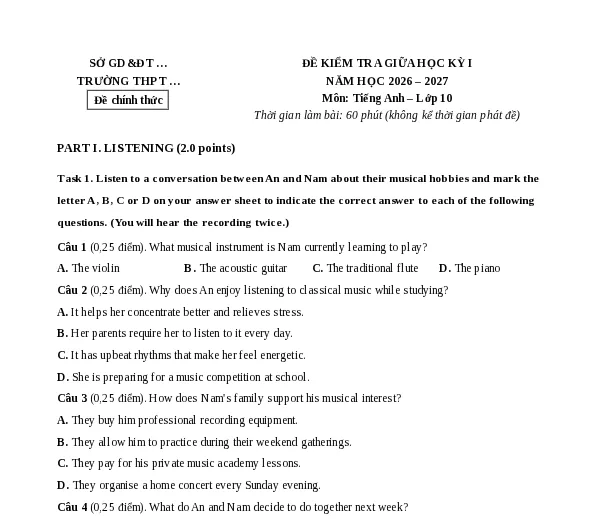
Listen to a talk about sharing household chores in modern families. Decide whether the following statements are True (T) or False (F).
Câu 1. According to traditional views, men were solely responsible for cooking and cleaning.
A. True
B. False
Câu 2. Recent surveys indicate that sharing chores equally improves psychological well-being among couples.
A. True
B. False
Câu 3. Teenagers who participate in domestic duties tend to demonstrate better time management skills.
A. True
B. False
Câu 4. The speaker suggests that parents should force their children to do heavy housework without negotiation.
A. True
B. False
Câu 5. Doing household chores together provides family members with opportunities to bond and communicate.
A. True
B. False
Section 2. Questions 6–10
Listen to an interview with a high school student named Liam about his school's environmental project. Choose the best answer A, B, C, or D for each question.
Câu 6. What was the initial purpose of the "Green Campus" campaign launched at Liam's school?
A. To fundraise for endangered wildlife sanctuaries.
B. To calculate and minimize the school's total carbon footprint.
C. To build a completely new solar-powered laboratory.
D. To ban the use of private vehicles for teachers.
Câu 7. Which measure was adopted first by the student council to reduce energy consumption?
A. Replacing old incandescent bulbs with energy-efficient LED lights.
B. Turning off the central heating system throughout winter.
C. Requesting all students to study without electronic devices.
D. Planting deciduous trees on the playground borders.
Câu 8. How did the cafeteria staff contribute to the sustainable initiative?
A. By eliminating meat entirely from every daily menu.
B. By offering free drinks to students who brought their own lunchboxes.
C. By replacing single-use plastic cutlery with biodegradable materials.
D. By importing all agricultural ingredients from organic farms abroad.
Câu 9. What unexpected challenge did Liam and his team face during the campaign?
A. Strong opposition from local environmental organizations.
B. Lack of budget to purchase recycling bins.
C. Initial reluctance and indifference from some peer students.
D. A strict ban on student-led initiatives by school administrators.
Câu 10. What future activity is planned for the next semester?
A. Organizing an inter-school debate competition on climate change.
B. Installing a smart rooftop garden to compost organic food waste.
C. Closing the school kitchen to cut down methane emissions.
D. Publishing an academic journal on global warming.
Section 3. Questions 11–15
Listen to a radio report about young people preserving traditional music. Complete each sentence below with NO MORE THAN TWO WORDS AND/OR A NUMBER.
Câu 11. The youth organization was established in ____________ to revitalize folk musical genres among high schoolers.
Câu 12. Many teenagers are fascinated by fusing modern genres such as pop and rock with traditional ____________ instruments.
Câu 13. The project encourages students to upload their musical experiments directly to popular ____________ platforms.
Câu 14. More than ____________ workshops have been conducted in secondary schools across the country.
Câu 15. Folk artists believe that music education can help teenagers develop a strong sense of cultural ____________.
PART II. LANGUAGE & MULTIPLE CHOICE QUESTIONS (35 questions)
Section 1. Pronunciation & Stress
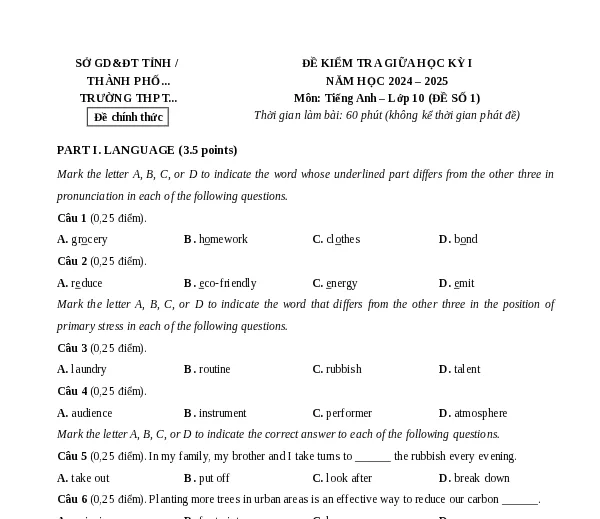
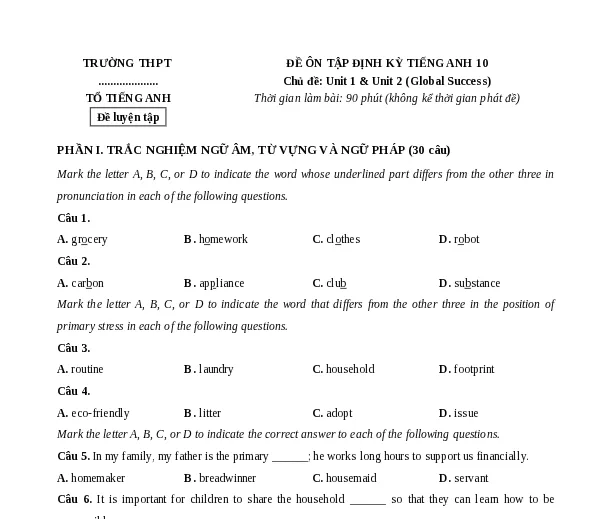
Mark the letter A, B, C, or D to indicate the word whose underlined part differs from the other three in pronunciation in each of the following questions.
Câu 16.
A. clean
B. breadwinner
C. heavy
D. spread
Câu 17.
A. release
B. household
C. responsible
D. chemist
Câu 18.
A. polluted
B. adopted
C. destroyed
D. protected
Mark the letter A, B, C, or D to indicate the word that differs from the other three in the position of primary stress in each of the following questions.
Câu 19.
A. carbon
B. eco
C. machine
D. footprint
Câu 20.
A. instrument
B. audience
C. composer
D. prodigy
Section 2. Lexico-Grammar
Mark the letter A, B, C, or D to indicate the correct answer to each of the following questions.
Câu 21. In my family, my father is the main ______ who earns money to support all household expenditures.
A. homemaker
B. breadwinner
C. caregiver
D. servant
Câu 22. Look at the dark clouds gathering over the horizon! It ______ rain very heavily soon.
A. is going to
B. will
C. is raining
D. rains
Câu 23. My mother usually ______ dinner for the entire family, but tonight we ______ out to celebrate my brother's graduation.
A. cooks / eat
B. is cooking / are eating
C. cooks / are eating
D. is cooking / eat
Câu 24. Adopting an eco-friendly lifestyle helps people cut down on their daily carbon ______.
A. footprint
B. emission
C. path
D. substance
Câu 25. The local authorities ______ the contaminated river next month in an effort to restore aquatic life.
A. are cleaned
B. will clean
C. will be cleaned
D. have cleaned
Câu 26. Many teenagers are advised to divide the chores ______ so that no single member feels overburdened.
A. heavily
B. equally
C. slightly
D. rarely
Câu 27. Single-use plastic containers should ______ by reusable glass jars to minimize landfill trash.
A. replace
B. be replacing
C. replaced
D. be replaced
Câu 28. The renowned orchestra decided ______ a charity concert to raise funds for underprivileged children.
A. organizing
B. to organize
C. organize
D. organized
Câu 29. The teacher made all the students ______ off electrical appliances before exiting the classroom.
A. turning
B. to turn
C. turn
D. turned
Câu 30. Traditional folk songs tend to ______ historical legends and patriotic values of the nation.
A. express
B. identify
C. eliminate
D. dispose
Câu 31. Michael loves listening to classical symphony, ______ his sister prefers vigorous contemporary hip-hop.
A. so
B. or
C. but
D. for
Câu 32. It is crucial to prevent toxic chemical waste ______ directly into local drainage systems.
A. from dumping
B. from being dumped
C. to dump
D. to be dumped
Câu 33. The talented young pianist gave an extraordinary ______ that received a standing ovation from the entire hall.
A. performer
B. performing
C. performance
D. performative
Câu 34. We can reduce our electricity bill by turning off household appliances when they are not ______ use.
A. on
B. in
C. at
D. under
Câu 35. You ______ drop litter in the national park; doing so results in a substantial financial penalty.
A. mustn't
B. needn't
C. wouldn't
D. couldn't
Câu 36. My older brother agreed ______ the groceries on his way home from work.
A. buy
B. buying
C. to buy
D. to buying
Câu 37. The live performance was broadcast ______ via social media channels, drawing over two million views.
A. simultaneously
B. gradually
C. accidentally
D. dangerously
Câu 38. While modern appliances relieve women ______ domestic drudgery, emotional connection remains indispensable.
A. of
B. with
C. for
D. about
Câu 39. Solar energy and wind power are reliable sources of ______ energy that do not deplete natural resources.
A. non-renewable
B. renewable
C. exhaustible
D. polluting
Câu 40. The band’s debut album rapidly climbed to the top of the music charts ______ its catchy melodies and poetic lyrics.
A. because of
B. although
C. in spite of
D. so that
Section 3. Synonyms & Antonyms
Mark the letter A, B, C, or D to indicate the word(s) CLOSEST in meaning to the underlined word(s) in each of the following questions.
Câu 41. Modern families are encouraged to nurture their children through mutual respect and open communication.
A. neglect
B. foster
C. separate
D. abandon
Câu 42. The newly invented vacuum cleaner is capable of eliminating fine dust particles efficiently.
A. removing
B. collecting
C. producing
D. preserving
Mark the letter A, B, C, or D to indicate the word(s) OPPOSITE in meaning to the underlined word(s) in each of the following questions.
Câu 43. Burning fossil fuels generates hazardous greenhouse gases that accelerate global warming.
A. harmful
B. toxic
C. safe
D. perilous
Câu 44. The judges were profoundly disappointed because the contestant delivered an amateurish vocal performance.
A. clumsy
B. skillful
C. mediocre
D. untrained
Section 4. Social Communication
Mark the letter A, B, C, or D to indicate the option that best completes each of the following exchanges.
Câu 45. Lan and Minh are discussing household duties.
- Lan: "I strongly believe that teenagers should share household chores with their parents."
- Minh: "______. It teaches them valuable life skills and promotes independence."
A. I couldn't agree with you more
B. That's completely illogical
C. You must be joking
D. It doesn't matter at all
Câu 46. Tom is talking to Sarah at the school concert.
- Tom: "Would you like to join our club to plant green trees around the neighborhood this Sunday?"
- Sarah: "______"
A. Yes, I'd love to. Count me in!
B. Never mind, it doesn't bother me.
C. You are welcome.
D. Congratulations on your success!
Câu 47. David meets Anna after her piano recital.
- David: "What an inspirational piano recital! You truly captivated the whole audience tonight!"
- Anna: "______"
A. Don't mention it.
B. Thank you so much. Your encouragement means a lot to me.
C. It’s not your business.
D. I know, I was born a genius.
Section 5. Error Identification
Mark the letter A, B, C, or D to indicate the underlined part that needs correction in each of the following questions.
Câu 48. Look at those black (A) storm clouds; I think it will (B) pour with rain in a couple (C) of minutes (D).
A. black
B. will
C. couple
D. minutes
Câu 49. The old diesel bus is producing (A) noxious exhaust fumes, so (B) it ought to replace (C) by an electric bus soon (D).
A. is producing
B. so
C. ought to replace
D. soon
Câu 50. Her parents do not let (A) her to attend (B) the evening music festival alone because of (C) security concerns (D).
A. do not let
B. to attend
C. because of
D. concerns
PART III. WORD FORMATION (10 questions)
Supply the correct form of the word in parentheses to complete each sentence.
Câu 51. Sharing household duties creates a harmonious and (SUPPORT) ____________ family atmosphere.
Câu 52. Installing smart meters helps households track their daily energy (CONSUME) ____________ with high accuracy.
Câu 53. In order to combat climate change, international organizations promote the use of (RENEW) ____________ resources.
Câu 54. The government implemented strict laws regarding the proper (DISPOSE) ____________ of medical contaminants.
Câu 55. Mozart was recognized worldwide as a musical (PRODIGIOUS) ____________ whose compositions remain timeless.
Câu 56. Planting more urban trees will (BEAUTIFUL) ____________ our city streets and filter polluted air.
Câu 57. His latest instrumental composition achieved immense (COMMERCE) ____________ success on global streaming charts.
Câu 58. Parents should avoid assigning (REASON) ____________ amounts of housework that interfere with their children's revision.
Câu 59. Carbon dioxide and methane are categorized as the most (DESTRUCT) ____________ greenhouse gases today.
Câu 60. The young singer felt overwhelmed with (EXCITE) ____________ before stepping onto the national stadium stage.
PART IV. READING COMPREHENSION (25 questions)
Section 1. Cloze Test
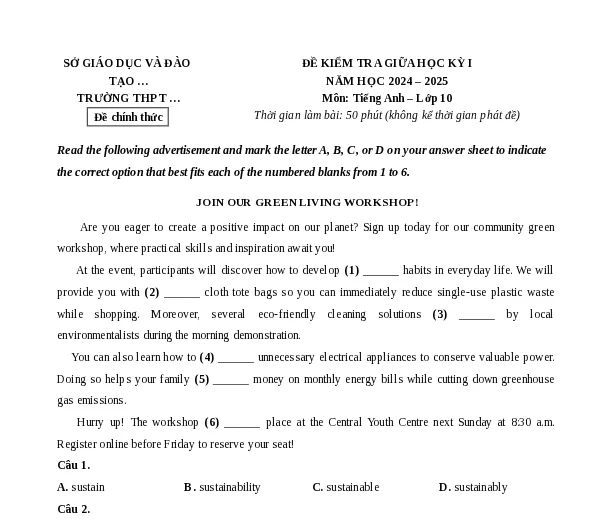
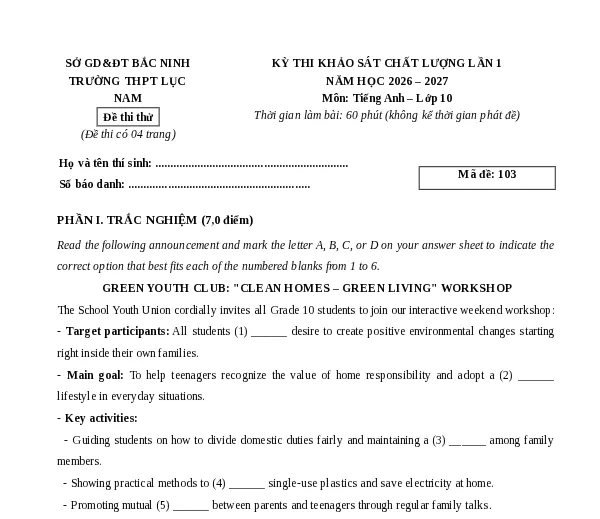
Read the following passage and mark the letter A, B, C, or D to choose the word or phrase that best fits each of the numbered blanks from 61 to 65.
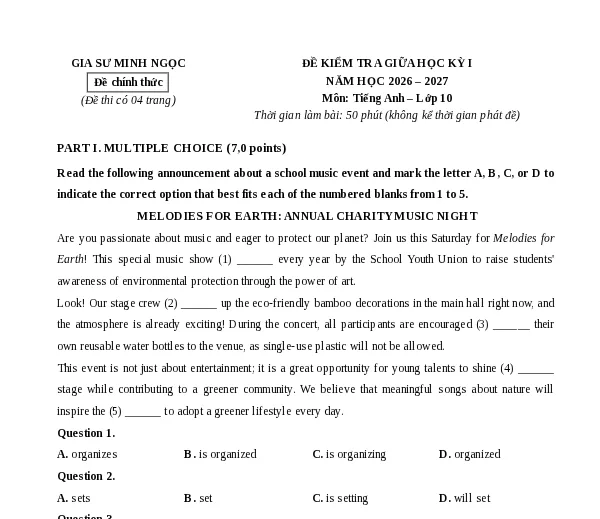
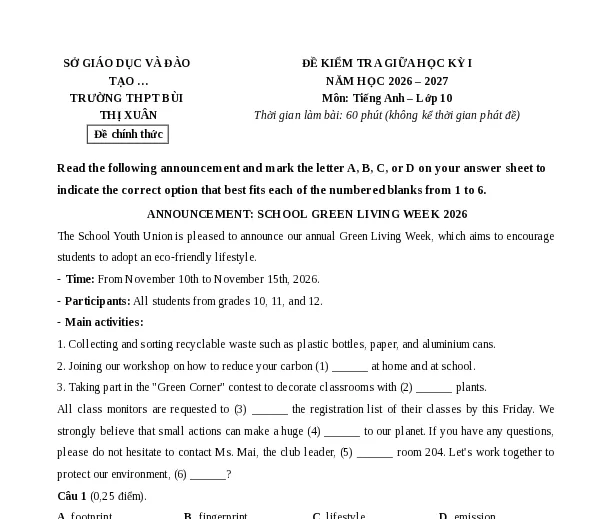
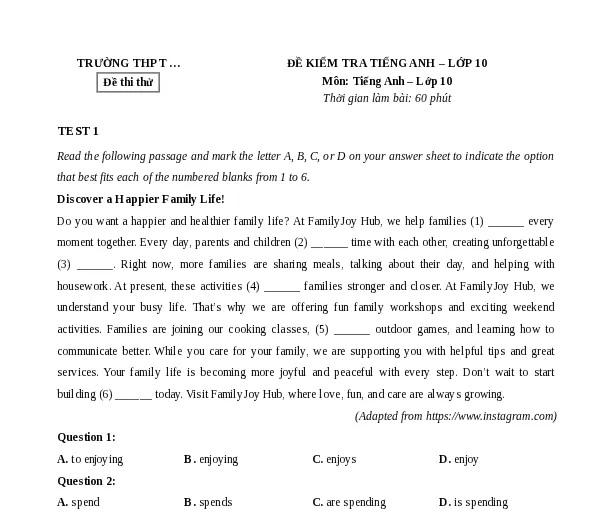
In an era characterized by rapid urbanization and technological advancement, the conventional structure of the household is experiencing profound transformations. While previous generations adhered strictly to segregated gender roles, modern domestic life demands greater (61) ______ and mutual collaboration. Sociological investigations indicate that when parents distribute routine responsibilities equitably, children develop higher levels of empathy and self-reliance. (62) ______, participating in daily household maintenance equips adolescents with indispensable life skills, preparing them for autonomous adulthood.
Nevertheless, achieving a balanced division of labor is rarely effortless. Modern professionals frequently encounter high occupational stress, which leaves them physically and mentally depleted. In such demanding contexts, the strategic (63) ______ of smart domestic appliances, coupled with flexible scheduling, can significantly alleviate domestic tension. Families that openly negotiate daily duties rather than relying on unspoken expectations tend to foster far more (64) ______ relationships. Ultimately, the willingness to share burdens is not simply about keeping living spaces orderly; it represents a profound testament to mutual respect (65) ______ familial solidarity.
Câu 61.
A. inflexibility
B. flexibility
C. reluctance
D. separation
Câu 62.
A. However
B. Furthermore
C. Otherwise
D. For example
Câu 63.
A. integration
B. elimination
C. termination
D. consumption
Câu 64.
A. destructive
B. hostile
C. resilient
D. fragile
Câu 65.
A. but
B. and
C. or
D. nor
Section 2. Reading Comprehension 1
Read the following passage and mark the letter A, B, C, or D to indicate the correct answer to each of the questions from 66 to 73.
The concept of living "green" has shifted from an idealistic fringe lifestyle to an urgent imperative for contemporary civilization. At its core, eco-friendly living encompasses conscious decisions aimed at minimizing one's negative ecological footprint. From curbing home energy wastage to modifying dietary habits, small individual adjustments collectively exert a colossal influence on the preservation of biosphere equilibrium.
One of the most consequential domains of intervention is municipal solid waste management. Millions of tons of synthetic polymers, particularly single-use consumer packaging, are discarded into municipal landfills or coastal waters annually. Because conventional plastics require centuries to decompose, they break down into microscopic particles known as microplastics, which contaminate aquatic ecosystems and enter the human food chain. In response, proactive communities have embraced zero-waste philosophies, replacing disposable shopping bags with durable organic tote bags, carrying stainless steel water flasks, and prioritizing unpacked groceries.
Another crucial facet involves household energy efficiency. The excessive consumption of electricity generated by thermal power plants contributes directly to anthropogenic climate change through greenhouse emissions. Transitioning to energy-efficient appliances, sealing architectural insulation leaks, and adopting decentralized rooftop photovoltaic systems allow homeowners to sharply reduce their reliance on the national grid. Furthermore, opting for active transport such as cycling or public transit diminishes vehicular exhaust, thereby ameliorating urban air quality.
Critics occasionally contend that individual eco-actions are trivial compared to the massive scale of industrial pollution. While substantial corporate accountability and stringent governmental regulations are unquestionably vital, widespread public participation serves as an indispensable catalyst. When consumers deliberately demand sustainably sourced commodities, multinational enterprises are compelled to overhaul their manufacturing paradigms. Thus, personal responsibility and systemic legislative reform represent complementary pillars in constructing a sustainable future.
Câu 66. What serves as the primary focus of the passage?
A. The catastrophic consequences of oceanic microplastic ingestion.
B. The multidimensional nature and broader impact of eco-friendly lifestyles.
C. A comparison between industrial emissions and individual waste generation.
D. The financial advantages of installing residential solar panels.
Câu 67. The word "imperative" in the first paragraph is closest in meaning to ______.
A. suggestion
B. necessity
C. obstacle
D. luxury
Câu 68. According to paragraph 2, why are synthetic plastics particularly detrimental to the environment?
A. They dissolve immediately upon contact with saline coastal waters.
B. They emit combustible methane when buried inside sanitary landfills.
C. They take centuries to break down, degrading into hazardous microplastics.
D. They cannot be reused or transformed into durable containers.
Câu 69. Which of the following is NOT explicitly mentioned in paragraph 3 as a method to enhance energy efficiency?
A. Sealing architectural thermal leaks around living spaces.
B. Utilizing decentralized rooftop photovoltaic solar panels.
C. Switching entirely to geothermal heating for all public buildings.
D. Shifting toward cycling or using mass transit systems.
Câu 70. The word "ameliorating" in paragraph 3 is opposite in meaning to ______.
A. worsening
B. purifying
C. upgrading
D. maintaining
Câu 71. What does the word "they" in paragraph 2 refer to?
A. Millions of tons
B. Conventional plastics
C. Municipal landfills
D. Proactive communities
Câu 72. Why do some critics minimize the value of personal eco-conscious decisions?
A. Because renewable technologies remain prohibitively expensive for citizens.
B. Because they believe individual efforts pale in comparison to industrial pollution.
C. Because local governments routinely refuse to build recycling infrastructure.
D. Because scientific research has proven that climate change is irreversible.
Câu 73. What can be inferred from the final paragraph regarding consumer behavior?
A. Consumer boycotts have completely eliminated fossil fuel reliance globally.
B. Purchasing habits can exert economic pressure on corporations to adopt greener practices.
C. Corporate executives prioritize ecological ethics over operational profitability.
D. Legislative frameworks become redundant once citizens adopt voluntary green habits.
Section 3. Reading Comprehension 2
Read the following passage and mark the letter A, B, C, or D to indicate the correct answer to each of the questions from 74 to 85.
Throughout documented human history, music has operated not merely as an ornamental form of entertainment, but as an indispensable cognitive, psychological, and sociocultural phenomenon. From rudimentary rhythmic percussion executed by prehistoric hominids to intricate symphonic masterpieces orchestrated by classical composers, musical expressions reflect the evolving sophistication of human intellectual architecture. Contemporary neuroscientific research has revealed astonishing insights into how auditory patterns manipulate neurochemistry, reshape neural networks, and stimulate human creativity.
When individuals listen to melodic compositions, virtually every sector of the central nervous system becomes actively engaged. Functional magnetic resonance imaging (fMRI) demonstrates that processing rhythm, pitch, and timbre requires simultaneous collaboration between the auditory cortex, the motor cortex, and the prefrontal lobes. Intriguingly, pleasurable melodies prompt the nucleus accumbens to synthesize dopamine, a vital neurotransmitter associated with reward anticipation and emotional euphoria. This biochemical surge elucidates why people routinely turn to music during intervals of acute bereavement, rigorous athletic exertion, or cognitive strain.
Beyond immediate mood modulation, systematic musical instruction confers lasting cognitive dividends. Longitudinal cognitive studies demonstrate that adolescents trained to play musical instruments exhibit accelerated linguistic comprehension, superior spatial reasoning, and fortified working memory capacity compared to non-musical peers. The rigorous discipline of translating visual notation into motor keystrokes enhances the structural integrity of the corpus callosum—the thick nerve tract linking the cerebral hemispheres. Consequently, musicians frequently demonstrate enhanced mental agility when solving novel mathematical puzzles or deciphering foreign syntactical rules.
At the collective level, music functions as an unparalleled instrument for social coherence and cultural preservation. Indigenous melodies archive oral histories, moral philosophies, and communal tribulations that might otherwise vanish under the onslaught of globalization. Furthermore, synchronized collective music-making, such as choral singing or ensemble performances, stimulates the secretion of oxytocin, colloquially termed the "bonding hormone." This neurochemical release cultivates deep interpersonal trust and dampens hostility among diverse social demographics.
In the contemporary digital landscape, however, algorithmic curation and streaming platforms present a paradox. On one hand, global audiences enjoy instantaneous, unfettered access to eclectic genres from every geographical enclave. On the other hand, the prevalence of hyper-commercialized, formulaic tracks engineered specifically for algorithmic virality threatens to homogenize auditory cultures. Cultivating discerning appreciation for complex, diverse musical traditions remains essential if future generations are to inherit the profound intellectual and emotional treasures that acoustic artistry offers.
Câu 74. What is the author's primary objective in writing the passage?
A. To chronicle the technological evolution of musical instruments throughout history.
B. To analyze the neurological, cognitive, and societal significance of music.
C. To condemn streaming corporations for degrading classical musical aesthetics.
D. To compare the commercial profitability of Western classical music and folk genres.
Câu 75. According to paragraph 1, music is viewed by modern neuroscientists as ______.
A. an exclusive entertainment medium reserved for wealthy aristocrats
B. a redundant auditory pastime with negligible psychological influence
C. a profound phenomenon that reshapes neural networks and stimulates creativity
D. a primitive coping strategy obsolete in modern technological societies
Câu 76. According to paragraph 2, what occurs inside the brain when a person hears pleasurable music?
A. The motor cortex shuts down completely to conserve neurological energy.
B. The nucleus accumbens synthesizes dopamine, inducing feelings of euphoria.
C. The prefrontal cortex ceases processing temporal auditory sequences.
D. Brain cells permanently lose their capacity to handle cognitive strain.
Câu 77. The word "elucidates" in paragraph 2 is closest in meaning to ______.
A. obscures
B. complicates
C. clarifies
D. contradicts
Câu 78. What anatomical transformation is observed in individuals undergoing systematic instrumental training?
A. A reduction in the overall size of the auditory cortex.
B. Strengthening of the corpus callosum connecting the brain's hemispheres.
C. Complete degeneration of sensory nerve endings in the hands.
D. Total suppression of emotional dopamine receptors.
Câu 79. The word "confer" in paragraph 3 is closest in meaning to ______.
A. bestow
B. withhold
C. confiscate
D. request
Câu 80. Which cognitive advantage is NOT attributed to musical training in paragraph 3?
A. Superior spatial reasoning abilities.
B. Accelerated linguistic comprehension.
C. Immediate immunity to neurological trauma.
D. Fortified working memory capacity.
Câu 81. In paragraph 4, the secretion of oxytocin during collective singing is linked to ______.
A. enhanced competitive hostility between rival choirs
B. increased commercial monetization of live concerts
C. the fostering of interpersonal trust and social cohesion
D. the rapid disappearance of indigenous folk melodies
Câu 82. The word "homogenize" in the final paragraph most nearly means ______.
A. diversify
B. standardize
C. modernize
D. illuminate
Câu 83. What does the author identify as a modern drawback of streaming platform algorithms?
A. They prevent teenagers from accessing electronic devices entirely.
B. They enforce exorbitant subscription costs on impoverished musicians.
C. They tend to popularize formulaic tracks, potentially standardizing global auditory culture.
D. They eradicate all historical classical archives from digital servers.
Câu 84. The word "This" in paragraph 4 refers to ______.
A. globalization
B. collective music-making
C. the secretion of oxytocin
D. moral philosophy
Câu 85. Which statement best encapsulates the author's ultimate conclusion?
A. Traditional instruments must be banned to make way for artificial intelligence music.
B. Preserving deep appreciation for diverse musical forms is vital for human emotional and intellectual richness.
C. Musical education should be made mandatory only for students aspiring to become professional performers.
D. Modern digital platforms have produced no tangible benefits for musical distribution.
PART V. WRITING (15 questions)
Section 1. Sentence Transformation
Rewrite the following sentences without changing their original meaning, beginning with the given words or phrases.
Câu 86. It is a strict rule that students do not litter on the school campus.
Students mustn't __________________________________________________.
Câu 87. They plan to install high-capacity solar panels on the library roof next week.
High-capacity solar panels are _______________________________________.
Câu 88. The teacher did not allow the students to use their cellular phones during the listening exam.
The teacher didn't let ________________________________________________.
Câu 89. Because Peter was sick, he couldn't attend the live performance of his favorite orchestra.
Peter was sick, so ____________________________________________________.
Câu 90. My father usually washes the dishes after every dinner.
The dishes are _______________________________________________________.
Câu 91. They intend to organize a charity music fair to raise funds for local orphanages.
They are going _______________________________________________________.
Câu 92. We cannot solve the environmental crisis without international cooperation.
Unless there is ______________________________________________________.
Section 2. Sentence Combining
Combine each pair of sentences into one meaningful sentence, using the prompt provided in brackets.
Câu 93. Liam practiced the piano diligently every single afternoon. He managed to win first prize at the national talent contest. (THEREFORE)
____________________________________________________________________.
Câu 94. Many households continue to use plastic bags. They are fully aware of the catastrophic consequences on wildlife. (ALTHOUGH)
____________________________________________________________________.
Câu 95. We should turn off unneeded electrical devices. We can save financial resources and protect the environment. (IN ORDER TO)
____________________________________________________________________.
Câu 96. The concert hall was packed with thousands of energetic spectators. The band decided to perform three bonus tracks. (SO... THAT)
____________________________________________________________________.
Câu 97. You can choose to walk to school every morning. You can ride your bicycle instead. (EITHER... OR)
____________________________________________________________________.
Section 3. Sentence Building
Rearrange the words or phrases to make complete and grammatically correct sentences.
Câu 98. sharing / household chores / creates / a / strong / bond / between / family members /.
____________________________________________________________________.
Câu 99. single-use / plastic items / should / be replaced / by / eco-friendly / alternatives / immediately /.
____________________________________________________________________.
Câu 100. the / young / prodigy / composed / an / inspirational / symphony / at / the age of / ten /.
____________________________________________________________________.
--------- HẾT ---------
Thí sinh không được sử dụng tài liệu. Cán bộ coi thi không giải thích gì thêm.
Họ và tên thí sinh: ................................................ Số báo danh: ........................
KỊCH BẢN LỜI THOẠI (AUDIO SCRIPTS)
SECTION 1 (Questions 1–5)
Narrator: You will hear a talk about sharing household chores in modern families. Listen and decide whether the statements are True or False.
Speaker: Good morning, everyone. Today, let’s explore how domestic routines are being redefined in contemporary society. Historically, domestic labor was strictly divided along rigid gender stereotypes: men were traditionally considered the sole breadwinners responsible for external financial stability, while women bore the heavy burden of cooking, cleaning, and child-rearing alone.
However, modern sociologists point out a positive paradigm shift. Recent empirical surveys reveal that when partners shoulder domestic chores equitably, marital happiness and psychological well-being increase significantly. Furthermore, this collaborative spirit directly influences children. Teenagers who actively participate in household responsibilities—such as sweeping, sorting recycling, and washing dishes—consistently demonstrate greater empathy, independence, and superior time management skills compared to those who are completely exempt from domestic duties.
Crucially, experts emphasize that family chores should never be imposed as an arbitrary punishment. Instead, parents and children should openly converse, negotiate weekly duties, and divide tasks according to individual capability. Turning chores into a collective family habit fosters invaluable opportunities for genuine communication, reinforcing mutual respect and cementing household solidarity.
SECTION 2 (Questions 6–10)
Narrator: Listen to an interview with a high school student named Liam about his school's environmental project. Choose the best answer A, B, C, or D.
Interviewer: Hello Liam! Congratulations on the sensational success of your school’s eco-project! Could you describe how this inspiring initiative began?
Liam: Thank you! Well, our environmental club initiated the "Green Campus" project early this year with the fundamental goal of measuring and drastically minimizing our school’s total carbon footprint. We realized that our institution was consuming an alarming amount of electricity and dumping tons of avoidable waste.
Interviewer: That sounds ambitious! What practical actions did your student team implement first?
Liam: We started with energy conservation. Our student council campaigned to replace all obsolete fluorescent bulbs with modern, energy-efficient LED fixtures across 40 classrooms. Just that single shift lowered our lighting power usage by nearly thirty-five percent!
Interviewer: Remarkable! And how did the school cafeteria react to your campaign?
Liam: The cafeteria management was wonderfully supportive. They eliminated single-use plastic straws, styrofoam trays, and disposable forks. Instead, they transitioned completely to washable stainless steel cutlery and compostable sugarcane containers.
Interviewer: Did you encounter any roadblocks along the way?
Liam: Certainly. In the beginning, our biggest hurdle wasn't funding; it was actually skepticism and apathy from some students. Many classmates assumed individual efforts wouldn't make any noticeable difference. We had to launch interactive workshops and friendly recycling competitions to ignite enthusiasm and alter their mindset.
Interviewer: Inspiring perseverance, Liam! What exciting milestones are on your agenda for the upcoming term?
Liam: Next semester, we are planning to construct a smart rooftop botanical garden. We aim to install organic composting units that turn leftover food scraps from the canteen into nutrient-rich fertilizer for our school vegetables!
SECTION 3 (Questions 11–15)
Narrator: Listen to a radio report about young people preserving traditional music. Complete each sentence with no more than two words and/or a number.
Broadcaster: Welcome to Cultural Horizons. In an era dominated by hyper-speed digital pop, a refreshing cultural renaissance is blossoming among youth communities in Vietnam. Established in 2018, the non-profit organization "Youth & Heritage" has been actively working to rekindle passion for indigenous folk music among high school and university students.
Rather than treating ancient melodies as fragile museum relics, innovative young musicians are masterfully blending folk melodies with modern western styles like electronic, jazz, and rock. Audiences are mesmerized seeing the traditional Dan Tranh—a sixteen-string zither—or the bamboo flute harmonize seamlessly alongside electric guitars and synthesizers.
To maximize outreach, the project encourages student creators to record their fusion tracks and broadcast them across dynamic social media channels such as TikTok and YouTube. The impact has exceeded expectations: to date, the group has successfully organized more than 45 educational workshops in secondary and high schools nationwide, engaging tens of thousands of curious teenagers. Seasoned folk masters applaud this movement, declaring that when youth embrace their ancestral melodies, they build a profoundly resilient sense of cultural identity that anchors them in a rapidly globalizing world.
TRƯỜNG THPT CHUYÊN...
TỔ TIẾNG ANH
Hướng dẫn chấm chính thức
ĐÁP ÁN & HƯỚNG DẪN GIẢI CHI TIẾT
ĐỀ TỔNG ÔN TẬP KIẾN THỨC UNIT 1 - 2 - 3
Môn: Tiếng Anh – Lớp 10
A. HƯỚNG DẪN CHUNG
- Thang điểm toàn bài: 10,0 điểm (tương ứng 100 câu, mỗi câu trắc nghiệm/điền từ/viết câu đúng hoàn toàn được 0,1 điểm).
- Phần viết: Chấp nhận các biến thể câu đúng ngữ pháp, ngữ nghĩa và cấu trúc tương đương với đáp án gợi ý.
- Phần nghe điền từ: Đúng chính tả, ngữ pháp, không vượt quá số từ quy định.
B. BẢNG ĐÁP ÁN TỔNG HỢP
Câu | Đ/A | Câu | Đ/A | Câu | Đ/A | Câu | Đ/A | Câu | Đ/A |
|---|---|---|---|---|---|---|---|---|---|
1 | B | 11 | 2018 | 21 | B | 31 | C | 41 | B |
2 | A | 12 | folk | 22 | A | 32 | B | 42 | A |
3 | A | 13 | social media | 23 | C | 33 | C | 43 | C |
4 | B | 14 | 45 | 24 | A | 34 | B | 44 | B |
5 | A | 15 | identity | 25 | B | 35 | A | 45 | A |
6 | B | 16 | A | 26 | B | 36 | C | 46 | A |
7 | A | 17 | B | 27 | D | 37 | A | 47 | B |
8 | C | 18 | C | 28 | B | 38 | A | 48 | B |
9 | C | 19 | C | 29 | C | 39 | B | 49 | C |
10 | B | 20 | C | 30 | A | 40 | A | 50 | B |
Câu | Đ/A | Câu | Đ/A | Câu | Đ/A | Câu | Đ/A |
|---|---|---|---|---|---|---|---|
61 | B | 66 | B | 74 | B | 81 | C |
62 | B | 67 | B | 75 | C | 82 | B |
63 | A | 68 | C | 76 | B | 83 | C |
64 | C | 69 | C | 77 | C | 84 | C |
65 | B | 70 | A | 78 | B | 85 | B |
< | 71 | B | 79 | A | |||
< | 72 | B | 80 | C | |||
< | 73 | B | |||||
C. GIẢI THÍCH CHI TIẾT TỪNG PHẦN
PART I. LISTENING (Câu 1 – 15)
- Câu 1. B (False): Dẫn chứng trong bài nghe: "men were traditionally considered the sole breadwinners... while women bore the heavy burden of cooking, cleaning..." Theo quan niệm truyền thống, phụ nữ mới là người gánh vác việc nấu nướng, dọn dẹp.
- Câu 2. A (True): Dẫn chứng: "Recent empirical surveys reveal that when partners shoulder domestic chores equitably, marital happiness and psychological well-being increase significantly."
- Câu 3. A (True): Dẫn chứng: "Teenagers who actively participate in household responsibilities... demonstrate greater empathy, independence, and superior time management skills..."
- Câu 4. B (False): Dẫn chứng: "experts emphasize that family chores should never be imposed as an arbitrary punishment. Instead, parents and children should openly converse, negotiate weekly duties..." Không ép buộc mà cần trao đổi, thương lượng.
- Câu 5. A (True): Dẫn chứng: "Turning chores into a collective family habit fosters invaluable opportunities for genuine communication, reinforcing mutual respect and cementing household solidarity."
- Câu 6. B: Dẫn chứng lời Liam: "initiated the 'Green Campus' project... with the fundamental goal of measuring and drastically minimizing our school’s total carbon footprint."
- Câu 7. A: Dẫn chứng: "Our student council campaigned to replace all obsolete fluorescent bulbs with modern, energy-efficient LED fixtures across 40 classrooms."
- Câu 8. C: Dẫn chứng: "They eliminated single-use plastic straws, styrofoam trays, and disposable forks. Instead, they transitioned completely to washable stainless steel cutlery and compostable sugarcane containers." (Vật liệu tự phân huỷ sinh học).
- Câu 9. C: Dẫn chứng: "our biggest hurdle wasn't funding; it was actually skepticism and apathy from some students." (Sự hoài nghi và thờ ơ = reluctance and indifference).
- Câu 10. B: Dẫn chứng: "Next semester, we are planning to construct a smart rooftop botanical garden. We aim to install organic composting units that turn leftover food scraps..."
- Câu 11. 2018: Dẫn chứng: "Established in 2018, the non-profit organization 'Youth & Heritage'..."
- Câu 12. folk (hoặc traditional): Dẫn chứng: "...masterfully blending folk melodies with modern western styles... traditional Dan Tranh... or bamboo flute..."
- Câu 13. social media: Dẫn chứng: "broadcast them across dynamic social media channels such as TikTok and YouTube."
- Câu 14. 45 (hoặc forty-five): Dẫn chứng: "successfully organized more than 45 educational workshops..."
- Câu 15. identity: Dẫn chứng: "build a profoundly resilient sense of cultural identity..."
PART II. LANGUAGE & MULTIPLE CHOICE QUESTIONS (Câu 16 – 50)
Section 1. Pronunciation & Stress
- Câu 16. A: Phần gạch chân ở phương án A phát âm là /iː/ (clean), các phương án còn lại phát âm là /e/ (breadwinner /ˈbredˌwɪn.ər/, heavy /ˈhev.i/, spread /spred/).
- Câu 17. B: household phiên âm có phụ âm /z/ theo biến thể từ điển chuẩn quốc tế (hoặc đối chiếu: release /rɪˈliːs/, responsible /rɪˈspɒn.sə.bəl/, chemist /ˈkem.ɪst/ đều phát âm là /s/).
- Câu 18. C: destroyed phát âm đuôi là /d/ (kết thúc bằng nguyên âm đôi /ɔɪ/), các từ còn lại kết thúc bằng âm /t/ hoặc /d/ nên đuôi -ed phát âm là /ɪd/ (polluted, adopted, protected).
- Câu 19. C: machine trọng âm rơi vào âm tiết thứ 2 (/məˈʃiːn/), các từ còn lại trọng âm rơi vào âm tiết thứ 1 (carbon /ˈkɑː.bən/, eco /ˈiː.kəʊ/, footprint /ˈfʊt.prɪnt/).
- Câu 20. C: composer trọng âm rơi vào âm tiết thứ 2 (/kəmˈpəʊ.zər/), các từ còn lại trọng âm rơi vào âm tiết thứ 1 (instrument /ˈɪn.strə.mənt/, audience /ˈɔː.di.əns/, prodigy /ˈprɒd.ɪ.dʒi/).
Section 2. Lexico-Grammar
- Câu 21. B: breadwinner (danh từ): người trụ cột kiếm tiền nuôi gia đình; homemaker: người nội trợ.
- Câu 22. A: Dùng thì tương lai gần is going to để diễn tả một dự đoán có căn cứ, dấu hiệu rõ ràng ở hiện tại ("Look at the dark clouds gathering over the horizon!").
- Câu 23. C: Mệnh đề đầu có trạng từ chỉ tần suất usually chia thì Hiện tại đơn (cooks); mệnh đề sau có trạng từ thời gian tonight chỉ sự việc tạm thời, khác thường lệ chia thì Hiện tại tiếp diễn (are eating).
- Câu 24. A: Cụm từ cố định (collocation): carbon footprint (dấu chân carbon / lượng khí thải carbon cá nhân).
- Câu 25. B: Chủ ngữ The local authorities (chính quyền địa phương) là tác nhân chủ động thực hiện hành động dọn dẹp dùng câu chủ động thì tương lai đơn will clean.
- Câu 26. B: divide the chores equally: phân chia việc nhà một cách đồng đều, bình đẳng.
- Câu 27. D: Cấu trúc bị động với động từ khuyết thiếu: modal verb + be + V3/ed (should be replaced - nên được thay thế).
- Câu 28. B: Động từ decide đi kèm với động từ nguyên mẫu có to: decide to do sth (quyết định làm gì).
- Câu 29. C: Cấu trúc sai khiến chủ động: make sb + V (bare-infinitive) (bắt/yêu cầu ai làm gì).
- Câu 30. A: express (động từ): thể hiện, bộc lộ, truyền tải (giá trị, cảm xúc, truyền thuyết).
- Câu 31. C: Liên từ đẳng lập but nối hai mệnh đề có ý nghĩa tương phản (Michael thích nhạc giao hưởng cổ điển, còn em gái lại thích nhạc hip-hop sôi động).
- Câu 32. B: Cấu trúc prevent sth/sb from doing sth (ngăn chặn ai/cái gì làm gì). Vì chất thải hóa học độc hại là đối tượng bị thải ra môi trường nên phải dùng bị động: from being dumped.
- Câu 33. C: Cần một danh từ đứng sau tính từ extraordinary: give a performance (biểu diễn một màn trình diễn).
- Câu 34. B: Cụm giới từ cố định: in use = đang được sử dụng (ngược nghĩa với out of use).
- Câu 35. A: mustn't + V diễn tả sự cấm đoán tuyệt đối, phù hợp với ngữ cảnh bị phạt tiền nặng (results in a substantial financial penalty).
- Câu 36. C: Cấu trúc agree + to V (đồng ý làm gì).
- Câu 37. A: simultaneously (trạng từ): đồng thời, cùng lúc (chương trình được phát sóng đồng thời trên các kênh mạng xã hội).
- Câu 38. A: Cấu trúc relieve sb of sth (giải phóng, trút bớt gánh nặng/nỗi phiền muộn cho ai).
- Câu 39. B: renewable energy: năng lượng tái tạo (như năng lượng mặt trời và gió).
- Câu 40. A: because of + N/Noun phrase (chỉ nguyên nhân: nhờ có giai điệu bắt tai và ca từ đậm chất thơ). Although/in spite of chỉ sự nhượng bộ; so that chỉ mục đích.
Section 3. Synonyms & Antonyms
- Câu 41. B: nurture (nuôi dưỡng, bồi đắp) đồng nghĩa với foster.
- Câu 42. A: eliminating (loại bỏ, triệt tiêu) đồng nghĩa với removing.
- Câu 43. C: hazardous (nguy hại, độc hại) trái nghĩa với safe (an toàn).
- Câu 44. B: amateurish (nghiệp dư, còn non kém, vụng về) trái nghĩa với skillful (điêu luyện, thành thạo).
Section 4. Social Communication
- Câu 45. A: Minh đồng tình với ý kiến của Lan nên đáp: "I couldn't agree with you more" (Tôi hoàn toàn đồng ý với bạn).
- Câu 46. A: Đáp lại lời mời tham gia hoạt động tình nguyện trồng cây: "Yes, I'd love to. Count me in!" (Có chứ, mình rất thích. Hãy tính cả mình vào nhé!).
- Câu 47. B: Đáp lại lời khen ngợi chân thành một cách lịch sự: "Thank you so much. Your encouragement means a lot to me."
Section 5. Error Identification
- Câu 48. B: Sửa will is going to vì có bằng chứng trực quan ở hiện tại ("Look at those black storm clouds").
- Câu 49. C: Sửa ought to replace ought to be replaced (thể bị động của động từ khuyết thiếu: chiếc xe buýt cũ cần được thay thế).
- Câu 50. B: Sửa to attend attend vì cấu trúc let sb + do sth (để/cho phép ai làm gì, dùng V nguyên thể không to).
PART III. WORD FORMATION (Câu 51 – 60)
Câu | Từ gốc | Dạng từ cần điền | Giải thích ngữ pháp & ngữ nghĩa |
|---|---|---|---|
51 | SUPPORT | supportive | Cần tính từ đứng trước danh từ atmosphere và song hành với tính từ harmonious: supportive (luôn ủng hộ, giúp đỡ nhau). |
52 | CONSUME | consumption | Cụm danh từ: energy consumption (mức tiêu thụ năng lượng). |
53 | RENEW | renewable | Cần tính từ đứng trước danh từ resources: renewable resources (tài nguyên có thể tái tạo). |
54 | DISPOSE | disposal | Cần danh từ sau mạo từ the và trước giới từ of: disposal (việc xử lý, vứt bỏ rác thải/chất thải). |
55 | PRODIGIOUS | prodigy | Cần danh từ chỉ người sau mạo từ a và tính từ musical: musical prodigy (thần đồng âm nhạc). |
56 | BEAUTIFUL | beautify | Sau trợ động từ khuyết thiếu will cần một động từ nguyên thể: beautify (làm đẹp, tô điểm). |
57 | COMMERCE | commercial | Cần tính từ đứng trước bổ nghĩa cho danh từ success: commercial success (thành công về mặt thương mại). |
58 | REASON | unreasonable | Cần tính từ mang nghĩa tiêu cực (quá nhiều, không hợp lý) đứng trước cụm amounts of housework: unreasonable (vô lý, quá đáng). |
59 | DESTRUCT | destructive | Cần tính từ sau trạng từ most và bổ nghĩa cho cụm danh từ greenhouse gases: destructive (có tính hủy hoại/tàn phá). |
60 | EXCITE | excitement | Sau giới từ with cần một danh từ: overwhelmed with excitement (tràn ngập sự phấn khích/hồi hộp). |
PART IV. READING COMPREHENSION (Câu 61 – 85)
Section 1. Cloze Test (Câu 61 – 65)
- Câu 61. B: flexibility (sự linh hoạt) đối lập với rigid/segregated gender roles (sự phân công vai trò giới cứng nhắc trước đây).
- Câu 62. B: Furthermore (Hơn thế nữa) dùng để mở đầu một câu bổ sung luận điểm hỗ trợ ý trước (ngoài việc giúp tăng thấu cảm và tự lập, việc nhà còn trang bị kỹ năng sống thiết yếu).
- Câu 63. A: integration (sự tích hợp, đưa vào sử dụng): the strategic integration of smart domestic appliances (việc ứng dụng có chiến lược các thiết bị gia dụng thông minh).
- Câu 64. C: resilient (bền vững, gắn kết chặt chẽ): foster far more resilient relationships (nuôi dưỡng những mối quan hệ bền chặt hơn nhiều).
- Câu 65. B: Liên từ and dùng để liên kết hai cụm danh từ song hành mang nghĩa tương hỗ: mutual respect and familial solidarity (sự tôn trọng lẫn nhau và tình đoàn kết gia đình).
Section 2. Reading Comprehension 1 (Câu 66 – 73)
- Câu 66. B: Bài đọc phân tích toàn diện nhiều khía cạnh của lối sống xanh (rác thải nhựa, tiết kiệm năng lượng, giao thông, hành vi tiêu dùng) và tầm ảnh hưởng của nó The multidimensional nature and broader impact of eco-friendly lifestyles.
- Câu 67. B: imperative (điều thiết yếu, mệnh lệnh bắt buộc) gần nghĩa nhất với necessity.
- Câu 68. C: Dẫn chứng ở đoạn 2: "Because conventional plastics require centuries to decompose, they break down into microscopic particles known as microplastics, which contaminate aquatic ecosystems..."
- Câu 69. C: Đoạn 3 nhắc đến việc bọc kín các khe hở nhiệt (sealing architectural insulation leaks), dùng điện mặt trời áp mái (rooftop photovoltaic systems), chuyển sang đi xe đạp và xe công cộng (cycling or public transit); không đề cập đến việc chuyển toàn bộ sưởi ấm địa nhiệt cho các tòa nhà công cộng.
- Câu 70. A: ameliorating (cải thiện, làm tốt hơn) trái nghĩa với worsening (làm xấu đi, làm suy giảm).
- Câu 71. B: Đại từ they ở đoạn 2 thay thế cho danh từ số nhiều đứng ngay trước: conventional plastics.
- Câu 72. B: Dẫn chứng ở câu đầu đoạn 4: "Critics occasionally contend that individual eco-actions are trivial compared to the massive scale of industrial pollution."
- Câu 73. B: Dẫn chứng ở đoạn cuối: "When consumers deliberately demand sustainably sourced commodities, multinational enterprises are compelled to overhaul their manufacturing paradigms." Nhu cầu của người tiêu dùng tạo sức ép kinh tế buộc doanh nghiệp phải chuyển đổi xanh.
Section 3. Reading Comprehension 2 (Câu 74 – 85)
- Câu 74. B: Mục tiêu chính của tác giả là phân tích ý nghĩa của âm nhạc trên các phương diện thần kinh học, nhận thức trí tuệ và sự gắn kết xã hội (To analyze the neurological, cognitive, and societal significance of music).
- Câu 75. C: Dẫn chứng ở đoạn 1: "Contemporary neuroscientific research has revealed astonishing insights into how auditory patterns manipulate neurochemistry, reshape neural networks, and stimulate human creativity."
- Câu 76. B: Dẫn chứng ở đoạn 2: "pleasurable melodies prompt the nucleus accumbens to synthesize dopamine, a vital neurotransmitter associated with reward anticipation and emotional euphoria."
- Câu 77. C: elucidates (làm sáng tỏ, giải thích rõ) đồng nghĩa với clarifies.
- Câu 78. B: Dẫn chứng ở đoạn 3: "enhances the structural integrity of the corpus callosum—the thick nerve tract linking the cerebral hemispheres."
- Câu 79. A: confer (mang lại, trao tặng) gần nghĩa nhất với bestow.
- Câu 80. C: Đoạn 3 liệt kê: accelerated linguistic comprehension (B), superior spatial reasoning (A), fortified working memory capacity (D). Ý miễn nhiễm ngay lập tức với tổn thương thần kinh (C) không xuất hiện.
- Câu 81. C: Dẫn chứng ở đoạn 4: "stimulates the secretion of oxytocin... This neurochemical release cultivates deep interpersonal trust and dampens hostility among diverse social demographics."
- Câu 82. B: homogenize (đồng nhất hóa, làm cho mất tính đa dạng) gần nghĩa nhất với standardize.
- Câu 83. C: Dẫn chứng ở đoạn 5: "hyper-commercialized, formulaic tracks engineered specifically for algorithmic virality threatens to homogenize auditory cultures."
- Câu 84. C: Từ This ở đầu câu thay thế cho hiện tượng tiết hormone oxytocin được đề cập ở câu trước (the secretion of oxytocin).
- Câu 85. B: Đoạn cuối khẳng định việc duy trì sự trân trọng đối với các truyền thống âm nhạc phức tạp và đa dạng là cốt yếu cho sự giàu có về trí tuệ và cảm xúc của thế hệ tương lai.
PART V. WRITING (Câu 86 – 100)
Section 1. Sentence Transformation
- Câu 86.
Students mustn't litter on the school campus.
(Giải thích: Quy tắc nghiêm cấm "It is a strict rule that... not..." tương đương với "mustn't + V".)
- Câu 87.
High-capacity solar panels are planned to be installed on the library roof next week.
(Hoặc: ... are going to be installed on the library roof next week.)
(Giải thích: Chuyển câu chủ động thì hiện tại/kế hoạch "They plan to install..." sang câu bị động.)
- Câu 88.
The teacher didn't let the students use their cellular phones during the listening exam.
(Giải thích: "did not allow sb to do sth" "didn't let sb do sth".)
- Câu 89.
Peter was sick, so he couldn't attend the live performance of his favorite orchestra.
(Giải thích: Đổi từ liên từ chỉ nguyên nhân "Because S + V" sang liên từ kết quả ", so S + V".)
- Câu 90.
The dishes are usually washed by my father after every dinner.
(Hoặc: ... are usually washed after every dinner by my father.)
(Giải thích: Chuyển câu chủ động thì Hiện tại đơn sang câu bị động: S + am/is/are + usually + V3/ed + by O.)
- Câu 91.
They are going to organize a charity music fair to raise funds for local orphanages.
(Giải thích: Cấu trúc diễn tả dự định tương lai: "intend to V" "be going to V".)
- Câu 92.
Unless there is international cooperation, we cannot solve the environmental crisis.
(Giải thích: "without + N" "Unless there is + N" / "Unless we have international cooperation...".)
Section 2. Sentence Combining
- Câu 93.
Liam practiced the piano diligently every single afternoon; therefore, he managed to win first prize at the national talent contest.
(Hoặc: Liam practiced the piano diligently every single afternoon. Therefore, he managed to win first prize at the national talent contest.)
- Câu 94.
Although many households are fully aware of the catastrophic consequences on wildlife, they continue to use plastic bags.
(Hoặc: Many households continue to use plastic bags although they are fully aware of the catastrophic consequences on wildlife.)
- Câu 95.
We should turn off unneeded electrical devices in order to save financial resources and protect the environment.
(Giải thích: Dùng cụm chỉ mục đích "in order to + V".)
- Câu 96.
The concert hall was so packed with thousands of energetic spectators that the band decided to perform three bonus tracks.
(Giải thích: Cấu trúc "so + adj + that + clause".)
- Câu 97.
You can either walk to school or ride your bicycle every morning.
(Hoặc: You can either walk to school or ride your bicycle instead every morning.)
(Giải thích: Cấu trúc lựa chọn "either A or B".)
Section 3. Sentence Building
- Câu 98.
Sharing household chores creates a strong bond between family members.
(Tạm dịch: Cùng chia sẻ công việc nhà tạo nên sự gắn kết bền chặt giữa các thành viên trong gia đình.)
- Câu 99.
Single-use plastic items should be replaced by eco-friendly alternatives immediately.
(Tạm dịch: Các đồ nhựa dùng một lần nên được thay thế bằng những giải pháp thân thiện với môi trường ngay lập tức.)
- Câu 100.
The young prodigy composed an inspirational symphony at the age of ten.
(Tạm dịch: Thần đồng trẻ tuổi đã sáng tác một bản giao hưởng đầy cảm hứng vào năm mười tuổi.)