SỞ GIÁO DỤC VÀ ĐÀO TẠO …
TRƯỜNG THPT BÙI THỊ XUÂN
Đề chính thức
ĐỀ KIỂM TRA GIỮA HỌC KỲ I
NĂM HỌC 2026 – 2027
Môn: Tiếng Anh – Lớp 10
Thời gian làm bài: 60 phút (không kể thời gian phát đề)
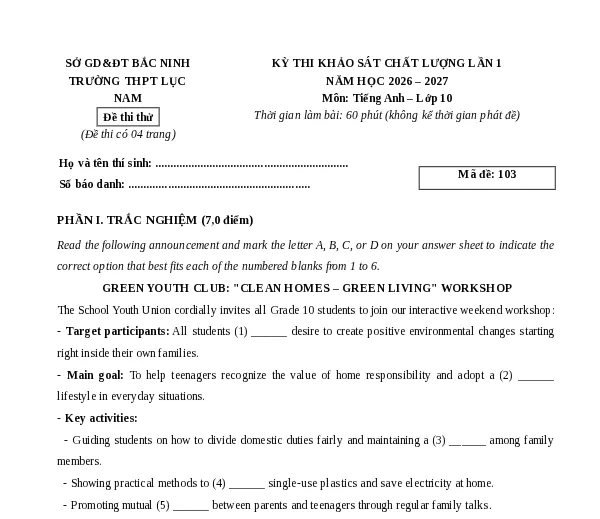
Read the following announcement and mark the letter A, B, C, or D on your answer sheet to indicate the correct option that best fits each of the numbered blanks from 1 to 6.
ANNOUNCEMENT: SCHOOL GREEN LIVING WEEK 2026
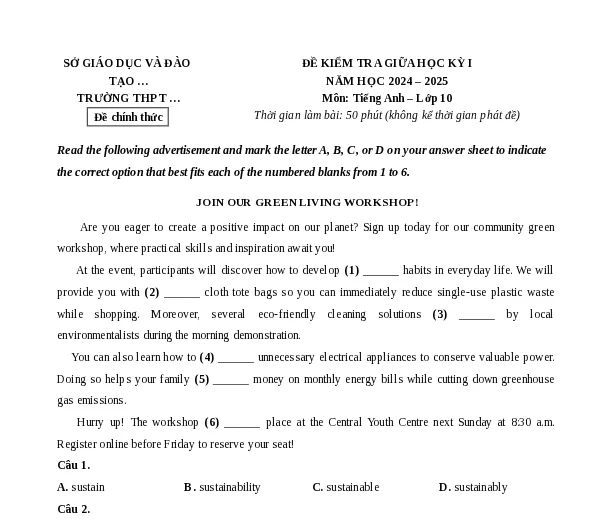
The School Youth Union is pleased to announce our annual Green Living Week, which aims to encourage students to adopt an eco-friendly lifestyle.
- Time: From November 10th to November 15th, 2026.
- Participants: All students from grades 10, 11, and 12.
- Main activities:
1. Collecting and sorting recyclable waste such as plastic bottles, paper, and aluminium cans.
2. Joining our workshop on how to reduce your carbon (1) ______ at home and at school.
3. Taking part in the "Green Corner" contest to decorate classrooms with (2) ______ plants.
All class monitors are requested to (3) ______ the registration list of their classes by this Friday. We strongly believe that small actions can make a huge (4) ______ to our planet. If you have any questions, please do not hesitate to contact Ms. Mai, the club leader, (5) ______ room 204. Let's work together to protect our environment, (6) ______?
Câu 1 (0,25 điểm).
A. footprint
B. fingerprint
C. lifestyle
D. emission
Câu 2 (0,25 điểm).
A. indoor
B. indoors
C. inn
D. inner
Câu 3 (0,25 điểm).
A. submit
B. delete
C. reject
D. cancel
Câu 4 (0,25 điểm).
A. difference
B. different
C. differently
D. differ
Câu 5 (0,25 điểm).
A. in
B. at
C. on
D. from
Câu 6 (0,25 điểm).
A. shall we
B. will you
C. don't we
D. do you
Read the following leaflet and mark the letter A, B, C, or D on your answer sheet to indicate the correct option that best fits each of the numbered blanks from 7 to 12.
SHARING HOUSEHOLD CHORES: A KEY TO FAMILY HAPPINESS
Do you know that doing housework is not just women's duty? Research shows that families sharing chores are much happier!
- Build Life Skills: Doing chores helps teenagers become more (7) ______ and responsible. You will learn how to cook, do the laundry, and manage your time effectively.
- Strengthen Family Bonds: When everyone helps with the heavy (8) ______, parents feel less stressed, and children learn to show (9) ______ for their parents' hard work.
- Create Good Habits: Sweeping the floor, washing dishes, or taking (10) ______ the rubbish teaches you good discipline that will benefit your future career.
- Tips for teenagers:
• Make a chore chart and (11) ______ turns doing different tasks every week.
• Do your duties without being (12) ______ repeatedly by your parents.
Start helping your family today to build a warm and joyful home!
Câu 7 (0,25 điểm).
A. independent
B. dependence
C. independently
D. depend
Câu 8 (0,25 điểm).
A. lifting
B. pulling
C. raising
D. pushing
Câu 9 (0,25 điểm).
A. gratitude
B. tradition
C. connection
D. talent
Câu 10 (0,25 điểm).
A. out
B. away
C. up
D. in
Câu 11 (0,25 điểm).
A. take
B. make
C. give
D. put
Câu 12 (0,25 điểm).
A. reminded
B. reminding
C. remind
D. reminds
Mark the letter A, B, C, or D on your answer sheet to indicate the correct arrangement of the sentences to make a meaningful conversation, letter, or paragraph for each of the following questions from 13 to 17.
Câu 13 (0,25 điểm). Sắp xếp các câu sau để tạo thành đoạn hội thoại hợp lý:
a. "I'm going to perform an acoustic guitar cover of a popular pop song."
b. "Have you signed up for the school talent show next month, Minh?"
c. "Yes, I have. I sent my registration form yesterday."
d. "That sounds wonderful! What are you planning to perform?"
A. b – c – d – a
B. b – d – a – c
C. d – a – b – c
D. c – b – d – a
Câu 14 (0,25 điểm). Sắp xếp các câu sau để tạo thành bức thư điện tử hợp lý:
a. Besides, listening to lively music while doing household chores makes the work much more enjoyable.
b. Dear Nam, I hope you are doing well with your studies.
c. Write back soon and let me know about your favourite songs!
d. I am writing to tell you about how music helps me relax after stressful days at school.
e. Whenever I feel exhausted, I usually turn on classical melodies, which instantly calm my mind.
A. b – d – e – a – c
B. b – e – a – d – c
C. d – b – e – a – c
D. b – d – a – e – c
Câu 15 (0,25 điểm). Sắp xếp các câu sau để tạo thành đoạn văn hoàn chỉnh về lối sống xanh:
a. Secondly, walking, cycling, or using public transport instead of private motorbikes can considerably reduce carbon emissions.
b. Living a green lifestyle brings numerous long-term advantages to both human health and the environment.
c. In conclusion, adopting these simple eco-friendly habits contributes significantly to a greener planet.
d. First of all, saving energy at home by turning off electrical appliances when not in use helps conserve natural resources.
e. Finally, sorting household waste and avoiding single-use plastics can help reduce land pollution.
A. b – d – a – e – c
B. b – a – d – e – c
C. d – a – e – b – c
D. b – e – d – a – c
Câu 16 (0,25 điểm). Sắp xếp các câu sau để tạo thành đoạn đối thoại ngắn hợp lý:
a. "Sure, what can I do to help you?"
b. "Could you give me a hand with the heavy lifting in the living room?"
c. "Please help me move this big wooden table to the corner."
A. b – a – c
B. a – c – b
C. c – a – b
D. b – c – a
Câu 17 (0,25 điểm). Sắp xếp các câu sau để tạo thành một đoạn văn miêu tả sự phân chia việc nhà:
a. As a result, our home is always tidy and everyone feels relaxed and respected.
b. In my family, household chores are divided equally among all family members.
c. My father is responsible for mending broken equipment and doing the heavy lifting.
d. Meanwhile, my mother prepares delicious meals and my sister and I take turns washing dishes and cleaning the house.
e. We all believe that sharing chores not only lightens the burden but also tightens our family bond.
A. b – c – d – e – a
B. b – d – c – a – e
C. c – d – b – e – a
D. b – e – c – d – a
Read the following passage and mark the letter A, B, C, or D on your answer sheet to indicate the correct option that best fits each of the numbered blanks from 18 to 22.
Music has always played a vital part in human culture, bringing people closer together and enhancing emotional well-being. Modern scientific research has demonstrated that (18) ______ can have a direct positive impact on physical and mental health. When individuals listen to soothing tunes, their brains release dopamine, a natural chemical (19) ______.
In addition to enhancing personal health, music serves as an effective medium for social communication. Through songs with meaningful lyrics, artists can raise public awareness about critical issues, such as environmental protection, (20) ______. For example, charity concerts organized by world-famous musicians have successfully raised millions of dollars (21) ______.
Furthermore, engaging in musical activities like playing an instrument or singing in a choir encourages discipline and teamwork among teenagers. Therefore, educators strongly encourage schools to integrate music into academic curricula (22) ______.
Câu 18 (0,25 điểm).
A. listening to pleasant music regularly
B. to listen to pleasant music regularly
C. regularly pleasant music listening
D. pleasant music regularly listen to
Câu 19 (0,25 điểm).
A. which helps reduce stress and elevate mood
B. which helps reducing stress and elevates mood
C. what helps reduce stress and elevate mood
D. that help reducing stress and elevating mood
Câu 20 (0,25 điểm).
A. global poverty, and gender equality
B. who suffer from poverty and inequality
C. where environmental damage is severe
D. because of global climate changes
Câu 21 (0,25 điểm).
A. to assist disadvantaged communities across the globe
B. in assisting disadvantaged communities across the globe
C. for they assist disadvantaged communities across the globe
D. which assist disadvantaged communities across the globe
Câu 22 (0,25 điểm).
A. so that students can develop both mentally and emotionally
B. although students might encounter various learning difficulties
C. but students find it hard to practice playing instruments
D. in order for students developing both mentally and emotionally
Read the following passage and mark the letter A, B, C, or D on your answer sheet to indicate the correct answer to each of the questions from 23 to 30.
Across the world, the concept of a "zero-waste lifestyle" has become increasingly popular, especially among young people who are deeply concerned about the future of the Earth. Contrary to what many people assume, living zero-waste does not mean producing absolutely no rubbish at all, which is practically impossible in modern industrial society. Instead, it is an ethical philosophy that encourages people to redesign their consumption habits so that all products can be reused, repaired, or recycled.
The journey toward zero-waste begins with the famous "5 Rs" principle: Refuse, Reduce, Reuse, Recycle, and Rot. First, individuals are advised to refuse what they do not need, such as disposable cutlery, plastic grocery bags, and promotional flyers. Second, reducing the purchase of unnecessary goods helps limit excessive production. Third, reusing durable items, such as refilling glass jars and shopping with cloth bags, extends the lifespan of everyday objects. Fourth, recycling is carried out for materials like paper, metal, and glass when they can no longer be used. Finally, "rot" refers to composting organic food scraps into nutrient-rich soil rather than sending them to landfills.
One of the greatest benefits of this lifestyle is the significant reduction in one's ecological footprint. Landfills are notorious for releasing large amounts of methane, a potent greenhouse gas that accelerates global warming. By composting organic waste and avoiding plastic packaging, zero-waste practitioners prevent harmful materials from polluting soil and oceans. Moreover, adopting this lifestyle allows individuals to save a considerable amount of money. When people stop buying trendy fast-fashion items or pre-packaged snacks, they realise they can live comfortably with much less.
However, transitioning to a zero-waste lifestyle is not without obstacles. Eco-friendly alternatives are sometimes more expensive or unavailable in local supermarkets, forcing consumers to spend extra time searching for packaging-free bulk stores. In addition, social pressure and fast-paced work routines often tempt people to choose single-use convenience over sustainability. Despite these hurdles, experts agree that we do not need a handful of people practicing zero waste perfectly; rather, we need millions of people doing it imperfectly to create a genuine global impact.
Câu 23 (0,25 điểm). What is the main idea of the passage?
A. The principles, benefits, and challenges of adopting a zero-waste lifestyle.
B. Why governments should ban all single-use plastic products immediately.
C. How composting organic food waste can prevent global greenhouse emissions.
D. The financial advantages of buying clothes in second-hand stores.
Câu 24 (0,25 điểm). According to paragraph 1, what is a common misconception about the zero-waste lifestyle?
A. It requires individuals to produce no rubbish at all.
B. It can only be practiced by wealthy people in cities.
C. It does not help in repairing or recycling old goods.
D. It focuses solely on cleaning up polluted oceans.
Câu 25 (0,25 điểm). The word "refuse" in paragraph 2 is closest in meaning to ______.
A. reject
B. accept
C. allow
D. require
Câu 26 (0,25 điểm). According to the 5 Rs principle mentioned in paragraph 2, what should people do with organic food scraps?
A. Turn them into compost for soil.
B. Send them directly to urban landfills.
C. Pack them in single-use plastic bags.
D. Burn them to produce renewable energy.
Câu 27 (0,25 điểm). The word "them" in paragraph 3 refers to ______.
A. organic food scraps
B. landfills
C. durable items
D. everyday objects
Câu 28 (0,25 điểm). According to paragraph 3, how does a zero-waste lifestyle help people financially?
A. By discouraging the purchase of unnecessary trendy clothes and pre-packaged food.
B. By offering free organic compost to all local gardeners.
C. By providing government rewards for families who sort waste.
D. By lowering the electricity bills of large households.
Câu 29 (0,25 điểm). The word "obstacles" in paragraph 4 is closest in meaning to ______.
A. difficulties
B. solutions
C. opportunities
D. advantages
Câu 30 (0,25 điểm). Which of the following can be inferred from the final sentence of the passage?
A. Widespread modest effort is more practical and impactful than rare perfection.
B. Achieving zero waste is impossible, so people should not waste time trying.
C. Only when everyone produces zero trash can environmental issues be solved.
D. Eco-friendly products must become cheaper before anyone will try them.
Mark the letter A, B, C, or D on your answer sheet to indicate the correct answer to each of the following questions from 31 to 40.
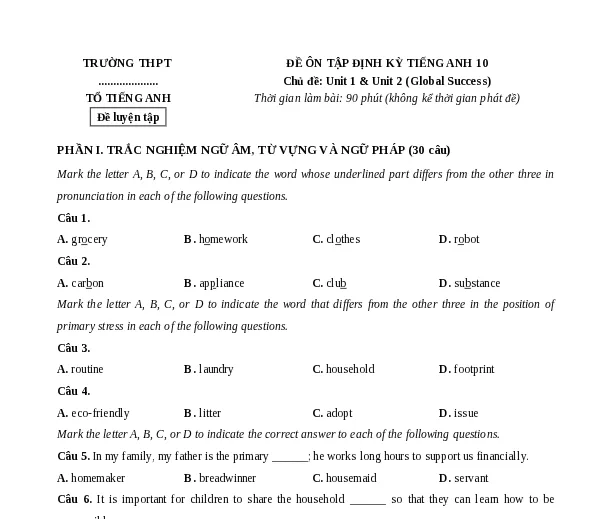
Câu 31 (0,25 điểm). Mark the letter A, B, C, or D to indicate the word whose underlined part differs from the other three in pronunciation.
A. clean
B. bread
C. health
D. heavy
Câu 32 (0,25 điểm). Mark the letter A, B, C, or D to indicate the word that differs from the other three in the position of primary stress.
A. perform
B. relax
C. rubbish
D. adopt
Câu 33 (0,25 điểm). In many Vietnamese families, the father is typically the ______ who works hard to earn money and support the whole household.
A. breadwinner
B. homemaker
C. volunteer
D. contestant
Câu 34 (0,25 điểm). Look at those black clouds in the sky! It ______ heavily in a few minutes.
A. is going to rain
B. will rain
C. rains
D. was raining
Câu 35 (0,25 điểm). The band's debut album ______ by millions of teenagers all over the country last year.
A. was bought
B. bought
C. is bought
D. has bought
Câu 36 (0,25 điểm). Many young people decide to ______ a green lifestyle to help preserve our natural environment.
A. adopt
B. adapt
C. admit
D. adjust
Câu 37 (0,25 điểm). Mai usually does the cooking, but today her mother ______ dinner because Mai is preparing for an English contest.
A. is preparing
B. prepares
C. prepared
D. has prepared
Câu 38 (0,25 điểm). Lan wanted to go to the live concert of her idol, ______ she could not afford the ticket price.
A. but
B. so
C. and
D. or
Câu 39 (0,25 điểm). The young singer has a wonderful voice and plays several musical ______ with great skill.
A. instruments
B. appliances
C. tools
D. equipment
Câu 40 (0,25 điểm). We ______ single-use plastic bags with reusable cloth bags to reduce plastic waste in our school.
A. should replace
B. should be replaced
C. must be replacing
D. replaced by
--------- HẾT ---------
Họ và tên thí sinh: .............................................................. Số báo danh: ........................
ĐÁP ÁN VÀ HƯỚNG DẪN GIẢI CHI TIẾT
BẢNG ĐÁP ÁN THAM KHẢO
Câu | Đ/A | Câu | Đ/A | Câu | Đ/A | Câu | Đ/A |
|---|---|---|---|---|---|---|---|
1 | A | 11 | A | 21 | A | 31 | A |
2 | A | 12 | A | 22 | A | 32 | C |
3 | A | 13 | A | 23 | A | 33 | A |
4 | A | 14 | A | 24 | A | 34 | A |
5 | A | 15 | A | 25 | A | 35 | A |
6 | A | 16 | A | 26 | A | 36 | A |
7 | A | 17 | A | 27 | A | 37 | A |
8 | A | 18 | A | 28 | A | 38 | A |
9 | A | 19 | A | 29 | A | 39 | A |
10 | A | 20 | A | 30 | A | 40 | A |
LỜI GIẢI CHI TIẾT
Câu 1: A. footprint
- Cụm danh từ cố định: carbon footprint (dấu chân carbon / lượng khí thải carbon).
Câu 2: A. indoor
- indoor là tính từ đứng trước danh từ plants mang nghĩa "cây trồng trong nhà". indoors là trạng từ.
Câu 3: A. submit
- submit the registration list: nộp danh sách đăng ký. Các từ khác không hợp nghĩa (delete: xóa, reject: từ chối, cancel: hủy).
Câu 4: A. difference
- Cụm từ cố định: make a difference to something (tạo ra sự khác biệt/ảnh hưởng tích cực đối với cái gì).
Câu 5: A. in
- Dùng giới từ in trước tên phòng học/phòng làm việc (in room 204).
Câu 6: A. shall we
- Câu hỏi đuôi cho cấu trúc rủ rê bắt đầu bằng Let's + V là shall we?.
Câu 7: A. independent
- Sau cấu trúc liên kết become more + Adj, ta cần tính từ independent (tự lập). dependence là danh từ.
Câu 8: A. lifting
- Thành ngữ/cụm từ quen thuộc: heavy lifting (công việc nặng nhọc, mang vác nặng trong gia đình).
Câu 9: A. gratitude
- show gratitude for something: thể hiện lòng biết ơn đối với điều gì.
Câu 10: A. out
- Cụm động từ: take out the rubbish (đi đổ rác).
Câu 11: A. take
- Cụm động từ cố định: take turns doing something (luân phiên làm việc gì).
Câu 12: A. reminded
- Cấu trúc bị động sau being: being + V3/ed (without being reminded: mà không cần phải bị/được nhắc nhở nhiều lần).
Câu 13: A. b – c – d – a
- b: Minh ơi, bạn đã đăng ký hội diễn tài năng trường tháng tới chưa?
- c: Rồi, mình vừa gửi đơn đăng ký hôm qua.
- d: Nghe tuyệt quá! Bạn dự định biểu diễn tiết mục gì?
- a: Mình sẽ biểu diễn một bản guitar acoustic một bài hát nhạc pop nổi tiếng.
Câu 14: A. b – d – e – a – c
- b mở đầu thư (Dear Nam...).
- d nêu mục đích viết thư (kể về tác dụng của âm nhạc trong việc thư giãn).
- e & a triển khai chi tiết các tình huống nghe nhạc (khi kiệt sức nghe nhạc cổ điển, khi làm việc nhà nghe nhạc sôi động).
- c kết thúc thư và lời chào hồi đáp.
Câu 15: A. b – d – a – e – c
- b giới thiệu câu chủ đề (Lối sống xanh mang lại nhiều lợi ích lâu dài).
- d: First of all... (tiết kiệm điện).
- a: Secondly... (sử dụng phương tiện công cộng/xe đạp).
- e: Finally... (phân loại rác, tránh đồ nhựa dùng một lần).
- c: In conclusion... (kết luận).
Câu 16: A. b – a – c
- b: Bạn có thể phụ mình khiêng vật nặng trong phòng khách không?
- a: Chắc chắn rồi, mình có thể giúp gì cho bạn?
- c: Vui lòng giúp mình chuyển chiếc bàn gỗ lớn này vào góc phòng.
Câu 17: A. b – c – d – e – a
- b nêu câu chủ đề: Việc nhà trong gia đình em được chia đều.
- c nêu việc của bố (sửa chữa đồ đạc, việc nặng).
- d nêu việc của mẹ và hai chị em (nấu ăn, rửa chén, lau nhà).
- e nêu nhận thức chung về lợi ích của việc chia sẻ việc nhà.
- a là kết quả: ngôi nhà luôn gọn gàng và mọi người đều vui vẻ.
Câu 18: A. listening to pleasant music regularly
- Cần một danh động từ (Gerund phrase) làm chủ ngữ cho mệnh đề phụ sau that: listening to pleasant music regularly.
Câu 19: A. which helps reduce stress and elevate mood
- which làm đại từ quan hệ thay thế cho danh từ số ít a natural chemical, động từ chia số ít helps, theo sau là động từ nguyên mẫu reduce và elevate.
Câu 20: A. global poverty, and gender equality
- Cần liệt kê các danh từ/cụm danh từ song hành với environmental protection sau such as: global poverty, and gender equality.
Câu 21: A. to assist disadvantaged communities across the globe
- Dùng to-V chỉ mục đích của hành động raised millions of dollars.
Câu 22: A. so that students can develop both mentally and emotionally
- Mệnh đề chỉ mục đích: so that + S + V (để học sinh có thể phát triển toàn diện cả về tinh thần và cảm xúc).
Câu 23: A. The principles, benefits, and challenges of adopting a zero-waste lifestyle.
- Bài đọc trình bày định nghĩa, các nguyên tắc (5 Rs), lợi ích về môi trường - tài chính và những khó khăn khi thực hiện lối sống không rác thải.
Câu 24: A. It requires individuals to produce no rubbish at all.
- Dẫn chứng đoạn 1: "living zero-waste does not mean producing absolutely no rubbish at all, which is practically impossible..."
Câu 25: A. reject
- refuse = reject (từ chối, không tiếp nhận những thứ không cần thiết).
Câu 26: A. Turn them into compost for soil.
- Dẫn chứng đoạn 2: "rot" refers to composting organic food scraps into nutrient-rich soil..."
Câu 27: A. organic food scraps
- Từ "them" thay thế cho danh từ số nhiều được nhắc ngay trước đó: organic food scraps.
Câu 28: A. By discouraging the purchase of unnecessary trendy clothes and pre-packaged food.
- Dẫn chứng đoạn 3: "When people stop buying trendy fast-fashion items or pre-packaged snacks, they realise they can live comfortably with much less."
Câu 29: A. difficulties
- obstacles = difficulties / hurdles (những khó khăn, trở ngại).
Câu 30: A. Widespread modest effort is more practical and impactful than rare perfection.
- Suy luận từ câu cuối: "...we do not need a handful of people practicing zero waste perfectly; rather, we need millions of people doing it imperfectly to create a genuine global impact."
Câu 31: A. clean
- Phần gạch chân của đáp án A phát âm là /iː/ (/kliːn/), các đáp án còn lại phát âm là /e/ (bread /bred/, health /helθ/, heavy /ˈhevi/).
Câu 32: C. rubbish
- rubbish /ˈrʌbɪʃ/ trọng âm rơi vào âm tiết thứ 1. Các từ còn lại có trọng âm rơi vào âm tiết thứ 2 (perform /pəˈfɔːm/, relax /rɪˈlæks/, adopt /əˈdɒpt/).
Câu 33: A. breadwinner
- breadwinner (người trụ cột kiếm tiền nuôi gia đình). homemaker (người nội trợ).
Câu 34: A. is going to rain
- Dùng thì tương lai gần be going to để diễn tả một dự đoán có bằng chứng cụ thể ở hiện tại (Look at those black clouds in the sky!).
Câu 35: A. was bought
- Câu bị động ở thì quá khứ đơn với mốc thời gian last year: was/were + V3/ed. Chủ ngữ The band's debut album số ít nên dùng was bought.
Câu 36: A. adopt
- Cụm từ cố định: adopt a green lifestyle (bắt đầu áp dụng lối sống xanh).
Câu 37: A. is preparing
- Diễn tả hành động tạm thời trái với thói quen hằng ngày (có trạng từ today đối lập với usually), dùng thì hiện tại tiếp diễn is preparing.
Câu 38: A. but
- Liên từ but dùng để nối hai mệnh đề có nghĩa tương phản (Muốn đi xem ca nhạc NHƯNG không đủ tiền mua vé).
Câu 39: A. instruments
- Cụm từ: musical instruments (các loại nhạc cụ).
Câu 40: A. should replace
- Cấu trúc khuyên bảo chủ động: S + should + V-infinitive + O (We should replace single-use plastic bags with reusable cloth bags).