BÀI TẬP ÔN TẬP TỪ VỰNG VÀ ĐỌC HIỂU
Môn: Tiếng Anh – Lớp 11 (Global Success)
Chuyên đề: Units 1, 2, 3 – Năm học 2026 – 2027
PART I. UNIT 1: A LONG AND HEALTHY LIFE
A. Pre-reading: Vocabulary
Mark the letter A, B, C, or D to indicate the correct answer to each of the following questions.
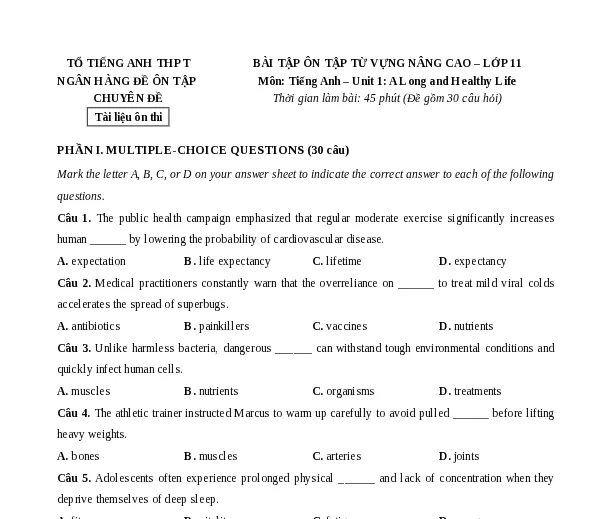
Câu 1. Regular physical exercise combined with a well-balanced diet helps strengthen the ______ and prevent serious illnesses.
A. immune system
B. life expectancy
C. food intake
D. prescription drug
Câu 2. Scientists have pointed out that genetics, lifestyle, and dietary habits are key factors contributing to human ______.
A. treatment
B. longevity
C. bacteria
D. muscle
Câu 3. To avoid weight gain and improve digestive health, you should limit foods high in ______ fats and refined sugars.
A. nutritious
B. organic
C. saturated
D. mineral
Câu 4. Washing hands regularly with soap is one of the most effective measures to stop the spread of ______ diseases.
A. infectious
B. continuous
C. nutritious
D. persistent
Câu 5. The doctor recommended that he cut down on fast food and increase his daily ______ of fresh fruits and green vegetables.
A. fitness
B. intake
C. recipe
D. remedy
B. Reading Comprehension
Read the following passage and mark the letter A, B, C, or D to indicate the correct answer to each of the questions from 6 to 10.
In recent years, researchers have paid special attention to several regions around the globe known as "Blue Zones," where an unusually high proportion of people live past the age of 100 while maintaining remarkable physical and mental vitality. Places such as Okinawa in Japan, Sardinia in Italy, and Ikaria in Greece are prime examples. Despite being geographically distinct and having different cultures, the populations in these areas share several fundamental lifestyle habits.
First and foremost, physical activity is naturally woven into their daily routines rather than confined to intense workouts at modern fitness centres. People in Blue Zones frequently garden, walk up steep hills, and carry out everyday household chores by hand. Furthermore, their diet is predominantly plant-based, consisting largely of whole grains, leafy greens, beans, and fresh fruits, with meat consumed only occasionally. They also practice moderate eating, stopping when their stomachs are about eighty percent full.
Equally important are strong social bonds and stress reduction strategies. Individuals living in these communities belong to tight-knit networks that offer mutual emotional and financial support throughout their lives. They also dedicate regular periods during the day to unwind, nap, or share quiet moments with family and friends. Modern societies often search for expensive medical treatments to prolong life, yet the secret to a long and healthy existence appears to lie in simple, sustainable everyday practices.
Câu 6. What is the main idea of the passage?
A. The rise of modern medical breakthroughs in extending life.
B. Common lifestyle practices that contribute to longevity in Blue Zones.
C. A comparison between Western diets and traditional Mediterranean food.
D. The reasons why regular workouts in gymnasiums are unnecessary.
Câu 7. According to paragraph 2, how do residents in Blue Zones typically exercise?
A. By lifting weights in well-equipped fitness centres.
B. By following strict fitness regimes created by personal trainers.
C. By integrating natural physical movement into their daily activities.
D. By engaging in competitive outdoor sporting events.
Câu 8. The word "predominantly" in paragraph 2 is closest in meaning to ______.
A. mostly
B. rarely
C. slightly
D. entirely
Câu 9. The word "They" in paragraph 3 refers to ______.
A. modern societies
B. medical treatments
C. tight-knit networks
D. individuals living in these communities
Câu 10. Which of the following can be inferred from the passage?
A. Expensive healthcare is the most reliable way to achieve longevity.
B. Social interaction and mental well-being play a crucial role in extending lifespan.
C. People in Blue Zones avoid consuming any kind of animal meat throughout their lives.
D. People can live beyond 100 only if they reside in Mediterranean countries.
PART II. UNIT 2: THE GENERATION GAP
A. Pre-reading: Vocabulary
Mark the letter A, B, C, or D to indicate the correct answer to each of the following questions.
Câu 11. Living in a(n) ______ with three or four generations under the same roof can sometimes lead to differences in lifestyles and viewpoints.
A. nuclear family
B. extended family
C. single-parent family
D. peer group
Câu 12. My parents have imposed a strict 9:30 p.m. ______ on weekdays to make sure that I get enough sleep before school.
A. curfew
B. duty
C. conflict
D. barrier
Câu 13. Teenagers often strive for ______ from their parents, wanting to make their own choices regarding clothes, hobbies, and friendships.
A. dependence
B. disagreement
C. independence
D. inequality
Câu 14. Grandparents tend to be more ______ when it comes to social customs, whereas young people prefer modern values.
A. open-minded
B. conservative
C. curious
D. energetic
Câu 15. Open communication and active listening are key to resolving family ______ and bridging the generation gap.
A. values
B. beliefs
C. agreements
D. conflicts
B. Reading Comprehension
Read the following passage and mark the letter A, B, C, or D to indicate the correct answer to each of the questions from 16 to 20.
The generation gap is a common phenomenon in many families, referring to the divide in values, opinions, and behaviours between younger and older generations. This divergence often arises because children grow up in an environment vastly different from that of their parents and grandparents. In today's digital era, rapid technological advancements, globalization, and shifting cultural standards have made this divide even more pronounced than in the past.
One of the most frequent sources of friction between parents and teenagers is technology use. While adolescents consider smartphones, instant messaging, and social networking platforms essential tools for communication and learning, parents may perceive excessive screen time as a distraction from academic responsibilities and face-to-face interaction. Furthermore, older family members frequently expect younger generations to follow traditional career pathways, such as becoming doctors, lawyers, or engineers, whereas many adolescents now gravitate toward creative professions and the gig economy.
Nevertheless, the generation gap does not have to result in permanent estrangement. When family members approach these differences with empathy and patience, conflicts can be transformed into opportunities for mutual learning. Parents should listen non-judgmentally to their children's opinions, granting them reasonable autonomy. In return, teenagers ought to appreciate their parents' life experiences and show respect for familial expectations. By establishing open lines of dialogue, families can bridge misunderstandings and nurture lasting harmony.
Câu 16. Which of the following is the best title for the passage?
A. The Decline of Family Values in Modern Society
B. Understanding and Bridging the Generation Gap
C. How Technology Completely Destroys Family Bonds
D. Traditional Career Paths versus Creative Careers
Câu 17. According to paragraph 1, why is the generation gap more noticeable nowadays?
A. Because young people refuse to communicate with their parents.
B. Because parents are becoming increasingly strict with their children.
C. Because of fast technological development and changing cultural norms.
D. Because extended families are no longer common in modern societies.
Câu 18. The word "friction" in paragraph 2 is closest in meaning to ______.
A. agreement
B. conflict
C. affection
D. cooperation
Câu 19. The word "them" in paragraph 3 refers to ______.
A. differences
B. parents
C. teenagers
D. opportunities
Câu 20. Which of the following statements is NOT supported by the passage?
A. Teenagers and parents often disagree on how screen time should be managed.
B. Parents usually prefer their children to choose well-established traditional careers.
C. Active dialogue and mutual empathy can help resolve family tensions.
D. The gap between generations can never be closed due to technological differences.
PART III. UNIT 3: CITIES OF THE FUTURE
A. Pre-reading: Vocabulary
Mark the letter A, B, C, or D to indicate the correct answer to each of the following questions.
Câu 21. Future urban planning focuses heavily on building ______ cities that produce zero net carbon emissions and rely on renewable energy.
A. crowded
B. sustainable
C. polluted
D. temporary
Câu 22. Upgrading modern transport ______ such as underground railways and cycling lanes will help ease traffic congestion in metropolises.
A. greenhouse
B. infrastructure
C. ingredient
D. generation
Câu 23. In a smart city, electronic ______ installed along main roads collect real-time data to optimize traffic flow and reduce delays.
A. sensors
B. nutrients
C. curfews
D. crops
Câu 24. Urban planners are working hard to create more green spaces and pedestrian zones to make cities more ______ for all citizens.
A. liveable
B. infectious
C. conservative
D. exhausted
Câu 25. Switching to electric buses and solar-powered street lighting is an ______ solution to combat climate change in urban centers.
A. eco-friendly
B. old-fashioned
C. unstable
D. unsafe
B. Reading Comprehension
Read the following passage and mark the letter A, B, C, or D to indicate the correct answer to each of the questions from 26 to 30.
By the mid-21st century, it is estimated that nearly seventy percent of the world's population will dwell in urban areas. Rapid urbanisation brings tremendous economic opportunities, but it also exerts immense pressure on housing, natural resources, public health, and the environment. In response to these pressing challenges, urban designers and engineers around the world are developing the concept of "smart and sustainable cities."
Smart cities utilise cutting-edge technologies, such as the Internet of Things (IoT) and Artificial Intelligence (AI), to manage public infrastructure and resources efficiently. For instance, intelligent monitoring systems equipped with sensors can detect water leaks in underground pipes, monitor air quality index levels in real time, and regulate street illumination based on foot and vehicle traffic. Additionally, smart traffic lights can automatically adjust their timing to mitigate gridlock during peak hours, significantly reducing fuel consumption and greenhouse gas emissions.
Alongside digital intelligence, environmental sustainability is another pillar of future city design. Tomorrow's cities will feature vertical farms integrated into high-rise buildings, extensive rooftop gardens, and public transport networks powered entirely by solar and wind power. Waste management systems will also undergo a major overhaul, turning household waste into clean biogas and electricity. Rather than concrete jungles, future cities are envisioned as harmonious ecosystems where human prosperity and environmental preservation coexist.
Câu 26. What does the passage mainly discuss?
A. The negative impacts of overpopulation in modern cities.
B. The concepts and key components of smart, sustainable future cities.
C. How AI will replace human civil engineers in urban planning.
D. The history of metropolitan architecture from the 20th century.
Câu 27. According to paragraph 2, how do smart sensors help city management?
A. By warning drivers of speeding violations directly on their phones.
B. By identifying underground water leakages and monitoring air quality.
C. By shutting down roads during extreme weather conditions.
D. By generating renewable electricity for street lighting.
Câu 28. The word "mitigate" in paragraph 2 is closest in meaning to ______.
A. alleviate
B. worsen
C. accelerate
D. prolong
Câu 29. The word "their" in paragraph 2 refers to ______.
A. smart cities
B. public resources
C. smart traffic lights
D. peak hours
Câu 30. Which of the following is TRUE about the cities of the future according to paragraph 3?
A. They will rely completely on traditional fossil fuels for public transit.
B. Vertical farming and rooftop greenery will be combined into buildings.
C. Waste will be disposed of in large landfills outside city limits.
D. They will look like dense concrete jungles with few natural landscapes.
--------- HẾT ---------
Họ và tên học sinh: .............................................................. Lớp: ........................
HƯỚNG DẪN GIẢI VÀ ĐÁP ÁN CHI TIẾT
BẢNG ĐÁP ÁN
Câu | Đáp án | Câu | Đáp án | Câu | Đáp án | Câu | Đáp án | Câu | Đáp án | Câu | Đáp án |
|---|---|---|---|---|---|---|---|---|---|---|---|
1 | A | 6 | B | 11 | B | 16 | B | 21 | B | 26 | B |
2 | B | 7 | C | 12 | A | 17 | C | 22 | B | 27 | B |
3 | C | 8 | A | 13 | C | 18 | B | 23 | A | 28 | A |
4 | A | 9 | D | 14 | B | 19 | C | 24 | A | 29 | C |
5 | B | 10 | B | 15 | D | 20 | D | 25 | A | 30 | B |
LỜI GIẢI CHI TIẾT
UNIT 1: A LONG AND HEALTHY LIFE
Câu 1. Chọn A.
- Kiến thức từ vựng: "immune system" nghĩa là hệ miễn dịch; "strengthen the immune system" = tăng cường hệ miễn dịch.
- B. life expectancy (tuổi thọ kỳ vọng); C. food intake (lượng thức ăn nạp vào); D. prescription drug (thuốc kê đơn).
- Tạm dịch: Tập thể dục thường xuyên kết hợp với chế độ ăn cân bằng giúp tăng cường hệ miễn dịch và ngăn ngừa các bệnh hiểm nghèo.
Câu 2. Chọn B.
- Kiến thức từ vựng: "longevity" (n) nghĩa là sự trường thọ, tuổi thọ cao.
- A. treatment (sự điều trị); C. bacteria (vi khuẩn); D. muscle (cơ bắp).
- Tạm dịch: Các nhà khoa học chỉ ra rằng di truyền, lối sống và chế độ ăn uống là các yếu tố chính đóng góp vào tuổi thọ của con người.
Câu 3. Chọn C.
- Kiến thức cụm từ: "saturated fats" nghĩa là chất béo bão hòa (chất béo xấu gây hại tim mạch).
- A. nutritious (bổ dưỡng); B. organic (hữu cơ); D. mineral (khoáng chất).
- Tạm dịch: Để tránh tăng cân và cải thiện hệ tiêu hóa, bạn nên hạn chế thực phẩm nhiều chất béo bão hòa và đường tinh luyện.
Câu 4. Chọn A.
- Kiến thức từ vựng: "infectious diseases" nghĩa là các bệnh truyền nhiễm.
- B. continuous (liên tục); C. nutritious (giàu dinh dưỡng); D. persistent (dai dẳng).
- Tạm dịch: Rửa tay thường xuyên bằng xà phòng là một trong những biện pháp hữu hiệu nhất để ngăn chặn sự lây lan của các bệnh truyền nhiễm.
Câu 5. Chọn B.
- Kiến thức từ vựng: "intake" (n) nghĩa là lượng nạp vào cơ thể; cụm "daily intake of..." = lượng nạp hàng ngày của...
- A. fitness (sự cân đối, thể lực); C. recipe (công thức nấu ăn); D. remedy (phương thuốc).
- Tạm dịch: Bác sĩ khuyên anh ấy nên cắt giảm thức ăn nhanh và tăng lượng nạp trái cây tươi và rau xanh hàng ngày.
Câu 6. Chọn B.
- Đọc hiểu - Ý chính: Đoạn văn nói về các "Vùng Xanh" (Blue Zones) và những thói quen lối sống chung (vận động tự nhiên, ăn uống từ thực vật, quan hệ xã hội gắn kết) giúp người dân ở đây sống thọ trên 100 tuổi. Phương án B thể hiện chính xác nhất nội dung này.
Câu 7. Chọn C.
- Đọc hiểu - Chi tiết: Đoạn 2 ghi: "physical activity is naturally woven into their daily routines rather than confined to intense workouts at modern fitness centres. People in Blue Zones frequently garden, walk up steep hills..." (hoạt động thể chất hòa vào sinh hoạt hàng ngày tự nhiên chứ không gò bó trong phòng tập gym). Chọn C.
Câu 8. Chọn A.
- Đọc hiểu - Từ đồng nghĩa: "predominantly" (chủ yếu, phần lớn) = "mostly".
- B. rarely (hiếm khi); C. slightly (nhẹ, một chút); D. entirely (hoàn toàn).
Câu 9. Chọn D.
- Đọc hiểu - Đại từ quy chiếu: Đoạn 3: "Individuals living in these communities belong to tight-knit networks... They also dedicate regular periods during the day to unwind..." -> "They" thay thế cho "Individuals living in these communities".
Câu 10. Chọn B.
- Đọc hiểu - Suy luận: Đoạn 3 nhấn mạnh: "Equally important are strong social bonds and stress reduction strategies... nurture lasting harmony" -> Tương tác xã hội và sức khỏe tinh thần đóng vai trò then chốt trong việc kéo dài tuổi thọ. Phương án A, C, D sai so với thông tin bài đọc.
UNIT 2: THE GENERATION GAP
Câu 11. Chọn B.
- Kiến thức từ vựng: "extended family" (gia đình đa thế hệ / đại gia đình gồm ông bà, bố mẹ, con cháu).
- A. nuclear family (gia đình hạt nhân chỉ gồm bố mẹ và con); C. single-parent family (gia đình đơn thân); D. peer group (nhóm bạn cùng trang lứa).
- Tạm dịch: Sống trong một đại gia đình với 3 hoặc 4 thế hệ chung một mái nhà đôi khi có thể dẫn đến sự khác biệt về lối sống và quan điểm.
Câu 12. Chọn A.
- Kiến thức từ vựng: "curfew" (n) nghĩa là giờ giới nghiêm, giờ phải về nhà.
- B. duty (nhiệm vụ); C. conflict (xung đột); D. barrier (rào cản).
- Tạm dịch: Bố mẹ tôi đặt ra giờ giới nghiêm nghiêm ngặt lúc 9:30 tối vào các ngày trong tuần để đảm bảo tôi ngủ đủ giấc trước khi đến trường.
Câu 13. Chọn C.
- Kiến thức từ vựng: "strive for independence" nghĩa là nỗ lực phấn đấu để có được sự tự lập/độc lập.
- A. dependence (sự phụ thuộc); B. disagreement (sự bất đồng); D. inequality (sự bất bình đẳng).
- Tạm dịch: Thanh thiếu niên thường nỗ lực tự lập khỏi cha mẹ, muốn tự mình đưa ra các quyết định liên quan đến trang phục, sở thích và bạn bè.
Câu 14. Chọn B.
- Kiến thức từ vựng: "conservative" (adj) nghĩa là bảo thủ, truyền thống, dè dặt trước cái mới.
- A. open-minded (cởi mở); C. curious (tò mò); D. energetic (năng động).
- Tạm dịch: Ông bà thường có xu hướng bảo thủ/truyền thống hơn khi nói đến các phong tục xã hội, trong khi giới trẻ lại ưa chuộng các giá trị hiện đại.
Câu 15. Chọn D.
- Kiến thức từ vựng: "family conflicts" nghĩa là các mâu thuẫn, xung đột trong gia đình.
- A. values (giá trị); B. beliefs (niềm tin); C. agreements (sự đồng thuận).
- Tạm dịch: Giao tiếp cởi mở và lắng nghe tích cực là chìa khóa để giải quyết xung đột gia đình và thu hẹp khoảng cách thế hệ.
Câu 16. Chọn B.
- Đọc hiểu - Tiêu đề: Toàn bộ bài văn giải thích nguyên nhân gây ra khoảng cách thế hệ (công nghệ, lựa chọn nghề nghiệp) và đưa ra giải pháp hòa giải (lắng nghe, đồng cảm). Do đó B ("Understanding and Bridging the Generation Gap") là tiêu đề thích hợp nhất.
Câu 17. Chọn C.
- Đọc hiểu - Chi tiết: Đoạn 1: "In today's digital era, rapid technological advancements, globalization, and shifting cultural standards have made this divide even more pronounced than in the past." -> Do sự phát triển công nghệ và các quy chuẩn văn hóa thay đổi nhanh chóng.
Câu 18. Chọn B.
- Đọc hiểu - Từ đồng nghĩa: "friction" trong ngữ cảnh này có nghĩa là sự va chạm, xung đột, xích mích = "conflict".
- A. agreement (sự nhất trí); C. affection (tình cảm); D. cooperation (sự hợp tác).
Câu 19. Chọn C.
- Đọc hiểu - Đại từ quy chiếu: Đoạn 3: "Parents should listen non-judgmentally to their children's opinions, granting them reasonable autonomy." -> "them" chỉ "children / teenagers" (con cái/thanh thiếu niên).
Câu 20. Chọn D.
- Đọc hiểu - Câu phủ định: Bài đọc khẳng định ở đoạn 3: "the generation gap does not have to result in permanent estrangement... families can bridge misunderstandings" (khoảng cách này không nhất thiết dẫn đến sự xa cách vĩnh viễn và hoàn toàn có thể thu hẹp được). Do đó nhận định D "không thể thu hẹp" là sai.
UNIT 3: CITIES OF THE FUTURE
Câu 21. Chọn B.
- Kiến thức từ vựng: "sustainable cities" nghĩa là các thành phố phát triển bền vững.
- A. crowded (đông đúc); C. polluted (bị ô nhiễm); D. temporary (tạm thời).
- Tạm dịch: Quy hoạch đô thị tương lai tập trung mạnh mẽ vào việc xây dựng các thành phố bền vững, không phát thải ròng carbon và dựa vào năng lượng tái tạo.
Câu 22. Chọn B.
- Kiến thức từ vựng: "transport infrastructure" nghĩa là cơ sở hạ tầng giao thông.
- A. greenhouse (nhà kính); C. ingredient (thành phần); D. generation (thế hệ).
- Tạm dịch: Nâng cấp cơ sở hạ tầng giao thông hiện đại như tàu điện ngầm và làn đường xe đạp sẽ giúp giảm ùn tắc giao thông ở các đô thị lớn.
Câu 23. Chọn A.
- Kiến thức từ vựng: "electronic sensors" nghĩa là các cảm biến điện tử.
- B. nutrients (chất dinh dưỡng); C. curfews (giờ giới nghiêm); D. crops (hoa màu).
- Tạm dịch: Trong thành phố thông minh, các cảm biến điện tử lắp đặt dọc các trục đường chính thu thập dữ liệu theo thời gian thực để tối ưu hóa lưu lượng giao thông.
Câu 24. Chọn A.
- Kiến thức từ vựng: "liveable" (adj) nghĩa là đáng sống, tiện nghi cho cuộc sống.
- B. infectious (truyền nhiễm); C. conservative (bảo thủ); D. exhausted (kiệt sức).
- Tạm dịch: Các nhà quy hoạch đô thị đang nỗ lực tạo ra nhiều không gian xanh và phố đi bộ để làm cho thành phố đáng sống hơn cho mọi cư dân.
Câu 25. Chọn A.
- Kiến thức từ vựng: "eco-friendly" (adj) nghĩa là thân thiện với môi trường, sinh thái.
- B. old-fashioned (cũ kỹ, lỗi thời); C. unstable (không ổn định); D. unsafe (không an toàn).
- Tạm dịch: Chuyển đổi sang xe buýt điện và đèn đường năng lượng mặt trời là một giải pháp thân thiện với môi trường để chống lại biến đổi khí hậu tại các trung tâm đô thị.
Câu 26. Chọn B.
- Đọc hiểu - Ý chính: Bài đọc trình bày về khái niệm đô thị thông minh và bền vững, bao gồm ứng dụng công nghệ (IoT, AI) và tính bền vững sinh thái (năng lượng tái tạo, nông nghiệp thẳng đứng). Chọn B.
Câu 27. Chọn B.
- Đọc hiểu - Chi tiết: Đoạn 2: "intelligent monitoring systems equipped with sensors can detect water leaks in underground pipes, monitor air quality index levels in real time..." -> Cảm biến giúp phát hiện rò rỉ nước ngầm và theo dõi chất lượng không khí.
Câu 28. Chọn A.
- Đọc hiểu - Từ đồng nghĩa: "mitigate" (giảm nhẹ, xoa dịu) = "alleviate".
- B. worsen (làm tệ hơn); C. accelerate (đẩy nhanh); D. prolong (kéo dài).
Câu 29. Chọn C.
- Đọc hiểu - Đại từ quy chiếu: Đoạn 2: "Additionally, smart traffic lights can automatically adjust their timing to mitigate gridlock..." -> "their" thay thế cho "smart traffic lights".
Câu 30. Chọn B.
- Đọc hiểu - Thông tin đúng: Đoạn 3: "Tomorrow's cities will feature vertical farms integrated into high-rise buildings, extensive rooftop gardens..." -> Nông nghiệp thẳng đứng và vườn trên mái sẽ được tích hợp vào các tòa nhà.