TRƯỜNG THPT CHUYÊN ĐỀ
Đề tham khảo
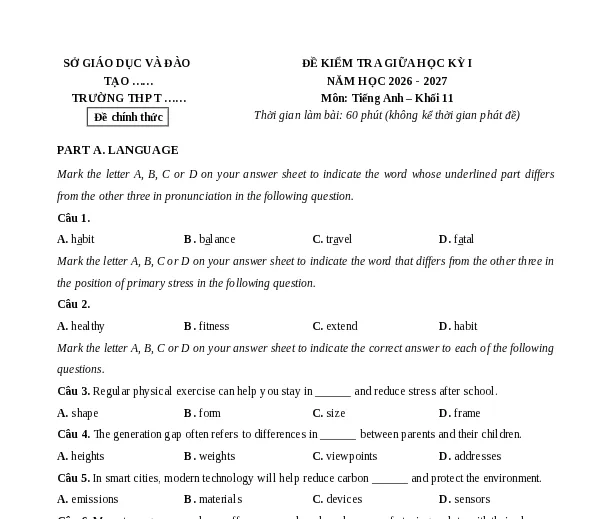
KỲ THI TỐT NGHIỆP TRUNG HỌC PHỔ THÔNG
Bài thi: NGOẠI NGỮ; Môn thi: TIẾNG ANH
Thời gian làm bài: 50 phút, không kể thời gian phát đề
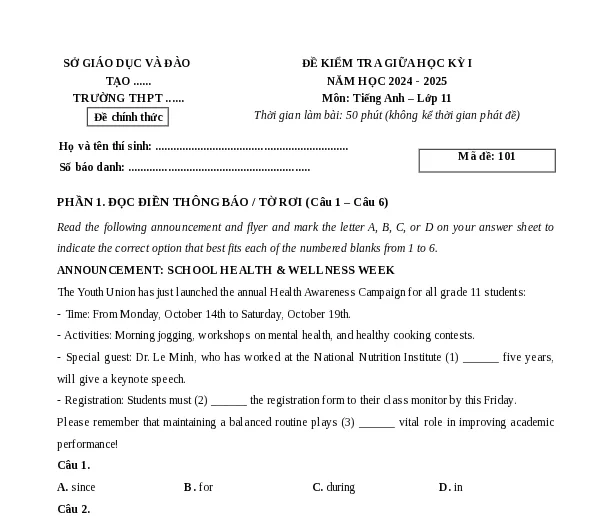
Họ và tên thí sinh: ................................................................ Số báo danh: ............................................................ | Mã đề: 101 |
Read the following advertisement/announcement and mark the letter A, B, C, or D on your answer sheet to indicate the correct option that best fits each of the numbered blanks from 1 to 6.
VITALITY FITNESS CLUB – TRANSFORM YOUR LIFESTYLE TODAY!
Are you looking to boost your energy and achieve a well-balanced physique? Join Vitality Fitness Club, where your health journey begins!
- Access state-of-the-art facilities and customized (1) ______ routines tailored to your personal goals.
- Professional certified trainers are always available to offer (2) ______ advice on diet and nutrition.
- Take part in vibrant group classes designed to build strength and (3) ______ stress after a busy workday.
- Special promotion: Register before October 15th to receive a 20% discount on all annual memberships!
Contact us at 0904-888-999 or visit www.vitalityfitness.com for more details.
Câu 1.
A. workout
B. workoutable
C. work
D. worker
Câu 2.
A. harmful
B. practical
C. infectious
D. synthetic
Câu 3.
A. increase
B. produce
C. relieve
D. suffer
ANNOUNCEMENT: CELEBRATION OF YOUTH HEALTH DAY
The School Youth Union is pleased to announce the upcoming "Youth Health Day" for all Grade 11 students:
- Time: 7:30 a.m. – 11:30 a.m., Saturday, October 21st.
- Venue: School Main Hall and Sports Complex.
- Key activities:
+ Attending a workshop hosted by Dr. Nguyen Nam on how to (4) ______ a strong immune system.
+ Joining interactive games that encourage teenagers to give (5) ______ sedentary habits.
+ Receiving free basic health check-ups and dietary consultations (6) ______ qualified medical volunteers.
All class monitors are requested to submit the list of participants to the Youth Union office by Wednesday.
Câu 4.
A. maintain
B. prescribe
C. damage
D. infect
Câu 5.
A. in
B. off
C. out
D. up
Câu 6.
A. by
B. with
C. for
D. on
Read the following leaflet and mark the letter A, B, C, or D on your answer sheet to indicate the correct option that best fits each of the numbered blanks from 7 to 12.
SECRETS TO LONGEVITY AND A HEALTHY LIFE
Living a long and fulfilling life is not merely a matter of good luck; it largely depends on the daily habits that you build. Here are key recommendations from leading medical researchers:
- Nourish your body: A balanced diet rich in leafy greens, whole grains, and fresh fruits provides essential vitamins and minerals. Eating nutritious meals helps your body fight off (7) ______ illnesses.
- Stay physically active: Regular physical exercise plays a crucial role in enhancing cardiac performance and extending life (8) ______. Aim for at least 30 minutes of moderate exercise each day.
- Pay attention to sleep hygiene: Getting (9) ______ hours of restful sleep every night is vital for cell renewal and mental clarity. Sleep deprivation can lead to chronic fatigue and weakened memory.
- Use medications properly: Never take (10) ______ without consulting a licensed physician. Misusing these medicines can create resistant bacteria that are difficult to eliminate.
- Manage stress effectively: Practicing mindfulness, yoga, or deep breathing techniques can significantly (11) ______ the risk of cardiovascular complications.
- Stay connected: Maintaining strong social ties with family and friends gives you emotional stability, (12) ______ is proven to promote psychological well-being.
Câu 7.
A. infectious
B. infection
C. infect
D. infectiously
Câu 8.
A. span
B. expectancy
C. extension
D. duration
Câu 9.
A. adequate
B. shortage
C. minor
D. excessive
Câu 10.
A. nutrients
B. minerals
C. antibiotics
D. ingredients
Câu 11.
A. cut down on
B. break out
C. run out of
D. catch up with
Câu 12.
A. what
B. which
C. who
D. where
Mark the letter A, B, C, or D on your answer sheet to indicate the best arrangement of utterances or sentences to make a meaningful exchange or text in each of the following questions from 13 to 17.
Câu 13.
a. Minh: "I have been feeling exhausted and sluggish every morning recently."
b. Minh: "That sounds like a great idea! I will try to go to bed before 10:30 p.m. tonight."
c. Lan: "Have you considered drinking more water and setting a fixed bedtime routine?"
A. a – c – b
B. c – a – b
C. b – a – c
D. a – b – c
Câu 14.
a. Doctor: "Good morning. What seems to be the trouble with you today?"
b. Doctor: "Let me check your throat and temperature. You might have caught a mild viral infection."
c. Patient: "I have had a sore throat, a runny nose, and a slight fever since yesterday afternoon."
d. Patient: "Thank you, doctor. Do I need to take any antibiotics for this?"
e. Doctor: "No, antibiotics only kill bacteria, not viruses. Plenty of rest and warm fluids will help."
A. a – c – b – d – e
B. c – a – b – e – d
C. a – b – c – d – e
D. c – b – a – d – e
Câu 15.
a. Dear Nam, I hope you are doing well and keeping up with your studies.
b. Besides, jogging in the early morning has also improved my focus in class.
c. Since I started following your advice on daily physical exercise, my overall energy levels have boosted remarkably.
d. Write back soon and let me know if you would like to join my weekend running club.
e. Best wishes, Phong.
A. a – c – b – d – e
B. a – b – c – d – e
C. c – a – b – d – e
D. a – c – d – b – e
Câu 16.
a. First and foremost, eating fresh vegetables and drinking sufficient water supply the body with vital nutrients.
b. Developing a healthy lifestyle requires continuous determination and positive daily habits.
c. In addition, participating in regular sports activities not only keeps our muscles toned but also reduces anxiety.
d. Finally, avoiding late-night smartphone usage guarantees better sleep quality.
e. In conclusion, by maintaining these simple routines, people can preserve both physical and mental wellness.
A. b – a – c – d – e
B. a – b – c – d – e
C. b – c – a – d – e
D. e – b – a – c – d
Câu 17.
a. Consequently, individuals in these regions suffer from fewer heart attacks and enjoy longer lifespans.
b. The Mediterranean diet has gained worldwide admiration for its notable contribution to cardiovascular health.
c. It primarily highlights healthy fats from extra virgin olive oil, fresh seafood, and abundant legumes.
d. Furthermore, processed foods and refined sugars are strictly limited in their daily culinary traditions.
e. Nutritionists therefore consider this dietary pattern one of the most sustainable paths to wellness.
A. b – c – d – a – e
B. b – a – c – d – e
C. c – b – d – a – e
D. b – d – c – e – a
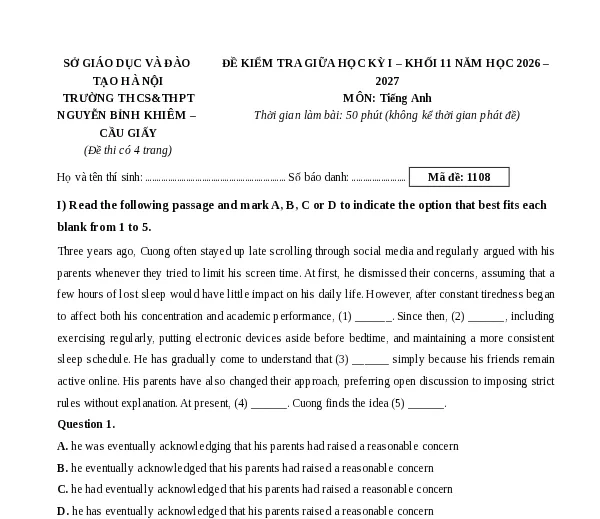
Read the following passage and mark the letter A, B, C, or D on your answer sheet to indicate the correct option that best fits each of the numbered blanks from 18 to 22.
The human immune system is a complex network of cells, tissues, and organs that work cooperatively to protect the body against dangerous invaders. Every single day, we encounter millions of pathogens such as bacteria, viruses, and fungi (18) ______. Without a functioning immune system, even a minor scratch or a common cold could lead to life-threatening complications.
Nutrition plays a pivotal role in strengthening this natural defense barrier. Medical evidence reveals that individuals (19) ______ are significantly more resilient against seasonal epidemics. Essential vitamins like vitamin C and vitamin D stimulate the production of white blood cells, which actively search for and neutralize harmful foreign substances.
In addition to wholesome nutrition, regular physical exercise serves as a powerful booster for our immunity. Engaging in moderate activities, such as brisk walking, cycling, or swimming, (20) ______. As blood circulation increases, immune cells are distributed more swiftly throughout the body, allowing them to detect potential infections at an early stage.
Nevertheless, modern lifestyle patterns can severely undermine immune defenses. Chronic psychological stress, combined with poor sleeping routines, triggers the release of cortisol, a hormone that (21) ______. Over time, people exposed to constant tension find themselves becoming ill much more frequently.
In summary, taking proactive steps toward an active routine, a nutrient-dense diet, and sufficient rest (22) ______. By taking care of our body daily, we construct an invincible armor for long-term health.
Câu 18.
A. which are capable of causing infectious diseases
B. whom people can transmit easily without knowing
C. that are completely harmless to our physical well-being
D. where harmful chemicals are continuously produced
Câu 19.
A. whose diets lack essential minerals and wholesome foods
B. who consume a balanced diet rich in antioxidant nutrients
C. whom doctors advise to take strong medications frequently
D. which frequently skip daily meals due to busy schedules
Câu 20.
A. improves cardiovascular health and enhances cellular circulation
B. will damage joint tissues and diminish physical endurance
C. having resulted in immediate exhaustion for sedentary teenagers
D. to reduce the natural capability of fighting against diseases
Câu 21.
A. can effectively eliminate any bacterial infection in the blood
B. suppresses immune response when present in high concentrations
C. stimulates the body to synthesize beneficial protective antibodies
D. helps teenagers fall asleep faster after exhausting physical work
Câu 22.
A. is considered the most reliable approach to sustaining longevity
B. will probably cause several unexpected metabolic complications
C. are often neglected by healthcare professionals around the globe
D. to demonstrate the necessity of relying heavily on pharmaceuticals
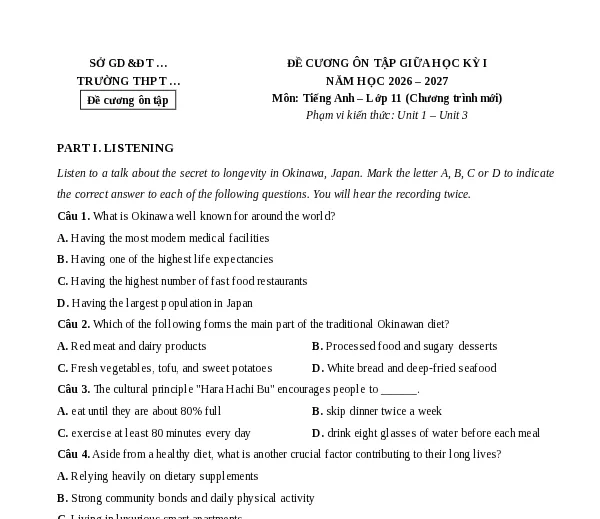
Read the following passage and mark the letter A, B, C, or D on your answer sheet to indicate the correct answer to each of the questions from 23 to 30.
Centenarians – people who live to be 100 years of age or older – were once viewed as rare medical anomalies. However, demographic statistics show that this population is growing faster than any other age group worldwide. Researchers exploring this phenomenon have identified several geographic areas known as "Blue Zones," including Okinawa in Japan, Sardinia in Italy, and Nicoya in Costa Rica. In these regions, individuals not only reach remarkable ages but also manage to remain physically vibrant and mentally alert well into their final decades.
A fundamental factor behind the extraordinary longevity in Blue Zones is their dietary pattern. Rather than relying on processed, pre-packaged foods, residents consume diets that are overwhelmingly plant-based. In Okinawa, for example, traditional meals emphasize sweet potatoes, tofu, and a wide array of green vegetables, while pork and fish are eaten only sparingly during special celebrations. Moreover, people in Okinawa adhere to the ancient cultural practice of Hara Hachi Bu, which instructs them to stop eating when their stomachs are approximately 80 percent full. This modest calorie intake prevents obesity and protects internal organs from metabolic strain.
Equally significant is the role of natural physical movement throughout the day. Unlike modern office workers who spend hours sitting down and then engage in strenuous workouts at gyms, residents in Blue Zones do not view exercise as a separate, isolated chore. Instead, their environments nudge them into constant, gentle movement. They tend lush vegetable gardens, knead bread by hand, walk up steep hills to visit neighbors, and climb stairs without mechanical assistance. This steady, lifelong activity helps them maintain healthy muscles and flexible joints without causing unnecessary physical injuries.
Finally, strong psychological support networks provide emotional cushioning against the damaging effects of chronic stress. In Sardinia, elderly citizens are deeply respected and live together with their extended families, giving them a profound sense of purpose. Similarly, Okinawans form moai, which are social circles of lifelong friends committed to supporting one another financially, practically, and emotionally. Surrounded by loving companions, older adults in these communities rarely suffer from acute loneliness or depression, proving that a long life is as much about human connection as it is about physical health.
Câu 23. What is the best title for the passage?
A. The Modern Craze for Strenuous Gym Workouts
B. Secrets of Longevity from the World's Blue Zones
C. The History of Medical Treatments in Okinawa
D. Why Modern Technology Eliminates Social Loneliness
Câu 24. The word anomalies in paragraph 1 is closest in meaning to ______.
A. exceptions
B. experts
C. benefits
D. symbols
Câu 25. According to paragraph 2, the Okinawan principle of Hara Hachi Bu advises people to ______.
A. avoid eating all kinds of meat and seafood
B. cease eating when they feel about eighty percent full
C. replace plant-based dishes with sugary processed foods
D. consume as many calories as possible during meals
Câu 26. The word strenuous in paragraph 3 is closest in meaning to ______.
A. exhausting
B. effortless
C. enjoyable
D. irregular
Câu 27. The word them in paragraph 3 refers to ______.
A. gym workouts
B. residents
C. environments
D. steep hills
Câu 28. Which of the following is NOT true according to paragraph 3?
A. Inhabitants of Blue Zones participate in continuous natural movements every day.
B. Blue Zone elders rely primarily on high-intensity gym routines to build stamina.
C. Gardening and walking up slopes are typical daily routines in Blue Zones.
D. Gentle daily actions prevent seniors from suffering severe physical trauma.
Câu 29. The word acute in paragraph 4 is opposite in meaning to ______.
A. severe
B. mild
C. painful
D. sudden
Câu 30. Which of the following can be inferred from the final paragraph?
A. Emotional bonds and social belonging contribute directly to extended life expectancy.
B. Living alone in modern cities is proven to be healthier than staying with family.
C. Elderly citizens in Sardinia generally feel burdensome to their younger relatives.
D. Financial assistance is the sole factor that holds the members of moai together.
Read the following passage and mark the letter A, B, C, or D on your answer sheet to indicate the correct answer to each of the questions from 31 to 40.
Antibiotics are widely celebrated as one of the most revolutionary discoveries in the history of medicine. Prior to the accidental identification of penicillin by Alexander Fleming in 1928, even seemingly minor bacterial infections – such as a scratch from a rose thorn or a bout of strep throat – could swiftly culminate in fatal outcomes. Following their widespread introduction in the mid-twentieth century, antibiotics have saved hundreds of millions of lives, transformed surgical procedures, and drastically increased global life expectancy. [A] Nevertheless, our over-reliance on these remarkable compounds has triggered a grave global health crisis known as antimicrobial resistance (AMR).
Antimicrobial resistance occurs when bacteria adapt and mutate in response to the medicines intended to neutralize them. [B] Whenever an individual takes an antibiotic, the drug successfully eradicates vulnerable bacteria; however, a microscopic handful of microbes with natural genetic mutations may survive. If the patient terminates their treatment prematurely or takes an inappropriate dosage, these surviving "superbugs" can multiply rapidly. Over successive generations, they share their protective traits with other bacterial strains through horizontal gene transfer, rendering standard therapies totally ineffective.
The root causes of this accelerating crisis lie in pervasive human mismanagement. In many developing territories, antibiotics can be purchased over the counter without a physician's prescription. Consequently, individuals frequently ingest powerful antibacterial drugs to treat conditions like the common cold, flu, or sore throat, despite the biological fact that these ailments are triggered by viruses, against which antibiotics are utterly powerless. [C] Furthermore, the agricultural sector contributes substantially to this dilemma. Millions of tons of antibiotics are administered to farm animals not to treat overt sickness, but to stimulate unnatural growth and prevent outbreaks in overcrowded livestock facilities. These resilient microbes eventually enter the food chain and contaminate natural water reservoirs.
The prospective ramifications of unmitigated antibiotic resistance are staggering. The World Health Organization has cautioned that without decisive collective intervention, common infections could claim up to ten million lives annually by 2050, matching the mortality toll of cancer. [D] Routine medical operations, including organ transplants, chemotherapy, and caesarean deliveries, would become exceptionally hazardous because physicians would no longer possess reliable tools to prevent post-procedural bacterial sepsis.
Combatting this impending catastrophe demands concerted action on multiple fronts. Healthcare practitioners must exercise rigorous stewardship by prescribing targeted antibiotics only when definitively justified by laboratory diagnostics. Simultaneously, the general public needs greater scientific literacy to understand that antibiotics are neither universal cure-alls nor remedies for viral infections. Only through international cooperation and responsible usage can humanity preserve the efficacy of these miraculous life-savers for generations to come.
Câu 31. Which of the following best serves as the main idea of the passage?
A. The biographical journey of Alexander Fleming and his groundbreaking medical innovations
B. The escalating hazard of antibiotic resistance resulting from human misuse and misapplication
C. The comparative effectiveness of pharmaceutical drugs versus holistic herbal treatments
D. Why modern agriculture should replace traditional livestock farming with artificial meat
Câu 32. The word culminate in paragraph 1 is closest in meaning to ______.
A. result
B. originate
C. protect
D. hesitate
Câu 33. Where in the passage does the following sentence best fit?
"This selective pressure accelerates the evolutionary emergence of strains impervious to existing pharmaceuticals."
A. [A]
B. [B]
C. [C]
D. [D]
Câu 34. According to paragraph 2, "superbugs" develop primarily because surviving bacteria ______.
A. are completely eradicated before they can reproduce
B. pass their resistance traits on to other bacterial strains
C. transform into harmless viral particles inside the human body
D. become vulnerable to lower dosages of prescribed medicine
Câu 35. The word pervasive in paragraph 3 is closest in meaning to ______.
A. widespread
B. temporary
C. confidential
D. accidental
Câu 36. The word they in paragraph 3 refers to ______.
A. antibacterial drugs
B. ailments
C. viruses
D. territories
Câu 37. Which of the following is TRUE about the use of antibiotics in agriculture according to paragraph 3?
A. Antibiotics are strictly banned in livestock farming across all countries.
B. Farmers utilize antibiotics solely when animals demonstrate severe symptoms of illness.
C. Antibiotics are administered to promote animal growth and suppress infections in crowded spaces.
D. Agricultural antibiotics have no connection with the contamination of local water supplies.
Câu 38. The word hazardous in paragraph 4 is opposite in meaning to ______.
A. dangerous
B. secure
C. complex
D. costly
Câu 39. Which of the following can be inferred from paragraph 4?
A. Cancer will be completely cured by 2050 using advanced antibiotic therapy.
B. Standard surgeries heavily depend on the efficacy of antibiotics to manage infection risks.
C. Organ transplants will be permanently discontinued worldwide within the next few years.
D. Sepsis is an inevitable outcome that occurs after every single modern surgical operation.
Câu 40. Which of the following best summarizes the solutions recommended in paragraph 5?
A. Halting all antibiotic production and relying entirely on traditional home remedies
B. Restricting pharmaceutical sales exclusively to wealthy nations with modern hospitals
C. Prudent medical prescribing paired with public enlightenment regarding proper drug application
D. Administering high dosages of antibiotics to the entire population as a preventive measure
--------- HẾT ---------
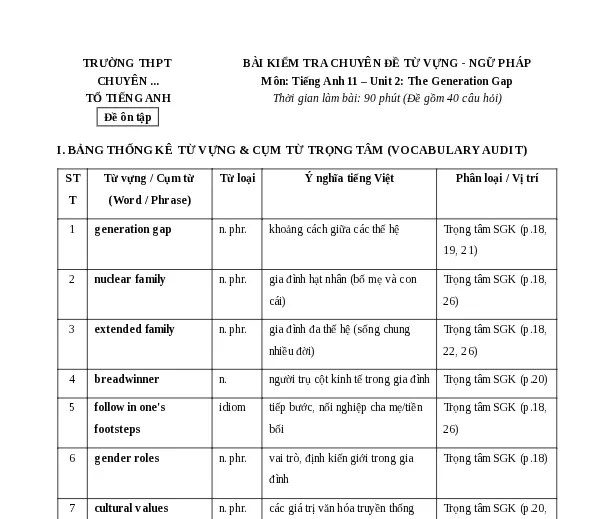
TỔNG HỢP TỪ VỰNG TRỌNG TÂM (UNIT 1: A LONG AND HEALTHY LIFE)
Từ vựng / Cụm từ | Phiên âm & Từ loại | Nghĩa tiếng Việt | Ngữ cảnh sử dụng tiêu biểu trong đề |
|---|---|---|---|
workout | /ˈwɜːkaʊt/ (n) | buổi tập thể dục, luyện tập | customized workout routines (bài tập cá nhân hóa) |
relieve (stress) | /rɪˈliːv/ (v) | làm dịu, giải tỏa (căng thẳng) | relieve stress after work (xả stress sau giờ làm) |
immune system | /ɪˈmjuːn ˌsɪstəm/ (n.phr) | hệ miễn dịch | a strong immune system (hệ miễn dịch khỏe mạnh) |
give up | /ɡɪv ʌp/ (phr.v) | từ bỏ (thói quen xấu) | give up sedentary habits (bỏ thói quen lười vận động) |
infectious | /ɪnˈfekʃəs/ (adj) | có tính lây nhiễm, truyền nhiễm | infectious diseases / illnesses (bệnh truyền nhiễm) |
life expectancy | /ˈlaɪf ɪkˌspektənsi/ (n.phr) | tuổi thọ trung bình | extending life expectancy (kéo dài tuổi thọ) |
longevity | /lɒnˈdʒevəti/ (n) | sự sống lâu, trường thọ | secrets to longevity (bí quyết trường thọ) |
adequate | /ˈædɪkwət/ (adj) | đầy đủ, thỏa đáng | adequate sleep (ngủ đủ giấc) |
antibiotic | /ˌæntibaɪˈɒtɪk/ (n) | thuốc kháng sinh | misuse of antibiotics (lạm dụng kháng sinh) |
cut down on | /kʌt daʊn ɒn/ (phr.v) | cắt giảm (tiêu thụ, nguy cơ) | cut down on processed foods / risk (giảm bớt) |
dietary | /ˈdaɪətəri/ (adj) | thuộc về chế độ ăn uống | dietary consultations / pattern (chế độ dinh dưỡng) |
nutritious | /njuːˈtrɪʃəs/ (adj) | giàu chất dinh dưỡng, bổ dưỡng | nutritious meals / diet (bữa ăn giàu dinh dưỡng) |
sedentary | /ˈsedntri/ (adj) | ít vận động, ngồi nhiều | sedentary lifestyle / habits (lối sống thụ động) |
pathogen | /ˈpæθədʒən/ (n) | mầm bệnh | bacteria and viruses are pathogens (vi khuẩn, virus) |
bacteria | /bækˈtɪəriə/ (n.pl) | vi khuẩn | bacteria develop resistance (vi khuẩn kháng thuốc) |
virus | /ˈvaɪrəs/ (n) | vi-rút | viral infection (nhiễm trùng do virus) |
strenuous | /ˈstrenjuəs/ (adj) | căng thẳng, đòi hỏi nhiều sức lực | strenuous workouts (các bài tập tốn nhiều sức) |
superbug | /ˈsuːpəbʌɡ/ (n) | siêu vi khuẩn kháng thuốc | resistant superbugs (siêu khuẩn kháng thuốc) |
antimicrobial resistance (AMR) | /ˌænti maɪˈkrəʊbiəl rɪˈzɪstəns/ (n.phr) | hiện tượng kháng kháng sinh | grave global health crisis of AMR (khủng hoảng AMR) |
hazardous | /ˈhæzədəs/ (adj) | nguy hiểm, độc hại | exceptionally hazardous operations (phẫu thuật nguy hiểm) |