SỞ GIÁO DỤC VÀ ĐÀO TẠO
TRƯỜNG THPT …
Đề tham khảo
ĐỀ ÔN TẬP CHUYÊN ĐỀ – UNIT 2
Môn: Tiếng Anh – Lớp 10
Thời gian làm bài: 50 phút (không kể thời gian phát đề)
Họ và tên thí sinh: ................................................................ Số báo danh: ............................................................ | Mã đề: 102 |
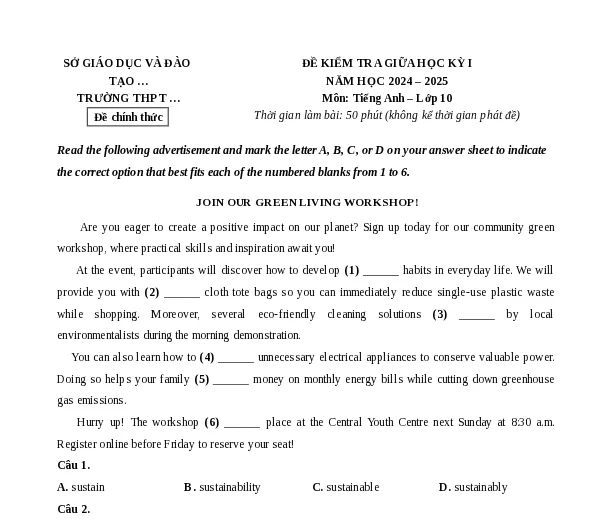
Read the following advertisement and mark the letter A, B, C or D on your answer sheet to indicate the option that best fits each of the numbered blanks from 1 to 6.
JOIN THE "GREEN YOUTH" CLUB TODAY!
Are you worried about the future of our planet? Do you want to live a more sustainable lifestyle? The Green Youth Club is looking for active high school students to join our upcoming (1) ______ campaign this Sunday!
Over the past few months, tons of plastic waste (2) ______ in our local parks and rivers by careless visitors. This has caused serious harm to the local ecosystem. Therefore, we have decided to take action! By joining our club, you will have the opportunity to participate (3) ______ meaningful activities such as tree-planting events, recycling workshops, and community clean-ups.
We also encourage our members (4) ______ eco-friendly habits at home and at school. Every week, a special workshop on (5) ______ is held by environmental experts at the school hall. Don't hesitate! Together, we can (6) ______ a big difference to our community and protect the Earth for future generations.
Sign up at Room 204 or visit our website at www.greenyouthclub.org!
Question 1.
A. environment
B. environmental
C. environmentally
D. environmentalist
Question 2.
A. have left
B. left
C. have been left
D. were leaving
Question 3.
A. in
B. on
C. at
D. with
Question 4.
A. adopt
B. adopting
C. to adopt
D. adopted
Question 5.
A. energy household saving
B. household energy saving
C. saving energy household
D. household saving energy
Question 6.
A. do
B. take
C. make
D. put
Read the following leaflet and mark the letter A, B, C or D on your answer sheet to indicate the option that best fits each of the numbered blanks from 7 to 12.
SMALL STEPS TOWARDS A GREENER HOME
Protecting the environment doesn't always require huge efforts. You can reduce your carbon footprint right at home by following these simple tips!
- Cut down on single-use plastics: Every year, millions of plastic bags and bottles are thrown away. Instead of buying bottled water, carry a refillable bottle with you. You can also bring your own cloth bags when going shopping so that you don't have to use (7) ______ plastic ones at the supermarket.
- Save electricity: Always remember to (8) ______ your electrical appliances when they are not in use. Leaving your TV or computer on standby still consumes a significant (9) ______ of energy and increases your monthly electricity bill.
- Choose organic products: Try to buy organic food at your local market. These products are grown without harmful (10) ______, which keeps both your family's health and the soil safe.
- Sort your household waste: Separate recyclable items such as paper, glass, and metal from food waste. (11) ______ throwing everything into one bin, use different bins to make the recycling process much easier and more effective. Let's act now to preserve our natural (12) ______!
Question 7.
A. other
B. others
C. the other
D. another
Question 8.
A. turn off
B. take off
C. put off
D. give off
Question 9.
A. number
B. amount
C. plenty
D. variedad
Question 10.
A. emissions
B. appliances
C. chemicals
D. footprints
Question 11.
A. Because of
B. In addition to
C. Instead of
D. In spite of
Question 12.
A. materials
B. resources
C. sources
D. substances
Mark the letter A, B, C or D on your answer sheet to indicate the best arrangement of utterances or sentences to make a meaningful exchange or text in each of the following questions from 13 to 17.
Question 13.
a. Nam: That's a great idea! I'll bring some reusable bags and gloves for both of us.
b. Mai: Hi Nam, are you free this Saturday morning? Our youth union is organizing a beach clean-up.
c. Nam: Yes, I am. I'd love to join! What time does it start?
A. b – c – a
B. a – b – c
C. c – b – a
D. b – a – c
Question 14.
a. Lan: Well, it helps reduce the amount of household waste sent to landfills and creates natural fertilizer for my garden.
b. Minh: Why do you spend so much time sorting food waste every day, Lan?
c. Minh: Really? I didn't know food waste could be turned into compost. Can you show me how to do it?
d. Lan: I'm making compost from vegetable peels and fruit scraps.
e. Minh: Oh, I see. What are the benefits of doing that?
A. b – d – e – a – c
B. b – a – e – d – c
C. d – b – a – e – c
D. b – d – c – a – e
Question 15.
Dear Mr. Harrison,
a. Furthermore, we plan to place recycling bins in every classroom to encourage students to sort their daily rubbish.
b. I am writing on behalf of the Student Council to propose a new "Green School" project for this semester.
c. We hope that you will consider our proposal and give us permission to launch the project next month.
d. Firstly, we would like to organize a "Tree Planting Day" on the school campus next Saturday to create more shade and fresh air.
e. We believe these practical activities will raise students' awareness of environmental protection.
Yours sincerely,
Nguyen Minh An
A. b – d – a – e – c
B. b – a – d – c – e
C. d – a – b – e – c
D. b – e – d – a – c
Question 16.
a. First of all, walking or cycling to school instead of going by motorbike helps reduce carbon emissions and keeps us fit.
b. Living a green lifestyle is not as difficult as many people think if we start with small daily changes.
c. Finally, planting more trees and flowers around our house will provide shade and make the air cleaner.
d. In addition, we should turn off lights, fans, and air conditioners whenever we leave a room to save electricity.
e. In conclusion, these simple habits can make a huge contribution to protecting our planet.
A. a – d – c – b – e
B. b – a – d – c – e
C. b – d – a – e – c
D. b – c – a – d – e
Question 17.
a. Consequently, marine animals such as sea turtles and dolphins often mistake plastic debris for food and die from eating it.
b. Plastic pollution has become one of the most pressing environmental issues facing our oceans today.
c. To solve this problem, governments and individuals must work together to ban single-use plastics and promote eco-friendly alternatives.
d. Every year, millions of tons of plastic waste are dumped into the sea from coastal cities and rivers.
e. Unlike organic materials, plastic takes hundreds of years to decompose and breaks down into tiny microplastics.
A. b – d – e – a – c
B. b – e – d – c – a
C. d – b – e – a – c
D. b – a – d – e – c
Read the following passage and mark the letter A, B, C or D on your answer sheet to indicate the option that best fits each of the numbered blanks from 18 to 22.
Carbon footprint is the total amount of greenhouse gases, vooral carbon dioxide, that are generated by our daily activities. Almost everything we do, from the food we eat to the way we travel, releases温室 gases into the atmosphere. Therefore, reducing our carbon footprint (18) ______.
One of the most effective ways to cut down on carbon emissions is changing our transportation habits. In many big cities, private vehicles such as cars and motorbikes are the main source of air pollution. If more people choose public transport like buses or skytrains, (19) ______. For short distances, walking or riding a bicycle is even better because it produces zero emissions and improves our physical health.
Another important factor is energy consumption in our homes. Many household appliances, such as refrigerators, air conditioners, and water heaters, consume a lot of electricity, (20) ______. To save energy, we should switch to energy-saving light bulbs and unplug electronic devices when they are not in use. Moreover, installing solar panels on the roof is a great choice for families (21) ______.
Finally, our diet also plays a significant role in protecting the environment. Producing meat, especially beef, requires huge amounts of water and land while releasing large quantities of methane, a powerful greenhouse gas. By eating more locally grown vegetables and fruits, (22) ______.
Question 18.
A. is considered one of the most urgent tasks to slow down global warming
B. which is considered one of the most urgent tasks to slow down global warming
C. considering one of the most urgent tasks to slow down global warming
D. was considering one of the most urgent tasks to slow down global warming
Question 19.
A. the amount of exhaust fumes in the air will be significantly reduced
B. the amount of exhaust fumes in the air would reduce significantly
C. people will be reduced the amount of exhaust fumes in the air
D. exhaust fumes in the air are going to reduce people significantly
Question 20.
A. most of which is still produced from burning fossil fuels like coal and gas
B. that is mostly produced from burning fossil fuels like coal and gas
C. whose production from burning fossil fuels like coal and gas is still high
D. produced mostly from burning fossil fuels like coal and gas is still common
Question 21.
A. who want to use clean and renewable energy sources
B. wanted to use clean and renewable energy sources
C. whom want to use clean and renewable energy sources
D. are wanting to use clean and renewable energy sources
Question 22.
A. we can both improve our health and lower our impact on the environment
B. our health and our impact on the environment can be both improved
C. the environment can lower its impact and improve our health
D. lowering our impact on the environment helps improve its health
Read the following passage and mark the letter A, B, C or D on your answer sheet to indicate the best answer to each of the questions from 23 to 30.
STUDENTS LEADING THE GREEN REVOLUTION
In recent years, high schools across Vietnam have started adopting the "Green School" model to raise students' awareness of environmental issues. Instead of only learning about climate change and pollution through textbooks, students are now taking part in practical activities right on their school campuses. These initiatives not only make the school environment cleaner and greener but also help young people develop sustainable habits for life.
One of the most popular activities is the "Zero Plastic Waste" campaign. At Nguyen Trai High School, students are encouraged to bring their own refillable water bottles instead of buying single-use plastic bottles at the canteen. Free water dispensers have been installed on every floor so that students can easily refill their bottles between classes. As a result, the amount of plastic waste collected at the school has dropped by nearly 60% in just one semester. Furthermore, the school canteen has replaced plastic straws and foam food boxes with biodegradable paper ones.
Another creative project is the "Trash for Trees" exchange program organized by the school's Go Green Club once a month. Students collect used paper, cardboard, aluminum cans, and old batteries from their homes and bring them to the club's booth. In return, they receive small potted plants or flower seeds to decorate their classrooms. The collected recyclable items are then sold to local recycling factories, and the money raised is used to buy more trees for the school garden.
Thanks to these hands-on projects, students have become much more conscious of their daily choices. Many of them have even persuaded their parents and neighbors to sort household waste and save energy at home. Clearly, when young people are given the chance to lead, their small actions at school can inspire positive changes across the whole community.
Question 23. Which of the following is NOT mentioned in paragraph 3 as an item that students bring to the "Trash for Trees" booth?
A. used paper
B. glass bottles
C. aluminum cans
D. old batteries
Question 24. The word they in paragraph 3 refers to ______.
A. old batteries
B. classrooms
C. students
D. recycling factories
Question 25. The word persuaded in paragraph 4 is CLOSEST in meaning to ______.
A. convinced
B. prevented
C. forced
D. refused
Question 26. The word biodegradable in paragraph 2 is OPPOSITE in meaning to ______.
A. eco-friendly
B. natural
C. non-recyclable
D. polluting
Question 27. Which of the following best paraphrases the underlined sentence in paragraph 2: "As a result, the amount of plastic waste collected at the school has dropped by nearly 60% in just one semester."?
A. Consequently, plastic rubbish at the school has decreased by almost 60% within a single term.
B. Therefore, nearly 60% of the students at the school have stopped collecting plastic waste this term.
C. Because of this, the school has collected 60% more plastic waste than it did in the previous semester.
D. In short, only 60% of the plastic waste at the school can be recycled after one semester.
Question 28. Which of the following is TRUE according to the passage?
A. Students at Nguyen Trai High School have to pay a small fee to use the water dispensers.
B. The "Trash for Trees" program takes place every week at Nguyen Trai High School.
C. Money earned from selling recyclable waste is spent on buying more trees for the school garden.
D. Students only learn about environmental protection through textbooks in the "Green School" model.
Question 29. In which paragraph does the writer mention the positive influence of students on their families and local community?
A. Paragraph 1
B. Paragraph 2
C. Paragraph 3
D. Paragraph 4
Question 30. In which paragraph does the writer describe changes made at the school canteen to reduce plastic waste?
A. Paragraph 1
B. Paragraph 2
C. Paragraph 3
D. Paragraph 4
Read the following passage and mark the letter A, B, C or D on your answer sheet to indicate the best answer to each of the questions from 31 to 40.
THE HIDDEN ENVIRONMENTAL COST OF FAST FASHION
Over the last two decades, the way people buy and wear clothes has changed dramatically. Driven by social media trends and low prices, "fast fashion"—the rapid mass production of cheap clothing—has become a global phenomenon. [I] Today, consumers buy 60% more clothes than they did twenty years ago, yet they keep each item for only half as long. [II] While this allows people to update their wardrobes frequently without spending much money, it comes at a devastating cost to our planet. [III] Unfortunately, most shoppers remain unaware of how their clothing choices affect the natural environment. [IV]
First of all, the fashion industry is one of the largest consumers of water in the world. Growing cotton, the most common natural fiber used in clothing, requires enormous amounts of water. For instance, it takes approximately 2,700 liters of water to produce just one cotton T-shirt—enough drinking water for one person for two and a half years. In addition, dyeing and treating fabrics involve thousands of toxic chemicals. In many developing countries, untreated wastewater from textile factories is discharged directly into local rivers, poisoning aquatic life and contaminating the water supply of nearby communities.
Furthermore, fast fashion contributes heavily to plastic pollution and global warming. To keep production costs low, manufacturers increasingly rely on synthetic fibers such as polyester and nylon, which are made from fossil fuels. Every time these synthetic clothes are washed in a household washing machine, they shed hundreds of thousands of tiny plastic fibers known as microplastics. Because these fibers are too small to be filtered out by sewage treatment plants, they end up in the ocean and enter the food chain through fish and shellfish. At the same time, the fashion industry accounts for nearly 10% of global carbon emissions—more than all international flights and maritime shipping combined.
What happens to these cheap clothes when they go out of style after just a few wears? Less than 1% of used clothing is actually recycled into new garments. The vast majority—around 85% of all textiles produced each year—is either burned in incinerators or dumped into massive landfills, where synthetic fabrics can take up to 200 years to decompose.
Fortunately, consumers have the power to change this unsustainable trend. By choosing quality over quantity, buying second-hand clothes, or swapping old items with friends, we can significantly reduce our fashion footprint. Supporting eco-friendly brands that use organic or recycled materials is another practical step towards protecting the environment.
Question 31. Where in paragraph 1 does the following sentence best fit?
"Every week, millions of new garments arrive in stores to satisfy the endless demand for the latest styles."
A. [I]
B. [II]
C. [III]
D. [IV]
Question 32. The word enormous in paragraph 2 is CLOSEST in meaning to ______.
A. tiny
B. huge
C. limited
D. moderate
Question 33. The word they in paragraph 3 refers to ______.
A. fossil fuels
B. manufacturers
C. synthetic clothes
D. washing machines
Question 34. The word decompose in paragraph 4 is OPPOSITE in meaning to ______.
A. decay
B. break down
C. remain intact
D. disappear
Question 35. According to paragraph 2, why is the production of a cotton T-shirt harmful to the environment?
A. It consumes a vast quantity of water and often involves toxic chemicals during fabric dyeing.
B. It releases millions of microplastics into local rivers when the T-shirt is washed.
C. Cotton plants release more carbon dioxide into the air than synthetic fibers do.
D. Cotton fabrics take more than 200 years to break down in landfills.
Question 36. Which of the following best summarizes paragraph 3?
A. Synthetic clothes are popular because they are cheap and easy to wash in household machines.
B. The use of synthetic fibers in fast fashion causes severe microplastic pollution in oceans and high carbon emissions.
C. Sewage treatment plants need to be upgraded to filter out microplastics from household washing machines.
D. International flights and maritime shipping produce more greenhouse gases than the textile industry.
Question 37. Which of the following is NOT TRUE according to the passage?
A. People nowadays keep their clothes for a shorter period of time than they did twenty years ago.
B. Polyester and nylon are synthetic fibers produced from fossil fuels.
C. Most used clothes are successfully recycled into new garments every year.
D. Wastewater from textile factories can pollute rivers in developing countries.
Question 38. Which of the following best paraphrases the underlined sentence in paragraph 5?
A. Our clothing's environmental impact can be greatly lowered if we buy fewer but more durable items, purchase used clothes, or exchange garments with friends.
B. Unless we stop buying new clothes and only wear second-hand items from our friends, we cannot reduce our carbon footprint.
C. Buying expensive designer clothes is the only way for consumers to reduce the amount of textile waste sent to landfills.
D. Swapping old clothes with friends is much more effective than buying second-hand items when it comes to protecting the planet.
Question 39. Which of the following can be inferred from the passage?
A. Eating seafood may expose humans to microplastics that originate from washing synthetic clothes.
B. Fast fashion brands will completely stop using cotton in the near future to save water.
C. Developing countries consume more fast fashion products than developed countries do.
D. Burning old clothes in incinerators is an eco-friendly way to deal with textile waste.
Question 40. Which of the following best summarizes the passage?
A. Fast fashion offers affordable and trendy clothes to consumers worldwide, boosting the global economy despite minor environmental concerns.
B. The rapid growth of fast fashion causes severe water depletion, chemical and microplastic pollution, high carbon emissions, and massive textile waste, requiring consumers to adopt more sustainable shopping habits.
C. Governments should ban the production of synthetic fibers like polyester and force textile factories to install advanced water treatment systems.
D. Cotton farming is the primary cause of global water shortages, so consumers should switch to wearing synthetic clothes made from recycled plastic.
--------- THE END ---------
Thí sinh không được sử dụng tài liệu. Cán bộ coi thi không giải thích gì thêm.
SỞ GIÁO DỤC VÀ ĐÀO TẠO
TRƯỜNG THPT …
Hướng dẫn chấm
ĐÁP ÁN VÀ HƯỚNG DẪN GIẢI CHI TIẾT
ĐỀ ÔN TẬP CHUYÊN ĐỀ – UNIT 2 (TIẾNG ANH 10)
Môn: Tiếng Anh – Lớp 10 (Mã đề: 102)
A. BẢNG ĐÁP ÁN TRẮC NGHIỆM (10,0 điểm)
Mỗi câu trả lời đúng được 0,25 điểm (40 câu x 0,25 = 10,0 điểm).
Câu | Đáp án | Câu | Đáp án | Câu | Đáp án | Câu | Đáp án |
|---|---|---|---|---|---|---|---|
1 | B | 11 | C | 21 | A | 31 | A |
2 | C | 12 | B | 22 | A | 32 | B |
3 | A | 13 | A | 23 | B | 33 | C |
4 | C | 14 | A | 24 | C | 34 | C |
5 | B | 15 | A | 25 | A | 35 | A |
6 | C | 16 | B | 26 | D | 36 | B |
7 | A | 17 | A | 27 | A | 37 | C |
8 | A | 18 | A | 28 | C | 38 | A |
9 | B | 19 | A | 29 | D | 39 | A |
10 | C | 20 | A | 30 | B | 40 | B |
B. LỜI GIẢI CHI TIẾT
Question 1. Đáp án B
- Kiến thức: Từ loại (Word form).
- Giải thích: Trước danh từ "campaign" (chiến dịch) cần một tính từ để bổ nghĩa. Environmental (adj): thuộc về môi trường → environmental campaign (chiến dịch bảo vệ môi trường).
Question 2. Đáp án C
- Kiến thức: Câu bị động (Passive voice) – trọng tâm ngữ pháp Unit 2.
- Giải thích: Dấu hiệu "Over the past few months" (chia thì hiện tại hoàn thành) và "by careless visitors" (câu bị động). Chủ ngữ "tons of plastic waste" là số nhiều → have been left.
Question 3. Đáp án A
- Kiến thức: Giới từ.
- Giải thích: Cụm động từ participate in sth (= take part in sth): tham gia vào hoạt động gì.
Question 4. Đáp án C
- Kiến thức: Danh động từ và động từ nguyên mẫu (To-infinitive).
- Giải thích: Cấu trúc encourage sb to do sth: khuyến khích ai làm gì. Ngoài ra cụm từ vựng Unit 2 là adopt eco-friendly habits (áp dụng thói quen thân thiện với môi trường).
Question 5. Đáp án B
- Kiến thức: Trật tự từ trong cụm danh từ (Word order).
- Giải thích: Danh từ chính là saving (việc tiết kiệm), bổ nghĩa trực tiếp là energy (năng lượng) → energy saving (việc tiết kiệm năng lượng); bổ nghĩa phạm vi phía trước là household (trong gia đình) → household energy saving (việc tiết kiệm năng lượng trong gia đình).
Question 6. Đáp án C
- Kiến thức: Cụm từ cố định (Collocation).
- Giải thích: Cụm từ make a difference (to sth): tạo nên sự khác biệt/thay đổi tích cực.
Question 7. Đáp án A
- Kiến thức: Lượng từ (Quantifiers).
- Giải thích: Phía sau có danh từ/đại từ số nhiều "plastic ones" (những chiếc túi nhựa khác) chưa xác định → dùng other + N số nhiều.
Question 8. Đáp án A
- Kiến thức: Cụm động từ (Phrasal verbs) thuộc chủ đề Unit 2.
- Giải thích: turn off: tắt (các thiết bị điện); take off: cất cánh/cởi đồ; put off: trì hoãn; give off: tỏa ra/thải ra.
Question 9. Đáp án B
- Kiến thức: Từ chỉ định lượng.
- Giải thích: "energy" là danh từ không đếm được → dùng a significant amount of energy (một lượng năng lượng đáng kể). A number of đi với danh từ đếm được số nhiều.
Question 10. Đáp án C
- Kiến thức: Từ vựng Unit 2.
- Giải thích: Thực phẩm hữu cơ (organic food) được trồng mà không sử dụng các hóa chất độc hại → harmful chemicals. (emissions: khí thải; appliances: thiết bị; footprints: dấu chân).
Question 11. Đáp án C
- Kiến thức: Liên từ/Cụm giới từ.
- Giải thích: "Thay vì (Instead of) vứt mọi thứ vào chung một thùng rác, hãy dùng các thùng khác nhau...".
Question 12. Đáp án B
- Kiến thức: Từ vựng (Collocation).
- Giải thích: Cụm danh từ natural resources: tài nguyên thiên nhiên.
Question 13. Đáp án A
- Kiến thức: Sắp xếp hội thoại ngắn.
- Giải thích: Mai rủ Nam đi dọn rác bãi biển vào sáng thứ Bảy (b) → Nam đồng ý và hỏi giờ bắt đầu (c) → Mai/Nam hưởng ứng và chuẩn bị túi tái sử dụng, găng tay (a). Trật tự hợp lý: b – c – a.
Question 14. Đáp án A
- Kiến thức: Sắp xếp hội thoại 5 lượt lời.
- Giải thích: Minh hỏi lý do Lan dành thời gian phân loại rác thực phẩm (b) → Lan trả lời đang làm phân hữu cơ (d) → Minh hỏi lợi ích của việc đó (e) → Lan giải thích giúp giảm rác thải ra bãi chôn lấp và tạo phân bón tự nhiên (a) → Minh ngạc nhiên và nhờ Lan chỉ cách làm (c).
Question 15. Đáp án A
- Kiến thức: Sắp xếp bức thư đề xuất (Proposal letter).
- Giải thích: Nêu mục đích viết thư đề xuất dự án "Trường học Xanh" (b) → Hoạt động thứ nhất "Firstly..." (d) → Hoạt động tiếp theo "Furthermore..." (a) → Nêu ý nghĩa của các hoạt động (e) → Lời kết mong thầy hiệu trưởng xem xét phê duyệt (c).
Question 16. Đáp án B
- Kiến thức: Sắp xếp đoạn văn chủ đề lối sống xanh.
- Giải thích: Câu chủ đề mở đoạn (b) → Ý thứ nhất "First of all..." (a) → Ý bổ sung "In addition..." (d) → Ý cuối "Finally..." (c) → Câu kết luận "In conclusion..." (e).
Question 17. Đáp án A
- Kiến thức: Sắp xếp đoạn văn về ô nhiễm nhựa đại dương.
- Giải thích: Câu chủ đề giới thiệu vấn đề ô nhiễm nhựa ở đại dương (b) → Thực trạng hàng triệu tấn rác nhựa đổ ra biển mỗi năm (d) → Đặc tính nhựa mất hàng trăm năm để phân hủy thành vi nhựa (e) → Hậu quả "Consequently..." đối với sinh vật biển (a) → Giải pháp "To solve this problem..." (c).
Question 18. Đáp án A
- Kiến thức: Cấu trúc câu (Vị ngữ của câu).
- Giải thích: Chủ ngữ của câu là cụm danh động từ "reducing our carbon footprint" (số ít), cần một động từ chính chia ở thể bị động → is considered one of the most urgent tasks...
Question 19. Đáp án A
- Kiến thức: Câu điều kiện loại 1 & Câu bị động (Tương lai đơn bị động: will be + V3/ed).
- Giải thích: Mệnh đề If ở hiện tại đơn ("choose"), mệnh đề chính diễn tả kết quả có thật ở tương lai. Chủ ngữ "the amount of exhaust fumes" (lượng khí thải) chịu tác động nên chia bị động: will be significantly reduced.
Question 20. Đáp án A
- Kiến thức: Mệnh đề quan hệ nối tiếp sau dấu phẩy.
- Giải thích: Thay thế cho danh từ không đếm được "electricity" đứng trước dấu phẩy → dùng most of which + V số ít (is still produced...). Không dùng that sau dấu phẩy.
Question 21. Đáp án A
- Kiến thức: Mệnh đề quan hệ.
- Giải thích: Bổ nghĩa cho danh từ chỉ người/nhóm người "families" (số nhiều) làm chủ ngữ → dùng đại từ quan hệ who + want to use...
Question 22. Đáp án A
- Kiến thức: Sự hòa hợp chủ ngữ khi rút gọn mệnh đề đồng chủ ngữ (By + V-ing).
- Giải thích: Cụm "By eating more locally grown vegetables and fruits" có chủ ngữ ngầm là con người (we) → mệnh đề chính phải có chủ ngữ là we: we can both improve our health and lower our impact on the environment.
Question 23. Đáp án B
- Kiến thức: Đọc tìm chi tiết (NOT mentioned).
- Giải thích: Đoạn 3 nêu: "Students collect used paper, cardboard, aluminum cans, and old batteries..." Không đề cập đến glass bottles (chai thủy tinh).
Question 24. Đáp án C
- Kiến thức: Quy chiếu (Reference).
- Giải thích: Câu trước nói học sinh (Students) mang rác tái chế đến gian hàng của câu lạc bộ; câu sau "In return, they receive small potted plants..." → they thay thế cho students.
Question 25. Đáp án A
- Kiến thức: Từ đồng nghĩa (Closest meaning).
- Giải thích: persuade (thuyết phục) = convince. (prevent: ngăn cản; force: ép buộc; refuse: từ chối).
Question 26. Đáp án D
- Kiến thức: Từ trái nghĩa (Opposite meaning).
- Giải thích: biodegradable (có thể phân hủy sinh học, thân thiện môi trường) >< polluting (gây ô nhiễm).
Question 27. Đáp án A
- Kiến thức: Diễn giải câu (Paraphrasing).
- Giải thích: Câu gốc: "Do đó, lượng rác thải nhựa thu gom tại trường đã giảm gần 60% chỉ trong một học kỳ." = Đáp án A (Consequently = As a result; plastic rubbish = plastic waste; decreased by almost 60% = dropped by nearly 60%; within a single term = in just one semester).
Question 28. Đáp án C
- Kiến thức: Đọc hiểu chi tiết Đúng/Sai (True/False).
- Giải thích: Thông tin ở câu cuối đoạn 3: "...and the money raised is used to buy more trees for the school garden." (A sai vì nước miễn phí "Free water dispensers"; B sai vì diễn ra mỗi tháng một lần "once a month"; D sai vì học sinh tham gia hoạt động thực tế chứ không chỉ học qua sách giáo khoa).
Question 29. Đáp án D
- Kiến thức: Định vị thông tin theo đoạn.
- Giải thích: Đoạn 4 đề cập đến việc học sinh thuyết phục bố mẹ và hàng xóm phân loại rác và tiết kiệm năng lượng, lan tỏa thay đổi tích cực ra cả cộng đồng.
Question 30. Đáp án B
- Kiến thức: Định vị thông tin theo đoạn.
- Giải thích: Câu cuối đoạn 2 nêu: "Furthermore, the school canteen has replaced plastic straws and foam food boxes with biodegradable paper ones."
Question 31. Đáp án A
- Kiến thức: Vị trí chèn câu (Sentence insertion).
- Giải thích: Câu cần chèn nói về việc hàng triệu bộ quần áo mới được đưa vào cửa hàng mỗi tuần để đáp ứng nhu cầu mẫu mã mới. Đặt ở vị trí [I] ngay sau câu định nghĩa "fast fashion—the rapid mass production of cheap clothing" giúp làm rõ khái niệm sản xuất hàng loạt tốc độ cao và dẫn dắt tự nhiên sang số liệu tiêu thụ ở câu sau ("Today, consumers buy 60% more clothes...").
Question 32. Đáp án B
- Kiến thức: Từ đồng nghĩa.
- Giải thích: enormous (khổng lồ, rất lớn) = huge. (tiny: nhỏ bé; limited: hạn chế; moderate: vừa phải).
Question 33. Đáp án C
- Kiến thức: Quy chiếu.
- Giải thích: "Every time these synthetic clothes are washed in a household washing machine, they shed hundreds of thousands of tiny plastic fibers..." → they chỉ synthetic clothes.
Question 34. Đáp án C
- Kiến thức: Từ trái nghĩa.
- Giải thích: decompose (phân hủy, mục rữa) >< remain intact (giữ nguyên vẹn, không bị phân hủy).
Question 35. Đáp án A
- Kiến thức: Đọc tìm chi tiết.
- Giải thích: Thông tin ở đoạn 2: Trồng bông tốn lượng nước khổng lồ (2.700 lít cho 1 chiếc áo phông) và quá trình nhuộm vải sử dụng hàng ngàn hóa chất độc hại xả ra sông ngòi.
Question 36. Đáp án B
- Kiến thức: Tóm tắt ý chính của đoạn văn.
- Giải thích: Đoạn 3 tập trung vào 2 tác hại của sợi tổng hợp (synthetic fibers) trong thời trang nhanh: thải hạt vi nhựa (microplastics) ra đại dương khi giặt và phát thải gần 10% lượng khí nhà kính toàn cầu.
Question 37. Đáp án C
- Kiến thức: Đọc tìm thông tin KHÔNG ĐÚNG (NOT TRUE).
- Giải thích: Đoạn 4 nêu: "Less than 1% of used clothing is actually recycled into new garments." (Chưa đến 1% quần áo cũ được tái chế thành quần áo mới) → Câu C nói "Hầu hết quần áo cũ được tái chế thành công" là SAI.
Question 38. Đáp án A
- Kiến thức: Diễn giải câu (Paraphrasing).
- Giải thích: Câu gốc: "Bằng cách chọn chất lượng hơn số lượng, mua quần áo cũ hoặc trao đổi đồ cũ với bạn bè, chúng ta có thể giảm đáng kể dấu chân thời trang của mình." → Khớp hoàn toàn về nghĩa với đáp án A (không chứa từ tuyệt đối hóa sai lệch như B, C hay so sánh sai như D).
Question 39. Đáp án A
- Kiến thức: Suy luận (Inference).
- Giải thích: Đoạn 3 nêu: khi giặt quần áo sợi tổng hợp, hạt vi nhựa trôi ra đại dương và đi vào chuỗi thức ăn qua cá và động vật có vỏ ("...they end up in the ocean and enter the food chain through fish and shellfish."). Từ đó suy ra con người ăn hải sản có thể bị nhiễm vi nhựa bắt nguồn từ việc giặt quần áo sợi tổng hợp.
Question 40. Đáp án B
- Kiến thức: Tóm tắt toàn bài (Passage summary).
- Giải thích: Toàn bài phân tích các tác hại nghiêm trọng của thời trang nhanh đối với môi trường (tiêu tốn nước, ô nhiễm hóa chất và vi nhựa, phát thải carbon cao, rác thải dệt may khổng lồ) và kêu gọi người tiêu dùng thay đổi thói quen mua sắm bền vững hơn → Đáp án B bao quát đầy đủ các luận điểm chính của bài.