SỞ GIÁO DỤC VÀ ĐÀO TẠO …
TRƯỜNG THPT …
Đề chính thức
ĐỀ KIỂM TRA GIỮA HỌC KỲ I
Môn: Tiếng Anh – Lớp 11
Thời gian làm bài: 60 phút
I. LISTENING (2,0 points)
You will hear each recording twice. There is a short pause before each recording.
Part 1. Questions 1 – 4
Listen to a conversation between a radio host and Dr. Lan about teenagers and sleep. Choose the best answer to each question.
Câu 1. How much sleep do most teenagers need a night?
A. Six to seven hours
B. Seven to nine hours
C. Eight to ten hours
D. More than eleven hours
Câu 2. According to Dr. Lan, what is the main reason many teenagers stay up late?
A. They are busy with homework.
B. They use their phones in bed.
C. They drink too much coffee.
D. They play sports in the evening.
Câu 3. What does Dr. Lan advise parents to do?
A. Take their children's phones away.
B. Let their children decide their own bedtime.
C. Ask the teachers for help.
D. Agree on a fixed bedtime with their children.
Câu 4. What does Dr. Lan say about exercise?
A. Teenagers should do at least an hour of sport every day.
B. A short walk after dinner helps teenagers fall asleep faster.
C. Exercise in the evening keeps teenagers awake.
D. Teenagers should exercise only in the morning.
Part 2. Questions 5 – 8
Listen to a talk about cities in the future and decide whether each statement is True (T) or False (F).
Câu 5. By 2050, more than two thirds of the world's population will live in cities.
A. True
B. False
Câu 6. All buildings in future cities will produce their own electricity.
A. True
B. False
Câu 7. Cars will not be allowed in the centre of future cities.
A. True
B. False
Câu 8. The biggest change in future cities will be the number of tall buildings.
A. True
B. False
II. LANGUAGE (3,0 points)
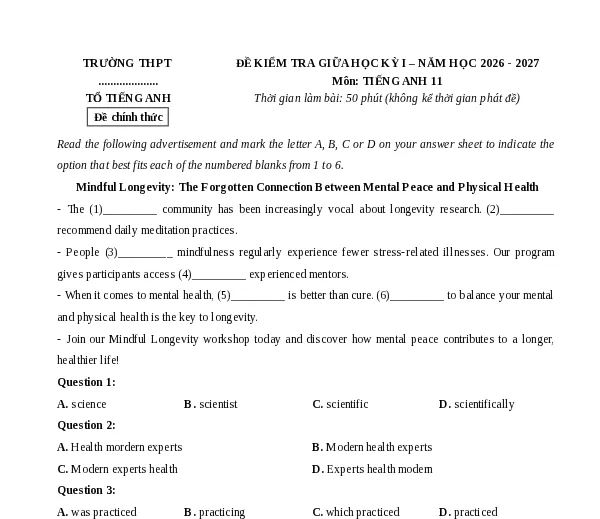
Read the following advertisement and mark the letter A, B, C or D to indicate the option that best fits each of the numbered blanks from 9 to 14.
FAMILY DAY — BRIDGING THE GENERATION GAP
Every family has a story, and every story is worth listening to. This year our community centre is organising a Family Day for (9) ______ families in the neighbourhood, young and old alike.
The event is free, but you (10) ______ register before 15 October so that we can prepare enough materials for everyone.
The morning begins with a talk by Dr. Ha, a sociologist (11) ______ has studied Vietnamese families for more than twenty years. She will explain why parents and teenagers often disagree and how both sides can listen better.
In the afternoon, families will join in games and a cooking competition. Last year, more than 300 people (12) ______ part in the event, and many said it was the best day of their year.
(13) ______ the programme is entertaining, it also teaches useful skills. Our volunteers will also help you (14) ______ friends with other families in the neighbourhood. Don't miss it!
Câu 9.
A. much
B. every
C. most
D. each
Câu 10.
A. must
B. mustn't
C. needn't
D. don't have to
Câu 11.
A. which
B. whose
C. who
D. where
Câu 12.
A. took
B. take
C. have taken
D. were taking
Câu 13.
A. Because
B. Although
C. Unless
D. So that
Câu 14.
A. do
B. make
C. take
D. get
Read the following leaflet and mark the letter A, B, C or D to indicate the option that best fits each of the numbered blanks from 15 to 20.
WELCOME TO GREEN CITY 2050
What will our cities look like in 2050? Visitors to our exhibition will see models of a (15) ______ city where people and nature live together.
The air will smell (16) ______ because most vehicles will run on electricity instead of petrol. Every new building will be designed (17) ______ rain water and solar energy, so the city will need far less power from coal.
Green design is also a (18) ______ way to develop our cities, as it saves both money and resources. Trees and flowers will play a key (19) ______ in the design of every street, and wide pavements will invite people to walk rather than drive.
Come and find out how you can (20) ______ a difference in your own neighbourhood today.
Câu 15.
A. modern green
B. green modern
C. greenly modern
D. modernly green
Câu 16.
A. freshly
B. fresh
C. freshness
D. freshen
Câu 17.
A. to use
B. using
C. use
D. used
Câu 18.
A. sustainably
B. sustainability
C. sustainable
D. sustain
Câu 19.
A. place
B. scene
C. role
D. position
Câu 20.
A. make
B. do
C. take
D. give
III. READING (3,0 points)
Part 1. Questions 21 – 25
Read the following passage and mark the letter A, B, C or D to indicate the option that best fits each of the numbered blanks.
The Generation Gap in a Changing World
Every generation grows up in a different world. Parents and children therefore hold different values, and (21) ______ can lead to daily arguments about clothes, friends or screen time. A father who grew up without the Internet may think that a quiet evening at home is the best kind of rest, while his son feels that chatting with friends online is the only way to relax.
(22) ______ . They want to choose their own friends, clothes and careers, and they hate being told what to do every hour of the day.
However, a gap does not have to become a war. Instead of shouting at each other, family members can learn to stay calm, to ask questions and (23) ______ . Listening is the first step, and it costs nothing. A teenager who feels heard is far more likely to explain his choices instead of hiding them. Parents should also create an atmosphere (24) ______ . In the same way, parents who are asked about their own youth usually enjoy telling the story. Families that learn to listen to each other can turn the gap into a bridge, (25) ______ .
Câu 21.
A. these difference
B. this difference
C. these differences
D. this different
Câu 22.
A. Their parents had far more freedom when they were young.
B. Young people today want much more freedom than their parents did at their age.
C. Freedom is not important to most teenagers.
D. Parents and children never discuss freedom at home.
Câu 23.
A. talking about their differences
B. talk about their differences
C. to talk about their differences
D. talked about their differences
Câu 24.
A. which children dare to share their ideas
B. in which children dare to share their ideas
C. where children dare to share their ideas in
D. that children dare to share their ideas
Câu 25.
A. that makes everyone's life at home much easier
B. makes everyone's life at home much easier
C. what makes everyone's life at home much easier
D. which makes everyone's life at home much easier
Part 2. Questions 26 – 32
Read the following passage and mark the letter A, B, C or D to indicate the correct answer to each question.
Cities of the Future
By 2050, more than two thirds of the world's population will live in cities. This rapid growth puts enormous pressure on transport, housing and energy, but it also gives planners a chance to start again.
One of the biggest changes will be in transport. Private cars will be banned from city centres, and residents will travel by electric buses, trams and underground trains. In some cities, a single ticket will cover every form of transport, so people will not need to own a vehicle at all.
Buildings will change too. New towers will be covered with plants, and rooftops will hold gardens that grow food for the people living below. These green roofs will keep buildings cool in summer, which means less electricity for air conditioning.
Perhaps the most surprising change concerns space. A square may be a car park in the morning, a market in the afternoon and a playground in the evening. Sensors will tell the city how each area is being used, and the city will adapt in real time.
None of this will happen by itself. It will require money, careful planning and, above all, the agreement of the people who live there. A city is not made of concrete and glass; it is made of the people who use it every day.
Câu 26. According to paragraph 1, by 2050 ______.
A. more than two thirds of the world's population will live in cities
B. the world's population will fall by two thirds
C. cities will have less pressure on transport
D. planners will have no chance to start again
Câu 27. The word "it" in paragraph 1 refers to ______.
A. housing
B. energy
C. the world's population
D. rapid growth
Câu 28. The word "banned" in paragraph 2 is closest in meaning to ______.
A. allowed
B. reduced
C. forbidden
D. charged
Câu 29. In which paragraph does the author mention a way of reducing the use of electricity in buildings?
A. Paragraph 4
B. Paragraph 3
C. Paragraph 1
D. Paragraph 2
Câu 30. What is the main idea of paragraph 4?
A. Car parks will disappear from future cities.
B. Public spaces in future cities will serve different purposes at different times of day.
C. Markets will be more important than playgrounds.
D. Sensors will replace the people who plan cities.
Câu 31. Which of the following best paraphrases the sentence "A city is not made of concrete and glass; it is made of the people who use it every day."?
A. A city's character comes from its residents rather than from its buildings.
B. Future cities will be built without concrete or glass.
C. People should use public buildings more often.
D. Buildings are the most important part of a city.
Câu 32. Which of the following is NOT mentioned in the passage?
A. Green roofs on new buildings
B. Farms built under the ground
C. Electric buses and trams
D. A single ticket for all forms of transport
IV. WRITING (2,0 points)
Part 1. Questions 33 – 36
Mark the letter A, B, C or D to indicate the correct arrangement of the sentences to make a meaningful exchange or text.
Câu 33.
a. Mum: That's a good idea, but you still need to finish your homework first.
b. Nam: Mum, can I go out and play football with my friends this afternoon?
c. Nam: Of course. I'll do it right after lunch.
A. b – c – a
B. a – b – c
C. b – a – c
D. c – b – a
Câu 34.
a. Dr. Minh: Exactly. So instead of banning the phone, agree on a time when it goes off.
b. Lan's mother: She says she needs it for homework, but I think she just chats with her friends.
c. Dr. Minh: How much sleep does your daughter get on a school night?
d. Lan's mother: About six hours. And she is always on her phone in bed.
e. Lan's mother: That sounds reasonable. We'll try it this week.
A. c – b – d – a – e
B. d – c – b – e – a
C. b – c – d – a – e
D. c – d – b – a – e
Câu 35.
Dear Aunt Mai,
a. I am writing to ask for your advice about my son, who is fifteen.
b. He spends hours in his room and refuses to talk to us at dinner.
c. Could you suggest what my husband and I should do?
d. We have tried taking his phone away, but that only made things worse.
Love,
Hoa
A. a – d – b – c
B. a – b – d – c
C. b – a – d – c
D. a – b – c – d
Câu 36.
a. First, parents can set a good example by using their own phones less.
b. In conclusion, small daily habits can close the gap between parents and teenagers.
c. The generation gap often appears in the way families use technology.
d. Second, families should agree on "screen-free" hours, for example during meals.
e. These simple rules give everyone time to talk and listen.
A. c – a – d – e – b
B. c – d – a – e – b
C. a – d – c – e – b
D. c – a – e – d – b
Part 2. Writing task (1,0 point)
Write a paragraph (120 – 180 words) about some solutions to the generation gap in a family. You can use the ideas below or your own ideas.
- Spending time together every day
- Listening and asking questions instead of giving orders
- Respecting each other's privacy and choices
--------- HẾT ---------
Họ và tên thí sinh: ................................................ Số báo danh: ........................
SỞ GIÁO DỤC VÀ ĐÀO TẠO …
TRƯỜNG THPT …
Hướng dẫn chấm
ĐỀ KIỂM TRA GIỮA HỌC KỲ I
Môn: Tiếng Anh – Lớp 11
Thời gian làm bài: 60 phút
HƯỚNG DẪN CHẤM VÀ THANG ĐIỂM
A. HƯỚNG DẪN CHUNG
- Tổng điểm toàn bài: 10,0 điểm, trong đó phần trắc nghiệm 9,0 điểm (36 câu × 0,25) và phần viết 1,0 điểm.
- Phần trắc nghiệm: mỗi câu trả lời đúng được 0,25 điểm. Câu nào khoanh hai đáp án hoặc tẩy xoá không rõ thì không cho điểm.
- Phần viết: chấm theo 04 tiêu chí ở mục B.2; không trừ điểm riêng nếu bài viết có ý hay nhưng diễn đạt khác với gợi ý.
- Chấp nhận các câu trả lời đúng ngữ pháp khác với đáp án, miễn là phù hợp với ngữ cảnh của câu.
B. ĐÁP ÁN VÀ THANG ĐIỂM
1. Phần trắc nghiệm (9,0 điểm)
Câu | 1 | 2 | 3 | 4 | 5 | 6 | 7 | 8 | 9 | 10 |
|---|---|---|---|---|---|---|---|---|---|---|
Đáp án | C | B | D | B | A | B | A | B | C | A |
Câu | 11 | 12 | 13 | 14 | 15 | 16 | 17 | 18 | 19 | 20 |
|---|---|---|---|---|---|---|---|---|---|---|
Đáp án | C | A | B | B | A | B | A | C | C | A |
Câu | 21 | 22 | 23 | 24 | 25 | 26 | 27 | 28 | 29 | 30 |
|---|---|---|---|---|---|---|---|---|---|---|
Đáp án | C | B | C | B | D | A | D | C | B | B |
Câu | 31 | 32 | 33 | 34 | 35 | 36 |
|---|---|---|---|---|---|---|
Đáp án | A | B | C | D | B | A |
Ghi chú: Câu 5 – 8, A = True, B = False. Mỗi câu trả lời đúng được 0,25 điểm.
2. Phần viết (1,0 điểm)
Tiêu chí | Yêu cầu | Điểm |
|---|---|---|
Nội dung (Task completion) | Viết đúng chủ đề giải pháp cho khoảng cách thế hệ; nêu được ít nhất 03 giải pháp cụ thể, có lí lẽ hoặc ví dụ minh hoạ; bảo đảm độ dài 120 – 180 từ. | 0,25 |
Bố cục, liên kết (Organization) | Có câu chủ đề, các ý triển khai theo trình tự hợp lí, dùng được từ nối (First, Second, Moreover, In conclusion…), có câu kết. | 0,25 |
Từ vựng – ngữ pháp (Vocabulary & Grammar) | Dùng từ vựng thuộc Unit 1 – 3 đúng ngữ cảnh; cấu trúc câu chính xác, có sử dụng modal verbs hoặc relative clauses; không quá 03 lỗi ngữ pháp. | 0,25 |
Chính tả, dấu câu (Spelling & Punctuation) | Viết đúng chính tả, dùng dấu câu và chữ hoa đúng quy tắc; không quá 03 lỗi. | 0,25 |
TỔNG | 1,0 |
Chấp nhận các câu trả lời đúng ngữ pháp khác. Bài viết dưới 80 từ chỉ cho tối đa 0,5 điểm toàn phần viết.
C. LỜI THOẠI BÀI NGHE (AUDIO SCRIPTS)
Recording 1 (Questions 1 – 4)
Host: Welcome back to Health Matters. Dr. Lan, many teenagers say they feel tired all day. Why is that?
Dr. Lan: Well, most teenagers need eight to ten hours of sleep a night, but very few of them actually get that much.
Host: So what keeps them awake?
Dr. Lan: Their phones, mostly. They take the phone to bed, and then they stay up late chatting or watching videos.
Host: What should parents do?
Dr. Lan: Instead of taking the phone away, they should sit down with their children and agree on a fixed bedtime. Dinner should also finish at least two hours before bed.
Host: And what about exercise?
Dr. Lan: Twenty minutes of walking after dinner is enough. It helps you fall asleep faster.
Recording 2 (Questions 5 – 8)
In 2050, more than two thirds of the world's population will live in cities, and those cities will look very different from the ones we know today. Most new buildings will have gardens on their roofs, and some of them will produce their own electricity from the sun. Cars will not be allowed in the city centre; instead, people will travel by electric buses, trams and underground trains. But perhaps the biggest change will be in the way we share space. A square may be a car park in the morning, a market in the afternoon and a playground in the evening. Planners believe that this flexibility will make future cities both greener and friendlier.
D. GIẢI THÍCH CHI TIẾT
Câu 1. C. Lời thoại: "most teenagers need eight to ten hours of sleep a night" – tám đến mười tiếng mỗi đêm.
Câu 2. B. Lời thoại: "They take the phone to bed, and then they stay up late chatting or watching videos" – nguyên nhân chính là dùng điện thoại trên giường.
Câu 3. D. Lời thoại: "they should sit down with their children and agree on a fixed bedtime" – thống nhất giờ đi ngủ cố định, không tịch thu điện thoại.
Câu 4. B. Lời thoại: "Twenty minutes of walking after dinner is enough. It helps you fall asleep faster."
Câu 5. A (True). "more than two thirds of the world's population will live in cities".
Câu 6. B (False). Bài nói "some of them will produce their own electricity", không phải tất cả các toà nhà.
Câu 7. A (True). "Cars will not be allowed in the city centre".
Câu 8. B (False). "perhaps the biggest change will be in the way we share space", không phải số lượng nhà cao tầng.
Câu 9. C. "most + danh từ đếm được số nhiều" = hầu hết các gia đình. much không đi với danh từ số nhiều; every, each phải đi với danh từ số ít.
Câu 10. A. Sự việc là điều kiện bắt buộc để ban tổ chức chuẩn bị tài liệu → must (phải). mustn't (không được), needn't/don't have to (không cần) trái nghĩa với ngữ cảnh.
Câu 11. C. Cần đại từ quan hệ thay cho người làm chủ ngữ của mệnh đề sau ("has studied") → who. which dùng cho vật, whose chỉ sở hữu, where chỉ nơi chốn.
Câu 12. A. "Last year" là mốc thời gian quá khứ xác định → thì quá khứ đơn: took part in.
Câu 13. B. Hai vế tương phản ("entertaining" >< "teaches useful skills") → Although (mặc dù).
Câu 14. B. Cụm cố định make friends with somebody (kết bạn với ai).
Câu 15. A. Trật tự tính từ: ý kiến/kích cỡ – tuổi – màu sắc → modern (tuổi) đứng trước green (màu): a modern green city.
Câu 16. B. smell là linking verb, theo sau là tính từ → fresh. freshly là trạng từ, freshness là danh từ, freshen là động từ.
Câu 17. A. Cấu trúc bị động be designed to do something (được thiết kế để làm gì) → to use.
Câu 18. C. Cần tính từ bổ nghĩa cho danh từ way → sustainable (bền vững). sustainably là trạng từ, sustainability là danh từ, sustain là động từ.
Câu 19. C. Cụm cố định play a key role in (đóng vai trò then chốt trong).
Câu 20. A. Cụm cố định make a difference (tạo ra sự thay đổi tích cực).
Câu 21. C. Danh từ thay thế là "different values" (số nhiều) → these differences. this difference sai số ít, this different và these difference sai từ loại/hình thái.
Câu 22. B. Câu cần chủ ngữ số nhiều chỉ giới trẻ để "They" ở câu sau quy chiếu tới, đồng thời khớp với nội dung "muốn tự chọn bạn bè, nghề nghiệp" → "Young people today want much more freedom than their parents did at their age."
Câu 23. C. Cấu trúc song song với "to stay calm", "to ask questions" → to talk about their differences.
Câu 24. B. Cụm "an atmosphere" cần mệnh đề quan hệ với giới từ đứng trước: an atmosphere in which children dare to share their ideas.
Câu 25. D. Mệnh đề quan hệ không xác định dùng which thay cho cả mệnh đề trước, diễn tả kết quả: ", which makes everyone's life at home much easier."
Câu 26. A. Đoạn 1: "By 2050, more than two thirds of the world's population will live in cities."
Câu 27. D. "it" thay cho "This rapid growth" – sự gia tăng dân số nhanh ở đô thị.
Câu 28. C. banned = forbidden (bị cấm). allowed trái nghĩa.
Câu 29. B. Đoạn 3: "These green roofs will keep buildings cool in summer, which means less electricity for air conditioning."
Câu 30. B. Đoạn 4 nói về không gian đa năng: bãi đỗ xe buổi sáng, chợ buổi chiều, sân chơi buổi tối.
Câu 31. A. Câu gốc nhấn mạnh thành phố được tạo nên bởi con người chứ không phải bê tông và kính → A sát nghĩa nhất.
Câu 32. B. Bài không nhắc tới trang trại dưới lòng đất; chỉ có vườn trên mái, xe buýt/tàu điện, vé dùng chung cho mọi phương tiện.
Câu 33. C. Mở đầu bằng lời xin phép (b), mẹ đồng ý kèm điều kiện (a), con chấp nhận (c) → b – a – c.
Câu 34. D. Bác sĩ hỏi về giờ ngủ (c), người mẹ trả lời kèm tình huống dùng điện thoại (d), người mẹ nói thêm nghi ngờ (b), bác sĩ khuyên (a), người mẹ đồng ý (e) → c – d – b – a – e.
Câu 35. B. Thư nêu mục đích (a), trình bày biểu hiện (b), nói việc đã thử (d), rồi mới xin lời khuyên (c) → a – b – d – c.
Câu 36. A. Câu chủ đề (c), giải pháp 1 (a), giải pháp 2 (d), câu nhận xét (e), câu kết (b) → c – a – d – e – b.
Bài viết mẫu tham khảo (1,0 điểm):
The generation gap in many families is widening, but parents and teenagers can close it with a few simple habits. First, parents should set a good example by putting their own phones away during meals. Children copy what they see, so adults who listen patiently are more likely to be listened to. Second, every family should agree on "screen-free" hours, for example thirty minutes at dinner, when everyone talks about their day without any device. This small rule creates space for real conversation. Third, parents should ask questions instead of giving orders. When a teenager explains why he chose a subject or a friend, parents understand him better and worry less. In conclusion, bridging the generation gap does not require money or big events; it requires time, respect and honest listening every day.