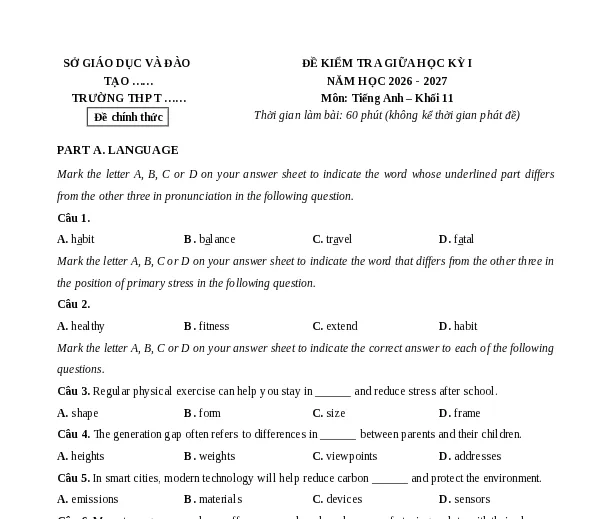
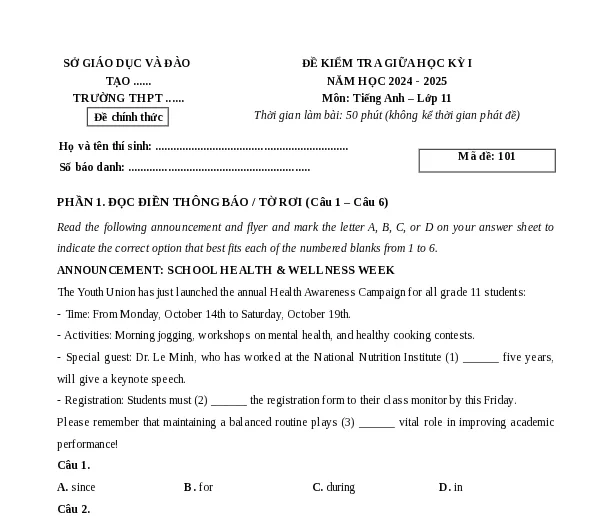
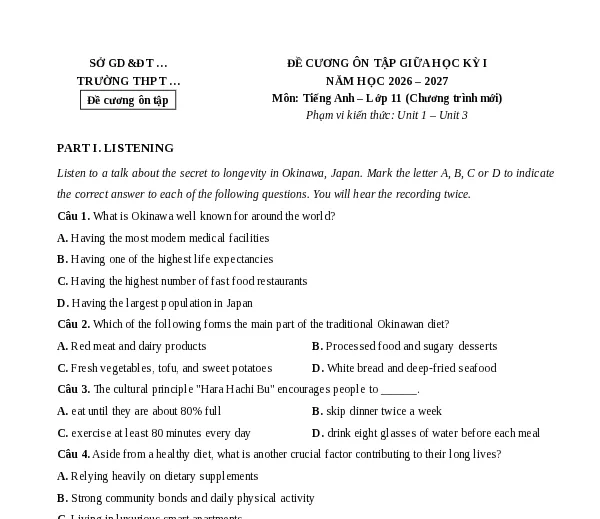
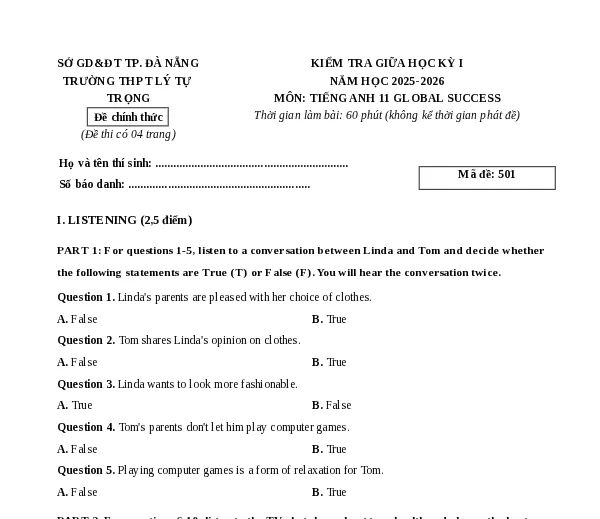
SỞ GD&ĐT …
TRƯỜNG THPT …
Đề chính thức
ĐỀ KIỂM TRA GIỮA HỌC KỲ I
NĂM HỌC 2026 – 2027
Môn: Tiếng Anh – Lớp 11
Thời gian làm bài: 60 phút (không kể thời gian phát đề)
I. LISTENING (2,5 điểm)
PART 1. Listen to a conversation between Lan and Mark about healthy lifestyles. Decide whether the following statements are True (T) or False (F). You will hear the recording twice.
Question 1. Mark stayed up late to finish a history project.
A. True
B. False
Question 2. Lan advises Mark to drink an energy drink when he feels tired.
A. True
B. False
Question 3. Mark has stopped eating junk food completely.
A. True
B. False
Question 4. Lan says that regular exercise can help reduce stress.
A. True
B. False
Question 5. Mark agrees to go jogging with Lan and her friends on Saturday morning.
A. True
B. False
PART 2. Listen to a talk about smart cities and choose the best answer A, B, C, or D for each question. You will hear the recording twice.
Question 6. What is the main purpose of building smart cities?
A. To increase the population in urban areas.
B. To improve people's quality of life and protect the environment.
C. To replace all human workers with robots.
D. To expand cities into rural areas.
Question 7. Which sources of clean energy are mentioned in the talk?
A. Coal and gas
B. Nuclear energy
C. Solar and wind energy
D. Oil and coal
Question 8. Smart transport systems can help ______.
A. reduce traffic congestion and air pollution
B. eliminate the need for traffic lights
C. make private cars cheaper
D. replace all public transport
Question 9. Smart sensors in buildings can ______.
A. record people's conversations
B. adjust lighting and room temperatures
C. monitor people's working hours
D. decorate the outside walls
Question 10. What challenge might smart cities face?
A. A lack of public transport
B. High installation costs and risks to personal data security
C. A decrease in the number of smartphones
D. A shortage of office workers
II. LANGUAGE FOCUS (1,75 điểm)
Mark the letter A, B, C, or D to indicate the correct answer to each of the following questions.
Question 11. Regular exercise and a balanced diet can help increase your life ______.
A. expectation
B. expectancy
C. extension
D. expansion
Question 12. Open conversations can help parents and teenagers narrow the generation ______.
A. bridge
B. distance
C. gap
D. space
Question 13. The city is improving its public ______ system to reduce traffic jams.
A. transport
B. footprint
C. emission
D. material
Question 14. You ______ touch that hot stove; you might burn your fingers.
A. don't have to
B. mustn't
C. may
D. needn't
Question 15. Teenagers ______ listen to their parents' advice and share their own opinions respectfully.
A. should
B. ought
C. had
D. can to
Question 16. Nam ______ in this neighbourhood since 2021.
A. lived
B. has lived
C. lives
D. is living
Question 17. The soup ______ delicious. Did you make it yourself?
A. tastes
B. is tasting
C. taste
D. are tasting
III. READING (4,0 điểm)
PART 1. Read the following passage and mark the letter A, B, C, or D to indicate the correct word or phrase that best fits each of the numbered blanks from 18 to 22.
Living a long and healthy life is a common goal for many people. Maintaining good daily habits plays an important role in keeping our bodies and minds strong. First, a balanced diet is essential. People should eat more vegetables, whole grains and fresh fruit (18) ______ limit their intake of sugary drinks.
Regular physical activity can help prevent lifestyle (19) ______, such as heart disease. Walking, cycling or swimming for thirty minutes a day can make a difference. Getting enough sleep also allows the body to (20) ______ after a busy day. Teenagers (21) ______ aim to get enough sleep each night. (22) ______, relaxing activities such as reading or listening to music can help them manage stress.
Question 18.
A. and
B. but
C. so
D. or
Question 19.
A. treatments
B. diseases
C. medicines
D. injuries
Question 20.
A. recover
B. damage
C. suffer
D. operate
Question 21.
A. ought
B. have
C. should
D. need to not
Question 22.
A. In addition
B. However
C. In contrast
D. Nevertheless
PART 2. Read the following passage and mark the letter A, B, C, or D to indicate the correct word or phrase that best fits each of the numbered blanks from 23 to 27.
Cities are changing rapidly as their populations grow. To make urban life more comfortable, many local authorities are developing smart cities. These cities use technology to provide better services and reduce their impact (23) ______ the environment.
For example, sensors can collect information about traffic and help drivers choose less crowded routes. Smart buildings can save energy by turning off lights when rooms are (24) ______. Some cities also encourage people to use electric buses, (25) ______ produce less air pollution than conventional vehicles.
However, technology alone cannot solve every problem. City planners need to listen to residents and ensure that new services are accessible to everyone. They must also protect the personal information (26) ______ by smart systems. With careful planning, a smart city can become a cleaner and more (27) ______ place to live.
Question 23.
A. on
B. at
C. with
D. for
Question 24.
A. empty
B. crowded
C. noisy
D. busy
Question 25.
A. who
B. which
C. whose
D. where
Question 26.
A. collecting
B. collect
C. collected
D. to collecting
Question 27.
A. liveable
B. harmful
C. polluted
D. wasteful
PART 3. Read the following passage and mark the letter A, B, C, or D to indicate the correct answer to each of the questions from 28 to 33.
The generation gap refers to differences in attitudes, values and behaviours between younger and older generations, especially between parents and their teenage children. Changes in technology and society can make these differences more noticeable.
One source of disagreement is the use of electronic devices. Many teenagers use smartphones to study, communicate and relax. Their parents, however, may worry that too much screen time affects their children's sleep, schoolwork and face-to-face communication. Arguments sometimes occur when parents set rules about using devices.
Career choices can also cause disagreement. Some parents prefer stable jobs and traditional professions, while their children may wish to work in creative fields such as graphic design or digital marketing. Both sides may have good reasons for their views, but they do not always explain them clearly.
Open communication and mutual respect can help families narrow the gap. Parents can listen to their children's plans before making judgments. Teenagers, in turn, can try to understand their parents' concerns and share their own ideas calmly. Instead of expecting everyone to agree immediately, family members can look for solutions together.
Question 28. What is the main idea of the passage?
A. The dangers of all electronic devices
B. Causes of the generation gap and ways to narrow it
C. The benefits of traditional professions
D. Reasons teenagers should choose creative careers
Question 29. The word “Their” in paragraph 2 refers to ______.
A. teenagers'
B. devices'
C. parents'
D. teachers'
Question 30. According to paragraph 2, parents may worry that too much screen time affects their children's ______.
A. ability to use a smartphone
B. interest in creative careers
C. sleep and face-to-face communication
D. choice of school subjects
Question 31. The word “stable” in paragraph 3 is closest in meaning to ______.
A. secure
B. unusual
C. creative
D. temporary
Question 32. According to the passage, what can teenagers do to improve communication with their parents?
A. Refuse to discuss their plans.
B. Share their ideas calmly.
C. Expect immediate agreement.
D. Avoid listening to their parents.
Question 33. Which of the following is NOT mentioned as a way to narrow the generation gap?
A. Listening before making judgments
B. Showing mutual respect
C. Looking for solutions together
D. Banning all electronic devices
IV. WRITING (1,75 điểm)
PART 1. Mark the letter A, B, C, or D to indicate the correct arrangement of the sentences to make a coherent paragraph in each of the following questions.
Question 34.
a. As a result, she feels more energetic during the school day.
b. First, she goes to bed early and gets enough sleep.
c. Mai has made several changes to improve her health.
d. She also cycles to school instead of asking her father to drive her.
A. c – b – d – a
B. b – a – c – d
C. d – c – a – b
D. a – d – b – c
Question 35.
a. They agreed to discuss their concerns without interrupting one another.
b. Last month, Minh and his parents often argued about his screen time.
c. After the discussion, they made a schedule that everyone accepted.
d. To solve the problem, the family decided to have a conversation.
A. a – c – b – d
B. b – d – a – c
C. c – a – d – b
D. d – b – c – a
Question 36.
a. These buses produce less air pollution than many conventional vehicles.
b. The local government has introduced electric buses in the city.
c. Together, these changes can make the city a better place to live.
d. It has also added more green spaces for residents to enjoy.
A. a – c – b – d
B. d – a – c – b
C. b – a – d – c
D. c – d – b – a
PART 2. Finish each of the following sentences so that it means the same as the sentence printed before it.
Question 37. The last time Peter went to the gym was two months ago.
→ Peter hasn't .......................................................................................................
Question 38. My brother started living in this eco-friendly city in 2021.
→ My brother has .......................................................................................................
PART 3. Arrange the given words and add any necessary words to make a complete sentence. Do not change the order of the given words.
Question 39. teenagers / should / talk / parents / their problems
→ ...........................................................................................................................
Question 40. smart sensors / help / buildings / save / energy
→ ...........................................................................................................................
--------- HẾT ---------
Họ và tên thí sinh: ................................................ Số báo danh: ........................
SỞ GD&ĐT …
TRƯỜNG THPT …
Hướng dẫn chấm chính thức
ĐỀ KIỂM TRA GIỮA HỌC KỲ I
NĂM HỌC 2026 – 2027
Môn: Tiếng Anh – Lớp 11
HƯỚNG DẪN CHẤM VÀ THANG ĐIỂM
A. HƯỚNG DẪN CHUNG
- Toàn bài có 40 câu; mỗi câu đúng được 0,25 điểm.
- Với phần viết câu, chấp nhận các câu trả lời khác đúng ngữ pháp, phù hợp yêu cầu và giữ nguyên nghĩa đối với câu viết lại.
B. AUDIO SCRIPT
PART 1 (Questions 1–5)
Lan: Hi Mark! You look quite exhausted today. Did you stay up late playing video games again?
Mark: Hi Lan. Not really. I stayed up until 1:00 a.m. finishing my history project. I feel so sleepy right now. I think I'll buy an energy drink to stay awake.
Lan: Oh Mark, you shouldn't drink energy drinks. They contain a lot of sugar and caffeine. If you feel tired, drink some water and take a short nap during lunchtime.
Mark: You're right. I've also tried to cut down on junk food, though I haven't stopped eating it completely.
Lan: That's a good start! Regular physical activity can also help reduce stress and give you more energy.
Mark: I know, but I'm usually busy with homework.
Lan: A few friends and I are going for a jog in the park this Saturday morning. Would you like to join us?
Mark: That sounds great! Count me in.
PART 2 (Questions 6–10)
Speaker: Today, I'd like to talk about smart cities. Their main goal is to use modern technology and green solutions to improve people's quality of life while protecting the environment.
One feature of smart cities is the use of clean energy. For example, solar panels and wind turbines can provide power for homes and offices.
Smart transport systems use sensors to monitor traffic. The information they collect can help reduce traffic congestion and air pollution. Cities can also encourage residents to use public transport.
Inside modern buildings, smart sensors can adjust lighting and room temperatures. This helps save electricity.
However, smart cities also face challenges. Installing new technology can be expensive, and planners must protect people's personal data from security risks.
C. ĐÁP ÁN VÀ THANG ĐIỂM
Questions 1–10
Câu | 1 | 2 | 3 | 4 | 5 | 6 | 7 | 8 | 9 | 10 |
|---|---|---|---|---|---|---|---|---|---|---|
Đáp án | A | B | B | A | A | B | C | A | B | B |
Questions 11–20
Câu | 11 | 12 | 13 | 14 | 15 | 16 | 17 | 18 | 19 | 20 |
|---|---|---|---|---|---|---|---|---|---|---|
Đáp án | B | C | A | B | A | B | A | A | B | A |
Questions 21–30
Câu | 21 | 22 | 23 | 24 | 25 | 26 | 27 | 28 | 29 | 30 |
|---|---|---|---|---|---|---|---|---|---|---|
Đáp án | C | A | A | A | B | C | A | B | A | C |
Questions 31–36
Câu | 31 | 32 | 33 | 34 | 35 | 36 |
|---|---|---|---|---|---|---|
Đáp án | A | B | D | A | B | C |
Questions 37–40
Câu | Nội dung đáp án | Điểm |
|---|---|---|
37 | Peter hasn't gone to the gym for two months. | 0,25 |
38 | My brother has lived in this eco-friendly city since 2021. | 0,25 |
39 | Teenagers should talk to their parents about their problems. | 0,25 |
40 | Smart sensors help buildings save energy. | 0,25 |
Chấp nhận các câu trả lời đúng ngữ pháp khác, phù hợp yêu cầu của từng câu.