SỞ GIÁO DỤC VÀ ĐÀO TẠO …
TRƯỜNG THPT …
Đề tham khảo
ĐỀ KIỂM TRA GIỮA HỌC KỲ I
NĂM HỌC 2026 – 2027
Môn: Tiếng Anh – Lớp 11
Thời gian làm bài: 60 phút
PHẦN I. NGHE ĐIỀN TỪ (0,5 điểm)
You will listen to a talk about a school garden project twice. Complete the notes. Write ONE WORD OR A NUMBER in each blank.
THE GREEN CORNER PROJECT
The school garden project started in (1) ______.
Students meet in the garden every (2) ______ afternoon.
They grow vegetables and learn how to make natural (3) ______ from food waste.
The vegetables are used to prepare healthy (4) ______ for students.
The project helps students become more responsible and work as a (5) ______.
PHẦN II. TRẮC NGHIỆM (8,0 điểm)
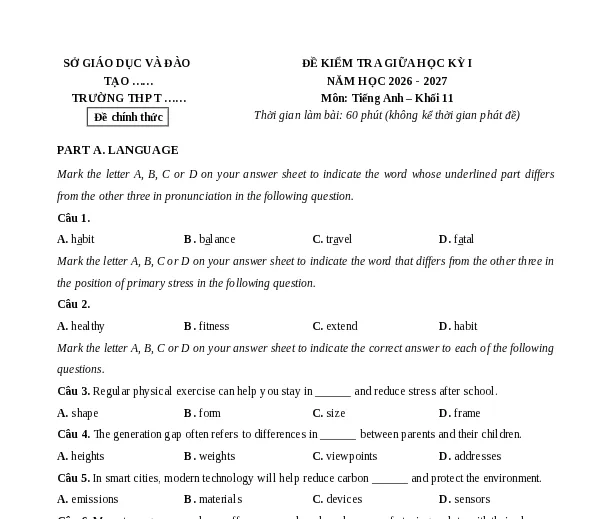
Mark the letter A, B, C or D to indicate the correct answer to each question.
Questions 1–5. You will listen twice to a conversation between Nam and his sister Mai about their family’s new weekly activity.
Câu 1. What does Nam suggest doing on Sunday mornings?
A. Visiting a museum
B. Cooking breakfast together
C. Going for a bike ride
D. Cleaning the neighbourhood
Câu 2. Why does Mai think their parents will like the idea?
A. They want the family to spend more time outdoors.
B. They are training for a race.
C. They have recently bought a car.
D. They want to meet their neighbours.
Câu 3. What is Mai worried about?
A. The weather might be too hot.
B. Their younger brother might get tired.
C. Their parents might be busy.
D. The route might be too crowded.
Câu 4. How will the family get ready for the activity?
A. They will borrow bicycles from friends.
B. They will choose a route and check their bicycles.
C. They will buy new sports clothes.
D. They will ask their neighbours for advice.
Câu 5. Where will Nam and Mai share their plan with their parents?
A. At breakfast on Saturday
B. At the park on Sunday
C. At dinner that evening
D. At school the next day
Read the following passage and mark the letter A, B, C or D to indicate the correct answer to each question from 6 to 13.
Many teenagers find it difficult to balance their studies with their personal interests. When homework, tests and extracurricular activities all demand attention, they may feel that there is no time left for themselves. However, learning to manage time does not mean filling every minute with work. It means deciding what matters and making room for both responsibilities and rest.
One useful strategy is to create a weekly plan. Students can write down deadlines and then break large tasks into smaller steps. For example, instead of waiting until the night before a presentation, they can research the topic on Monday, prepare slides on Wednesday and practise speaking on Friday. This approach makes the task less stressful and leaves time to deal with unexpected problems.
It is also important to recognise distractions. A phone can be helpful for learning, but frequent notifications may interrupt concentration. Some students put their phones away for a short period and check messages during a planned break. Others use an app that limits access to social media while they study.
Finally, a good plan should include time for sleep, exercise and activities that students enjoy. These activities are not a waste of time. They can restore energy and help young people return to their work with a clearer mind. No single schedule works for everyone, so students should review their routines and adjust them when necessary.
Câu 6. What is the passage mainly about?
A. Ways for teenagers to manage their time
B. Reasons why students should give up hobbies
C. The history of extracurricular activities
D. The effects of using phones in the classroom
Câu 7. According to paragraph 2, what should students do with a large task?
A. Leave it until the deadline
B. Divide it into smaller steps
C. Ask a friend to complete it
D. Finish it without taking a break
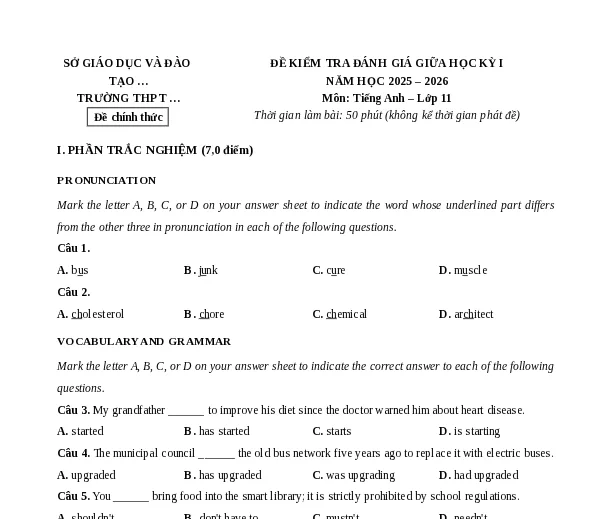
Câu 8. The word “They” in the last paragraph refers to ______.
A. schedules
B. young people
C. activities such as sleep and exercise
D. unexpected problems
Câu 9. The word “restore” in the last paragraph is CLOSEST in meaning to ______.
A. use up
B. bring back
C. hide
D. measure
Câu 10. The word “frequent” in paragraph 3 is OPPOSITE in meaning to ______.
A. regular
B. common
C. repeated
D. occasional
Câu 11. Which of the following is NOT mentioned as a way to reduce distractions?
A. Putting phones away for a while
B. Checking messages during a planned break
C. Using an app to limit social media access
D. Deleting every learning app from a phone
Câu 12. What can be inferred from the last paragraph?
A. Students should follow exactly the same schedule.
B. Students may need to change their plans to suit their needs.
C. Rest is less important than every school task.
D. Students should stop exercising during the school year.
Câu 13. Which of the following best paraphrases the sentence “Learning to manage time does not mean filling every minute with work”?
A. Good time management requires students to work without stopping.
B. Students can manage time well while still allowing time for rest.
C. Students should avoid making plans for their free time.
D. Time management is only necessary when students have tests.
Read the following passage and mark the letter A, B, C or D to indicate the option that best fits each numbered blank from 14 to 18.
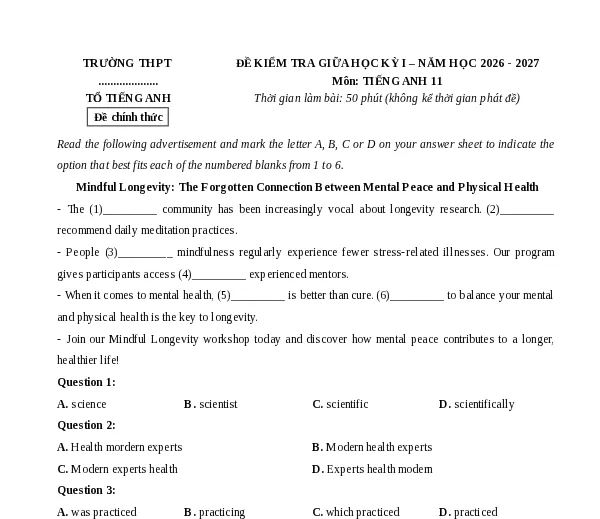
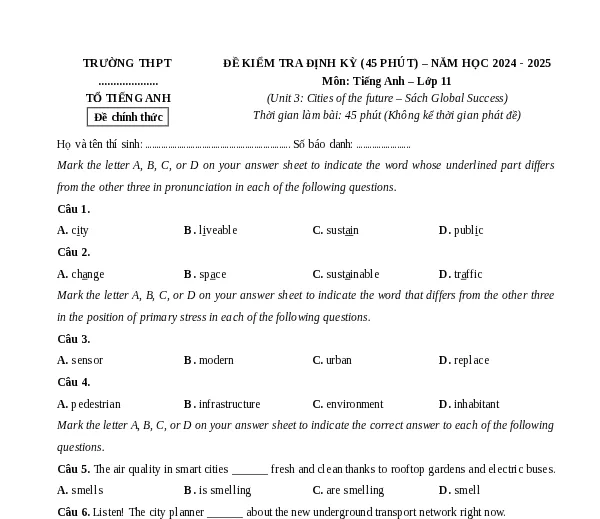
Cities of the future may become more comfortable places to live if technology is used wisely. For example, smart traffic systems can collect information about the number of vehicles on the road. This information helps city managers adjust traffic lights, (14) ______ can reduce waiting times at busy junctions.
Technology can also help cities save energy. In some buildings, lights turn off automatically when rooms are empty. Residents can use an app (15) ______ how much electricity they consume and change their habits if necessary.
However, a successful smart city needs more than modern devices. It should provide public spaces (16) ______ people can meet, exercise and enjoy nature. City planners must also consider people who do not own smartphones or find digital services difficult to use.
Above all, residents should have a voice in decisions about their neighbourhoods. When local people share their ideas, planners are more likely to develop solutions that respond (17) ______ real needs. By combining technology with thoughtful planning, cities can become greener, safer and more (18) ______ for everyone.
Câu 14.
A. who
B. which
C. whose
D. where
Câu 15.
A. monitor
B. monitoring
C. to monitor
D. monitored
Câu 16.
A. where
B. whom
C. which
D. whose
Câu 17.
A. for
B. with
C. on
D. to
Câu 18.
A. live
B. living
C. liveable
D. livelihood
Read the following advertisement and mark the letter A, B, C or D to indicate the option that best fits each numbered blank from 19 to 23.
Discover Family Stories!
Would you like to understand your family better? Join our weekend workshop and learn how to record the stories of older family members.
You will practise asking open questions and listening (19) ______. Our friendly volunteers will show you how to use a phone to record an interview.
You don’t need any special experience, but you (20) ______ bring a notebook and a pen. Please ask for permission before (21) ______ anyone’s voice or taking photographs.
The workshop is free, and there are only 25 places. If you want to join, complete the online form (22) ______ Friday evening.
Come along and discover how family stories can help different generations connect (23) ______ one another!
Câu 19.
A. care
B. careful
C. carefully
D. careless
Câu 20.
A. should
B. mustn’t
C. can’t
D. shouldn’t
Câu 21.
A. record
B. recording
C. to record
D. recorded
Câu 22.
A. since
B. during
C. by
D. for
Câu 23.
A. at
B. from
C. of
D. with
Mark the letter A, B, C or D to indicate the best arrangement of the sentences in each question from 24 to 25.
Câu 24.
a. Linh: That’s a great idea. We could also bring reusable bottles.
b. An: How can we reduce waste during our class picnic?
c. An: Agreed. I’ll remind everyone not to use disposable cups.
A. a – c – b
B. b – a – c
C. b – c – a
D. c – b – a
Câu 25.
a. Next, residents could grow vegetables there and share the harvest.
b. Dear Mr Brown, I am writing to suggest a project for our neighbourhood.
c. This shared activity would not only provide fresh food but also bring people closer together.
d. First, we could turn the empty piece of land near the community centre into a garden.
e. I hope you will consider this suggestion.
Best wishes,
Minh
A. b – d – a – c – e
B. d – b – c – a – e
C. b – a – d – e – c
D. d – a – b – c – e
Read the following passage and mark the letter A, B, C or D to indicate the correct answer to each question from 26 to 35.
In one neighbourhood, a group of teenagers noticed that some older residents rarely joined community activities. The teenagers wanted to help, but they did not know what kind of activity would interest people of different ages. Instead of making assumptions, they visited the local community centre and asked residents for suggestions.
Several older people said they would enjoy sharing practical skills, while the teenagers wanted to learn more about repairing everyday objects. From these conversations, the “Repair and Share” project was born. Once a month, volunteers gather at the community centre with broken lamps, loose bicycle brakes and clothes that need small repairs. Experienced residents demonstrate how to fix the items, and younger participants help organise tools or look up instructions.
The project has benefits beyond saving money. Repairing an object instead of throwing it away can reduce waste. Participants also have opportunities to talk to people they might not otherwise meet. At first, some teenagers were nervous about asking questions, but the friendly atmosphere soon encouraged them to take part. One student said that learning to replace a button was useful, but hearing the volunteer’s stories was just as memorable.
The organisers have also faced challenges. They cannot repair every item, and electrical equipment must be checked by someone with suitable knowledge. To keep the event safe, the team explains what volunteers can and cannot do. It also asks participants to bring items that can be carried easily and to describe the problem when they register.
The project shows that cooperation between generations does not require a complicated plan. A simple activity, designed around people’s shared interests and supported by clear safety rules, can build trust. Its success has encouraged a nearby neighbourhood to consider starting a similar event.
Câu 26. Which of the following is the best title for the passage?
A. A Competition to Design New Household Devices
B. Bringing Generations Together Through Repair
C. Why Teenagers Prefer Working Alone
D. The History of the Community Centre
Câu 27. Why did the teenagers ask local residents for suggestions?
A. They wanted to find an activity that could appeal to different age groups.
B. They needed someone to buy new tools for them.
C. They wanted older residents to stop attending activities.
D. They were looking for a place to sell used objects.
Câu 28. The word “they” in paragraph 1 refers to ______.
A. assumptions
B. older residents
C. teenagers
D. community activities
Câu 29. The word “demonstrate” in paragraph 2 is CLOSEST in meaning to ______.
A. forget
B. show
C. refuse
D. imagine
Câu 30. The word “complicated” in the last paragraph is OPPOSITE in meaning to ______.
A. costly
B. popular
C. detailed
D. simple
Câu 31. Where does the following sentence best fit in paragraph 3?
“This change helped them become more confident when working with older volunteers.”
A. After the first sentence
B. After the second sentence
C. After the fourth sentence
D. After the last sentence
Câu 32. According to the passage, what is one environmental benefit of the project?
A. It reduces the amount of waste.
B. It produces electricity for the centre.
C. It creates new land for a community garden.
D. It replaces all old equipment with new products.
Câu 33. Which of the following best paraphrases the idea that the project has benefits beyond saving money?
A. The project costs more than the organisers expected.
B. Saving money is the only reason to join the project.
C. The project offers advantages in addition to financial savings.
D. Participants must pay for all the repairs.
Câu 34. What is the main idea of paragraph 4?
A. The team plans to move the event to another centre.
B. The organisers manage limitations and safety concerns.
C. Teenagers prefer repairing electrical equipment.
D. Residents are taught how to manufacture new tools.
Câu 35. Which of the following is NOT true according to the passage?
A. The project takes place once a month.
B. Younger participants sometimes help with tools.
C. Volunteers are able to repair every item brought to the event.
D. Another neighbourhood is considering a similar event.
Read the following school announcement and mark the letter A, B, C or D to indicate the option that best fits each numbered blank from 36 to 40.
School Announcement – Green Travel Day
Our school will hold Green Travel Day next Wednesday. The event aims to encourage students (36) ______ more environmentally friendly ways of travelling.
You can walk, cycle or share a ride with a friend, depending on the distance from your home. Those who cycle should wear helmets and check their bicycles (37) ______ leaving home.
At lunchtime, the Eco Club will give a short talk about the connection between transport and air (38) ______. Students will also have an opportunity to share practical ideas for making the journey to school safer.
The event is open to everyone, (39) ______? Please tell your class monitor how you plan to travel so that the club can prepare a summary of the results.
Let’s take one small step towards a (40) ______ school community!
Câu 36.
A. choose
B. to choose
C. choosing
D. chosen
Câu 37.
A. before
B. although
C. unless
D. because
Câu 38.
A. pollute
B. polluted
C. pollution
D. polluting
Câu 39.
A. does it
B. doesn’t it
C. is it
D. isn’t it
Câu 40.
A. green
B. greener
C. greenest
D. greenly
PHẦN III. VIẾT TỰ LUẬN (1,5 điểm)
Rewrite each sentence without changing its meaning, using the word given. Do not change the word given.
Câu 1. It is a good idea for students to take regular breaks when they study. (SHOULD)
→ Students __________________________________________________________.
Câu 2. It is not necessary for Lan to print the document because she can read it online. (HAVE)
→ Lan ______________________________________________________________.
Câu 3. The community built a cycle lane because it wanted to make cycling safer. (ORDER)
→ The community ____________________________________________________.
Câu 4. My brother started volunteering at the library two years ago, and he still volunteers there. (HAS)
→ My brother _______________________________________________________.
Câu 5. The last time our class visited the science museum was in April. (SINCE)
→ Our class _________________________________________________________.
--------- HẾT ---------
Họ và tên thí sinh: ................................................ Số báo danh: ........................
LỜI THOẠI BÀI NGHE DÀNH CHO GIÁO VIÊN
Mỗi bài nghe hai lần. Giáo viên đọc hoặc thu âm theo lời thoại dưới đây. Không phát trang này cho học sinh trước khi kiểm tra.
Bài nghe Phần I
Our school started the Green Corner project in September. At first, the space behind the library was empty and covered with rubbish. Now it is a small garden where students meet every Thursday afternoon.
During each session, we grow vegetables, water the plants and learn how to make natural compost from food waste. When the vegetables are ready, the school kitchen uses them to prepare healthy lunches for students.
The project is not just about gardening. It teaches us to take responsibility for a shared space and work as a team. We are proud to see how a neglected corner has become a useful part of our school.
Bài nghe Phần II, Câu 1–5
Nam: Mai, I’ve been thinking about a new activity for our family. What about going for a bike ride on Sunday mornings?
Mai: I like that idea. Mum and Dad have been saying that we should spend more time outdoors together.
Nam: Exactly. We could ride along the river and stop at the park.
Mai: That sounds fun, but I’m a little worried that our younger brother might get tired.
Nam: Good point. Let’s choose a short route for the first ride. We can make it longer another time.
Mai: Great. We should also check everyone’s bicycle before we leave.
Nam: Yes. We can choose the route and check the bicycles on Saturday.
Mai: When shall we tell Mum and Dad?
Nam: Let’s share the plan with them at dinner this evening. We can ask what they think.
SỞ GIÁO DỤC VÀ ĐÀO TẠO …
TRƯỜNG THPT …
Hướng dẫn chấm đề tham khảo
ĐỀ KIỂM TRA GIỮA HỌC KỲ I
NĂM HỌC 2026 – 2027
Môn: Tiếng Anh – Lớp 11
HƯỚNG DẪN CHẤM VÀ THANG ĐIỂM
A. HƯỚNG DẪN CHUNG
Chấm theo thang điểm 10,0. Chấp nhận các câu trả lời phần viết đúng ngữ pháp, giữ nguyên nghĩa và sử dụng đúng từ cho sẵn.
B. ĐÁP ÁN VÀ THANG ĐIỂM
PHẦN I. NGHE ĐIỀN TỪ (0,5 điểm)
Mỗi câu trả lời đúng được 0,1 điểm.
Câu | 1 | 2 | 3 | 4 | 5 |
|---|---|---|---|---|---|
Đáp án | September | Thursday | compost | lunches | team |
PHẦN II. TRẮC NGHIỆM (8,0 điểm)
Mỗi câu trả lời đúng được 0,2 điểm.
Câu | 1 | 2 | 3 | 4 | 5 | 6 | 7 | 8 | 9 | 10 |
|---|---|---|---|---|---|---|---|---|---|---|
Đáp án | C | A | B | B | C | A | B | C | B | D |
Câu | 11 | 12 | 13 | 14 | 15 | 16 | 17 | 18 | 19 | 20 |
|---|---|---|---|---|---|---|---|---|---|---|
Đáp án | D | B | B | B | C | A | D | C | C | A |
Câu | 21 | 22 | 23 | 24 | 25 | 26 | 27 | 28 | 29 | 30 |
|---|---|---|---|---|---|---|---|---|---|---|
Đáp án | B | C | D | B | A | B | A | C | B | D |
Câu | 31 | 32 | 33 | 34 | 35 | 36 | 37 | 38 | 39 | 40 |
|---|---|---|---|---|---|---|---|---|---|---|
Đáp án | C | A | C | B | C | B | A | C | D | B |
Lưu ý các câu cần giải thích:
Câu 14: “which” thay cho ý điều chỉnh đèn giao thông ở mệnh đề trước.
Câu 24: B là thứ tự dự kiến phù hợp nhất trong bốn phương án. Tuy nhiên, “That’s a great idea” chưa có ý tưởng cụ thể để đáp lại vì câu trước chỉ đặt câu hỏi; nên sửa lời thoại trước khi sử dụng đề.
Câu 31: Đặt câu đã cho sau câu thứ tư để “This change” nối với việc các bạn trẻ từ chỗ lo lắng đến chỗ được khuyến khích tham gia.
Câu 40: “greener” phù hợp với ý hướng tới một cộng đồng trường học xanh hơn.
PHẦN III. VIẾT TỰ LUẬN (1,5 điểm)
Mỗi câu viết đúng được 0,3 điểm.
Câu | Đáp án | Điểm |
|---|---|---|
1 | Students should take regular breaks when they study. | 0,3 |
2 | Lan doesn’t have to print the document because she can read it online. | 0,3 |
3 | The community built a cycle lane in order to make cycling safer. | 0,3 |
4 | My brother has volunteered at the library for two years. | 0,3 |
5 | Our class hasn’t visited the science museum since April. | 0,3 |
Câu 4 cũng chấp nhận: “My brother has been volunteering at the library for two years.” Chấp nhận các câu trả lời đúng ngữ pháp khác nếu giữ nguyên nghĩa và dùng đúng từ cho sẵn.