TRƯỜNG THCS-THPT NGUYỄN BỈNH KHIÊM HÀ NỘI
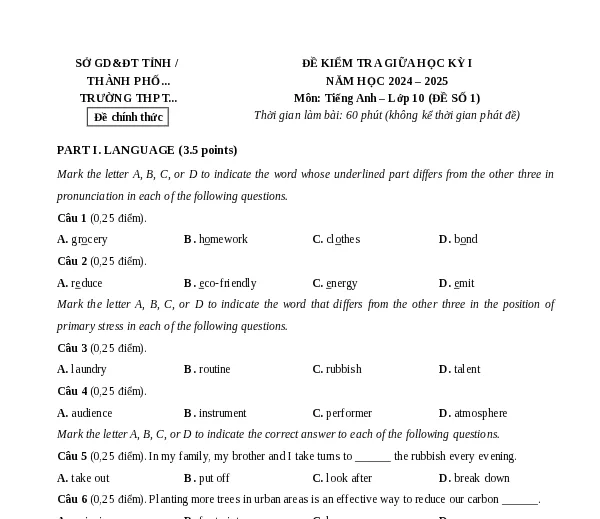
Đề chính thức
ĐỀ KIỂM TRA GIỮA HỌC KỲ I
MÔN: TIẾNG ANH 10 - ĐỀ 1
Thời gian làm bài: 50 phút
(Đề gồm 40 câu trắc nghiệm)
II) PRACTICE TEST
I) Read the following advertisement/announcement and mark the letter A, B, C or D to indicate the option that best fits each numbered blank from 1 to 6.
FAMILY TEAMWORK WEEK
Our school is holding Family Teamwork Week to help students appreciate everyday contributions at home. Each (1) ______ one household task for seven days and records what he or she learns. At the moment, many students (2) ______ short videos about cooking, doing the laundry, or shopping for groceries. You can work alone, (3) ______ you can invite a family member to join you. The project encourages teenagers to (4) ______ responsibility rather than leave all the housework to adults. We also hope the activities will (5) ______ family bonds. Remember that everyone (6) ______ a chance to feel valued at home.
Câu 1.
A. chooses
B. is choosing
C. choose
D. has chosen
Câu 2.
A. make
B. made
C. are making
D. makes
Câu 3.
A. and
B. but
C. so
D. or
Câu 4.
A. take
B. do
C. make
D. bring
Câu 5.
A. strengthen
B. eliminate
C. delay
D. upload
Câu 6.
A. needs
B. is needing
C. need
D. has needed
II) Read the following leaflet and mark the letter A, B, C or D to indicate the option that best fits each numbered blank from 7 to 12.
LOW-CARBON SCHOOL DAY
Next Friday, our class (7) ______ hold a Low-Carbon School Day. The plan was agreed on at yesterday's meeting. Students are encouraged to (8) ______ on unnecessary electricity use by switching off lights and fans. Refillable bottles (9) ______ at the entrance so that fewer single-use cups are needed. Our teacher asked each group (10) ______ one practical idea for protecting natural resources. We expect the campaign (11) ______ students see how small choices affect their carbon footprint. At the end of the day, all collected paper and plastic (12) ______ for recycling.
Câu 7.
A. will
B. is going to
C. is going
D. was going to
Câu 8.
A. cut down
B. break down
C. carry on
D. put out
Câu 9.
A. provide
B. will provide
C. will be provided
D. are providing
Câu 10.
A. suggest
B. to suggest
C. suggesting
D. suggested
Câu 11.
A. help
B. to help
C. helping
D. helped
Câu 12.
A. sort
B. will sort
C. will be sorted
D. is sorting
III) Mark the letter A, B, C or D to indicate the best arrangement of utterances or sentences to make a cohesive and coherent exchange or text in Questions 13 to 17.
Câu 13.
a. Mai: Shall we divide the housework before Mum gets home?
b. Nam: That's a good idea. I can tidy up the living room.
c. Mai: Great. I'll do the washing-up after dinner.
A. a - b - c
B. b - a - c
C. c - a - b
D. a - c - b
Câu 14.
a. Lan: I really want to, but I have to finish my science project tonight.
b. Hoa: Why don't we join the school clean-up this afternoon?
c. Hoa: No problem. Maybe you can join us next time.
A. a - b - c
B. b - c - a
C. b - a - c
D. c - b - a
Câu 15.
a. First, list the chores that need to be done.
b. Finally, review the list at the end of the week and adjust it if necessary.
c. In my opinion, a fair chore plan can reduce arguments at home.
d. Next, discuss who has enough time and skill for each task.
e. Then, divide the jobs and write everyone's responsibilities on a shared timetable.
A. c - a - d - e - b
B. a - c - e - d - b
C. c - d - a - b - e
D. a - d - c - e - b
Câu 16.
a. I think you should start by carrying a refillable bottle.
b. I want to live more sustainably, but I don't know where to begin.
c. What should I do to reduce plastic waste at school?
A. c - b - a
B. b - a - c
C. b - c - a
D. a - c - b
Câu 17.
a. As a result, students learn that responsibility is a shared value rather than an individual burden.
b. Sharing chores gives teenagers opportunities to develop practical life skills.
c. They also become more aware of how much work is required to run a home.
d. For example, cooking and doing the laundry require planning and careful time management.
e. These experiences can gradually strengthen family bonds.
A. b - d - c - a - e
B. d - b - a - c - e
C. b - c - d - e - a
D. c - b - d - a - e
IV) Read the following passage and mark the letter A, B, C or D to indicate the option that best fits each numbered blank from 18 to 22.
In the Nguyen family, everyone contributes to daily housework. Mr Nguyen usually prepares breakfast before work, while his daughter (18) ______ the table. This week, however, their routine is different because the kitchen (19) ______. Therefore, meals (20) ______ in the small dining area by the balcony. Each family member (21) ______ responsible for keeping shared spaces tidy, and this arrangement has brought a noticeable (22) ______ in family cooperation.
Câu 18.
A. sets
B. is setting
C. set
D. has set
Câu 19.
A. renovates
B. is renovating
C. is being renovated
D. was renovating
Câu 20.
A. serve
B. are served
C. served
D. are serving
Câu 21.
A. are
B. were
C. is
D. be
Câu 22.
A. improve
B. improving
C. improvement
D. improved
V) Read the following passage and mark the letter A, B, C or D to indicate the best answer to each question from 23 to 30.
BEHIND A SUCCESSFUL SCHOOL MUSIC SHOW
At Riverside High, the annual music show used to be regarded mainly as entertainment. This year, however, teachers redesigned it as a student-led project. Participants formed small teams, selected songs, arranged rehearsal schedules and dealt with practical issues such as microphones, lighting and publicity. The judges still evaluated the final performances, but much of the learning took place long before anyone stepped onto the stage.
One challenge was that several talented singers initially preferred to work alone. They believed independence would allow them to perform at their best. Rehearsals soon revealed a different reality. A strong solo voice could not compensate for a band that entered at the wrong moment or ignored one another's signals. Students therefore had to listen carefully, accept comments and sometimes change an idea they personally liked.
The online side of the project created another lesson. Teams uploaded short rehearsal clips to social media to attract an audience. One group received thousands of views, while another received only a few hundred. Rather than treating popularity as proof of musical quality, the teachers asked students to examine why particular videos spread quickly. They discovered that timing, captions and existing follower networks could influence attention as much as performance quality.
By the final concert, the most noticeable change was not technical perfection but cooperation. Students who had once competed for attention began helping other teams adjust equipment and manage delays. The project suggested that a music show can be more than a search for a winner. Properly designed, it can become a practical lesson in collaboration, judgement and responsible use of online media.
Câu 23. What is the main purpose of paragraph 1?
A. To explain why the school cancelled its annual music show
B. To introduce changes that made the show a learning project
C. To compare professional and school music competitions
D. To describe how judges choose the best singer
Câu 24. The word "compensate" in paragraph 2 is closest in meaning to ______.
A. make up for
B. identify with
C. vote for
D. come up with
Câu 25. Why does the writer mention the groups' different numbers of views?
A. To prove the most viewed group was the most talented
B. To show that online popularity is affected by several factors
C. To criticize students for using social media during rehearsals
D. To explain why teachers eliminate one group
Câu 26. What can be inferred about the solo singers after rehearsals?
A. They stopped performing music completely
B. They came to value coordination with others
C. They refused to accept the judges' comments
D. They were replaced by less talented participants
Câu 27. Which of the following best states the author's purpose in paragraph 3?
A. To warn schools never to upload performance videos
B. To show students how online attention may differ from musical quality
C. To recommend a specific social media platform
D. To argue that captions are more important than songs
Câu 28. Which statement is TRUE according to the passage?
A. Teachers controlled every rehearsal decision
B. Only the winning team learned to cooperate
C. Some students helped other teams by the final concert
D. The judges selected songs for all participants
Câu 29. Which best summarises the passage?
A. A school music show became a broader learning experience involving teamwork, reflection and digital awareness.
B. Students discovered that gaining social-media views is the only reliable path to musical success.
C. Riverside High replaced classroom lessons with a professional music competition.
D. The annual concert succeeded mainly because teachers chose talented solo singers.
Câu 30. What can be inferred from the final paragraph?
A. Competition and cooperation cannot exist in the same project
B. Technical perfection was the school's only measure of success
C. The project changed how some students understood success
D. Students became less interested in live performances
VI) Read the following passage and mark the letter A, B, C or D on your answer sheet to indicate the best answer to each question.
BIRTH ORDER AND THE STORIES WE TELL
At family gatherings, people often compare brothers and sisters. The oldest child may be described as responsible and mature, while a younger sibling may be called spoiled, lazy, or rebellious. These labels are easy to remember, but they can become stereotypes. A quiet firstborn may be ignored because everyone expects firstborns to be confident and hard-working; a talkative youngest child may be treated as proof that birth order decides personality.
The idea has a long history in psychology. Early theories suggested that children react to the place they occupy in a family. A firstborn, for example, might become anxious after a new baby arrives and takes some parental attention. A middle child might become competitive in an effort to be noticed. The youngest, surrounded by older family members, might appear charming but immature. An only child might seem sensitive or even unfriendly when asked to share attention.
[I] Modern research, however, gives us reasons to be cautious. [II] Large studies have found that birth order alone does not strongly predict whether a person will be extroverted, ambitious, generous, impatient, or creative. [III] Two firstborn children can grow into very different adults, just as two youngest children can. [IV] Ages, personalities, family relationships, school experiences, and natural differences between siblings all contribute to personality.
There is also a simple problem with everyday observation. We usually compare siblings at different ages. A five-year-old may look calmer and more responsible than a ten-year-old, but part of that difference may come from age rather than birth order. Five years later, the younger child may also have become calmer. Because we cannot watch both siblings living through exactly the same age at exactly the same time, our memories may make the birth-order theory seem stronger than it really is.
This does not mean family position has no influence at all. Brothers and sisters can create different experiences for one another, and parents may also change their behaviour as the family grows. Still, a useful conclusion is to treat birth order as one possible influence rather than a fixed rule. Personality is better understood as the result of many factors working together.
Câu 31. The word anxious in paragraph 2 is closest in meaning to ______.
A. careless
B. worried
C. cheerful
D. patient
Câu 32. According to paragraph 2, a middle child might become competitive because he or she ______.
A. is naturally better at school
B. copies the behaviour of adults
C. spends less time with siblings
D. wants to receive more attention
Câu 33. Which of the following is NOT mentioned in paragraph 3 as a factor contributing to personality?
A. physical height
B. family relationships
C. school experiences
D. culture
Câu 34. Where in paragraph 3 does the following sentence best fit? "Researchers therefore warn against turning common family observations into universal laws."
A. [I]
B. [II]
C. [III]
D. [IV]
Câu 35. Which of the following best summarises paragraph 4?
A. Older siblings are always calmer because they have more duties.
B. Comparing siblings of different ages can create a misleading impression about birth order.
C. Younger siblings eventually develop exactly the same personality as older ones.
D. Memories of childhood are usually more accurate than scientific research.
Câu 36. The word "that" in paragraph 4, in "part of that difference", refers to ______.
A. the difference in calmness and responsibility
B. the age gap between the siblings
C. the younger child becoming calmer
D. the strength of the theory
Câu 37. What conclusion can be drawn from paragraph 5?
A. Parents completely control the personalities of their children.
B. Scientists have proved that family position has no effect of any kind.
C. Siblings influence one another more strongly than culture does.
D. Birth order should be considered one influence among many rather than a strict rule.
Câu 38. Which of the following is TRUE according to the passage?
A. Only children are scientifically proven to be unfriendly.
B. Large studies strongly support traditional birth-order stereotypes.
C. People often use simple labels to explain differences among siblings.
D. Children in the same birth position usually develop similar personalities.
Câu 39. Which of the following can be inferred from the passage?
A. A personality label may seem convincing when people notice examples that match it.
B. Birth order is more important than age in explaining maturity.
C. Firstborns become less responsible as they grow older.
D. Scientific studies are unable to examine personality differences.
Câu 40. Which of the following would be the best title for the passage?
A. Why Younger Children Become Rebellious
B. How Parents Should Raise An Only Child
C. The Best Position to Have in a Family
D. Birth Order: Useful Clue or Easy Stereotype?
--------- HẾT ---------