ĐỀ KIỂM TRA GIỮA HỌC KỲ I - THPT NGUYỄN BỈNH KHIÊM
MÔN: TIẾNG ANH 10 - ĐỀ 3
Thời gian làm bài: 50 phút
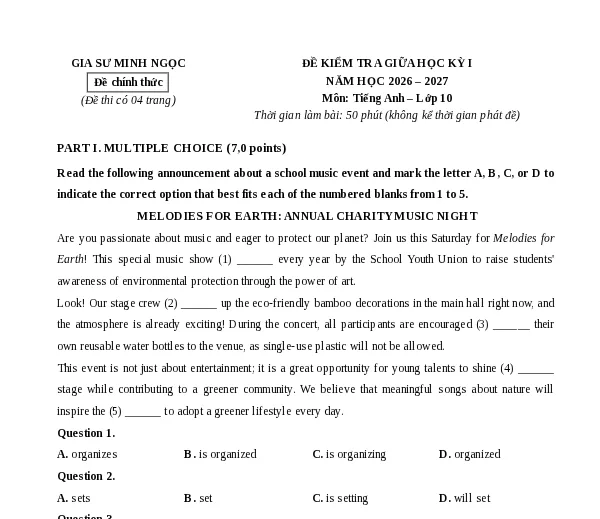
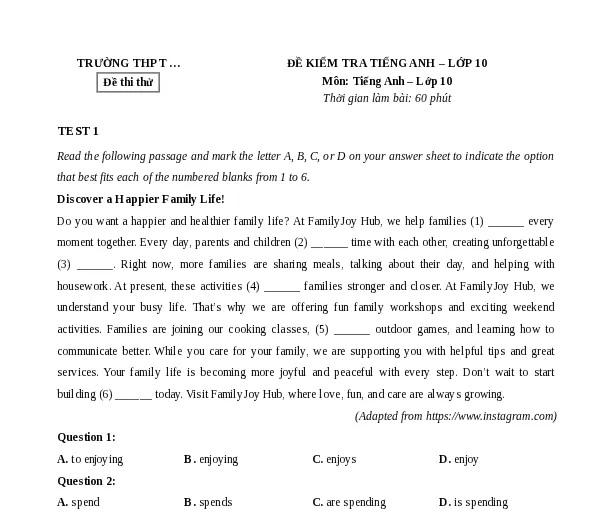
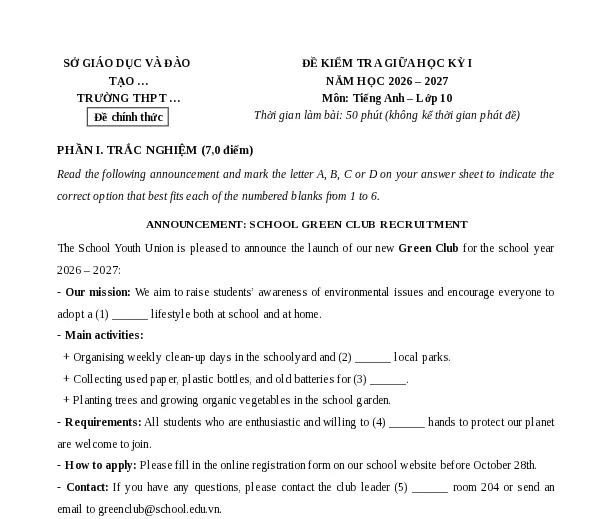
Read the following advertisement/announcement and mark the letter A, B, C or D to indicate the option that best fits each numbered blank from 1 to 6.
HOME SKILLS CHALLENGE
The Grade 10 Home Skills Challenge invites students to take part in a friendly competition. Every student normally (1) ______ one regular chore, but this week participants (2) ______ a second task chosen with their parents. You can prepare a meal, (3) ______ you can help with heavy lifting or laundry. The aim is to (4) ______ the housework fairly and help teenagers develop life skills. Short reflections should describe one practical (5) ______ of sharing responsibilities. We (6) ______ that contribution matters more than doing every task perfectly.
Question 1.
A. has
B. is having
C. have
D. had
Question 2.
A. try
B. tried
C. are trying
D. tries
Question 3.
A. but
B. or
C. so
D. because
Question 4.
A. divide
B. break
C. upload
D. enhance
Question 5.
A. benefit
B. award
C. emission
D. audience
Question 6.
A. are agreeing
B. agree
C. are wanting
D. agrees
Read the following leaflet and mark the letter A, B, C or D to indicate the option that best fits each numbered blank from 7 to 12.
CLEAN CAMPUS STARTER GUIDE
Our class has already decided on Saturday's clean-up, so we (7) ______ meet at 7 a.m. First, volunteers should (8) ______ rubbish around the sports field. New colour - coded bins (9) ______ near the canteen before the activity begins. The teacher expects everyone (10) ______ gloves and refillable water bottles. Team leaders will make participants (11) ______ plastic from paper. After the event, a short report on collected waste (12) ______ on the school website.
Question 7.
A. are going to
B. will perhaps
C. have
D. were
Question 8.
A. pick up
B. put out
C. carry on
D. identify with
Question 9.
A. install
B. will install
C. will be installed
D. are installed yesterday
Question 10.
A. bring
B. to bring
C. bringing
D. brought
Question 11.
A. separate
B. to separate
C. separating
D. separated
Question 12.
A. posts
B. will post
C. will be posted
D. is posting
Mark the letter A,B, C or D to indicate the best arrangement of uttreances or sentences to make a cohesive and coherent exchange or text in Question 13 to 17.
Question 13.
a. Son: Why don't we cook dinner for Dad tonight?
b. Linh: That's a good idea. I can prepare the vegetables.
c. Son: Great. I'll make the soup.
A. a - b - c
B. b - a - c
C. c - b - a
D. a - c - b
Question 14.
a. Nam: I really want to come, but I'm visiting my grandparents this weekend.
b. Mai: How about joining the Green Club meeting on Sunday?
c. Nam: No worries. I'll send you the club notes afterwards.
A. b - a - c
B. a - c - b
C. b - c - a
D. c - a - b
Question 15.
a. Then, compare the amount of electricity used on different days.
b. To my mind, saving energy begins with knowing where it is wasted.
c. Finally, choose two realistic habits the family can maintain.
d. First, write down when major appliances are used for one week.
e. Next, discuss which uses are necessary and which can be reduced.
A. b - c - d - a - e
B. d - b - e - a - c
C. b - a - d - c - e
D. d - a - b - e - c
Question 16.
a. If I were you, I would start with small jobs you can do regularly.
b. I want to help more at home, but I'm worried that housework will take too much study time.
c. What do you advise me to do?
A. b - c - a
B. c - b - a
C. b - a - c
D. a - c - b
Question 17. Choose the correct arrangement of the following sentences to make a cohesive paragraph.
a. Consequently, the audience can judge a performance on more than vocal ability.
b. A successful live concert depends on several people working together.
c. Lighting and sound crews, for instance, help performers communicate clearly with listeners.
d. Singers must also respond to the band and manage unexpected delays.
e. These combined elements shape the audience's overall experience.
A. b - c - d - a - e
B. c - b - a - d - e
C. b - d - c - e - a
D. d - c - b - a - e
Read the following passage and mark the letter A, B, C or D to indicate the option that best fits each numbered blank from 18 to 22.
A student music club at West Lake School (18) ________ every Wednesday. This month, its members (19) _______ for a charity concert. Tickets (20) _________ online and at the school office. Each of the performers (21) _________ responsible for one part of the programme, and their careful preparation has made the event highly (22) _________ among students.
Question 18.
A. meets
B. is meeting
C. meet
D. met
Question 19.
A. rehearse
B. rehearsed
C. are rehearsing
D. rehearses
Question 20.
A. sell
B. are sold
C. are selling
D. sold
Question 21.
A. are
B. were
C. is
D. be
Question 22.
A. popularity
B. popular
C. popularly
D. popularize
Read the passage and mark the letter A, B, C or D on your answer sheet to indicate the best answer to each question 23 to 30.
THE HIDDEN COST OF THROWING FOOD AWAY
Food waste is often discussed as a problem in restaurants and supermarkets, but homes also play an important role. A family may throw away a few spoonfuls of rice, a forgotten piece of fruit or vegetables bought without a plan. Each item may appear insignificant. Taken together, however, repeated waste represents money, energy and natural resources that were used to produce, transport and store food that nobody eventually eats.
One practical response is surprisingly simple: plan before shopping. A grocery list based on actual meals can reduce impulsive purchases. Families can also check cupboards and refrigerators first, because buying a second item while a usable one remains at home creates unnecessary waste. Such habits do not require specialised technology, only attention.
Storage matters as well. Some people throw food away because they cannot remember when it was prepared. Clear containers and simple date labels can make leftovers easier to notice. Placing older items where they can be seen may also encourage people to use them first. The goal is not to keep unsafe food, but to avoid losing good food at the back of a crowded refrigerator.
Reducing household food waste will not solve every environmental issue. Nevertheless, it is a useful example of a green lifestyle because the action is repeated, measurable and connected to daily choices. It also shows why environmental awareness does not always begin with dramatic sacrifice. Sometimes it begins with looking carefully at what we already buy, use and throw away.
Question 23. What is the main idea of paragraph 1?
A. Small household food waste can collectively waste resources
B. Restaurants produce no food waste
C. Families should stop buying vegetables
D. Transport is the only environmental cost of food
Question 24. The word "impulsive" in paragraph 2 is closest in meaning to
A. unplanned
B. organic
C. sustainable
D. refillable
Question 25. Why does the writer mention checking cupboards before shopping?
A. To avoid buying items already available at home
B. To encourage families to purchase more food
C. To show refrigerators use too much energy
D. To suggest all food should be stored in cupboards
Question 26. What can be inferred about clear containers?
A. They can make forgotten leftovers more visible
B. They guarantee food remains safe forever
C. They increase impulsive shopping
D. They replace the need for grocery lists
Question 27. What is the writer's purpose in paragraph 3?
A. To give practical methods for reducing waste through better storage
B. To argue that leftovers are always unsafe
C. To advertise special refrigerator technology
D. To explain how supermarkets label food
Question 28. Which is TRUE according to the passage?
A. Reducing food waste requires expensive technology
B. Date labels can help people notice leftovers
C. The writer says household action solves every environmental issue
D. Families should keep unsafe food to reduce waste
Question 29. Which best summarises the passage?
A. Planning purchases and managing stored food carefully can reduce household waste and support greener routines.
B. Food waste can be solved only by restaurants and supermarkets.
C. A green lifestyle requires families to make dramatic sacrifices every day.
D. The best way to protect natural resources is to stop storing food.
Question 30. What can be inferred from the final paragraph?
A. Effective environmental habits may begin with ordinary repeated choices
B. Individual household routines have no environmental valuc
C. Only large sacrifices can raise environmental awareness
D. Measuring waste always requires specialist equipment
Read the passage and mark the letter A, B, C or D on your answer sheet to indicate the best answer to each question.
THE REAL PRICE OF FAST FASHION
For many teenagers, buying a new T-shirt is an easy decision. Fast-fashion shops offer fashionable designs at low prices, so even shoppers with a modest income can afford something new. This affordability is one reason the industry has grown. Social media can make the process even faster: a style appears online, becomes popular, and is soon replaced by another look.
The low price, however, can hide a larger environmental cost. When consumers repeatedly buy clothes to follow fleeting trends, wardrobes fill quickly. Some items are worn only a few times before being discarded. If the material is non-recyclable, the clothing may remain in a landfill for a long time. In other cases, unwanted clothes are incinerated, a process that can release pollution into the air.
[I] The waste problem is only one part of the picture. [II] Making clothes also requires water, energy, dyes, and other resources. [III] Producing huge numbers of low - cost items can therefore creates an alarming environmental burden before the clothes even reach a shop. [IV] Transporting products from factories to stores and customers also adds emissions.
Supporters of fast fashion point out that cheap clothing gives customers more choice and allows people on limited budgets to enjoy new styles. That benefit is real. The question is whether shoppers can enjoy fashion without treating clothes as short-lived products. Buying fewer items does not mean giving up personal style; it may simply mean choosing more carefully.
A more sustainable approach can include buying higher-quality clothes, repairing damaged items, exchanging clothes with friends, or choosing recycled and environmentally friendly materials. Consumers can also pause before buying and ask whether an item will be worn many times. No single decision will solve the industry's environmental problems, but millions of more careful decisions can help minimize unnecessary waste.
Question 31. The word fleeting in paragraph 2 is closest in meaning to
A. very expensive
B. widely advertised
C. easy to recycle
D. lasting for a short time
Question 32. According to paragraph 2, what may happen to non-recyclable clothing?
A. It is always exchanged between friends.
B. It may remain in a landfill for a long period.
C. It becomes more fashionable over time.
D. It is automatically changed into new fabric.
Question 33. Which of the following is NOT mentioned in paragraph 3 as connected with clothing production or delivery?
A. water
B. energy
C. advertising costs
D. emissions
Question 34. Where in paragraph 3 does the following sentence best fit?
"In other words, environmental damage begins long before an unwanted shirt is thrown away."
A. [IV]
B. [1]
C. [II]
D. [III]
Question 35. Which option best summarises paragraph 4?
A. Fast fashion should disappear because low prices have no social benefit.
B. Only wealthy consumers are able to develop a personal style.
C. Personal style depends mainly on buying new clothes frequently,
D. Affordable fashion offers benefits, but consumers can still make less wasteful choices.
Question 36. The phrase "That benefit" in paragraph 4 refers to
A. reducing the environmental cost of production
B. transporting clothes from factories to shops
C. giving consumers more choice at affordable prices
D. replacing short-lived products with recycled ones
Question 37. What conclusion can be drawn from paragraph 5?
A. Repairing clothes is effective only when the material is recyclable.
B. A combination of practical consumer choices can reduce unnecessary clothing waste.
C. Buying expensive clothes is the only sustainable solution.
D. Individual choices have no relationship with industry waste.
Question 38. Which statement is TRUE according to the passage?
A. Incinerating unwanted clothes can contribute to air pollution.
B. Fast fashion is unpopular among people with modest incomes.
C. The environmental cost of clothes begins only after disposal.
D. Sustainable fashion requires consumers to stop following all styles.
Question 39. Which of the following can be inferred from the passage?
A. Fast-fashion companies produce only non-recyclable clothing.
B. Students are the main cause of worldwide textile pollution.
C. A very cheap price tag may not include all the environmental costs connected with an item..
D. Recycling completely removes the environmental effects of clothing production.
Question 40. Which title best reflects the passage?
A. How Social Media Creates Every Fashion Trend
B. Fast Fashion: Looking Beyond the Price Tag
C. Why Expensive Clothes Are Always Sustainable
D. Fashion Rules for Teenagers on a Modest Income