SỞ GIÁO DỤC VÀ ĐÀO TẠO ...
TRƯỜNG THPT ...
Đề chính thức
ĐỀ KIỂM TRA GIỮA HỌC KỲ I
Môn: Tiếng Anh – Lớp 10
Thời gian làm bài: 50 phút (không kể thời gian phát đề)
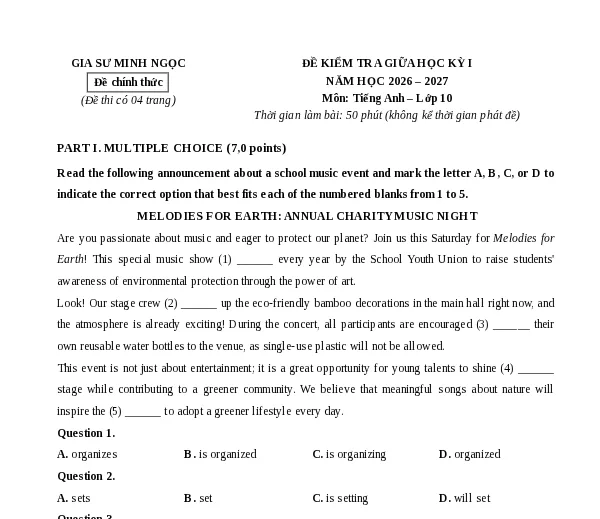
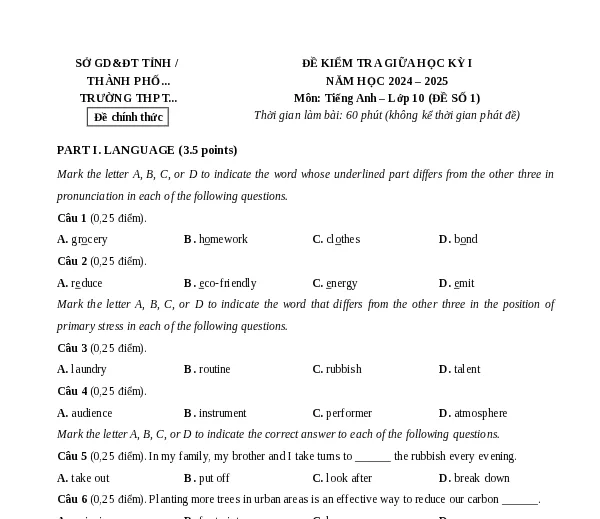
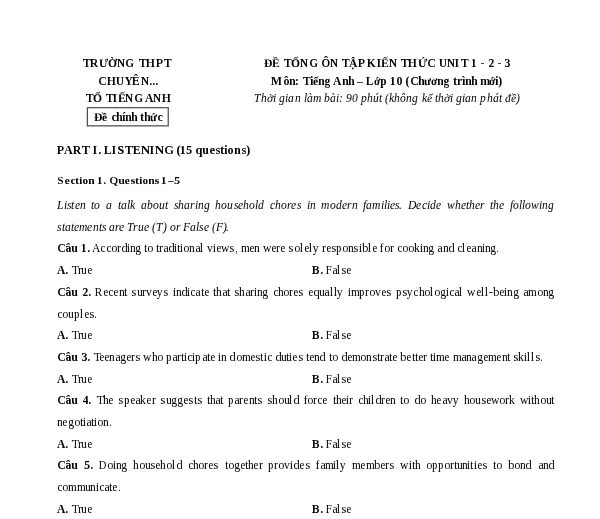
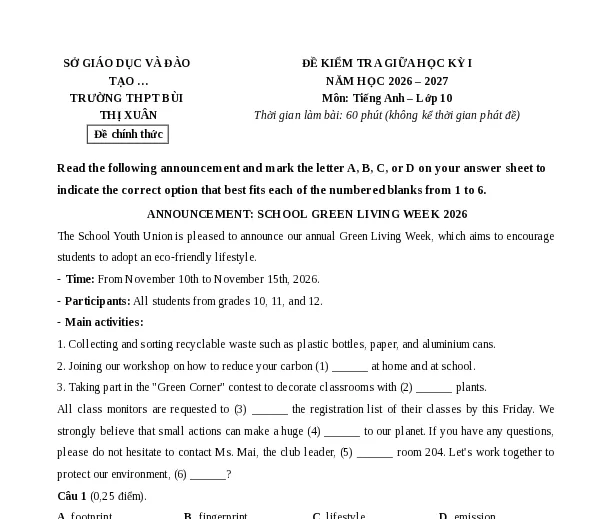
PART I. PRONUNCIATION & STRESS (1,0 điểm)
Mark the letter A, B, C, or D to indicate the word whose underlined part differs from the other three in pronunciation in each of the following questions.
Question 1.
A. trash
B. tree
C. truth
D. create
Question 2.
A. grocery
B. adopt
C. social
D. moment
Mark the letter A, B, C, or D to indicate the word that differs from the other three in the position of primary stress in each of the following questions.
Question 3.
A. routine
B. laundry
C. household
D. picnic
Question 4.
A. organic
B. energy
C. appliance
D. performance
PART II. VOCABULARY, GRAMMAR & COMMUNICATION (4,0 điểm)
Mark the letter A, B, C, or D to indicate the correct answer to each of the following questions.
Question 5. Look at those dark clouds! It ______ heavily in a few minutes.
A. will rain
B. is going to rain
C. rains
D. is raining
Question 6. My mother usually ______ the cooking, while my father does the heavy lifting in our family.
A. does
B. makes
C. takes
D. puts
Question 7. More and more trees ______ in our neighborhood every spring to make the air cleaner.
A. plant
B. are planting
C. are planted
D. were planted
Question 8. My parents never allow me ______ out late in the evening on weekdays.
A. go
B. going
C. to go
D. gone
Question 9. Please be quiet! My little sister ______ for her upcoming music competition in the next room.
A. practices
B. is practicing
C. practiced
D. will practice
Question 10. Turning off electrical appliances when they are not in use is a simple way to reduce our ______.
A. carbon footprint
B. greenhouse effect
C. global warming
D. natural resource
Question 11. The concert was very exciting, ______ we decided to stay until the very end.
A. but
B. or
C. so
D. nor
Question 12. Dividing household chores equally helps strengthen family ______ and teaches children responsibility.
A. bonds
B. rules
C. routines
D. manners
Question 13. The ______ cheered loudly when the talented singer walked onto the stage and started singing.
A. judges
B. audience
C. viewers
D. contestants
Question 14. Remember ______ your reusable bag when you go to the supermarket this afternoon.
A. bring
B. bringing
C. to bring
D. brought
Mark the letter A, B, C, or D to indicate the word(s) CLOSEST in meaning to the underlined word(s) in each of the following questions.
Question 15. Children should be taught to show gratitude to their parents for all their hard work and love.
A. thankfulness
B. kindness
C. honesty
D. sympathy
Question 16. Using eco-friendly products is one of the best ways to protect our planet from pollution.
A. expensive
B. environmentally harmless
C. artificial
D. chemical
Mark the letter A, B, C, or D to indicate the word(s) OPPOSITE in meaning to the underlined word(s) in each of the following questions.
Question 17. We should reduce the amount of plastic waste we produce every single day.
A. cut down
B. increase
C. lower
D. reuse
Question 18. Listening to classical music helps me feel relaxed after a long day at school.
A. calm
B. comfortable
C. stressed
D. peaceful
Mark the letter A, B, C, or D to indicate the option that best completes each of the following exchanges.
Question 19. Nam and Lan are talking about their weekend plans.
- Nam: "Shall we join the school's green campaign this Sunday?"
- Lan: "______"
A. That's a great idea!
B. Yes, I did it yesterday.
C. You're welcome.
D. No, I don't mind.
Question 20. Minh is asking his sister for advice.
- Minh: "Which musical instrument do you think I should learn to play?"
- Hoa: "______"
A. I bought a new guitar last week.
B. If I were you, I would choose the piano.
C. Music is very popular nowadays.
D. Thank you for your kind words.
PART III. CLOZE TEST (1,25 điểm)
Read the following passage and mark the letter A, B, C, or D to indicate the correct word or phrase that best fits each of the numbered blanks from 21 to 25.
Living a green lifestyle is becoming increasingly important in today's world. There are many simple habits we can adopt at home to protect the environment. First, we should always remember to turn off lights and electronic devices when leaving a room. This not only saves electricity (21) ______ also lowers our monthly energy bills. Second, cutting down on single-use plastic is essential. Instead of using plastic bags, we can bring (22) ______ cloth bags when shopping for groceries.
Furthermore, saving water is another key part of living sustainably. Taking shorter showers and fixing leaky faucets can prevent a huge amount of water from being wasted. Many families also choose to buy (23) ______ food, which is grown without harmful chemicals or pesticides. Finally, planting more trees in our gardens or local parks helps absorb carbon dioxide and provides fresh air (24) ______ everyone. By making these small changes in our daily routines, we can (25) ______ a big difference to the future of our planet.
Question 21.
A. and
B. but
C. or
D. so
Question 22.
A. reusable
B. reuse
C. usefully
D. useless
Question 23.
A. artificial
B. polluted
C. organic
D. chemical
Question 24.
A. with
B. on
C. at
D. for
Question 25.
A. do
B. make
C. take
D. put
PART IV. READING COMPREHENSION (2,5 điểm)
Read the following passage and mark the letter A, B, C, or D to indicate the correct answer to each of the questions from 26 to 30.
In modern society, both parents often work full-time to support their families. As a result, sharing household chores has become more important than ever. When everyone in the family contributes to housework, no single person feels overburdened or exhausted. While parents usually handle more complex tasks like cooking meals or paying bills, children can easily help with age-appropriate chores such as setting the table, feeding pets, taking out the rubbish, or tidying up their own bedrooms.
Doing housework offers numerous benefits for children. Psychologists suggest that children who regularly do chores develop a strong sense of responsibility and self-reliance. They learn essential life skills like cooking, cleaning, and time management, which will be extremely useful when they grow up and live independently. Moreover, working together on household tasks gives family members valuable time to talk, bond, and understand each other better. It teaches children to appreciate the hard work required to maintain a clean and comfortable home.
Question 26. What is the main idea of the passage?
A. How to cook healthy meals for a big family.
B. The importance and benefits of sharing household chores.
C. Why children should not do any housework on weekdays.
D. The difficulties of working full-time in modern society.
Question 27. The word "overburdened" in paragraph 1 is closest in meaning to ______.
A. given too much work to do
B. feeling very excited and happy
C. having too much free time
D. proud of family traditions
Question 28. According to paragraph 1, which of the following is NOT mentioned as a chore for children?
A. Feeding pets
B. Setting the table
C. Paying monthly bills
D. Tidying up their bedrooms
Question 29. The word "They" in paragraph 2 refers to ______.
A. psychologists
B. parents
C. benefits
D. children
Question 30. According to the passage, why is doing housework helpful for children's future?
A. Because they can earn a lot of pocket money from their parents.
B. Because they learn essential life skills to live independently later.
C. Because they do not have to study hard at school anymore.
D. Because they can become professional psychologists when they grow up.
Read the following passage and mark the letter A, B, C, or D to indicate the correct answer to each of the questions from 31 to 35.
Quan Ho singing is a traditional Vietnamese folk music style that originated in the Red River Delta, primarily in Bac Ninh and Bac Giang provinces. In 2009, it was officially recognized by UNESCO as an Intangible Cultural Heritage of Humanity. Historically, Quan Ho was performed during spring festivals, where young men and women from different villages gathered to sing alternating verses to express their feelings and build friendships.
In a traditional Quan Ho performance, female singers, known as liền chị, wear distinctive traditional costumes including multi-layered dresses and large flat palm hats (nón quai thao). Male singers, called liền anh, dress in long tunics, turbans, and carry umbrellas. The singing requires great vocal control and harmony, as traditional Quan Ho is performed without any musical instrument accompaniment. Singers must match the melody and rhythm of their partners' songs.
Today, local authorities and cultural organizations are making great efforts to preserve Quan Ho singing. Folk clubs have been established in many villages, where older artisans teach young children the traditional melodies and lyrics so that this precious cultural heritage will continue to thrive for generations to come.
Question 31. What is the passage mainly about?
A. The history of modern pop music in Vietnam.
B. Quan Ho singing – a traditional Vietnamese cultural heritage.
C. How to make traditional palm hats in Bac Ninh province.
D. Famous musical instruments in the Red River Delta.
Question 32. When was Quan Ho singing recognized by UNESCO as an Intangible Cultural Heritage of Humanity?
A. In 1999
B. In 2005
C. In 2009
D. In 2019
Question 33. What is special about a traditional Quan Ho singing performance?
A. It is performed without any musical instruments.
B. Only male singers are allowed to sing on stage.
C. It uses electric guitars and modern drums.
D. Singers must write new songs during the festival.
Question 34. The word "preserve" in paragraph 3 is closest in meaning to ______.
A. destroy
B. protect
C. forget
D. replace
Question 35. How are local communities keeping Quan Ho singing alive today?
A. By banning modern music in Bac Ninh and Bac Giang.
B. By selling traditional costumes to foreign tourists.
C. By setting up folk clubs where artisans teach the younger generation.
D. By replacing traditional lyrics with English words.
PART V. ERROR IDENTIFICATION & WRITING (1,25 điểm)
Mark the letter A, B, C, or D to indicate the underlined part that needs correction in each of the following questions.
Question 36. My brother always is responsible for watering the plants in the garden every morning.
A. always
B. is
C. watering
D. in
Question 37. His parents made him to finish all his homework before watching his favorite TV show last night.
A. made
B. to finish
C. watching
D. last night
Mark the letter A, B, C, or D to indicate the sentence that is closest in meaning to each of the following questions.
Question 38. Volunteers collect plastic bottles on the beach every weekend.
A. Plastic bottles collect volunteers on the beach every weekend.
B. Plastic bottles are collected on the beach by volunteers every weekend.
C. Plastic bottles were collected on the beach by volunteers every weekend.
D. Plastic bottles will be collected on the beach by volunteers every weekend.
Question 39. We have already bought the tickets, and we have a plan to see the live concert tonight.
A. We are going to see the live concert tonight.
B. We will probably buy tickets for the concert tonight.
C. We saw the live concert with our friends last night.
D. We don't want to see the live concert tonight.
Mark the letter A, B, C, or D to indicate the sentence that best combines each pair of sentences in the following questions.
Question 40. Minh wanted to join the school music club. He practiced playing the guitar every day.
A. Minh wanted to join the school music club, so he practiced playing the guitar every day.
B. Minh wanted to join the school music club, but he practiced playing the guitar every day.
C. Minh wanted to join the school music club, or he practiced playing the guitar every day.
D. Minh wanted to join the school music club, nor he practiced playing the guitar every day.
--------- HẾT ---------
Thí sinh không được sử dụng tài liệu. Cán bộ coi thi không giải thích gì thêm.
Họ và tên thí sinh: ................................................ Số báo danh: ........................
SỞ GIÁO DỤC VÀ ĐÀO TẠO ...
TRƯỜNG THPT ...
Hướng dẫn chấm
ĐÁP ÁN ĐỀ KIỂM TRA GIỮA HỌC KỲ I
Môn: Tiếng Anh – Lớp 10
Thời gian làm bài: 50 phút
A. BẢNG ĐÁP ÁN TRẮC NGHIỆM (10,0 điểm)
Mỗi câu trả lời đúng được 0,25 điểm (40 câu x 0,25 = 10,0 điểm).
Câu | Đáp án | Câu | Đáp án | Câu | Đáp án | Câu | Đáp án |
|---|---|---|---|---|---|---|---|
1 | D | 11 | C | 21 | B | 31 | B |
2 | B | 12 | A | 22 | A | 32 | C |
3 | A | 13 | B | 23 | C | 33 | A |
4 | B | 14 | C | 24 | D | 34 | B |
5 | B | 15 | A | 25 | B | 35 | C |
6 | A | 16 | B | 26 | B | 36 | B |
7 | C | 17 | B | 27 | A | 37 | B |
8 | C | 18 | C | 28 | C | 38 | B |
9 | B | 19 | A | 29 | D | 39 | A |
10 | A | 20 | B | 30 | B | 40 | A |
B. GIẢI THÍCH CHI TIẾT
Câu | Nội dung giải thích | Điểm |
|---|---|---|
1 | Đáp án D. create phát âm là /kr/, các từ còn lại (trash, tree, truth) phát âm là /tr/. | 0,25 |
2 | Đáp án B. adopt (/əˈdɒpt/) có chữ "o" phát âm là /ɒ/, các từ còn lại (grocery, social, moment) phát âm là /əʊ/. | 0,25 |
3 | Đáp án A. routine (/ruːˈtiːn/) nhấn âm 2, các từ còn lại (laundry /ˈlɔːndri/, household /ˈhaʊshəʊld/, picnic /ˈpɪknɪk/) nhấn âm 1. | 0,25 |
4 | Đáp án B. energy (/ˈenədʒi/) nhấn âm 1, các từ còn lại (organic /ɔːˈɡænɪk/, appliance /əˈplaɪəns/, performance /pəˈfɔːməns/) nhấn âm 2. | 0,25 |
5 | Đáp án B. Dự đoán có căn cứ ở hiện tại ("Look at those dark clouds!") dùng cấu trúc be going to + V: is going to rain. | 0,25 |
6 | Đáp án A. Cụm từ cố định (collocation): do the cooking (nấu ăn). | 0,25 |
7 | Đáp án C. Câu bị động ở thì hiện tại đơn (dấu hiệu "every spring", chủ ngữ "More and more trees"): are planted. | 0,25 |
8 | Đáp án C. Cấu trúc allow + O + to V (cho phép ai làm gì): to go. | 0,25 |
9 | Đáp án B. Dấu hiệu "Please be quiet!" chỉ hành động đang diễn ra tại thời điểm nói, chia hiện tại tiếp diễn: is practicing. | 0,25 |
10 | Đáp án A. Cụm từ carbon footprint (dấu chân các-bon / lượng khí thải các-bon). | 0,25 |
11 | Đáp án C. Liên từ chỉ kết quả trong câu ghép: Buổi hòa nhạc rất thú vị, vì vậy (so) chúng tôi quyết định ở lại đến cuối. | 0,25 |
12 | Đáp án A. Cụm từ family bonds (sự gắn kết gia đình). | 0,25 |
13 | Đáp án B. audience (khán giả xem trực tiếp tại sân khấu/hội trường). | 0,25 |
14 | Đáp án C. Cấu trúc remember + to V (nhớ phải làm gì): to bring. | 0,25 |
15 | Đáp án A. gratitude (lòng biết ơn) = thankfulness. | 0,25 |
16 | Đáp án B. eco-friendly (thân thiện với môi trường) = environmentally harmless (vô hại với môi trường). | 0,25 |
17 | Đáp án B. reduce (giảm bớt) >< increase (làm tăng lên). | 0,25 |
18 | Đáp án C. relaxed (thư giãn, thoải mái) >< stressed (căng thẳng). | 0,25 |
19 | Đáp án A. Đáp lại lời rủ/đề nghị ("Shall we join...?"): That's a great idea! (Đó là một ý kiến tuyệt vời!). | 0,25 |
20 | Đáp án B. Đáp lại câu xin lời khuyên ("Which musical instrument do you think I should learn...?"): If I were you, I would choose the piano. | 0,25 |
21 | Đáp án B. Cấu trúc not only ... but also ... (không những ... mà còn ...). | 0,25 |
22 | Đáp án A. Cần một tính từ đứng trước danh từ "cloth bags": reusable (có thể tái sử dụng). | 0,25 |
23 | Đáp án C. organic food (thực phẩm hữu cơ, được trồng không dùng hóa chất độc hại). | 0,25 |
24 | Đáp án D. Cấu trúc provide something for somebody (cung cấp cái gì cho ai). | 0,25 |
25 | Đáp án B. Cụm từ cố định make a difference (tạo nên sự khác biệt). | 0,25 |
26 | Đáp án B. Đoạn 1 nêu tầm quan trọng của việc chia sẻ việc nhà, đoạn 2 nêu các lợi ích của việc làm việc nhà đối với trẻ em. | 0,25 |
27 | Đáp án A. overburdened (quá tải, gánh vác quá nhiều) = given too much work to do. | 0,25 |
28 | Đáp án C. Thông tin đoạn 1: "parents usually handle more complex tasks like cooking meals or paying bills", nên trả hóa đơn không phải việc của trẻ em. | 0,25 |
29 | Đáp án D. Đại từ "They" thay thế cho danh từ "children" ở câu trước đó. | 0,25 |
30 | Đáp án B. Thông tin đoạn 2: "They learn essential life skills ... which will be extremely useful when they grow up and live independently." | 0,25 |
31 | Đáp án B. Bài đọc giới thiệu khái quát về dân ca Quan họ (nguồn gốc, cách biểu diễn truyền thống và nỗ lực bảo tồn). | 0,25 |
32 | Đáp án C. Thông tin đoạn 1: "In 2009, it was officially recognized by UNESCO as an Intangible Cultural Heritage of Humanity." | 0,25 |
33 | Đáp án A. Thông tin đoạn 2: "... traditional Quan Ho is performed without any musical instrument accompaniment." | 0,25 |
34 | Đáp án B. preserve (bảo tồn, giữ gìn) = protect (bảo vệ). | 0,25 |
35 | Đáp án C. Thông tin đoạn 3: "Folk clubs have been established in many villages, where older artisans teach young children..." | 0,25 |
36 | Đáp án B. Trạng từ chỉ tần suất "always" phải đứng sau động từ to be: sửa always is thành is always. | 0,25 |
37 | Đáp án B. Cấu trúc sai khiến make + O + V (nguyên thể không to): sửa to finish thành finish. | 0,25 |
38 | Đáp án B. Chuyển sang câu bị động thì hiện tại đơn ("every weekend"): S + am/is/are + V3/ed + (by O). | 0,25 |
39 | Đáp án A. Kế hoạch, dự định đã được sắp xếp từ trước (đã mua vé) được diễn đạt bằng cấu trúc be going to + V. | 0,25 |
40 | Đáp án A. Ghép câu dùng liên từ so để chỉ kết quả hợp lý: Minh muốn tham gia câu lạc bộ âm nhạc, vì vậy cậu ấy luyện đàn mỗi ngày. | 0,25 |