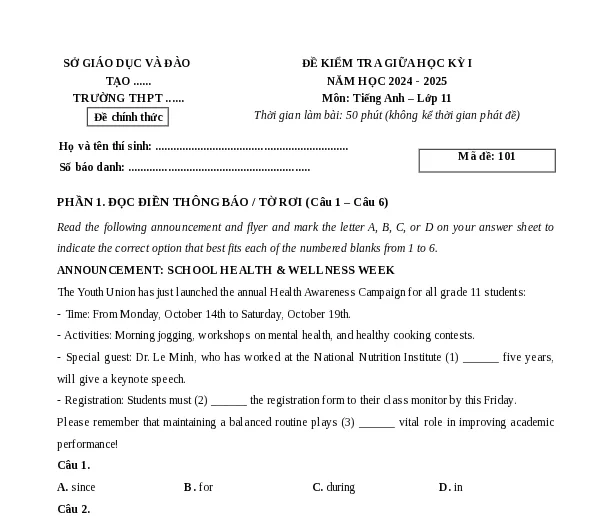
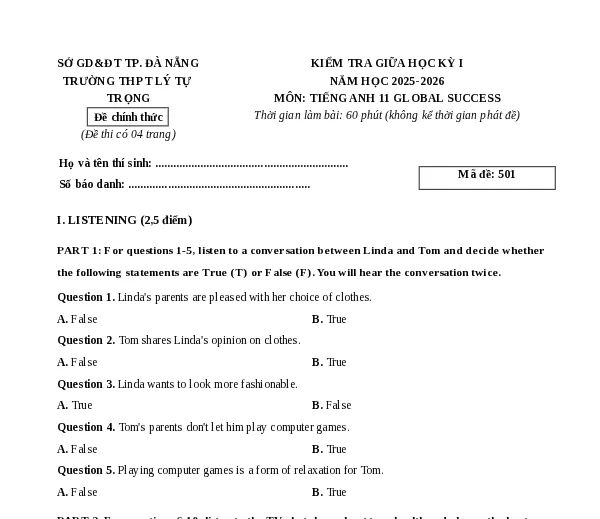
TRƯỜNG THPT ....................
TỔ TIẾNG ANH
Đề chính thức
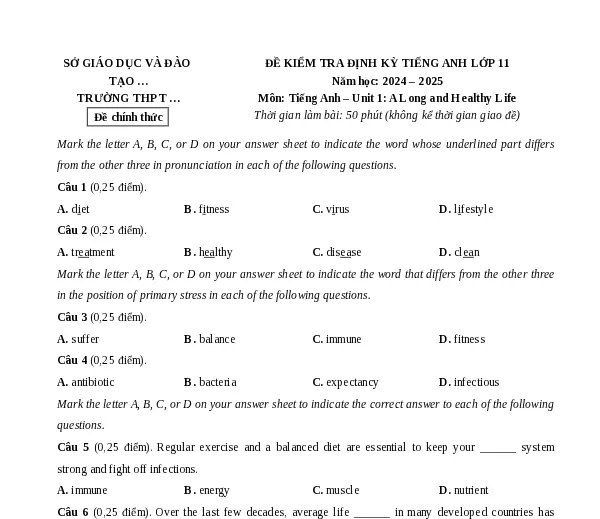
ĐỀ KIỂM TRA ĐỊNH KỲ NĂM HỌC 2024 – 2025
Môn: Tiếng Anh – Lớp 11
Thời gian làm bài: 45 phút (không kể thời gian phát đề)
Mã đề thi: 101
Mark the letter A, B, C, or D on your answer sheet to indicate the correct option that best fits each of the numbered blanks from 1 to 4.
SCHOOL HEALTH WORKSHOP: BUILDING A HEALTHY LIFESTYLE
Last Friday, our school held a special workshop on personal healthcare.
- While the doctor (1) ______ about dietary habits, many students took detailed notes.
- A guest nutritionist suddenly (2) ______ into the hall while the principal was delivering the opening speech.
- All attendees were encouraged to do regular physical (3) ______ to boost life expectancy.
- Last year, our school club (4) ______ a campaign to prevent infectious diseases.
Câu 1.
A. talks
B. is talking
C. was talking
D. talked
Câu 2.
A. stepped
B. was stepping
C. is stepping
D. steps
Câu 3.
A. organism
B. exercise
C. bacteria
D. nutrient
Câu 4.
A. launches
B. was launching
C. launched
D. is launching
Mark the letter A, B, C, or D on your answer sheet to indicate the correct option that best fits each of the numbered blanks from 5 to 8.
HEALTH TIPS: RECOVERING FROM ILLNESS
- Yesterday afternoon, while Mark (5) ______ rest in bed, his mother made him some chicken soup.
- When the doctor arrived at the clinic, the nurses (6) ______ the medical equipment carefully.
- Patients must complete the full course of (7) ______ prescribed by their physician to completely kill harmful bacteria.
- Regular check-ups help doctors examine human (8) ______ and treat health problems early.
Câu 5.
A. took
B. was taking
C. is taking
D. takes
Câu 6.
A. sterilized
B. are sterilizing
C. were sterilizing
D. sterilize
Câu 7.
A. antibiotics
B. nutrients
C. organisms
D. muscles
Câu 8.
A. fitness
B. organs
C. longevity
D. lifestyle
Mark the letter A, B, C, or D on your answer sheet to indicate the correct arrangement of the sentences to make a meaningful exchange or text from 9 to 12.
Câu 9.
a. Minh: "I fell off my bicycle while I was cycling in the park yesterday morning."
b. Lan: "Oh dear! Did you visit the doctor immediately?"
c. Lan: "Why are you walking with a limp today, Minh?"
A. c - a - b
B. a - b - c
C. b - c - a
D. c - b - a
Câu 10.
a. Nam: "While my father was reading a health magazine, he found an article about the immune system."
b. Nam: "Yes, it showed that regular physical activity helps the body fight off infections."
c. Mai: "Really? Did it mention any practical tips to boost our natural defenses?"
A. a - b - c
B. a - c - b
C. c - a - b
D. b - c - a
Câu 11.
a. While I was examining my daily diet last month, I realized that I consumed too much fast food.
b. As a result, I decided to cut down on sugary drinks and eat more fresh vegetables.
c. Consequently, my energy levels improved dramatically and I felt much healthier.
d. Before that change, I frequently felt exhausted after school hours.
A. a - d - b - c
B. d - a - c - b
C. a - b - d - c
D. b - a - d - c
Câu 12.
a. Dear Dr. Adams, I am writing to ask for medical advice regarding my sleep routine.
b. Two days ago, while I was doing workout exercises at 10 p.m., my heart started beating very fast.
c. I immediately stopped exercising and drank some warm water.
d. Since that evening, I have been worried about my cardiovascular health.
e. Could you please give me some recommendations on appropriate workout times?
A. a - b - c - d - e
B. a - c - b - d - e
C. b - a - c - e - d
D. a - d - b - c - e
Mark the letter A, B, C, or D on your answer sheet to indicate the correct option that best fits each of the numbered blanks from 13 to 17.
Living a long and healthy life has always been a key goal for humans. In the past, people suffered from many deadly infections because (13) ______. During the early 20th century, scientists made a groundbreaking discovery. In 1928, while Alexander Fleming (14) ______, he accidentally observed a mould that destroyed bacteria in a petri dish. That discovery led to penicillin, the world's first modern antibiotic.
Last year, a local hospital conducted a study on lifestyle changes among middle-aged residents. While the researchers (15) ______, they noticed that individuals with balanced diets had stronger immune systems. One participant reported that when he (16) ______ severe chest pains last autumn, the medical staff (17) ______ him in the emergency room without delay. Today, modern healthcare continues to raise life expectancy worldwide.
Câu 13.
A. they did not understand how harmful microorganisms spread diseases
B. they are not understanding how harmful microorganisms spread diseases
C. they were not understanding how harmful microorganisms spread diseases
D. they do not understand how harmful microorganisms spread diseases
Câu 14.
A. worked on influenza virus cultures in his laboratory
B. was working on bacteria in his London laboratory
C. is working on modern laboratory samples
D. has worked on various infectious organisms
Câu 15.
A. collect health information from local volunteers
B. were collecting data about participants' daily habits
C. are collecting blood samples from elderly people
D. collected information when participants slept
Câu 16.
A. is experiencing
B. experiences
C. was experiencing
D. experience
Câu 17.
A. treated
B. were treating
C. are treating
D. treat
Read the following passage and mark the letter A, B, C, or D on your answer sheet to indicate the correct answer to each of the questions from 18 to 25.
In 2015, a team of British researchers traveled to the Japanese island of Okinawa to investigate the secrets of longevity. At that time, demographers considered Okinawa one of the world's most famous "Blue Zones"—regions where people live significantly longer and healthier lives than the global average.
When the researchers arrived in the village of Ogimi, local elderly residents were working actively in their vegetable gardens. Most of these seniors were over ninety years old, yet they displayed remarkable stamina and mental sharpness. The scientists conducted comprehensive interviews and examined daily habits. While Mrs. Kazu, a 98-year-old resident, was preparing traditional green tea, she explained that her diet consisted mainly of sweet potatoes, seaweed, tofu, and fresh vegetables. She rarely consumed processed foods or refined sugar.
Furthermore, physical exercise was woven naturally into their daily routines. Unlike modern city dwellers who often pay for gym memberships, Okinawans maintained constant low-intensity movement. While elderly men were walking through hilly paths to visit their neighbors, women gathered to practice traditional dances. Social connection, known locally as moai, provided vital emotional support. In 2018, when scientists published their final report, they concluded that a plant-based diet, regular natural exercise, and strong community bonds shielded these residents against chronic diseases and extended their life expectancy.
Câu 18. What is the best title for the passage?
A. The Discovery of Modern Antibiotics
B. Secrets of Longevity in Okinawa
C. How to Join Fitness Gyms
D. Chronic Diseases Among the Elderly
Câu 19. According to paragraph 1, why did the British researchers travel to Okinawa in 2015?
A. To treat infectious diseases among local villagers
B. To explore why local people enjoyed exceptionally long lives
C. To introduce western dietary habits to elderly residents
D. To build a modern medical center on the island
Câu 20. The phrase were working in paragraph 2 describes an action that ______.
A. happened after the scientists finished their research
B. was in progress when the researchers reached the village
C. was completed before the researchers traveled to Japan
D. was planned for the distant future
Câu 21. The word stamina in paragraph 2 is closest in meaning to ______.
A. physical strength
B. severe illness
C. bad memory
D. poor eyesight
Câu 22. According to paragraph 2, what was Mrs. Kazu doing when she talked about her diet?
A. She was working in a commercial factory.
B. She was making traditional green tea.
C. She was buying processed food at a grocery store.
D. She was receiving medical treatment from a doctor.
Câu 23. The word shielded in paragraph 3 is closest in meaning to ______.
A. attacked
B. protected
C. produced
D. caused
Câu 24. Which of the following is NOT mentioned as a factor contributing to Okinawans' long life?
A. Consuming a diet rich in vegetables, tofu, and seaweed
B. Regular low-intensity natural movement
C. Frequent visits to modern fitness centers and gyms
D. Strong social networks that provide emotional support
Câu 25. What can be inferred from the passage?
A. High-stress urban lifestyles are superior for promoting health.
B. Only genetic factors determine a person's life expectancy.
C. Simple natural habits and community care greatly enhance longevity.
D. Okinawans stopped working as soon as they reached sixty years old.
--------- HẾT ---------
Họ và tên thí sinh: ................................................................ Số báo danh: ........................
HƯỚNG DẪN CHẤM VÀ GIẢI CHI TIẾT
MÔN: TIẾNG ANH 11 – THỜI GIAN: 45 PHÚT
A. BẢNG ĐÁP ÁN (Mỗi câu 0,4 điểm)
Câu | Đáp án | Câu | Đáp án | Câu | Đáp án | Câu | Đáp án | Câu | Đáp án |
|---|---|---|---|---|---|---|---|---|---|
1 | C | 6 | C | 11 | A | 16 | C | 21 | A |
2 | A | 7 | A | 12 | A | 17 | A | 22 | B |
3 | B | 8 | B | 13 | A | 18 | B | 23 | B |
4 | C | 9 | A | 14 | B | 19 | B | 24 | C |
5 | B | 10 | B | 15 | B | 20 | B | 25 | C |
B. LỜI GIẢI CHI TIẾT
Câu 1. Chọn C.
- Kiến thức thì: Phối hợp thì với While. Mệnh đề đi kèm While diễn tả hành động đang diễn ra trong quá khứ: was/were + V-ing. Chủ ngữ the doctor số ít was talking.
- Dịch: Trong khi bác sĩ đang nói về thói quen ăn uống, nhiều học sinh đã ghi chép cẩn thận.
Câu 2. Chọn A.
- Kiến thức thì: Hành động đang xảy ra (was delivering) thì một hành động khác xen vào đột ngột chia ở thì Quá khứ đơn (stepped).
- Dịch: Một chuyên gia dinh dưỡng khách mời bất ngờ bước vào hội trường khi thầy hiệu trưởng đang phát biểu khai mạc.
Câu 3. Chọn B.
- Kiến thức từ vựng: Cụm từ physical exercise (tập thể dục thể chất). Các từ khác: organism (sinh vật), bacteria (vi khuẩn), nutrient (chất dinh dưỡng).
- Dịch: Tất cả người tham gia đều được khuyến khích tập thể dục thường xuyên để nâng cao tuổi thọ.
Câu 4. Chọn C.
- Kiến thức thì: Dấu hiệu thời gian Last year chỉ hành động đã xảy ra và kết thúc trong quá khứ Quá khứ đơn (launched).
- Dịch: Năm ngoái, câu lạc bộ trường chúng tôi đã phát động một chiến dịch phòng ngừa bệnh truyền nhiễm.
Câu 5. Chọn B.
- Kiến thức thì: Cấu trúc với While chỉ hành động đang diễn ra trong quá khứ: was taking rest (đang nghỉ ngơi).
- Dịch: Chiều hôm qua, trong khi Mark đang nghỉ ngơi trên giường, mẹ bạn ấy đã nấu cho bạn ấy một bát súp gà.
Câu 6. Chọn C.
- Kiến thức thì: Hành động ngắn cắt ngang chia Quá khứ đơn (arrived), hành động dài đang diễn ra chia Quá khứ tiếp diễn (were sterilizing - vì chủ ngữ the nurses số nhiều).
- Dịch: Khi bác sĩ đến phòng khám, các y tá đang khử trùng trang thiết bị y tế một cách cẩn thận.
Câu 7. Chọn A.
- Kiến thức từ vựng: course of antibiotics (liệu trình thuốc kháng sinh) dùng để diệt vi khuẩn (kill bacteria).
- Dịch: Bệnh nhân phải hoàn thành đủ liệu trình kháng sinh do bác sĩ kê đơn để tiêu diệt hoàn toàn vi khuẩn có hại.
Câu 8. Chọn B.
- Kiến thức từ vựng: examine human organs (khám các cơ quan trong cơ thể người). Các từ khác: fitness (sự vừa vặn/thể lực), longevity (tuổi thọ), lifestyle (lối sống).
- Dịch: Khám sức khỏe định kỳ giúp bác sĩ kiểm tra các cơ quan trong cơ thể và điều trị sớm các vấn đề sức khỏe.
Câu 9. Chọn A.
- Trật tự hội thoại hợp lý:
- (c) Lan hỏi nguyên nhân Minh đi khập khiễng: "Why are you walking with a limp today, Minh?"
- (a) Minh giải thích hành động quá khứ tiếp diễn bị cắt ngang: "I fell off my bicycle while I was cycling in the park yesterday morning."
- (b) Lan hỏi thăm tiếp: "Oh dear! Did you visit the doctor immediately?"
Câu 10. Chọn B.
- Trật tự hội thoại hợp lý:
- (a) Nam kể lại việc bố đọc báo: "While my father was reading a health magazine, he found an article about the immune system."
- (c) Mai tò mò hỏi thêm chi tiết: "Really? Did it mention any practical tips to boost our natural defenses?"
- (b) Nam trả lời nội dung bài báo: "Yes, it showed that regular physical activity helps the body fight off infections."
Câu 11. Chọn A.
- Logic đoạn văn:
- (a) Nhận thức vấn đề trong quá khứ khi đang rà soát chế độ ăn (While I was examining...).
- (d) Miêu tả trạng thái tiêu cực trước đó (Before that change, I frequently felt exhausted...).
- (b) Hành động khắc phục (As a result, I decided to cut down on...).
- (c) Kết quả đạt được (Consequently, my energy levels improved...).
Câu 12. Chọn A.
- Cấu trúc bức thư gửi bác sĩ:
- (a) Nêu lý do viết thư xin tư vấn (I am writing to ask for medical advice...).
- (b) Kể lại sự cố đang tập thể dục thì tim đập nhanh (Two days ago, while I was doing workout exercises...).
- (c) Hành động xử lý tức thời (I immediately stopped exercising...).
- (d) Tình trạng lo lắng sau đó (Since that evening...).
- (e) Lời đề nghị bác sĩ đưa ra lời khuyên (Could you please give me some recommendations...?).
Câu 13. Chọn A.
- Ngữ pháp: Bối cảnh quá khứ (In the past, people suffered...) động từ chia ở thì Quá khứ đơn thể phủ định: did not understand. Động từ nhận thức understand không chia tiếp diễn.
- Dịch: Trong quá khứ, con người phải chịu đựng nhiều bệnh truyền nhiễm gây chết người vì họ không hiểu các vi sinh vật có hại lây lan bệnh tật như thế nào.
Câu 14. Chọn B.
- Ngữ pháp: Mệnh đề sau while diễn tả hành động nghiên cứu đang diễn ra trong quá khứ thì quan sát thấy nấm mốc (observed) chia Quá khứ tiếp diễn: was working on bacteria in his London laboratory.
Câu 15. Chọn B.
- Ngữ pháp: Đi sau liên từ While trong bối cảnh nghiên cứu năm ngoái (Last year) Quá khứ tiếp diễn: were collecting data about participants' daily habits.
Câu 16. Chọn C.
- Ngữ pháp: Diễn tả cơn đau đang xuất hiện (was experiencing severe chest pains) khi bệnh nhân nhập viện.
Câu 17. Chọn A.
- Ngữ pháp: Hành động nhân viên y tế cấp cứu, điều trị cho bệnh nhân xảy ra dứt khoát trong quá khứ Quá khứ đơn: treated.
Câu 18. Chọn B.
- Tiêu đề phù hợp nhất là Secrets of Longevity in Okinawa (Bí quyết trường thọ ở Okinawa) vì toàn bộ bài đọc phân tích chế độ ăn, tập luyện và đời sống xã hội giúp người dân nơi đây sống thọ.
Câu 19. Chọn B.
- Căn cứ thông tin đoạn 1: "In 2015, a team of British researchers traveled to the Japanese island of Okinawa to investigate the secrets of longevity." Tìm hiểu nguyên nhân người dân sống thọ đặc biệt.
Câu 20. Chọn B.
- Ngữ pháp và ngữ nghĩa: Cụm were working chia ở thì Quá khứ tiếp diễn kết hợp với mệnh đề When the researchers arrived in the village chỉ hành động đang diễn ra khi các nhà nghiên cứu đến làng.
Câu 21. Chọn A.
- Từ vựng: stamina có nghĩa là sức bền, thể lực dẻo dai gần nghĩa với physical strength.
Câu 22. Chọn B.
- Căn cứ thông tin đoạn 2: "While Mrs. Kazu, a 98-year-old resident, was preparing traditional green tea, she explained that her diet consisted mainly of sweet potatoes..." Bà Kazu đang pha trà xanh truyền thống.
Câu 23. Chọn B.
- Từ vựng: shielded (che chắn, bảo vệ) đồng nghĩa với protected.
Câu 24. Chọn C.
- Đoạn 3 nêu rõ: "Unlike modern city dwellers who often pay for gym memberships, Okinawans maintained constant low-intensity movement." (Không giống cư dân thành thị phải trả tiền đến phòng gym, người Okinawa duy trì vận động tự nhiên) Việc đến phòng gym hiện đại không phải là yếu tố của người Okinawa.
Câu 25. Chọn C.
- Suy luận từ đoạn kết bài: Lối sống tự nhiên, chế độ ăn lành mạnh và sự gắn kết cộng đồng hỗ trợ kéo dài tuổi thọ con người (Simple natural habits and community care greatly enhance longevity).
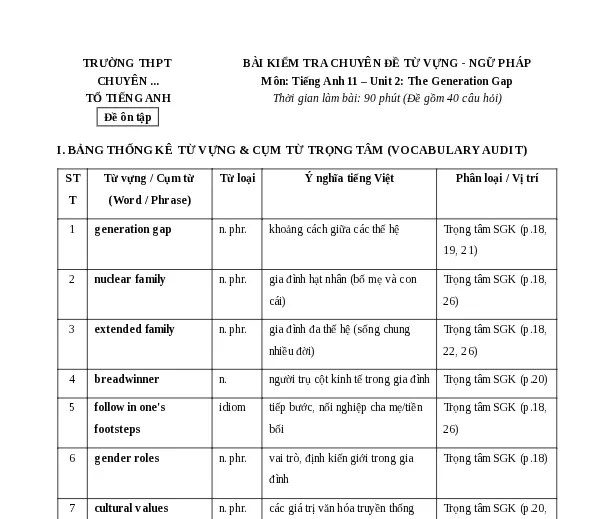
C. BẢNG THỐNG KÊ TỪ VỰNG UNIT 1 (GLOBAL SUCCESS 11) ĐÃ SỬ DỤNG TRONG ĐỀ
STT | Từ vựng / Cụm từ | Từ loại / Nghĩa | Vị trí trong đề | Thuộc phần trong Unit 1 SGK |
|---|---|---|---|---|
1 | life expectancy | (n phr) tuổi thọ dự tính | Câu 3, 17, 18 | Getting Started, Reading |
2 | infectious disease | (n phr) bệnh truyền nhiễm | Câu 4, 13 | Language, Reading |
3 | antibiotics | (n) thuốc kháng sinh | Câu 7, 14, 18 | Language, Reading |
4 | bacteria | (n) vi khuẩn | Câu 3, 7, 14 | Getting Started, Language |
5 | organism / microorganism | (n) sinh vật / vi sinh vật | Câu 3, 13, 14 | Language |
6 | organ | (n) cơ quan (trong cơ thể) | Câu 8 | Language, Looking Back |
7 | immune system | (n phr) hệ miễn dịch | Câu 10, 15 | Reading, Looking Back |
8 | workout | (n, v) luyện tập thể lực | Câu 12 | Getting Started, Speaking |
9 | longevity | (n) sự trường thọ, tuổi thọ cao | Câu 8, 18, 19 | Reading, Culture |
10 | stamina | (n) sức chịu đựng, sức bền | Câu 21 | Reading |
11 | cut down on | (phr v) cắt giảm | Câu 11 | Writing, Looking Back |
12 | dietary | (adj) thuộc chế độ ăn uống | Câu 1, 19 | Reading, Listening |
13 | nutrient | (n) chất dinh dưỡng | Câu 3, 7 | Language |
14 | sterilize | (v) khử trùng, tiệt trùng | Câu 6 | Language |
15 | chronic disease | (n phr) bệnh mãn tính | Câu 18, 23 | Reading |