TRƯỜNG THPT ....................
TỔ TIẾNG ANH
Tài liệu ôn tập
ĐỀ CƯƠNG ÔN TẬP GIỮA HỌC KỲ I
Môn: Tiếng Anh – Lớp 10 (Global Success)
Chương trình: Unit 1 (Family Life) & Unit 2 (Humans and the Environment)
PHẦN I. VOCABULARY & GRAMMAR (50 CÂU)
Mark the letter A, B, C, or D to indicate the correct answer to each of the following questions.
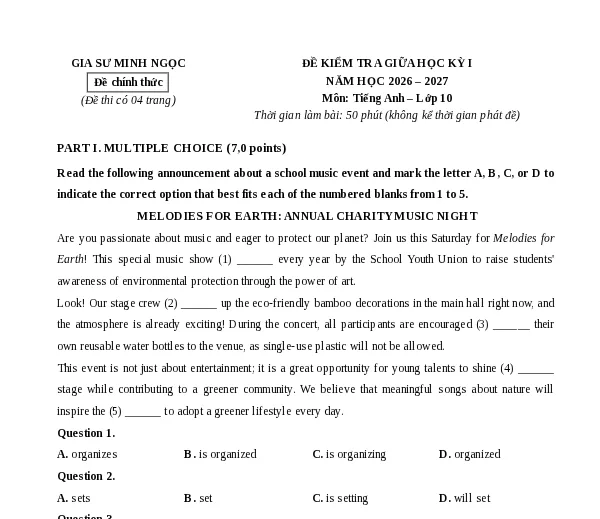
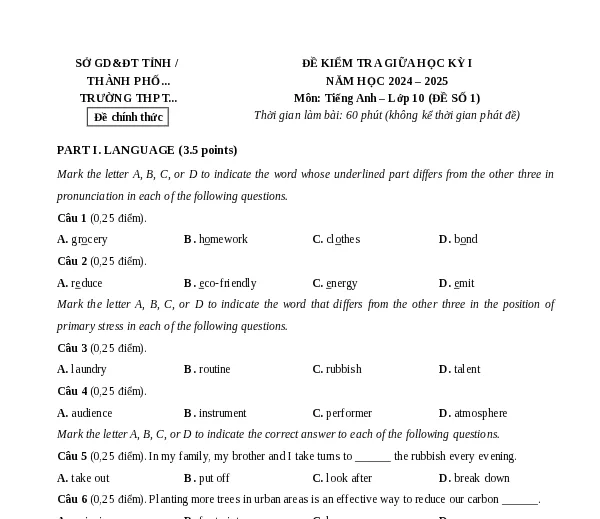
Câu 1. In my family, my brother and father usually do the ______ lifting such as moving heavy furniture.
A. heavy
B. strong
C. hard
D. huge
Câu 2. Doing household chores together helps children learn to ______ responsibility for their family.
A. make
B. take
C. give
D. pay
Câu 3. Both husband and wife should ______ hands to build a happy and stable home.
A. shake
B. hold
C. join
D. connect
Câu 4. After having dinner, my sister always helps my mother ______ the dishes.
A. wash up
B. clean out
C. take out
D. put away
Câu 5. We should replace single-use plastic bags with ______ shopping bags made of cloth.
A. eco-friendly
B. polluting
C. hazardous
D. poisonous
Câu 6. Turning off unused lights and electrical devices helps ______ a lot of energy.
A. waste
B. conserve
C. damage
D. exhaust
Câu 7. Planting more trees along streets helps ______ harmful gases and cleans the air.
A. release
B. emit
C. absorb
D. produce
Câu 8. "Look, there are black clouds coming!" – "Yes, it ______ soon."
A. is going to rain
B. will rain
C. rains
D. is raining
Câu 9. My mother rarely ______ out for dinner because she enjoys preparing homemade meals.
A. is eating
B. eats
C. will eat
D. eat
Câu 10. A large amount of household waste ______ into compost for gardening every month.
A. turns
B. is turned
C. is turning
D. will turn
Câu 11. In my family, my father is the ______ who works hard to earn money and support all of us.
A. breadwinner
B. homemaker
C. servant
D. babysitter
Câu 12. My mother takes care of the house and does all the cooking; she is a wonderful ______.
A. breadwinner
B. homemaker
C. employer
D. engineer
Câu 13. Sharing household ______ helps family members build stronger bonds with one another.
A. chores
B. finances
C. values
D. manners
Câu 14. Doing the ______ every day can be tiring, especially washing large blankets and curtains.
A. cooking
B. laundry
C. shopping
D. gardening
Câu 15. Could you please ______ the rubbish before the garbage truck arrives?
A. take out
B. put on
C. look after
D. give up
Câu 16. Every Sunday morning, my sister and I go to the supermarket to shop for ______.
A. clothes
B. groceries
C. appliances
D. electricity
Câu 17. Children should learn to do simple chores to develop their life skills and a sense of ______.
A. response
B. responsible
C. responsibility
D. responsibly
Câu 18. Parents should show ______ for the small things their children do around the house.
A. grateful
B. gratitude
C. gratefully
D. ingratitude
Câu 19. Turning off household ______ when not in use helps save energy and lower electricity bills.
A. appliances
B. furniture
C. tools
D. vehicles
Câu 20. Using public transport instead of personal cars helps reduce our carbon ______.
A. footprint
B. impact
C. damage
D. layer
Câu 21. We should adopt a greener ______ to protect natural resources for future generations.
A. lifetime
B. lifestyle
C. lifeline
D. lifeguard
Câu 22. Plastic bags take hundreds of years to ______ completely in the natural environment.
A. decompose
B. develop
C. discover
D. destroy
Câu 23. Planting more trees is one of the most effective ways to ______ carbon dioxide from the atmosphere.
A. emit
B. absorb
C. produce
D. release
Câu 24. Many youth clubs organize community clean-up events to raise people's environmental ______.
A. aware
B. awareness
C. unaware
D. awared
Câu 25. You should never ______ trash into rivers or onto the streets because it harms the ecosystem.
A. recycle
B. litter
C. collect
D. sort
Câu 26. Eco-friendly products are made from materials that are ______ to the environment.
A. harmful
B. harmless
C. danger
D. toxic
Câu 27. The local council has launched a campaign to encourage residents to ______ plastic bottles and cans.
A. reuse
B. emit
C. drop
D. waste
Câu 28. Solar energy and wind power are clean, ______ sources of energy.
A. renewable
B. limited
C. harmful
D. polluting
Câu 29. The heavy ______ in big cities is mostly caused by exhaust fumes from motor vehicles and factories.
A. polluted
B. pollute
C. pollutant
D. pollution
Câu 30. Taking a quick shower instead of a long bath helps ______ a significant amount of freshwater.
A. consume
B. conserve
C. destroy
D. contaminate
Câu 31. In my family, my brother usually ______ the rubbish every evening.
A. takes out
B. is taking out
C. will take out
D. was taking out
Câu 32. Look! Nam ______ the floor while his sister is washing the dishes.
A. sweeps
B. is sweeping
C. will sweep
D. swept
Câu 33. My father rarely ______ dinner on weekdays because he comes home very late.
A. cooks
B. is cooking
C. cook
D. will cook
Câu 34. Please be quiet! The baby ______ in the next room.
A. sleeps
B. is sleeping
C. will sleep
D. slept
Câu 35. Water ______ at 100 degrees Celsius under standard atmospheric pressure.
A. boils
B. is boiling
C. will boil
D. boiled
Câu 36. At the moment, we ______ a school project on how to live green.
A. do
B. are doing
C. did
D. will do
Câu 37. I think modern technology ______ people reduce their carbon footprint in the future.
A. helps
B. is helping
C. will help
D. is going to help
Câu 38. Look at those dark clouds in the sky! It ______.
A. will rain
B. is going to rain
C. rains
D. is raining
Câu 39. "The phone is ringing." – "Don't worry, I ______ it."
A. answer
B. will answer
C. am answering
D. am going to answer
Câu 40. We have already bought the tickets. We ______ the eco-exhibition this Sunday.
A. will visit
B. are going to visit
C. visit
D. visited
Câu 41. I promise I ______ turn off all the lights before leaving the classroom.
A. will
B. am going to
C. do
D. must
Câu 42. The laundry ______ by my sister every Saturday morning.
A. does
B. is doing
C. is done
D. will do
Câu 43. Rubbish in this residential area ______ every night at 9 p.m.
A. is collected
B. collects
C. will collect
D. was collecting
Câu 44. More trees ______ along the main streets next month to improve air quality.
A. will plant
B. will be planted
C. are planted
D. plant
Câu 45. Household electrical appliances should ______ when they are not in use.
A. turn off
B. be turned off
C. turned off
D. turning off
Câu 46. The living room ______ by all family members right now.
A. is being tidied
B. is tidied
C. tidies
D. was tidying
Câu 47. Organic waste ______ into compost to fertilize plants in the garden.
A. can turn
B. can be turned
C. will turn
D. is turning
Câu 48. Thousands of plastic containers ______ into the ocean every single day.
A. throw
B. are thrown
C. are throwing
D. will throw
Câu 49. My mother always ______ my sister and me to share the chores equally.
A. encourages
B. is encouraging
C. encourage
D. will encourage
Câu 50. Why ______ your coat? Are you going out to buy some groceries?
A. do you wear
B. are you wearing
C. will you wear
D. did you wear
PHẦN II. READING COMPREHENSION
Bài 1. Cloze Test 1: Family Life
Read the following passage and mark the letter A, B, C, or D to indicate the correct word or phrase that best fits each of the numbered blanks from 51 to 55.
Sharing household chores among family members plays a vital role in creating a happy home. In many traditional societies, women used to be responsible for all domestic (51) ______ while men went out to earn a living. However, in modern society, both husbands and wives often work full-time jobs, which means that household duties should be divided (52) ______.
When children participate in daily chores, they develop valuable life skills such as cooking, cleaning, and time management. More importantly, doing chores teaches them to be more (53) ______ and independent. When every member contributes to the housework, the burden on any single person is greatly reduced. Family members also have more time to relax together, which strengthens their emotional (54) ______ and brings immense (55) ______ to the family atmosphere.
Câu 51.
A. chores
B. products
C. appliances
D. careers
Câu 52.
A. equally
B. rarely
C. hardly
D. heavily
Câu 53.
A. response
B. responsible
C. responsibility
D. irresponsibly
Câu 54.
A. bonds
B. values
C. benefits
D. routines
Câu 55.
A. sadness
B. happiness
C. stress
D. tiredness
Bài 2. Cloze Test 2: Living Green
Read the following passage and mark the letter A, B, C, or D to indicate the correct word or phrase that best fits each of the numbered blanks from 56 to 60.
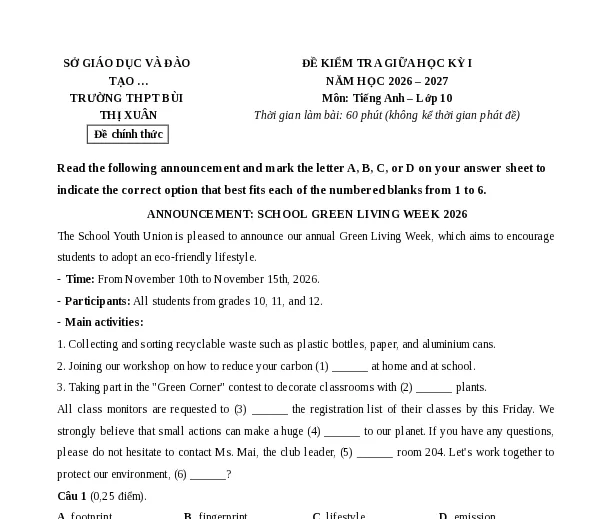
Going green is no longer just a trend; it has become a necessary lifestyle for everyone who cares about our planet. Our daily choices have a direct impact on the environment and contribute to our carbon (56) ______. Small changes in routine can make a huge difference if millions of people practice them together.
First of all, saving energy at home is one of the simplest steps. You should make it a habit to turn off lights and unplug electrical (57) ______ when they are not in use. Secondly, reducing single-use plastic is essential. Instead of taking plastic bags at the supermarket, bring your own cloth bags and refillable water bottles. Furthermore, sorting waste into organic materials, paper, and recyclables allows useful resources to be (58) ______ instead of dumped into landfills. By taking (59) ______ for our surroundings, we ensure that Earth remains a healthy and green home for (60) ______ generations.
Câu 56.
A. print
B. footprint
C. shadow
D. mark
Câu 57.
A. appliances
B. clothes
C. ingredients
D. furniture
Câu 58.
A. reused
B. littered
C. emitted
D. damaged
Câu 59.
A. advantage
B. care
C. responsibility
D. action
Câu 60.
A. past
B. ancient
C. future
D. former
Bài 3. Reading Comprehension 1: Benefits of Sharing Housework
Read the following passage and mark the letter A, B, C, or D to indicate the correct answer to each of the questions from 61 to 65.
Many people believe that household chores are purely a mother's duty. However, numerous psychological studies have shown that sharing housework brings enormous benefits to the entire family, especially to children's development.
First and foremost, sharing chores fosters a strong sense of responsibility. When children are assigned age-appropriate tasks, such as making their beds, feeding pets, or setting the table, they realize that maintaining a clean living space requires collective effort. They stop taking their parents' work for granted and learn to appreciate the comfort they enjoy at home. Research indicates that kids who do regular chores grow up to be more cooperative colleagues and reliable leaders in their adult careers.
Secondly, doing housework together provides quality time for family members to interact. In today's digital age, children and parents often spend their free time glued to smartphones and television screens. Doing chores together, such as preparing meals or gardening on weekends, creates natural opportunities for casual conversations. Parents can listen to their children's school stories, offer guidance, and share laughs without the distraction of digital gadgets.
Lastly, it promotes gender equality within the home. When boys see their fathers cooking meals, doing the laundry, and washing dishes alongside their mothers, they learn that domestic duties are not defined by gender. Consequently, they are much more likely to support their future spouses, creating harmonious and balanced marriages in the future.
Câu 61. What is the main idea of the passage?
A. The history of traditional gender roles in domestic life.
B. Practical techniques for teaching children how to cook.
C. The positive impacts of sharing household chores on families.
D. The negative effects of digital devices on modern children.
Câu 62. According to paragraph 2, doing chores helps children ______.
A. finish their school homework faster
B. appreciate their parents' hard work and become more responsible
C. earn pocket money to buy personal belongings
D. avoid conflicts with their classmates at school
Câu 63. The word "collective" in paragraph 2 is closest in meaning to ______.
A. individual
B. shared
C. difficult
D. private
Câu 64. Why does the author mention smartphones and television screens in paragraph 3?
A. To show how technology helps people do household chores faster.
B. To highlight that modern devices often prevent genuine family interaction.
C. To suggest that children should use apps to divide chores evenly.
D. To criticize parents for spending too much money on entertainment.
Câu 65. According to paragraph 4, what happens when boys see their fathers doing domestic work?
A. They believe that fathers do not have to work outside the home.
B. They become confused about traditional family values.
C. They understand that household chores are not tied to specific genders.
D. They refuse to do difficult chores because their fathers can do them.
Bài 4. Reading Comprehension 2: Reducing Carbon Footprint
Read the following passage and mark the letter A, B, C, or D to indicate the correct answer to each of the questions from 66 to 70.
A carbon footprint is the total amount of greenhouse gases, primarily carbon dioxide, that are emitted into the atmosphere by human activities. Everything we do—from turning on an air conditioner and driving a petrol-fueled motorbike to buying imported food—contributes to this footprint. With global temperatures steadily climbing, reducing carbon emissions has become an urgent priority for both governments and individuals.
One of the largest sources of individual carbon emissions comes from transport. Traditional motor vehicles burn fossil fuels, releasing massive amounts of carbon dioxide and harmful pollutants into the air. By choosing to walk, cycle, or take public buses for daily commutes, people can dramatically lower their impact on the environment. In many European cities, cycling infrastructure has been extensively developed, encouraging thousands of citizens to leave their private cars at home.
Another major contributor is household energy consumption. A large proportion of the electricity supplied to our homes is still generated by burning coal and natural gas. Therefore, cutting back on electricity use directly decreases greenhouse gas emissions. Simple daily actions, such as switching off unnecessary lights, using energy-saving LED bulbs, and setting air conditioners at 26 degrees Celsius or above, can result in noticeable energy savings.
Finally, consumer habits also dictate environmental health. The production and transportation of goods, especially meat and packaged foods, require vast amounts of energy and natural resources. Adopting a diet with more locally grown vegetables and buying second-hand items are practical ways to minimize waste. Combating climate change might seem like a daunting challenge, but it begins with our conscious everyday decisions.
Câu 66. What does the term "carbon footprint" mainly refer to?
A. The mark left by boots when walking on muddy soil.
B. The total volume of greenhouse gases produced by human activities.
C. The amount of coal and gas remaining underground.
D. The total area of forest destroyed by human expansion.
Câu 67. According to paragraph 2, how can citizens reduce transport-related emissions?
A. By buying bigger petrol-fueled motorbikes.
B. By walking, cycling, or using public transport.
C. By traveling only during late hours at night.
D. By importing vehicles from European nations.
Câu 68. The word "generated" in paragraph 3 is closest in meaning to ______.
A. produced
B. consumed
C. wasted
D. destroyed
Câu 69. Which of the following is NOT mentioned as a way to save household energy?
A. Using energy-efficient LED light bulbs.
B. Switching off unnecessary lights.
C. Keeping air conditioners at 26 degrees Celsius or higher.
D. Replacing all electronic appliances every two years.
Câu 70. Which of the following can be inferred from the final paragraph?
A. Eating imported meat is better for the environment than eating local vegetables.
B. Individual consumer choices have a meaningful role in fighting climate change.
C. Only governments have the power to solve environmental problems.
D. Second-hand items are always of poor quality and should not be purchased.
--------- HẾT ---------
Họ và tên thí sinh: ................................................ Số báo danh: ........................