SỞ GIÁO DỤC VÀ ĐÀO TẠO …
TRƯỜNG THPT …
Đề cương ôn tập
ĐỀ CƯƠNG ÔN TẬP GIỮA HỌC KÌ I
Môn: Tiếng Anh – Lớp 10
Năm học 2026 – 2027
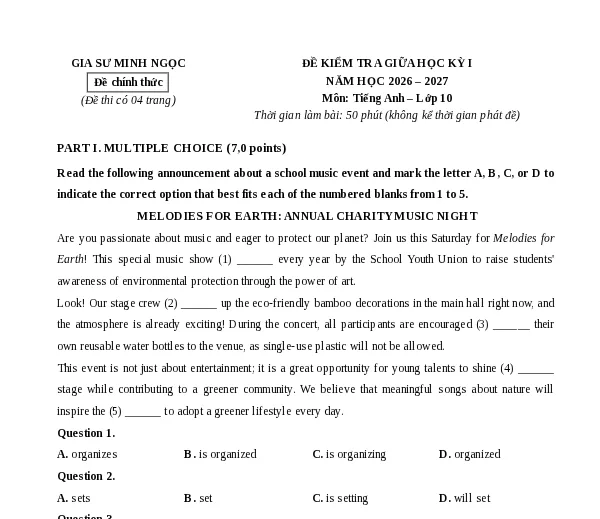
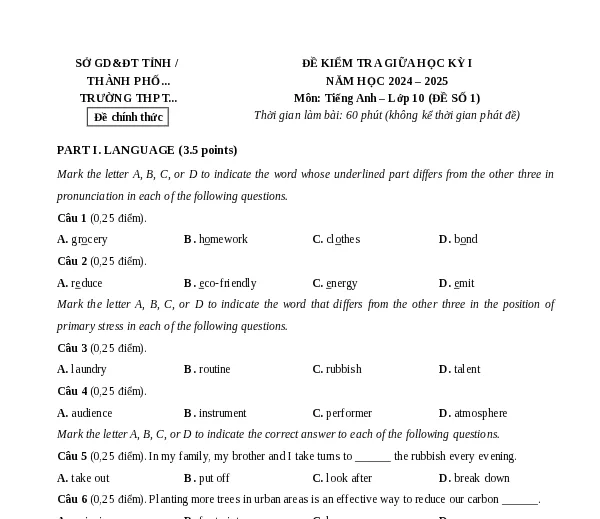
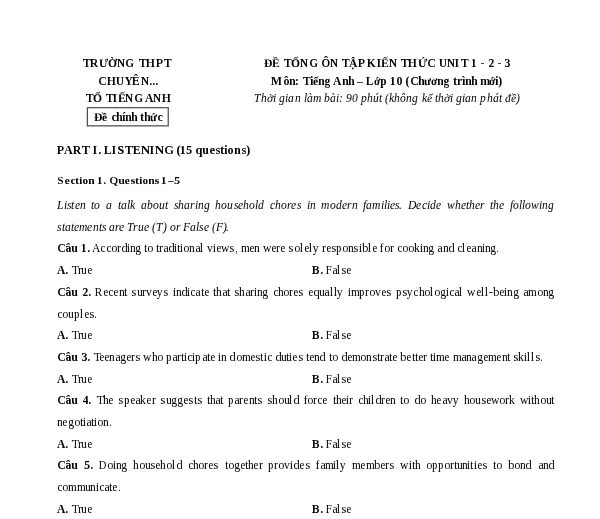
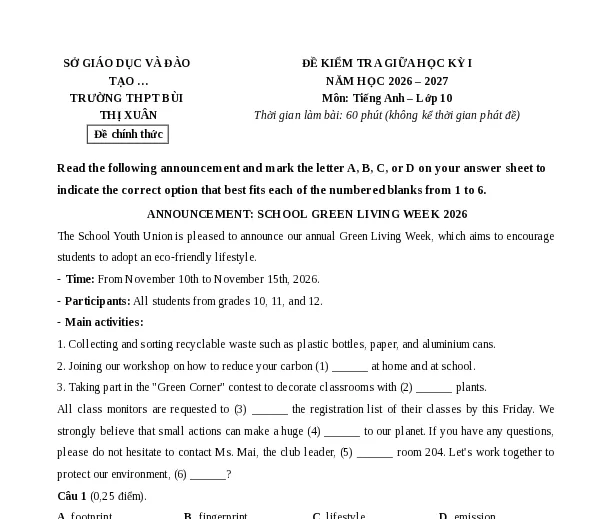
Phạm vi: Unit 1 – Family Life; Unit 2 – Humans and the Environment; Unit 3 – Music (Global Success 10).
PHẦN A. KIẾN THỨC CẦN NHỚ
A.1. PHÁT ÂM (PRONUNCIATION)
Âm | Cách đọc | Ví dụ |
|---|---|---|
/tr/ | đầu lưỡi chạm lợi rồi bật hơi, môi hơi tròn | tree, train, travel, trash |
/kr/ | /k/ bật mạnh nối liền /r/ | cream, crash, crowd, creative |
/br/ | /b/ môi khép rồi bật nối /r/ | bread, brush, brother, breakfast |
/kl/ | /k/ + /l/ | clean, class, clothes, close |
/pl/ | /p/ + /l/ | plastic, planet, please, plenty |
/gr/ | /g/ + /r/ | green, group, grow, grocery |
/pr/ | /p/ + /r/ | protect, provide, price, project |
/ɔː/ | nguyên âm dài, môi tròn | sport, more, talk, audience |
/ɒ/ | nguyên âm ngắn, miệng mở hơn | box, hot, watch, concert |
Lưu ý: "oo" trong door, floor đọc /ɔː/; most, post, note có /əʊ/ nên khác nhóm với lost, cost, boss (/ɒ/).
A.2. TRỌNG ÂM (STRESS)
- Danh từ và tính từ 2 âm tiết: trọng âm thường rơi vào âm tiết thứ nhất (HOUSEhold, LAUNdry, RUBbish, HAPpy).
- Động từ 2 âm tiết: trọng âm thường rơi vào âm tiết thứ hai (beCOME, proTECT, reDUCE, perFORM).
- Từ có hậu tố -ion, -ity, -ic, -ical, -ious, -ial: trọng âm rơi vào âm tiết ngay trước hậu tố (poLLUtion, aBILity, ecoNOMic, muSIcian).
- Hậu tố -ment, -ness, -ful, -less, -able, -er, -ing, -ed không làm đổi trọng âm của từ gốc (enJOY → enJOYment, HELP → HELPful).
- Từ 3 âm tiết trở lên: thường nhấn âm tiết thứ nhất nếu là danh từ (INstrument, AUdience, MELody), nhấn âm tiết thứ hai nếu là động từ/tính từ dài (imPORtant, exPENsive, roMANtic).
- Từ ghép (compound noun): trọng âm rơi vào từ thứ nhất (GREENhouse, FOOTball, POP star, MUSic festival).
A.3. TỪ VỰNG THEO UNIT
Unit 1 – Family Life
Word | Word family | Nghĩa |
|---|---|---|
chore /tʃɔː/ | chores (pl) | việc nhà |
do the washing-up | – | rửa bát đĩa |
do the laundry | – | giặt giũ |
mop the floor | – | lau nhà |
sweep the house | – | quét nhà |
take out the rubbish | – | đổ rác |
water the plants | – | tưới cây |
iron the clothes | – | là quần áo |
lay the table | – | dọn bàn ăn |
tidy up | – | dọn dẹp gọn gàng |
breadwinner | – | người trụ cột kinh tế |
homemaker | – | người nội trợ |
responsibility | responsible (adj) | trách nhiệm |
contribute | contribution (n) | đóng góp |
share | – | chia sẻ |
gratitude | grateful (adj) | lòng biết ơn |
lend a hand | – | giúp một tay |
Unit 2 – Humans and the Environment
Word | Word family | Nghĩa |
|---|---|---|
pollute | pollution (n), pollutant (n), polluted (adj) | gây ô nhiễm |
deforestation | – | sự phá rừng |
greenhouse gas | – | khí nhà kính |
emission | emit (v) | khí thải |
carbon footprint | – | dấu chân các-bon |
renewable | renew (v) | có thể tái tạo |
sustainable | sustain (v) | bền vững |
ecosystem | – | hệ sinh thái |
habitat | – | môi trường sống |
endangered species | endanger (v) | loài có nguy cơ tuyệt chủng |
preserve / conserve | preservation, conservation | bảo tồn |
recycle | recycling (n), recyclable (adj) | tái chế |
global warming | – | sự nóng lên toàn cầu |
waste | wasteful (adj) | rác thải; lãng phí |
Unit 3 – Music
Word | Word family | Nghĩa |
|---|---|---|
perform | performance (n), performer (n) | biểu diễn |
compose | composer (n), composition (n) | sáng tác |
audience | – | khán giả |
lyrics | – | lời bài hát |
melody | – | giai điệu |
rhythm | – | nhịp điệu |
instrument | – | nhạc cụ |
talented | talent (n) | có tài năng |
concert | – | buổi hoà nhạc |
release | – | phát hành |
judge | – | giám khảo |
idol | – | thần tượng |
catchy | – | dễ nhớ, hấp dẫn |
passionate | passion (n) | đam mê |
A.4. NGỮ PHÁP TRỌNG TÂM
1. Present simple vs Present continuous
- Present simple: S + V(s/es) — thói quen, sự thật hiển nhiên, lịch trình.
Dấu hiệu: every day, always, usually, often, sometimes, never, on Mondays.
- Present continuous: S + am/is/are + V-ing — đang xảy ra, kế hoạch gần đã sắp xếp.
Dấu hiệu: now, right now, at the moment, Look!, Listen!, Be quiet!, today, this week.
- Động từ trạng thái không dùng ở tiếp diễn: know, like, want, need, believe, understand, belong, remember, prefer.
2. Will vs Be going to
Will + V | Be going to + V |
|---|---|
Quyết định tức thời tại lúc nói | Dự định đã lên kế hoạch từ trước |
Lời hứa, lời đề nghị, lời đe doạ | Dự đoán có căn cứ rõ ràng |
Dự đoán không có căn cứ (I think, I hope, probably) | Look at those clouds! It is going to rain. |
I'll help you with the dishes. | We are going to visit Hue next week. |
3. Passive voice (câu bị động)
- Công thức chung: S + be + V3/ed (+ by O).
- Hiện tại đơn: am/is/are + V3/ed — The rubbish is collected every Monday.
- Quá khứ đơn: was/were + V3/ed — This song was written in 2020.
- Với động từ khuyết thiếu: modal + be + V3/ed — Plastic must be reduced.
- Chỉ chuyển sang bị động khi động từ có tân ngữ; chủ ngữ không xác định (they, people, someone) thường bỏ "by".
4. To-infinitive và Bare infinitive
- To + V: sau want, need, decide, hope, plan, promise, try, ask/tell/advise somebody, be going to, be able to; sau tính từ (happy/important/easy + to V); chỉ mục đích.
- Bare V (V không "to"): sau động từ khuyết thiếu (can, could, must, should, may, might, will, would); sau make/let + O + V; sau had better, would rather, why not; sau động từ giác quan (see/hear/watch + O + V).
- V-ing (cần phân biệt): sau enjoy, avoid, mind, suggest, deny, can't stand, look forward to, be used to, spend time.
- Một số động từ đổi nghĩa: remember/stop/try + to V khác + V-ing.
5. Compound nouns (danh từ ghép)
- Cấu tạo: noun + noun (housework, bedroom, greenhouse, toothpaste, football, pop star, music festival).
- Trọng âm rơi vào từ thứ nhất; số nhiều thêm "s" ở từ thứ hai (bedrooms, music festivals).
- Viết rời, viết liền hay có gạch nối tuỳ từ, cần học theo cụm.
A.5. BẢNG TỔNG HỢP BẪY THƯỜNG GẶP
STT | Bẫy / lỗi thường gặp | Dạng sai | Dạng đúng |
|---|---|---|---|
1 | Dùng tiếp diễn với động từ trạng thái | I am knowing the answer. | I know the answer. |
2 | Dùng "will" cho dự định đã sắp xếp | I will go to the concert tonight (đã có vé). | I am going to the concert tonight. |
3 | Dùng "will" cho dự đoán có căn cứ | Look! It will rain. | Look! It is going to rain. |
4 | Sai dạng quá khứ phân từ trong bị động | The homework was did. | The homework was done. |
5 | Thêm "to" sau make/let | My mother made me to clean my room. | My mother made me clean my room. |
6 | Quên V-ing sau giới từ | I look forward to see you. | I look forward to seeing you. |
7 | Dùng "to V" sau suggest/avoid/enjoy | She suggested to go out. | She suggested going out. |
8 | Nhầm "be used to + V-ing" và "used to + V" | I am used to get up early. | I am used to getting up early. |
9 | Nhầm "a number of" (số nhiều) và "the number of" (số ít) | The number of students are increasing. | The number of students is increasing. |
10 | Nhầm tính từ đuôi -ed / -ing | The film was boring me. | The film was boring. / I was bored. |
Trường hợp đặc biệt – nâng cao (phân hoá)
- Đảo ngữ: Not only does she sing well, but she also dances beautifully. / Hardly had we arrived when it started to rain. / Never have I seen such a wonderful performance.
- Thức giả định (subjunctive): sau các động từ/tính từ như suggest, recommend, insist, it is important/necessary + that + S + (should) + V nguyên mẫu. It is necessary that every member (should) share the household chores.
- Câu điều kiện loại 2 với "were": If I were you, I would join the music club.
PHẦN B. BÀI TẬP LUYỆN TẬP
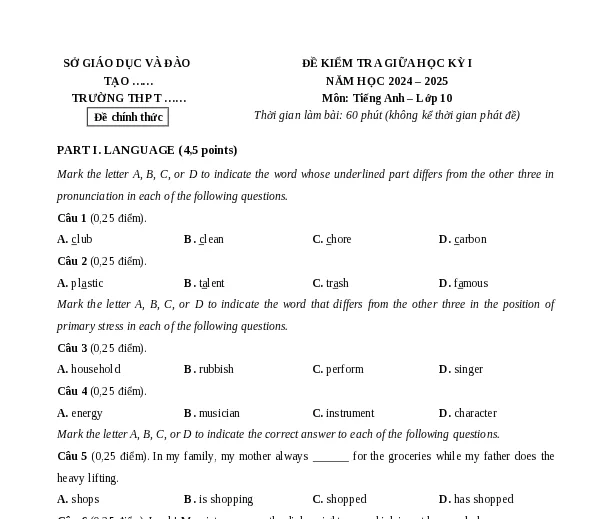
B.I. PHÁT ÂM (10 câu)
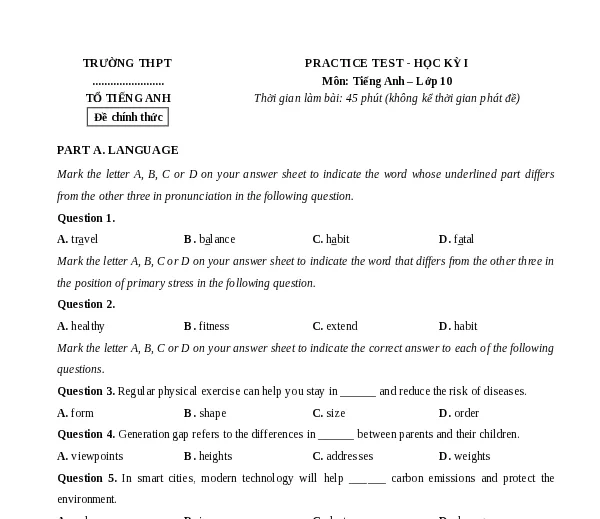
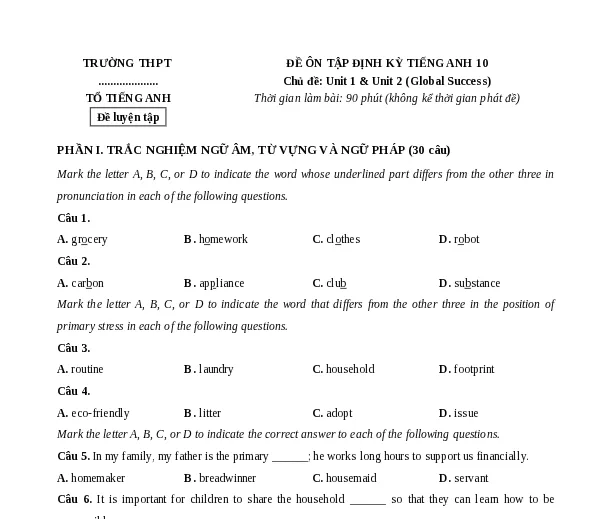
Mark the letter A, B, C or D to indicate the word whose underlined part differs from the other three in pronunciation in each of the following questions.
Câu 1. A. bread B. brush C. bring D. cream
Câu 2. A. tree B. train C. clean D. travel
Câu 3. A. class B. clean C. clothes D. grow
Câu 4. A. plastic B. please C. planet D. protect
Câu 5. A. green B. group C. grocery D. price
Câu 6. A. protect B. provide C. project D. brother
Câu 7. A. sport B. more C. short D. box
Câu 8. A. talk B. walk C. small D. watch
Câu 9. A. lost B. cost C. most D. boss
Câu 10. A. door B. floor C. four D. fox
B.II. TRỌNG ÂM (10 câu)
Mark the letter A, B, C or D to indicate the word that differs from the other three in the position of primary stress in each of the following questions.
Câu 1. A. household B. laundry C. rubbish D. routine
Câu 2. A. become B. provide C. protect D. visit
Câu 3. A. pollution B. tradition C. composer D. melody
Câu 4. A. important B. delicious C. popular D. expensive
Câu 5. A. musical B. national C. cultural D. romantic
Câu 6. A. environment B. economy C. ecology D. instrument
Câu 7. A. perform B. release C. record D. concert
Câu 8. A. energy B. encourage C. endanger D. enjoyment
Câu 9. A. audience B. festival C. attention D. instrument
Câu 10. A. reduce B. reuse C. result D. rubbish
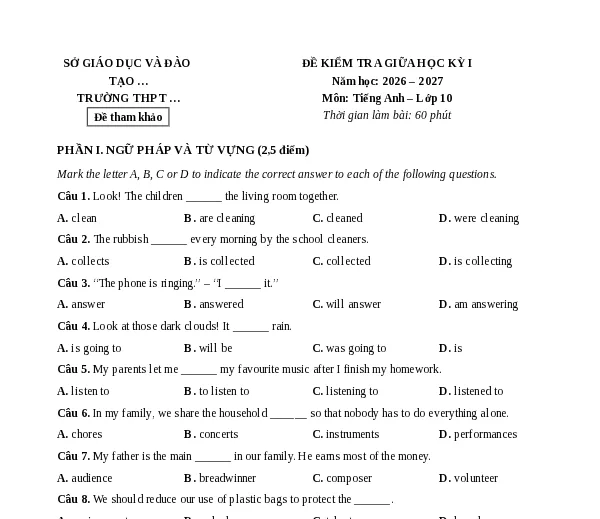
B.III. NGỮ PHÁP – TỪ VỰNG (30 câu)
Mark the letter A, B, C or D to indicate the correct answer to each of the following questions.
Câu 1. My sister ______ the washing-up every evening after dinner.
A. do
B. does
C. is doing
D. has done
Câu 2. Be quiet! The baby ______ in the next room.
A. sleeps
B. is sleeping
C. slept
D. has slept
Câu 3. Look at those dark clouds! It ______ rain.
A. will
B. is going to
C. is raining
D. rains
Câu 4. Don't worry. I ______ you with the housework tomorrow.
A. am helping
B. will help
C. help
D. am going to help
Câu 5. The rubbish ______ every Monday morning.
A. collects
B. is collected
C. is collecting
D. has collected
Câu 6. Thousands of trees ______ down last year.
A. cut
B. were cut
C. are cut
D. have cut
Câu 7. My mother asked me ______ her with the cooking.
A. help
B. to help
C. helping
D. helped
Câu 8. You should ______ the floor before you leave.
A. to mop
B. mopping
C. mop
D. mopped
Câu 9. We are looking forward to ______ part in the music festival.
A. take
B. taking
C. took
D. be taken
Câu 10. He is the ______ of the band and writes most of the songs.
A. compose
B. composer
C. composition
D. composed
Câu 11. Air ______ is a serious problem in big cities.
A. pollute
B. pollution
C. polluted
D. pollutant
Câu 12. She is a talented ______; she can play three instruments.
A. music
B. musician
C. musical
D. musically
Câu 13. We need to reduce our carbon ______ to protect the environment.
A. footprint
B. print
C. mark
D. step
Câu 14. ______ energy comes from the sun, wind or water.
A. Renewable
B. Renewed
C. Non-renewable
D. Renewing
Câu 15. My brother ______ the table while I was cooking.
A. lays
B. lies
C. laid
D. lay
Câu 16. It is important for family members ______ the household chores.
A. share
B. to share
C. sharing
D. shared
Câu 17. She usually ______ to school by bike, but today she ______ the bus.
A. goes – takes
B. is going – takes
C. goes – is taking
D. is going – is taking
Câu 18. I promise I ______ forget your birthday again.
A. won't
B. am not going to
C. don't
D. not
Câu 19. The song ______ by a famous singer in 2020.
A. was recorded
B. recorded
C. is recorded
D. has recorded
Câu 20. He denied ______ the window.
A. break
B. to break
C. breaking
D. broke
Câu 21. My father often ______ me ______ the plants.
A. helps – watering
B. help – water
C. helps – water
D. helping – water
Câu 22. We should ______ plastic bags when we go shopping.
A. avoid
B. to avoid
C. avoiding
D. avoided
Câu 23. The new concert hall ______ next month.
A. will be opened
B. will open it
C. is opening
D. opens
Câu 24. She is a famous ______ star in Viet Nam.
A. pop
B. pops
C. popular
D. popularity
Câu 25. Water ______ at 100 degrees Celsius.
A. boils
B. is boiling
C. boiled
D. has boiled
Câu 26. I can't stand ______ the same song all day.
A. hear
B. to hear
C. hearing
D. heard
Câu 27. They ______ a new album at the moment.
A. record
B. are recording
C. recorded
D. have recorded
Câu 28. ______ the rubbish out, please. It smells terrible.
A. Take
B. Taking
C. To take
D. Took
Câu 29. The government is trying ______ the environment.
A. protect
B. to protect
C. protected
D. protection
Câu 30. Let's ______ a look at the lyrics before we sing.
A. have
B. to have
C. having
D. had
B.IV. CHIA ĐỘNG TỪ (15 câu)
Give the correct form of the verbs in brackets.
Câu 1. My brother usually (do) ______ the washing-up, but today he (clean) ______ the windows.
Câu 2. Look! The children (water) ______ the plants in the garden.
Câu 3. I think it (be) ______ sunny tomorrow.
Câu 4. We (visit) ______ our grandparents this weekend. We have already bought the tickets.
Câu 5. The rubbish (collect) ______ at 6 a.m. every day.
Câu 6. This song (write) ______ by a young composer two years ago.
Câu 7. My father promised (take) ______ us to the music festival.
Câu 8. You had better (not / stay) ______ up too late.
Câu 9. She is used to (get) ______ up early to help her mother.
Câu 10. Would you mind (open) ______ the window?
Câu 11. Let me (help) ______ you with the housework.
Câu 12. They (not / finish) ______ the project yet.
Câu 13. If I (be) ______ you, I would join the school music club.
Câu 14. Not only (she / sing) ______ well but she also dances beautifully.
Câu 15. It is necessary that every member (share) ______ the household chores.
B.V. WORD FORM (10 câu)
Give the correct form of the words in brackets.
Câu 1. Doing household chores together builds a sense of ______ in children. (RESPONSIBLE)
Câu 2. Air ______ is getting worse in many big cities. (POLLUTE)
Câu 3. We should use ______ energy such as solar or wind power. (RENEW)
Câu 4. He is a famous ______ in Viet Nam. (COMPOSE)
Câu 5. The ______ last night was amazing. (PERFORM)
Câu 6. She sings very ______. (BEAUTIFUL)
Câu 7. ______ is destroying many natural habitats. (DEFOREST)
Câu 8. The band gained international ______ after their first tour. (FAMOUS)
Câu 9. We need to protect ______ species such as tigers and elephants. (ENDANGER)
Câu 10. His ______ to the project was highly appreciated. (CONTRIBUTE)
B.VI. CLOZE TEST (10 câu)
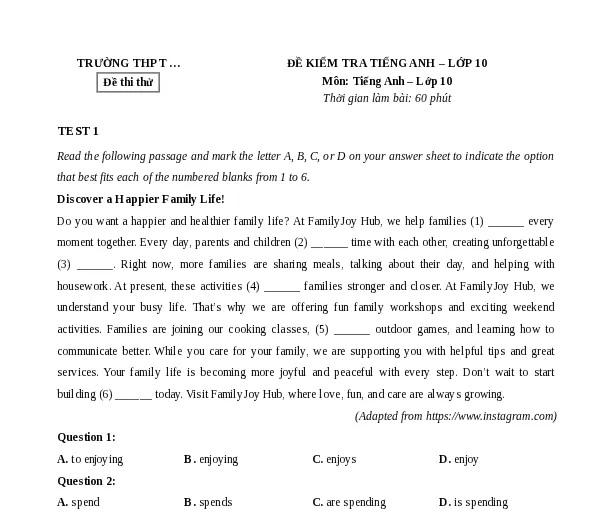
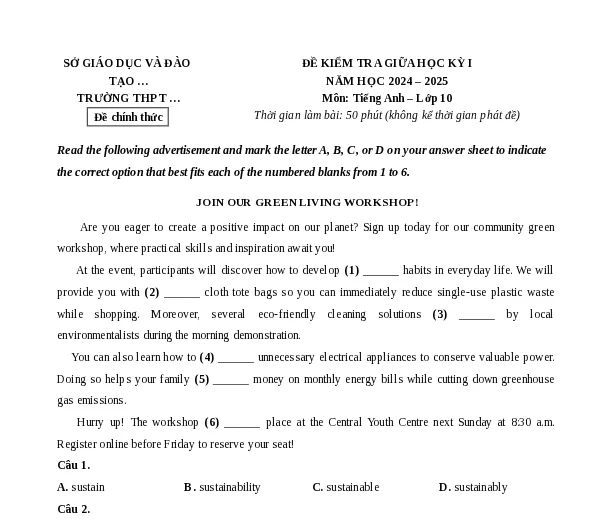
Read the following passage and mark the letter A, B, C or D to indicate the correct word or phrase that best fits each of the numbered blanks.
Life in a Vietnamese family has changed a lot over the past thirty years. In the past, most families lived in the countryside and every member (1) ______ a clear role. The father often worked in the fields, (2) ______ the mother stayed at home, cooked meals and looked (3) ______ the children. Children were expected (4) ______ their parents with the housework and to respect older people.
Nowadays, many families live in big cities (5) ______ both parents go out to work. Household chores are (6) ______ equally among family members, and even small children learn to tidy up their rooms or (7) ______ out the rubbish. Sharing the housework not only makes the home cleaner but also (8) ______ family members closer. However, some teenagers spend too much time on their phones and rarely help their parents. It is important (9) ______ parents and children talk openly about the chores. A family that shares the work will certainly be (10) ______.
Câu 1.
A. have
B. had
C. has
D. having
Câu 2.
A. but
B. so
C. while
D. because
Câu 3.
A. at
B. after
C. for
D. up
Câu 4.
A. help
B. helping
C. to help
D. helped
Câu 5.
A. where
B. which
C. who
D. when
Câu 6.
A. share
B. shared
C. sharing
D. to share
Câu 7.
A. take
B. make
C. put
D. bring
Câu 8.
A. brings
B. bring
C. is bringing
D. has brought
Câu 9.
A. that
B. for
C. which
D. what
Câu 10.
A. happy
B. happily
C. happiness
D. unhappily
B.VII. ĐỌC HIỂU (10 câu)
Read the following passage and mark the letter A, B, C or D to indicate the correct answer to each of the questions.
Bat Trang is a small village on the bank of the Red River, about thirteen kilometres from the centre of Ha Noi. For more than five hundred years, the villagers have made pottery from the clay of the river. In the past, most families in the village earned their living by producing bowls, plates and vases and selling them at local markets. Today, Bat Trang pottery is famous all over Viet Nam and has been exported to many countries.
Visitors to Bat Trang can watch artisans shaping clay on a spinning wheel, painting patterns on the products and putting them into the kiln. Many tourists say that the most interesting part of the visit is trying to make a small bowl themselves. However, the village is now facing some problems. The growing number of tourists has produced more rubbish, and the smoke from the kilns has polluted the air. In addition, many young people have moved to Ha Noi to find better-paid jobs, so fewer of them want to learn the traditional craft.
To solve these problems, the local government has built a new craft centre where young people can learn from experienced artisans. Some families have also started to use cleaner fuels in their kilns. They hope that Bat Trang will remain a lively craft village for many generations to come.
Câu 1. What is the passage mainly about?
A. A traditional craft village in Viet Nam
B. The history of Ha Noi
C. How to make a clay bowl
D. Pollution in Vietnamese cities
Câu 2. How long have the villagers of Bat Trang made pottery?
A. About thirteen years
B. More than five hundred years
C. Since 1990
D. For about fifty years
Câu 3. In the past, most families in Bat Trang earned their living by ______.
A. selling tickets to tourists
B. growing rice
C. producing and selling pottery
D. working in Ha Noi
Câu 4. The word "them" in paragraph 1 refers to ______.
A. the villagers
B. the families
C. bowls, plates and vases
D. countries
Câu 5. According to the passage, visitors to Bat Trang can ______.
A. paint patterns on the products
B. buy the kiln
C. work as artisans for a year
D. export pottery to other countries
Câu 6. Which problem of the village is NOT mentioned in the passage?
A. More rubbish from tourists
B. Polluted air from the kilns
C. Young people leaving the village
D. A shortage of clay from the river
Câu 7. Why have many young people moved to Ha Noi?
A. To study pottery
B. To find better-paid jobs
C. To open new kilns
D. To meet tourists
Câu 8. What has the local government done to help?
A. Built a new craft centre for young learners
B. Closed all the kilns in the village
C. Moved the village to Ha Noi
D. Stopped tourists from visiting
Câu 9. The word "experienced" in paragraph 3 is closest in meaning to ______.
A. young
B. skilled
C. famous
D. rich
Câu 10. What can be inferred from the passage?
A. Bat Trang pottery is no longer popular.
B. The village will disappear next year.
C. Traditional crafts need support to survive.
D. Tourists are not allowed to visit the village.
B.VIII. VIẾT LẠI CÂU (15 câu)
Rewrite each sentence so that it has a similar meaning, beginning as shown or using the word given.
Câu 1. My mother usually does the laundry on Sundays.
→ The laundry ______________________________________________________
Câu 2. People collect the rubbish every Monday.
→ The rubbish ______________________________________________________
Câu 3. Someone built this house in 1990.
→ This house _______________________________________________________
Câu 4. "You should help your mother with the housework," my teacher said to me.
→ My teacher advised ________________________________________________
Câu 5. It is necessary for us to protect endangered species.
→ We need __________________________________________________________
Câu 6. She spends two hours doing the housework every day.
→ It takes __________________________________________________________
Câu 7. I find it interesting to make pottery.
→ I am interested ____________________________________________________
Câu 8. They are going to open a new music club next month.
→ A new music club _________________________________________________
Câu 9. Although she was tired, she cooked dinner for the family.
→ Despite __________________________________________________________
Câu 10. "Why don't we take part in the clean-up campaign?" said Nam.
→ Nam suggested ____________________________________________________
Câu 11. He can't play the guitar, and he can't sing either. (NEITHER)
→ __________________________________________________________________
Câu 12. She had never seen such a wonderful performance before. (NEVER)
→ __________________________________________________________________
Câu 13. The villagers planted a lot of trees. The air became cleaner. (IF)
→ __________________________________________________________________
Câu 14. My brother is too young to join the music club. (ENOUGH)
→ __________________________________________________________________
Câu 15. Not only did she sing well, but she also danced beautifully. (AS WELL AS)
→ __________________________________________________________________
PHẦN C. BA ĐỀ KIỂM TRA THAM KHẢO
ĐỀ KIỂM TRA SỐ 1
Thời gian làm bài: 60 phút (không kể thời gian phát đề)
PHẦN I. TRẮC NGHIỆM (8,0 điểm)
A. PHÁT ÂM (Câu 1 – 2)
Mark the letter A, B, C or D to indicate the word whose underlined part differs from the other three in pronunciation.
Câu 1. A. trash B. travel C. clean D. train
Câu 2. A. bread B. brush C. cream D. brother
B. TRỌNG ÂM (Câu 3 – 4)
Mark the letter A, B, C or D to indicate the word that differs from the other three in the position of primary stress.
Câu 3. A. household B. laundry C. routine D. rubbish
Câu 4. A. pollution B. musician C. energy D. tradition
C. NGỮ PHÁP – TỪ VỰNG (Câu 5 – 16)
Mark the letter A, B, C or D to indicate the correct answer to each of the questions.
Câu 5. My father usually ______ the floor after dinner.
A. mop
B. mops
C. is mopping
D. mopping
Câu 6. Listen! Someone ______ the guitar in the next room.
A. plays
B. is playing
C. played
D. has played
Câu 7. A: "The rubbish is full." B: "OK, ______ it out."
A. I'm going to take
B. I take
C. I'll take
D. I'm taking
Câu 8. We ______ a party next Sunday. We have already sent the invitations.
A. will have
B. are going to have
C. have
D. are having had
Câu 9. English ______ in more than seventy countries.
A. speaks
B. is speaking
C. is spoken
D. has spoken
Câu 10. These letters ______ yesterday morning.
A. were sent
B. sent
C. are sent
D. have sent
Câu 11. My parents let me ______ my own clothes.
A. to choose
B. choosing
C. choose
D. chose
Câu 12. He promised ______ me with the housework.
A. help
B. to help
C. helping
D. helped
Câu 13. She is interested in ______ part in the music contest.
A. take
B. to take
C. taking
D. took
Câu 14. The ______ of the concert were clapping for ten minutes.
A. audience
B. judges
C. composers
D. instruments
Câu 15. We should ______ the amount of plastic we use every day.
A. reduce
B. increase
C. produce
D. pollute
Câu 16. ______ is the process of cutting down forests.
A. Pollution
B. Deforestation
C. Conservation
D. Emission
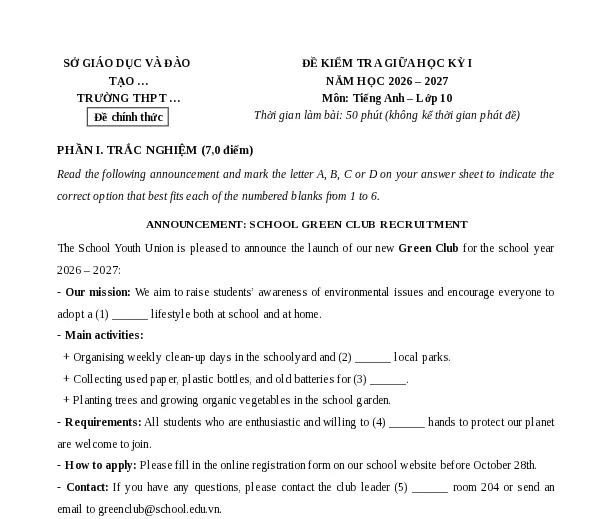
D. CLOZE TEST (Câu 17 – 24)
Read the passage and mark the letter A, B, C or D to indicate the correct word that best fits each numbered blank.
Nowadays, many people are trying to reduce their carbon (17) ______ by changing small habits in daily life. They use (18) ______ bags when shopping instead of plastic ones, turn off the lights when leaving a room, and take short showers instead of long baths. In many cities, (19) ______ bins are placed on every street so that glass, paper and metal can be (20) ______ again. Young people are also (21) ______ part in clean-up campaigns at weekends. These activities not only protect the (22) ______ but also help us understand the (23) ______ of natural resources. If everyone (24) ______ a small effort, our city will become a much greener place to live.
Câu 17.
A. footprint
B. footstep
C. mark
D. print
Câu 18.
A. reuse
B. reusable
C. reused
D. reusing
Câu 19.
A. recycle
B. recycling
C. recycled
D. recyclable
Câu 20.
A. use
B. used
C. using
D. usage
Câu 21.
A. take
B. taking
C. took
D. taken
Câu 22.
A. environment
B. environmental
C. environmentally
D. environmentalist
Câu 23.
A. important
B. importance
C. importantly
D. import
Câu 24.
A. make
B. makes
C. making
D. made
E. ĐỌC HIỂU (Câu 25 – 32)
Read the passage and mark the letter A, B, C or D to indicate the correct answer to each of the questions.
Bat Trang is a small village on the bank of the Red River, about thirteen kilometres from the centre of Ha Noi. For more than five hundred years, the villagers have made pottery from the clay of the river. In the past, most families earned their living by producing bowls, plates and vases and selling them at local markets. Today, Bat Trang pottery is famous all over Viet Nam and has been exported to many countries.
Visitors can watch artisans shaping clay on a spinning wheel, painting patterns on the products and putting them into the kiln. Many tourists say that the most interesting part of the visit is trying to make a small bowl themselves. However, the village is now facing some problems. The growing number of tourists has produced more rubbish, and the smoke from the kilns has polluted the air. In addition, many young people have moved to Ha Noi to find better-paid jobs, so fewer of them want to learn the traditional craft.
To solve these problems, the local government has built a new craft centre where young people can learn from experienced artisans. Some families have also started to use cleaner fuels in their kilns. They hope that Bat Trang will remain a lively craft village for many generations to come.
Câu 25. What is the passage mainly about?
A. A traditional craft village in Viet Nam
B. The history of Ha Noi
C. How to build a kiln
D. Pollution in Vietnamese cities
Câu 26. How long have the villagers made pottery?
A. About thirteen years
B. More than five hundred years
C. Since 1990
D. For about fifty years
Câu 27. In the past, most families in Bat Trang ______.
A. sold tickets to tourists
B. grew rice
C. produced and sold pottery
D. worked in Ha Noi
Câu 28. The word "them" in paragraph 1 refers to ______.
A. the villagers
B. the families
C. bowls, plates and vases
D. countries
Câu 29. According to the passage, visitors can ______.
A. paint patterns on the products
B. buy the kiln
C. work as artisans for a year
D. export pottery
Câu 30. Which problem is NOT mentioned in the passage?
A. More rubbish from tourists
B. Polluted air from the kilns
C. Young people leaving the village
D. A shortage of clay
Câu 31. Why have many young people moved to Ha Noi?
A. To study pottery
B. To find better-paid jobs
C. To open new kilns
D. To meet tourists
Câu 32. What has the local government done?
A. Built a new craft centre for young learners
B. Closed all the kilns
C. Moved the village to Ha Noi
D. Stopped tourists from visiting
PHẦN II. TỰ LUẬN (2,0 điểm)
A. CHIA ĐỘNG TỪ (Câu 33 – 35)
Give the correct form of the verbs in brackets.
Câu 33. My mother usually (do) ______ the cooking, but today she (clean) ______ the house.
Câu 34. The rubbish (collect) ______ at six o'clock every morning.
Câu 35. Not only (he / sing) ______ beautifully but he also plays the piano well.
B. WORD FORM (Câu 36 – 37)
Give the correct form of the words in brackets.
Câu 36. Air ______ is a serious problem in big cities. (POLLUTE)
Câu 37. She is a famous ______ in Viet Nam. (COMPOSE)
C. VIẾT LẠI CÂU (Câu 38 – 40)
Rewrite each sentence so that it has a similar meaning.
Câu 38. People collect the rubbish every Monday.
→ The rubbish ______________________________________________________
Câu 39. "You should share the housework with your sister," my mother said to me.
→ My mother advised ________________________________________________
Câu 40. She had never heard such a beautiful song before. (NEVER)
→ __________________________________________________________________
ĐỀ KIỂM TRA SỐ 2
Thời gian làm bài: 60 phút (không kể thời gian phát đề)
PHẦN I. TRẮC NGHIỆM (8,0 điểm)
A. PHÁT ÂM (Câu 1 – 2)
Mark the letter A, B, C or D to indicate the word whose underlined part differs from the other three in pronunciation.
Câu 1. A. plastic B. please C. protect D. planet
Câu 2. A. green B. group C. price D. grow
B. TRỌNG ÂM (Câu 3 – 4)
Mark the letter A, B, C or D to indicate the word that differs from the other three in the position of primary stress.
Câu 3. A. composer B. musician C. instrument D. tradition
Câu 4. A. encourage B. energy C. endanger D. enjoyment
C. NGỮ GRAMMAR – TỪ VỰNG (Câu 5 – 16)
Mark the letter A, B, C or D to indicate the correct answer to each of the questions.
Câu 5. My brother ______ the plants every morning before school.
A. water
B. waters
C. is watering
D. watering
Câu 6. Look! The children ______ the floor together.
A. mop
B. are mopping
C. mopped
D. have mopped
Câu 7. I think the concert ______ a great success.
A. is
B. will be
C. is being
D. has been
Câu 8. We ______ a new album this weekend. The studio is already booked.
A. will record
B. are going to record
C. record
D. recorded
Câu 9. This song ______ by a young composer two years ago.
A. wrote
B. was written
C. is written
D. has written
Câu 10. Millions of trees ______ down every year.
A. cut
B. are cut
C. are cutting
D. have cut
Câu 11. My mother made me ______ my room before going out.
A. to tidy
B. tidying
C. tidy
D. tidied
Câu 12. She decided ______ part in the singing contest.
A. take
B. to take
C. taking
D. took
Câu 13. He enjoys ______ to music while doing the housework.
A. listen
B. to listen
C. listening
D. listened
Câu 14. The ______ clapped loudly at the end of the performance.
A. audience
B. lyrics
C. melody
D. rhythm
Câu 15. We should ______ plastic bottles and paper instead of throwing them away.
A. recycle
B. pollute
C. waste
D. destroy
Câu 16. Solar energy is a ______ source of power because it will never run out.
A. renewable
B. polluted
C. harmful
D. expensive
D. CLOZE TEST (Câu 17 – 24)
Read the passage and mark the letter A, B, C or D to indicate the correct word that best fits each numbered blank.
Music has always played an important (17) ______ in Vietnamese life. In the past, people sang folk songs while working in the fields or (18) ______ the housework. Today, young people listen to pop music on their phones and dream of becoming famous (19) ______. To become a singer, a young person needs a good voice, a lot of practice and, above all, real (20) ______. Many of them take part in singing contests on television, (21) ______ judges choose the best performers. Some contestants become (22) ______ very quickly, but only a few can keep their careers for a long time. Experts say that talent is not (23) ______; singers also need to work hard and stay humble. For the (24) ______, a good song is not only a catchy melody but also a meaningful message.
Câu 17.
A. part
B. role
C. place
D. way
Câu 18.
A. do
B. does
C. doing
D. did
Câu 19.
A. audiences
B. stars
C. judges
D. composers
Câu 20.
A. passion
B. passionate
C. passionately
D. passionless
Câu 21.
A. where
B. which
C. who
D. when
Câu 22.
A. famous
B. fame
C. famously
D. infamous
Câu 23.
A. enough
B. too
C. so
D. such
Câu 24.
A. audience
B. listeners
C. performers
D. judges
E. ĐỌC HIỂU (Câu 25 – 32)
Read the passage and mark the letter A, B, C or D to indicate the correct answer to each of the questions.
A large number of young people in Viet Nam now live in big cities such as Ha Noi, Da Nang and Ho Chi Minh City. They leave their home villages because they hope to find better jobs, higher salaries and more exciting lives. For many of them, city life is a dream that comes true.
However, life in the city is not always easy. Rents are high, so many young people have to share a small flat with two or three friends. Traffic jams make them spend hours on the road every day, and the air is often polluted. Some of them work ten hours a day and have very little free time. They also miss their families, especially during holidays such as Tet.
Despite these difficulties, most young people do not want to return to their villages. They believe that the city gives them more chances to develop their skills and to meet interesting people. Some of them send part of their salary home every month to help their parents.
The government is now trying to create more jobs in rural areas. If more factories and offices are built in the countryside, fewer young people will have to move far from home.
Câu 25. What is the passage mainly about?
A. Young people moving to big cities in Viet Nam
B. How to find a job in Ha Noi
C. Traffic problems in Da Nang
D. Holidays in Viet Nam
Câu 26. Why do young people leave their home villages?
A. To escape from their families
B. To look for better jobs and higher salaries
C. To study music
D. To build factories
Câu 27. According to the passage, many young people in the city ______.
A. live in large houses
B. share a small flat with friends
C. buy their own flats
D. live with their parents
Câu 28. Which difficulty is NOT mentioned in paragraph 2?
A. High rents
B. Traffic jams
C. Little free time
D. Bad food
Câu 29. The word "they" in paragraph 2 refers to ______.
A. young people
B. families
C. friends
D. holidays
Câu 30. Most young people do not want to return to their villages because ______.
A. their villages are too far
B. they think the city offers more opportunities
C. they cannot find any job there
D. their parents do not allow them
Câu 31. What does the government plan to do?
A. Build more factories and offices in rural areas
B. Move all young people back to their villages
C. Close the factories in the cities
D. Reduce salaries in the cities
Câu 32. The word "difficulties" in paragraph 3 is opposite in meaning to ______.
A. problems
B. advantages
C. troubles
D. challenges
PHẦN II. TỰ LUẬN (2,0 điểm)
A. CHIA ĐỘNG TỪ (Câu 33 – 35)
Give the correct form of the verbs in brackets.
Câu 33. Look! The baby (sleep) ______, so please keep quiet.
Câu 34. This album (release) ______ by a famous band last month.
Câu 35. It is necessary that every student (take) ______ part in the campaign.
B. WORD FORM (Câu 36 – 37)
Give the correct form of the words in brackets.
Câu 36. The ______ last night was wonderful. (PERFORM)
Câu 37. We should protect ______ species such as tigers. (ENDANGER)
C. VIẾT LẠI CÂU (Câu 38 – 40)
Rewrite each sentence so that it has a similar meaning.
Câu 38. Someone built this school in 1990.
→ This school ______________________________________________________
Câu 39. It is necessary for us to protect the environment.
→ We need __________________________________________________________
Câu 40. She had never seen such a wonderful performance before. (NEVER)
→ __________________________________________________________________
ĐỀ KIỂM TRA SỐ 3
Thời gian làm bài: 60 phút (không kể thời gian phát đề)
PHẦN I. TRẮC NGHIỆM (8,0 điểm)
A. PHÁT ÂM (Câu 1 – 2)
Mark the letter A, B, C or D to indicate the word whose underlined part differs from the other three in pronunciation.
Câu 1. A. class B. clothes C. grow D. clean
Câu 2. A. sport B. box C. more D. short
B. TRỌNG ÂM (Câu 3 – 4)
Mark the letter A, B, C or D to indicate the word that differs from the other three in the position of primary stress.
Câu 3. A. audience B. festival C. attention D. instrument
Câu 4. A. reduce B. rubbish C. reuse D. result
C. NGỮ PHÁP – TỪ VỰNG (Câu 5 – 16)
Mark the letter A, B, C or D to indicate the correct answer to each of the questions.
Câu 5. My sister ______ the laundry every Sunday morning.
A. do
B. does
C. is doing
D. has done
Câu 6. Be quiet! The baby ______.
A. sleeps
B. is sleeping
C. slept
D. has slept
Câu 7. A: "It's hot in here." B: "OK, ______ the window."
A. I'm going to open
B. I open
C. I'll open
D. I'm opening
Câu 8. They ______ a clean-up campaign next Saturday. It's already on the notice board.
A. will organise
B. are going to organise
C. organise
D. organised
Câu 9. The village festival ______ every year in May.
A. holds
B. is held
C. is holding
D. has held
Câu 10. Thousands of plastic bags ______ into the sea every day.
A. throw
B. are thrown
C. are throwing
D. have thrown
Câu 11. My parents don't let me ______ out late at night.
A. to stay
B. staying
C. stay
D. stayed
Câu 12. We are planning ______ a music club at school.
A. start
B. to start
C. starting
D. started
Câu 13. He is good at ______ the guitar.
A. play
B. to play
C. playing
D. played
Câu 14. The song has a catchy ______ that everyone can sing along.
A. melody
B. audience
C. judge
D. instrument
Câu 15. We should ______ water by turning off the tap while brushing our teeth.
A. waste
B. save
C. pollute
D. increase
Câu 16. Many wild animals are losing their ______ because of deforestation.
A. habitats
B. habits
C. homesick
D. households
D. CLOZE TEST (Câu 17 – 24)
Read the passage and mark the letter A, B, C or D to indicate the correct word that best fits each numbered blank.
In many Vietnamese families today, both parents go out to work, so household chores must be (17) ______ among all members. In the past, the mother did almost everything at home, but now the father and the children also (18) ______ a hand. Teenagers are often asked to do the washing-up, (19) ______ the floor or take out the rubbish. Some families even make a timetable so that everyone knows (20) ______ to do.
Sharing the housework has many benefits. It (21) ______ the burden on the mother and teaches children to be (22) ______. Children who do chores regularly usually become more independent and more confident when they live (23) ______ from home. However, parents should not give their children too (24) ______ tasks. A small job suitable for their age will help them feel useful and happy.
Câu 17.
A. share
B. shared
C. sharing
D. to share
Câu 18.
A. lend
B. give
C. take
D. put
Câu 19.
A. sweep
B. sweeping
C. to sweep
D. swept
Câu 20.
A. what
B. which
C. who
D. why
Câu 21.
A. reduces
B. reduce
C. is reducing
D. has reduced
Câu 22.
A. responsibility
B. responsible
C. responsibly
D. irresponsible
Câu 23.
A. far
B. away
C. apart
D. out
Câu 24.
A. much
B. many
C. few
D. little
E. ĐỌC HIỂU (Câu 25 – 32)
Read the passage and mark the letter A, B, C or D to indicate the correct answer to each of the questions.
Every summer, the small town of Hoi An becomes a meeting place for thousands of young musicians. The Hoi An Music Festival, which started in 2015, lasts for three days and attracts both Vietnamese and foreign bands. Performers play many kinds of music, from traditional folk songs to modern pop and rock.
The festival is not only about music. Visitors can join workshops where they learn to play simple instruments such as the drum or the flute. Local food stalls open along the river, and in the evening, small boats carry lanterns on the water. Many families say the festival is a good chance for their children to meet new friends and to understand more about Vietnamese culture.
However, organising such a big event is not easy. The town has to prepare stages, electricity and rubbish collection for thousands of visitors. In 2024, the organisers decided to use paper cups instead of plastic ones to reduce waste. They also asked visitors to take their rubbish home. These small changes have made the festival greener and more popular than ever.
Câu 25. What is the passage mainly about?
A. A music festival in Viet Nam
B. How to play the drum
C. Food in Hoi An
D. Travelling by boat
Câu 26. When did the Hoi An Music Festival start?
A. In 2005
B. In 2015
C. In 2024
D. Three years ago
Câu 27. How long does the festival last?
A. One day
B. Two days
C. Three days
D. A week
Câu 28. According to the passage, performers play ______.
A. only folk songs
B. only rock music
C. many kinds of music
D. only foreign music
Câu 29. Visitors can join workshops to ______.
A. learn to play simple instruments
B. cook local food
C. build stages
D. sell lanterns
Câu 30. Which problem of organising the festival is NOT mentioned?
A. Preparing stages
B. Electricity
C. Rubbish collection
D. Finding hotels
Câu 31. In 2024, the organisers decided to ______.
A. use paper cups instead of plastic ones
B. stop foreign bands from coming
C. sell tickets at a higher price
D. close the food stalls
Câu 32. The word "greener" in the last paragraph is closest in meaning to ______.
A. more environmentally friendly
B. more colourful
C. more expensive
D. more crowded
PHẦN II. TỰ LUẬN (2,0 điểm)
A. CHIA ĐỘNG TỪ (Câu 33 – 35)
Give the correct form of the verbs in brackets.
Câu 33. My father usually (water) ______ the plants, but today I (do) ______ it.
Câu 34. The new song (record) ______ in a small studio last week.
Câu 35. If I (be) ______ you, I would take part in the singing contest.
B. WORD FORM (Câu 36 – 37)
Give the correct form of the words in brackets.
Câu 36. Doing chores together builds a sense of ______ in children. (RESPONSIBLE)
Câu 37. ______ is destroying many natural habitats. (DEFOREST)
C. VIẾT LẠI CÂU (Câu 38 – 40)
Rewrite each sentence so that it has a similar meaning.
Câu 38. People speak English in many countries.
→ English __________________________________________________________
Câu 39. "Why don't we take part in the clean-up campaign?" said Nam.
→ Nam suggested ____________________________________________________
Câu 40. Not only did she sing well, but she also danced beautifully. (AS WELL AS)
→ __________________________________________________________________
--------- HẾT ---------