ĐỀ 1 | ĐỀ ÔN TẬP GIỮA HỌC KỲ I |
|---|
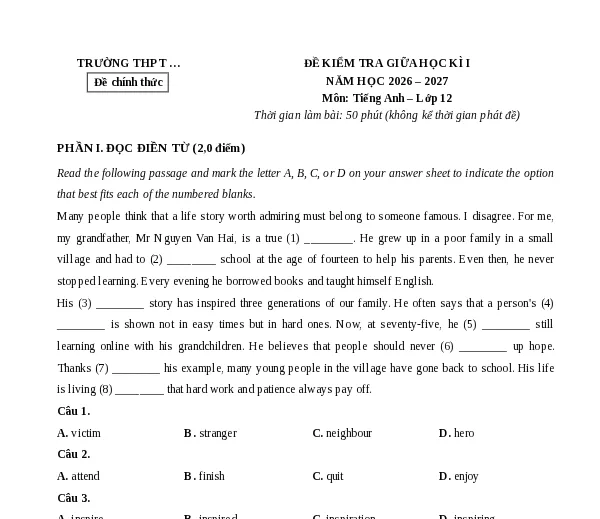
Read the following advertisement and mark the letter A, B, C, or D on your answer sheet to indicate the option that best fits each of the numbered blanks from 1 to 6.
DISCOVER THE FLAVORS OF ASIA: STREET FOOD FESTIVAL 2026!
Are you eager to embark on an unforgettable culinary adventure across Southeast Asia? Our upcoming food festival offers an (1) ________ experience, bringing together the region’s most beloved street vendors and traditional recipes. (2) ________ part in this vibrant weekend gathering will surely broaden your cultural horizons!
Accompanied by seasoned culinary experts, you will have the golden opportunity (3) ________ with skilled cooks, observing time-honored cooking techniques passed down through generations. Besides enjoying live cooking demonstrations, you can sample authentic specialties and listen to folkloric music, (4) ________ you deep insight into communal traditions.
Don’t miss this chance to take your culinary passion to the next level! Whether you are especially keen (5) ________ spicy delicacies, sweet desserts, or vegetarian delights, our festival promises to satisfy every palate. Secure your (6) ________ today to reserve your tasting pass!
Question 1.
A. exceptional cultural cuisine B. exceptional cuisine cultural
C. cultural exceptional cuisine D. cuisine exceptional cultural
Question 2. A. Taking B. Giving C. Making D. Putting
Question 3. A. to interacting B. interact C. to interact D. interacted
Question 4. A. which give B. giving C. that given D. gave
Question 5. A. of B. with C. on D. about
Question 6. A. ticket entrance early B. entrance ticket early C. early entrance ticket D. entrance early ticket
Read the following leaflet and mark the letter A, B, C, or D on your answer sheet to indicate the correct option that best fits each of the numbered blanks from 7 to 12.
MARIE CURIE: PIONEER OF MODERN PHYSICS
Marie Curie was a trailblazing scientist whose groundbreaking discoveries grabbed the (7) ________ worldwide and laid the foundation for modern nuclear science. Overcoming tremendous adversity, she became the first woman to win a Nobel Prize and remains the only person to receive Nobel Prizes in two distinct scientific fields. Curie strived to (8) ________ humanity with her discoveries in radioactivity.
Early Life & Education
Born in 1867 in Warsaw, Poland, Curie showed an extraordinary intellect from childhood. (9) ________ severe poverty and gender barriers in education, she persevered and moved to Paris to study at the Sorbonne. Throughout those demanding years, she maintained a passionate (10) ________ in chemical research and mathematics.
Enduring Legacy
Curie’s contribution to medical science and cancer treatment is truly (11) ________. In addition to establishing mobile radiography units during the First World War, her selfless dedication continues to inspire countless (12) ________ to pursue careers in scientific discovery.
Question 7. A. headlines B. slogans C. trademarks D. copyrights
Question 8. A. build up B. light up C. give away D. carry off
Question 9. A. In view of B. In spite of C. Instead of D. In place of
Question 10. A. relief B. hobby C. leisure D. interest
Question 11. A. negligible B. immeasurable C. superficial D. unremarkable
Question 12. A. another B. others C. other D. each other
Mark the letter A, B, C, or D on your answer sheet to indicate the best arrangement of utterances or sentences to make a meaningful exchange or text in each of the following questions from 13 to 17.
Question 13.
a. Tom: You look completely worn out, Liam. Is everything alright with your studies?
b. Liam: Not really. I’m overwhelmed trying to balance exam prep with my part-time job.
c. Tom: I know that feeling all too well. I can share a study routine application that really keeps things manageable.
A. b - a - c B. a - b - c C. c - a - b D. a - c - b
Question 14.
a. Chloe: Definitely! They also use renewable solar grids that supply power across the whole complex.
b. David: Have you read about the zero-emission eco-district being built in Songdo?
c. David: Exactly, and automated electric shuttles are planned to transport residents around the clock.
d. Chloe: Sounds remarkable, but are citizens confident that the network won’t suffer power outages?
e. David: Absolutely, because backup battery systems and smart regulators are installed at every point.
A. b - a - c - d - e B. b - c - a - d - e C. a - b - c - e - d D. b - d - e - a - c
Question 15.
Dear Oliver,
a. Seeing ancient temple architecture standing right alongside bustling modern cafes is truly captivating.
b. The blend of expatriate and local lifestyles here in Kyoto has given this city an enchanting character.
c. You can effortlessly locate tranquil workspaces situated inside authentic wooden townhouses.
d. If you get a chance, you should plan a visit soon — it might transform how you balance travel and work.
e. You would be amazed at how local craftsmen have incorporated contemporary design into their traditional ceramics.
Best regards, Minh
A. b - c - e - a - d B. b - a - c - e - d C. a - c - b - e - d D. b - e - a - c - d
Question 16.
a. Rather than working under rigid department walls, we formed interdisciplinary circles for each project.
b. In my initial weeks at the creative agency, I was taken aback by their horizontal workplace culture.
c. In contrast to my former multinational firm, leadership was decentralized and decisions were made collectively.
d. That refreshing environment not only sparked new ideas but also fostered sincere camaraderie among us.
e. Reflecting on that chapter, I recognize how fundamentally it altered my approach to team collaboration.
A. b - c - a - d - e B. b - a - c - d - e C. c - a - b - e - d D. b - d - a - c - e
Question 17.
a. Furthermore, the advent of refrigeration allowed fresh agricultural produce to travel thousands of miles without spoiling.
b. Before the mid-19th century, food preservation relied almost entirely on salting, smoking, and seasonal cellars.
c. That simple thermodynamic breakthrough dramatically altered human diets and reduced urban malnutrition.
d. Today, comparable breakthroughs are unfolding in cellular agriculture and sustainable food biotechnology.
e. The introduction of artificial cooling systems soon allowed warehouses to store perishable items indefinitely.
A. b - e - a - c - d B. b - a - e - c - d C. e - b - a - c - d D. b - c - e - a - d
Read the following passage about General Võ Nguyên Giáp, a legendary Vietnamese military figure, and mark the letter A, B, C or D on your answer sheet to indicate the option that best fits each of the numbered blanks from 18 to 22.
General Võ Nguyên Giáp, born in 1911 in Quảng Bình Province, was widely revered as one of the twentieth century’s most brilliant military strategists. Despite having no formal training at a military academy, Giáp, through sheer self-study and tactical genius, (18) ________.
In his youth, Giáp earned a degree in law and economics and worked as a history teacher, an occupation that deepened his appreciation for patriotic struggles. He began his revolutionary activities in the late 1930s alongside fellow patriots, forming specialized combat units (19) ________. His brilliant military command came to prominence during the resistance against colonial rule.
(20) ________. Most notably, his ingenious logistics and flexible "strike surely" strategy during the historic campaign at Điện Biên Phủ in 1954 captured international admiration. General Giáp’s tactical choices demonstrated a deep empathy for soldiers’ lives and an acute understanding of guerrilla warfare.
His stature extended well beyond national borders, earning genuine respect from military historians and former adversaries alike. He authored numerous seminal treatises on revolutionary defense tactics. Furthermore, prioritizing national harmony and collective dignity, (21) ________.
Following the nation's reunification, (22) ________. Until his passing in 2013 at the age of 102, he was fondly remembered as the "Elder Brother" of the Vietnam People's Army, leaving behind a lasting monument of integrity, strategic brilliance, and humility.
Question 18.
A. who was regarded as the mastermind behind defining national victories
B. became recognized worldwide as the architect of monumental military victories
C. becoming known as a military strategist through sheer willpower
D. whose strategic acumen and battlefield leadership being praised globally
Question 19.
A. that laid the foundation for the revolutionary armed forces
B. which foundation for the revolutionary armed forces having been laid
C. where to lay the crucial basis of armed military units
D. whose lay foundation in establishing modern tactical combat troops
Question 20.
A. Aimed combatants across various battlegrounds celebrated Giáp's strategic insight during wartime
B. Giáp distinguished himself by orchestrating campaigns that overcame overwhelming technological disadvantages
C. The merging of political commitment and historical knowledge helped Giáp's wartime prominence
D. Recognizing the balance between offensive warfare and civilian morale was an essential task
Question 21.
A. Giáp’s leadership inspired lasting solidarity across generations of Vietnamese citizens
B. solidifying national resilience was the primary motivation behind Giáp's actions
C. generations of Vietnamese citizens were profoundly motivated by his conduct
D. an enduring spirit of national unity was actively cultivated
Question 22.
A. by dedicating his energies to promoting scientific education, national progress could be attained
B. his tireless commitment to educational advancement and modernization inspired the entire nation
C. he continued serving his country by championing educational and scientific modernization
D. promoting the values of education and scientific innovation, the country was served by him
Read the following passage and mark the letter A, B, C or D on your answer sheet to indicate the option that best fits each of the numbered blanks from 23 to 30.
In a cozy, brick-walled shop in downtown Seattle, young people browse shelves filled with cassette tapes and second-hand 35mm film cameras. Over the past three years, independent camera repair workshops and analog print studios have witnessed record spikes in patronage. In a world saturated with ephemeral notifications, algorithmic feeds, and instant digital photographs, consumers across diverse demographics are actively rediscovering physical, vintage media.
Statistical surveys released by the Cultural Analytics Center indicate a striking resurgence in tactile leisure pursuits. Film cartridge manufacturing has jumped by 65% over the past two years, while manual typewriter refurbishers report waiting lists stretching several months. Contemporary consumers are drawn toward legacy technologies because they offer an intentional, slower sensory experience that digital screens fail to replicate. Online streaming services offering lo-fi aesthetic channels also record average
engagement times 30% higher than hyper-produced modern video content, revealing an underlying desire for imperfection and authenticity.
Sociological research published in the Journal of Contemporary Culture demonstrates that retro-oriented consumption often accelerates during times of rapid technological acceleration. Consumers channel significant financial resources into tangible cultural artifacts that provide psychological grounding. Classic aesthetics from the 1980s and 1990s now permeate fashion, graphic design, and industrial hardware, appealing strongly to Gen Z and millennial buyers. Observers note that engaging with physical media fosters deliberate attention; consumers spend 50% more time immersed in listening to a full vinyl side or carefully framing a 24-exposure film roll than they do skipping through infinite digital playlists.
In response, major creative studios and consumer brands are retooling their product strategies. Technology manufacturers are incorporating tactile knobs and mechanical feedback into modern smartphones and audio equipment, while entertainment producers blend grain textures and retro color palettes into new films. These retrospective design choices not only evoke communal memory but also bridge generational divides. Digital discussion communities dedicated to legacy technologies continue to flourish, allowing enthusiasts to dissect historical crafts while reinventing them for modern lifestyles.
Question 23. Which of the following is NOT mentioned as a benefit or feature of analog media?
A. Sensory, slower user experience B. Psychological grounding during fast changes
C. Superior computing and processing speed D. Cultivation of deliberate attention
Question 24. The word they in paragraph 2 refers to ______.
A. digital screens B. legacy technologies C. contemporary consumers D. statistical surveys
Question 25. Which of the following best paraphrases the underlined sentence in paragraph 3
A. Individuals spend considerable money acquiring physical goods that give them a sense of stability.
B. Financial investments in cultural properties generally produce reliable psychological stability.
C. People purchase expensive vintage goods primarily to preserve historical heritage.
D. Modern consumers prefer free digital platforms over tangible objects that cost extra funds.
Question 26. The word retooling in paragraph 4 is closest in meaning to ______.
A. abandoning B. restructuring C. postponing D. automating
Question 27. The word flourish in paragraph 4 could be replaced by ______.
A. collapse B. prosper C. decline D. terminate
Question 28. Which of the following is TRUE according to the passage?
A. Younger generations show little interest in the visual styles of the late 20th century.
B. Streaming lo-fi channels achieve higher user engagement than typical modern digital channels.
C. Hardware companies have entirely phased out mechanical features in consumer electronics.
D. Cassette tape manufacturing has fallen steadily over the past two years.
Question 29. In which paragraph does the author discuss the psychological motivations behind nostalgia during periods of swift change?
A. Paragraph 1 B. Paragraph 2 C. Paragraph 3 D. Paragraph 4
Question 30. In which paragraph does the author illustrate how modern businesses adapt their designs to capture nostalgic interest?
A. Paragraph 1 B. Paragraph 2 C. Paragraph 3 D. Paragraph 4
Read the following passage about cultural heritage preservation and mark the letter A, B, C or D on your answer sheet to indicate the best answer to each of the following questions from 31 to 40.
The Áo Bà Ba, often referred to as the traditional silk shirt of Southern Vietnam, represents simplicity, modesty, and the resilient spirit of the Mekong Delta people. Historically consisting of a plain, collarless shirt split at the sides and paired with loose silk trousers, it has symbolized agrarian life and domestic warmth for generations. [I] Even as Western clothing styles dominate modern urban wardrobes, the Áo Bà Ba preserves a distinctive image of Southern gentleness and rural pride. [II]
In recent years, an increasing number of international travelers visiting Can Tho and neighboring provinces have expressed a keen interest in owning custom-tailored Áo Bà Ba. [III] However, most vacationers only spend one or two days exploring floating markets and rustic orchards, making the traditional week-long tailoring turnaround completely impractical. To address this challenge, family-run tailoring ateliers near Ninh Kieu Wharf have introduced rapid three-hour tailoring services specifically configured for excursionists. Foreign tourists can place an order, take a morning boat tour along the waterways, and collect their finished bespoke garments by early afternoon. [IV]
Currently, more than 80 boutique shops across the central riverfront area offer this express garment craft. Mrs. Le Thi Mai, a veteran seamstress operating a boutique on Hai Ba Trung Street, reported that her workshop customizes roughly 25 to 35 garments daily during the tourist season from November to February. The tailoring charge ranges around 280,000 VND for children and 320,000 VND for adults. She noted that a substantial proportion of her patrons hail from France, Australia, and Japan, frequently favoring natural linen or soft silk textiles adorned with hand-painted lotus blossoms.
Mr. Pham Hoang Nam, a representative from the local tourism department, highlighted that the rapid tailoring model illustrates how local artisans flexibly adapt to the requirements of the global tourism sector. He observed that this service not only substantially elevates household earnings for regional seamstresses and fabric weavers, but also transforms the riverfront into an engaging cultural hub while keeping ancestral attire vibrant and relevant in contemporary commerce.
Question 31. Where in the passage does the following sentence best fit?
“It encapsulates the serene beauty of riverine communities and remains a timeless hallmark of Southern folk culture.”
A. [I] B. [II] C. [III] D. [IV]
Question 32. The word bespoke in paragraph 2 is closest in meaning to ______.
A. pre-packaged B. mass-produced C. custom-made D. low-cost
Question 33. The word it in paragraph 1 refers to ______.
A. modesty B. modern urban wardrobe C. the Áo Bà Ba D. rural pride
Question 34. According to paragraph 3, which of the following is NOT true regarding Mrs. Le Thi Mai’s atelier?
A. A significant proportion of her clients arrive from European and Asian countries.
B. Her workshop produces hundreds of custom outfits each afternoon during peak months.
C. Adult outfits typically cost approximately 320,000 VND each.
D. Many visitors choose textiles decorated with hand-painted lotus motifs.
Question 35. Which of the following best summarizes paragraph 4?
A. Express tailoring services support local artisans' livelihoods, enhance tourism appeal, and revitalize heritage attire.
B. Tourism authorities have mandated that all riverfront shops must sell traditional clothing to international travelers.
C. Traditional Mekong Delta tailors have abandoned hand techniques to maximize revenue from overseas clients.
D. The expansion of riverside ateliers focuses solely on increasing household income for weaving families.
Question 36. The word resilient in paragraph 1 is OPPOSITE in meaning to ______.
A. vulnerable B. adaptable C. sturdy D. vigorous
Question 37. Which of the following is TRUE according to the passage?
A. Travelers must wait at least seven working days to obtain garments from Ninh Kieu riverside shops.
B. Rapid tailoring allows excursionists to embark on river tours while their garments are being assembled.
C. The Áo Bà Ba is exclusively worn by farmers during harvesting periods.
D. Modern residents in major cities avoid wearing Western attire in favor of the Áo Bà Ba.
Question 38. Which of the following best paraphrases the highlighted sentence in paragraph 2?
A. Visitors are required to take a morning boat excursion in order to qualify for afternoon garment pickup.
B. After buying ready-made attire in the morning, tourists spend the afternoon sailing along the canals.
C. Tourists can order garments, enjoy a canal excursion, and retrieve their completed clothes a few hours later.
D. Tailors personally deliver custom-made clothes directly to tour boats cruising on the river in the afternoon.
Question 39. What can be inferred from the passage?
A. Faster artisan production models help traditional cultural attire remain competitive and cherished in the modern tourist economy.
B. Foreign visitors only value Vietnamese garments if they are made from synthetic imported fibers.
C. The popularity of the Áo Bà Ba is declining among Western travelers due to high tailoring expenses.
D. Riverfront tailoring workshops are gradually replacing floating markets as the primary draw for tourists.
Question 40. Which of the following serves as the best title for the entire passage?
A. The Economic Decline of Handcrafted Garments in Southern Vietnam
B. Floating Markets: The Ultimate Travel Attraction in the Mekong Delta
C. The Áo Bà Ba: Preserving Southern Attire Through Fast, Tourist-Friendly Tailoring
D. A Historical Evolution of Modern Western Fashion across Can Tho City
------------------ THE END ------------------
ĐÁP ÁN VÀ LỜI GIẢI CHI TIẾT
Câu | Đáp án | Câu | Đáp án | Câu | Đáp án | Câu | Đáp án |
|---|---|---|---|---|---|---|---|
1 | A | 11 | B | 21 | A | 31 | B |
2 | A | 12 | B | 22 | C | 32 | C |
3 | C | 13 | B | 23 | C | 33 | C |
4 | B | 14 | A | 24 | B | 34 | B |
5 | C | 15 | B | 25 | A | 35 | A |
6 | C | 16 | A | 26 | B | 36 | A |
7 | A | 17 | A | 27 | B | 37 | B |
8 | A | 18 | B | 28 | B | 38 | C |
9 | B | 19 | A | 29 | C | 39 | A |
10 | D | 20 | B | 30 | D | 40 | C |
Lưu ý: Câu 1–12 bám theo đáp án và phần lời giải đã in sẵn trong ảnh nguồn. Các câu còn lại được giải trực tiếp từ nội dung đề.
I. STREET FOOD FESTIVAL 2026
Câu 1. Đáp án A – exceptional cultural cuisine
• Theo đáp án nguồn, trật tự cụm từ là “exceptional cultural cuisine”. “Exceptional” (đánh giá: xuất sắc) đứng trước “cultural” (phân loại: thuộc văn hóa); “cuisine” là danh từ trung tâm trong cụm bổ nghĩa cho “experience”.
• Câu hoàn chỉnh: “offers an exceptional cultural cuisine experience”.
Câu 2. Đáp án A – Taking
• Cụm cố định: take part in = tham gia vào.
• Cả cụm đứng đầu câu làm chủ ngữ nên dùng V-ing: “Taking part in this vibrant weekend gathering will…”
Câu 3. Đáp án C – to interact
• Cấu trúc: have the opportunity to do something = có cơ hội làm gì.
• Do đó: “have the golden opportunity to interact with skilled cooks”.
Câu 4. Đáp án B – giving
• Sau dấu phẩy, “giving” là cụm V-ing chỉ kết quả/ý bổ sung cho toàn bộ hành động trước: thưởng thức món ăn và âm nhạc, qua đó mang lại hiểu biết sâu sắc về truyền thống cộng đồng.
• Có thể hiểu tương đương với “which gives you deep insight…”, rút gọn thành “giving you…”.
Câu 5. Đáp án C – on
• Cụm cố định trong đề: be keen on + noun/V-ing = đặc biệt yêu thích/hứng thú với.
• “keen on spicy delicacies, sweet desserts, or vegetarian delights”.
Câu 6. Đáp án C – early entrance ticket
• Theo trật tự từ của đáp án nguồn: tính từ “early” + danh từ ghép “entrance ticket”.
• Câu: “Secure your early entrance ticket today…” = hãy đặt vé vào cửa sớm ngay hôm nay.
II. MARIE CURIE
Câu 7. Đáp án A – headlines
• Collocation: grab the headlines = thu hút sự chú ý lớn của báo chí/công chúng, xuất hiện trên các tiêu đề nổi bật.
• “slogans”, “trademarks”, “copyrights” không kết hợp với “grab” theo nghĩa này.
Câu 8. Đáp án A – build up
• Theo đáp án nguồn: build up mang nghĩa xây dựng, bồi đắp, đóng góp cho sự phát triển.
• Trong ngữ cảnh, Marie Curie nỗ lực dùng các khám phá phóng xạ để đóng góp cho nhân loại.
Câu 9. Đáp án B – In spite of
• Sau chỗ trống là cụm danh từ “severe poverty and gender barriers…”, cần cụm giới từ chỉ nhượng bộ.
• In spite of = mặc dù/bất chấp. Vế sau “she persevered…” tạo quan hệ tương phản rõ ràng.
Câu 10. Đáp án D – interest
• Collocation: maintain an interest in something = duy trì sự quan tâm/đam mê đối với lĩnh vực nào đó.
• “a passionate interest in chemical research and mathematics”.
Câu 11. Đáp án B – immeasurable
• Ngữ cảnh ca ngợi đóng góp của Curie đối với y học và điều trị ung thư là vô cùng to lớn, không thể đo đếm.
• immeasurable = không thể đo lường/đong đếm; các phương án còn lại đều mang sắc thái giảm nhẹ hoặc tiêu cực.
Câu 12. Đáp án B – others
• “countless others” = vô số người khác. “Others” dùng độc lập để chỉ những người khác ngoài nhân vật đã nhắc.
• “other” cần đi kèm danh từ; “another” thường số ít; “each other” = lẫn nhau.
III. SẮP XẾP HỘI THOẠI / ĐOẠN VĂN
Câu 13. Đáp án B – a – b – c
• a mở hội thoại: Tom nhận thấy Liam kiệt sức và hỏi tình hình học tập.
• b là câu trả lời trực tiếp của Liam: đang quá tải vì vừa ôn thi vừa làm thêm.
• c Tom đồng cảm “I know that feeling…” và đề nghị chia sẻ ứng dụng/lịch học.
• Trình tự tự nhiên: a → b → c.
Câu 14. Đáp án A – b – a – c – d – e
• b David mở bằng câu hỏi về khu đô thị sinh thái zero-emission ở Songdo.
• a Chloe xác nhận và bổ sung thông tin về lưới điện mặt trời.
• c David tiếp lời “Exactly, and…” về xe điện tự động.
• d Chloe nêu lo ngại về mất điện; e David trả lời trực tiếp bằng hệ thống pin dự phòng và bộ điều tiết thông minh.
• Vì vậy: b → a → c → d → e.
Câu 15. Đáp án B – b – a – c – e – d
• b là câu chủ đề khái quát nét quyến rũ của Kyoto nhờ sự pha trộn lối sống địa phương và người nước ngoài.
• a minh họa sự hòa trộn cổ – kim qua đền cổ và quán cà phê hiện đại.
• c tiếp tục bằng không gian làm việc yên tĩnh trong nhà gỗ truyền thống; e thêm ví dụ đồ gốm truyền thống mang thiết kế đương đại.
• d là lời mời Oliver đến thăm, phù hợp kết thư.
Câu 16. Đáp án A – b – c – a – d – e
• b mở đoạn bằng ấn tượng ban đầu về văn hóa làm việc ngang, ít cấp bậc.
• c dùng “In contrast to my former multinational firm” để giải thích sự khác biệt: lãnh đạo phân quyền và quyết định tập thể.
• a cụ thể hóa cách làm việc: thay vì các “bức tường phòng ban”, nhóm lập các vòng liên ngành.
• d “That refreshing environment” tổng kết tác động tích cực; e “Reflecting on that chapter” là câu kết hồi tưởng.
Câu 17. Đáp án A – b – e – a – c – d
• b đặt bối cảnh trước giữa thế kỷ XIX, bảo quản thực phẩm chủ yếu bằng ướp muối, hun khói và hầm theo mùa.
• e giới thiệu bước đột phá: hệ thống làm lạnh nhân tạo cho phép kho chứa thực phẩm dễ hỏng lâu hơn.
• a bắt đầu bằng “Furthermore”, bổ sung lợi ích của refrigeration: nông sản tươi có thể vận chuyển hàng nghìn dặm.
• c “That simple thermodynamic breakthrough” tổng kết tác động của bước đột phá vừa nêu; d nối tới các đột phá hiện đại ngày nay.
IV. GENERAL VÕ NGUYÊN GIÁP
Câu 18. Đáp án B
• Câu đã có chủ ngữ “Giáp”; sau cụm chen “through sheer self-study and tactical genius” cần một động từ chính hoàn chỉnh.
• B “became recognized worldwide as the architect of monumental military victories” vừa đúng ngữ pháp vừa phù hợp ý ca ngợi tài năng quân sự.
• A/D là mệnh đề quan hệ không phù hợp cấu trúc; C là V-ing làm câu thiếu động từ chính.
Câu 19. Đáp án A
• “specialized combat units” cần mệnh đề quan hệ xác định bổ nghĩa.
• A “that laid the foundation for the revolutionary armed forces” hoàn chỉnh và hợp nghĩa.
• Các phương án B/C/D sai cấu trúc hoặc dùng từ không tự nhiên.
Câu 20. Đáp án B
• Sau câu về tài chỉ huy nổi bật trong kháng chiến, đoạn tiếp theo cần một câu khái quát thành tựu quân sự trước khi nêu chiến dịch Điện Biên Phủ “Most notably…”.
• B nêu Giáp nổi bật nhờ tổ chức các chiến dịch vượt qua bất lợi lớn về công nghệ, phù hợp mạch ý và dẫn vào ví dụ cụ thể.
Câu 21. Đáp án A
• Cụm đầu “prioritizing national harmony and collective dignity” đòi hỏi chủ thể tiếp theo phải gắn với Giáp/việc lãnh đạo của Giáp.
• A “Giáp’s leadership inspired lasting solidarity…” là phương án phù hợp nhất về cả ngữ pháp và ý nghĩa.
• C/D tạo lỗi chủ thể của cụm phân từ; B không hoàn chỉnh theo mạch câu.
Câu 22. Đáp án C
• Sau “Following the nation’s reunification,” cần một mệnh đề có chủ ngữ là Giáp và động từ hoàn chỉnh.
• C “he continued serving his country by championing educational and scientific modernization” đáp ứng đúng cấu trúc và nối hợp lý với phần di sản sau chiến tranh.
V. ANALOG / VINTAGE MEDIA
Câu 23. Đáp án C
• Bài nêu các đặc điểm/lợi ích: trải nghiệm cảm giác chậm hơn, sự neo giữ tâm lý trong thời kỳ thay đổi nhanh, và tăng sự chú ý có chủ đích.
• Không hề nêu “superior computing and processing speed”; đây lại là đặc trưng của công nghệ số, không phải analog.
Câu 24. Đáp án B – legacy technologies
• Câu: “Contemporary consumers are drawn toward legacy technologies because they offer…”
• “they” thay cho “legacy technologies”.
Câu 25. Đáp án A
• Câu gạch chân: người tiêu dùng dành nguồn tài chính đáng kể cho các hiện vật văn hóa hữu hình giúp tạo cảm giác ổn định/neo giữ tâm lý.
• A diễn đạt sát nhất: bỏ nhiều tiền mua vật phẩm vật lý mang lại cảm giác ổn định.
• B khái quát quá mức; C tự thêm mục đích bảo tồn di sản; D trái nghĩa.
Câu 26. Đáp án B – restructuring
• retooling product strategies = điều chỉnh/tái cấu trúc chiến lược sản phẩm để thích nghi với xu hướng mới.
• restructuring là gần nghĩa nhất; abandoning/postponing/automating không phù hợp.
Câu 27. Đáp án B – prosper
• flourish = phát triển mạnh, thịnh vượng.
• prosper gần nghĩa nhất; collapse/decline/terminate mang nghĩa suy giảm hoặc chấm dứt.
Câu 28. Đáp án B
• Đoạn 2 nêu rõ các kênh streaming phong cách lo-fi có thời gian tương tác trung bình cao hơn 30% so với nội dung video hiện đại được sản xuất cầu kỳ.
• A sai vì Gen Z/millennials rất quan tâm thẩm mỹ 1980s–1990s; C sai vì hãng phần cứng đang đưa núm vặn/phản hồi cơ học trở lại; D sai vì sản xuất film cartridge tăng 65%.
Câu 29. Đáp án C – Paragraph 3
• Đoạn 3 trực tiếp giải thích tiêu dùng hoài cổ tăng khi công nghệ tăng tốc và các vật phẩm hữu hình đem lại “psychological grounding”.
• Đây chính là động cơ tâm lý của nostalgia trong thời kỳ thay đổi nhanh.
Câu 30. Đáp án D – Paragraph 4
• Đoạn 4 mô tả các doanh nghiệp “retooling their product strategies”: tích hợp núm cơ học, phản hồi xúc giác, grain textures và bảng màu retro vào sản phẩm mới.
• Vì vậy đáp án D.
VI. ÁO BÀ BA VÀ BẢO TỒN DI SẢN
Câu 31. Đáp án B – [II]
• Câu chèn “It encapsulates the serene beauty… and remains a timeless hallmark…” là một nhận xét tổng kết về ý nghĩa văn hóa của Áo Bà Ba.
• Đặt tại [II] sau câu “the Áo Bà Ba preserves a distinctive image of Southern gentleness and rural pride” tạo kết luận tự nhiên cho đoạn 1 trước khi chuyển sang nhu cầu của du khách ở đoạn 2.
• “It” có tiền ngữ rõ ràng là “the Áo Bà Ba”.
Câu 32. Đáp án C – custom-made
• bespoke = được may/thiết kế riêng theo yêu cầu, tức custom-made.
• pre-packaged/mass-produced trái nghĩa; low-cost nói về giá, không nói tính cá nhân hóa.
Câu 33. Đáp án C – the Áo Bà Ba
• Trong câu “Historically consisting of… it has symbolized…”, đại từ “it” thay cho chủ thể chính “The Áo Bà Ba”.
Câu 34. Đáp án B
• Đoạn 3 nói xưởng của bà Mai may khoảng 25–35 bộ mỗi ngày trong mùa du lịch, không phải “hundreds … each afternoon”.
• A đúng vì khách đến từ Pháp, Úc, Nhật; C đúng giá người lớn khoảng 320.000 VND; D đúng vì nhiều khách chọn vải có hoa sen vẽ tay.
Câu 35. Đáp án A
• Đoạn 4 nhấn mạnh ba tác động: tăng thu nhập cho thợ may/thợ dệt địa phương, biến khu bờ sông thành điểm văn hóa hấp dẫn, và giúp trang phục truyền thống tiếp tục sống động trong thương mại hiện đại.
• A tóm tắt đầy đủ nhất; B/C/D đều thu hẹp hoặc làm sai nội dung.
Câu 36. Đáp án A – vulnerable
• resilient = kiên cường, có khả năng phục hồi.
• Từ trái nghĩa là vulnerable = dễ bị tổn thương/yếu thế.
• adaptable, sturdy, vigorous đều mang sắc thái mạnh mẽ/tích cực gần với resilient hơn.
Câu 37. Đáp án B
• Đoạn 2 nêu rõ khách có thể đặt áo, đi tour thuyền buổi sáng và đến đầu giờ chiều quay lại nhận bộ đồ đã hoàn thành.
• Vì vậy dịch vụ may nhanh cho phép du khách tham quan sông nước trong lúc trang phục được may.
Câu 38. Đáp án C
• Câu gốc có ba hành động theo thứ tự: đặt may → đi tour thuyền buổi sáng → lấy quần áo hoàn thiện đầu giờ chiều.
• C giữ nguyên ba ý này: du khách đặt đồ, tận hưởng chuyến tham quan kênh rạch, rồi nhận quần áo sau vài giờ.
• A thêm điều kiện bắt buộc; B nói ready-made và đảo thời gian; D nói thợ giao tận thuyền, đều sai.
Câu 39. Đáp án A
• Có thể suy ra việc rút thời gian may xuống ba giờ giúp Áo Bà Ba phù hợp lịch trình ngắn của khách quốc tế, tăng thu nhập và giữ trang phục truyền thống hiện diện trong kinh tế du lịch hiện đại.
• Đó chính là ý A: mô hình sản xuất nhanh giúp trang phục văn hóa truyền thống duy trì sức cạnh tranh và được trân trọng.
Câu 40. Đáp án C
• Toàn bài vừa giới thiệu ý nghĩa văn hóa của Áo Bà Ba, vừa tập trung vào dịch vụ may nhanh thân thiện với khách du lịch để gìn giữ và phát huy trang phục này.
• C bao quát đầy đủ nhất. A nói suy giảm kinh tế trái bài; B chỉ nói chợ nổi; D nói lịch sử thời trang phương Tây không phải chủ đề.