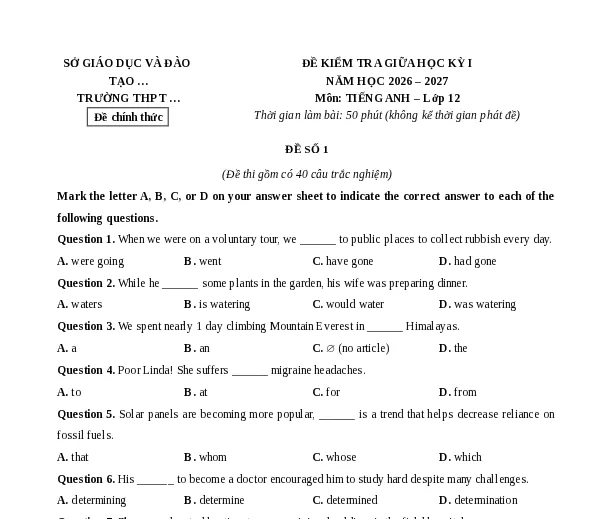
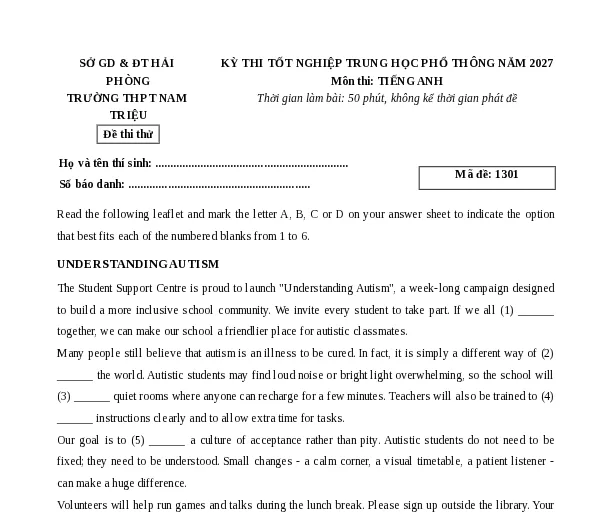
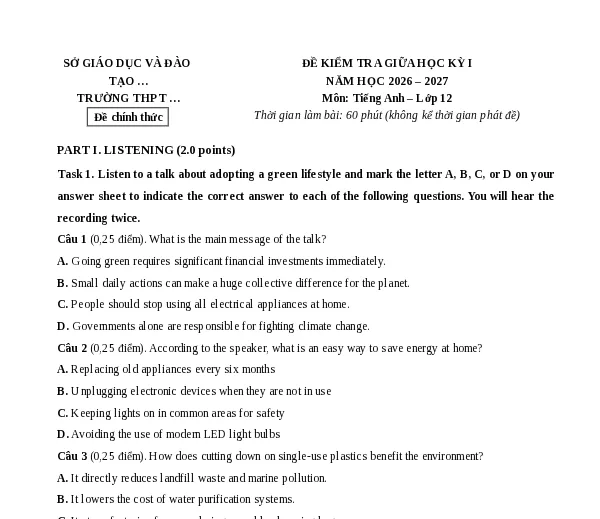
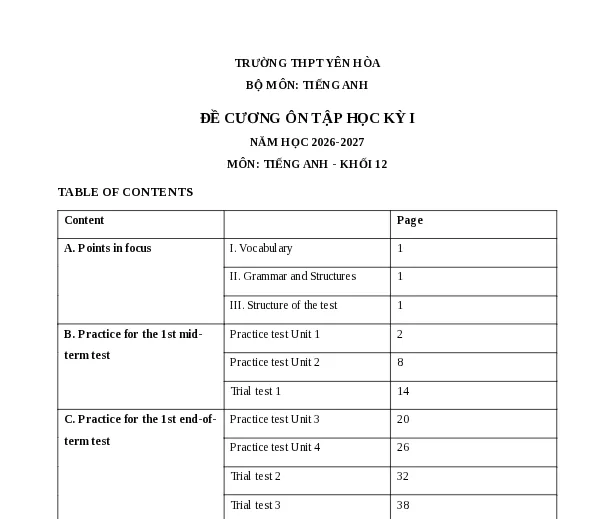
SỞ GIÁO DỤC VÀ ĐÀO TẠO …
TRƯỜNG THPT …
Đề chính thức
(Đề thi có 04 trang)
KỲ THI TỐT NGHIỆP TRUNG HỌC PHỔ THÔNG NĂM 2027
Bài thi: NGOẠI NGỮ; Môn thi: TIẾNG ANH
Thời gian làm bài: 50 phút, không kể thời gian phát đề
Họ và tên thí sinh: ................................................................ Số báo danh: ............................................................ | Mã đề thi: 101 |
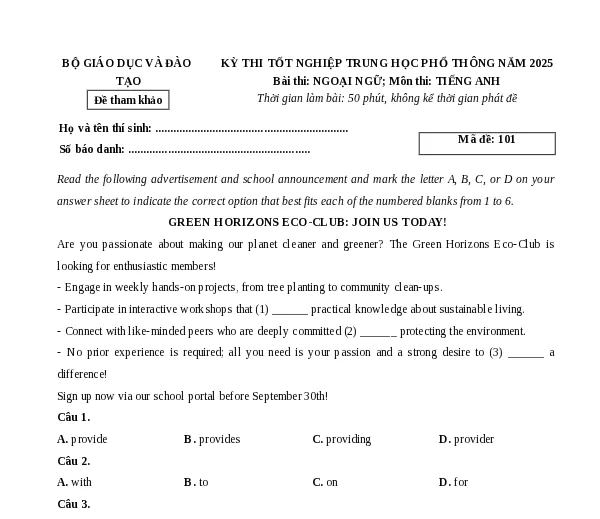
Read the following advertisement/announcement and mark the letter A, B, C, or D on your answer sheet to indicate the correct option that best fits each of the numbered blanks from 1 to 6.
JOIN OUR ANNUAL SCHOOL ART EXHIBITION!
Are you passionate about creativity and visual expression? The Youth Creative Club is delighted to announce our Annual High School Art Exhibition, scheduled to take place next month.
- We welcome original artworks (1) ______ by current high school students.
- Each participant may submit up to three pieces, ranging from oil paintings to digital graphics.
- Please ensure that your entry (2) ______ our club guidelines before the deadline.
- Winning artworks will be displayed at the city’s Cultural Centre, offering you an invaluable opportunity to gain public (3) ______!
Registration forms are available at Room 204. For inquiries, email us at [email protected].
Câu 1.
A. creating
B. created
C. create
D. to create
Câu 2.
A. complies with
B. breaks out
C. takes off
D. turns down
Câu 3.
A. recognition
B. recognized
C. recognizable
D. recognizably
ANNOUNCEMENT: VOLUNTEER TUTORS WANTED
The Green Sprouts Educational Project is currently recruiting enthusiastic student volunteers to tutor primary school children from disadvantaged backgrounds.
- Selected tutors will deliver weekend classes in basic English and Mathematics.
- Applicants should possess good communication skills and a strong commitment to community service.
- The project will (4) ______ training sessions to equip you with effective teaching methodologies.
- Participating in this program will help you develop leadership skills and (5) ______ meaningful friendships.
- The deadline for submission is 5:00 PM on October 25th.
If you have any questions or require additional information, please contact the coordinator (6) ______ phone at 0912-345-678.
Câu 4.
A. organize
B. organize
C. hold
D. conduct
Câu 5.
A. do
B. make
C. give
D. take
Câu 6.
A. in
B. by
C. on
D. at
Read the following leaflet and mark the letter A, B, C, or D on your answer sheet to indicate the correct option that best fits each of the numbered blanks from 7 to 12.
DISCOVER THE NEW METRO LINE – TRAVEL GREENER, FASTER!
Our city's newly launched underground metro network is here to transform your daily commute. Here is everything you need to know:
- Fast and Efficient: The modern electric trains travel much faster than traditional buses, helping you beat traffic congestion during peak hours. In fact, the more people switch to public transit, (7) ______ our urban air becomes.
- Convenient Connections: Stations are strategically situated near major universities and commercial centers, (8) ______ allows passengers to transfer seamlessly between routes.
- Eco-Friendly Impact: You (9) ______ leave your private motorbikes at home to help cut down carbon emissions. If every citizen took the metro twice a week, greenhouse gases (10) ______ substantially.
- Affordable Fares: We offer discounted monthly passes for students and senior citizens. However, (11) ______ passengers must tap their smart cards at the automated gates prior to boarding.
- Passenger Support: Should you encounter any difficulties while purchasing tickets, our station assistants, (12) ______ to help all commuters, are always standing by at the information kiosks.
Câu 7.
A. cleaner
B. the cleanest
C. the cleaner
D. cleanest
Câu 8.
A. which
B. that
C. who
D. whom
Câu 9.
A. ought
B. should
C. might
D. would
Câu 10.
A. will decrease
B. decrease
C. would decrease
D. had decreased
Câu 11.
A. each
B. all
C. another
D. much
Câu 12.
A. training
B. who trained
C. trained
D. have trained
Mark the letter A, B, C, or D on your answer sheet to indicate the best arrangement of utterances or sentences to make a meaningful exchange or text in each of the following questions from 13 to 17.
Câu 13.
a. Lan: That sounds like a wonderful idea! Let me check the cinema schedule online right now.
b. Minh: Are you free this Saturday evening? The new historical movie is finally showing.
c. Minh: Great! Please book two tickets in the middle row if there are seats available.
A. b - a - c
B. a - b - c
C. c - a - b
D. b - c - a
Câu 14.
a. Nam: Yes, but only when it is strictly supervised by teachers to avoid cheating.
b. Mai: Do you think artificial intelligence should be widely integrated into classroom assignments?
c. Mai: I completely agree; responsible guidance is key to making technology beneficial.
A. c - b - a
B. b - a - c
C. a - c - b
D. b - c - a
Câu 15.
a. Furthermore, engaging in group discussions allows teenagers to appreciate viewpoints that differ from their own.
b. To begin with, working in diverse teams equips students with vital conflict resolution skills.
c. Consequently, collaborative learning plays an essential role in preparing young people for future workplace environments.
d. Collaborative school projects have recently gained popularity in modern educational curricula.
e. In addition, students who regularly cooperate on academic tasks tend to achieve higher academic confidence.
A. d - b - e - a - c
B. d - a - b - c - e
C. b - d - a - e - c
D. d - c - b - e - a
Câu 16.
Dear Mr. Harrison,
a. We are confident that this workshop will equip participants with practical tools to manage academic stress effectively.
b. On behalf of the Student Council, I am writing to invite you as the keynote speaker for our upcoming Mental Health Awareness Day.
c. Please let us know if you are available on this date, and we will promptly send you the detailed schedule.
d. The event is scheduled to take place on Friday, November 14th, in the main school hall.
e. Your extensive research in adolescent psychology would provide our students with invaluable guidance.
Sincerely,
Nguyen Linh
A. b - d - e - a - c
B. b - e - d - a - c
C. d - b - a - e - c
D. b - d - a - c - e
Câu 17.
a. During his university years, he spent countless late nights experimenting with eco-friendly alternatives in his garage.
b. Born into a farming family, Hoang had always observed the harmful impact of non-biodegradable plastics on fertile soil.
c. His straw-based packaging products are now exported to several international markets, proving that passion and persistence can drive green innovation.
d. After facing dozens of failed prototypes and running out of personal savings, he finally invented a durable biodegradable container made from rice husks.
e. Encouraged by this breakthrough, he established a green startup that quickly attracted attention from sustainable investment funds.
A. b - a - d - e - c
B. a - b - d - e - c
C. b - d - a - e - c
D. b - a - e - d - c
Read the following passage and mark the letter A, B, C, or D on your answer sheet to indicate the correct option that best fits each of the numbered blanks from 18 to 22.
Cultural diversity is the presence of multiple distinct cultural traditions within a single society or community. In an increasingly globalized world, people of different cultural backgrounds frequently interact in schools, workplaces, and neighborhoods. Embracing cultural diversity (18) ______, but it also fosters mutual understanding, tolerance, and social cohesion.
When individuals encounter people from diverse traditions, they are prompted to examine their own unconscious assumptions and expand their perspectives. Exposure to different languages, culinary traditions, and philosophical viewpoints (19) ______. Research shows that multi-ethnic teams consistently outperform homogeneous groups in creative problem-solving because team members approach tasks from distinct angles.
However, building an inclusive society requires concerted effort from governments, educational institutions, and citizens. Prejudices and stereotypes (20) ______ unless schools actively promote intercultural dialogue from an early age. Educators should design curricula that highlight the unique contributions of various ethnic groups, (21) ______.
Ultimately, cultural diversity should never be viewed as a threat to national identity. Instead, communities that celebrate their multicultural roots (22) ______, paving the way for sustainable global cooperation.
Câu 18.
A. not only enriches our daily lives through varied artistic and culinary expressions
B. enriching our daily lives neither through varied artistic nor culinary expressions
C. which not only enriches our daily lives through artistic and culinary expressions
D. having enriched our daily lives through varied artistic expressions
Câu 19.
A. stimulates cognitive flexibility and enhances innovative thinking
B. stimulating cognitive flexibility by innovative thinking
C. to stimulate cognitive flexibility and innovative thinking
D. which stimulates cognitive flexibility as well as innovative thinking
Câu 20.
A. can quickly take root and generate social division
B. taking root quickly and generating social division
C. which can quickly take root to generate social division
D. that will quickly take root or generate social division
Câu 21.
A. thereby fostering empathy and mutual respect among youngsters
B. which foster empathy and mutual respect among youngsters
C. and to foster empathy as well as mutual respect among youngsters
D. they foster empathy and mutual respect among youngsters
Câu 22.
A. are much more likely to cultivate resilient and peaceful societies
B. being much more likely to cultivate resilient and peaceful societies
C. that are much more likely to cultivate resilient and peaceful societies
D. will be cultivating resilient and peaceful societies much more likely
Read the following passage and mark the letter A, B, C, or D on your answer sheet to indicate the correct answer to each of the questions from 23 to 30.
The phenomenon of celebrity culture has undergone a radical transformation over the past two decades. In the mid-twentieth century, fame was largely restricted to exceptional performers: Hollywood actors, accomplished athletes, and world-renowned musicians whose public exposure was strictly managed by movie studios and publicists. The general public caught only occasional glimpses of these stars through formal television interviews, magazine spreads, and cinematic premieres. This barrier preserved an aura of mystique and unreachable glamour around celebrated figures.
However, the advent of internet connectivity and social media platforms has completely redefined the mechanics of fame. Today, celebrity status is no longer the exclusive domain of established entertainment industries. Content creators, online influencers, and ordinary individuals can achieve widespread recognition almost overnight by posting viral videos from their living rooms. By offering direct, unscripted access into their daily routines, modern influencers cultivate an illusion of intimate friendship with their followers, creating what sociologists term parasocial relationships.
While fame has historically brought immense financial rewards and social prestige, its psychological costs are increasingly coming to light. Relentless scrutiny from both the mainstream press and digital audiences leaves high-profile personalities vulnerable to anxiety, burnout, and depression. Unlike public figures in the past, contemporary celebrities are subjected to 24-hour evaluation, where an awkward remark or an ill-considered social media post can trigger immediate public backlash and jeopardize lucrative sponsorship deals.
Furthermore, the pursuit of fame has deeply impacted youth psychology. Surveys indicate that a significant proportion of teenagers now rank becoming a social media influencer among their top career aspirations, often prioritizing internet popularity over academic or professional accomplishments. Media analysts caution that this constant quest for external validation can undermine self-esteem, especially when young people mistake polished digital personas for authentic fulfillment. Celebrity culture, therefore, continues to reflect our collective fascination with recognition, while serving as a cautionary tale about the perils of living under the perpetual spotlight.
Câu 23. Which of the following is the best title for the passage?
A. The Evolution and Pitfalls of Modern Celebrity Culture
B. How Traditional Media Managed Famous Movie Stars
C. The Financial Advantages of Becoming a Social Influencer
D. Why Young People Prefer Celebrities to Professionals
Câu 24. According to paragraph 1, twentieth-century celebrities maintained an aura of mystique because ______.
A. they completely avoided television appearances and magazine interviews
B. their public appearances were rare and closely regulated by professionals
C. they were significantly more talented than modern internet influencers
D. cinema studios prohibited them from communicating with ordinary people
Câu 25. The word parasocial in paragraph 2 most likely describes a relationship that is ______.
A. mutually beneficial and financially rewarding
B. one-sided and felt deeply by the fan despite lack of actual interaction
C. based entirely on face-to-face professional collaboration
D. highly destructive and condemned by modern psychologists
Câu 26. The word jeopardize in paragraph 3 is closest in meaning to ______.
A. threaten
B. improve
C. evaluate
D. terminate
Câu 27. The word their in paragraph 4 refers to ______.
A. surveys
B. teenagers
C. career aspirations
D. accomplishments
Câu 28. Which of the following is NOT mentioned in paragraph 3 as a negative consequence of fame?
A. Suffering from emotional burnout and severe anxiety
B. Enduring constant twenty-four-hour surveillance from the public
C. Facing legal prosecution from former corporate sponsors
D. Risking financial loss due to spontaneous online backlash
Câu 29. Which of the following is TRUE according to the passage?
A. The barriers to achieving fame have become higher due to strict algorithmic controls.
B. Twentieth-century stars were exposed to the same levels of online scrutiny as modern influencers.
C. Direct digital interaction makes fans feel a false sense of closeness to influencers.
D. Aspiring to become an online influencer guarantees personal happiness and self-esteem.
Câu 30. Which of the following can be inferred from the final paragraph?
A. Most teenagers who aspire to fame will eventually regret their career choices.
B. Digital fame often presents an idealized reality that fails to deliver genuine life satisfaction.
C. Social media platforms should be legally restricted for teenagers seeking popularity.
D. Academic achievements are no longer regarded as valuable in modern society.
Read the following passage and mark the letter A, B, C, or D on your answer sheet to indicate the correct answer to each of the questions from 31 to 40.
Green living, broadly defined as adopting lifestyle practices that conserve ecological resources and minimize environmental degradation, has transitioned from a niche philosophy into a global movement. [I] Spurred by scientific warnings regarding global climate change and resource depletion, millions of individuals across the world are re-evaluating their relationship with consumption. From reducing household electricity usage to boycotting single-use plastics, green initiatives aim to shrink our collective ecological footprint. [II]
At the household level, transition towards sustainability often begins with conscious consumerism. Consumers are increasingly scrutinizing the life cycle of the products they purchase, favoring locally sourced organic foods, cruelty-free cosmetics, and garments manufactured under fair-trade certifications. Moreover, embracing a plant-rich diet has gained tremendous momentum. [III] Livestock agriculture is responsible for an estimated fourteen percent of global greenhouse gas emissions and extensive deforestation in tropical regions. By substituting plant proteins for meat, individuals can drastically lower their carbon and water footprints without compromising nutritional health. [IV]
Beyond individual dietary and shopping choices, waste management represents a critical pillar of green living. The conventional "take-make-dispose" linear economic model has burdened landfills and oceans with millions of tons of non-biodegradable waste. In response, advocates champion the circular economic model, emphasizing the five R's: refuse, reduce, reuse, repurpose, and recycle. Zero-waste advocates strive to eliminate trash entirely by buying food in bulk, carrying reusable cloth totes, and composting organic food scraps. When organic waste decomposes anaerobically in landfills, it releases methane, a greenhouse gas twenty-eight times more potent than carbon dioxide over a century-long period. Composting, by contrast, converts kitchen scraps into nutrient-rich soil enhancer, sequestering carbon naturally.
However, critics often argue that individual actions alone are insufficient to avert planetary ecological collapse. Multinational corporations and state energy sectors account for the vast majority of carbon emissions and industrial effluents. Furthermore, green products frequently carry higher price tags, rendering eco-friendly lifestyles inaccessible to economically disadvantaged families. While individual efforts are undeniably commendable, systemic transformation through stringent governmental regulations, renewable energy infrastructure subsidies, and strict corporate accountability must accompany grassroots behavioral shifts. True sustainability is achieved only when personal responsibility converges with comprehensive institutional reform.
Câu 31. Where in paragraph 1 does the following sentence best fit?
"This growing awareness is largely fueled by visible evidence of environmental disruption, such as recurring heatwaves and severe flooding."
A. [I]
B. [II]
C. [III]
D. [IV]
Câu 32. Which of the following best summarizes the main idea of paragraph 2?
A. Purchasing certified goods guarantees that global deforestation will cease.
B. Conscious buying habits and dietary changes play a vital role in sustainable domestic living.
C. Livestock agriculture is the only significant contributor to global climate change.
D. Plant-based diets are difficult to maintain without specialized nutritional supplements.
Câu 33. The word circular in paragraph 3 is closest in meaning to ______.
A. roundabout
B. regenerative
C. spherical
D. predictable
Câu 34. According to paragraph 3, composting is preferable to landfill disposal because it ______.
A. eliminates the need to carry reusable shopping bags
B. produces methane gas for domestic heating purposes
C. prevents the release of methane and restores soil nutrients
D. completely solves the problem of oceanic plastic waste
Câu 35. The word potent in paragraph 3 is opposite in meaning to ______.
A. powerful
B. ineffective
C. hazardous
D. intense
Câu 36. The word it in paragraph 3 refers to ______.
A. trash
B. food
C. organic waste
D. carbon dioxide
Câu 37. Which of the following is NOT true according to paragraph 4?
A. Industrial corporations contribute a substantial proportion of global carbon emissions.
B. Eco-friendly merchandise is occasionally priced higher than conventional alternatives.
C. Individual green actions are sufficient on their own to stop planetary ecological breakdown.
D. Structural change requires state subsidies for clean and renewable energy systems.
Câu 38. Which of the following best paraphrases the underlined sentence in paragraph 4?
"True sustainability is achieved only when personal responsibility converges with comprehensive institutional reform."
A. Authentic sustainable progress requires both private citizen commitment and wide-ranging structural policies.
B. Governments must mandate personal responsibility before establishing institutional green reforms.
C. Neither individual behavioral modifications nor government policies can guarantee genuine environmental balance.
D. Personal green habits are far more consequential than broad institutional regulations in achieving sustainability.
Câu 39. Which of the following can be inferred from the passage?
A. Traditional linear economic systems are economically more profitable than circular models.
B. A consumer who purchases locally grown vegetables is directly aiding ecological conservation.
C. In the near future, meat consumption will be universally prohibited by governmental policies.
D. Low-income populations generally show apathy towards pressing environmental dilemmas.
Câu 40. Which of the following best expresses the author's overall attitude toward green living?
A. Skeptical and dismissive of grassroots consumer activism
B. Supportive, yet recognizing the imperative need for systemic support
C. Overly optimistic about the potential of individual dietary changes
D. Indifferent to the economic hurdles faced by low-income families
--------- HẾT ---------
SỞ GIÁO DỤC VÀ ĐÀO TẠO …
TRƯỜNG THPT …
Hướng dẫn chấm chính thức
(Hướng dẫn chấm gồm 02 trang)
KỲ THI TỐT NGHIỆP TRUNG HỌC PHỔ THÔNG NĂM 2027
Bài thi: NGOẠI NGỮ; Môn thi: TIẾNG ANH
Thời gian làm bài: 50 phút
HƯỚNG DẪN CHẤM VÀ THANG ĐIỂM
A. HƯỚNG DẪN CHUNG
- Đề thi gồm 40 câu hỏi trắc nghiệm nhiều phương án lựa chọn.
- Mỗi câu trả lời đúng được 0,25 điểm. Tổng điểm toàn bài là 10,0 điểm.
- Thí sinh tô đúng đáp án vào phiếu trả lời trắc nghiệm thì được điểm của câu đó; tô sai hoặc không trả lời thì không được điểm.
B. ĐÁP ÁN VÀ THANG ĐIỂM
Câu | Đáp án | Câu | Đáp án | Câu | Đáp án | Câu | Đáp án |
|---|---|---|---|---|---|---|---|
1 | B | 11 | B | 21 | A | 31 | B |
2 | A | 12 | C | 22 | A | 32 | B |
3 | A | 13 | A | 23 | A | 33 | B |
4 | D | 14 | B | 24 | B | 34 | C |
5 | B | 15 | A | 25 | B | 35 | B |
6 | B | 16 | A | 26 | A | 36 | C |
7 | C | 17 | A | 27 | B | 37 | C |
8 | A | 18 | A | 28 | C | 38 | A |
9 | B | 19 | A | 29 | C | 39 | B |
10 | C | 20 | A | 30 | B | 40 | B |
C. GIẢI THÍCH CHI TIẾT CÁC CÂU HỎI
- Câu 1: B – Rút gọn mệnh đề quan hệ mang nghĩa bị động: artworks (which are) created by current high school students.
- Câu 2: A – Cụm động từ: comply with (tuân thủ quy định/hướng dẫn).
- Câu 3: A – Từ loại: sau tính từ public cần một danh từ: recognition (sự công nhận, biết đến).
- Câu 4: D – Kết hợp từ (collocation): conduct training sessions (tiến hành/tổ chức các buổi tập huấn).
- Câu 5: B – Kết hợp từ: make friends (kết bạn).
- Câu 6: B – Cụm giới từ phương tiện liên lạc: contact somebody by phone (liên hệ qua điện thoại).
- Câu 7: C – Cấu trúc so sánh kép (The more... the + so sánh hơn): the cleaner our urban air becomes.
- Câu 8: A – Đại từ quan hệ thay thế cho cả mệnh đề đứng trước dùng , which.
- Câu 9: B – Động từ khuyết thiếu: should + V-bare (đưa ra lời khuyên: nên để xe máy ở nhà).
- Câu 10: C – Câu điều kiện loại 2 (diễn tả giả định không có thật ở hiện tại): mệnh đề If chia quá khứ đơn (took), mệnh đề chính dùng would + V-bare (would decrease).
- Câu 11: B – Lượng từ: all + danh từ đếm được số nhiều (all passengers).
- Câu 12: C – Rút gọn mệnh đề quan hệ bị động: our station assistants, (who are) trained to help...
- Câu 13: A – Trật tự hội thoại logic: b (Minh rủ đi xem phim) a (Lan đồng ý và bảo sẽ kiểm tra lịch chiếu) c (Minh nhờ đặt vé hàng ghế giữa).
- Câu 14: B – Trật tự hội thoại logic: b (Mai hỏi về việc ứng dụng AI) a (Nam đồng ý nhưng với điều kiện có giám sát) c (Mai đồng tình với ý kiến của Nam).
- Câu 15: A – Đoạn văn: d (Giới thiệu chủ đề dự án hợp tác) b (Lợi ích đầu tiên: giải quyết xung đột) e (Bổ sung: tự tin trong học tập) a (Bổ sung tiếp: hiểu góc nhìn khác) c (Kết luận vai trò chuẩn bị cho tương lai).
- Câu 16: A – Bố cục thư mời trang trọng: b (Nêu mục đích mời diễn giả) d (Thời gian, địa điểm tổ chức) e (Lý do chọn diễn giả - chuyên môn) a (Kỳ vọng về giá trị buổi hội thảo) c (Lời hẹn phản hồi).
- Câu 17: A – Đoạn văn/câu chuyện kể: b (Bối cảnh xuất thân và quan sát ban đầu) a (Nỗ lực thời sinh viên nghiên cứu vật liệu thay thế) d (Vượt qua thất bại và tạo ra sản phẩm từ trấu) e (Thành lập công ty khởi nghiệp) c (Thành công vươn ra quốc tế).
- Câu 18: A – Cấu trúc song hành với liên từ tương quan: not only... but it also fosters.... Mệnh đề làm vị ngữ chính cho chủ ngữ Embracing cultural diversity.
- Câu 19: A – Cần vị ngữ chính (động từ chia thì số ít theo chủ ngữ danh từ Exposure): stimulates... and enhances....
- Câu 20: A – Vị ngữ chính sau chủ ngữ Prejudices and stereotypes: can quickly take root and generate....
- Câu 21: A – Mệnh đề phân từ chỉ kết quả/hệ quả: , thereby fostering empathy....
- Câu 22: A – Vị ngữ chính cho chủ ngữ communities: are much more likely to cultivate....
- Câu 23: A – Tiêu đề khái quát cả bài: sự chuyển dịch từ danh tiếng truyền thống sang thời đại mạng xã hội và những cạm bẫy/tác hại tâm lý của nó.
- Câu 24: B – Dẫn chứng đoạn 1: "The general public caught only occasional glimpses of these stars through formal television interviews, magazine spreads, and cinematic premieres. This barrier preserved an aura of mystique..."
- Câu 25: B – Ngữ cảnh đoạn 2: mối quan hệ một chiều do người hâm mộ tự cảm thấy gắn bó, thân thiết với người nổi tiếng qua mạng dù không có tương tác thật ngoài đời.
- Câu 26: A – jeopardize = threaten (đe dọa, làm nguy hại đến các hợp đồng tài trợ).
- Câu 27: B – Từ their thay thế cho danh từ số nhiều teenagers ngay trước đó (top career aspirations of teenagers).
- Câu 28: C – Đoạn 3 nhắc đến lo âu/trầm cảm (A), áp lực soi xét 24/7 (B), mất hợp đồng tài trợ (D); không nhắc đến việc bị truy tố pháp lý từ nhà tài trợ (C).
- Câu 29: C – Dẫn chứng đoạn 2: "By offering direct, unscripted access into their daily routines, modern influencers cultivate an illusion of intimate friendship with their followers..."
- Câu 30: B – Suy luận từ câu cuối đoạn 4: việc chạy theo danh vọng số bóng bẩy trên mạng không đem lại sự thỏa mãn, trọn vẹn đích thực cho cuộc sống (authentic fulfillment).
- Câu 31: B – Vị trí [II] liên kết tự nhiên sau khi nêu việc tái đánh giá mối quan hệ tiêu dùng do cảnh báo biến đổi khí hậu ở câu trước, dẫn chứng sự biến đổi khí hậu thể hiện qua sóng nhiệt và lũ lụt.
- Câu 32: B – Đoạn 2 tập trung vào: thói quen mua sắm có ý thức (conscious consumerism) và chuyển đổi sang chế độ ăn nhiều thực vật (plant-rich diet) ở quy mô hộ gia đình.
- Câu 33: B – circular (kinh tế tuần hoàn) mang nghĩa tái tạo, khép kín vòng đời sản phẩm, đồng nghĩa với regenerative.
- Câu 34: C – Dẫn chứng đoạn 3: Rác hữu cơ ở bãi chôn lấp sinh ra khí mê-tan gây hiệu ứng nhà kính; trong khi ủ phân (composting) biến rác thành chất dinh dưỡng cho đất và giữ carbon lại tự nhiên.
- Câu 35: B – potent (mạnh, có tác động lớn) trái nghĩa với ineffective (không hiệu quả/yếu ớt).
- Câu 36: C – Từ it quy chiếu cho cụm danh từ organic waste ở vế trước (When organic waste decomposes anaerobically in landfills, it releases methane...).
- Câu 37: C – Dẫn chứng đoạn 4: Câu đầu tiên nêu rõ "individual actions alone are insufficient to avert planetary ecological collapse", do đó khẳng định ở phương án C là sai sự thật trong bài.
- Câu 38: A – Diễn đạt lại: Bền vững thực sự chỉ đạt được khi trách nhiệm cá nhân kết hợp cùng cải cách thể chế toàn diện Cần cả cam kết của người dân lẫn chính sách mang tính cơ cấu của nhà nước.
- Câu 39: B – Suy luận từ đoạn 2: Người tiêu dùng mua thực phẩm hữu cơ, nguồn gốc địa phương (locally sourced foods) sẽ giảm phát thải vận chuyển và bảo tồn tài nguyên sinh thái.
- Câu 40: B – Thái độ của tác giả: Hoàn toàn ủng hộ lối sống xanh của cá nhân, nhưng nhấn mạnh rằng phải đi kèm sự cải cách mang tính hệ thống của các tập đoàn và chính phủ thì mới đạt được hiệu quả bền vững thực sự.