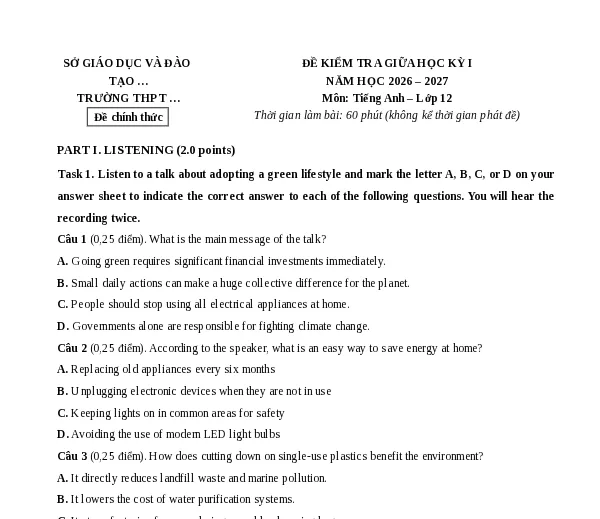
SỞ GIÁO DỤC VÀ ĐÀO TẠO …
TRƯỜNG THPT …
Đề chính thức
ĐỀ KIỂM TRA GIỮA HỌC KỲ I
NĂM HỌC 2026 – 2027
Môn: TIẾNG ANH – Lớp 12
Thời gian làm bài: 50 phút (không kể thời gian phát đề)
ĐỀ SỐ 1
(Đề thi gồm có 40 câu trắc nghiệm)
Mark the letter A, B, C, or D on your answer sheet to indicate the correct answer to each of the following questions.
Question 1. When we were on a voluntary tour, we ______ to public places to collect rubbish every day.
A. were going
B. went
C. have gone
D. had gone
Question 2. While he ______ some plants in the garden, his wife was preparing dinner.
A. waters
B. is watering
C. would water
D. was watering
Question 3. We spent nearly 1 day climbing Mountain Everest in ______ Himalayas.
A. a
B. an
C. (no article)
D. the
Question 4. Poor Linda! She suffers ______ migraine headaches.
A. to
B. at
C. for
D. from
Question 5. Solar panels are becoming more popular, ______ is a trend that helps decrease reliance on fossil fuels.
A. that
B. whom
C. whose
D. which
Question 6. His ______ to become a doctor encouraged him to study hard despite many challenges.
A. determining
B. determine
C. determined
D. determination
Question 7. The nurse devoted her time to ______ injured soldiers in the field hospital.
A. putting on
B. take after
C. taking care of
D. break down
Question 8. The soldiers fought bravely to defend their homeland from the ______.
A. ally
B. enemy
C. hero
D. neighbor
Question 9. Respect for elders is a ______ of Asian cultures, while individualism is often seen in Western societies.
A. tradition
B. feature
C. characteristic
D. custom
Question 10. New policies were introduced to ______ natural resources, which are rapidly depleting.
A. pollute
B. damage
C. consume
D. conserve
Question 11. Living in a ______ city has taught me to appreciate different perspectives.
A. multicultural
B. culture shock
C. uncultured
D. cultural confusion
Question 12. Not until the professional chef shared his recipe did we realize why the dish was so ______ that everyone wanted a second serving.
A. beautiful
B. tasty
C. interesting
D. expensive
Read the following announcement and mark the letter A, B, C, or D on your answer sheet to indicate the correct option that best fits each of the numbered blanks from 13 to 18.
GREEN YOUTH CLUB ANNOUNCEMENT: SCHOOL CLEAN-UP DAY
Our school Green Club is thrilled to announce the annual "Campus Cleanup Day" next Saturday!
- Please bring (13) ______ reusable water bottles and work gloves if you have them.
- All participants are requested to (14) ______ at the school gate at 7:30 a.m.
- We aim (15) ______ our school's carbon footprint and foster environmental awareness among students.
- Make sure you (16) ______ organic waste from recyclable materials before putting them into bins.
- This practical activity contributes to the (17) ______ of our natural surroundings.
- Joining hands in this campaign offers a(n) (18) ______ opportunity to inspire the whole community to adopt a sustainable lifestyle.
Question 13.
A. every
B. some
C. much
D. another
Question 14.
A. turn up
B. give away
C. pass away
D. break out
Question 15.
A. reduce
B. to reduce
C. reducing
D. reduced
Question 16.
A. sort
B. release
C. decompose
D. contaminate
Question 17.
A. protect
B. protective
C. protection
D. protectively
Question 18.
A. scarce
B. invaluable
C. trivial
D. disposable
Mark the letter A, B, C, or D on your answer sheet to indicate the correct arrangement of the sentences to make a meaningful conversation, letter, or paragraph in each of the following questions.
Question 19.
a. Nick: Yes! Her groundbreaking work in science, despite facing so many challenges, is incredible.
b. Jack: Her perseverance and passion for discovery truly inspire me.
c. Jack: Have you ever heard about the life story of Marie Curie?
A. a-c-b
B. b-a-c
C. c-a-b
D. c-b-a
Question 20.
a. Ethan: That's good. Understanding the culture beforehand really helps with adjusting when you get there.
b. Ethan: I'm moving to Japan for work soon. Are you worried about experiencing culture shock?
c. Fiona: A little, but I've been reading a lot about their culture and customs.
A. b-a-c
B. b-c-a
C. a-b-c
D. c-b-a
Question 21.
Dear Mom and Dad,
I hope this letter finds you both well.
a. I’ve also started reading about biological research and cutting-edge treatments that resist deadly diseases, which I find fascinating and inspiring.
b. The more I learn, the more I realize how much medicine and innovation have advanced.
c. Last weekend, I visited a field hospital and met a surgeon who shared his personal account of treating soldiers during the resistance war, showing their incredible determination and resilience.
d. I'm excited to continue my journey and hope to use this knowledge in the future.
Sending my love and hoping to see you both soon!
Warm regards,
Emma
A. c-a-b-d
B. d-b-a-c
C. d-c-b-a
D. c-b-a-d
Question 22.
a. Reusing or “upcycling” furniture in this way can protect the environment—we don’t have to cut down trees to get wood for new tables and chairs.
b. For example, some people recycle old furniture as a hobby. They buy old furniture at yard sales or stores that sell used items.
c. If you damage a piece of furniture, don't put it in the trash: Repair it or turn it into something new.
d. Then they paint it or change it in some way to create something new.
e. One way to help the environment is to reuse old furniture instead of throwing it out.
A. e-c-d-b-a
B. c-a-b-d-e
C. e-b-d-a-c
D. e-c-b-d-a
Mark the letter A, B, C, or D on your answer sheet to indicate the word(s) CLOSEST in meaning to the underlined word(s) in each of the following questions.
Question 23. Young people are advised to adopt an eco-friendly lifestyle to protect the Earth.
A. environmentally friendly
B. wasteful
C. traditional
D. complicated
Question 24. Before submitting the report, I had to check whether all the sources of information are valid.
A. straightforward
B. legitimate
C. available
D. clear
Mark the letter A, B, C, or D on your answer sheet to indicate the word(s) OPPOSITE in meaning to the underlined word(s) in each of the following questions.
Question 25. School uniform is compulsory in most Vietnamese schools.
A. depended
B. optional
C. obligatory
D. required
Question 26. The 21st century has witnessed the surprisingly increasing formation of multicultural societies where a varying number of ethnic people stay together.
A. monocultural
B. global
C. universal
D. worldwide
Read the following passage and mark the letter A, B, C, or D on your answer sheet to indicate the correct option that best fits each of the numbered blanks from 27 to 32.
In our modern globalized era, preserving cultural heritage while adopting a green lifestyle has become a crucial goal for many communities. (27) ______ people now realize that traditional practices often contain eco-friendly wisdom that modern society has neglected. (28) ______, indigenous building techniques emphasize using local bamboo and clay, which significantly reduces energy consumption. Local artisans (29) ______ traditional crafts pass down valuable knowledge across generations, (30) ______ enables young people to stay deeply connected to their ancestral roots. Furthermore, organizing cultural festivities with eco-friendly decorations raises public (31) ______ of environmental conservation. By learning to (32) ______ modern sustainability with traditional values, we can build vibrant, enduring communities for future generations.
Question 27.
A. Many
B. Much
C. Every
D. Another
Question 28.
A. However
B. For instance
C. Therefore
D. Although
Question 29.
A. creating
B. destroying
C. releasing
D. omitting
Question 30.
A. which
B. whom
C. whose
D. where
Question 31.
A. aware
B. awareness
C. unaware
D. awarenesses
Question 32.
A. harmonize
B. harmonizing
C. harmonized
D. harmonization
Read the following passage and mark the letter A, B, C, or D on your answer sheet to indicate the correct answer to each of the questions from 33 to 40.
Living a green life has evolved from an individual preference into a worldwide movement. In recent years, growing concerns about climate change and environmental degradation have prompted cities around the globe to rethink their development strategies. Sustainable urban living involves not only reducing plastic waste and recycling materials, but also redefining how urban inhabitants interact with their surroundings.
One prominent aspect of this green transformation is the preservation of cultural identities within urban architecture. Instead of demolishing historical quarters to erect modern glass skyscrapers, many forward-thinking cities are rehabilitating historical buildings using sustainable, low-carbon materials. This dual approach helps conserve irreplaceable architectural heritage while dramatically diminishing the carbon footprint generated by conventional construction. By integrating green spaces into preserved cultural precincts, urban planners have successfully revitalized historical neighborhoods into bustling, eco-friendly community hubs.
Furthermore, community-driven green initiatives play an indispensable role in transforming social mindsets. Local food markets that promote regional specialties reduce the need for long-distance freight transport, thereby cutting greenhouse gas emissions. When residents actively engage in composting organic waste or patronizing local handicraft artisans, they foster a profound sense of communal belonging and shared environmental responsibility. In this way, ecological practices reinforce cultural cohesion, showing that cultural diversity and environmental sustainability are complementary forces driving modern societal progress.
Question 33. The word indispensable in paragraph 3 is OPPOSITE in meaning to ______.
A. vital
B. unnecessary
C. significant
D. practical
Question 34. Which of the following is the main idea of the passage?
A. The total failure of conventional building materials in contemporary cities.
B. The harmony between green living and cultural preservation in urban development.
C. The financial advantages of purchasing local produce at community markets.
D. The technological innovations required to combat worldwide climate change.
Question 35. The word they in paragraph 3 refers to ______.
A. local food markets
B. regional specialties
C. greenhouse gas emissions
D. residents
Question 36. According to paragraph 2, historical quarters in forward-thinking cities are ______.
A. torn down to construct glass towers
B. rehabilitated using sustainable materials
C. abandoned due to high renovation costs
D. converted entirely into commercial zones
Question 37. Which of the following is NOT TRUE according to the passage?
A. Buying local specialties helps lower greenhouse gas emissions from freight transport.
B. Sustainable living is limited exclusively to recycling plastics and reducing waste.
C. Integrating green spaces helps transform old quarters into lively community hubs.
D. Environmental sustainability can enhance cultural cohesion within communities.
Question 38. The word revitalized in paragraph 2 is closest in meaning to ______.
A. destroyed
B. examined
C. refreshed
D. ignored
Question 39. Which of the following best paraphrases the underlined sentence in paragraph 3: "ecological practices reinforce cultural cohesion, showing that cultural diversity and environmental sustainability are complementary forces driving modern societal progress."?
A. Environmental actions weaken communal relationships because cultural diversity contradicts sustainable practices.
B. Both eco-friendly actions and cultural diversity work together harmoniously to advance modern society.
C. Cultural cohesion can only be maintained if urban communities completely abandon modern green initiatives.
D. Modern societal progress relies solely on economic growth rather than environmental and cultural efforts.
Question 40. In which paragraph does the author mention a specific measure to lower carbon emissions in building development?
A. Paragraph 1
B. Paragraph 2
C. Paragraph 3
D. Paragraph 1 and 3
--------- HẾT ĐỀ SỐ 1 ---------
SỞ GIÁO DỤC VÀ ĐÀO TẠO …
TRƯỜNG THPT …
Đề chính thức
ĐỀ KIỂM TRA GIỮA HỌC KỲ I
NĂM HỌC 2026 – 2027
Môn: TIẾNG ANH – Lớp 12
Thời gian làm bài: 50 phút (không kể thời gian phát đề)
ĐỀ SỐ 2
(Đề thi gồm có 40 câu trắc nghiệm)
Mark the letter A, B, C, or D on your answer sheet to indicate the correct answer to each of the following questions.
Question 1. I ______ Maria for the first time at the Heart-to-Heart Charity Office.
A. saw
B. was seeing
C. was seen
D. has seen
Question 2. The boys broke a window when they ______ football.
A. played
B. were playing
C. half played
D. are playing
Question 3. Her favourite pastime is playing ______ piano.
A. an
B. the
C. a
D. (no article)
Question 4. The course in this school appeals ______ me the most.
A. by
B. on
C. to
D. of
Question 5. Many people are turning to cycling, ______ is a habit that reduces carbon emissions significantly.
A. which
B. what
C. whom
D. who
Question 6. The school encourages students to respect cultural ______ by learning about different customs and traditions.
A. diversity
B. diversify
C. diverse
D. diversely
Question 7. The surgeon was famous ______ her innovative techniques in treating battlefield injuries.
A. to
B. for
C. about
D. with
Question 8. The fighters hid in the ______ to avoid detection by the enemy.
A. village
B. jungle
C. house
D. hotel
Question 9. Respect is an essential ______ of cultural traditions, without which communities can lose their unity.
A. value
B. belief
C. element
D. origin
Question 10. Recyclable products should not be ended up in open ______ sites.
A. landfill
B. leftover
C. resource
D. footprint
Question 11. As a ______ thinker, she proposed strategies that saved thousands of lives.
A. practical
B. logical
C. visionary
D. conventional
Question 12. While many people were familiar with the tradition of tug of war, having ______ in the game gave them a deeper understanding, and so they ______ its cultural meaning more.
A. watched – ignored
B. played – forgot
C. participated – appreciated
D. observed – respected
Read the following leaflet and mark the letter A, B, C, or D on your answer sheet to indicate the correct option that best fits each of the numbered blanks from 13 to 18.
DISCOVER THE MULTICULTURAL FOOD FAIR 2026!
Are you ready to explore an exciting world of flavors and traditions right in your town?
- Experience authentic dishes prepared by chefs from (13) ______ distinct cultural backgrounds.
- Don’t hesitate to (14) ______ for our free cooking workshop to learn time-honored recipes.
- Visitors are encouraged (15) ______ traditional attire to receive a complimentary handmade souvenir.
- Every food (16) ______ will feature traditional music and art exhibitions.
- This vibrant festival promotes mutual respect and cultural (17) ______ within our community.
- Joining us guarantees an unforgettable experience that will surely (18) ______ your cultural perspective!
Question 13.
A. each
B. many
C. much
D. every
Question 14.
A. sign up
B. pass away
C. cut down
D. give up
Question 15.
A. wear
B. to wear
C. wearing
D. worn
Question 16.
A. landfill
B. booth
C. emission
D. ingredient
Question 17.
A. appreciation
B. appreciate
C. appreciative
D. appreciably
Question 18.
A. restrict
B. broaden
C. damage
D. decompose
Mark the letter A, B, C, or D on your answer sheet to indicate the correct arrangement of the sentences to make a meaningful conversation, letter, or paragraph in each of the following questions.
Question 19.
a. Alice: I really admire the story of Steve Jobs, he changed the entire tech industry.
b. Bob: That's true, he wasn't just a founder, he was a visionary.
c. Alice: His persistence in developing Apple is truly impressive.
d. Bob: Jobs taught us that failure is part of success, the key is to never give up.
A. a-c-b-d
B. a-b-c-d
C. c-a-d-b
D. b-a-c-d
Question 20.
a. Henry: Oh, Indian cuisine can be quite a shock with all the spices. How did you find it?
b. Grace: It was definitely spicier than I'm used to, but I enjoyed the flavors a lot. It's amazing how food reflects so much about a culture's identity.
c. Grace: I tried traditional Indian food for the first time last night, and it was quite an experience!
A. b-a-c
B. a-c-b
C. c-a-b
D. c-b-a
Question 21.
Dear Sarah,
a. It was truly inspiring to hear how innovation and determination drive the creative process in this field.
b. In addition, I’ve started working on a poetic project where I’m writing poems inspired by nature, and it’s been a great way to express my thoughts and emotions.
c. Last week, I had the chance to attend a presentation about the film industry, where I learned about the process of creating computer-animated movies, and the speaker, a visionary director, shared fascinating insights into how they bring magical worlds and characters to life on screen.
d. I'm excited to see where this journey leads, and I look forward to catching up soon and hearing all about what you've been up to!
e. I hope this letter finds you well and happy, and that everything is going smoothly for you.
Take care and best wishes,
Emma
A. e-a-c-b-d
B. e-c-a-b-d
C. a-c-e-d-b
D. d-e-a-c-b
Question 22.
a. As a result, hundreds of water bottles and single-use plastic containers are thrown away every day.
b. Many students at our school buy bottled water or takeaway food.
c. Besides, students often put containers with leftovers in them into the recycling bin, which can lead to contaminating the recyclable waste.
d. This means our school produces a lot of plastic waste that goes to landfills and has a harmful effect on the environment.
A. d-b-a-c
B. b-a-c-d
C. b-c-a-d
D. b-d-c-a
Mark the letter A, B, C, or D on your answer sheet to indicate the word(s) CLOSEST in meaning to the underlined word(s) in each of the following questions.
Question 23. Stories from the resistance war continue to inspire younger generations to cherish peace and independence.
A. civil war
B. battle zone
C. fight for national defense
D. victory parade
Question 24. Japanese sushi is a tasty food that people from different cultures enjoy.
A. terrible
B. tasteless
C. delicious
D. unusual
Mark the letter A, B, C, or D on your answer sheet to indicate the word(s) OPPOSITE in meaning to the underlined word(s) in each of the following questions.
Question 25. Single-use products provide great convenience, but they also harm the environment.
A. Contaminated
B. Decomposed
C. Reusable
D. Released
Question 26. The restaurant is known for its ability to blend ingredients from different culinary traditions.
A. connect
B. mix
C. separate
D. combine
Read the following passage and mark the letter A, B, C, or D on your answer sheet to indicate the correct option that best fits each of the numbered blanks from 27 to 32.
Learning about influential historical figures provides students with profound moral lessons and life values. Throughout history, (27) ______ national heroes dedicated their entire lives to serving their people. (28) ______, Dr. Dang Thuy Tram, a young and passionate battlefield surgeon, worked tirelessly in rudimentary field hospitals during the war. Her poignant diary, (29) ______ captured both the brutality of armed conflict and her undying love for humanity, continues to inspire millions worldwide. Teachers (30) ______ introduce these remarkable life stories to classrooms help students understand the actual cost of peace. By fostering admiration for such (31) ______ deeds, education motivates the youth (32) ______ responsible and patriotic citizens.
Question 27.
A. many
B. much
C. every
D. another
Question 28.
A. In addition
B. For example
C. However
D. Therefore
Question 29.
A. which
B. whom
C. whose
D. where
Question 30.
A. who
B. which
C. whom
D. whose
Question 31.
A. hero
B. heroic
C. heroically
D. heroism
Question 32.
A. become
B. becoming
C. to become
D. became
Read the following passage and mark the letter A, B, C, or D on your answer sheet to indicate the correct answer to each of the questions from 33 to 40.
In recent decades, culinary diplomacy has emerged as one of the most effective tools for fostering mutual understanding among diverse nations. Food is rarely just a biological necessity; it acts as a cultural ambassador that conveys historical narratives, geography, and cherished traditions. When people share an authentic meal originating from an unfamiliar culture, they transcend geopolitical divisions and establish personal bonds.
A notable example of culinary exchange can be observed in the global journey of Vietnamese phở. Originating in northern Vietnam during the early twentieth century, this aromatic noodle soup skillfully absorbed culinary nuances from French and Chinese cooking while retaining its distinct Vietnamese identity. Today, phở is celebrated globally not only for its delicate equilibrium of herbs and spices, but also as an embodiment of the Vietnamese people's resilience and adaptability. International diners indulging in a bowl of phở often gain a deeper appreciation of Vietnam’s rich cultural tapestry.
Nevertheless, globalization also presents tangible risks to traditional culinary arts. The rapid expansion of multinational fast-food corporations threatens to homogenize dietary patterns and overshadow regional specialties. In response, numerous communities have inaugurated local food initiatives to protect heritage recipes and endorse sustainable agriculture. By purchasing fresh, locally cultivated ingredients, consumers can preserve regional culinary traditions while simultaneously mitigating the carbon emissions associated with worldwide food transportation. Consequently, preserving culinary authenticity is intrinsically connected to the broader pursuit of global environmental sustainability.
Question 33. The word homogenize in paragraph 3 is OPPOSITE in meaning to ______.
A. standardize
B. diversify
C. assimilate
D. unify
Question 34. What is the primary focus of the passage?
A. The detailed history and precise recipe of Vietnamese phở.
B. The role of cuisine in cultural exchange and its link to sustainability.
C. The financial supremacy of multinational fast-food enterprises.
D. The medical advantages of eating organic, plant-based diets.
Question 35. The word it in paragraph 1 refers to ______.
A. food
B. biological necessity
C. cultural ambassador
D. mutual understanding
Question 36. According to paragraph 2, Vietnamese phở is characterized by ______.
A. a complete exclusion of foreign culinary influences
B. an aroma that relies exclusively on French culinary techniques
C. a delicate balance of spices reflecting resilience and adaptability
D. an origin that dates back to the seventeenth century
Question 37. Which of the following is NOT TRUE according to the passage?
A. Food serves as an ambassador expressing historical and cultural heritage.
B. Fast-food expansion poses no threat whatsoever to regional food cultures.
C. Sourcing local ingredients helps decrease transportation-related emissions.
D. Sharing meals can help people overcome international geopolitical barriers.
Question 38. The word mitigating in paragraph 3 is closest in meaning to ______.
A. escalating
B. monitoring
C. lessening
D. neglecting
Question 39. Which of the following best paraphrases the underlined sentence in paragraph 3: "preserving culinary authenticity is intrinsically connected to the broader pursuit of global environmental sustainability."?
A. Protecting traditional food cultures is closely linked with efforts to safeguard the global environment.
B. Culinary authenticity must be abandoned if societies want to achieve sustainable living.
C. Environmental preservation has little or nothing to do with protecting indigenous food practices.
D. Global sustainability can only be achieved by modernizing culinary traditions into fast food.
Question 40. In which paragraph does the author discuss the negative impact of globalization on traditional diets?
A. Paragraph 1
B. Paragraph 2
C. Paragraph 3
D. Paragraph 1 and 2
--------- HẾT ĐỀ SỐ 2 ---------
SỞ GIÁO DỤC VÀ ĐÀO TẠO …
TRƯỜNG THPT …
Hướng dẫn chấm chính thức
KỲ THI KIỂM TRA GIỮA HỌC KỲ I
NĂM HỌC 2026 – 2027
Môn: TIẾNG ANH – Lớp 12
HƯỚNG DẪN CHẤM VÀ ĐÁP ÁN CHI TIẾT
A. HƯỚNG DẪN CHUNG
- Đề kiểm tra gồm 40 câu hỏi trắc nghiệm khách quan 4 lựa chọn (A, B, C, D).
- Thang điểm 10,0; mỗi câu trả lời đúng được 0,25 điểm.
B. ĐÁP ÁN TRẮC NGHIỆM
ĐỀ SỐ 1
Câu | 1 | 2 | 3 | 4 | 5 | 6 | 7 | 8 | 9 | 10 |
|---|---|---|---|---|---|---|---|---|---|---|
Đáp án | B | D | D | D | D | D | C | B | B | D |
Câu | 11 | 12 | 13 | 14 | 15 | 16 | 17 | 18 | 19 | 20 |
|---|---|---|---|---|---|---|---|---|---|---|
Đáp án | A | B | B | A | B | A | C | B | D | B |
Câu | 21 | 22 | 23 | 24 | 25 | 26 | 27 | 28 | 29 | 30 |
|---|---|---|---|---|---|---|---|---|---|---|
Đáp án | A | D | A | B | B | A | A | B | A | A |
Câu | 31 | 32 | 33 | 34 | 35 | 36 | 37 | 38 | 39 | 40 |
|---|---|---|---|---|---|---|---|---|---|---|
Đáp án | B | A | B | B | D | B | B | C | B | B |
ĐỀ SỐ 2
Câu | 1 | 2 | 3 | 4 | 5 | 6 | 7 | 8 | 9 | 10 |
|---|---|---|---|---|---|---|---|---|---|---|
Đáp án | A | B | B | C | A | A | B | B | C | A |
Câu | 11 | 12 | 13 | 14 | 15 | 16 | 17 | 18 | 19 | 20 |
|---|---|---|---|---|---|---|---|---|---|---|
Đáp án | C | C | B | A | B | B | A | B | A | C |
Câu | 21 | 22 | 23 | 24 | 25 | 26 | 27 | 28 | 29 | 30 |
|---|---|---|---|---|---|---|---|---|---|---|
Đáp án | B | B | C | C | C | C | A | B | A | A |
Câu | 31 | 32 | 33 | 34 | 35 | 36 | 37 | 38 | 39 | 40 |
|---|---|---|---|---|---|---|---|---|---|---|
Đáp án | B | C | B | B | A | C | B | C | A | C |
GIẢI THÍCH CHI TIẾT ĐỀ SỐ 1
- Câu 1: B. Thói quen trong quá khứ diễn ra trong suốt chuyến đi tình nguyện ("every day") dùng thì Quá khứ đơn: went.
- Câu 2: D. Hành động đang diễn ra song song trong quá khứ ("While he was watering..., his wife was preparing...").
- Câu 3: D. Dãy núi Himalaya có dạng số nhiều ("Himalayas") nên dùng mạo từ xác định the.
- Câu 4: D. Cấu trúc cố định: suffer from something (chịu đựng căn bệnh/nỗi đau gì).
- Câu 5: D. Đại từ quan hệ which đứng sau dấu phẩy thay thế cho toàn bộ mệnh đề đứng trước.
- Câu 6: D. Đứng sau tính từ sở hữu His cần một danh từ: determination (sự quyết tâm).
- Câu 7: C. Cụm động từ: take care of (chăm sóc), sau giới từ to trong devote time to dùng V-ing (taking care of).
- Câu 8: B. Ngữ cảnh: chiến đấu dũng cảm bảo vệ tổ quốc khỏi quân thù/kẻ địch (enemy).
- Câu 9: B. feature of something: nét đặc trưng/đặc điểm nổi bật của một nền văn hóa.
- Câu 10: D. conserve natural resources: bảo tồn, gìn giữ tài nguyên thiên nhiên.
- Câu 11: A. Trước danh từ city dùng tính từ multicultural (đa văn hóa).
- Câu 12: B. Tính từ tasty (ngon miệng) phù hợp với ngữ cảnh món ăn ngon đến mức ai cũng muốn thêm một phần.
- Câu 13: B. some đi với danh từ đếm được số nhiều (reusable water bottles).
- Câu 14: A. Cụm động từ turn up mang nghĩa "có mặt, đến nơi tập trung".
- Câu 15: B. Cấu trúc: aim to do something (nhằm mục đích làm gì).
- Câu 16: A. sort organic waste: phân loại rác thải hữu cơ.
- Câu 17: C. Đứng sau mạo từ the và trước of cần một danh từ: protection (sự bảo vệ).
- Câu 18: B. invaluable opportunity: cơ hội vô giá, rất quý báu.
- Câu 19: D. Trật tự hội thoại hợp lý: Jack mở đầu hỏi về cuộc đời Marie Curie (c) Nick đồng tình và khen ngợi công trình khoa học (b) Jack tiếp lời về sự kiên trì và đam mê truyền cảm hứng (a).
- Câu 20: B. Ethan hỏi về việc chuyển sang Nhật làm việc và nỗi lo sốc văn hóa (b) Fiona trả lời hơi lo nhưng đang tìm hiểu phong tục (c) Ethan khen ngợi điều đó giúp ích cho việc thích nghi (a).
- Câu 21: A. Thứ tự thư: Emma kể về chuyến thăm bệnh viện dã chiến gặp bác sĩ phẫu thuật (c) liên hệ việc mình đọc thêm về nghiên cứu y sinh (a) nhận thức được sự tiến bộ của y học (b) háo hức tiếp tục hành trình và áp dụng kiến thức trong tương lai (d).
- Câu 22: D. Đoạn văn: Khẳng định tái sử dụng đồ nội thất là cách bảo vệ môi trường (e) khuyên không nên vứt đồ hỏng mà hãy sửa hoặc biến đổi (c) đưa ví dụ người tái chế làm thú vui từ việc mua đồ cũ (b) sơn hoặc đổi kiểu (d) kết luận việc tái chế/upcycling này bảo vệ rừng không phải đốn cây (a).
- Câu 23: A. eco-friendly đồng nghĩa với environmentally friendly (thân thiện với môi trường).
- Câu 24: B. valid (hợp lệ, có căn cứ) đồng nghĩa với legitimate.
- Câu 25: B. compulsory (bắt buộc) trái nghĩa với optional (tùy chọn, không bắt buộc).
- Câu 26: A. multicultural (đa văn hóa) trái nghĩa với monocultural (đơn văn hóa).
- Câu 27: A. Many đi với danh từ số nhiều đếm được (people).
- Câu 28: B. For instance (chẳng hạn như) đưa ra ví dụ cụ thể cho việc kỹ thuật xây dựng truyền thống giúp giảm tiêu thụ năng lượng.
- Câu 29: A. Rút gọn mệnh đề quan hệ dạng chủ động: artisans creating traditional crafts (những nghệ nhân tạo ra đồ thủ công truyền thống).
- Câu 30: A. Đại từ which thay cho cả mệnh đề đứng trước: việc truyền lại tri thức giúp thế hệ trẻ gắn kết cội nguồn.
- Câu 31: B. Cụm danh từ: public awareness (nhận thức của cộng đồng/công chúng).
- Câu 32: A. Cấu trúc: learn to do something learn to harmonize (học cách hòa hợp).
- Câu 33: B. indispensable (không thể thiếu, thiết yếu) trái nghĩa với unnecessary (không cần thiết).
- Câu 34: B. Đoạn văn tập trung nói về mối quan hệ hài hòa, bổ trợ lẫn nhau giữa lối sống xanh và việc gìn giữ bản sắc văn hóa trong phát triển đô thị.
- Câu 35: D. Từ they trong câu "When residents actively engage... they foster a profound sense..." chỉ residents (cư dân).
- Câu 36: B. Thông tin ở đoạn 2: "...many forward-thinking cities are rehabilitating historical buildings using sustainable, low-carbon materials."
- Câu 37: B. Câu B sai vì đoạn 1 nêu rõ: "Sustainable urban living involves not only reducing plastic waste and recycling materials, but also redefining how urban inhabitants interact with their surroundings." (Lối sống xanh không chỉ giới hạn ở việc giảm rác nhựa và tái chế).
- Câu 38: C. revitalized (hồi sinh, làm mới lại) gần nghĩa nhất với refreshed.
- Câu 39: B. Câu gốc diễn đạt: các thực hành sinh thái củng cố sự gắn kết văn hóa, cho thấy đa dạng văn hóa và tính bền vững môi trường cùng hỗ trợ thúc đẩy xã hội tiến bộ Phương án B diễn đạt đúng và đầy đủ nhất.
- Câu 40: B. Đoạn 2 trực tiếp đề cập giải pháp giảm phát thải trong xây dựng: "...rehabilitating historical buildings using sustainable, low-carbon materials... diminishing the carbon footprint generated by conventional construction."
GIẢI THÍCH CHI TIẾT ĐỀ SỐ 2
- Câu 1: A. Hành động xảy ra tại một thời điểm xác định trong quá khứ ("for the first time at...") dùng thì Quá khứ đơn: saw.
- Câu 2: B. Hành động đang diễn ra thì hành động khác xen vào: các cậu bé đang chơi bóng đá (were playing) thì làm vỡ cửa sổ (broke).
- Câu 3: B. Nhạc cụ đi với mạo từ xác định the: play the piano.
- Câu 4: C. Cấu trúc: appeal to somebody (thu hút, hấp dẫn ai).
- Câu 5: A. Đại từ quan hệ which thay thế cho toàn bộ mệnh đề đi trước.
- Câu 6: A. Cụm danh từ: cultural diversity (sự đa dạng văn hóa).
- Câu 7: B. Cấu trúc: be famous for something (nổi tiếng về cái gì).
- Câu 8: B. Ngữ cảnh: các chiến sĩ ẩn nấp trong rừng rậm (jungle) để tránh bị địch phát hiện.
- Câu 9: C. essential element of something: yếu tố thiết yếu/cốt lõi.
- Câu 10: A. Cụm từ: landfill sites (bãi chôn lấp rác).
- Câu 11: C. visionary thinker: nhà tư tưởng có tầm nhìn xa trông rộng.
- Câu 12: C. Phù hợp ngữ nghĩa: đã tham gia vào trò chơi (participated in) giúp hiểu sâu hơn và thêm trân trọng giá trị văn hóa (appreciated).
- Câu 13: B. many đi với danh từ số nhiều distinct cultural backgrounds.
- Câu 14: A. Cụm động từ: sign up for (đăng ký tham gia).
- Câu 15: B. Cấu trúc: encourage somebody to do something bị động: be encouraged to wear.
- Câu 16: B. food booth: gian hàng ẩm thực trong hội chợ.
- Câu 17: A. Sau tính từ cultural cần một danh từ: appreciation (sự trân trọng, đánh giá cao).
- Câu 18: B. broaden one's perspective: mở rộng thế giới quan/góc nhìn.
- Câu 19: A. Trật tự đối thoại: Alice khen ngợi Steve Jobs thay đổi ngành công nghệ (a) Alice tiếp tục ấn tượng trước sự bền bỉ của ông (c) Bob công nhận ông là nhà nhìn xa trông rộng (b) Bob đúc kết bài học về thất bại và không bao giờ bỏ cuộc (d).
- Câu 20: C. Grace kể vừa thử đồ ăn Ấn Độ lần đầu tối qua (c) Henry ngạc nhiên hỏi cảm nhận vì món Ấn rất nhiều gia vị (a) Grace chia sẻ dù cay hơn bình thường nhưng hương vị rất tuyệt và thể hiện bản sắc văn hóa (b).
- Câu 21: B. Trật tự thư: Lời thăm hỏi (e) kể về tuần trước dự buổi thuyết trình phim hoạt hình (c) cảm nghĩ truyền cảm hứng từ buổi thuyết trình (a) kể thêm về dự án làm thơ (b) lời kết mong sớm gặp lại (d).
- Câu 22: B. Trật tự đoạn văn: Học sinh mua nước đóng chai hoặc thức ăn mang về (b) Kết quả là hàng trăm chai nhựa bị vứt bỏ mỗi ngày (a) Thêm vào đó, việc để thức ăn thừa vào thùng rác tái chế làm ô nhiễm rác (c) Kết luận trường học tạo ra nhiều rác thải nhựa tác hại tới môi trường (d).
- Câu 23: C. resistance war (cuộc kháng chiến) đồng nghĩa với fight for national defense (cuộc chiến đấu bảo vệ tổ quốc).
- Câu 24: C. tasty (ngon) đồng nghĩa với delicious.
- Câu 25: C. Single-use (dùng một lần) trái nghĩa với Reusable (tái sử dụng được).
- Câu 26: C. blend (trộn lẫn, hòa trộn) trái nghĩa với separate (tách rời).
- Câu 27: A. many đi với danh từ số nhiều national heroes.
- Câu 28: B. For example (ví dụ) mở đầu dẫn chứng về bác sĩ Đặng Thùy Trâm.
- Câu 29: A. Đại từ quan hệ which làm chủ ngữ thay thế cho danh từ chỉ vật poignant diary.
- Câu 30: A. Đại từ quan hệ who thay thế cho danh từ chỉ người Teachers.
- Câu 31: B. Trước danh từ deeds cần một tính từ: heroic deeds (những hành động anh hùng).
- Câu 32: C. Cấu trúc: motivate somebody to do something to become.
- Câu 33: B. homogenize (đồng nhất hóa, làm cho giống nhau) trái nghĩa với diversify (làm cho đa dạng).
- Câu 34: B. Ý chính của bài viết nói về vai trò của ẩm thực trong ngoại giao/giao lưu văn hóa và mối liên hệ mật thiết với phát triển bền vững.
- Câu 35: A. Đại từ it trong câu đầu thay thế cho danh từ Food.
- Câu 36: C. Đoạn 2 nêu rõ món phở nổi tiếng vì: "...delicate equilibrium of herbs and spices, but also as an embodiment of the Vietnamese people's resilience and adaptability."
- Câu 37: B. Câu B sai vì đoạn 3 khẳng định: "The rapid expansion of multinational fast-food corporations threatens to homogenize dietary patterns and overshadow regional specialties." (Đồ ăn nhanh đe dọa làm lu mờ đặc sản vùng miền).
- Câu 38: C. mitigating (giảm nhẹ, xoa dịu) gần nghĩa nhất với lessening.
- Câu 39: A. Câu gốc khẳng định việc bảo tồn tính nguyên bản của ẩm thực gắn liền mật thiết với mục tiêu phát triển bền vững môi trường toàn cầu Câu A diễn đạt chính xác nhất.
- Câu 40: C. Đoạn 3 đề cập đến mặt tiêu cực: "The rapid expansion of multinational fast-food corporations threatens to homogenize dietary patterns and overshadow regional specialties."
--------- HẾT ---------