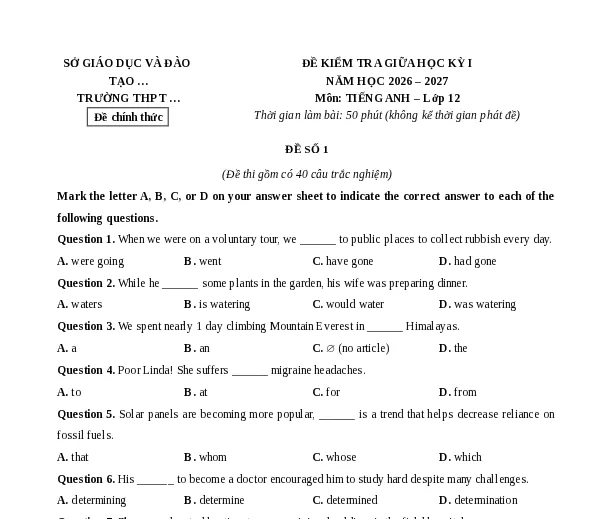
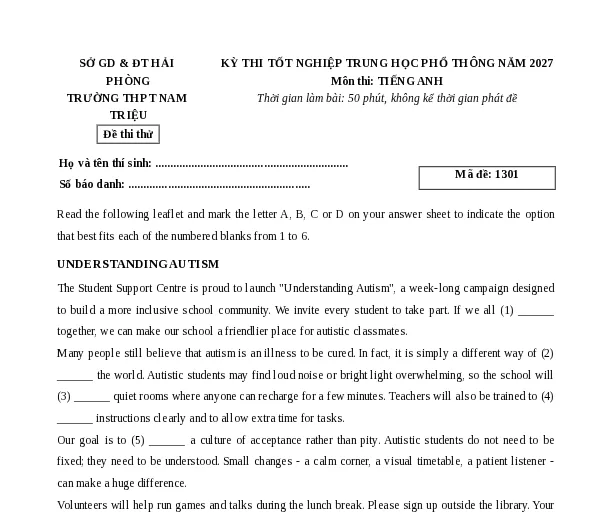
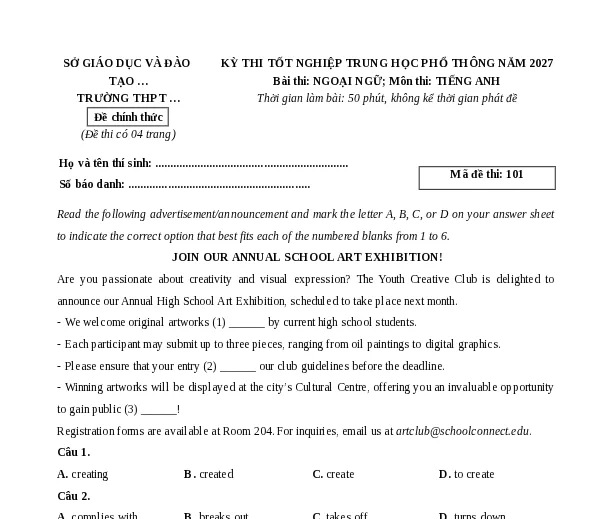
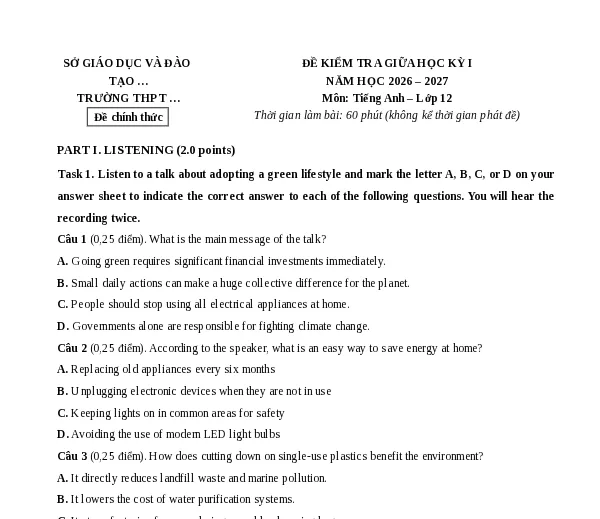
TRƯỜNG THPT …
Đề chính thức
ĐỀ KIỂM TRA GIỮA HỌC KÌ I
NĂM HỌC 2026 – 2027
Môn: Tiếng Anh – Lớp 12
Thời gian làm bài: 50 phút (không kể thời gian phát đề)
PHẦN I. ĐỌC ĐIỀN TỪ (2,0 điểm)
Read the following passage and mark the letter A, B, C, or D on your answer sheet to indicate the option that best fits each of the numbered blanks.
Many people think that a life story worth admiring must belong to someone famous. I disagree. For me, my grandfather, Mr Nguyen Van Hai, is a true (1) ________. He grew up in a poor family in a small village and had to (2) ________ school at the age of fourteen to help his parents. Even then, he never stopped learning. Every evening he borrowed books and taught himself English.
His (3) ________ story has inspired three generations of our family. He often says that a person's (4) ________ is shown not in easy times but in hard ones. Now, at seventy-five, he (5) ________ still learning online with his grandchildren. He believes that people should never (6) ________ up hope. Thanks (7) ________ his example, many young people in the village have gone back to school. His life is living (8) ________ that hard work and patience always pay off.
Câu 1.
A. victim
B. stranger
C. neighbour
D. hero
Câu 2.
A. attend
B. finish
C. quit
D. enjoy
Câu 3.
A. inspire
B. inspired
C. inspiration
D. inspiring
Câu 4.
A. character
B. appearance
C. outfit
D. accent
Câu 5.
A. was
B. has
C. does
D. is
Câu 6.
A. take
B. put
C. give
D. set
Câu 7.
A. for
B. of
C. with
D. to
Câu 8.
A. prove
B. proof
C. proven
D. proving
PHẦN II. SẮP XẾP HỘI THOẠI, ĐOẠN VĂN (2,0 điểm)
Mark the letter A, B, C, or D on your answer sheet to indicate the best arrangement of utterances or sentences to make a meaningful exchange or text in each of the following questions.
Câu 9.
a. Tom: Hi An, it's a pleasure to meet you. Nam has told me a lot of good things about you.
b. Nam: An, have you met Tom? He is an exchange student staying with my family this term.
c. An: Nice to meet you too, Tom! I hope you are enjoying our cultural fair today.
A. b – c – a
B. a – c – b
C. c – b – a
D. b – a – c
Câu 10.
a. Peter: That's great news! I'm thrilled that our project made such a strong impression.
b. Trang: Peter, I'm pleased to tell you that our project on inspiring life stories was voted the best in the grade.
c. Trang: The judges especially praised our creative presentation of the people we admire.
d. Peter: It was a pleasure working with you, and this prize makes all our effort worthwhile.
A. a – b – c – d
B. b – a – c – d
C. b – c – a – d
D. c – b – a – d
Câu 11.
Dear Mai,
a. I would like to introduce you to my cousin Lucas, who is arriving in Hanoi next Monday for a student exchange programme.
b. He is an energetic teenager from France who is deeply interested in Asian history and Vietnamese food.
c. Since this is his first trip abroad, he feels quite anxious about living in a new culture.
d. I immediately thought of you because your warm hospitality and good English will help him feel at home.
e. I would be grateful if you could show him around the Old Quarter and try some local street food.
Warm regards,
Elena
A. a – c – b – d – e
B. b – a – c – d – e
C. a – d – b – c – e
D. a – b – c – d – e
Câu 12.
a. For example, the popularity of Western films and brands may make some local customs less visible.
b. However, many communities use social media to bring their traditions back to life.
c. While this exchange enriches our lives, it also raises concerns about losing local identity.
d. Globalisation has changed cultures around the world by spreading ideas, food and habits across borders.
e. In the end, we need to engage with global trends mindfully to protect cultural diversity.
A. d – a – c – b – e
B. d – c – a – b – e
C. d – c – b – a – e
D. d – a – b – c – e
Câu 13.
a. Hoa: Hi Lan, it's nice to meet you. Minh often mentions you.
b. Minh: Lan, this is my cousin Hoa. She has just come back from Australia.
c. Lan: Nice to meet you too, Hoa. How long have you been back?
d. Hoa: I came back last Saturday, and I'm still looking for a job here.
A. a – b – c – d
B. b – c – a – d
C. b – a – c – d
D. c – b – a – d
Câu 14.
a. Tourist: That sounds interesting. Could you tell me where the food stalls are?
b. Student: Sure. They are behind the main stage, next to the bamboo gate.
c. Tourist: Excuse me, is this the way to the cultural festival?
d. Student: Yes, it is. You are almost there. Today we are celebrating our ethnic minority cultures.
A. c – d – a – b
B. c – a – d – b
C. d – c – a – b
D. a – c – d – b
Câu 15.
a. After the war, he worked as a teacher and helped hundreds of children in his village.
b. His life story has inspired many young people to work hard and stay hopeful.
c. Uncle Ba was born in a poor family and had to leave school when he was twelve.
d. He later joined the army and served his country for ten years.
A. c – a – d – b
B. d – c – a – b
C. c – d – a – b
D. c – d – b – a
Câu 16.
a. Travelling abroad gives us a chance to taste new food and meet people from different cultures.
b. Therefore, being open-minded is the key to enjoying a multicultural world.
c. We may find some habits strange at first, but they soon become interesting.
d. Such experiences teach us to respect differences and to see the world from new angles.
A. a – c – d – b
B. a – d – c – b
C. c – a – d – b
D. a – c – b – d
PHẦN III. ĐỌC ĐIỀN TỪ (2,5 điểm)
Read the following passage and mark the letter A, B, C, or D on your answer sheet to indicate the option that best fits each of the numbered blanks.
The Mid-Autumn Festival
The Mid-Autumn Festival, also known as Tet Trung Thu, is one of the most (17) ________ festivals in Vietnam. It (18) ________ on the 15th day of the eighth lunar month, when the moon is at its fullest and brightest. The festival is celebrated (19) ________ children, who are given lanterns, masks and toys. On this occasion, families (20) ________ together to enjoy moon cakes and fruit.
The moon cake, (21) ________ with sticky rice, beans and lotus seeds, is the symbol of the festival. Many parents (22) ________ their children to make lanterns out of bamboo and coloured paper. At present, some young people (23) ________ modern lanterns online, but traditional ones are still popular. The festival also gives children a chance to (24) ________ part in lion dances and folk games.
The Mid-Autumn Festival is (25) ________ to the preservation of Vietnamese culture, and it reminds us that family love and community spirit are (26) ________ important.
Câu 17.
A. popularity
B. popularly
C. popularise
D. popular
Câu 18.
A. takes off
B. takes up
C. takes place
D. takes part
Câu 19.
A. for
B. with
C. by
D. from
Câu 20.
A. gathering
B. gather
C. gathered
D. gathers
Câu 21.
A. make
B. making
C. made
D. to make
Câu 22.
A. discouragement
B. encouraging
C. discourage
D. encourage
Câu 23.
A. buy
B. bought
C. are buying
D. have bought
Câu 24.
A. make
B. take
C. do
D. get
Câu 25.
A. essential
B. essentially
C. essence
D. essentiality
Câu 26.
A. extreme
B. extremely
C. extremity
D. extremeness
PHẦN IV. ĐỌC HIỂU (3,5 điểm)
Read the following passage and mark the letter A, B, C, or D on your answer sheet to indicate the best answer to each of the following questions.
Marie Curie was born in Warsaw, Poland, in 1867. At that time, women in Poland were not allowed to study at university, so she saved money for years and travelled to Paris to study physics and chemistry at the Sorbonne. She lived in a small, cold room and often had very little to eat, but she never gave up her dream.
In Paris she met Pierre Curie, a scientist who shared her passion for research. Together they studied radioactivity, a word that Marie herself invented. In 1898 they discovered two new elements, polonium and radium. Four years later, the couple received the Nobel Prize in Physics for their work.
After Pierre died in a car accident in 1906, Marie continued their research alone. She became the first woman professor at the Sorbonne and, in 1911, she won a second Nobel Prize, this time in Chemistry. She remains the only person to have won Nobel Prizes in two different sciences.
During the First World War, she used her knowledge to help wounded soldiers, driving mobile X-ray units to the front. She worked so hard that her health was seriously damaged. Marie Curie died in 1934.
Her life story is inspiring because it shows that hard work, curiosity and determination can overcome social barriers. She once said, "Nothing in life is to be feared, it is only to be understood."
Câu 27. Which of the following best serves as the title of the passage?
A. The Sorbonne and Its Famous Students
B. Marie Curie: A Life of Discovery and Determination
C. How to Win a Nobel Prize
D. Women in Polish Universities
Câu 28. The word "passion" in paragraph 2 is closest in meaning to ________.
A. strong love
B. deep fear
C. slight doubt
D. sudden anger
Câu 29. The word "they" in paragraph 2 refers to ________.
A. two new elements
B. physics and chemistry
C. radioactivity
D. Pierre and Marie Curie
Câu 30. Which of the following best paraphrases the underlined sentence in the passage?
A. We should avoid everything that frightens us.
B. Fear is more useful than knowledge in science.
C. Understanding things helps us deal with them instead of being afraid.
D. Life is full of things that can never be understood.
Câu 31. According to the passage, which of the following is NOT mentioned?
A. Marie Curie's study at the Sorbonne.
B. Her work with mobile X-ray units during the war.
C. Her marriage to a scientist named Pierre Curie.
D. Her return to Warsaw to become a professor.
Câu 32. Which of the following is NOT true according to the passage?
A. Marie Curie was the first woman professor at the Sorbonne.
B. She discovered polonium and radium with her husband.
C. Her health was damaged by her hard work.
D. She won two Nobel Prizes in the same field.
Câu 33. In which paragraph does the writer mention the difficulties Marie Curie faced as a student?
A. Paragraph 1
B. Paragraph 2
C. Paragraph 3
D. Paragraph 4
Câu 34. In which paragraph does the writer describe how she helped soldiers during the First World War?
A. Paragraph 1
B. Paragraph 4
C. Paragraph 2
D. Paragraph 3
Câu 35. The word "inspiring" in the last paragraph is OPPOSITE in meaning to ________.
A. encouraging
B. motivating
C. depressing
D. uplifting
Câu 36. Why does the writer mention the word "radioactivity"?
A. To show that Marie Curie invented a scientific term.
B. To explain why she moved to Paris.
C. To describe the Nobel Prize ceremony.
D. To prove that her husband was more famous.
Câu 37. What can be inferred about Marie Curie from paragraph 3?
A. She gave up research after her husband died.
B. She was never recognised by the Sorbonne.
C. She achieved success in more than one scientific field.
D. She preferred teaching to doing research.
Câu 38. The word "barriers" in the last paragraph is closest in meaning to ________.
A. obstacles
B. chances
C. prizes
D. choices
Câu 39. Which of the following is TRUE according to the passage?
A. Marie Curie was born in Paris.
B. She won the Nobel Prize in Chemistry in 1911.
C. Her husband won three Nobel Prizes.
D. She stopped working during the First World War.
Câu 40. What is the main purpose of the passage?
A. To persuade readers to study physics.
B. To inform readers about the life of an admired scientist.
C. To criticise the Sorbonne's rules.
D. To compare two Nobel Prize winners.
--------- HẾT ---------
Thí sinh không được sử dụng tài liệu. Cán bộ coi thi không giải thích gì thêm.
Họ và tên thí sinh: ................................................ Số báo danh: ........................
TRƯỜNG THPT …
Hướng dẫn chấm
ĐỀ KIỂM TRA GIỮA HỌC KÌ I
NĂM HỌC 2026 – 2027
Môn: Tiếng Anh – Lớp 12
HƯỚNG DẪN CHẤM VÀ THANG ĐIỂM
A. HƯỚNG DẪN CHUNG
- Tổng điểm toàn bài: 10,0 điểm; mỗi câu trắc nghiệm đúng được 0,25 điểm.
- Chấm theo đáp án dưới đây; không trừ điểm trình bày đối với bài làm trên phiếu trắc nghiệm.
- Học sinh làm theo cách khác, nếu đúng vẫn cho điểm tối đa.
B. ĐÁP ÁN VÀ THANG ĐIỂM
Câu | 1 | 2 | 3 | 4 | 5 | 6 | 7 | 8 | 9 | 10 |
|---|---|---|---|---|---|---|---|---|---|---|
Đáp án | D | C | D | A | D | C | D | B | D | B |
Câu | 11 | 12 | 13 | 14 | 15 | 16 | 17 | 18 | 19 | 20 |
|---|---|---|---|---|---|---|---|---|---|---|
Đáp án | D | B | C | A | C | A | D | C | A | B |
Câu | 21 | 22 | 23 | 24 | 25 | 26 | 27 | 28 | 29 | 30 |
|---|---|---|---|---|---|---|---|---|---|---|
Đáp án | C | D | C | B | A | B | B | A | D | C |
Câu | 31 | 32 | 33 | 34 | 35 | 36 | 37 | 38 | 39 | 40 |
|---|---|---|---|---|---|---|---|---|---|---|
Đáp án | D | D | A | B | C | A | C | A | B | B |
Mỗi câu trả lời đúng được 0,25 điểm.
C. LỜI GIẢI CHI TIẾT
Câu | Đáp án | Giải thích |
|---|---|---|
1 | D | "a true hero" (một tấm gương anh hùng thật sự) – danh từ chỉ người đáng khâm phục, hợp nghĩa với "a life story worth admiring". |
2 | C | "quit school" = bỏ học. "attend school" (đi học), "finish school" (học xong), "enjoy school" không hợp với ngữ cảnh nghèo khó. |
3 | D | Trước danh từ "story" cần tính từ: "His inspiring story" (câu chuyện truyền cảm hứng của ông). |
4 | A | "a person's character" = phẩm chất, tính cách con người; các phương án còn lại chỉ ngoại hình. |
5 | D | "Now, at seventy-five, he is still learning" – thì hiện tại tiếp diễn với "now" diễn tả hành động đang diễn ra. |
6 | C | Cụm cố định "give up hope" = từ bỏ hy vọng. |
7 | D | Cụm "Thanks to + N" = nhờ vào, nhờ có. |
8 | B | Sau "living" cần danh từ: "living proof" = bằng chứng sống. |
9 | D | Nam giới thiệu Tom (b) → Tom chào An (a) → An đáp lại (c). |
10 | B | Trang báo tin (b) → Peter vui mừng (a) → Trang nói thêm về giám khảo (c) → Peter kết lại (d). |
11 | D | Giới thiệu Lucas (a) → miêu tả cậu ấy (b) → lý do lo lắng (c) → nhờ Mai giúp (d) → lời đề nghị cụ thể (e). |
12 | B | Câu chủ đề về toàn cầu hoá (d) → mặt tích cực và lo ngại (c) → ví dụ (a) → phản biện, gìn giữ bản sắc (b) → kết luận (e). |
13 | C | Minh giới thiệu Hoa (b) → Hoa chào Lan (a) → Lan đáp lại và hỏi (c) → Hoa trả lời (d). |
14 | A | Khách hỏi đường (c) → sinh viên xác nhận và giới thiệu lễ hội (d) → khách hỏi quầy ăn (a) → sinh viên chỉ đường (b). |
15 | C | Bối cảnh tuổi thơ (c) → nhập ngũ (d) → làm giáo viên sau chiến tranh (a) → ảnh hưởng, kết luận (b). |
16 | A | Trải nghiệm du lịch (a) → cảm nhận ban đầu (c) → bài học tôn trọng khác biệt (d) → kết luận (b). |
17 | D | Trước danh từ "festivals" cần tính từ: "the most popular festivals". |
18 | C | "take place" = diễn ra (dùng cho sự kiện, lễ hội). |
19 | A | "be celebrated for + N" = được tổ chức dành cho, vì lợi ích của ai. |
20 | B | Chủ ngữ số nhiều "families" + thì hiện tại đơn chỉ thói quen hằng năm: "families gather together". |
21 | C | Rút gọn mệnh đề quan hệ bị động: "the moon cake, (which is) made with sticky rice…" → made. |
22 | D | Cần động từ làm vị ngữ: "Many parents encourage their children to make lanterns". |
23 | C | "At present" là dấu hiệu thì hiện tại tiếp diễn: "are buying". |
24 | B | Cụm "take part in" = tham gia. |
25 | A | Sau "is" cần tính từ: "is essential to the preservation". |
26 | B | Trạng từ bổ nghĩa cho tính từ "important": "extremely important". |
27 | B | Nhan đề bao quát cả bài: cuộc đời Marie Curie với những phát minh và nghị lực. |
28 | A | "passion" = niềm đam mê, gần nghĩa nhất với "strong love". |
29 | D | "Together they studied radioactivity" – "they" thay cho Marie và Pierre Curie. |
30 | C | Câu nói khuyên hiểu biết giúp ta đối diện nỗi sợ thay vì sợ hãi. |
31 | D | Bài không nói bà trở về Warsaw làm giáo sư; bà làm giáo sư tại Sorbonne (Paris). |
32 | D | Bà nhận hai giải Nobel ở hai lĩnh vực khác nhau (Vật lí 1903, Hoá học 1911), không phải cùng một lĩnh vực. |
33 | A | Đoạn 1 nói về khó khăn khi học: phòng lạnh, ít thức ăn, phải tự tiết kiệm tiền. |
34 | B | Đoạn 4 kể việc bà lái xe X-quang lưu động ra mặt trận giúp thương binh. |
35 | C | "inspiring" (truyền cảm hứng) trái nghĩa với "depressing" (làm nản lòng). |
36 | A | Tác giả nêu "radioactivity" để cho thấy chính Marie đặt ra thuật ngữ khoa học này. |
37 | C | Việc bà nhận Nobel Vật lí rồi Nobel Hoá học cho thấy thành công ở hơn một lĩnh vực. |
38 | A | "barriers" = rào cản, gần nghĩa với "obstacles". |
39 | B | "in 1911, she won a second Nobel Prize, this time in Chemistry". |
40 | B | Mục đích chính là cung cấp thông tin về cuộc đời một nhà khoa học đáng khâm phục. |
Chỉ cho điểm tối đa khi học sinh chọn đúng phương án theo đáp án trên; với câu hỏi suy luận (Câu 37, 40), phương án đúng phải phù hợp với nội dung toàn bài.