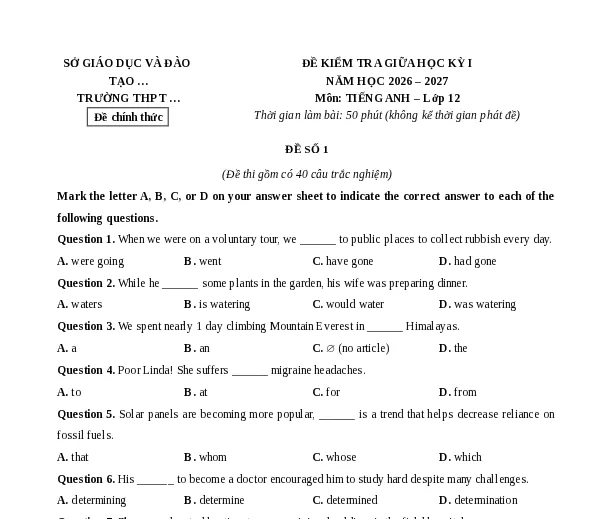
SỞ GIÁO DỤC VÀ ĐÀO TẠO …
TRƯỜNG THPT …
Đề chính thức
ĐỀ KIỂM TRA GIỮA HỌC KỲ I
NĂM HỌC 2026 – 2027
Môn: Tiếng Anh – Lớp 12
Thời gian làm bài: 60 phút (không kể thời gian phát đề)
PART I. LISTENING (2.0 points)
Task 1. Listen to a talk about adopting a green lifestyle and mark the letter A, B, C, or D on your answer sheet to indicate the correct answer to each of the following questions. You will hear the recording twice.
Câu 1 (0,25 điểm). What is the main message of the talk?
A. Going green requires significant financial investments immediately.
B. Small daily actions can make a huge collective difference for the planet.
C. People should stop using all electrical appliances at home.
D. Governments alone are responsible for fighting climate change.
Câu 2 (0,25 điểm). According to the speaker, what is an easy way to save energy at home?
A. Replacing old appliances every six months
B. Unplugging electronic devices when they are not in use
C. Keeping lights on in common areas for safety
D. Avoiding the use of modern LED light bulbs
Câu 3 (0,25 điểm). How does cutting down on single-use plastics benefit the environment?
A. It directly reduces landfill waste and marine pollution.
B. It lowers the cost of water purification systems.
C. It stops factories from producing reusable shopping bags.
D. It helps households consume more fresh packaged foods.
Câu 4 (0,25 điểm). What does the speaker recommend doing with organic food waste?
A. Burning it in backyards to generate heat
B. Disposing of it directly into local rivers
C. Turning it into rich compost for gardening
D. Sending it to landfills in sealed plastic bags
Task 2. Listen to an interview with a high school student about a cultural exchange festival. Decide whether each of the following statements is True (T) or False (F). You will hear the recording twice.
Câu 5 (0,25 điểm). The International Youth Culture Festival took place over an entire week.
Câu 6 (0,25 điểm). Lan and her classmates set up a stall showcasing traditional Vietnamese conical hats and food.
Câu 7 (0,25 điểm). Lan found it difficult to communicate with international participants because of language barriers.
Câu 8 (0,25 điểm). Lan believes that learning about other customs helps young people overcome cultural stereotypes.
PART II. LANGUAGE (3.0 points)
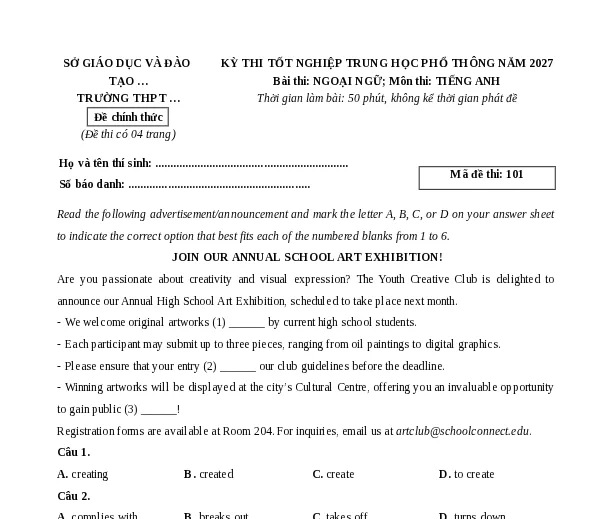
Read the following announcement and mark the letter A, B, C, or D on your answer sheet to indicate the correct option that best fits each of the numbered blanks from 9 to 14.
GREEN YOUTH CLUB: JOIN OUR "ZERO-WASTE CAMPUS" CAMPAIGN!
Are you concerned about the growing amount of plastic waste around our school? Join the Green Youth Club this Friday to make a real difference!
- Our Mission: We aim to raise awareness and help students adopt eco-friendly habits. While many volunteers (9) ______ litter around the schoolyard yesterday, others were setting up specialized recycling bins.
- Key Action: Please remember to carry (10) ______ reusable water bottle instead of purchasing single-use bottles every day. We also encourage everyone (11) ______ part in our weekend tree-planting events.
- Exclusive Workshop: Come to our interactive workshop to learn practical skills from our (12) ______ coordinators. We will provide all members with (13) ______ eco-friendly tote bags made from natural cotton.
- Get Involved: Don't hesitate! Sign (14) ______ our green club today at the Youth Union Hall or via our official school forum.
Together, let's turn our school into a cleaner, greener community!
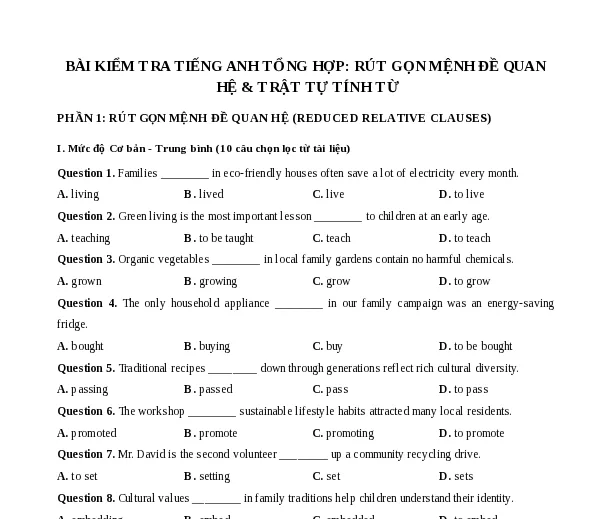
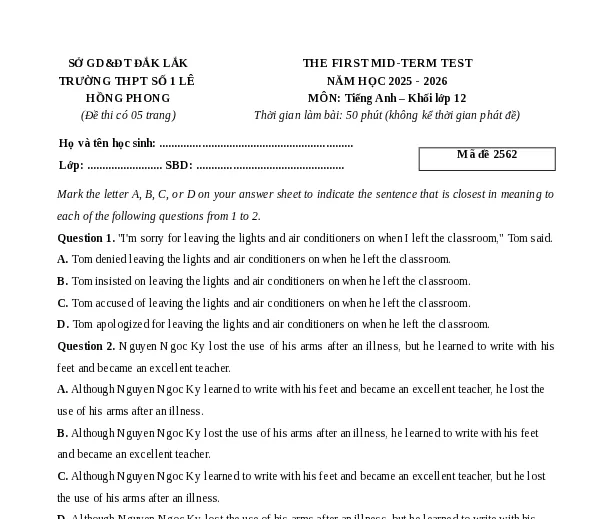
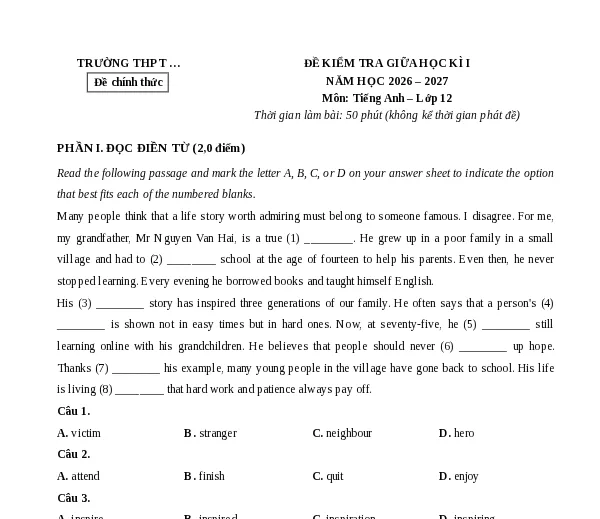
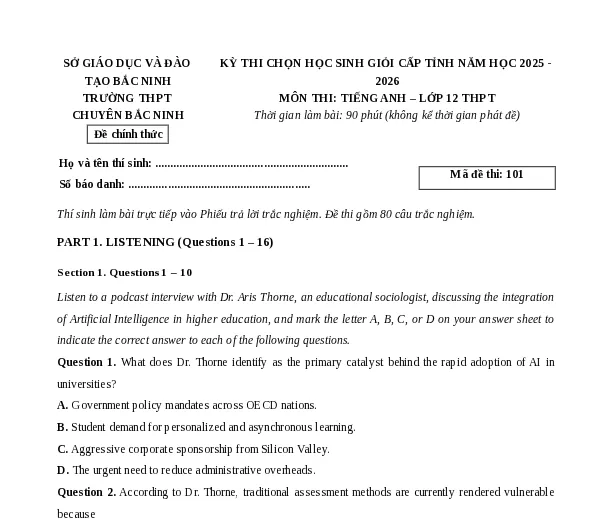
Câu 9 (0,25 điểm).
A. were collecting
B. are collecting
C. collected
D. collect
Câu 10 (0,25 điểm).
A. an
B. a
C. the
D. 0 (no article)
Câu 11 (0,25 điểm).
A. take
B. taking
C. to take
D. took
Câu 12 (0,25 điểm).
A. inspiringly
B. inspire
C. inspiration
D. inspiring
Câu 13 (0,25 điểm).
A. lovely small canvas
B. canvas lovely small
C. small lovely canvas
D. canvas small lovely
Câu 14 (0,25 điểm).
A. off
B. out
C. up for
D. away with
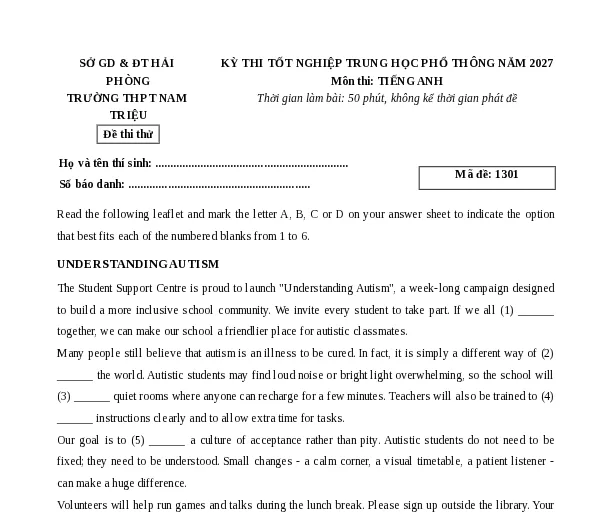
Read the following leaflet and mark the letter A, B, C, or D on your answer sheet to indicate the correct option that best fits each of the numbered blanks from 15 to 20.
YOUTH FOR CULTURAL HARMONY: EMBRACING OUR DIVERSITY
Living in an increasingly connected world, young people have unique opportunities to explore different customs and traditions.
- Global Connections: In our modern society, (15) ______ students are choosing to study abroad or join international student networks to broaden their horizons.
- Overcoming Prejudices: Learning about foreign etiquette helps us avoid cultural misunderstandings. (16) ______, when people respect unfamiliar rituals, they build bridges of lasting friendship.
- Inspiring Figures: We can learn a lot from visionary ambassadors (17) ______ dedicated their whole lives to promoting world peace and mutual tolerance.
- Healthy Lifestyle Choices: Immersing yourself in diverse cultures allows you to (18) ______ healthy culinary habits and savor nutritious dishes from different continents.
- Taking Responsibility: Each student should (19) ______ an effort to stamp out discrimination and celebrate diversity both in the classroom and online.
- Long-term Impact: Preserving heritage while welcoming positive cultural influences will surely (20) ______ the way for sustainable community development.
Câu 15 (0,25 điểm).
A. much
B. many
C. every
D. little
Câu 16 (0,25 điểm).
A. However
B. Furthermore
C. Although
D. In spite of
Câu 17 (0,25 điểm).
A. which
B. whom
C. whose
D. who
Câu 18 (0,25 điểm).
A. adopt
B. invent
C. decline
D. discard
Câu 19 (0,25 điểm).
A. take
B. make
C. do
D. give
Câu 20 (0,25 điểm).
A. pave
B. clear
C. show
D. guide
PART III. READING (3.0 points)
Task 1. Read the following passage and mark the letter A, B, C, or D on your answer sheet to indicate the option that best fits each of the numbered blanks from 21 to 25.
In recent years, the movement toward green architecture has gained widespread popularity as cities struggle with rapid urbanization and climate change. Green buildings are intentionally designed to reduce the overall impact of the built environment on human health and nature. Architects achieve this objective by using energy, water, and other natural resources efficiently, (21) ______.
One of the most remarkable features of eco-friendly construction is the integration of rooftop gardens and living green walls. These natural elements not only absorb carbon dioxide and release oxygen, (22) ______. As a consequence, urban households can significantly cut down on their monthly electricity bills while enjoying cleaner air.
Furthermore, modern green buildings utilize advanced solar panel systems (23) ______. By generating their own renewable electricity on-site, these facilities decrease reliance on traditional power grids that burn fossil fuels. Another crucial aspect is water recycling, (24) ______. Rainwater harvesting systems collect and filter storm water for landscape irrigation and toilet flushing.
In addition to environmental benefits, eco-friendly structures enhance occupant well-being. Studies have shown that workers in spaces with natural daylight and proper ventilation exhibit higher productivity and less stress. (25) ______, green architecture will inevitably become the global standard for modern living.
Câu 21 (0,25 điểm).
A. while protecting the environment and reducing waste and pollution
B. but they fail to conserve finite natural resources in urban areas
C. which causes severe damage to local ecological systems
D. so that fossil fuels become the primary source of clean energy
Câu 22 (0,25 điểm).
A. or they increase the heat trapped inside concrete structures
B. but they also help insulate buildings from extreme outside temperatures
C. so building operators must install more high-capacity air conditioners
D. and they prevent sunlight from entering residential apartments
Câu 23 (0,25 điểm).
A. which were demolished due to high maintenance costs
B. whose harmful emissions pollute the surrounding residential neighborhoods
C. that capture sunlight and convert it directly into clean energy
D. although builders refuse to integrate them into modern designs
Câu 24 (0,25 điểm).
A. which allows residential properties to conserve millions of liters of clean water annually
B. preventing residents from accessing safe drinking water inside their homes
C. that increases the total quantity of wastewater discharged into municipal rivers
D. where people consume massive amounts of unpurified surface water
Câu 25 (0,25 điểm).
A. Because green buildings cost too much to maintain in the long term
B. As more governments and communities recognize these comprehensive advantages
C. Although urban dwellers show little interest in sustainable living habits
D. Unless developers abandon traditional energy-saving construction technologies
Task 2. Read the following passage and mark the letter A, B, C, or D on your answer sheet to indicate the correct answer to each of the questions from 26 to 32.
Cultural heritage plays a profound role in defining the identity and historical continuity of human societies. From ancient architectural monuments and archaeological sites to oral traditions, performing arts, and traditional rituals, heritage reflects the creative genius and lived experiences of our ancestors. In an era marked by rapid globalization and technological advancement, preserving these cultural treasures has become both more urgent and challenging than ever before.
One major reason for safeguarding cultural heritage is its capacity to foster mutual understanding and respect among diverse communities. When people are exposed to traditions distinct from their own, they are more likely to appreciate the richness of human diversity and overcome deep-seated prejudices. In multicultural nations, celebrating various cultural festivals serves as a vibrant reminder that unique traditions can harmoniously coexist, thereby strengthening social cohesion and national unity.
Moreover, heritage preservation provides considerable economic benefits, particularly through the development of cultural tourism. Historic towns, traditional craft villages, and sacred temples often attract millions of international and domestic visitors each year. The revenue generated from tourism can be reinvested into local infrastructure, health care, and conservation projects, while also creating employment opportunities for local residents. For instance, in towns such as Hoi An in Viet Nam, the careful restoration of wooden shophouses has transformed the municipality into a prosperous destination without compromising its historic charm.
Nevertheless, cultural heritage across the world is confronting grave threats. Urban sprawl, unchecked industrialization, and environmental pollution have severely degraded numerous delicate monuments. Furthermore, the commercialization of intangible heritage—where authentic sacred rituals are turned into superficial spectacles purely for tourist amusement—risks diluting their intrinsic cultural meaning. To counteract these hazards, governments, non-governmental organizations, and local communities must collaborate to enact strict conservation regulations and implement educational campaigns that encourage young generations to take pride in their ancestors' legacy.
Câu 26 (0,25 điểm). What is the main idea of the passage?
A. Cultural heritage preservation offers social and economic benefits despite facing modern threats.
B. Tourism is the sole factor responsible for the erosion of sacred traditional rituals worldwide.
C. Governments should prohibit international tourists from visiting ancient monuments.
D. Globalization has eliminated all traditional cultural identities in multicultural nations.
Câu 27 (0,25 điểm). The word "prejudices" in paragraph 2 is closest in meaning to ______.
A. customs
B. biases
C. achievements
D. admirations
Câu 28 (0,25 điểm). The word "its" in paragraph 3 refers to ______.
A. cultural tourism
B. local infrastructure
C. revenue
D. Hoi An
Câu 29 (0,25 điểm). According to paragraph 3, how does cultural tourism contribute to local communities?
A. It replaces all traditional craft workshops with modern industrial factories.
B. It generates funding that can be used to improve local infrastructure and public welfare.
C. It forces residents to abandon their ancestral customs to cater to foreign visitors.
D. It reduces national tax revenues collected from residential heritage sites.
Câu 30 (0,25 điểm). Which of the following is NOT mentioned in paragraph 4 as a threat to cultural heritage?
A. Excessive commercialization of sacred rituals
B. Urban expansion and uncontrolled industrialization
C. Natural disasters such as volcanic eruptions and earthquakes
D. Environmental degradation and pollution
Câu 31 (0,25 điểm). Which of the following best paraphrases the underlined sentence in paragraph 4?
“To counteract these hazards, governments, non-governmental organizations, and local communities must collaborate to enact strict conservation regulations...”
A. Enacting strict conservation policies requires joint efforts from authorities, organizations, and citizens to mitigate these dangers.
B. Only non-governmental organizations possess the authority to enforce conservation rules against environmental destruction.
C. Governments should allow local communities to manage ancient sites without imposing any legal regulations.
D. These dangers can be avoided entirely if people stop establishing non-governmental conservation organizations.
Câu 32 (0,25 điểm). Which of the following can be inferred from the passage?
A. Modern technologies have made traditional cultural preservation completely effortless.
B. Young people are naturally incapable of appreciating ancient architecture and rituals.
C. Sustainable heritage preservation requires balancing authentic conservation with economic development.
D. Communities must completely isolate their heritage sites from all tourism activities to keep them intact.
PART IV. WRITING (2.0 points)
Task 1. Mark the letter A, B, C, or D on your answer sheet to indicate the correct arrangement of sentences to make a meaningful exchange or text in each of the following questions from 33 to 36.
Câu 33 (0,25 điểm).
a. Nam: That's a practical tip! I will start bringing my own canvas bag when grocery shopping.
b. Nam: Hi Linh, I want to cut down on plastic waste at home. Do you have any suggestions?
c. Linh: You can replace single-use plastic bags with reusable cloth bags and say no to plastic straws.
A. b – c – a
B. c – a – b
C. a – c – b
D. b – a – c
Câu 34 (0,25 điểm).
a. David: Yes, I noticed that too! There were culinary stalls representing more than a dozen countries.
b. David: Have you visited the Global Culture Fair at our university campus yet?
c. Mai: That sounds wonderful. Experiencing diverse cuisines and traditional dances truly helps us appreciate different cultures.
d. Mai: I went there yesterday morning, and I was genuinely amazed by the colorful traditional costumes!
e. David: Exactly, and engaging with international students gives us a much broader perspective on the world.
A. b – d – a – c – e
B. b – a – d – e – c
C. d – b – a – c – e
D. b – c – a – d – e
Câu 35 (0,25 điểm).
Dear Peter,
a. I am writing to invite you to our upcoming Eco-Action Workshop next Saturday morning.
b. I hope this email finds you well and energized for the new school term!
c. During the session, we will demonstrate how to build domestic composting bins and repurpose old clothes.
d. Please let me know by Thursday if you can come so that I can prepare the materials for you.
e. It will be held in our community center from 8:30 a.m. to 11:30 a.m.
Warm regards,
Minh
A. b – a – e – c – d
B. a – c – e – b – d
C. b – e – a – c – d
D. a – b – c – e – d
Câu 36 (0,25 điểm).
a. First of all, switching off unnecessary electrical appliances directly cuts down on electricity consumption and saves money.
b. In conclusion, adopting modest changes in our daily routine enables us to protect the planet effectively.
c. There are several straightforward steps that every household can take to lead a greener life.
d. Finally, sorting household rubbish into recyclable and organic components reduces the volume of waste sent to landfills.
e. Secondly, choosing public transport or cycling instead of driving private motorbikes helps curb harmful exhaust emissions.
A. c – a – e – d – b
B. c – e – a – d – b
C. a – e – d – c – b
D. c – a – d – e – b
Task 2. Paragraph Writing (1.0 point)
Câu 37 (1,0 điểm).
Write a problem-solving paragraph (150 – 180 words) proposing practical solutions to reduce food waste in households or school canteens.
You may use the following prompts:
- Raising awareness of meal planning and smart grocery shopping;
- Storing food properly and utilizing leftovers creatively;
- Composting organic food scraps instead of sending them to landfills.
--------- HẾT ---------
Họ và tên thí sinh: ................................................................ Số báo danh: ........................
SỞ GIÁO DỤC VÀ ĐÀO TẠO …
TRƯỜNG THPT …
Hướng dẫn chấm chính thức
HƯỚNG DẪN CHẤM VÀ ĐÁP ÁN
ĐỀ KIỂM TRA GIỮA HỌC KỲ I
Môn: Tiếng Anh – Lớp 12
HƯỚNG DẪN CHẤM VÀ THANG ĐIỂM
A. HƯỚNG DẪN CHUNG
- Cán bộ chấm thi chấm đúng theo đáp án và thang điểm hướng dẫn.
- Phần trắc nghiệm khách quan chấm theo thang điểm quy định: 36 câu trắc nghiệm khách quan (từ Câu 1 đến Câu 36), mỗi câu đúng được 0,25 điểm (tổng 9,0 điểm).
- Phần viết đoạn văn (Câu 37) chấm theo 4 tiêu chí chuẩn (tổng 1,0 điểm). Chấp nhận các ý tưởng diễn đạt sáng tạo, hợp lý và chính xác về mặt ngữ pháp.
B. AUDIO SCRIPTS (NỘI DUNG BÀI NGHE)
Task 1 (Questions 1 – 4)
Audio Script:
> "Welcome to today's talk on adopting a green lifestyle. Many people believe that going green requires drastic changes or huge financial investments, but that simply isn't true. In reality, living sustainably is all about making mindful choices in our everyday routines, and these small actions can collectively make a tremendous difference for our planet.
>
> First, let's look at household energy consumption. A simple habit like unplugging phone chargers, computers, and kitchen appliances when you aren't using them helps eliminate standby power waste and noticeably lowers your electricity bill. Second, we must address single-use plastics. By replacing disposable shopping bags and plastic bottles with reusable alternatives, we directly prevent tons of non-biodegradable waste from ending up in our landfills and polluting marine ecosystems.
>
> Finally, food waste is another critical issue. Instead of discarding vegetable peelings and leftovers into trash bins, consider turning organic waste into rich compost for your home garden. This simple practice enriches the soil naturally without toxic chemical fertilizers. Remember, building a sustainable future does not happen overnight; it begins with the small, consistent choices we make each day."
Task 2 (Questions 5 – 8)
Audio Script:
> Interviewer: "Welcome back, listeners! Today in the studio, we have Lan, a twelfth grader who recently participated in the International Youth Culture Festival held in our city. Hi Lan, could you tell us about your experience?"
>
> Lan: "Hi everyone! The festival was an incredible three-day event bringing together high school students from over ten different countries. My class was responsible for setting up a cultural booth representing Viet Nam. We decorated our stall with traditional conical hats, paper lanterns, and served iconic dishes like spring rolls and lotus tea. Hundreds of visitors dropped by to taste our food and try wearing traditional Áo Dài."
>
> Interviewer: "That sounds exciting! Did you find it challenging to interact with students from such varied cultural backgrounds?"
>
> Lan: "Not at all! Although we came from different parts of the world, everyone was extremely friendly and eager to exchange ideas. English was our common language, so communication was surprisingly smooth. We even participated in interactive workshops discussing traditional music and folk games."
>
> Interviewer: "What was the most valuable lesson you took away from the festival?"
>
> Lan: "I truly realized that embracing diversity doesn't mean losing one's identity. When we take the time to learn about other customs and perspectives, it breaks down negative stereotypes and fosters genuine mutual respect among young people."
C. ĐÁP ÁN VÀ THANG ĐIỂM CHI TIẾT
1. Đáp án trắc nghiệm khách quan (Từ Câu 1 đến Câu 36: 36 × 0,25 = 9,0 điểm)
Câu | 1 | 2 | 3 | 4 | 5 | 6 | 7 | 8 | 9 | 10 |
|---|---|---|---|---|---|---|---|---|---|---|
Đáp án | B | B | A | C | F | T | F | T | A | B |
Câu | 11 | 12 | 13 | 14 | 15 | 16 | 17 | 18 | 19 | 20 |
|---|---|---|---|---|---|---|---|---|---|---|
Đáp án | C | D | A | C | B | B | D | A | B | A |
Câu | 21 | 22 | 23 | 24 | 25 | 26 | 27 | 28 | 29 | 30 |
|---|---|---|---|---|---|---|---|---|---|---|
Đáp án | A | B | C | A | B | A | B | D | B | C |
Câu | 31 | 32 | 33 | 34 | 35 | 36 |
|---|---|---|---|---|---|---|
Đáp án | A | C | A | A | A | A |
Mỗi câu trả lời đúng được 0,25 điểm.
2. Giải thích chi tiết các câu trắc nghiệm
- Câu 1: B. Bài nói nhấn mạnh "living sustainably is all about making mindful choices in our everyday routines, and these small actions can collectively make a tremendous difference".
- Câu 2: B. Chi tiết: "unplugging phone chargers, computers, and kitchen appliances when you aren't using them helps eliminate standby power waste".
- Câu 3: A. Chi tiết: "we directly prevent tons of non-biodegradable waste from ending up in our landfills and polluting marine ecosystems".
- Câu 4: C. Chi tiết: "consider turning organic waste into rich compost for your home garden".
- Câu 5: F (False). Bài nghe nói sự kiện kéo dài trong 3 ngày ("an incredible three-day event"), không phải 1 tuần ("entire week").
- Câu 6: T (True). Chi tiết: "decorated our stall with traditional conical hats... and served iconic dishes".
- Câu 7: F (False). Lan khẳng định giao tiếp rất thuận lợi: "Not at all! ... communication was surprisingly smooth".
- Câu 8: T (True). Chi tiết: "breaks down negative stereotypes and fosters genuine mutual respect".
- Câu 9: A. Thì quá khứ tiếp diễn kết hợp với while: hành động đang diễn ra trong quá khứ ("were collecting litter") song song với "others were setting up...".
- Câu 10: B. Danh từ đếm được số ít bắt đầu bằng phụ âm ("reusable water bottle"), nhắc đến lần đầu mang nghĩa "một" dùng mạo từ "a".
- Câu 11: C. Cấu trúc: encourage someone to do something (khuyến khích ai làm gì) "to take".
- Câu 12: D. Cần tính từ đứng trước danh từ "coordinators" để bổ nghĩa mang nghĩa chủ động gây cảm hứng "inspiring".
- Câu 13: A. Trật tự tính từ OSASCOMP: Opinion (lovely) + Size (small) + Material (canvas) "lovely small canvas".
- Câu 14: C. Cụm động từ: sign up for (đăng ký tham gia một câu lạc bộ/hoạt động).
- Câu 15: B. "students" là danh từ đếm được số nhiều dùng lượng từ "many".
- Câu 16: B. Liên từ mang tính bổ sung thông tin ("Hơn nữa / Thêm vào đó") "Furthermore".
- Câu 17: D. Đại từ quan hệ thay thế cho danh từ chỉ người ("visionary ambassadors") làm chủ ngữ trong mệnh đề quan hệ "who".
- Câu 18: A. Kết hợp từ (Collocation): adopt healthy habits (tiếp nhận/hình thành thói quen lành mạnh).
- Câu 19: B. Kết hợp từ (Collocation): make an effort to do something (nỗ lực làm gì).
- Câu 20: A. Thành ngữ / Cụm từ cố định: pave the way for something (mở đường cho cái gì phát triển).
- Câu 21: A. Mệnh đề phân từ chỉ phương thức, bổ nghĩa tiếp nối sự hòa hợp về nghĩa "while protecting the environment and reducing waste and pollution".
- Câu 22: B. Cấu trúc tương liên: not only... but they also help insulate buildings...
- Câu 23: C. Mệnh đề quan hệ xác định bổ nghĩa cho "solar panel systems": "that capture sunlight and convert it directly into clean energy".
- Câu 24: A. Mệnh đề quan hệ không xác định bổ nghĩa cho việc tái chế nước "which allows residential properties to conserve millions of liters of clean water annually".
- Câu 25: B. Mệnh đề trạng ngữ chỉ nguyên nhân/thời gian phù hợp với kết quả "green architecture will inevitably become the global standard...": "As more governments and communities recognize these comprehensive advantages".
- Câu 26: A. Toàn bộ bài đọc bàn về các giá trị xã hội, kinh tế của di sản văn hóa cùng các nguy cơ trong thời hiện đại và biện pháp bảo vệ.
- Câu 27: B. prejudices (định kiến, thành kiến) đồng nghĩa với biases.
- Câu 28: D. Từ quy chiếu "its historic charm" trong câu cuối đoạn 3 quy chiếu về thị trấn "Hoi An".
- Câu 29: B. Dẫn chứng đoạn 3: "The revenue generated from tourism can be reinvested into local infrastructure, health care, and conservation projects...".
- Câu 30: C. Thiên tai như núi lửa, động đất không được đề cập trong đoạn 4.
- Câu 31: A. Diễn giải câu: Để đẩy lùi nguy cơ này, chính phủ, tổ chức phi chính phủ và người dân phải phối hợp ban hành quy định bảo tồn nghiêm ngặt Trùng khớp với A.
- Câu 32: C. Suy luận logic: Di sản vừa mang lại lợi ích kinh tế (du lịch) vừa đối mặt với thương mại hóa quá mức, do đó cần cân bằng giữa bảo tồn nguyên bản và phát triển kinh tế.
- Câu 33: A. Trật tự logic hội thoại ngắn: Hỏi lời khuyên (b) Đưa ra giải pháp (c) Phản hồi đồng tình và hứa thực hiện (a).
- Câu 34: A. Trật tự hội thoại 5 lượt: b (mở đầu hỏi sự kiện) d (trả lời đã đi và nêu ấn tượng) a (đồng tình và bổ sung chi tiết gian hàng ẩm thực) c (khái quát ý nghĩa ẩm thực và điệu múa) e (chốt lại bài học về góc nhìn rộng mở).
- Câu 35: A. Cấu trúc thư điện tử: b (lời chào thăm hỏi) a (nêu mục đích mời tham gia workshop) e (nêu thời gian, địa điểm) c (nội dung cụ thể) d (đề nghị phản hồi xác nhận).
- Câu 36: A. Trật tự đoạn văn hoàn chỉnh: c (câu chủ đề giới thiệu các bước sống xanh) a (First of all: tiết kiệm điện) e (Secondly: đi lại xanh) d (Finally: phân loại rác) b (In conclusion: câu kết luận).
3. Barem chấm bài viết tự luận (Task 2 - Câu 37: 1,0 điểm)
Tiêu chí | Yêu cầu cần đạt | Điểm |
|---|---|---|
Nội dung | - Trả lời đầy đủ yêu cầu của đề: Đề xuất các giải pháp khả thi, thực tế để giảm thiểu lãng phí thực phẩm. | 0,3 |
Bố cục, liên kết | - Bố cục đoạn văn mạch lạc, chặt chẽ. | 0,25 |
Từ vựng - ngữ pháp | - Vận dụng từ vựng phong phú, chuẩn xác thuộc chủ đề Green Living (food scraps, composting, landfill, leftovers, smart planning, biodegradable...). | 0,25 |
Chính tả, dấu câu | - Viết đúng chính tả, không mắc lỗi dùng từ ngớ ngẩn. | 0,20 |
Chấp nhận các câu trả lời và cách hành văn đúng ngữ pháp khác.
Bài viết tham khảo (Sample Paragraph):
Food waste has emerged as an alarming environmental and economic challenge in modern society, but households and school canteens can implement several pragmatic measures to alleviate this problem. First and foremost, meal planning and smart grocery shopping are vital steps. By drafting a clear shopping list based on actual weekly demands, families can prevent impulsive over-purchasing of perishable items. In school canteens, managers should calculate daily portion sizes accurately to ensure that prepared meals match students' nutritional requirements without leaving excess food. Secondly, proper food preservation significantly prolongs the shelf life of ingredients. Leftovers should be refrigerated promptly and creatively repurposed into new wholesome dishes rather than thrown away carelessly. Finally, any inevitable organic scraps, such as fruit peelings and vegetable stalks, should be collected for composting instead of being discarded into landfills where they produce harmful methane emissions. In conclusion, by combining conscious purchasing, effective food preservation, and domestic composting, communities can substantially curb food waste and build a more sustainable future. (173 words)