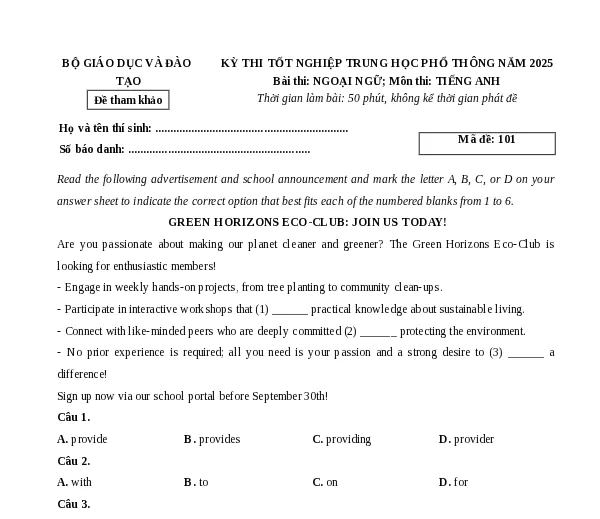
BỘ GIÁO DỤC VÀ ĐÀO TẠO
Đề tham khảo
ĐỀ KIỂM TRA THUẦN TÚY UNIT 2: A MULTICULTURAL WORLD
KỲ THI TỐT NGHIỆP THPT TỪ NĂM 2025
Môn: Tiếng Anh – Lớp 12
Thời gian làm bài: 50 phút, không kể thời gian phát đề
Họ và tên thí sinh: ................................................................ Số báo danh: ............................................................ | Mã đề: 101 |
Read the following advertisement and mark the letter A, B, C or D on your answer sheet to indicate the option that best fits each of the numbered blanks from 1 to 6.
INTERNATIONAL YOUTH CULTURAL FESTIVAL 2025!
Are you ready to explore the world without leaving our city? Join us for an exciting (1) ______ of diverse traditions at the Annual Youth Cultural Festival!
- Time & Venue: 9:00 AM – 9:00 PM, October 18–20, at Nguyen Hue Walking Street.
- Highlights: Taste mouthwatering street food (2) ______ around the world, from spicy Thai noodles to authentic Italian pasta. Learn the art of bamboo dancing and take part in a thrilling game of (3) ______ war with international friends!
- Special Feature: Meet global guest speakers and listen to inspiring talks on how cultural diversity is gaining (4) ______ among younger generations.
- Don't forget to visit our cultural booths to purchase handcrafted souvenirs and get an exclusive (5) ______ from renowned folk artists.
(6) ______ your student ID card along to receive free admission and a welcome gift pack!
Question 1:
A. celebrate
B. celebration
C. celebratory
D. celebrator
Question 2:
A. from
B. with
C. about
D. for
Question 3:
A. pull of
B. push of
C. tug of
D. catch of
Question 4:
A. mystery
B. popularity
C. lifestyle
D. anxiety
Question 5:
A. autograph
B. barrier
C. origin
D. ingredient
Question 6:
A. Bringing
B. Bring
C. Brought
D. To bring
Read the following leaflet and mark the letter A, B, C or D on your answer sheet to indicate the option that best fits each of the numbered blanks from 7 to 12.
NAVIGATING CULTURE SHOCK: A GUIDE FOR GLOBAL CITIZENS
Moving to a new country or living in a multicultural community can be exciting, but it may also bring unexpected challenges.
Did you know?
- More than 70% of international students report experiencing some degree of culture shock and (7) ______ during their first semester abroad.
- Facing an unfamiliar environment and a language (8) ______ can easily lead to confusion and homesickness.
Practical Steps to Adapt:
- Keep an open mind: Try to understand local customs instead of considering them strange or (9) ______.
- Explore culinary arts: Do not hesitate to taste a new (10) ______ or learn about staple foods in the region.
- Engage with the community: Join (11) ______ clubs or volunteer projects. Interacting with (12) ______ students from different backgrounds will help you build meaningful friendships and develop a broader worldview.
Question 7:
A. festivity
B. anxiety
C. trend
D. specialty
Question 8:
A. barrier
B. border
C. obstacle
D. boundary
Question 9:
A. tasty
B. insulting
C. connected
D. staple
Question 10:
A. dish
B. booth
C. costume
D. origin
Question 11:
A. delicious
B. spicy
C. extracurricular
D. unique
Question 12:
A. other
B. another
C. others
D. the other
Mark the letter A, B, C or D on your answer sheet to indicate the best arrangement of utterances or sentences to make a meaningful exchange or text in each of the following questions from 13 to 17.
Question 13:
a. Lan: Have you tried that new Mexican restaurant near our school?
b. Lan: That's right! We should definitely go there together this Friday.
c. Tom: Not yet, but I heard their dishes are really spicy and flavorful.
A. a – c – b
B. c – a – b
C. b – a – c
D. a – b – c
Question 14:
a. Minh: Why bamboo dancing? Isn't it difficult to coordinate your steps?
b. David: I am planning to sign up for a traditional dance workshop this weekend.
c. Minh: What kind of cultural activity are you going to join?
d. David: It looks challenging, but it is a great way to appreciate Vietnamese traditions and stay active.
e. Minh: That sounds exciting! Maybe I will come along and try it with you.
A. c – b – a – d – e
B. b – c – a – d – e
C. c – a – b – e – d
D. b – a – c – d – e
Question 15:
Dear Anna,
a. Please let me know if you can make it so that I can arrange our schedule.
b. It is a fantastic celebration of diverse traditions with folk music, dances, and street food from around the globe.
c. I hope this letter finds you well and that you are enjoying your new semester.
d. I have some exciting news: our city is hosting a vibrant multicultural festival next month, and I would love for you to join us.
e. Your presence would mean so much to me, and it would give us a great opportunity to explore local specialties together.
Warm regards,
Thanh
A. c – d – b – e – a
B. d – b – c – e – a
C. c – b – d – a – e
D. d – c – b – a – e
Question 16:
a. To sum up, multiculturalism makes our world a better place because it teaches people to live together in mutual respect.
b. Secondly, when individuals from diverse backgrounds collaborate, they share novel perspectives and spark creativity.
c. Embracing cultural diversity brings numerous significant benefits to modern society.
d. Firstly, it allows citizens to discover and appreciate a wide range of unique traditions and customs.
e. Finally, developing cross-cultural understanding makes it much easier to build international friendships and eliminate prejudices.
A. c – d – b – e – a
B. c – b – d – e – a
C. d – c – b – e – a
D. c – d – e – b – a
Question 17:
a. However, without conscious efforts to preserve local customs, younger generations may gradually lose their sense of identity.
b. Globalisation has connected nations more closely than ever before, bringing foreign trends and lifestyles into daily life.
c. Therefore, balancing international integration with the preservation of cultural heritage is vital for every community.
d. This widespread connectivity enables people to enjoy diverse cuisines, arts, and innovations from across the globe.
e. For instance, many teenagers enthusiastically adopt foreign holidays while showing little interest in their own traditional festivals.
A. b – d – a – e – c
B. b – a – d – e – c
C. d – b – a – c – e
D. b – d – e – a – c
Read the following passage about cultural identity and adapting to new environments and mark the letter A, B, C or D on your answer sheet to indicate the option that best fits each of the numbered blanks from 18 to 22.
Culture is an essential aspect of human life that shapes our perceptions, values, and social interactions. (18) ______ and beliefs that help individuals relate to the world around them. It provides the foundation for customs, dietary habits, and social norms. Culture gives us a definite starting point (19) ______. Knowing where a person comes from will help define how they perceive family obligations and celebrate important milestones in life.
When living in an increasingly interconnected world, people frequently encounter diverse ways of living. Experiencing culture shock involves encountering unfamiliar customs, (20) ______, and grappling with confusion and anxiety. A language barrier makes communication challenging, while different social practices can cause temporary disorientation.
Overcoming culture shock requires patience, openness, and (21) ______. Initially, the experience may cause emotional strain, but with time and conscious effort, (22) ______. By embracing differences, individuals navigate cultural transitions effectively, leading to profound personal growth and enriched cross-cultural experiences.
Question 18:
A. It is the underlying foundation of traditions
B. Which serves as the underlying foundation of traditions
C. Having been the underlying foundation of traditions
D. Being the underlying foundation of traditions
Question 19:
A. when beginning to search for our roots
B. when we will begin to search for our roots
C. to begin searching for our roots which
D. began to search for our roots
Question 20:
A. to face unfamiliar traditions
B. facing unfamiliar traditions
C. if we face unfamiliar traditions
D. face unfamiliar traditions
Question 21:
A. a willingness to adapt
B. willing to adapt
C. adapt willingly
D. to adapt willingly
Question 22:
A. one can gradually adjust and integrate into the new environment
B. an adjustment and integration into the new environment can be achieved
C. the new environment will help people adjust and integrate easily
D. cultural adjustment and integration will take place naturally
Read the following passage about international gift-giving customs and mark the letter A, B, C or D on your answer sheet to indicate the best answer to each of the following questions from 23 to 30.
The tradition of gift-giving is a universal practice that has existed since the dawn of human civilization. It serves as an essential medium for expressing gratitude, strengthening friendships, and establishing social bonds. However, as societies evolved in different geographical and cultural environments, they developed distinct gift-giving customs and traditions that reflect their unique values.
In France, bringing wine to a dinner party for the hostess is generally considered inappropriate because the hostess prefers to select the specific vintage that complements the meal. In Sweden, conversely, a bottle of fine wine or a bouquet of flowers is regarded as a thoughtful and suitable present. In Vietnam, a gift of whisky is often appropriate for the host, while fresh fruit or small treats are preferred for the hostess, children, or elderly family members. Furthermore, gifts in Vietnam should never be wrapped in black paper, as this colour is traditionally associated with mourning and funerals. Sharp objects such as knives or scissors must also be avoided because they symbolize the severing of a relationship.
Beyond the item itself, the manner in which a gift is presented and received carries profound cultural significance. In many Asian and Middle Eastern cultures, it is customary to offer and accept gifts using both hands, or at least the right hand, as using the left hand is viewed as impolite. In Singapore, standard etiquette dictates that a recipient should graciously refuse a gift several times before finally accepting it, demonstrating humility. Moreover, recipients in many Asian nations refrain from unwrapping presents directly in front of the giver to avoid appearing greedy or impatient, whereas in Western cultures, opening a gift immediately to show excitement is widely expected.
Understanding these international customs and taking the time to select an appropriate gift will prevent awkwardness or embarrassment. In an increasingly interconnected world, mastering cross-cultural gift etiquette is not merely a polite gesture, but a valuable asset for building fruitful personal and professional relationships.
Question 23: Which of the following is NOT mentioned in paragraph 2 as a custom in gift-giving?
A. Avoiding wrapping gifts in black paper in Vietnam.
B. Presenting flowers or wine to the hostess in Sweden.
C. Selecting vintage wine to match the host's preferences in France.
D. Giving sharp items like scissors to celebrate a new business.
Question 24: The word inappropriate in paragraph 2 is OPPOSITE in meaning to ______.
A. suitable
B. unfamiliar
C. insulting
D. complex
Question 25: The word they in paragraph 2 refers to ______.
A. gifts
B. funerals
C. elderly family members
D. sharp objects
Question 26: The word etiquette in paragraph 3 is closest in meaning to ______.
A. rules of behavior
B. dietary habits
C. language barriers
D. financial costs
Question 27: Which of the following best paraphrases the underlined sentence in paragraph 4?
A. Being polite when exchanging gifts is the only way to establish successful business ties in modern society.
B. Learning gift-giving rules across cultures is more than politeness; it strongly aids in creating positive personal and work connections.
C. If people do not understand gift etiquette, they will fail to communicate with international partners.
D. Cross-cultural relationships can be built without paying attention to gift customs as long as one remains polite.
Question 28: Which of the following is TRUE according to the passage?
A. Swedish dinner party hosts always choose the wine themselves instead of accepting it from guests.
B. In France, guests are encouraged to unwrap presents immediately in front of the dinner hostess.
C. In Singapore, recipients typically decline a gift multiple times before accepting it to show modesty.
D. In Vietnam, black wrapping paper is commonly used to express respect to elderly people.
Question 29: In which paragraph does the writer explain the symbolic meanings of certain colors and items?
A. Paragraph 1
B. Paragraph 2
C. Paragraph 3
D. Paragraph 4
Question 30: In which paragraph does the writer discuss the bodily gestures and actions involved in presenting and receiving gifts?
A. Paragraph 1
B. Paragraph 2
C. Paragraph 3
D. Paragraph 4
Read the following passage about globalization and preserving cultural identity and mark the letter A, B, C or D on your answer sheet to indicate the best answer to each of the following questions from 31 to 40.
[I] In an era defined by rapid technological advancement and international integration, the world has become a vast multicultural landscape. [II] People across continents can now easily consume international media, wear global fashion brands, and enjoy exotic cuisines that were once restricted to specific regions. [III] While this borderless exchange fosters mutual understanding and opens up exciting opportunities, it also exerts profound pressure on traditional ways of life. [IV]
Globalisation brings undeniable benefits to local communities by encouraging cultural cross-pollination. When people from diverse ethnic backgrounds interact, they exchange innovative ideas and creative practices, enriching artistic expression and social norms. In metropolitan areas, international cultural festivals and food fairs draw enthusiastic crowds, allowing citizens to celebrate foreign festivities while sharing their own heritage. Furthermore, exposure to different cultural perspectives enhances tolerance, helps dismantle language barriers, and reduces deep-seated social prejudices. However, this intense exposure can also lead to cultural homogenisation, where dominant global trends overshadow smaller indigenous customs.
The gradual erosion of cultural identity has become an alarming reality in many parts of the world. First, the widespread popularity of Western entertainment and digital platforms has caused many young people to abandon their native languages and folklore in favour of global pop culture. When a community ceases to speak its mother tongue, a vast repository of ancestral wisdom, moral values, and historical memory is irretrievably lost. Second, traditional festivals and ceremonies are frequently commercialised or modified to cater to foreign tourists. In doing so, these sacred practices lose their authentic spiritual significance and are reduced to mere spectacles for amusement, creating confusion among the younger generations about their true roots.
Preserving cultural diversity within a multicultural world requires deliberate policies and active community participation. Governments, educational institutions, and civic groups must collaborate to ensure that cultural heritage is not sacrificed on the altar of economic modernisation. By integrating traditional arts and local history into school curricula, we can instill a robust sense of identity in young minds, enabling them to navigate the globalised world with pride and purpose.
Question 31: Where in paragraph 1 does the following sentence best fit?
"Consequently, the flow of cultural goods and ideas between nations has reached unprecedented levels."
A. [I]
B. [II]
C. [III]
D. [IV]
Question 32: The phrase cross-pollination in paragraph 2 is closest in meaning to ______.
A. mutual exchange
B. severe conflict
C. financial support
D. economic decline
Question 33: The word they in paragraph 2 refers to ______.
A. benefits
B. local communities
C. artistic expressions
D. people from diverse ethnic backgrounds
Question 34: According to paragraph 2, which of the following is NOT mentioned as a benefit of cultural interaction?
A. Enhancing tolerance and reducing social prejudices.
B. Dismantling language barriers between people.
C. Eliminating all commercial competition in local markets.
D. Enriching artistic expressions and social norms.
Question 35: Which of the following best summarises paragraph 3?
A. Digital media platforms encourage young people to actively study indigenous folklore and traditions.
B. The loss of native languages and the commercialisation of sacred rites threaten cultural identity.
C. Tourism is the single most effective method to maintain authentic spiritual rituals in modern cities.
D. Younger generations prefer foreign festivals because traditional customs lack moral values.
Question 36: The word erosion in paragraph 3 is OPPOSITE in meaning to ______.
A. preservation
B. decline
C. destruction
D. weakness
Question 37: Which of the following is TRUE according to the passage?
A. Cultural homogenisation occurs when local traditions completely replace dominant global trends.
B. When a mother tongue disappears, the historical memory and ancestral wisdom of that community are also lost.
C. Commercialising traditional festivals helps preserve their authentic spiritual significance for tourists.
D. Young people are discouraged from learning local history in school to facilitate global integration.
Question 38: Which of the following best paraphrases the underlined sentence in paragraph 4?
A. Economic modernisation should be halted immediately to allow educational institutions to protect cultural heritage.
B. Different sectors of society need to work together so that economic progress does not come at the expense of traditional culture.
C. Cultural heritage will naturally disappear unless governments prioritize commercial growth above all else.
D. Educational institutions alone are responsible for balancing modernization with the preservation of local customs.
Question 39: Which of the following can be inferred from the passage?
A. Total isolation from global media is the only viable method for nations to protect their cultural roots.
B. Embracing multiculturalism requires individuals to abandon their distinct ethnic identity.
C. Without an understanding of their own traditions, youths may feel disoriented in a globalised environment.
D. International food fairs and cultural festivals cause irreversible damage to local social norms.
Question 40: Which of the following best summarises the passage?
A. While globalisation promotes cross-cultural exchange and mutual tolerance, it poses risks of cultural erosion, highlighting the need for collective efforts to preserve heritage while embracing progress.
B. Technological progress has completely erased local traditions worldwide, leaving younger generations entirely dependent on Western entertainment and consumerism.
C. Multicultural societies must suppress foreign influences and eliminate international tourism to protect native languages and rituals from commercialisation.
D. Global integration provides endless economic opportunities, proving that ancient customs and mother tongues are no longer relevant in modern education.
--------- HẾT ---------
Thí sinh không được sử dụng tài liệu. Giám thị không giải thích gì thêm.
HƯỚNG DẪN CHẤM VÀ GIẢI CHI TIẾT
ĐỀ KIỂM TRA ĐỊNH KỲ TIẾNG ANH 12 - UNIT 2: A MULTICULTURAL WORLD
A. BẢNG ĐÁP ÁN THAM KHẢO
Câu | Đ/A | Điểm | Câu | Đ/A | Điểm | Câu | Đ/A | Điểm | Câu | Đ/A | Điểm |
|---|---|---|---|---|---|---|---|---|---|---|---|
1 | B | 0,25 | 11 | C | 0,25 | 21 | A | 0,25 | 31 | B | 0,25 |
2 | A | 0,25 | 12 | A | 0,25 | 22 | A | 0,25 | 32 | A | 0,25 |
3 | C | 0,25 | 13 | A | 0,25 | 23 | D | 0,25 | 33 | D | 0,25 |
4 | B | 0,25 | 14 | A | 0,25 | 24 | A | 0,25 | 34 | C | 0,25 |
5 | A | 0,25 | 15 | A | 0,25 | 25 | D | 0,25 | 35 | B | 0,25 |
6 | B | 0,25 | 16 | A | 0,25 | 26 | A | 0,25 | 36 | A | 0,25 |
7 | B | 0,25 | 17 | A | 0,25 | 27 | B | 0,25 | 37 | B | 0,25 |
8 | A | 0,25 | 18 | A | 0,25 | 28 | C | 0,25 | 38 | B | 0,25 |
9 | B | 0,25 | 19 | A | 0,25 | 29 | B | 0,25 | 39 | C | 0,25 |
10 | A | 0,25 | 20 | B | 0,25 | 30 | C | 0,25 | 40 | A | 0,25 |
B. GIẢI THÍCH CHI TIẾT TỪNG CÂU
Câu 1. Đáp án B
- Kiến thức: Từ loại (Word formation).
- Giải thích: Sau mạo từ "an" và tính từ "exciting" cần một danh từ số ít. "Celebration" (sự kỷ niệm, lễ hội) là danh từ phù hợp. Cụm "an exciting celebration of diverse traditions" nghĩa là một sự tôn vinh/lễ hội sôi nổi về các truyền thống đa dạng.
- Dịch nghĩa: "Hãy tham gia cùng chúng tôi trong một lễ hội sôi động tôn vinh các truyền thống đa dạng tại Lễ hội Văn hóa Thanh niên thường niên!"
Câu 2. Đáp án A
- Kiến thức: Giới từ (Preposition).
- Giải thích: Cụm "street food from around the world" mang nghĩa ẩm thực đường phố đến từ khắp nơi trên thế giới.
Câu 3. Đáp án C
- Kiến thức: Từ vựng Unit 2 (Collocations).
- Giải thích: Cụm danh từ "tug of war" nghĩa là trò chơi kéo co (trò chơi dân gian truyền thống trong Unit 2).
Câu 4. Đáp án B
- Kiến thức: Cụm từ cố định (Collocation).
- Giải thích: Cụm "gain popularity" có nghĩa là ngày càng trở nên phổ biến, được ưa chuộng.
Câu 5. Đáp án A
- Kiến thức: Từ vựng Unit 2.
- Giải thích: "Autograph" (chữ ký của người nổi tiếng). Cụm "get an exclusive autograph from renowned folk artists" (nhận chữ ký độc quyền từ các nghệ sĩ dân gian danh tiếng).
Câu 6. Đáp án B
- Kiến thức: Thức mệnh lệnh (Imperatives).
- Giải thích: Câu mệnh lệnh trực tiếp đứng đầu câu để đưa ra lời hướng dẫn/yêu cầu dùng động từ nguyên thể không "to": "Bring your student ID card along...".
Câu 7. Đáp án B
- Kiến thức: Từ vựng Unit 2 (Nouns).
- Giải thích: "Anxiety" nghĩa là sự lo lắng, bồn chồn. Cặp danh từ "culture shock and anxiety" (sốc văn hóa và sự lo lắng) là cụm từ vựng cốt lõi của Unit 2 miêu tả trạng thái khi đối mặt môi trường mới.
Câu 8. Đáp án A
- Kiến thức: Cụm từ cố định Unit 2 (Collocations).
- Giải thích: "Language barrier" nghĩa là rào cản ngôn ngữ.
Câu 9. Đáp án B
- Kiến thức: Từ vựng Unit 2 (Adjectives).
- Giải thích: "Insulting" nghĩa là mang tính xúc phạm, sỉ nhục. Ngữ cảnh: cố gắng thấu hiểu phong tục địa phương thay vì coi chúng là kỳ lạ hay xúc phạm ("strange or insulting").
Câu 10. Đáp án A
- Kiến thức: Từ vựng Unit 2 (Nouns).
- Giải thích: "Dish" ở đây chỉ món ăn. "Taste a new dish" = nếm thử một món ăn mới.
Câu 11. Đáp án C
- Kiến thức: Từ vựng Unit 2 (Adjectives).
- Giải thích: "Extracurricular clubs" nghĩa là các câu lạc bộ ngoại khóa.
Câu 12. Đáp án A
- Kiến thức: Lượng từ / Từ chỉ định (Quantifiers).
- Giải thích: "Other + danh từ đếm được số nhiều" (other students). "Another + N số ít", "Others" không đi kèm danh từ phía sau.
Câu 13. Đáp án A
- Kiến thức: Sắp xếp đoạn hội thoại ngắn.
- Giải thích:
+ Lan mở đầu bằng câu hỏi: "Have you tried that new Mexican restaurant near our school?" (a)
+ Tom trả lời thông tin về quán ăn: "Not yet, but I heard their dishes are really spicy and flavorful." (c)
+ Lan tán thành và đưa ra lời rủ: "That's right! We should definitely go there together this Friday." (b)
-> Thứ tự đúng: a – c – b.
Câu 14. Đáp án A
- Kiến thức: Sắp xếp đoạn hội thoại mở rộng.
- Giải thích:
+ c. Minh hỏi David dự định tham gia hoạt động văn hóa nào ("What kind of cultural activity...?").
+ b. David trả lời về việc đăng ký workshop nhảy truyền thống ("I am planning to sign up...").
+ a. Minh hỏi lý do chọn múa sạp và độ khó ("Why bamboo dancing? Isn't it difficult...?").
+ d. David giải thích lý do và lợi ích ("It looks challenging, but it is a great way...").
+ e. Minh hào hứng ngỏ ý đi cùng ("That sounds exciting! Maybe I will come along...").
-> Thứ tự đúng: c – b – a – d – e.
Câu 15. Đáp án A
- Kiến thức: Sắp xếp thư/email giao tiếp.
- Giải thích:
+ c. Lời hỏi thăm mở đầu thư chuẩn mực ("I hope this letter finds you well...").
+ d. Nêu mục đích viết thư / tin tức sự kiện ("I have some exciting news: our city is hosting...").
+ b. Miêu tả chi tiết về lễ hội đa văn hóa ("It is a fantastic celebration of diverse traditions...").
+ e. Bày tỏ ý nghĩa sự hiện diện của bạn mình ("Your presence would mean so much to me...").
+ a. Lời kết mong sớm nhận phản hồi ("Please let me know if you can make it...").
-> Thứ tự đúng: c – d – b – e – a.
Câu 16. Đáp án A
- Kiến thức: Sắp xếp đoạn văn nghị luận/thuyết trình.
- Giải thích:
+ c. Câu chủ đề khái quát: Đón nhận sự đa dạng văn hóa đem lại nhiều lợi ích to lớn.
+ d. Ý thứ nhất bắt đầu bằng liên từ "Firstly, it allows citizens to discover...".
+ b. Ý thứ hai nối tiếp bằng "Secondly, when individuals from diverse backgrounds collaborate...".
+ e. Ý bổ sung cuối cùng bắt đầu bằng "Finally, developing cross-cultural understanding...".
+ a. Câu kết đoạn bắt đầu bằng từ nối kết luận "To sum up, multiculturalism makes our world a better place...".
-> Thứ tự đúng: c – d – b – e – a.
Câu 17. Đáp án A
- Kiến thức: Sắp xếp đoạn văn nguyên nhân - hệ quả - giải pháp.
- Giải thích:
+ b. Mở đầu bằng bối cảnh toàn cầu hóa kết nối thế giới và lối sống ("Globalisation has connected nations...").
+ d. Nối tiếp sự kết nối đó bằng "This widespread connectivity enables people to enjoy...".
+ a. Nêu mặt trái / cảnh báo với liên từ tương phản "However, without conscious efforts to preserve local customs...".
+ e. Đưa ra dẫn chứng cụ thể cho mặt trái đó: "For instance, many teenagers enthusiastically adopt foreign holidays...".
+ c. Câu kết luận đề xuất giải pháp cân bằng: "Therefore, balancing international integration with the preservation...".
-> Thứ tự đúng: b – d – a – e – c.
Câu 18. Đáp án A
- Kiến thức: Cấu trúc câu độc lập (Main clause).
- Giải thích: Chỗ trống đứng sau dấu chấm và đứng trước liên từ "and" nối hai danh từ. Câu cần một mệnh đề chính hoàn chỉnh có chủ ngữ và động từ chia thì: "It is the underlying foundation of traditions...".
Câu 19. Đáp án A
- Kiến thức: Mệnh đề trạng ngữ rút gọn (Reduced adverbial clause).
- Giải thích: Cấu trúc rút gọn đồng chủ ngữ với liên từ thời gian: "when beginning to search for our roots" (khi bắt đầu tìm kiếm về cội nguồn của chúng ta). Sau "begin" dùng động từ nguyên mẫu có to ("to search").
Câu 20. Đáp án B
- Kiến thức: Cấu trúc song hành (Parallel structure).
- Giải thích: Đứng giữa "encountering unfamiliar customs" và "and grappling with confusion and anxiety", thành phần này phải ở dạng V-ing: "facing unfamiliar traditions".
Câu 21. Đáp án A
- Kiến thức: Cấu trúc song hành danh từ (Parallel structure).
- Giải thích: Đứng sau liên từ liệt kê "requires patience, openness, and...", vị trí này cần một cụm danh từ tương đương: "a willingness to adapt" (sự sẵn lòng thích nghi).
Câu 22. Đáp án A
- Kiến thức: Cấu trúc câu và sự hòa hợp chủ - vị / Tránh lỗi sai chủ ngữ logic (Dangling modifier).
- Giải thích: Câu "with time and conscious effort, (22) ______" cần một mệnh đề chỉ người có khả năng thích nghi và hòa nhập vào môi trường mới. "One can gradually adjust and integrate into the new environment" (một người có thể dần thích nghi và hòa nhập vào môi trường mới). Các phương án B, C, D đều diễn đạt bị động hoặc biến môi trường thành chủ thể hành động không phù hợp ngữ cảnh.
Câu 23. Đáp án D
- Kiến thức: Đọc hiểu chi tiết (Negative detail).
- Thông tin: Trong đoạn 2 nêu rõ: "Sharp objects such as knives or scissors must also be avoided because they symbolize the severing of a relationship" -> Kéo và vật sắc nhọn phải TRÁNH vì tượng trưng cho sự cắt đứt mối quan hệ, chứ không phải tặng để chúc mừng kinh doanh mới.
Câu 24. Đáp án A
- Kiến thức: Từ trái nghĩa (Antonyms).
- Giải thích: "Inappropriate" (không phù hợp, không thích hợp) trái nghĩa với "suitable" (phù hợp, thích hợp).
Câu 25. Đáp án D
- Kiến thức: Quy chiếu đại từ (Pronoun reference).
- Thông tin: Trong đoạn 2: "Sharp objects such as knives or scissors must also be avoided because they symbolize the severing of a relationship." -> "They" thay thế cho danh từ số nhiều đứng ngay trước là "sharp objects".
Câu 26. Đáp án A
- Kiến thức: Từ đồng nghĩa theo ngữ cảnh (Vocabulary in context).
- Giải thích: "Etiquette" (phép lịch sự, quy tắc ứng xử chuẩn mực) = "rules of behavior".
Câu 27. Đáp án B
- Kiến thức: Diễn giải câu (Paraphrase).
- Giải thích: Câu gốc: "In an increasingly interconnected world, mastering cross-cultural gift etiquette is not merely a polite gesture, but a valuable asset for building fruitful personal and professional relationships." (Nắm vững phép tắc tặng quà liên văn hóa không chỉ là cử chỉ lịch thiệp mà còn là tài sản quý giá để xây dựng các mối quan hệ cá nhân và công việc tốt đẹp). Phương án B diễn đạt chính xác và trọn vẹn nhất ý này.
Câu 28. Đáp án C
- Kiến thức: Đọc hiểu chi tiết (True statement).
- Thông tin: Đoạn 3 nêu: "In Singapore, standard etiquette dictates that a recipient should graciously refuse a gift several times before finally accepting it, demonstrating humility." -> Người nhận ở Singapore thường lịch sự từ chối quà vài lần trước khi nhận để thể hiện sự khiêm nhường.
Câu 29. Đáp án B
- Kiến thức: Xác định vị trí thông tin trong đoạn văn (Paragraph-finding).
- Thông tin: Đoạn 2 giải thích ý nghĩa biểu tượng của màu đen ("associated with mourning and funerals") và vật sắc nhọn ("symbolize the severing of a relationship").
Câu 30. Đáp án C
- Kiến thức: Xác định vị trí thông tin trong đoạn văn (Paragraph-finding).
- Thông tin: Đoạn 3 bàn về cử chỉ cơ thể và hành động khi trao nhận: dùng cả hai tay hoặc tay phải ("using both hands, or at least the right hand"), việc mở quà trước mặt hay không mở quà.
Câu 31. Đáp án B
- Kiến thức: Điền câu vào đoạn văn (Sentence insertion).
- Giải thích: Câu cần chèn: "Consequently, the flow of cultural goods and ideas between nations has reached unprecedented levels." (Do đó, dòng chảy hàng hóa văn hóa và ý tưởng giữa các quốc gia đã đạt đến mức độ chưa từng có). Vị trí [II] là hoàn hảo vì nó nối tiếp nhận định ở câu [I] (thế giới trở thành một bức tranh đa văn hóa rộng lớn) và dẫn chứng cho câu tiếp theo (con người tiêu thụ truyền thông, mặc thương hiệu quốc tế, ăn món ăn nước ngoài).
Câu 32. Đáp án A
- Kiến thức: Cụm từ theo ngữ cảnh (Vocabulary in context).
- Giải thích: "Cross-pollination" theo nghĩa đen là thụ phấn chéo, trong văn cảnh văn hóa mang nghĩa sự giao thoa, trao đổi qua lại giữa các nền văn hóa = "mutual exchange".
Câu 33. Đáp án D
- Kiến thức: Quy chiếu đại từ (Pronoun reference).
- Thông tin: Đoạn 2: "When people from diverse ethnic backgrounds interact, they exchange innovative ideas..." -> "They" thay thế cho "people from diverse ethnic backgrounds".
Câu 34. Đáp án C
- Kiến thức: Đọc hiểu chi tiết (Negative detail).
- Thông tin: Đoạn 2 đề cập đến việc làm giàu nghệ thuật (D), tăng lòng bao dung và giảm định kiến (A), phá bỏ rào cản ngôn ngữ (B). Không có thông tin về việc "loại bỏ mọi cạnh tranh thương mại ở thị trường địa phương" (C).
Câu 35. Đáp án B
- Kiến thức: Tóm tắt đoạn văn (Paragraph summary).
- Thông tin: Toàn bộ đoạn 3 tập trung phân tích 2 khía cạnh làm xói mòn bản sắc: mất tiếng mẹ đẻ/văn hóa dân gian do văn hóa đại chúng phương Tây, và sự thương mại hóa làm mất đi tính thiêng liêng của các nghi lễ truyền thống. Phương án B tóm lược đầy đủ cả hai luận điểm này.
Câu 36. Đáp án A
- Kiến thức: Từ trái nghĩa (Antonyms).
- Giải thích: "Erosion" (sự xói mòn, mai một dần) trái nghĩa với "preservation" (sự bảo tồn, gìn giữ).
Câu 37. Đáp án B
- Kiến thức: Đọc hiểu chi tiết (True statement).
- Thông tin: Đoạn 3 có câu: "When a community ceases to speak its mother tongue, a vast repository of ancestral wisdom, moral values, and historical memory is irretrievably lost." -> Khớp chính xác với phương án B.
Câu 38. Đáp án B
- Kiến thức: Diễn giải câu (Paraphrase).
- Giải thích: Câu gạch chân đoạn 4: "Governments, educational institutions, and civic groups must collaborate to ensure that cultural heritage is not sacrificed on the altar of economic modernisation." (Chính phủ, cơ sở giáo dục và các nhóm dân sự phải hợp tác để đảm bảo rằng di sản văn hóa không bị hy sinh vì sự hiện đại hóa kinh tế) tương đương với phương án B: Các thành phần xã hội cần chung tay để sự phát triển kinh tế không trả giá bằng văn hóa truyền thống.
Câu 39. Đáp án C
- Kiến thức: Câu hỏi suy luận (Inference).
- Giải thích: Ở cuối đoạn 3, tác giả nói việc mất gốc tạo ra "confusion among the younger generations about their true roots" và ở đoạn 4 khẳng định việc học lịch sử/nghệ thuật địa phương sẽ truyền cho thanh thiếu niên "a robust sense of identity in young minds, enabling them to navigate the globalised world with pride and purpose". Từ đó suy ra: nếu thiếu hiểu biết về truyền thống của mình, người trẻ sẽ cảm thấy mất phương hướng/bối rối trong thế giới toàn cầu hóa.
Câu 40. Đáp án A
- Kiến thức: Ý chính toàn bài (Passage summary).
- Giải thích: Bài đọc trình bày: Toàn cầu hóa tạo ra cơ hội giao lưu và thấu hiểu văn hóa (đoạn 1, 2), nhưng đồng thời đe dọa làm xói mòn bản sắc truyền thống (đoạn 3), do đó đòi hỏi sự chung tay của toàn xã hội để bảo tồn di sản song hành với phát triển (đoạn 4). Phương án A khái quát toàn diện và khách quan nhất toàn bộ nội dung này.