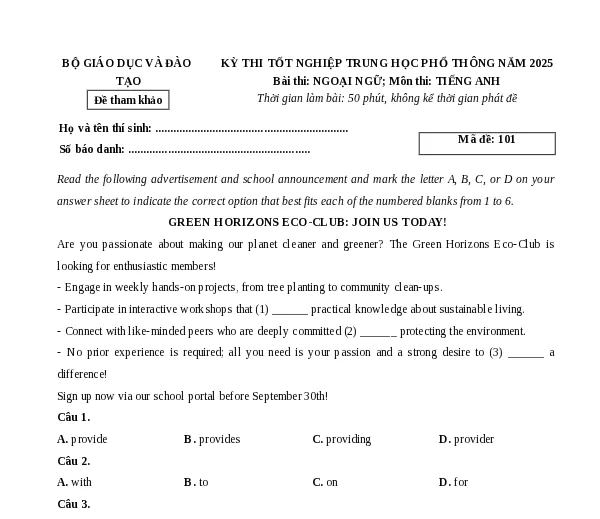
BỘ GIÁO DỤC VÀ ĐÀO TẠO
TRƯỜNG THPT …
Đề chính thức
KỲ THI TỐT NGHIỆP TRUNG HỌC PHỔ THÔNG NĂM 2027
Bài thi: NGOẠI NGỮ; Môn thi: TIẾNG ANH
Thời gian làm bài: 50 phút, không kể thời gian phát đề
Họ và tên thí sinh: ................................................................ Số báo danh: ............................................................ | Mã đề: 101 |
Read the following advertisement/announcement and mark the letter A, B, C, or D on your answer sheet to indicate the correct option that best fits each of the numbered blanks from 1 to 6.
CANINE COGNITION WORKSHOP: EXPLORING DOG PSYCHOLOGY
Are you fascinated by how dogs perceive the world? Join our interactive weekend seminar hosted by the Animal Mind Institute!
- Discover how canines process visual shapes and sounds, including their (1) ______ to sensory cross-modal associations.
- Learn hands-on training techniques based on modern behavioral science directly from (2) ______ animal behaviorists.
- Participate in live demonstrations and gain deep insights (3) ______ your pet's everyday communication.
Time: 8:30 AM – 4:00 PM, Saturday, November 15
Venue: Oakridge Community Hall
Registration is free but advance booking is essential. Visit www.animalmind.org to reserve your seat today!
Câu 1 (0,25 điểm).
A. susceptible
B. susceptibility
C. suspect
D. suspiciously
Câu 2 (0,25 điểm).
A. prominent
B. remote
C. superficial
D. obsolete
Câu 3 (0,25 điểm).
A. on
B. at
C. into
D. with
ANNOUNCEMENT: SPECIAL EXHIBITION ON 20TH-CENTURY AVANT-GARDE ART
The City Museum of Contemporary Art is pleased to announce a landmark retrospective exhibition entitled "Breaking the Mould: Dada to Pop Art".
- The exhibition will officially open on December 1st and run (4) ______ the end of January.
- Visitors will have the unique opportunity to admire radical masterpieces that fundamentally (5) ______ conventional definitions of aesthetic beauty.
- Guided tours led by renowned art historians are scheduled daily at 10:00 AM and 2:30 PM.
- Please note that flash photography and large bags are strictly (6) ______ within the gallery premises.
For group ticket bookings and educational workshops, please contact our guest services desk at [email protected].
Câu 4 (0,25 điểm).
A. through
B. along
C. across
D. beneath
Câu 5 (0,25 điểm).
A. challenged
B. simulated
C. concealed
D. reinforced
Câu 6 (0,25 điểm).
A. prohibited
B. prohibition
C. prohibiting
D. prohibitive
Read the following leaflet and mark the letter A, B, C, or D on your answer sheet to indicate the correct option that best fits each of the numbered blanks from 7 to 12.
SAVING OUR OCEAN GIANTS: PROTECTING MARINE MAMMALS
Cetaceans, including deep-diving toothed whales such as bottlenose whales, represent some of the most intelligent creatures in our oceans. Marine biologists have documented instances showing that these animals frequently (7) ______ for vulnerable pod members during times of illness or physical distress. However, their survival is increasingly threatened by human activities.
What are the primary threats?
- Acoustic pollution: High-intensity naval sonars and seismic surveys cause severe disorientation, (8) ______ often leads to mass beaching events.
- Commercial fishing: Ghost nets and longlines unintentionally entrap (9) ______ species of marine wildlife every year.
Actions you can take:
- Reduce your consumption of single-use plastics to prevent harmful debris from entering marine ecosystems.
- Support marine conservation charities that actively (10) ______ research initiatives and rescue operations.
- Report any sightings of stranded or injured cetaceans to the local coastguard immediately so that emergency responders can (11) ______ the rescue operation promptly.
Together, we can ensure that future generations inherit oceans filled with thriving marine life. Make a positive difference (12) ______ taking responsible actions today!
Câu 7 (0,25 điểm).
A. look after
B. take down
C. make up
D. give away
Câu 8 (0,25 điểm).
A. whom
B. which
C. where
D. that
Câu 9 (0,25 điểm).
A. every
B. numerous
C. much
D. another
Câu 10 (0,25 điểm).
A. finance
B. terminate
C. resist
D. discard
Câu 11 (0,25 điểm).
A. look off
B. set out
C. carry out
D. pull through
Câu 12 (0,25 điểm).
A. by
B. in
C. on
D. at
Mark the letter A, B, C, or D on your answer sheet to indicate the correct arrangement of the sentences to make a meaningful exchange or text in each of the following questions from 13 to 17.
Câu 13 (0,25 điểm).
a. Mark: "I certainly will! It's amazing how those artists turned everyday soup cans and comics into high art."
b. Mark: "Hi, Linda! Have you had a chance to visit the new Pop Art exhibition at the city gallery yet?"
c. Linda: "Not yet, Mark, but I've heard wonderful reviews about Andy Warhol's iconic prints on display. You should definitely check it out this weekend!"
A. b – c – a
B. a – c – b
C. c – b – a
D. b – a – c
Câu 14 (0,25 điểm).
a. David: "That's truly fascinating. It proves that empathy and mutual support are not unique to human beings."
b. Sarah: "Did you know that marine researchers recently observed wild bottlenose whales assisting an ailing companion to breathe at the surface?"
c. Sarah: "Exactly! Such collaborative behavior reflects a remarkably sophisticated level of social cohesion among cetaceans."
A. c – a – b
B. b – a – c
C. a – b – c
D. b – c – a
Câu 15 (0,25 điểm).
a. Dear Dr. Evans, I am writing to express my gratitude for your enlightening lecture on canine sensory perception yesterday.
b. In particular, your explanation regarding how dogs associate specific vocal sounds with geometric shapes completely changed my perspective.
c. I would greatly appreciate it if you could recommend any introductory academic literature for further reading on this subject.
d. Yours sincerely, Minh Thu.
e. Our student biology club is organizing a seminar next month, and we hope to discuss these intriguing findings in greater depth.
A. a – b – e – c – d
B. a – c – b – e – d
C. b – a – e – c – d
D. a – e – b – c – d
Câu 16 (0,25 điểm).
a. Emerging in Zurich during the turmoil of World War I, the Dada movement deliberately rejected traditional artistic logic and reasoned aesthetics.
b. Instead of celebrating bourgeois values, Dadaist artists employed absurd collages, photomontages, and readymade objects to provoke the public.
c. Decades later, Pop Art embraced similar disruptive impulses by appropriating imagery from mass advertising and consumer culture.
d. Consequently, both movements challenged the distinction between 'high culture' and ordinary life, fundamentally redefining what could be considered art.
e. By dismantling established artistic hierarchies, they paved the way for modern conceptual art practices worldwide.
A. a – b – c – d – e
B. b – a – d – c – e
C. a – c – b – e – d
D. c – a – b – d – e
Câu 17 (0,25 điểm).
a. For decades, linguists assumed that the 'bouba-kiki effect'—the tendency to map spiky shapes to harsh sounds—was exclusively human.
b. However, groundbreaking experiments conducted with domestic dogs have recently challenged this long-held anthropocentric assumption.
c. When presented with contrasting abstract symbols and corresponding sounds, canine subjects systematically demonstrated non-random choices.
d. This startling outcome indicates that cross-modal sensory mappings may have deep evolutionary origins predating human language.
e. As a result, cognitive scientists are now re-evaluating the fundamental mechanisms underlying animal communication and perception.
A. a – b – c – d – e
B. b – a – c – e – d
C. a – c – b – d – e
D. c – a – b – e – d
Read the following passage and mark the letter A, B, C, or D on your answer sheet to indicate the correct option that best fits each of the numbered blanks from 18 to 22.
During the twentieth century, Western art underwent profound revolutions that continuously challenged centuries of academic tradition. Among the most radical rebellions was Dadaism, an avant-garde movement born amid the horrors of the First World War. Frustrated by the rationalism that had led to unprecedented global destruction, Dadaist creators sought to upend conventional aesthetics through mockery and irrationality. Rather than producing meticulously crafted oil paintings, (18) ______. Marcel Duchamp’s submission of a porcelain urinal entitled Fountain epitomized this philosophy, insisting that an artist’s conceptual choice mattered far more than technical craftsmanship.
By the mid-1950s, another artistic earthquake shook the Western cultural landscape in the form of Pop Art. While Dada had reacted against war and societal pretension, (19) ______. Artists like Andy Warhol, Roy Lichtenstein, and Richard Hamilton rejected the emotional abstraction that dominated the postwar era. Instead, (20) ______, elevating ordinary supermarket commodities, comic strips, and celebrity photographs into museum-worthy subjects. By screen-printing mass-produced images in vibrant, mechanical colors, Warhol challenged the romantic idea of the unique, handmade masterpiece.
Despite operating in distinct historical eras, both movements shared an enduring mission: to break down the barrier between fine art and ordinary existence. Through their irreverent approaches, (21) ______. By democratizing creative expression, they forced audiences to reconsider what constitutes artistic value, (22) ______.
Câu 18 (0,25 điểm).
A. everyday found objects and nonsensical texts were assembled by them to confound the public
B. they embraced everyday found objects and nonsensical texts to confound the public
C. the public was confounded because they assembled everyday found objects and nonsensical texts
D. having assembled everyday found objects and nonsensical texts to confound the public
Câu 19 (0,25 điểm).
A. Pop Art emerged as a direct response to the burgeoning consumer culture of the post-WWII boom
B. the post-WWII boom of consumer culture had emerged in response to Pop Art
C. which emerged as a direct response to the burgeoning consumer culture of the post-WWII boom
D. having emerged as a direct response to the burgeoning consumer culture of the post-WWII boom
Câu 20 (0,25 điểm).
A. mass media and commercial iconography were drawn on by their imagery
B. the imagery of mass media and commercial iconography drew them on
C. they drew on the imagery of mass media and commercial iconography
D. drawing heavily on the imagery of mass media and commercial iconography
Câu 21 (0,25 điểm).
A. institutional authority was undermined while consumer complacency was persistently critiqued
B. they undermined institutional authority and persistently critiqued consumer complacency
C. to undermine institutional authority and persistently critique consumer complacency
D. undermining institutional authority and persistently critiquing consumer complacency
Câu 22 (0,25 điểm).
A. an ethos that continues to inspire contemporary creators across the globe
B. which an ethos continues to inspire contemporary creators across the globe
C. although this ethos continues to inspire contemporary creators across the globe
D. so that contemporary creators across the globe continue inspiring this ethos
Read the following passage and mark the letter A, B, C, or D on your answer sheet to indicate the correct answer to each of the questions from 23 to 30.
In the freezing, sun-deprived depths of the North Atlantic Ocean, northern bottlenose whales spend their lives executing deep foraging dives to hunt squid. Reaching depths of over one thousand meters, these toothed whales must manage their oxygen stores with extreme physiological precision. Yet, life in the deep abyss carries severe perils. When diving profiles are interrupted by military sonar or when individuals succumb to natural disease, cetaceans face fatal risks. Remarkably, recent field observations published by marine ethologists reveal that bottlenose whales may actively care for and support one another in times of illness or physical impairment.
Such cooperative behavior, scientifically termed epimeletic or care-giving behavior, has long been observed in smaller dolphins, but documentation in offshore beaked whales has historically remained scarce. During a recent multi-week survey off the coast of Nova Scotia, a research vessel encountered a pod of bottlenose whales exhibiting highly coordinated swimming patterns around a severely compromised companion. The distressed individual, noticeably emaciated and struggling to maintain vertical equilibrium, was repeatedly flanked by two healthy adult peers. These healthy whales positioned their sturdy flanks beneath the ailing whale's pectoral fins, gently lifting it toward the ocean's surface to facilitate regular respiration.
This intervention was neither accidental nor transient. Over the course of nearly twelve hours, different members of the pod took turns assuming this strenuous support role. Whenever the sick whale began to list to one side, nearby companions adjusted their swimming speeds and nudged it upward. Biologists note that maintaining another individual at the surface incurs substantial energetic costs. Supporting a heavy, non-buoyant pod member prevents the care-givers from diving to hunt, forcing them to expend vital metabolic reserves while remaining vulnerable to surface predators.
The motivations driving such self-sacrificing actions remain a subject of intense scientific inquiry. Evolutionary biologists hypothesize that strong kinship ties within pods foster reciprocal altruism: individuals aid sick relatives because doing so preserves shared genetic lineages. Alternatively, highly developed neuroanatomy, specifically the presence of spindle neurons in cetacean brains—cells associated with social intelligence, empathy, and emotional processing—may enable these marine mammals to perceive and respond directly to the distress of their companions. Regardless of the underlying mechanism, these compelling observations demonstrate that complex social empathy is far from a uniquely human prerogative.
Câu 23 (0,25 điểm). Which of the following is the best title for the passage?
A. The Perils of Deep-Sea Squid Hunting in the North Atlantic
B. Compassion in the Abyss: How Bottlenose Whales Care for Their Sick
C. Anthropogenic Threats and the Decline of Ocean Cetaceans
D. The Neurological Evolution of Spindle Neurons in Aquatic Mammals
Câu 24 (0,25 điểm). According to paragraph 1, what is true about northern bottlenose whales?
A. They rarely dive deeper than one hundred meters to capture prey.
B. They are entirely immune to the disruptive effects of military sonar.
C. They hunt squid in deep ocean waters while strictly managing their oxygen reserves.
D. They live exclusively in tropical shallow waters where food is abundant.
Câu 25 (0,25 điểm). The word it in paragraph 2 refers to ______.
A. the research vessel
B. the ocean's surface
C. the distressed individual
D. a healthy adult peer
Câu 26 (0,25 điểm). The word transient in paragraph 3 is closest in meaning to ______.
A. temporary
B. deliberate
C. aggressive
D. permanent
Câu 27 (0,25 điểm). According to paragraph 3, what major cost do care-giving whales endure when assisting a sick peer?
A. They lose their ability to communicate acoustically with other pods.
B. They forfeit opportunities to forage for food and expend crucial energy reserves.
C. They are immediately expelled from the pod by dominant members.
D. Their dorsal fins become permanently damaged from physical contact.
Câu 28 (0,25 điểm). The word them in paragraph 3 refers to ______.
A. surface predators
B. deep dives
C. the care-givers
D. metabolic reserves
Câu 29 (0,25 điểm). Which of the following is NOT stated in paragraph 4 as a potential reason for care-giving behavior in bottlenose whales?
A. Evolutionary kinship ties that favor the preservation of shared genes
B. The presence of specialized spindle neurons linked to emotional processing
C. Fear of punishment from other members of the social group
D. Reciprocal altruism developed through close social bonding
Câu 30 (0,25 điểm). Which of the following can be inferred from the passage?
A. Whales assist injured pod members purely out of automated instinct without social bonding.
B. Complex social empathy and mutual support mechanisms have evolved independently in cetaceans.
C. Deep-sea squid hunting is the sole reason why whales exhibit cooperative behavior.
D. Bottlenose whales are unable to survive in cold water without human intervention.
Read the following passage and mark the letter A, B, C, or D on your answer sheet to indicate the correct answer to each of the questions from 31 to 40.
For nearly a century, psychological research has highlighted a peculiar phenomenon known as sound symbolism, most famously exemplified by the "bouba-kiki effect." First documented by psychologist Wolfgang Köhler in 1929 and later refined in modern cognitive studies, this effect demonstrates that humans reliably map specific speech sounds onto geometric shapes. When presented with two abstract shapes—one round and curved, the other sharp and jagged—and asked to match them with the invented non-words "bouba" and "kiki," up to 95 percent of people across diverse linguistic and cultural backgrounds associate the jagged shape with "kiki" and the rounded shape with "bouba." Historically, scholars concluded that this cross-modal sensory correspondence was deeply rooted in human speech biology and symbolic thought.
[I] However, a compelling study led by cognitive scientists has cast doubt on the assumption that sound symbolism is strictly an anthropocentric cognitive quirk. [II] Researchers investigated whether domestic dogs (Canis familiaris), animals renowned for their acute auditory acuity and long evolutionary history alongside humans, exhibit sensitivity to similar sound-shape mappings. [III] The primary objective was to determine whether cross-modal sensory matching could occur in a non-human species lacking the anatomical and neurological apparatus for articulated speech. [IV]
To test this hypothesis, the scientists designed an ingenious experimental setup. Pet dogs were brought into a quiet testing arena where two digital screens displayed abstract geometric figures: one with curvilinear, wavy contours and another with sharp, acute angles. Simultaneously, an audio speaker positioned between the screens broadcast synthesized speech sounds consisting of soft, rounded vowels like "bouba" or clipped, high-frequency consonants like "kiki." Using eye-tracking cameras and motion sensors, the research team monitored the dogs' head orientations, initial fixations, and gaze durations. The results were unambiguous: dogs looked significantly sooner and maintained their gaze substantially longer at the spiky visual shape when hearing "kiki," whereas the rounded shape preferentially captured their visual attention when "bouba" was played.
To rule out confounding variables, the researchers implemented rigorous controls. The audio stimuli were equalized in volume and acoustic duration, and human handlers wore dark, opaque glasses to prevent inadvertent social cueing. Furthermore, the shapes were rotated and swapped between left and right displays to eliminate spatial bias. The canines' consistent responses across multiple testing trials strongly indicate that cross-modal correspondences are not merely by-products of human language acquisition or cultural socialization. Instead, they appear to reflect a more fundamental sensory integration mechanism shared across mammalian brains.
These findings carry profound evolutionary implications. They suggest that sensory mapping—linking high-frequency, abrupt acoustic signals to sharp, threatening physical edges, and low-frequency, resonant sounds to softer, rounded entities—may have evolved as an ecological survival adaptation. In natural environments, rapid acoustic assessment of visual threats confers an undeniable survival advantage. By demonstrating that dogs share this cross-modal intuition, cognitive biology takes a momentous step toward deciphering the ancient sensory foundations upon which human language eventually flourished.
Câu 31 (0,25 điểm). Where in paragraph 2 does the following sentence best fit?
"This longstanding belief prompted researchers to probe beyond the boundaries of our own species."
A. [I]
B. [II]
C. [III]
D. [IV]
Câu 32 (0,25 điểm). The word acute in paragraph 2 is closest in meaning to ______.
A. dull
B. sharp
C. mild
D. brief
Câu 33 (0,25 điểm). According to paragraph 1, what happens when human participants are presented with the words "bouba" and "kiki"?
A. Most people associate "bouba" with sharp angles and "kiki" with soft curves.
B. Their choices vary wildly depending on their native language and alphabet.
C. An overwhelming majority assign "kiki" to the jagged shape and "bouba" to the rounded shape.
D. Only individuals trained in linguistics can detect any meaningful pattern between them.
Câu 34 (0,25 điểm). The word unambiguous in paragraph 3 is opposite in meaning to ______.
A. equivocal
B. distinct
C. transparent
D. decisive
Câu 35 (0,25 điểm). According to paragraph 3, how did researchers evaluate the dogs' responses to the auditory stimuli?
A. By measuring the intensity and pitch of their vocal barks
B. By tracking the direction and duration of their visual gaze toward screens
C. By recording how quickly they ran toward food rewards behind the screens
D. By analyzing their heart rates and stress hormone levels
Câu 36 (0,25 điểm). The word they in paragraph 4 refers to ______.
A. testing trials
B. human handlers
C. cross-modal correspondences
D. visual displays
Câu 37 (0,25 điểm). Which of the following is NOT mentioned in paragraph 4 as a control measure in the experiment?
A. Keeping the volume and duration of audio tracks equivalent
B. Having handlers wear dark glasses to prevent unintentional cueing
C. Alternating and rotating the positions of the shapes on the screens
D. Administering mild sedatives to ensure the dogs remained calm
Câu 38 (0,25 điểm). Which of the following best paraphrases the underlined sentence in paragraph 5?
A. Surviving in the wild requires animals to rely solely on vision rather than auditory warnings.
B. Quickly evaluating visual dangers through acoustic cues provides animals with a distinct survival benefit.
C. Dangerous predators typically make high-frequency sounds to confuse their unsuspecting prey.
D. Threatening physical edges in nature prevent animals from developing keen acoustic senses.
Câu 39 (0,25 điểm). Which of the following can be inferred from the passage?
A. The bouba-kiki effect requires formal training in human language grammar.
B. Cross-modal sensory connections likely originated well before the advent of human speech.
C. Dogs prefer rounded shapes over jagged shapes because rounded shapes resemble dog toys.
D. Domestic dogs are the only animals capable of processing abstract geometric symbols.
Câu 40 (0,25 điểm). Which of the following best summarizes the main idea of the passage?
A. The historical controversy surrounding Wolfgang Köhler's 1929 sound symbolism experiments
B. The technical limitations of using eye-tracking equipment in domestic animal psychology
C. Evidence that dogs experience the bouba-kiki effect, suggesting deep evolutionary roots for cross-modal perception
D. A comparative analysis of acoustic hearing thresholds between human beings and domestic canines
--------- HẾT ---------
ĐÁP ÁN VÀ HƯỚNG DẪN GIẢI CHI TIẾT
BẢNG ĐÁP ÁN TỔNG HỢP (ANSWER KEY)
Câu | Đ/A | Câu | Đ/A | Câu | Đ/A | Câu | Đ/A |
|---|---|---|---|---|---|---|---|
1 | B | 11 | C | 21 | B | 31 | B |
2 | A | 12 | A | 22 | A | 32 | B |
3 | C | 13 | A | 23 | B | 33 | C |
4 | A | 14 | B | 24 | C | 34 | A |
5 | A | 15 | A | 25 | C | 35 | B |
6 | A | 16 | A | 26 | A | 36 | C |
7 | A | 17 | A | 27 | B | 37 | D |
8 | B | 18 | B | 28 | C | 38 | B |
9 | B | 19 | A | 29 | C | 39 | B |
10 | A | 20 | C | 30 | B | 40 | C |
HƯỚNG DẪN GIẢI CHI TIẾT
Câu 1. Chọn B.
- Kiến thức: Từ loại (Word formation).
- Giải thích: Sau tính từ sở hữu "their" cần một danh từ. "Susceptibility" (n) nghĩa là khả năng nhạy cảm, dễ tiếp thu/chịu ảnh hưởng. "Susceptible" là tính từ; "suspect" là động từ/danh từ (nghi phạm); "suspiciously" là phó từ.
Câu 2. Chọn A.
- Kiến thức: Từ vựng (Vocabulary).
- Giải thích: "Prominent" (adj) nghĩa là xuất chúng, lỗi lạc, có tiếng tăm. Cụm "prominent animal behaviorists" (các chuyên gia hành vi động vật hàng đầu). Các từ khác: remote (xa xôi), superficial (nông cạn), obsolete (lỗi thời).
Câu 3. Chọn C.
- Kiến thức: Giới từ đi với danh từ (Prepositions).
- Giải thích: Cụm cố định "gain insight into something" (có được sự thấu hiểu sâu sắc về điều gì).
Câu 4. Chọn A.
- Kiến thức: Giới từ chỉ thời gian (Prepositions of time).
- Giải thích: Cụm "run through the end of January" nghĩa là kéo dài liên tục cho tới hết cuối tháng 1.
Câu 5. Chọn A.
- Kiến thức: Từ vựng (Vocabulary).
- Giải thích: "Challenged" (thách thức, nghi ngờ tính đúng đắn). Đoạn văn nói về các kiệt tác nghệ thuật cấp tiến đã thách thức những định nghĩa thông thường về cái đẹp mỹ học. Các từ khác: simulated (mô phỏng), concealed (che giấu), reinforced (củng cố).
Câu 6. Chọn A.
- Kiến thức: Thể bị động / Dạng phân từ (Passive voice).
- Giải thích: Cấu trúc bị động "are strictly prohibited" (bị nghiêm cấm). "Prohibition" là danh từ, "prohibitive" là tính từ mang nghĩa đắt đỏ/ngăn cản.
Câu 7. Chọn A.
- Kiến thức: Cụm động từ (Phrasal verbs).
- Giải thích: "Look after" nghĩa là chăm sóc, quan tâm giúp đỡ. Ngữ cảnh: cá voi chăm sóc các thành viên yếu trong đàn khi bị ốm. "Take down" (ghi chép, tháo dỡ), "make up" (bịa chuyện, trang điểm), "give away" (cho đi, tiết lộ).
Câu 8. Chọn B.
- Kiến thức: Mệnh đề quan hệ không xác định (Relative pronouns).
- Giải thích: Đại từ quan hệ "which" đứng sau dấu phẩy thay thế cho toàn bộ mệnh đề đứng trước ("High-intensity naval sonars and seismic surveys cause severe disorientation").
Câu 9. Chọn B.
- Kiến thức: Lượng từ (Quantifiers).
- Giải thích: "Numerous" đi với danh từ đếm được số nhiều "species". "Every" và "another" đi với danh từ số ít; "much" đi với danh từ không đếm được.
Câu 10. Chọn A.
- Kiến thức: Từ vựng (Vocabulary).
- Giải thích: "Finance" (v) nghĩa là tài trợ, cấp vốn cho các hoạt động nghiên cứu. "Terminate" (chấm dứt), "resist" (kháng cự), "discard" (vứt bỏ).
Câu 11. Chọn C.
- Kiến thức: Cụm động từ (Phrasal verbs).
- Giải thích: "Carry out" nghĩa là tiến hành, thực hiện (carry out the rescue operation: triển khai chiến dịch cứu hộ). "Look off" (nhìn đi chỗ khác), "set out" (khởi hành, bắt đầu), "pull through" (hồi phục sau bạo bệnh).
Câu 12. Chọn A.
- Kiến thức: Giới từ chỉ phương thức (Prepositions).
- Giải thích: Cấu trúc "by + V-ing" (bằng cách làm gì): "by taking responsible actions today" (bằng cách hành động có trách nhiệm ngay hôm nay).
Câu 13. Chọn A.
- Kiến thức: Sắp xếp hội thoại (Dialogue ordering).
- Giải thích:
+ b. Mark mở đầu bằng câu hỏi gợi mở về triển lãm nghệ thuật Pop Art: "Hi, Linda! Have you had a chance to visit...?"
+ c. Linda trả lời chưa đi nhưng khen ngợi tranh của Andy Warhol và khuyên Mark nên đi xem cuối tuần: "Not yet, Mark, but I've heard wonderful reviews..."
+ a. Mark hưởng ứng lời khuyên và nhận xét về các tác phẩm lon súp/truyện tranh: "I certainly will! It's amazing how those artists..."
Câu 14. Chọn B.
- Kiến thức: Sắp xếp hội thoại (Dialogue ordering).
- Giải thích:
+ b. Sarah nêu sự thật khoa học thú vị: "Did you know that marine researchers recently observed wild bottlenose whales assisting an ailing companion...?"
+ a. David đáp lại sự ngạc nhiên và bình luận về lòng trắc ẩn: "That's truly fascinating. It proves that empathy..."
+ c. Sarah đồng tình và củng cố thêm về sự gắn kết xã hội: "Exactly! Such collaborative behavior reflects..."
Câu 15. Chọn A.
- Kiến thức: Sắp xếp thư từ (Letter ordering).
- Giải thích:
+ a. Mở đầu thư cảm ơn giảng viên: "Dear Dr. Evans, I am writing to express my gratitude for your enlightening lecture..."
+ b. Nêu chi tiết nội dung tâm đắc nhất: "In particular, your explanation regarding how dogs associate specific vocal sounds..."
+ e. Trình bày dự định của câu lạc bộ sinh học sinh viên: "Our student biology club is organizing a seminar next month..."
+ c. Đưa ra lời đề nghị xin tài liệu đọc thêm: "I would greatly appreciate it if you could recommend..."
+ d. Lời chào kết thư: "Yours sincerely, Minh Thu."
Câu 16. Chọn A.
- Kiến thức: Sắp xếp đoạn văn (Cohesive paragraph ordering).
- Giải thích:
+ a. Giới thiệu sự ra đời của phong trào Dada thời Thế chiến I: "Emerging in Zurich during the turmoil of World War I..."
+ b. Làm rõ cách thức thể hiện nghệ thuật phi lý của Dada: "Instead of celebrating bourgeois values, Dadaist artists employed..."
+ c. Nối tiếp thời gian tới phong trào Pop Art nhiều thập kỷ sau: "Decades later, Pop Art embraced similar disruptive impulses..."
+ d. Khái quát điểm chung và hệ quả của hai trào lưu: "Consequently, both movements challenged the distinction..."
+ e. Đúc kết tầm ảnh hưởng lâu dài: "By dismantling established artistic hierarchies, they paved the way..."
Câu 17. Chọn A.
- Kiến thức: Sắp xếp đoạn văn (Cohesive paragraph ordering).
- Giải thích:
+ a. Nêu quan niệm truyền thống về hiệu ứng bouba-kiki: "For decades, linguists assumed that the 'bouba-kiki effect'..."
+ b. Nêu bước ngoặt nghiên cứu trên loài chó phản bác giả định cũ: "However, groundbreaking experiments conducted with domestic dogs..."
+ c. Miêu tả kết quả quan sát đối tượng nghiên cứu: "When presented with contrasting abstract symbols... demonstrated non-random choices."
+ d. Giải thích ý nghĩa tiến hóa của kết quả: "This startling outcome indicates that cross-modal sensory mappings may have deep evolutionary origins..."
+ e. Kết luận về tác động khoa học hiện nay: "As a result, cognitive scientists are now re-evaluating..."
Câu 18. Chọn B.
- Kiến thức: Mệnh đề chính cùng chủ ngữ (Subject-verb cohesion).
- Giải thích: Vế trước bắt đầu bằng cụm giới từ chỉ sự tương phản "Rather than producing meticulously crafted oil paintings", chủ ngữ của vế chính phải là tác nhân thực hiện hành động tạo tác nghệ thuật ("they" = Dadaist creators). Phương án B bảo đảm cấu trúc chủ động và mạch lạc logic.
Câu 19. Chọn A.
- Kiến thức: Cấu trúc câu độc lập / Liên kết thời gian (Clause structure).
- Giải thích: Vế đầu là mệnh đề trạng ngữ chỉ sự nhượng bộ/tương phản ("While Dada had reacted against war..."), vế sau cần một mệnh đề chính hoàn chỉnh có chủ ngữ và động từ chính ở thì quá khứ đơn ("Pop Art emerged as a direct response...").
Câu 20. Chọn C.
- Kiến thức: Cấu trúc chủ ngữ và động từ chính (Clause syntax).
- Giải thích: "Instead" đứng đầu mệnh đề chính, cần cấu trúc "S + V" chủ động với chủ ngữ "they" (chỉ các nghệ sĩ Pop Art) đi với động từ "drew on" (tận dụng, khai thác hình ảnh từ truyền thông đại chúng).
Câu 21. Chọn B.
- Kiến thức: Mệnh đề chính (Main clause).
- Giải thích: Sau cụm giới từ chỉ phương thức "Through their irreverent approaches", câu cần mệnh đề chính với chủ ngữ "they" và vị ngữ song hành gồm 2 động từ thì quá khứ đơn: "undermined... and persistently critiqued...".
Câu 22. Chọn A.
- Kiến thức: Cụm danh từ đồng vị giải thích ý nghĩa (Appositive noun phrase).
- Giải thích: Cụm danh từ "an ethos that continues to inspire..." đóng vai trò đồng vị ngữ đứng cuối câu tóm tắt cho toàn bộ tư tưởng/tinh thần nghệ thuật được mô tả ở mệnh đề trước.
Câu 23. Chọn B.
- Kiến thức: Ý chính / Nhan đề bài đọc (Main idea / Best title).
- Giải thích: Toàn bài đọc nói về việc cá voi mũi chai phương Bắc giúp đỡ, chăm sóc đồng loại ốm yếu bằng cách cùng nhau nâng bạn lên mặt nước để thở, cùng với những lý giải sinh học về sự đồng cảm này. Nhan đề "Compassion in the Abyss: How Bottlenose Whales Care for Their Sick" phản ánh đúng và bao quát nhất nội dung bài.
Câu 24. Chọn C.
- Kiến thức: Đọc quét thông tin chi tiết (Scanning details).
- Giải thích: Đoạn 1 nêu: "...bottlenose whales spend their lives executing deep foraging dives to hunt squid... these toothed whales must manage their oxygen stores with extreme physiological precision." Do đó C là khẳng định chính xác.
Câu 25. Chọn C.
- Kiến thức: Từ quy chiếu (Reference).
- Giải thích: "These healthy whales positioned their sturdy flanks beneath the ailing whale's pectoral fins, gently lifting it toward the ocean's surface..." -> Từ "it" thay thế cho "the distressed individual / the ailing whale" (cá thể cá voi bị nạn/bị ốm).
Câu 26. Chọn A.
- Kiến thức: Từ đồng nghĩa trong ngữ cảnh (Vocabulary in context).
- Giải thích: "Transient" mang nghĩa ngắn ngủi, nhất thời, tạm thời. Đồng nghĩa với "temporary". (Câu văn khẳng định hành động cứu giúp này diễn ra bền bỉ trong 12 giờ chứ không hề ngẫu nhiên hay chỉ thoáng qua).
Câu 27. Chọn B.
- Kiến thức: Đọc hiểu chi tiết (Detailed comprehension).
- Giải thích: Thông tin ở cuối đoạn 3: "Supporting a heavy, non-buoyant pod member prevents the care-givers from diving to hunt, forcing them to expend vital metabolic reserves..." (Việc nâng bạn khiến cá voi cứu hộ không thể lặn đi săn mồi và buộc phải tiêu hao năng lượng trao đổi chất quan trọng).
Câu 28. Chọn C.
- Kiến thức: Từ quy chiếu (Reference).
- Giải thích: "...prevents the care-givers from diving to hunt, forcing them to expend vital metabolic reserves..." -> "them" chỉ "the care-givers" (những con cá voi làm nhiệm vụ chăm sóc/cứu hộ).
Câu 29. Chọn C.
- Kiến thức: Chi tiết không được đề cập (Negative fact).
- Giải thích: Đoạn 4 đề cập tới mối quan hệ huyết thống bảo tồn gen (A), nơ-ron hình thoi liên quan tới trí tuệ xã hội và cảm xúc (B), và lòng vị tha tương hỗ (D). Không hề có thông tin nói rằng cá voi sợ bị trừng phạt (C).
Câu 30. Chọn B.
- Kiến thức: Câu hỏi suy luận (Inference).
- Giải thích: Câu cuối bài khẳng định: "Regardless of the underlying mechanism, these compelling observations demonstrate that complex social empathy is far from a uniquely human prerogative." (Sự đồng cảm xã hội phức tạp hoàn toàn không phải là đặc quyền duy nhất của con người, mà đã phát triển độc lập ở các loài thú biển biển khơi).
Câu 31. Chọn B.
- Kiến thức: Chèn câu vào đoạn văn (Sentence insertion).
- Giải thích: Câu cần chèn: "This longstanding belief prompted researchers to probe beyond the boundaries of our own species." (Niềm tin lâu đời này đã thôi thúc các nhà nghiên cứu tìm kiếm vượt ra ngoài ranh giới loài người). Cụm "This longstanding belief" liên kết trực tiếp với niềm tin ở cuối đoạn 1 rằng hiệu ứng bouba-kiki gắn liền với sinh học tiếng nói loài người, và câu tiếp theo ở vị trí [II] giới thiệu việc nghiên cứu trên loài chó (Canis familiaris). Do đó vị trí thích hợp nhất là [II].
Câu 32. Chọn B.
- Kiến thức: Từ đồng nghĩa trong ngữ cảnh (Vocabulary in context).
- Giải thích: "Acute" trong cụm "acute auditory acuity" nghĩa là sắc bén, thính nhạy (sharp). "Dull" (cùn, trì trệ), "mild" (nhẹ nhàng), "brief" (ngắn ngủi).
Câu 33. Chọn C.
- Kiến thức: Đọc hiểu chi tiết (Detailed comprehension).
- Giải thích: Đoạn 1 nêu: "...up to 95 percent of people across diverse linguistic and cultural backgrounds associate the jagged shape with 'kiki' and the rounded shape with 'bouba'." Do đó, tuyệt đại đa số mọi người gán "kiki" cho hình sắc nhọn và "bouba" cho hình tròn bo góc.
Câu 34. Chọn A.
- Kiến thức: Từ trái nghĩa trong ngữ cảnh (Antonym).
- Giải thích: "Unambiguous" nghĩa là rõ ràng, dứt khoát, không thể nhầm lẫn. Từ trái nghĩa là "equivocal" (mập mờ, nước đôi, khó hiểu). "Distinct" (khác biệt, rõ ràng), "transparent" (minh bạch), "decisive" (quyết đoán).
Câu 35. Chọn B.
- Kiến thức: Đọc hiểu chi tiết (Detailed comprehension).
- Giải thích: Thông tin ở đoạn 3: "Using eye-tracking cameras and motion sensors, the research team monitored the dogs' head orientations, initial fixations, and gaze durations." (Sử dụng camera theo dõi chuyển động mắt để đo hướng quay đầu và thời lượng ánh nhìn).
Câu 36. Chọn C.
- Kiến thức: Từ quy chiếu (Reference).
- Giải thích: "The canines' consistent responses across multiple testing trials strongly indicate that cross-modal correspondences are not merely by-products... Instead, they appear to reflect a more fundamental sensory integration mechanism..." -> "they" quy chiếu cho "cross-modal correspondences" (những tương ứng cảm giác chéo giữa âm thanh và hình dạng).
Câu 37. Chọn D.
- Kiến thức: Chi tiết không được đề cập (Negative fact).
- Giải thích: Đoạn 4 liệt kê: âm thanh được cân bằng âm lượng và độ dài (A), người điều khiển đeo kính đen chắn tín hiệu vô thức (B), hoán đổi và xoay vị trí các hình (C). Hoàn toàn không có việc cho chó dùng thuốc an thần (D).
Câu 38. Chọn B.
- Kiến thức: Diễn giải câu (Paraphrasing).
- Giải thích: Câu gốc: "In natural environments, rapid acoustic assessment of visual threats confers an undeniable survival advantage." (Trong môi trường tự nhiên, việc đánh giá nhanh các mối đe dọa trực quan thông qua âm thanh mang lại lợi thế sinh tồn không thể phủ nhận). Câu diễn đạt tương đương hoàn hảo là B: "Quickly evaluating visual dangers through acoustic cues provides animals with a distinct survival benefit."
Câu 39. Chọn B.
- Kiến thức: Câu hỏi suy luận (Inference).
- Giải thích: Đoạn 4 và 5 phân tích rằng hiện tượng này không phụ thuộc vào ngôn ngữ hay văn hóa của con người mà phản ánh cơ chế liên kết giác quan nguyên thủy của não động vật có vú, tiến hóa như một sự thích nghi sinh tồn từ xa xưa trước khi ngôn ngữ loài người ra đời ("cross-modal sensory mappings may have deep evolutionary origins... ancient sensory foundations upon which human language eventually flourished").
Câu 40. Chọn C.
- Kiến thức: Tóm tắt ý chính toàn bài (Main idea / Summary).
- Giải thích: Toàn bài viết tường thuật nghiên cứu khoa học mang tính đột phá chứng minh loài chó cũng nhạy cảm với hiệu ứng bouba-kiki, từ đó làm sáng tỏ nguồn gốc tiến hóa sâu xa của khả năng tích hợp đa giác quan vượt ra ngoài khuôn khổ tiếng nói loài người. Tóm tắt đúng nhất là C.