BỘ GIÁO DỤC VÀ ĐÀO TẠO
Đề tham khảo
(Đề thi có 04 trang)
KỲ THI TỐT NGHIỆP TRUNG HỌC PHỔ THÔNG NĂM 2025
Bài thi: NGOẠI NGỮ; Môn thi: TIẾNG ANH
Thời gian làm bài: 50 phút (không kể thời gian phát đề)
Họ và tên thí sinh: ................................................................ Số báo danh: ............................................................ | Mã đề: 101 |
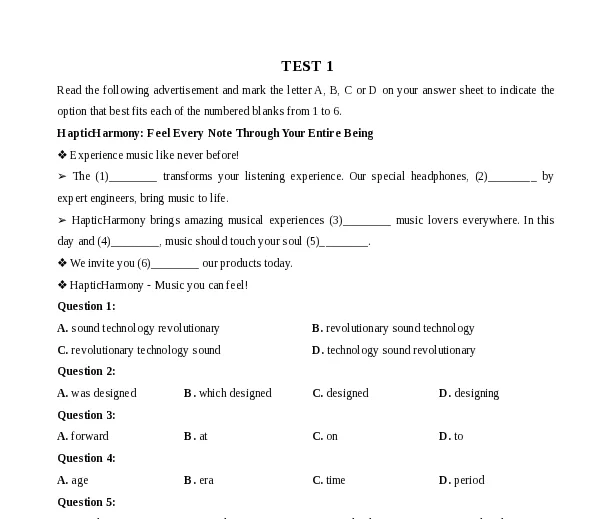
Read the following advertisement and announcement and mark the letter A, B, C, or D on your answer sheet to indicate the correct option that best fits each of the numbered blanks from 1 to 6.
DISCOVER GREEN LIVING WITH ECOHOME!
Are you looking for an effective way to reduce your carbon footprint? EcoHome is here to help you transform your lifestyle with our smart, energy-saving devices.
- Smart Thermostats: Regulate room temperatures automatically and save up to 25% on your monthly electricity (1) ______.
- Solar Lighting Kits: Easy to install, waterproof, and extremely durable, providing bright light without consuming power from the main (2) ______.
- Personalized Advice: Our team of environmental specialists will give you useful tips on how to live sustainably.
Visit our website today to get a special 15% discount on your first order! If you have any inquiries, please do not hesitate to contact our customer support team. Let’s work together to create a (3) ______ future for the next generations!
Question 1.
A. fee
B. bill
C. fare
D. fine
Question 2.
A. grid
B. wire
C. line
D. pole
Question 3.
A. sustain
B. sustainably
C. sustainability
D. sustainable
ANNOUNCEMENT OF THE ANNUAL SCHOOL SCIENCE FAIR
The School Youth Union is pleased to announce the organization of our Annual Science Fair:
- Time: 8:00 AM – 4:30 PM, Saturday, November 15th
- Location: The Main Hall and School Courtyard
This year's theme is "Artificial Intelligence in Everyday Life". All classes are required to register their science projects with the organizing board (4) ______ October 25th.
- Each team should consist of no more than five students.
- Projects will be judged on creativity, practical application, and presentation skills.
- The winning teams will be (5) ______ prestigious awards and certificates of merit.
For detailed guidelines and registration forms, please (6) ______ the school website or meet Mr. Hoang in Room 204 during office hours.
Question 4.
A. by
B. on
C. at
D. in
Question 5.
A. earned
B. admitted
C. awarded
D. accepted
Question 6.
A. call on
B. look up
C. refer to
D. get off
Read the following leaflet and mark the letter A, B, C, or D on your answer sheet to indicate the correct option that best fits each of the numbered blanks from 7 to 12.
TIPS FOR BALANCING SCREEN TIME AND WELL-BEING
In today's digital era, technology has become an indispensable part of our daily routines. However, spending excessive time on digital gadgets can take a heavy toll on your physical and emotional health. Here are several practical strategies to maintain a healthy digital balance:
- Take Frequent Breaks: Follow the 20-20-20 rule. Every 20 minutes, take a break for at least 20 seconds and focus your eyes on an object that is at least 20 feet (7) ______. This simple habit helps minimize digital eye strain significantly.
- Establish "Tech-Free" Zones: Designate particular areas in your home, such as the bedroom or the dining table, where screens are strictly prohibited. This will allow you to enjoy quality time with family members without any digital (8) ______.
- Set Daily Boundaries: Limit your recreational screen use to no more than two hours a day. Spend (9) ______ time engaging in outdoor sports, reading paper books, or pursuing creative hobbies.
- Avoid Screens Before Bed: The blue light (10) ______ by smartphones and tablets interferes with melatonin production, which makes it harder for you to fall asleep. Turn off all electronic devices at least one hour prior to bedtime.
- Prioritize Meaningful Interactions: Social media can create a false sense of connection. Do not rely entirely on texting; instead, make an effort to (11) ______ touch with your friends and loved ones through direct conversations.
- Be Mindful of Notifications: Disable non-essential app alerts so that you can concentrate on your studies and work without (12) ______ interrupted.
Question 7.
A. out
B. away
C. far
D. along
Question 8.
A. distract
B. distractingly
C. distractions
D. distracted
Question 9.
A. more
B. many
C. few
D. each
Question 10.
A. emitting
B. emitted
C. which emits
D. is emitted
Question 11.
A. make
B. take
C. keep
D. hold
Question 12.
A. being
B. having been
C. to be
D. be
Mark the letter A, B, C, or D on your answer sheet to indicate the correct arrangement of the sentences to make a meaningful exchange or text in each of the following questions from 13 to 17.
Question 13.
a. Nam: That sounds like a wonderful opportunity! What kind of volunteer work will you do?
b. Lan: I'm planning to join the community clean-up campaign in our neighborhood this weekend.
c. Lan: We will collect plastic waste around the park and plant more flowers along the walking paths.
A. b – a – c
B. a – c – b
C. c – b – a
D. b – c – a
Question 14.
a. Peter: Certainly! There's an art exhibition in the city center and an outdoor acoustic concert in the central park.
b. Peter: I'm glad you like the idea. Shall we book the concert tickets online right now?
c. Mary: An outdoor concert sounds really exciting! I've been studying hard all week and need to relax.
d. Mary: Hi, Peter! Do you have any recommendations for fun activities this Saturday evening?
e. Mary: Yes, please. Let's do that immediately before they sell out.
A. d – c – a – b – e
B. d – a – c – b – e
C. a – d – c – b – e
D. d – b – a – c – e
Question 15.
Hi Sarah,
a. In addition, taking regular evening walks has significantly improved my sleep quality and energy levels.
b. I hope everything is going well with you in London.
c. Let me know if you would like to join me for a morning run sometime next week!
d. Recently, I've decided to adopt a healthier daily routine by cooking balanced meals at home instead of ordering fast food.
e. It was difficult at first, but now I feel much more refreshed and productive throughout the day.
Best wishes,
Mai
A. b – d – e – a – c
B. b – a – d – e – c
C. d – e – a – b – c
D. b – d – a – e – c
Question 16.
a. Over the past few decades, urbanization has accelerated rapidly across developing nations.
b. Consequently, authorities must implement well-planned infrastructure projects to build more sustainable urban centers.
c. This trend has provided rural residents with broader career prospects and improved public amenities.
d. However, it has also triggered major urban challenges, including traffic congestion, air pollution, and housing shortages.
e. As cities expand continuously, large numbers of people migrate from rural communities in search of higher living standards.
A. a – e – c – d – b
B. a – c – e – d – b
C. e – a – c – d – b
D. a – e – d – c – b
Question 17.
a. First, active participation in clubs allows undergraduates to develop essential soft skills such as teamwork, leadership, and conflict resolution.
b. Furthermore, being part of a vibrant student community broadens one's social network, establishing valuable professional connections for future employment.
c. In conclusion, engaging in campus clubs not only enriches academic life but also prepares students comprehensively for their upcoming careers.
d. Joining extracurricular clubs is widely considered one of the most rewarding experiences for university students.
e. Finally, it provides an effective outlet for stress relief after demanding hours of lectures and examinations.
A. d – b – a – e – c
B. d – a – b – e – c
C. a – d – b – e – c
D. d – a – e – b – c
Read the following passage and mark the letter A, B, C, or D on your answer sheet to indicate the correct option that best fits each of the numbered blanks from 18 to 22.
Lifelong learning has emerged as one of the most vital concepts in modern education and career development. In the contemporary fast-changing world driven by continuous technological advancements, the knowledge acquired during formal schooling can quickly become obsolete. Therefore, individuals must constantly acquire new competencies (18) ______.
One of the primary benefits of lifelong learning is its positive impact on employability. As automation and artificial intelligence reshape the global job market, many traditional professions are disappearing, (19) ______. Professionals who commit to continuous learning are better positioned to adapt to these fluctuations. By taking online courses, attending professional seminars, or mastering new digital tools, (20) ______.
Furthermore, lifelong learning plays an indispensable role in maintaining mental sharp-mindedness and overall personal satisfaction. Engaging in intellectually stimulating activities stimulates the brain, which can delay cognitive decline in older adults. (21) ______. People who actively explore novel interests, such as learning a musical instrument or studying a foreign language, often experience a profound sense of fulfillment and self-confidence.
In order to cultivate a habit of lifelong learning, individuals should maintain an open mindset and take personal initiative. Rather than perceiving education as a temporary phase that ends with graduation, (22) ______. In doing so, they not only secure their professional relevance but also lead richer, more meaningful lives.
Question 18.
A. so that they can remain competitive and adaptable in their chosen fields
B. although they might face unexpected difficulties during their studies
C. which prevents them from keeping pace with modern industry standards
D. because of their reluctance to embrace innovative technologies
Question 19.
A. while new roles requiring specialized digital and interpersonal skills emerge
B. because traditional occupations continue to dominate the entire employment landscape
C. whereas employers are reluctant to hire workers with diverse technological backgrounds
D. since job opportunities in technology sectors have experienced a noticeable decrease
Question 20.
A. their careers will be seriously disrupted by modern technological innovations
B. workers can broaden their expertise and enhance their career progression prospects
C. the existing educational system will undergo comprehensive and radical reform
D. employers may find it increasingly difficult to assess candidates' actual abilities
Question 21.
A. Besides, it fosters personal curiosity and encourages a deeper understanding of the world
B. However, excessive intellectual exertion may lead to cognitive fatigue and distress
C. In contrast, social interactions are considered much more beneficial to human psychology
D. Therefore, learning new skills should be limited exclusively to formal academic settings
Question 22.
A. one must acknowledge that formal qualifications are the sole guarantee of career success
B. adults should view education as an ongoing, voluntary journey of self-improvement
C. society ought to restrict educational resources to younger demographic groups
D. learners are advised to depend entirely on traditional teaching methodologies
Read the following passage and mark the letter A, B, C, or D on your answer sheet to indicate the correct answer to each of the questions from 23 to 30.
Ecotourism has gained remarkable momentum worldwide over recent decades as travelers increasingly seek out authentic experiences that respect the natural world. Unlike conventional mass tourism, which frequently leads to environmental degradation and cultural commodification, ecotourism emphasizes responsible travel to fragile, pristine, and relatively undisturbed natural areas. Its core purpose is to educate visitors, foster ecological conservation, and directly benefit the socio-economic welfare of local communities.
One of the fundamental pillars of ecotourism is environmental preservation. Revenue generated from entrance fees, guided nature treks, and eco-lodge accommodations is often channeled directly into funding wildlife reserves and reforestation programs. For instance, in Costa Rica, where extensive national parks encompass lush rainforests and active volcanoes, ecotourism receipts have helped reverse decades of severe deforestation. Local authorities and international conservation bodies utilize these financial resources to patrol protected territories, combat illegal poaching, and conduct vital ecological research.
Equally important is the active engagement and empowerment of indigenous populations. In many conventional tourism destinations, profits are largely siphoned off by foreign-owned hotel chains and multinational tour operators, leaving host communities with low-paying seasonal jobs. Ecotourism, by contrast, prioritizes community-based enterprises. Local residents are trained and employed as naturalists, boat operators, artisanal culinary hosts, and park rangers. This direct economic inclusion incentivizes indigenous inhabitants to protect their natural habitats rather than exploit them through destructive practices such as logging or overfishing.
Nevertheless, the rapid expansion of ecotourism is not devoid of pitfalls. A major dilemma is the phenomenon known as "greenwashing," where unscrupulous commercial operators label their services as eco-friendly without implementing genuine sustainability measures. Furthermore, unrestricted influxes of visitors into delicate ecosystems can inadvertently disturb animal nesting grounds, accelerate soil erosion, and generate excessive waste. Therefore, stringent regulatory frameworks and strict visitor quotas are imperative to guarantee that ecotourism remains true to its founding ideals.
Question 23. Which of the following is the best title for the passage?
A. The Financial Consequences of Mass Tourism in Developing Nations
B. Ecotourism: Principles, Benefits, and Emerging Challenges
C. The Threat of Poaching and Deforestation in Modern National Parks
D. How Indigenous Communities Manage Global Travel Enterprises
Question 24. According to paragraph 1, ecotourism differs from traditional mass tourism in that it ______.
A. focuses on building luxurious resorts in remote rural landscapes
B. discourages travelers from engaging directly with local cultures
C. emphasizes responsible travel and benefits local communities
D. prioritizes maximizing tourism revenue over ecological preservation
Question 25. The word siphoned off in paragraph 3 is closest in meaning to ______.
A. redistributed
B. diverted
C. generated
D. invested
Question 26. The phrase by contrast in paragraph 3 is used to ______.
A. highlight a difference between conventional tourism and ecotourism
B. provide an example of environmental degradation in coastal regions
C. summarize the financial achievements of multinational corporations
D. introduce the historical origin of community-based tourism
Question 27. The word them in paragraph 3 refers to ______.
A. local residents
B. natural habitats
C. foreign-owned hotel chains
D. seasonal jobs
Question 28. Which of the following is NOT mentioned in paragraph 2 as an initiative supported by ecotourism funds?
A. Funding wildlife reserves and reforestation projects
B. Patrolling protected areas to prevent poaching
C. Providing free accommodation for all international travelers
D. Conducting scientific research on local ecosystems
Question 29. Which of the following is TRUE according to the passage?
A. Costa Rica has abandoned its ecotourism initiatives due to severe deforestation.
B. "Greenwashing" refers to operators genuinely applying sustainable principles.
C. Unchecked visitor numbers can cause unintended damage to fragile ecosystems.
D. Ecotourism ensures that no waste is ever produced in national parks.
Question 30. Which of the following can be inferred from the passage?
A. Ecotourism can only succeed if host communities are completely excluded from commercial operations.
B. Without strict enforcement of regulations, ecotourism risks harming the very environments it aims to protect.
C. Modern travelers are losing interest in educational and sustainable vacation choices.
D. Mass tourism will soon be entirely replaced by community-based ecotourism projects.
Read the following passage and mark the letter A, B, C, or D on your answer sheet to indicate the correct answer to each of the questions from 31 to 40.
The transition from fossil fuels to renewable energy sources represents one of the most critical endeavors of the twenty-first century. For more than two centuries, the global economy has been propelled by coal, oil, and natural gas. However, the combustion of these hydrocarbons has released unprecedented volumes of greenhouse gases into the atmosphere, precipitating climate disruptions, rising sea levels, and catastrophic weather events. [I] To mitigate these existential threats, governments and energy corporations around the globe are investing colossal sums in clean technologies, predominantly solar photovoltaic systems, wind turbines, and hydroelectric power plants.
Among the various forms of renewable energy, solar and wind power have witnessed the most dramatic cost reductions. Advances in photovoltaic cell manufacturing and aerodynamic turbine engineering have driven prices down to levels that are now competitive with, or even lower than, those of conventional fossil-fuel power stations in many geographic regions. [II] In addition, public policies such as carbon pricing, feed-in tariffs, and tax subsidies have accelerated the adoption of these decentralized energy systems. Many developing economies are now leapfrogging traditional fossil-based power grids altogether, opting instead for localized solar microgrids in rural settlements.
Despite this remarkable progress, the transition to renewable energy faces formidable technical and logistical hurdles. The most prominent obstacle is intermittency: solar panels generate electricity only during daylight hours, while wind turbines depend on unpredictable wind patterns. [III] Because existing power networks were originally engineered for steady, centralized power output, integrating large proportions of fluctuating renewable electricity requires sophisticated modernization. Advanced grid management systems, long-distance high-voltage transmission lines, and large-scale battery storage facilities are indispensable to smooth out these supply variations and ensure unbroken electrical delivery.
Another critical consideration involves the geopolitical and environmental dimensions of renewable infrastructure. While clean energy technologies do not emit carbon during operation, their manufacturing processes require considerable quantities of critical minerals, including lithium, cobalt, nickel, and rare earth elements. The extraction and processing of these raw materials are concentrated in a handful of countries, creating precarious supply chains susceptible to geopolitical tensions. [IV] Moreover, poorly regulated mining activities can inflict severe environmental damage on local water supplies and ecosystems, undermining the ecological integrity of the green transition.
Ultimately, achieving a fully decarbonized energy paradigm will require a holistic and multifaceted approach. Technological innovation must be complemented by international cooperation, responsible supply chain governance, and circular economy practices such as battery recycling. Only through concerted, equitable efforts can humanity establish an energy system that is both environmentally sustainable and economically resilient.
Question 31. Where in paragraph 1 does the following sentence best fit?
This reliance on fossil fuels, while driving industrialization, has exacted an enormous ecological price.
A. [I]
B. [II]
C. [III]
D. [IV]
Question 32. Which of the following is the main idea of paragraph 2?
A. The dominance of hydroelectric power plants across developing nations
B. The rapid cost decrease and accelerated deployment of solar and wind energy
C. The technical failures of centralized power distribution networks
D. The international disagreement over the enforcement of carbon pricing
Question 33. The word precipitating in paragraph 1 is closest in meaning to ______.
A. predicting
B. triggering
C. preventing
D. evaluating
Question 34. The word intermittency in paragraph 3 mostly refers to ______.
A. the continuous flow of electric power through high-voltage wires
B. the high financial cost of maintaining renewable power equipment
C. the irregular and non-continuous nature of solar and wind energy generation
D. the inability of power stations to transport electricity over long distances
Question 35. According to paragraph 3, which of the following is necessary to cope with the fluctuating supply of renewable power?
A. Returning completely to coal-fired power stations during nighttime
B. Reducing the total amount of energy consumed by urban factories
C. Employing large-scale battery storage and advanced grid management
D. Eliminating high-voltage transmission lines from regional networks
Question 36. The word their in paragraph 4 refers to ______.
A. clean energy technologies
B. transmission lines
C. greenhouse gases
D. fossil-fuel power stations
Question 37. Which of the following is NOT true according to paragraph 4?
A. Clean energy technologies produce zero carbon emissions while operating.
B. The extraction of critical minerals requires no environmental oversight.
C. The processing of lithium and cobalt is heavily concentrated in certain nations.
D. Mining of rare minerals can cause detrimental damage to water supplies.
Question 38. Which of the following best paraphrases the underlined sentence in paragraph 5?
“Technological innovation must be complemented by international cooperation, responsible supply chain governance, and circular economy practices such as battery recycling.”
A. Technological breakthroughs alone are insufficient; they must be accompanied by global collaboration, ethical material sourcing, and recycling systems.
B. International cooperation is the only requirement to resolve the technical and financial shortcomings of battery recycling systems.
C. Without new technological inventions, governments cannot engage in international diplomacy or enforce mineral recycling policies.
D. Battery recycling will eventually replace the need for technological progress and international treaties in the clean energy industry.
Question 39. Which of the following can be inferred from the passage?
A. Developing nations are legally prohibited from installing decentralized solar microgrids.
B. The green transition might unintentionally create new environmental and geopolitical vulnerabilities if mineral sourcing is not managed carefully.
C. Solar and wind energy will remain significantly more expensive than fossil fuels for the foreseeable future.
D. Power grids originally designed for fossil fuels can easily absorb intermittent green energy without any technological modification.
Question 40. Which of the following best summarizes the entire passage?
A. The global shift toward renewables offers great climate benefits and economic potential, but overcoming technological, material, and geopolitical challenges requires a comprehensive approach.
B. While fossil fuels are becoming too expensive, renewable energy sources have failed to supply sufficient power to industrial economies.
C. The environmental hazards of lithium and cobalt mining far outweigh any benefits provided by wind and solar power generation.
D. International disputes over fossil fuel reserves will soon be resolved by the universal adoption of localized solar microgrids.
--------- HẾT ---------
Thí sinh không được sử dụng tài liệu. Cán bộ coi thi không giải thích gì thêm.