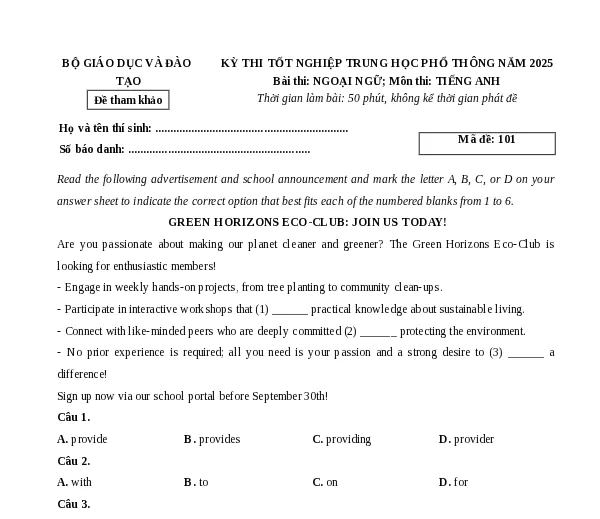
BỘ GIÁO DỤC VÀ ĐÀO TẠO
ĐỀ THI THAM KHẢO
Đề chính thức
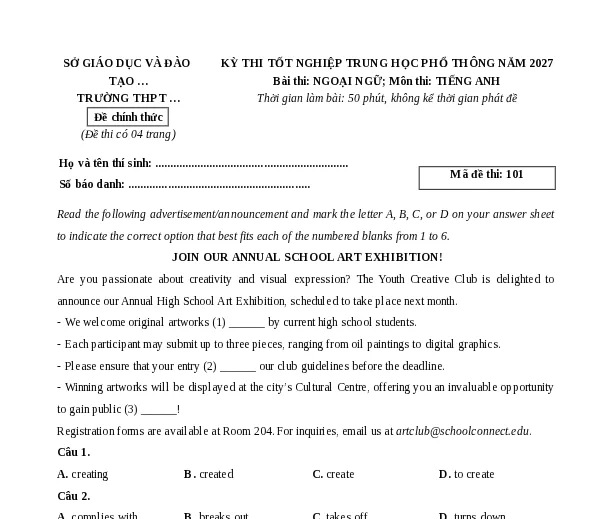
KỲ THI TỐT NGHIỆP TRUNG HỌC PHỔ THÔNG NĂM 2025
Bài thi: NGOẠI NGỮ; Môn thi: TIẾNG ANH
Thời gian làm bài: 50 phút, không kể thời gian phát đề
Họ và tên thí sinh: ................................................................ Số báo danh: ............................................................ | Mã đề: 101 |
Read the following advertisement/announcement and mark the letter A, B, C, or D on your answer sheet to indicate the correct option that best fits each of the numbered blanks from 1 to 6.
GREEN CAMPUS INITIATIVE: CALL FOR STUDENT AMBASSADORS!
Are you passionate about environmental conservation and eager to lead meaningful change in our school? Join the Green Campus Initiative today!
- As a student ambassador, you will be responsible for (1) ______ awareness of sustainable waste management among your peers.
- Participants will collaborate closely with faculty members to (2) ______ innovative solutions for plastic reduction.
- After (3) ______ our intensive weekend leadership workshop, successful applicants will receive an official certification.
For further details and application guidelines, please reach (4) ______ to the Student Affairs Office or check our official portal before October 15.
Câu 1.
A. raising
B. rising
C. promoting
D. enlarging
Câu 2.
A. carry out
B. come up with
C. look down on
D. put up with
Câu 3.
A. attend
B. attended
C. having attended
D. to attend
ANNOUNCEMENT OF CAMPUS LIBRARY RENOVATION
The School Administration wishes to announce the upcoming renovation of the Central Library:
- The facility will undergo comprehensive modernization, (5) ______ may cause temporary disruptions to student study spaces.
- Students are kindly requested to return all borrowed books prior to the closure date.
- We apologize for (6) ______ inconvenience caused and appreciate your full cooperation during this period.
Câu 4.
A. in
B. at
C. out
D. for
Câu 5.
A. what
B. which
C. that
D. who
Câu 6.
A. an
B. the
C. a
D. Ø (no article)
Read the following leaflet and mark the letter A, B, C, or D on your answer sheet to indicate the correct option that best fits each of the numbered blanks from 7 to 12.
MASTERING DIGITAL CITIZENSHIP IN THE 21ST CENTURY
Navigating the contemporary online landscape requires critical awareness and responsible conduct. Keep these essential principles in mind:
- Protect Personal Identity: Avoid sharing sensitive personal data indiscriminately across social networks. Cybercriminals often rely (7) ______ subtle oversights to gain unauthorized access to private accounts.
- Combat Misinformation: Always cross-examine online sources before endorsing or forwarding news stories. Refraining from spreading unverified rumors is fundamental to maintaining (8) ______ healthy digital sphere.
- Promote Constructive Discourse: Having acknowledged (9) ______ hateful remarks in online forums in the past, many adolescents have pledged to practice constructive engagement, (10) ______ greatly contributes to a safer cyberspace for everyone.
- Report Cyberbullying: When encountering harassment, do not hesitate to (11) ______ abusive users immediately to platform moderators instead of retaliating.
- Maintain Digital Balance: Excessive screen time can impair cognitive performance. Allocate ample time for offline physical activities to ensure (12) ______ well-being.
Câu 7.
A. on
B. in
C. with
D. about
Câu 8.
A. an
B. the
C. a
D. Ø (no article)
Câu 9.
A. make
B. having made
C. to have made
D. be making
Câu 10.
A. that
B. which
C. what
D. where
Câu 11.
A. call off
B. turn down
C. report on
D. give up
Câu 12.
A. holistic
B. holistically
C. holism
D. wholeness
Mark the letter A, B, C, or D on your answer sheet to indicate the correct arrangement of the sentences to make a meaningful exchange or text in each of the following questions from 13 to 17.
Câu 13.
a. Minh: "That sounds like a great idea! What time should we meet at the community center?"
b. Lan: "Would you like to join our neighborhood tree-planting campaign this Saturday morning?"
c. Minh: "Eight o'clock works perfectly for me. See you then!"
d. Lan: "How about eight o'clock? That gives us plenty of time before it gets too hot."
A. b – a – d – c
B. b – c – a – d
C. a – b – d – c
D. d – c – b – a
Câu 14.
a. Nam: "I am really struggling to choose a topic for my graduation essay."
b. Nam: "Artificial intelligence in modern classrooms? That sounds captivating and highly relevant."
c. Mai: "Why don't you focus on the ethical implications of artificial intelligence in education?"
d. Mai: "Exactly, and there are abundant empirical studies available online to support your arguments."
A. a – b – c – d
B. a – c – b – d
C. c – b – a – d
D. b – a – c – d
Câu 15.
Dear Professor Evans,
a. Having reviewed the prerequisite syllabus, I am confident that my academic background aligns well with the seminar's objectives.
b. I am writing to formally request permission to enroll in your Advanced Cognitive Psychology course for the upcoming autumn semester.
c. Thank you very much for your time and kind consideration of my application.
d. Although the official registration deadline has passed, I hope you might consider accepting one additional student into your lecture cohort.
e. Please find attached my academic transcript and a brief letter of recommendation from Dr. Harrison.
Sincerely,
David Nguyen
A. b – a – d – e – c
B. b – d – a – e – c
C. a – b – d – c – e
D. d – b – a – e – c
Câu 16.
a. First, rapid urban growth places overwhelming strain on aging municipal transportation infrastructures.
b. Consequently, residents must endure persistent traffic congestion and deteriorating air quality on a daily basis.
c. Rapid urbanization presents modern metropolitan areas with numerous socio-economic predicaments.
d. To tackle these issues, city planners must invest heavily in sustainable public transit networks and green spaces.
e. Furthermore, inadequate housing supplies drive living expenses beyond the reach of low-income families.
A. c – a – b – e – d
B. c – e – a – b – d
C. a – b – c – e – d
D. c – a – e – b – d
Câu 17.
a. In addition, interacting with peers from distinct cultural backgrounds sharpens one's interpersonal communication skills.
b. Studying abroad offers university undergraduates transformative opportunities for both intellectual and personal growth.
c. Ultimately, navigating an unfamiliar academic environment fosters profound resilience and self-reliance.
d. Primarily, it exposes learners to innovative pedagogical methodologies that may not be available domestically.
e. These invaluable qualities prepare graduates thoroughly for the competitive demands of the global workforce.
A. b – d – a – c – e
B. b – a – d – c – e
C. d – a – b – c – e
D. b – d – c – a – e
Read the following passage and mark the letter A, B, C, or D on your answer sheet to indicate the correct option that best fits each of the numbered blanks from 18 to 22.
Lifelong learning has evolved from an optional pursuit into an indispensable requirement for professional survival in the twenty-first century. As automated systems and artificial intelligence continue to reshape conventional industries, (18) ______. Professionals who fail to update their technical proficiencies risk falling behind, (19) ______.
Recognizing this reality, progressive corporations are establishing dedicated upskilling programs for their staff. By participating in continuous professional development, (20) ______. Moreover, modern online education platforms have dismantled geographical barriers, (21) ______.
Nevertheless, acquiring new competencies requires genuine dedication and self-discipline. Many mid-career specialists admit to (22) ______, yet those who consistently dedicate time to expanding their intellectual horizons ultimately secure their long-term employability.
Câu 18.
A. established skill sets are becoming obsolete at an unprecedented pace
B. which causes conventional career trajectories to disappear entirely
C. because manual labor retains complete dominance in all sectors
D. despite economic models remaining largely unchanged over decades
Câu 19.
A. which highlights the critical urgency of continuous personal development
B. that makes employers dismiss the necessity of employee training
C. whom educational institutions fail to accommodate adequately
D. what creates permanent job security in traditional manufacturing
Câu 20.
A. employees can adapt flexibly to changing industrial landscapes
B. adaptation to industrial changes is neglected by senior executives
C. automated machinery will immediately replace human judgment
D. businesses may reduce their operational investment in research
Câu 21.
A. enabling motivated learners worldwide to access high-quality academic resources
B. to prevent non-traditional students from pursuing specialized degrees
C. where traditional universities have ceased all campus-based teaching
D. which restricting underprivileged communities from acquiring digital literacy
Câu 22.
A. having struggled to balance rigorous workplace demands with study schedules
B. struggle to keep up with daily vocational routines without assistance
C. to have avoided all opportunities for professional advancement
D. have experienced profound difficulty during their university years
Read the following passage and mark the letter A, B, C, or D on your answer sheet to indicate the correct answer to each of the questions from 23 to 30.
The circular economy has emerged as a compelling alternative to the traditional linear economic paradigm characterized by the "take-make-dispose" model. In a conventional linear system, finite natural resources are extracted, transformed into consumer goods, and ultimately discarded as waste once their utility diminishes. This unsustainable trajectory has precipitated acute resource depletion, escalating carbon emissions, and catastrophic environmental degradation. In contrast, the circular framework seeks to decouple economic expansion from resource consumption by preserving the intrinsic value of products, components, and materials for as long as possible.
At the core of the circular model lie three foundational principles: designing out waste and pollution, keeping products and materials in productive use, and regenerating natural systems. Instead of treating discarded products as worthless refuse, manufacturers operating within a circular framework conceive products with longevity, reparability, and recyclability in mind from the outset. Modular smartphones, for instance, permit consumers to replace individual defective components—such as a battery or camera module—without discarding the entire apparatus, thereby dramatically curbing electronic waste.
Furthermore, transitioning toward circularity demands an overhaul of conventional business models. Rather than relying exclusively on outright sales of physical goods, enterprises are increasingly adopting "product-as-a-service" systems. Under this arrangement, companies retain ownership of their products and furnish consumers with operational performance rather than tangible hardware. For example, several lighting corporations now lease illumination services to commercial facilities, assuming full responsibility for maintenance, repair, and end-of-life recycling. This structure incentivizes manufacturers to engineer durable, energy-efficient equipment rather than goods engineered for planned obsolescence.
Nevertheless, the global transition to a circular economy is fraught with logistical and structural impediments. Global supply chains remain predominantly configured for linear extraction, and secondary recycled materials frequently struggle to compete on cost with virgin raw materials. Overcoming these entrenched hurdles requires comprehensive legislative interventions, such as mandatory extended producer responsibility schemes, coupled with substantial investments in recycling infrastructure and cross-industry collaboration.
Câu 23. Which of the following is the best title for the passage?
A. The Inevitable Downfall of Global Manufacturing
B. The Circular Economy: Redefining Sustainable Production and Consumption
C. Technological Breakthroughs in Consumer Electronics
D. The Financial Burdens of Industrial Waste Management
Câu 24. According to paragraph 1, the traditional linear economic model is problematic primarily because it ______.
A. discourages consumers from purchasing newly engineered products
B. relies entirely on state subsidies rather than free-market incentives
C. depletes finite natural reserves and generates enormous environmental harm
D. prevents multinational enterprises from expanding into foreign markets
Câu 25. The word "discarding" in paragraph 2 is closest in meaning to ______.
A. throwing away
B. holding back
C. looking into
D. putting off
Câu 26. The word "obsolescence" in paragraph 3 is closest in meaning to the state of being ______.
A. innovative
B. out of date
C. cost-effective
D. eco-friendly
Câu 27. The phrase "this arrangement" in paragraph 3 refers to ______.
A. planned obsolescence
B. outright sale of physical goods
C. product-as-a-service system
D. electronic waste disposal
Câu 28. Which of the following is NOT mentioned in paragraph 2 as a guiding principle of the circular economy?
A. Regenerating living natural ecosystems
B. Designing out environmental pollution and waste
C. Maintaining materials and products in use
D. Maximizing extraction of non-renewable fossil fuels
Câu 29. Which of the following can be inferred from the passage?
A. Virgin raw materials are consistently more expensive than recycled secondary materials.
B. Product-as-a-service models encourage manufacturers to construct flimsy products that degrade quickly.
C. Systemic regulatory policies and infrastructure overhauls are indispensable for circular transitions.
D. Electronic waste has been entirely eradicated through the introduction of modular smart devices.
Câu 30. Which of the following is TRUE according to the passage?
A. Modular design enables consumers to upgrade specific parts without abandoning the whole device.
B. Commercial enterprises lose financial viability when offering lighting as a lease service.
C. The linear economy prioritizes material recycling over natural resource extraction.
D. Cross-industry collaboration is deemed unnecessary by current circular economy advocates.
Read the following passage and mark the letter A, B, C, or D on your answer sheet to indicate the correct answer to each of the questions from 31 to 40.
The rapid proliferation of generative artificial intelligence (AI) has reignited profound debates surrounding the future of human intellect, creative expression, and workplace autonomy. Unlike preceding waves of automation, which primarily displaced routine mechanical labor in factories and agricultural fields, modern generative algorithms demonstrate uncanny proficiency in tasks once considered the exclusive sanctuary of human cognition—such as synthesizing complex literature, writing software code, and composing visual art. [I] Consequently, white-collar professionals across diverse industries find themselves re-evaluating their professional indispensability.
Proponents argue that generative AI functions as a cognitive amplifier rather than an outright replacement. By delegating tedious, repetitive administrative duties to automated agents, human knowledge workers can redirect their energy toward higher-order strategic deliberation, nuanced ethical evaluation, and empathetic interpersonal collaboration. In medical diagnostics, for instance, machine learning models can sift through vast troves of radiological scans with astonishing velocity, flagging subtle anomalies that might elude the human eye. [II] Rather than supplanting licensed physicians, these tools empower clinicians to make more accurate prognostic assessments while devoting more time to compassionate bedside patient care.
Conversely, skeptics caution against the creeping erosion of fundamental human capabilities caused by over-reliance on automated cognition. When individuals consistently depend on algorithms to draft correspondence, summarize research, or resolve analytical quandaries, their capacity for critical reasoning and deep synthesis may atrophy over time. [III] Furthermore, algorithmic outputs often exhibit subtle "hallucinations"—confidently fabricated assertions presented as verifiable facts. Lacking deep domain expertise, uncritical users risk absorbing and propagating these insidious falsehoods, thereby polluting the broader intellectual ecosystem. [IV]
Addressing these profound dilemmas requires cultivating what educational theorists term "AI literacy." Rather than either banning generative technologies outright or succumbing to uncritical technological determinism, educational institutions and corporate training regimes must instruct individuals in rigorous algorithmic critique. Learners must be taught how to interrogate AI methodologies, detect algorithmic bias, and cross-reference automated outputs against authoritative primary sources. Cultivating these analytical faculties ensures that emerging generations will steer technological advancements responsibly, utilizing algorithmic power to augment, rather than diminish, human dignity and intellectual vigor.
Câu 31. Which of the following best expresses the main idea of the passage?
A. Generative AI will inevitably replace all medical professionals and software engineers within decades.
B. The impact of generative AI presents both powerful cognitive enhancements and profound cognitive risks, necessitating critical AI literacy.
C. Educational institutions should strictly prohibit algorithmic technologies to preserve student critical thinking.
D. Previous waves of industrial automation were far more disruptive to society than contemporary algorithmic systems.
Câu 32. According to paragraph 1, generative AI differs from earlier forms of automation because it ______.
A. focuses strictly on manual tasks in manufacturing environments
B. operates without requiring any electricity or computational power
C. performs tasks involving cognitive and creative domains once exclusive to humans
D. has been unanimously rejected by white-collar knowledge workers worldwide
Câu 33. The word "sanctuary" in paragraph 1 is closest in meaning to ______.
A. protected realm
B. dangerous hazard
C. public market
D. temporary obstacle
Câu 34. The word "supplanting" in paragraph 2 is closest in meaning to ______.
A. assisting
B. replacing
C. consulting
D. evaluating
Câu 35. The word "their" in paragraph 3 refers to ______.
A. individuals
B. algorithms
C. quandaries
D. capabilities
Câu 36. Which of the following is NOT true according to paragraph 2?
A. Generative AI can relieve workers of repetitive administrative burdens.
B. Machine learning algorithms can process radiological data with high speed.
C. Physicians are expected to abandon all direct patient interactions due to AI.
D. AI integration can facilitate more accurate diagnostic assessments.
Câu 37. The author describes algorithmic "hallucinations" in paragraph 3 as ______.
A. deliberate jokes created by programmers to entertain users
B. fabricated statements presented plausibly as authentic facts
C. visual illusions that temporarily blind computer operators
D. software updates designed to improve computational speed
Câu 38. Which of the following best paraphrases the underlined sentence in paragraph 4: "Rather than either banning generative technologies outright or succumbing to uncritical technological determinism, educational institutions and corporate training regimes must instruct individuals in rigorous algorithmic critique."?
A. Organizations should neither completely prohibit AI nor blindly surrender to it; instead, they must train people to evaluate algorithms critically.
B. Schools must forbid generative AI systems because employees refuse to embrace corporate training programs.
C. Because technological determinism is unavoidable, institutions should ban all computational tools from academic curricula.
D. Teaching algorithmic criticism is futile unless governments completely outlaw generative technologies in workplaces.
Câu 39. Where in the passage does the following sentence best fit?
"This cognitive outsourcing could ultimately foster an illusion of competence while hollowed-out foundational skills languish."
A. [I]
B. [II]
C. [III]
D. [IV]
Câu 40. Which of the following can be most reasonably inferred from the passage?
A. Developing critical AI literacy allows societies to harness computational power without compromising intellectual rigor.
B. Unchecked technological expansion will naturally eliminate all forms of cognitive bias without human intervention.
C. Professionals with advanced domain expertise will soon become entirely irrelevant across all analytical fields.
D. Algorithmic tools generate flawless outputs whenever applied to scientific and medical research.
--------- HẾT ---------
ĐÁP ÁN VÀ HƯỚNG DẪN CHẤM
KỲ THI TỐT NGHIỆP THPT NĂM 2025 - MÔN TIẾNG ANH (MÃ ĐỀ 101)
BẢNG ĐÁP ÁN KHÁCH QUAN (MỖI CÂU ĐÚNG 0,25 ĐIỂM)
Câu | Đáp án | Câu | Đáp án | Câu | Đáp án | Câu | Đáp án |
|---|---|---|---|---|---|---|---|
1 | A | 11 | C | 21 | A | 31 | B |
2 | B | 12 | A | 22 | A | 32 | C |
3 | C | 13 | A | 23 | B | 33 | A |
4 | C | 14 | B | 24 | C | 34 | B |
5 | B | 15 | B | 25 | A | 35 | A |
6 | B | 16 | A | 26 | B | 36 | C |
7 | A | 17 | A | 27 | C | 37 | B |
8 | C | 18 | A | 28 | D | 38 | A |
9 | B | 19 | A | 29 | C | 39 | C |
10 | B | 20 | A | 30 | A | 40 | A |
GIẢI THÍCH CHI TIẾT CÁC CÂU NGỮ PHÁP TRỌNG TÂM:
- Câu 1: Cụm cố định raise awareness of something (nâng cao nhận thức).
- Câu 2: Cụm động từ come up with (nghĩ ra, nảy ra ý tưởng/giải pháp).
- Câu 3: After having attended: Danh động từ hoàn thành (perfect gerund) nhấn mạnh hành động hoàn thành khóa tập huấn trước khi nhận chứng chỉ.
- Câu 4: Cụm động từ reach out to somebody (liên hệ với ai).
- Câu 5: Đại từ quan hệ which đứng sau dấu phẩy thay thế cho toàn bộ mệnh đề phía trước (The facility will undergo comprehensive modernization).
- Câu 6: Dùng mạo từ xác định the vì danh từ inconvenience đã được xác định bởi ngữ cảnh việc tu sửa thư viện.
- Câu 7: Động từ đi kèm giới từ: rely on (dựa vào, trông cậy vào).
- Câu 8: Cụm danh từ đếm được số ít mang nghĩa "một môi trường/không gian số lành mạnh" dùng mạo từ bất định a healthy digital sphere.
- Câu 9: Động từ acknowledge đi với danh động từ hoàn thành having made để diễn tả việc thừa nhận một hành động đã xảy ra trong quá khứ.
- Câu 10: Mệnh đề quan hệ không xác định dùng , which thay thế cho toàn bộ sự việc phía trước (pledged to practice constructive engagement).
- Câu 11: Cụm động từ đi kèm giới từ: report somebody/something on/to... (ở đây report on/to mang nghĩa báo cáo hành vi).
- Câu 12: Vị trí trước danh từ well-being cần một tính từ bổ nghĩa: holistic well-being (sức khỏe toàn diện).
- Câu 18–22: Tích hợp liên kết mệnh đề nguyên nhân - hệ quả, mệnh đề quan hệ bổ nghĩa toàn câu (which highlights... ở câu 19), mệnh đề phân từ và cấu trúc danh động từ hoàn thành (admit to having struggled ở câu 22).
- Câu 39: Câu cần chèn bàn về "cognitive outsourcing" (việc thuê ngoài nhận thức / ỷ lại công nghệ) làm thui chột kĩ năng nền tảng, hoàn toàn khớp với ngữ cảnh vị trí [III] sau khi nói về nguy cơ suy giảm tư duy phản biện.