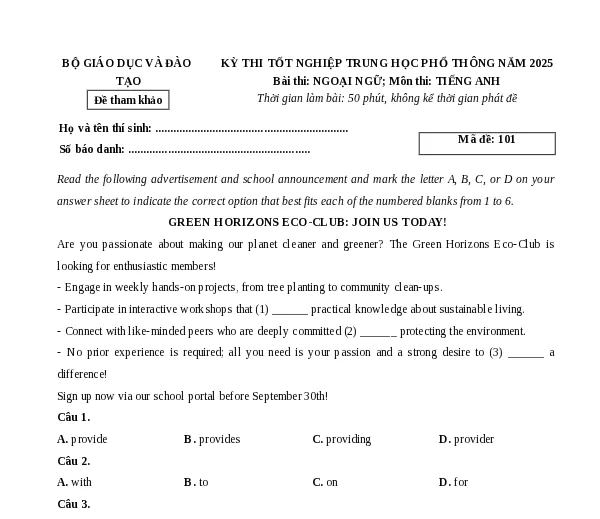
BỘ GIÁO DỤC VÀ ĐÀO TẠO
Đề tham khảo
KỲ THI TỐT NGHIỆP TRUNG HỌC PHỔ THÔNG NĂM 2025
Bài thi: NGOẠI NGỮ; Môn thi: TIẾNG ANH
Thời gian làm bài: 50 phút, không kể thời gian phát đề
Họ và tên thí sinh: ................................................................ Số báo danh: ............................................................ | Mã đề: 101 |
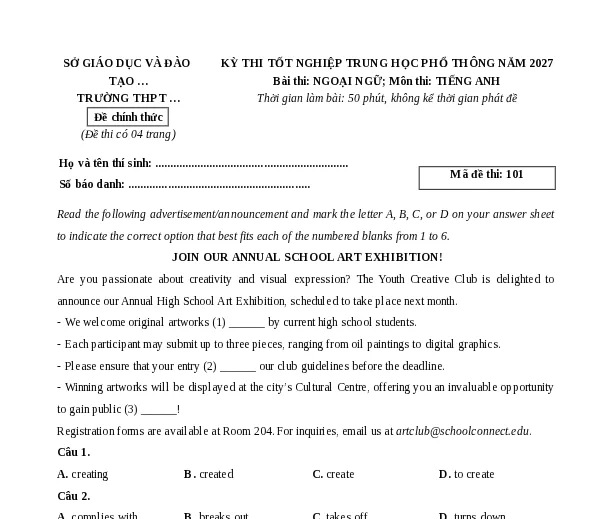
Read the following advertisement and mark the letter A, B, C, or D on your answer sheet to indicate the option that best fits each of the numbered blanks from 1 to 3.
JOIN OUR ECO-FRIENDLY YOUTH CLUB!
Are you passionate about protecting the environment? The Green Pioneers Club is looking for enthusiastic young volunteers!
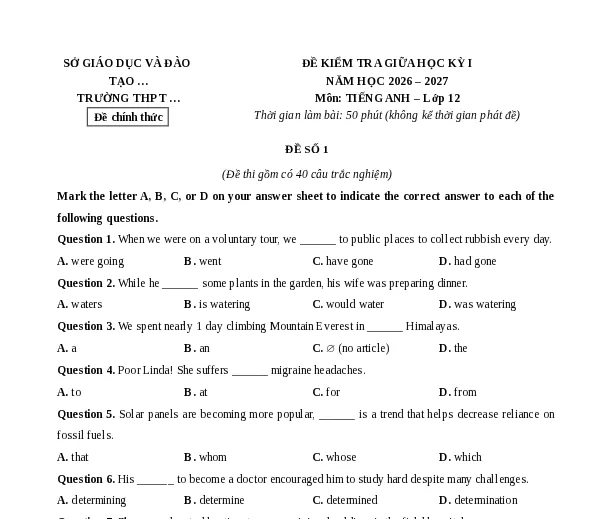
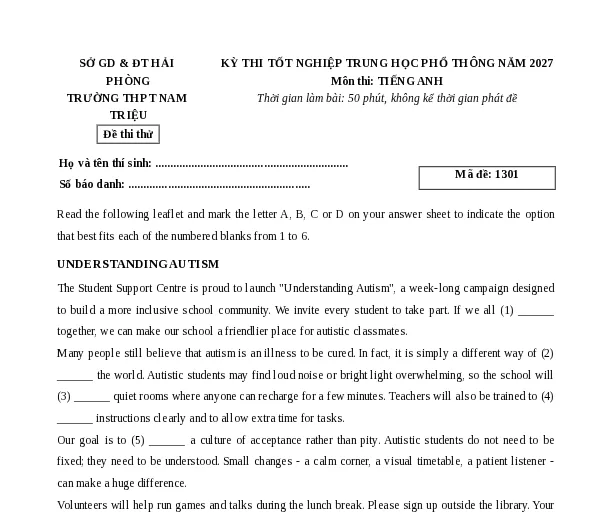
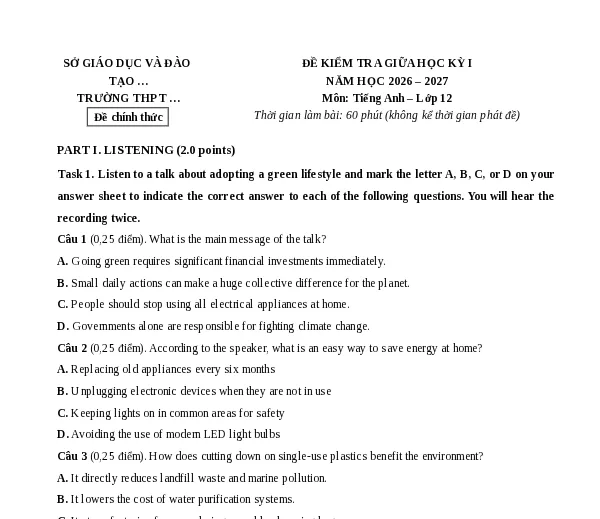
- Meaningful projects: Participate in local tree-planting events, beach clean-ups, and recycling workshops that really make a (1) ______ in our community.
- Valuable skills: Develop teamwork, leadership, and public speaking skills while working alongside like-minded friends.
- Convenient schedule: Activities are flexibly arranged on weekends, (2) ______ it easy for high school students to balance schoolwork and volunteering.
Don't hesitate! Please (3) ______ our online registration form at www.greenpioneers.org before October 15 to secure your spot.
Câu 1 (0,25 điểm).
A. difference
B. effort
C. choice
D. result
Câu 2 (0,25 điểm).
A. make
B. making
C. to make
D. made
Câu 3 (0,25 điểm).
A. fill out
B. break down
C. take over
D. turn off
Read the following announcement and mark the letter A, B, C, or D on your answer sheet to indicate the option that best fits each of the numbered blanks from 4 to 6.
ANNOUNCEMENT: SCHOOL CAREER ORIENTATION FAIR 2025
The School Youth Union is pleased to announce our annual Career Fair:
- Time: 8:00 AM – 4:30 PM, Saturday, November 22, 2025.
- Location: School Main Hall & Campus Yard.
All twelfth-graders are cordially invited to attend this special event. You will have an opportunity to listen to inspiring talks delivered by guest speakers from various fields, including artificial intelligence, digital marketing, and green energy. Representatives from prestigious universities will also offer personal (4) ______ regarding university admissions and career pathways.
Please note that students are required to wear formal school uniforms. To ensure smooth organization, please confirm your (5) ______ with your class monitor by this Friday. We look forward to seeing (6) ______ of you at the fair!
Câu 4 (0,25 điểm).
A. advise
B. advisory
C. advisor
D. advice
Câu 5 (0,25 điểm).
A. attendance
B. attention
C. allowance
D. entrance
Câu 6 (0,25 điểm).
A. every
B. all
C. each
D. another
Read the following leaflet and mark the letter A, B, C, or D on your answer sheet to indicate the option that best fits each of the numbered blanks from 7 to 12.
DIGITAL DETOX: RECLAIM YOUR TIME AND FOCUS!
In our hyper-connected world, many teenagers spend more than six hours daily staring at digital screens. Excessive screen time can harm sleep quality and trigger emotional distress. Here are practical steps to establish healthier digital habits:
- Set digital boundaries: Designate specific "screen-free zones" such as the dining table or your bedroom. Avoid using electronic devices at least one hour (7) ______ going to bed.
- Turn off unnecessary notifications: Frequent alerts and pop-ups constantly disrupt your focus, causing you to lose track of (8) ______ time you spend browsing social media.
- Engage in offline pastimes: Try replacing evening scrolling with reading physical books, doing physical exercise, or (9) ______ a musical instrument.
- Spend quality time with family: Meaningful personal conversations without the presence of smartphones can significantly (10) ______ interpersonal bonds.
- Use technology (11) ______: Leverage digital tools to learn and communicate productively rather than mindlessly consuming short videos.
If you (12) ______ regular digital detox sessions, you will soon experience better concentration and reduced stress levels. Start today!
Câu 7 (0,25 điểm).
A. prior to
B. in addition to
C. on behalf of
D. in terms of
Câu 8 (0,25 điểm).
A. many
B. how much
C. a number of
D. few
Câu 9 (0,25 điểm).
A. holding up
B. picking up
C. taking up
D. putting on
Câu 10 (0,25 điểm).
A. strengthen
B. shorten
C. weaken
D. widen
Câu 11 (0,25 điểm).
A. purposeful
B. purposefully
C. purpose
D. purposeless
Câu 12 (0,25 điểm).
A. practice
B. will practice
C. practiced
D. had practiced
Mark the letter A, B, C, or D on your answer sheet to indicate the correct arrangement of the sentences to make a meaningful exchange or text in each of the following questions from 13 to 17.
Câu 13 (0,25 điểm).
a. Nam: "That sounds like a great idea! Do we need to bring our own gloves and trash bags?"
b. Lan: "Our youth group is planning a cleanup campaign along the riverbank this Sunday morning. Would you like to join us?"
c. Lan: "No, everything will be provided by the organizers. Just remember to bring a reusable water bottle."
A. b – a – c
B. a – c – b
C. c – a – b
D. b – c – a
Câu 14 (0,25 điểm).
a. Tom: "I've been preparing for the IELTS exam, but I find it really difficult to manage my time in the Reading section."
b. Tom: "Thanks a lot! I'll try that technique during my practice test tomorrow."
c. Mai: "Why don't you try skimming the questions first to locate key terms before reading the whole passage?"
d. Mai: "Don't worry, many learners face that issue initially. Practice will definitely help you improve."
e. Tom: "Do you have any specific advice on how to locate the information faster?"
A. a – d – e – c – b
B. e – c – a – d – b
C. a – c – e – d – b
D. d – a – c – e – b
Câu 15 (0,25 điểm).
a. Dear Minh, I hope you are having a wonderful summer holiday with your family.
b. If you are free next Saturday afternoon, would you like to come over to my house to study together?
c. Our English teacher assigned a group presentation on renewable energy sources, and I think we should start working on it soon.
d. Please drop me a line whenever you read this email so that we can fix the schedule.
e. Best wishes, Phong.
A. a – c – b – d – e
B. a – b – c – d – e
C. c – a – b – d – e
D. b – c – a – d – e
Câu 16 (0,25 điểm).
a. In addition, automated translation applications allow travelers to communicate effortlessly across language barriers.
b. In conclusion, smart technology has transformed contemporary tourism into a far more accessible and enriching experience.
c. To begin with, tourists can now research destinations, compare airfares, and book accommodations within minutes using mobile apps.
d. Technological advancements have fundamentally altered how people plan and experience international journeys.
e. Furthermore, digital navigation systems eliminate the fear of getting lost in unfamiliar cities.
A. d – c – e – a – b
B. d – a – c – e – b
C. c – e – a – d – b
D. d – e – c – a – b
Câu 17 (0,25 điểm).
a. However, without proper time management, these tools can easily distract students from genuine cognitive thinking.
b. Today, generative artificial intelligence tools are becoming increasingly popular in educational settings.
c. Consequently, educators should guide learners to utilize technology responsibly as an aid rather than a replacement for personal effort.
d. When used constructively, they can act as virtual tutors that explain complex concepts and provide instant feedback.
e. For instance, learners may be tempted to submit AI-generated essays without thoroughly comprehending the content.
A. b – d – a – e – c
B. b – a – e – d – c
C. d – b – a – c – e
D. a – e – b – d – c
Read the following passage and mark the letter A, B, C, or D on your answer sheet to indicate the option that best fits each of the numbered blanks from 18 to 22.
Lifelong learning refers to the continuous, self-motivated pursuit of knowledge for either personal or professional reasons. In today's dynamic global economy, (18) ______. The rapid acceleration of automation and digital transformation has reshaped traditional workplace demands. Consequently, professionals who fail to adapt their competencies risk (19) ______.
One of the greatest benefits of embracing lifelong learning is that it fosters cognitive adaptability. When individuals regularly challenge their minds with new skills, (20) ______. Furthermore, acquiring varied competencies broadens career prospects, allowing workers to pivot into emerging industries with confidence.
Fortunately, continuing education has never been more accessible. Online platforms offer thousands of free and affordable courses across diverse disciplines, (21) ______. Learners can now study at their own pace without having to leave their homes or sacrifice existing employment commitments.
Ultimately, maintaining an inquisitive mindset is essential for long-term fulfillment. By viewing education as an ongoing journey rather than a temporary stage of youth, (22) ______.
Câu 18 (0,25 điểm).
A. learning a single trade in one's youth is no longer sufficient to guarantee lifetime employment
B. which guarantees that traditional degrees will remain the sole indicator of professional merit
C. people used to believe that formal schooling would adequately prepare anyone for life
D. because workers could effortlessly preserve their occupations without gaining new skills
Câu 19 (0,25 điểm).
A. being replaced by automated systems or technologically proficient competitors
B. having their professional qualifications recognized immediately by international firms
C. to achieve extraordinary milestones in corporate leadership positions
D. that they would easily outshine others without exerting further mental effort
Câu 20 (0,25 điểm).
A. their problem-solving capabilities and analytical faculties are significantly enhanced
B. but their memory capacity will gradually decline due to informational overload
C. so that young generations might neglect traditional educational values completely
D. although modern technology often complicates straightforward everyday tasks
Câu 21 (0,25 điểm).
A. which were exclusively reserved for wealthy individuals in urban metropolitan centers
B. ranging from coding and data analysis to foreign languages and graphic design
C. whose certificates have little practical application in contemporary corporate sectors
D. despite demanding that all participants attend physical lecture rooms daily
Câu 22 (0,25 điểm).
A. we can successfully navigate the complexities of an ever-changing world
B. one should rely entirely on government policies for personal career growth
C. people are unlikely to encounter any professional challenges in the future
D. students must prioritize recreational activities over academic development
Read the following passage and mark the letter A, B, C, or D on your answer sheet to indicate the correct answer to each of the questions from 23 to 30.
The circular economy is rapidly emerging as a revolutionary alternative to the traditional "take-make-waste" linear model of industrial production. For over a century, the global economy has operated on an unsustainable pattern: raw natural resources are extracted from the earth, manufactured into consumer goods, and then discarded into landfills after a relatively brief period of usage. This linear approach has precipitated severe environmental crises, including resource depletion, widespread pollution, and unprecedented quantities of plastic and electronic waste.
In contrast, the circular economy is built upon three foundational principles: eliminating waste and pollution through intelligent design, keeping products and materials in circulation at their highest utility, and regenerating natural ecosystems. Rather than treating items as disposable rubbish once their primary function ends, circular design ensures that materials are repaired, refurbished, remanufactured, or recycled back into industrial cycles. For example, some forward-thinking apparel brands now collect worn garments from customers, break down the synthetic fibers, and weave them into brand-new textile products.
Transitioning to a circular economic framework brings substantial socioeconomic benefits. Studies conducted by environmental think tanks indicate that circular strategies could diminish global greenhouse gas emissions by up to 40% by 2050, primarily by decreasing the demand for energy-intensive extraction and primary processing of raw materials. Furthermore, this systemic shift presents lucrative commercial prospects. Companies that embrace circular models often discover novel revenue streams, such as offering equipment leasing or product-as-a-service subscriptions rather than one-time sales.
Nevertheless, achieving a genuinely circular global economy requires overcoming formidable hurdles. Modern product supply chains are immensely intricate, with components originating from dozens of distinct nations, making material tracing and recovery extraordinarily challenging. Furthermore, recycling infrastructure in many developing regions remains severely underdeveloped. To accelerate this vital transition, governments must enforce progressive policies, such as extended producer responsibility laws, while consumers must reconsider their purchasing habits and demand durable, repairable goods.
(Adapted from Global Environmental Outlook, UNEP)
Câu 23 (0,25 điểm). Which of the following is the best title for the passage?
A. The High Cost of Conventional Manufacturing
B. Rethinking Production: The Rise of the Circular Economy
C. The Failure of Modern Waste Management Systems
D. How Global Apparel Brands Tackle Carbon Emissions
Câu 24 (0,25 điểm). According to paragraph 1, the traditional linear economic model is characterized by ______.
A. regenerating ecological systems through smart industrial practices
B. extracting natural materials, manufacturing goods, and discarding them as waste
C. keeping consumer goods in circulation for as long as possible
D. relying predominantly on synthetic fibers to minimize resource consumption
Câu 25 (0,25 điểm). The word regenerating in paragraph 2 is closest in meaning to ______.
A. renewing
B. consuming
C. polluting
D. ignoring
Câu 26 (0,25 điểm). The word them in paragraph 2 refers to ______.
A. circular principles
B. synthetic fibers
C. apparel brands
D. worn garments
Câu 27 (0,25 điểm). The word lucrative in paragraph 3 is closest in meaning to ______.
A. profitable
B. complex
C. risky
D. temporary
Câu 28 (0,25 điểm). Which of the following is NOT mentioned in paragraph 3 as a benefit of the circular economy?
A. Lowering worldwide greenhouse gas emissions
B. Creating new commercial business models
C. Completely eradicating corporate taxation
D. Reducing the demand for raw material extraction
Câu 29 (0,25 điểm). Which of the following statements is TRUE according to the passage?
A. Global supply chains are straightforward, making it easy to track materials for recycling.
B. The circular economy aims to eliminate pollution through deliberate product design.
C. All developing countries currently possess state-of-the-art recycling facilities.
D. The linear economic model has existed for less than two decades.
Câu 30 (0,25 điểm). Which of the following can be inferred from paragraph 4?
A. Voluntary corporate initiatives alone are insufficient to achieve a circular economy.
B. Developing nations should bear the entire burden of funding recycling infrastructure.
C. Consumers have virtually no role to play in promoting sustainable production.
D. Extended producer responsibility laws will harm sustainable business models.
Read the following passage and mark the letter A, B, C, or D on your answer sheet to indicate the correct answer to each of the questions from 31 to 40.
[I] Throughout human history, cities have served as vibrant epicenters of commerce, innovation, and culture. [II] Today, more than half of the global population resides in urban zones, and demographic forecasters estimate that this proportion will soar to nearly seventy percent by the middle of the twenty-first century. [III] While urbanization drives economic expansion, it simultaneously gives rise to daunting dilemmas, ranging from crippling traffic congestion and atmospheric pollution to acute housing shortages. [IV] In response, city planners and municipal authorities are progressively turning toward the concept of "smart cities" to engineer livable, resilient urban futures.
At its core, a smart city harnesses digital connectivity, the Internet of Things (IoT), and big data analytics to optimize city administration and enhance citizen well-being. Embedded sensors across metropolitan areas continuously gather real-time data regarding traffic flow, energy consumption, water purity, and municipal waste levels. Centralized algorithms then process this voluminous information to optimize public transit schedules, reroute emergency vehicles around bottlenecks, and calibrate street lighting according to pedestrian density. For instance, intelligent traffic management networks in Singapore and Barcelona have reduced commuter travel times by up to twenty-five percent and curtailed urban carbon emissions significantly.
Furthermore, smart cities empower residents by democratizing access to civic engagement and essential municipal services. Mobile portals enable citizens to report civic infrastructure deficits—such as potholes or malfunctioning streetlights—directly to responsible agencies with geolocation tags. Similarly, digital health platforms facilitate remote medical consultations, lessening the strain on municipal hospital wards. Public safety is also augmented through smart surveillance and automated emergency alert systems that inform residents of imminent natural hazards.
However, the march toward pervasive smart urbanism is fraught with profound ethical and structural challenges. Foremost among these is the preservation of digital privacy. The ubiquitous presence of surveillance cameras, facial recognition software, and location trackers generates justifiable public apprehension regarding pervasive governmental and corporate surveillance. Without robust data protection frameworks, private personal information remains vulnerable to illicit exploitation and cyberattacks.
Another pressing impediment is the pervasive digital divide. High-tech smart initiatives risk disproportionately benefiting affluent, tech-savvy demographics while leaving marginalized groups—such as senior citizens and low-income households lacking digital literacy or devices—further disenfranchised. If a municipal government transitions entirely to smartphone applications for civic administration or welfare distribution, those without internet access may find themselves effectively excluded from civic life. Ultimately, the true measure of a smart city's success lies not in the sophistication of its algorithms, but in its ability to foster social equity and elevate the lived experience of every resident.
(Adapted from Urban Planning and Digital Governance, MIT Press)
Câu 31 (0,25 điểm). Where in paragraph 1 does the following sentence best fit?
"However, this unprecedented influx of people strains existing civic infrastructure to its breaking point."
A. [I]
B. [II]
C. [III]
D. [IV]
Câu 32 (0,25 điểm). Which of the following best summarizes the main idea of paragraph 2?
A. The historical emergence of IoT devices in major Asian metropolitan areas
B. How data collection and digital technologies optimize urban administration
C. The financial expenditure required to install intelligent sensors in cities
D. Why public transit remains the sole beneficiary of smart city initiatives
Câu 33 (0,25 điểm). The word voluminous in paragraph 2 is closest in meaning to ______.
A. enormous
B. secret
C. obsolete
D. fragile
Câu 34 (0,25 điểm). According to paragraph 2, intelligent traffic management networks have helped Singapore and Barcelona to ______.
A. eliminate the need for traffic police officers entirely
B. shorten commuter travel times and reduce vehicle carbon emissions
C. provide complimentary public transit for all residents
D. replace all conventional private cars with autonomous buses
Câu 35 (0,25 điểm). The word augmented in paragraph 3 is closest in meaning to ______.
A. enhanced
B. threatened
C. replaced
D. measured
Câu 36 (0,25 điểm). Which of the following is NOT true according to paragraph 3?
A. Citizens can report civic infrastructure problems via mobile applications.
B. Telemedicine platforms help ease the burden on public hospital facilities.
C. Smart city systems send out warnings about approaching natural disasters.
D. Mobile portals require residents to visit administrative offices to report issues.
Câu 37 (0,25 điểm). The word these in paragraph 4 refers to ______.
A. structural challenges
B. smart cities
C. essential services
D. responsible agencies
Câu 38 (0,25 điểm). Which of the following best paraphrases the underlined sentence in paragraph 5?
A. Wealthy individuals often resist the introduction of smart technology into municipal services.
B. High-tech initiatives might favor privileged groups while further isolating underprivileged citizens.
C. Low-income residents consistently adapt to modern digital technology faster than affluent groups.
D. Smart city planners deliberately exclude senior citizens from testing new software applications.
Câu 39 (0,25 điểm). Which of the following can be inferred from the passage?
A. Advanced algorithms alone are insufficient to guarantee a fair and successful smart city.
B. Technological surveillance has eliminated all instances of cybercrime in modern cities.
C. Developing countries have completely resolved the digital divide in their metropolitan centers.
D. Urban populations are projected to decline substantially before the middle of this century.
Câu 40 (0,25 điểm). Which of the following best expresses the author's primary attitude toward smart cities?
A. Enthusiastic and uncritical of prospective risks
B. Completely dismissive and opposed to technological integration
C. Balanced, acknowledging constructive benefits while highlighting serious concerns
D. Indifferent to the future evolution of urban environments
--------- HẾT ---------
HƯỚNG DẪN CHẤM VÀ ĐÁP ÁN CHI TIẾT
BÀI THI TỐT NGHIỆP THPT MÔN TIẾNG ANH (ĐỊNH DẠNG MỚI 2025)
A. BẢNG ĐÁP ÁN (0,25 điểm/câu)
Câu | Đáp án | Câu | Đáp án | Câu | Đáp án | Câu | Đáp án |
|---|---|---|---|---|---|---|---|
1 | A | 11 | B | 21 | B | 31 | C |
2 | B | 12 | A | 22 | A | 32 | B |
3 | A | 13 | A | 23 | B | 33 | A |
4 | D | 14 | A | 24 | B | 34 | B |
5 | A | 15 | A | 25 | A | 35 | A |
6 | B | 16 | A | 26 | B | 36 | D |
7 | A | 17 | A | 27 | A | 37 | A |
8 | B | 18 | A | 28 | C | 38 | B |
9 | C | 19 | A | 29 | B | 39 | A |
10 | A | 20 | A | 30 | A | 40 | C |
B. GIẢI THÍCH CHI TIẾT
- Câu 1. A. Cụm cố định (collocation): make a difference (tạo nên sự khác biệt, đem lại điều ý nghĩa).
- Câu 2. B. Rút gọn mệnh đề quan hệ dạng chủ động chỉ kết quả của hành động trước đó: ..., which makes it easy... ..., making it easy...
- Câu 3. A. Cụm động từ: fill out (điền vào mẫu đơn). Các phương án khác: break down (hỏng hóc, suy sụp), take over (tiếp quản), turn off (tắt).
- Câu 4. D. Vị trí cần một danh từ không đếm được đi sau tính từ personal: advice (lời khuyên). Advise là động từ; adviser/advisor là danh từ chỉ người cố vấn.
- Câu 5. A. Danh từ phù hợp ngữ cảnh: attendance (sự có mặt, tham dự). Cụm confirm your attendance (xác nhận sự tham gia của bạn).
- Câu 6. B. all of you (tất cả các bạn). Each/Every không đi với cấu trúc danh từ số nhiều trong trường hợp này (every không đi trực tiếp với of).
- Câu 7. A. Cụm giới từ chỉ thời gian: prior to + V-ing/N = before (trước khi).
- Câu 8. B. Danh từ time là danh từ không đếm được, dùng từ để hỏi lượng how much time (bao nhiêu thời gian).
- Câu 9. C. Cụm động từ: take up a hobby/instrument (bắt đầu một sở thích, bắt đầu học một nhạc cụ).
- Câu 10. A. Động từ: strengthen interpersonal bonds (củng cố các mối quan hệ giữa các cá nhân).
- Câu 11. B. Cần trạng từ bổ nghĩa cho động từ use: purposefully (một cách có mục đích, có chủ đích).
- Câu 12. A. Câu điều kiện loại 1 diễn tả khả năng có thật ở hiện tại/tương lai: mệnh đề if chia thì hiện tại đơn (practice).
- Câu 13. A. Trật tự đối thoại tự nhiên: Lan mở đầu bằng lời rủ rê (b) Nam đồng ý và hỏi về dụng cụ (a) Lan giải thích ban tổ chức đã chuẩn bị và nhắc nhở (c).
- Câu 14. A. Tom nêu khó khăn về thời gian đọc (a) Mai an ủi và động viên (d) Tom hỏi xin mẹo cụ thể (e) Mai gợi ý kỹ thuật đọc lướt câu hỏi (c) Tom cảm ơn (b).
- Câu 15. A. Lời chào mở đầu thư (a) Nêu lý do làm bài tập nhóm môn Tiếng Anh (c) Đưa ra lời mời gặp vào chiều thứ Bảy (b) Lời hẹn hồi âm (d) Ký tên (e).
- Câu 16. A. Câu chủ đề giới thiệu công nghệ thay đổi du lịch (d) Luận điểm 1: tìm kiếm và đặt vé/phòng (c) Luận điểm 2: định vị số dẫn đường (e) Luận điểm 3: ứng dụng dịch thuật (a) Câu kết luận (b).
- Câu 17. A. Giới thiệu sự phổ biến của AI trong giáo dục (b) Lợi ích của AI làm gia sư ảo (d) Quan điểm trái chiều về nguy cơ gây xao nhãng (a) Ví dụ minh họa về nộp bài AI (e) Kết luận và khuyến nghị cho giáo viên (c).
- Câu 18. A. Mệnh đề chính hoàn chỉnh về nghĩa: Trong nền kinh tế số, việc chỉ học một nghề khi còn trẻ không còn đủ để đảm bảo việc làm cả đời (learning a single trade in one's youth is no longer sufficient...).
- Câu 19. A. Cấu trúc risk + V-ing (có nguy cơ bị...): risk being replaced by automated systems... (nguy cơ bị thay thế bởi hệ thống tự động).
- Câu 20. A. Sau liên từ When..., cần mệnh đề chính hợp nghĩa: Khi thường xuyên thử thách trí não, năng lực giải quyết vấn đề và tư duy phân tích được tăng cường mạnh mẽ.
- Câu 21. B. Cụm phân từ rút gọn giải thích và đưa ví dụ cho diverse disciplines: ranging from coding and data analysis to foreign languages... (từ lập trình đến ngôn ngữ).
- Câu 22. A. Cụm phân từ By viewing education as an ongoing journey... đồng chủ ngữ với we: we can successfully navigate the complexities of an ever-changing world.
- Câu 23. B. Tiêu đề chính xác nhất: "Rethinking Production: The Rise of the Circular Economy" (Tái tư duy sản xuất: Sự trỗi dậy của nền kinh tế tuần hoàn).
- Câu 24. B. Thông tin ở đoạn 1: mô hình tuyến tính "take-make-waste" khai thác tài nguyên tự nhiên, sản xuất thành hàng tiêu dùng rồi vứt bỏ (extracting natural materials, manufacturing goods, and discarding them as waste).
- Câu 25. A. regenerating (tái sinh, phục hồi) đồng nghĩa với renewing.
- Câu 26. B. ...break down the synthetic fibers, and weave them into brand-new textile products: them thay thế cho synthetic fibers (sợi tổng hợp).
- Câu 27. A. lucrative (sinh lợi, đem lại nhiều tiền) đồng nghĩa với profitable.
- Câu 28. C. Đoạn 3 không hề đề cập đến việc xóa bỏ thuế doanh nghiệp (completely eradicating corporate taxation).
- Câu 29. B. Thông tin đoạn 2: nguyên tắc cốt lõi của kinh tế tuần hoàn là loại bỏ ô nhiễm và rác thải thông qua thiết kế thông minh (eliminating waste and pollution through intelligent design).
- Câu 30. A. Đoạn 4 nêu rõ để đẩy nhanh quá trình này cần chính sách pháp luật bắt buộc từ chính phủ (luật EPR), suy ra chỉ dựa vào sáng kiến tự nguyện của doanh nghiệp là chưa đủ (Voluntary corporate initiatives alone are insufficient...).
- Câu 31. C. Câu chèn nói về làn sóng người đổ về đô thị làm quá tải cơ sở hạ tầng, kết nối logic sau câu [II] (nêu số liệu dân số đô thị tăng vọt) và trước câu chỉ ra các thách thức như tắc đường, ô nhiễm.
- Câu 32. B. Đoạn 2 giải thích cơ chế thu thập dữ liệu qua cảm biến IoT và phân tích dữ liệu để vận hành đô thị thông minh (How data collection and digital technologies optimize urban administration).
- Câu 33. A. voluminous (khổng lồ, đồ sộ về khối lượng) đồng nghĩa với enormous.
- Câu 34. B. Dẫn chứng ở cuối đoạn 2: hệ thống giao thông thông minh giúp giảm thời gian di chuyển tới 25% và cắt giảm đáng kể lượng phát thải carbon.
- Câu 35. A. augmented (được tăng cường, nâng cao) đồng nghĩa với enhanced.
- Câu 36. D. Đoạn 3 nêu người dân báo cáo sự cố hạ tầng trực tiếp qua ứng dụng điện thoại có gắn vị trí, chứ không bắt buộc phải đến trụ sở hành chính (Mobile portals require residents to visit administrative offices... là sai).
- Câu 37. A. these quy chiếu về danh từ số nhiều đứng ngay trước: ethical and structural challenges (những thách thức về mặt cấu trúc và đạo đức).
- Câu 38. B. Câu gạch chân: Các sáng kiến công nghệ cao có nguy cơ làm lợi cho nhóm khá giả am hiểu công nghệ trong khi khiến nhóm yếu thế bị tước quyền lợi Câu diễn giải đúng nhất là B (High-tech initiatives might favor privileged groups while further isolating underprivileged citizens).
- Câu 39. A. Dẫn chứng ở câu cuối bài: Thước đo thành công của một đô thị thông minh không nằm ở thuật toán tinh vi mà ở việc đảm bảo công bằng xã hội và cải thiện đời sống mọi cư dân.
- Câu 40. C. Thái độ của tác giả là khách quan, cân bằng (Balanced), vừa nhìn nhận các thành tựu và tiện ích của đô thị thông minh, vừa chỉ rõ những thách thức đạo đức, quyền riêng tư và bất bình đẳng số.