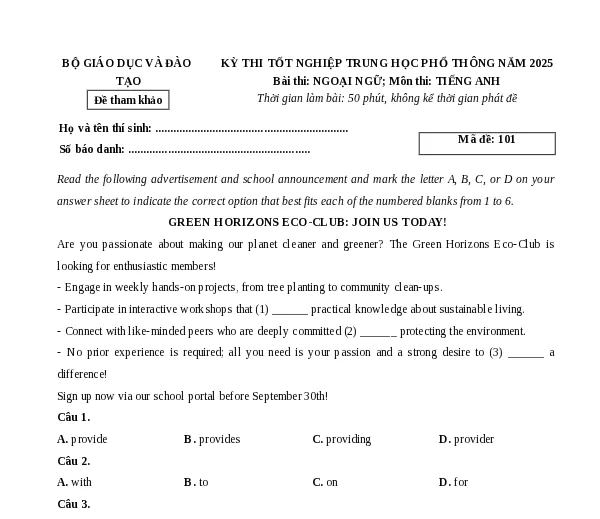
BỘ GIÁO DỤC VÀ ĐÀO TẠO
ĐỀ THI THAM KHẢO
Đề chính thức
KỲ THI TỐT NGHIỆP TRUNG HỌC PHỔ THÔNG NĂM 2025
Bài thi: NGOẠI NGỮ; Môn thi: TIẾNG ANH
Thời gian làm bài: 50 phút, không kể thời gian phát đề
Họ và tên thí sinh: ................................................................ Số báo danh: ............................................................ | Mã đề: 401 |
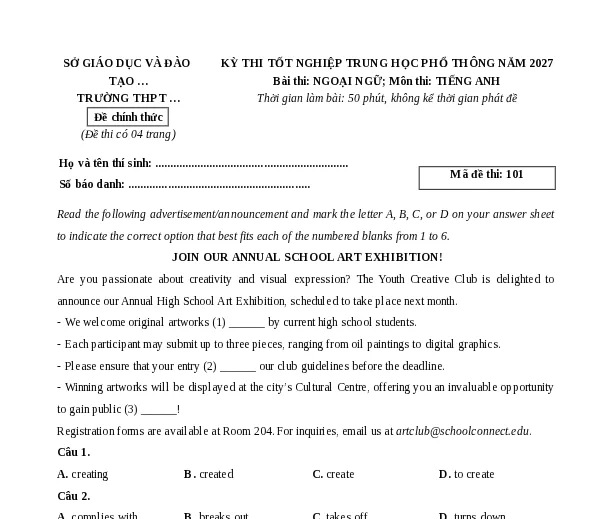
Read the following advertisement/announcement and mark the letter A, B, C, or D on your answer sheet to indicate the correct option that best fits each of the numbered blanks from 1 to 6.
WORKSHOP: ECO-FARMING INNOVATIONS
Are you passionate about sustainable agriculture? Join our interactive workshop on circular farming practices!
- Discover Natural Fertilizers: Learn why aging human and animal urine is gaining global (1) ______ as a chemical-free fertilizer rich in nitrogen and phosphorus.
- Safety First: Experts will demonstrate how storing liquid waste at specific temperatures safely neutralizes pathogens (2) ______ retaining vital crop nutrients.
- Hands-on Practice: Build your own low-cost, odor-controlled storage containers right at the center.
Register before October 15th to receive an exclusive guide on eco-friendly soil maintenance. Don't miss the opportunity to make your farm truly green and (3) ______!
Câu 1 (0,25 điểm).
A. recognition
B. recognitive
C. recognize
D. recognizably
Câu 2 (0,25 điểm).
A. despite
B. while
C. because
D. unless
Câu 3 (0,25 điểm).
A. cost-effective
B. time-consuming
C. high-priced
D. short-lived
ANNOUNCEMENT: SCHOOL DIGITAL DETOX CAMPAIGN
To promote mental wellbeing and healthy study habits, Oakridge High School is launching the annual "Unplug to Connect" program.
- All students are encouraged to minimize recreational screen time to under two hours daily (4) ______ the exam preparation period.
- Weekly outdoor team sports and book club gatherings will be hosted on campus (5) ______ excessive social media dependence.
- Students (6) ______ wish to participate in the 7-day screen-free challenge must submit parental consent forms to the Youth Union office by Friday.
Let us reclaim our focus, improve sleep quality, and build genuine friendships!
Câu 4 (0,25 điểm).
A. during
B. between
C. among
D. along
Câu 5 (0,25 điểm).
A. to combat
B. combat
C. combating
D. combated
Câu 6 (0,25 điểm).
A. whom
B. who
C. which
D. whose
Read the following leaflet and mark the letter A, B, C, or D on your answer sheet to indicate the correct option that best fits each of the numbered blanks from 7 to 12.
NEXT-GEN DERMAL TECH: SMART TATTOOS
Imagine a tattoo that illuminates on command and fades away when no longer needed. Bioengineers have developed microscopic light-responsive dermal implants that can be turned on and off with specific wavelengths of light.
1. How does it work?
Scientists embed photo-switchable biocompatible dyes into the upper layers of the skin. Exposing the pigment to blue light activates its molecular luminescence, (7) ______ infrared light triggers a structural change that reverts the ink back to an invisible state.
2. Key Applications
- Medical Diagnostics: These subdermal monitors can alert patients to sudden shifts in blood glucose levels or UV exposure, serving as an (8) ______ early warning indicator.
- Aesthetic Flexibility: Users can switch their body art on for evening events and deactivate it in conservative professional (9) ______.
- Minimal Invasiveness: Unlike conventional ink, (10) ______ synthetic compounds degrade harmlessly without requiring painful laser removal procedures.
3. Safety and Availability
Extensive clinical trials have demonstrated that the procedure carries (11) ______ risk of long-term skin irritation. Researchers are now working to (12) ______ production costs before making this breakthrough technology available to the public.
Câu 7 (0,25 điểm).
A. whereas
B. therefore
C. furthermore
D. otherwise
Câu 8 (0,25 điểm).
A. invaluable
B. exhausting
C. artificial
D. indifferent
Câu 9 (0,25 điểm).
A. environments
B. climates
C. landscapes
D. atmospheres
Câu 10 (0,25 điểm).
A. these
B. this
C. another
D. each
Câu 11 (0,25 điểm).
A. little
B. few
C. many
D. a few
Câu 12 (0,25 điểm).
A. drive down
B. give off
C. turn down
D. take up
Mark the letter A, B, C, or D on your answer sheet to indicate the best arrangement of utterances or sentences to make a meaningful exchange or text in each of the following questions from 13 to 17.
Câu 13 (0,25 điểm).
a. Mark: "That sounds fascinating! Does it leave any permanent scars on your skin?"
b. Lan: "Have you read about the new light-activated tattoos developed by bioengineers?"
c. Lan: "Not at all. The dyes are designed to dissolve naturally without any cellular damage."
A. b – a – c
B. a – c – b
C. b – c – a
D. c – a – b
Câu 14 (0,25 điểm).
a. Alex: "I have been staying up late browsing video clips, and now I can barely concentrate during morning classes."
b. Chloe: "You should set an app timer and keep your phone outside the bedroom overnight."
c. Alex: "Thanks for the advice, Chloe. I will give that a try starting tonight."
d. Chloe: "You look exhausted today, Alex. Did you get enough sleep last night?"
A. d – a – b – c
B. a – d – b – c
C. d – b – a – c
D. b – a – d – c
Câu 15 (0,25 điểm).
Dear Dr. Reynolds,
a. We are currently organizing our university's Annual Sustainable Living Symposium, scheduled for next November.
b. Given your pioneering research in closed-loop agricultural systems, we would be deeply honored if you could deliver the keynote address on organic bio-fertilizers.
c. I am writing to you on behalf of the Department of Environmental Sciences at Greenvale University.
d. Please let us know if you are available, and we will promptly send you the tentative schedule along with travel arrangements.
e. Our students and faculty members are particularly eager to learn about your recent findings regarding aged urine recycling.
Yours sincerely,
Elena Vance
A. c – a – b – e – d
B. a – c – e – b – d
C. c – b – a – e – d
D. a – e – b – c – d
Câu 16 (0,25 điểm).
a. When used on agricultural fields, it provides crops with an abundant source of macro-nutrients, matching synthetic chemical products in crop yield.
b. Over several months, stored urine undergoes natural chemical transformations that elevate its pH, eliminating harmful pathogens.
c. Aging urine is rapidly emerging as a revolutionary technique in sustainable circular agriculture.
d. Consequently, this simple practice reduces environmental pollution while saving farmers substantial input costs.
e. Once the liquid has matured and stabilized, it can be diluted safely with rainwater.
A. c – b – e – a – d
B. b – c – a – e – d
C. c – a – b – d – e
D. e – b – c – a – d
Câu 17 (0,25 điểm).
a. Moreover, excessive screen exposure before bedtime inhibits the secretion of melatonin, disrupting regular circadian rhythms.
b. Many teenagers today spend an average of over six hours daily engaging with digital devices for entertainment.
c. To prevent long-term cognitive and emotional setbacks, parents and educators must encourage balanced digital hygiene habits.
d. This prolonged screen time has been closely linked to heightened anxiety, loneliness, and diminished academic performance.
e. Over time, chronic sleep deprivation impairs memory consolidation and emotional regulation during critical developmental stages.
A. b – d – a – e – c
B. b – a – d – c – e
C. d – b – a – e – c
D. a – e – b – d – c
Read the following passage and mark the letter A, B, C, or D on your answer sheet to indicate the correct option that best fits each of the numbered blanks from 18 to 22.
Modern industrial agriculture has long relied heavily upon synthetic fertilizers to sustain high crop yields. However, the production of these artificial nutrients consumes enormous amounts of fossil fuels and (18) ______. In search of sustainable alternatives, agricultural scientists are turning their attention to a surprising resource: human and livestock urine.
Fresh urine is naturally packed with nitrogen, phosphorus, and potassium, which are the exact essential elements that crops require to thrive. Despite its fertility value, untreated urine cannot be applied directly to edible plants because (19) ______. To overcome this obstacle, researchers recommend the practice of aging urine in sealed airtight containers for several weeks or months.
During the storage period, urea decomposes into ammonia through a biological process known as ureolysis. This reaction causes the liquid's pH level to rise above nine, creating an alkaline environment (20) ______. Once the biological stabilization process is complete, farmers obtain a potent, pathogen-free liquid fertilizer (21) ______.
Adopting this closed-loop nutrient cycle offers substantial economic and ecological advantages. Not only does it divert high-nutrient wastewater from overburdened sewage treatment facilities, (22) ______. Ultimately, aging urine transforms an overlooked waste product into a valuable cornerstone of resilient organic farming.
Câu 18 (0,25 điểm).
A. leads to widespread soil degradation and waterway pollution
B. which caused massive damage to local marine ecosystems
C. having deteriorated the natural fertility of global arable land
D. was responsible for contaminating groundwater supplies
Câu 19 (0,25 điểm).
A. fresh biological fluids contain excessive mineral salts that might harbor potential bacterial contaminants
B. its high chemical concentration can burn delicate root systems and pose sanitary risks
C. farmers have refused to handle unsterilized animal by-products on commercial farms
D. modern irrigation systems were incapable of distributing dense organic substances
Câu 20 (0,25 điểm).
A. that effectively neutralizes virtually all disease-causing microorganisms
B. where harmful microbes could flourish without any competition
C. which were eliminated by industrial heat sterilization methods
D. having failed to eradicate microscopic viral structures in the solution
Câu 21 (0,25 điểm).
A. that rivals commercial petroleum-derived formulas in nutrient availability
B. although synthetic chemical products remain far superior in quality
C. because it required costly industrial filtration before application
D. which had been banned across major developed nations
Câu 22 (0,25 điểm).
A. but it also lessens farmers' dependence on volatile global fertilizer markets
B. and it will increase the overall operational expenses for smallholder farms
C. nor does it protect surrounding river basins from chemical runoff
D. so that rural communities can manufacture synthetic nitrogen in factories
Read the following passage and mark the letter A, B, C, or D on your answer sheet to indicate the correct answer to each of the questions from 23 to 30.
In recent years, the ubiquity of smartphones, tablets, and social media platforms has transformed adolescent life. While digital connectivity offers undeniable benefits in education and social communication, psychologists and pediatricians are growing increasingly concerned about the physical and psychological toll of chronic screen exposure. Today's teenagers spend an unprecedented proportion of their waking hours gazing at glowing screens, often displacing essential developmental activities such as physical exercise, face-to-face interaction, and restorative rest.
One of the most immediate casualties of heavy screen use is adolescent sleep. The blue light emitted by digital screens suppresses the brain's production of melatonin, a vital hormone that signals the body when it is time to sleep. When teenagers scroll through algorithmic feeds or play high-intensity video games late into the evening, their neurobiological sleep cues are delayed. This disruption leads not only to difficulty falling asleep but also to fragmented slumber. Chronic sleep deprivation in adolescents is notoriously pernicious, impairing memory consolidation, dampening academic engagement, and heightening emotional volatility.
Beyond physical health, excessive screen immersion profoundly alters teenage social development. Psychologists note that when online communication replaces direct personal contact, young individuals miss out on interpreting subtle non-verbal cues—such as facial expressions, vocal inflections, and body language—which form the bedrock of empathy. Furthermore, social media platforms perpetuate an environment of perpetual social comparison. Adolescents are constantly bombarded with curated, idealized depictions of their peers' lives, fostering feelings of inadequacy, exclusion, and low self-worth.
Fortunately, addressing digital overuse does not require an absolute rejection of technology. Instead, experts advocate for structured "digital hygiene" practices within families and school environments. Establishing tech-free zones, such as bedrooms and dining areas, encourages genuine interpersonal engagement and allows biological rhythms to recover naturally. When teenagers learn to treat digital devices as intentional tools rather than compulsive distractions, they can enjoy the informational richness of the online world without sacrificing their holistic well-being.
Câu 23 (0,25 điểm). Which of the following is the best title for the passage?
A. The Psychological and Physical Repercussions of Teen Screen Time
B. How Blue Light Disrupts the Production of Human Hormones
C. The Evolution of Digital Communication in Secondary Schools
D. Practical Strategies for Eradicating Smartphones from Teen Life
Câu 24 (0,25 điểm). According to paragraph 1, excessive screen time prevents adolescents from ______.
A. accessing online educational databases
B. engaging in restorative rest and direct social contact
C. acquiring technical proficiencies for future employment
D. maintaining communication with remote family members
Câu 25 (0,25 điểm). The word pernicious in paragraph 2 is closest in meaning to ______.
A. harmful
B. temporary
C. unpredictable
D. manageable
Câu 26 (0,25 điểm). The word curated in paragraph 3 is closest in meaning to ______.
A. carefully selected
B. randomly assembled
C. completely fabricated
D. unintentionally exposed
Câu 27 (0,25 điểm). The word they in paragraph 4 refers to ______.
A. teenagers
B. digital hygiene practices
C. families
D. biological rhythms
Câu 28 (0,25 điểm). Which of the following is NOT true according to the passage?
A. Blue light emitted by screens hinders the natural secretion of melatonin.
B. Missing out on non-verbal cues in face-to-face contact can impede the growth of empathy.
C. Experts suggest that the only viable solution is a complete and permanent ban on smartphones.
D. Social comparison on digital platforms can provoke feelings of inferiority among teenagers.
Câu 29 (0,25 điểm). Which of the following can be inferred from the passage?
A. Adolescents who interact strictly online will eventually lose their verbal communication abilities.
B. Screen-induced sleep deficiency impacts both intellectual performance and emotional balance.
C. Schools that allow smartphones in class produce higher rates of academic dropouts.
D. Parental intervention is generally ineffective in regulating teenage device consumption.
Câu 30 (0,25 điểm). Which of the following best summarizes the main idea of paragraph 4?
A. Digital devices must be banned during dining times to ensure children digest food properly.
B. Adopting sensible digital hygiene enables teens to benefit from technology safely.
C. Technological advancement is fundamentally incompatible with traditional family values.
D. Schools should take sole responsibility for training students in device management.
Read the following passage and mark the letter A, B, C, or D on your answer sheet to indicate the correct answer to each of the questions from 31 to 40.
For centuries, mathematics has stood as the ultimate citadel of pure human intellect. Unlike empirical sciences, which rely on observational data and experimental verification, mathematical truth is established through rigorous deductive proof—a sequence of logical inferences constructed by conscious human minds. [I] However, the sudden emergence of sophisticated artificial intelligence systems capable of complex reasoning, such as advanced neural models developed by organizations like OpenAI, has precipitated an unexpected existential crisis within the mathematical community.
Historically, computers served mathematicians merely as glorified calculators, capable of crunching gargantuan numerical sequences or verifying tedious mechanical computations. Yet recent breakthroughs in large language models trained with reinforcement learning have crossed a conceptual threshold. [II] These frontier models no longer just calculate; they generate intuitive heuristics, propose novel conjectures, and even draft formal proofs for theorems that previously stymied professional researchers. For instance, automated theorem provers coupled with neural search algorithms can now navigate colossal problem spaces, identifying elegant proof pathways that human mathematicians overlooked.
This rapid encroachment has ignited a profound philosophical dilemma regarding the very nature of mathematical understanding. If an AI system produces a valid 500-page formal proof that no single human mathematician can comprehend or mentally verify within a lifetime, can humanity genuinely claim to "know" that the theorem is true? Renowned mathematicians argue that the primary purpose of doing mathematics is not merely accumulating certified truths, but attaining deep, intuitive insight into abstract structures. [III] When a machine delivers an uninterpretable answer without conveying the underlying conceptual beauty, mathematics risks being reduced to opaque mechanical verification, stripping the discipline of its aesthetic and philosophical essence.
Moreover, the psychological impact on young mathematicians cannot be understated. Doctoral students and early-career researchers, who invest decades mastering intricate analytical techniques, now find themselves questioning their professional relevance. If automated engines can formulate and verify conjectures in minutes, the romantic ideal of the solitary scholar laboring for years to unravel profound mysteries appears increasingly obsolete. [IV] Consequently, some academics voice apprehension that future generations might abandon pure theoretical research altogether, relegating mathematics to an automated engineering pipeline.
Nevertheless, more optimistic theorists contend that AI will not eclipse mathematicians, but rather transfigure their creative roles. By offloading computational drudgery and routine verification to machines, scholars could operate at higher levels of abstraction, acting as intellectual directors who synthesize disparate fields. In this prospective paradigm, the synthesis between artificial computational prowess and human aesthetic intuition could inaugurate a golden era of discovery, expanding the frontiers of knowledge far beyond what either could achieve alone.
Câu 31 (0,25 điểm). Where in paragraph 1 or 2 does the following sentence best fit?
"Instead of replacing creative deduction, these automated tools were seen as subordinate assistants."
A. [I]
B. [II]
C. [III]
D. [IV]
Câu 32 (0,25 điểm). What is the primary purpose of the author in the passage?
A. To celebrate the total triumph of artificial intelligence over traditional university faculties
B. To explore the profound intellectual and existential disruptions caused by advanced AI in mathematics
C. To provide a technical manual on how to train reinforcement learning algorithms on mathematical datasets
D. To criticize computer scientists for creating technologies that undermine abstract philosophy
Câu 33 (0,25 điểm). According to paragraph 1, mathematics differs fundamentally from empirical sciences because ______.
A. it requires continuous laboratory experimentation to confirm physical hypotheses
B. its validity is derived from rigorous deductive proofs rather than observation
C. it has remained completely insulated from technological innovation throughout history
D. it does not involve abstract logic or theoretical formulations
Câu 34 (0,25 điểm). The word opaque in paragraph 3 is closest in meaning to ______.
A. incomprehensible
B. transparent
C. undeniable
D. flawless
Câu 35 (0,25 điểm). The word apprehension in paragraph 4 is closest in meaning to ______.
A. anxiety
B. enthusiasm
C. indifference
D. confidence
Câu 36 (0,25 điểm). Which of the following is NOT mentioned in paragraph 2 as a capability of new AI models?
A. Generating intuitive heuristics
B. Formulating novel mathematical conjectures
C. Physically manufacturing laboratory hardware
D. Finding proof pathways overlooked by humans
Câu 37 (0,25 điểm). Which of the following best paraphrases the underlined sentence in paragraph 3:
“When a machine delivers an uninterpretable answer without conveying the underlying conceptual beauty, mathematics risks being reduced to opaque mechanical verification...”?
A. Mathematics loses its aesthetic and intellectual value if complex machine solutions offer no human insight into the underlying concepts.
B. If computer proofs are too concise and beautiful, human scholars will reject them as mechanically invalid.
C. Machines are superior to humans because they can solve equations without getting distracted by philosophical beauty.
D. The verified accuracy of machine answers guarantees that future mathematicians will no longer need conceptual theories.
Câu 38 (0,25 điểm). Which of the following can be inferred about the future relationship between humans and AI in mathematics from paragraph 5?
A. Human intuition and machine power could combine to elevate research to unprecedented levels.
B. Computer algorithms will eventually eliminate the need for human universities and research institutes.
C. AI will be banned by international academic journals to protect the jobs of doctoral candidates.
D. Human researchers will focus exclusively on manual paper computations to preserve traditional heritage.
Câu 39 (0,25 điểm). Which of the following statements would the author most likely agree with?
A. The value of mathematics lies solely in the number of verified theorems produced each year.
B. The crisis in mathematics stems not from machine incompetence, but from machines succeeding in domains once thought exclusively human.
C. Early-career scholars should immediately cease studying mathematics and switch to computer hardware engineering.
D. Large language models are incapable of handling abstract reasoning due to mathematical limitations.
Câu 40 (0,25 điểm). Which of the following best summarizes the overall passage?
A. AI reasoning tools have sparked philosophical and vocational crises in mathematics, though collaborative synergy may redefine human exploration.
B. OpenAI has successfully solved every outstanding millennium prize problem, rendering pure mathematics completely obsolete.
C. The mathematical community has unanimously rejected algorithmic theorem provers to defend traditional scientific methodologies.
D. Due to widespread anxiety among doctoral candidates, computer science departments are abandoning artificial reasoning models.
--------- HẾT ---------
Thí sinh không được sử dụng tài liệu. Cán bộ coi thi không giải thích gì thêm.
HƯỚNG DẪN CHẤM VÀ ĐÁP ÁN CHI TIẾT
KỲ THI TỐT NGHIỆP TRUNG HỌC PHỔ THÔNG NĂM 2025
Môn thi: TIẾNG ANH (Mã đề: 401)
A. BẢNG ĐÁP ÁN (Mỗi câu đúng: 0,25 điểm)
Câu | Đ/A | Câu | Đ/A | Câu | Đ/A | Câu | Đ/A |
|---|---|---|---|---|---|---|---|
1 | A | 11 | A | 21 | A | 31 | B |
2 | B | 12 | A | 22 | A | 32 | B |
3 | A | 13 | A | 23 | A | 33 | B |
4 | A | 14 | A | 24 | B | 34 | A |
5 | A | 15 | A | 25 | A | 35 | A |
6 | B | 16 | A | 26 | A | 36 | C |
7 | A | 17 | A | 27 | A | 37 | A |
8 | A | 18 | A | 28 | C | 38 | A |
9 | A | 19 | B | 29 | B | 39 | B |
10 | A | 20 | A | 30 | B | 40 | A |
B. GIẢI THÍCH CHI TIẾT
Câu 1. A (recognition): Sau tính từ "global" cần danh từ. "gain global recognition" = nhận được sự công nhận toàn cầu.
Câu 2. B (while): "while + V-ing" diễn tả hai hành động diễn ra song song (vừa trung hòa mầm bệnh, vừa giữ lại các dưỡng chất).
Câu 3. A (cost-effective): Phù hợp ngữ cảnh nông trại "green and cost-effective" (thân thiện môi trường và hiệu quả về mặt chi phí).
Câu 4. A (during): Giới từ chỉ khoảng thời gian ("during the exam preparation period").
Câu 5. A (to combat): Chỉ mục đích ("được tổ chức... nhằm chống lại / giải quyết sự phụ thuộc quá mức").
Câu 6. B (who): Đại từ quan hệ thay thế cho danh từ chỉ người "Students" làm chủ ngữ.
Câu 7. A (whereas): Liên từ chỉ sự đối lập ("trong khi ánh sáng xanh kích hoạt huỳnh quang... thì tia hồng ngoại chuyển nó về trạng thái vô hình").
Câu 8. A (invaluable): Tính từ mang nghĩa "vô giá / cực kỳ hữu ích" (invaluable early warning indicator).
Câu 9. A (environments): Cụm danh từ "professional environments" (môi trường làm việc chuyên nghiệp).
Câu 10. A (these): Đi với danh từ đếm được số nhiều "synthetic compounds".
Câu 11. A (little): Đi với danh từ không đếm được "risk" mang nghĩa hầu như không có nguy cơ ("little risk of long-term skin irritation").
Câu 12. A (drive down): Phrasal verb có nghĩa "làm giảm bớt, hạ giá thành" (drive down production costs).
Câu 13. A (b – a – c): Lan mở đầu hỏi về hình xăm thông minh (b) Mark hỏi về sẹo (a) Lan giải thích không để lại sẹo vì hạt mực tự tiêu biến (c).
Câu 14. A (d – a – b – c): Chloe hỏi thăm vẻ mệt mỏi của Alex (d) Alex giải thích do thức khuya xem video (a) Chloe khuyên để điện thoại ngoài phòng ngủ (b) Alex cảm ơn và nhận lời thử (c).
Câu 15. A (c – a – b – e – d): Mở đầu thư trang trọng giới thiệu danh tính người gửi (c) giới thiệu sự kiện hội thảo (a) ngỏ lời mời đọc diễn văn (b) nêu chủ đề cụ thể người nghe quan tâm (e) lời chào kết thúc chờ hồi âm (d).
Câu 16. A (c – b – e – a – d): Giới thiệu chủ đề ủ nước tiểu (c) diễn biến biến đổi hóa học khử trùng (b) pha loãng sau khi ủ (e) bón ruộng hiệu quả tương đương phân hóa học (a) hệ quả giảm ô nhiễm và tiết kiệm (d).
Câu 17. A (b – d – a – e – c): Nêu thực trạng thanh thiếu niên dùng màn hình > 6 tiếng/ngày (b) hệ quả lo âu, sa sút học tập (d) cơ chế ức chế melatonin gây mất ngủ (a) mất ngủ kinh niên làm suy giảm trí nhớ (e) giải pháp vệ sinh số (c).
Câu 18. A: Cấu trúc song hành với động từ số ít "consumes ... and leads to...".
Câu 19. B: Giải thích nguyên nhân nước tiểu tươi không tưới trực tiếp được: "nồng độ hóa chất cao có thể làm cháy rễ và gây nguy cơ vệ sinh".
Câu 20. A: Mệnh đề quan hệ bổ nghĩa cho "an alkaline environment" (môi trường kiềm giúp tiêu diệt hầu hết vi sinh vật gây bệnh).
Câu 21. A: Phân bón lỏng giàu dưỡng chất "cạnh tranh / sánh ngang với các công thức thương mại từ dầu mỏ về hàm lượng dinh dưỡng".
Câu 22. A: Đảo ngữ với "Not only does it ..., but it also lessens...".
Câu 23. A: Tiêu đề khái quát toàn diện cả về mặt tâm lý lẫn thể chất do thời gian dùng màn hình quá mức.
Câu 24. B: Thông tin ở đoạn 1: "...displacing essential developmental activities such as physical exercise, face-to-face interaction, and restorative rest."
Câu 25. A: pernicious = độc hại, gây hại nghiêm trọng (harmful).
Câu 26. A: curated = được chọn lọc kỹ càng, chau chuốt (carefully selected).
Câu 27. A: "they" quy chiếu trực tiếp đến danh từ số nhiều "teenagers" ở đầu câu.
Câu 28. C: Đoạn 4 nêu rõ "addressing digital overuse does not require an absolute rejection of technology", do đó nhận định cấm hoàn toàn vĩnh viễn là SAI.
Câu 29. B: Dẫn chứng đoạn 2: thiếu ngủ vừa làm suy giảm củng cố trí nhớ (trí tuệ), vừa làm gia tăng dao động cảm xúc (tâm lý).
Câu 30. B: Đoạn 4 nói về việc áp dụng thói quen dùng thiết bị số lành mạnh để tận dụng công nghệ an toàn.
Câu 31. B: Vị trí [II] nối tiếp ý computers trước đây chỉ là "glorified calculators" (công cụ tính toán đơn thuần).
Câu 32. B: Mục đích chính của bài đọc là phân tích những biến động sâu sắc về triết học và hiện sinh mà AI lý luận đem lại cho toán học.
Câu 33. B: Đoạn 1: "mathematical truth is established through rigorous deductive proof—a sequence of logical inferences...".
Câu 34. A: opaque trong ngữ cảnh chứng minh khó hiểu mang nghĩa mờ mịt, không thể hiểu thấu (incomprehensible).
Câu 35. A: apprehension = sự lo ngại, âu lo (anxiety).
Câu 36. C: Đoạn 2 liệt kê heuristics, conjectures, proof pathways; không đề cập đến việc chế tạo phần cứng (laboratory hardware).
Câu 37. A: Câu gốc diễn đạt: khi máy móc đưa ra đáp án không thể diễn giải mà thiếu đi vẻ đẹp khái niệm, toán học mất đi giá trị thẩm mỹ và trí tuệ cốt lõi.
Câu 38. A: Đoạn cuối: "the synthesis between artificial computational prowess and human aesthetic intuition could inaugurate a golden era of discovery...".
Câu 39. B: Tác giả nhấn mạnh cuộc khủng hoảng toán học sinh ra do AI đạt được bước tiến lớn trong khả năng suy luận logic vốn được coi là đặc quyền của con người.
Câu 40. A: Tóm tắt trọn vẹn: AI gây ra khủng hoảng hiện sinh nhưng đồng thời mở ra tiềm năng hợp tác nâng tầm khám phá toán học.