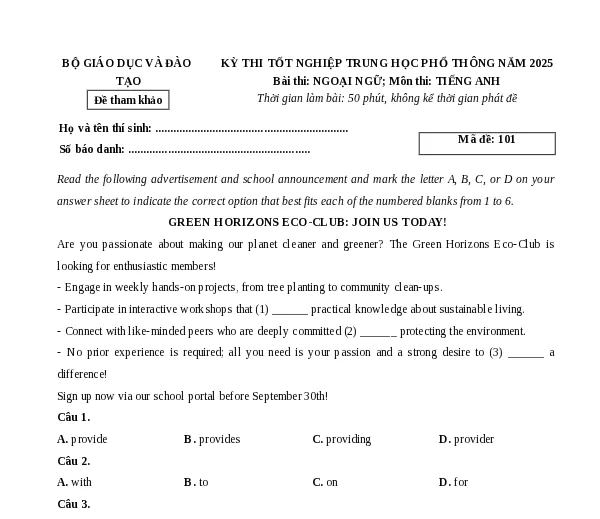
BỘ GIÁO DỤC VÀ ĐÀO TẠO
ĐỀ THI THAM KHẢO
Đề thi thử số 06
KỲ THI TỐT NGHIỆP TRUNG HỌC PHỔ THÔNG NĂM 2026
Bài thi: NGOẠI NGỮ; Môn thi: TIẾNG ANH
Thời gian làm bài: 50 phút, không kể thời gian phát đề
Họ và tên thí sinh: ................................................................ Số báo danh: ............................................................ | Mã đề: 106 |
Mark the letter A, B, C, or D on your answer sheet to indicate the correct option that best fits each of the numbered blanks from 1 to 6.
Read the following announcement and mark the letter A, B, C, or D on your answer sheet to indicate the correct option that best fits each of the numbered blanks from 1 to 3.
YOUTH CLIMATE ACTION SYMPOSIUM 2026
We are pleased to invite high school students to participate in our upcoming regional forum on coastal ecosystem resilience:
- Date: October 18, 2026
- Venue: Green Horizon Convention Center
- Key objective: To raise public (1) ______ about sea-level rise and innovative habitat restoration.
Guest scientists will present the latest findings on coastal retreat and inland salinization. Attendees will also have the opportunity to engage (2) ______ interactive workshops and propose practical solutions.
Please register by September 30 to secure your seat. Selected delegates will be awarded certificates of (3) ______ upon completion.
A. awareness
B. aware
C. unaware
D. awarenesses
A. at
B. in
C. with
D. for
A. accomplishment
B. appreciation
C. recognition
D. participation
Read the following advertisement and mark the letter A, B, C, or D on your answer sheet to indicate the correct option that best fits each of the numbered blanks from 4 to 6.
JOIN THE COASTAL FOREST RESTORATION PROJECT!
Are you concerned about coastal erosion and rising sea waters? Take part in our conservation drive and help protect vulnerable marshlands!
- Hands-on experience: Work alongside leading botanists to replant native salt-tolerant trees that (4) ______ extreme tides.
- Community impact: Strengthen natural buffers, protecting local agricultural soil from deadly saltwater (5) ______.
- Flexible schedules: Weekend shifts available for student volunteers.
No prior experience is necessary. We guarantee that your contribution will make a significant (6) ______ to safeguarding our coastlines!
A. withstand
B. collapse
C. surrender
D. deteriorate
A. intrude
B. intrusion
C. intrusive
D. intrusively
A. effort
B. change
C. difference
D. movement
Mark the letter A, B, C, or D on your answer sheet to indicate the correct option that best fits each of the numbered blanks from 7 to 12.
Read the following leaflet and mark the letter A, B, C, or D on your answer sheet to indicate the correct option that best fits each of the numbered blanks from 7 to 12.
UNDERSTANDING OUR CHANGING COASTLINES: THE SPREAD OF GHOST FORESTS
As global temperatures climb, coastal landscapes throughout North America are undergoing a rapid and alarming transformation.
- What are ghost forests?
Ghost forests are vast expanses of dead, bleached tree trunks left standing in coastal wetlands. They occur when rising sea levels push saltwater further inland, poisoning the soil (7) ______ freshwater species depend on.
- The underlying mechanism:
Trees like bald cypresses and loblolly pines are unable to tolerate high salinity. Over time, recurring storm surges accelerate the (8) ______ of these ancient coastal woodlands into open salt marshes.
- A symptom of broader change:
Scientists note that ghost forests are not merely local tragedies; they serve as a visible indicator of (9) ______ sea-level rise driven by thermal expansion and melting polar ice caps.
- What can we do to mitigate the loss?
- Support coastal zoning policies (10) ______ restrict unsustainable developments in critical marsh migration corridors.
- Implement adaptive drainage techniques to (11) ______ the accumulation of brine in inland aquifers.
- Spread the word! Educating the public is vital because (12) ______ action taken today will help protect vulnerable biomes for tomorrow.
A. which
B. where
C. whom
D. whose
A. restoration
B. transition
C. preservation
D. exploration
A. accelerating
B. accelerate
C. acceleration
D. accelerated
A. what
B. who
C. that
D. whose
A. run out of
B. cut down on
C. make up for
D. look down on
A. every
B. many
C. several
D. others
Mark the letter A, B, C, or D on your answer sheet to indicate the correct arrangement of the sentences to make a meaningful exchange or text in each of the following questions from 13 to 17.
Câu 13.
a. Mark: "I just read an article about how saltwater intrusion is turning living woods into ghost forests along the Atlantic coast."
b. Mark: "Exactly. The salt poisons their root systems, leaving behind stands of pale, skeletal trunks."
c. Jane: "Really? Are the trees dying because the groundwater is becoming too saline?"
A. a – c – b
B. b – a – c
C. c – a – b
D. a – b – c
Câu 14.
a. Dear Dr. Evans, I am writing to express my gratitude for your enlightening lecture on marine ice dynamics yesterday.
b. In particular, your explanation of why towering ice cliffs collapse unpredictably helped clarify our research topic.
c. We hope to invite you back next semester for a follow-up discussion on polar ocean currents.
d. Best regards, The Earth Science Student Committee.
e. Our study group found the visual models of fracture propagation especially insightful.
A. a – b – e – c – d
B. a – c – b – e – d
C. b – a – e – c – d
D. a – e – b – d – c
Câu 15.
a. When warm seawater seeps beneath the grounded edges of Antarctic glaciers, it thins the floating ice shelves that hold them back.
b. Consequently, massive inland ice streams accelerate their slide into the Southern Ocean, driving global sea levels higher.
c. As these supportive floating shelves disintegrate, towering vertical ice faces are exposed directly to the ocean.
d. Without buttressing ice, these colossal frozen walls become structurally unstable and collapse under their own immense weight.
e. This positive feedback loop demonstrates why polar retreat can continue even during temporary pauses in atmospheric warming.
A. a – c – d – b – e
B. c – a – d – b – e
C. a – b – c – d – e
D. c – d – a – e – b
Câu 16.
a. For decades, ecologists viewed the boundary between maritime marshes and inland forests as a static ecological frontier.
b. Modern satellite telemetry, however, reveals that this boundary is migrating inland at an unprecedented pace.
c. Entire groves of mature hardwoods are suffocated within just a few years of severe hurricane storm tides.
d. What remains behind are vast 'ghost forests' of bleached timber, documenting the rapid reach of climate change.
e. This rapid retreat permanently reorganizes local biodiversity and disrupts coastal carbon sequestration.
A. a – b – c – d – e
B. b – a – c – e – d
C. a – c – b – d – e
D. b – c – a – d – e
Câu 17.
a. The Thwaites Glacier, often dubbed the 'Doomsday Glacier', holds enough water to raise world oceans by more than half a meter.
b. Recent computational simulations suggest that once its grounding line retreats past deep submarine ridges, runaway melting becomes inevitable.
c. Even if oceanic temperatures were to stabilize or cool slightly, the physical geometry of the seabed ensures continued instability.
d. Understanding these complex bedrock dynamics is therefore paramount for coastal planners worldwide preparing for inevitable sea-level rise.
e. Such alarming projections underline the critical need to curb greenhouse emissions before these irreversible thresholds are crossed.
A. a – b – c – e – d
B. a – c – b – d – e
C. b – a – c – e – d
D. c – a – b – e – d
Read the following passage and mark the letter A, B, C, or D on your answer sheet to indicate the correct option that best fits each of the numbered blanks from 18 to 22.
Recent glaciological research has shed new light on the phenomenon known as Marine Ice Cliff Instability (MICI). In conventional climate models, the retreat of polar ice sheets was assumed to occur gradually as rising atmospheric temperatures melted surface ice. However, scientists investigating polar margins have discovered that (18) ______.
When floating ice shelves break away completely, they leave behind vertical ice walls that tower over eighty meters above the ocean surface. Ice of that magnitude possesses finite structural strength, (19) ______. For years, researchers debated whether such cliffs would disintegrate continuously in catastrophic runaway collapses or whether their destruction would follow a different pattern.
Advanced 3D computer simulations have recently revealed that ice cliff failure occurs in intermittent bursts rather than as a smooth, continuous process. (20) ______. As tension fractures propagate through the frozen slab, immense blocks shear off and plunge into the sea. Following a major calving event, the remaining ice wall often stabilizes temporarily (21) ______.
This discovery of 'fits and starts' collapse dynamics is crucial because (22) ______. Although it shows that the ice does not collapse instantaneously overnight, it confirms that once critical thresholds are breached, massive retreat remains practically impossible to halt.
A. vertical ice cliffs can fail mechanically under their own weight
B. vertical ice cliffs failing mechanically under their own weight
C. whose mechanical failure of vertical ice cliffs occurs under their weight
D. of which vertical ice cliffs fail under their mechanical weight
A. making it highly vulnerable to shear stress and structural fracture
B. which makes it highly vulnerable to shear stress and structural fracture
C. that makes it highly vulnerable to shear stress and structural fracture
D. it makes it highly vulnerable to shear stress and structural fracture
A. Stresses accumulate steadily within the cliff face until internal cracks reach a tipping point
B. Although stresses accumulate steadily within the cliff face until cracks reach a tipping point
C. Because stresses accumulate steadily within the cliff face until internal cracks reaching a tipping point
D. Having accumulated stresses steadily within the cliff face until internal cracks reach a tipping point
A. before deep crevasses widen and trigger the next round of structural collapse
B. while deep crevasses widened and triggered the next round of structural collapse
C. so that deep crevasses widen to trigger the next round of structural collapse
D. despite deep crevasses widening and triggering the next round of structural collapse
A. it provides a far more accurate timetable for future global sea-level projections
B. it provided a far more accurate timetable for future global sea-level projections
C. providing a far more accurate timetable for future global sea-level projections
D. which provides a far more accurate timetable for future global sea-level projections
Read the following passage and mark the letter A, B, C, or D on your answer sheet to indicate the correct answer to each of the questions from 23 to 30.
Along the low-lying Atlantic and Gulf coasts of the United States, an eerie transformation is silently underway. Stands of once-stately loblolly pines, Atlantic white cedars, and bald cypresses are withering away, replaced by skeletal wooden spires bleached pale by sun and wind. Known to scientists and locals alike as 'ghost forests', these dead woodlands have expanded by hundreds of thousands of acres over the past few decades, marking one of the most visible terrestrial symptoms of sea-level rise on Earth.
The fundamental culprit behind this rapid arboreal die-off is saltwater intrusion. Under natural baseline conditions, freshwater flowing downstream from inland watersheds creates a hydraulic barrier that keeps marine tides at bay. However, as global warming fuels higher sea levels and more violent storm surges, saline water penetrates deeper into estuarine rivers, low-lying coastal plains, and underlying groundwater reservoirs.
Most terrestrial trees can tolerate brief splashes of salt, but prolonged exposure disrupts their physiological equilibrium. Salt compounds accumulate within the soil, preventing roots from absorbing essential moisture and drawing water out of root tissues through osmotic pressure. Furthermore, sodium and chloride ions poison plant cells, causing leaves to drop prematurely and photosynthetic machinery to fail. Eventually, the trees succumb, unable to regenerate as their seedlings are even more vulnerable to soil salinity than mature specimens.
As these woodlands perish, the landscape does not remain barren for long. Salt-tolerant marsh grasses and shrubs quickly colonize the dying forest understory, permanently converting forested wetlands into open tidal marshes. While salt marshes provide critical ecosystem services such as storm buffering and fish nurseries, the loss of mature coastal forests releases substantial amounts of carbon previously locked in wooden biomass. For researchers studying coastal resilience, ghost forests serve as an unequivocal warning: climate-driven marine encroachment is no longer a distant theoretical threat, but an accelerating reality reshaping our coastlines today.
Câu 23. Which of the following is the best title for the passage?
A. The Evolution of Salt-Tolerant Plants in American Marshes
B. Inland Ghost Forests: A Haunting Sign of Rising Seas
C. How Freshwater Species Protect Coastal Aquifers
D. Mitigating Carbon Emissions in Coastal Wetlands
Câu 24. According to paragraph 1, ghost forests are characterized by ______.
A. newly planted seedlings thriving in coastal wetlands
B. stands of dead, bleached tree trunks left standing along coasts
C. flourishing groves of Atlantic white cedars and bald cypresses
D. completely barren wastelands devoid of any vegetation
Câu 25. The word succumb in paragraph 3 is closest in meaning to ______.
A. perish
B. adapt
C. recover
D. flourish
Câu 26. The word their in paragraph 3 refers to ______.
A. leaves
B. the trees
C. root tissues
D. plant cells
Câu 27. According to paragraph 2, what naturally prevents seawater from advancing inland?
A. High agricultural dikes along estuarine rivers
B. The natural downward flow of freshwater from inland watersheds
C. Artificial drainage channels built through coastal plains
D. Dense barriers of salt-tolerant shrubs along the shore
Câu 28. Which of the following is NOT true according to the passage?
A. Mature trees are generally more sensitive to soil salinity than their seedlings.
B. Osmotic pressure caused by soil salinity draws water out of tree roots.
C. Dying woodlands are gradually replaced by salt-tolerant marsh grasses.
D. The decay of dead coastal forests releases carbon stored in their biomass.
Câu 29. The word unequivocal in paragraph 4 is closest in meaning to ______.
A. ambiguous
B. undeniable
C. controversial
D. temporary
Câu 30. It can be inferred from the passage that ghost forests will likely ______.
A. revert back to healthy pine forests once summer temperatures decrease
B. continue migrating further inland as global sea levels continue to climb
C. absorb far more carbon dioxide than the original mature woodlands
D. be eradicated completely by introducing artificial fertilizers into wetlands
Read the following passage and mark the letter A, B, C, or D on your answer sheet to indicate the correct answer to each of the questions from 31 to 40.
Antarctica's Thwaites Glacier, notoriously known as the 'Doomsday Glacier', has long been a focal point of glaciological anxiety. Spanning an area roughly equivalent to the size of Great Britain, this colossal body of ice acts as a cork holding back the vast West Antarctic Ice Sheet. Should Thwaites collapse entirely, it would release enough meltwater to raise global sea levels by approximately 65 centimeters, while potentially destabilizing adjacent glaciers and triggering several meters of additional sea-level rise. [I]
For years, it was assumed that ice sheet loss was governed primarily by atmospheric temperature fluctuations. [II] Recent underwater autonomous vehicle surveys, however, have revealed a far more insidious mechanism: deep channels carved into the seabed allow warm, dense circumpolar water to funnel directly toward the glacier's grounding line—the vulnerable boundary where the ice transitions from resting on bedrock to floating on the sea. This warm subsurface intrusion melts the glacier from below, unpinning it from submerged bedrock ridges that previously anchored it in place. [III]
More alarming still is the revelation that Thwaites may have crossed a threshold of irreversible retreat. Computer modeling indicates that the bedrock beneath Thwaites slopes downward as it moves inland, creating a retrograde bed slope. In such a geological configuration, as the glacier retreats into deeper waters, the exposed vertical ice front grows thicker. This geometric reality implies that even if atmospheric and upper-ocean temperatures were to cool back to pre-industrial levels, the gravitational instability of the thicker ice cliff would cause calving to continue unabated. [IV]
Compounding this problem is the sheer mechanical instability of towering ice cliffs. When floating ice shelves that cushion the glacier's seaward edge crumble, the exposed ice faces can reach heights where the internal yield strength of ice is exceeded. While collapse does not proceed in a continuous, smooth avalanche, the episodic fracturing and slumping of these massive ice cliffs—occurring in sudden fits and starts—accelerates the drainage of inland reservoirs.
Recognizing these alarming dynamics has fundamentally altered international climate projections. Scientists emphasize that mitigating greenhouse emissions remains imperative; while it may not completely stop the retreat of Thwaites's most vulnerable sectors, ambitious mitigation could dramatically decelerate the pace of ice discharge, granting vulnerable coastal cities precious decades to adapt to the burgeoning oceans.
Câu 31. Which of the following best summarizes the main idea of the passage?
A. Recent cooling trends in Antarctica have successfully mitigated the collapse of Thwaites Glacier.
B. New discoveries reveal that Thwaites Glacier faces irreversible melting mechanisms that defy simple temperature solutions.
C. Submarine robots have discovered that the West Antarctic Ice Sheet is entirely supported by artificial bedrock ridges.
D. Towering ice cliffs in polar regions collapse continuously without any pause or structural resistance.
Câu 32. According to paragraph 1, Thwaites Glacier is commonly referred to as the 'Doomsday Glacier' because ______.
A. it is the oldest and deepest formation of ice in the Southern Hemisphere
B. its total disintegration could destabilize adjacent ice sheets and dramatically elevate sea levels
C. it prevents warm atmospheric winds from entering the Antarctic continent
D. scientists predict that an asteroid will strike its floating shelf in the near future
Câu 33. The word insidious in paragraph 2 is closest in meaning to ______.
A. harmless
B. subtle yet destructive
C. easily detected
D. rapidly reversible
Câu 34. The word unpinning in paragraph 2 is closest in meaning to ______.
A. fastening
B. detaching
C. repairing
D. evaluating
Câu 35. According to paragraph 2, what crucial role do submerged bedrock ridges play?
A. They prevent cold surface winds from freezing the glacier's surface.
B. They anchor the glacier and impede its advance into the ocean.
C. They heat the underlying water to create smooth drainage channels.
D. They block all floating icebergs from escaping into international shipping lanes.
Câu 36. Which of the following best paraphrases the underlined sentence in paragraph 3?
“This geometric reality implies that even if atmospheric and upper-ocean temperatures were to cool back to pre-industrial levels, the gravitational instability of the thicker ice cliff would cause calving to continue unabated.”
A. Due to its physical geometry, the glacier will continue shedding ice uncontrollably despite potential atmospheric and oceanic cooling.
B. Cooling the atmosphere to pre-industrial levels is guaranteed to halt the gravitational collapse of thicker ice cliffs.
C. The geometric shape of the seabed will cause the ice cliff to grow thicker and more stable if ocean temperatures cool.
D. Calving will only cease if both atmospheric temperatures and seabed topography return to their historical states.
Câu 37. Where does the following sentence best fit in the passage?
"Consequently, the fate of the glacier is dictated far more by hidden oceanic currents than by surface air weather."
A. [I]
B. [II]
C. [III]
D. [IV]
Câu 38. The word it in paragraph 5 refers to ______.
A. greenhouse emissions
B. ambitious mitigation
C. vulnerable sector
D. international climate projection
Câu 39. Which of the following is NOT mentioned in the passage?
A. Thwaites Glacier covers a land area approximately equal in size to Great Britain.
B. Deep seabed channels allow warm water to reach the grounding line of the glacier.
C. Construction of artificial barriers has successfully halted the collapse of ice cliffs.
D. Ice cliff collapse occurs in intermittent fits and starts rather than a uniform slide.
Câu 40. Which of the following can be most reasonably inferred from the passage?
A. Lowering carbon emissions immediately will enable coastal communities to buy vital time for sea-level adaptation.
B. The West Antarctic Ice Sheet will remain completely intact if global temperatures rise by only two degrees.
C. Submarine robotic vehicles are the primary cause of fracturing along the grounding line of Thwaites.
D. The retrograde bed slope beneath the glacier will eventually tilt upward as ice weight is removed.
--------- HẾT ---------
Thí sinh không được sử dụng tài liệu. Cán bộ coi thi không giải thích gì thêm.
HƯỚNG DẪN CHẤM VÀ GIẢI CHI TIẾT
ĐỀ THI THỬ TỐT NGHIỆP THPT MÔN TIẾNG ANH – ĐỀ SỐ 06
A. BẢNG ĐÁP ÁN (40 CÂU – MỖI CÂU 0,25 ĐIỂM)
Câu | Đ/A | Câu | Đ/A | Câu | Đ/A | Câu | Đ/A | Câu | Đ/A | Câu | Đ/A | Câu | Đ/A | Câu | Đ/A |
|---|---|---|---|---|---|---|---|---|---|---|---|---|---|---|---|
1 | A | 6 | C | 11 | B | 16 | A | 21 | A | 26 | B | 31 | B | 36 | A |
2 | B | 7 | A | 12 | A | 17 | A | 22 | A | 27 | B | 32 | B | 37 | C |
3 | D | 8 | B | 13 | A | 18 | A | 23 | B | 28 | A | 33 | B | 38 | B |
4 | A | 9 | A | 14 | A | 19 | B | 24 | B | 29 | B | 34 | B | 39 | C |
5 | B | 10 | C | 15 | A | 20 | A | 25 | A | 30 | B | 35 | B | 40 | A |
B. GIẢI THÍCH CHI TIẾT
Câu 1. Đáp án A
- Kiến thức: Cụm từ cố định (Collocation) / Từ loại.
- Cụm từ: raise public awareness about something (nâng cao nhận thức của cộng đồng về điều gì).
- Dịch nghĩa: "...nhằm nâng cao nhận thức cộng đồng về mực nước biển dâng và phục hồi sinh cảnh."
Câu 2. Đáp án B
- Kiến thức: Giới từ sau động từ.
- Cấu trúc: engage in something (tham gia vào, dấn thân vào hoạt động nào đó).
Câu 3. Đáp án D
- Kiến thức: Cụm danh từ / Ngữ cảnh thực tế.
- Cụm từ: certificate of participation (giấy chứng nhận tham gia).
Câu 4. Đáp án A
- Kiến thức: Từ vựng.
- Giải thích: withstand (chịu đựng được, chống chịu được); collapse (sụp đổ); surrender (đầu hàng); deteriorate (suy thoái). Ngữ cảnh trồng cây chịu mặn để chống chịu sóng triều dữ dội.
Câu 5. Đáp án B
- Kiến thức: Từ loại và cụm danh từ.
- Giải thích: Sau tính từ deadly và danh từ ghép ta cần danh từ intrusion. Cụm saltwater intrusion có nghĩa là sự xâm nhập mặn.
Câu 6. Đáp án C
- Kiến thức: Cụm từ cố định (Collocation).
- Cụm từ: make a (significant) difference to something (tạo ra sự khác biệt/đóng góp đáng kể cho cái gì).
Câu 7. Đáp án A
- Kiến thức: Mệnh đề quan hệ.
- Giải thích: Danh từ bị thay thế là the soil (vật), giới từ on đứng cuối mệnh đề (depend on the soil), do đó đại từ quan hệ phù hợp là which.
Câu 8. Đáp án B
- Kiến thức: Từ vựng.
- Giải thích: transition (sự chuyển đổi, biến chuyển); các đợt triều cường đẩy nhanh sự chuyển đổi rừng ven biển thành đầm lầy mặn. Restoration (phục hồi), preservation (bảo tồn), exploration (khám phá).
Câu 9. Đáp án A
- Kiến thức: Phân từ đóng vai trò tính từ.
- Giải thích: accelerating sea-level rise (mực nước biển dâng đang tăng tốc nhanh chóng). Ta dùng hiện tại phân từ mang nghĩa chủ động / đang diễn tiến.
Câu 10. Đáp án C
- Kiến thức: Đại từ quan hệ.
- Giải thích: Bổ nghĩa cho danh từ chỉ vật/chính sách coastal zoning policies, làm chủ ngữ cho động từ restrict -> dùng that (hoặc which).
Câu 11. Đáp án B
- Kiến thức: Cụm động từ (Phrasal verbs).
- Giải thích: cut down on (cắt giảm, giảm bớt); run out of (hết, cạn kiệt); make up for (đền bù); look down on (coi thường). Ngữ cảnh: giảm bớt sự tích tụ muối trong các tầng chứa nước ngầm.
Câu 12. Đáp án A
- Kiến thức: Lượng từ.
- Giải thích: Danh từ action là danh từ đếm được số ít trong ngữ cảnh này (hành động cụ thể) hoặc danh từ số ít đi với every (every action taken today: mỗi hành động được thực hiện hôm nay). Các từ many, several, others đi với danh từ số nhiều.
Câu 13. Đáp án A
- Kiến thức: Sắp xếp hội thoại giao tiếp.
- Thứ tự logic: a (Mark mở đầu bằng thông tin về rừng ma) -> c (Jane hỏi lại làm rõ nguyên nhân có phải do nước ngầm nhiễm mặn không) -> b (Mark khẳng định "Exactly" và giải thích cơ chế muối đầu độc rễ cây).
Câu 14. Đáp án A
- Kiến thức: Sắp xếp thư từ / email trang trọng.
- Thứ tự logic: a (Lời chào và cảm ơn về buổi giảng) -> b (Nêu cụ thể nội dung tâm đắc: vách băng sụp đổ) -> e (Bổ sung thêm chi tiết về mô hình trực quan) -> c (Hy vọng mời lại diễn giả kỳ tới) -> d (Lời chào kết thư).
Câu 15. Đáp án A
- Kiến thức: Sắp xếp đoạn văn mô tả tiến trình khoa học.
- Thứ tự logic: a (Nước biển ấm làm mỏng thềm băng trôi nâng đỡ) -> c (Khi thềm băng tan rã, vách băng lộ thiên) -> d (Không còn điểm tựa, vách băng sụp đổ do trọng lực) -> b (Hệ quả là băng lục địa trượt nhanh ra đại dương làm nước biển dâng) -> e (Vòng phản hồi củng cố này kết luận vì sao băng tan liên tục).
Câu 16. Đáp án A
- Kiến thức: Sắp xếp đoạn văn học thuật.
- Thứ tự logic: a (Trước đây ranh giới giữa đầm lầy và rừng được coi là tĩnh) -> b (Tuy nhiên vệ tinh hiện đại cho thấy ranh giới này đang dịch chuyển vào đất liền) -> c (Rừng gỗ chết ngạt chỉ sau vài năm bão dâng) -> d (Hậu quả để lại là các 'rừng ma') -> e (Ý nghĩa sinh thái học và gián đoạn lưu trữ carbon).
Câu 17. Đáp án A
- Kiến thức: Sắp xếp đoạn văn lập luận.
- Thứ tự logic: a (Giới thiệu sông băng Thwaites 'Doomsday Glacier') -> b (Mô phỏng cho thấy điểm tựa vượt qua gờ đáy biển thì hiện tượng tan chảy không thể đảo ngược) -> c (Kể cả nhiệt độ đại dương hạ nhiệt, hình học đáy biển vẫn gây bất ổn) -> e (Cảnh báo sự cần thiết phải cắt giảm khí nhà kính) -> d (Kết luận tầm quan trọng đối với các nhà quy hoạch bờ biển).
Câu 18. Đáp án A
- Kiến thức: Cấu trúc mệnh đề danh ngữ sau discovered that.
- Giải thích: Cần một mệnh đề hoàn chỉnh gồm S + V. Phương án A có chủ ngữ vertical ice cliffs và động từ chính can fail. Các phương án khác sai cấu trúc ngữ pháp (dùng V-ing hoặc đại từ quan hệ thừa).
Câu 19. Đáp án B
- Kiến thức: Mệnh đề quan hệ không xác định thay thế cho cả mệnh đề phía trước.
- Giải thích: ", which makes it..." thay thế cho sự việc vách băng có độ cao khổng lồ khiến nó dễ bị nứt gãy và chịu ứng suất cắt. Dùng that không đứng sau dấu phẩy; making thiếu liên từ nếu không dùng mệnh đề độc lập.
Câu 20. Đáp án A
- Kiến thức: Mạch lạc và cấu trúc câu độc lập.
- Giải thích: Câu đứng độc lập sau câu mở đoạn cần có đầy đủ S + V làm câu chủ đề diễn giải cơ chế: "Stresses accumulate steadily... until internal cracks reach a tipping point." Các câu B, C, D đều là mệnh đề phụ thuộc hoặc cụm phân từ, không tạo thành câu hoàn chỉnh.
Câu 21. Đáp án A
- Kiến thức: Liên từ thời gian và mệnh đề trạng ngữ.
- Giải thích: before deep crevasses widen and trigger... (trước khi các khe nứt sâu lại mở rộng và kích hoạt đợt sụp đổ tiếp theo). Diễn tả quy luật chu kỳ sụp đổ ngắt quãng "fits and starts".
Câu 22. Đáp án A
- Kiến thức: Cấu trúc câu sau because.
- Giải thích: because + clause (S + V). Sự thật khoa học tổng quát dùng thì hiện tại đơn: it provides a far more accurate timetable....
Câu 23. Đáp án B
- Kiến thức: Đọc hiểu - Ý chính / Tiêu đề bài viết.
- Giải thích: Bài đọc nói về hiện tượng "rừng ma" (ghost forests) ở duyên hải Hoa Kỳ đang mở rộng nhanh chóng do nước biển dâng và xâm nhập mặn. Do đó, tiêu đề thích hợp nhất là "Inland Ghost Forests: A Haunting Sign of Rising Seas".
Câu 24. Đáp án B
- Kiến thức: Đọc hiểu - Chi tiết.
- Dẫn chứng đoạn 1: "...stands of pale, skeletal wooden spires bleached pale by sun and wind. Known to scientists and locals alike as 'ghost forests', these dead woodlands have expanded..." -> Là những dải thân cây chết khô, bạc màu đứng trơ trọi ven biển.
Câu 25. Đáp án A
- Kiến thức: Từ vựng trong ngữ cảnh.
- Từ: succumb (chết, ngã gục, đầu hàng trước bệnh tật/áp lực) = perish (chết, diệt vong).
Câu 26. Đáp án B
- Kiến thức: Quy chiếu đại từ.
- Dẫn chứng đoạn 3: "Eventually, the trees succumb, unable to regenerate as their seedlings are even more vulnerable..." -> their thay thế cho the trees.
Câu 27. Đáp án B
- Kiến thức: Đọc hiểu - Chi tiết.
- Dẫn chứng đoạn 2: "Under natural baseline conditions, freshwater flowing downstream from inland watersheds creates a hydraulic barrier that keeps marine tides at bay." (Dòng nước ngọt chảy xuôi từ đầu nguồn nội địa tạo thành rào chắn thủy lực ngăn thủy triều biển).
Câu 28. Đáp án A
- Kiến thức: Đọc hiểu - Câu hỏi NOT.
- Dẫn chứng đoạn 3: "...as their seedlings are even more vulnerable to soil salinity than mature specimens." (Cây con non nớt thậm chí còn dễ bị tổn thương trước độ mặn hơn cây trưởng thành). Do đó nhận định A ("Cây trưởng thành nhạy cảm hơn cây con") là SAI.
Câu 29. Đáp án B
- Kiến thức: Từ vựng trong ngữ cảnh.
- Từ: unequivocal (rõ ràng, không thể bàn cãi, dứt khoát) = undeniable.
Câu 30. Đáp án B
- Kiến thức: Đọc hiểu - Suy luận.
- Giải thích: Vì nguyên nhân cốt lõi là mực nước biển dâng (sea-level rise) và xâm nhập mặn ngày càng mạnh, nên rừng ma sẽ tiếp tục lan sâu hơn vào đất liền khi mực nước biển toàn cầu tiếp tục dâng cao.
Câu 31. Đáp án B
- Kiến thức: Đọc hiểu - Tóm tắt ý chính.
- Giải thích: Toàn bộ bài đọc tập trung vào những phát hiện mới về sông băng Thwaites: các cơ chế tan chảy ngầm do dòng biển ấm và địa hình dốc nghịch khiến sự sụp đổ của nó trở nên không thể đảo ngược, không phụ thuộc đơn thuần vào việc làm mát nhiệt độ bề mặt.
Câu 32. Đáp án B
- Kiến thức: Đọc hiểu - Chi tiết.
- Dẫn chứng đoạn 1: "Should Thwaites collapse entirely, it would release enough meltwater to raise global sea levels by approximately 65 centimeters, while potentially destabilizing adjacent glaciers and triggering several meters of additional sea-level rise."
Câu 33. Đáp án B
- Kiến thức: Từ vựng trong ngữ cảnh.
- Từ: insidious (âm thầm, ngấm ngầm nhưng cực kỳ nguy hại/phá hoại) = subtle yet destructive.
Câu 34. Đáp án B
- Kiến thức: Từ vựng trong ngữ cảnh.
- Từ: unpinning (tháo gỡ, tách rời, làm mất điểm tựa) = detaching.
Câu 35. Đáp án B
- Kiến thức: Đọc hiểu - Chi tiết.
- Dẫn chứng đoạn 2: "...unpinning it from submerged bedrock ridges that previously anchored it in place." (Gờ đá ngầm trước đây đóng vai trò mỏ neo giữ cố định sông băng).
Câu 36. Đáp án A
- Kiến thức: Đọc hiểu - Diễn giải câu (Paraphrase).
- Câu gốc: Thực tế hình học này hàm ý rằng ngay cả khi nhiệt độ khí quyển và đại dương tầng mặt có hạ nhiệt về thời kỳ tiền công nghiệp, sự mất ổn định trọng lực của vách băng dày hơn vẫn sẽ khiến hiện tượng nứt vỡ băng tiếp diễn không suy giảm.
- Phương án A diễn đạt tương đương chính xác nhất ý nghĩa câu gốc.
Câu 37. Đáp án C
- Kiến thức: Đọc hiểu - Điền câu vào vị trí thích hợp.
- Câu cần điền: "Consequently, the fate of the glacier is dictated far more by hidden oceanic currents than by surface air weather." (Do đó, số phận của sông băng bị chi phối bởi các dòng hải lưu ngầm nhiều hơn là thời tiết khí quyển bề mặt).
- Vị trí [III] là hoàn hảo, ngay sau khi đoạn văn mô tả các dòng nước ngầm ấm luồn qua rãnh đáy biển làm tan chảy đường tiếp đất (grounding line).
Câu 38. Đáp án B
- Kiến thức: Quy chiếu đại từ.
- Dẫn chứng đoạn 5: "...ambitious mitigation remains imperative; while it may not completely stop the retreat of Thwaites's most vulnerable sectors, ambitious mitigation could dramatically decelerate the pace..." -> it thay thế cho ambitious mitigation (hoặc mitigating greenhouse emissions).
Câu 39. Đáp án C
- Kiến thức: Đọc hiểu - Câu hỏi loại trừ (NOT mentioned).
- Giải thích: Trong bài hoàn toàn không nhắc tới việc "xây dựng các đê/rào chắn nhân tạo đã chặn thành công sự sụp đổ của vách băng". Các ý A, B, D đều được đề cập rõ trong các đoạn 1, 2 và 4.
Câu 40. Đáp án A
- Kiến thức: Đọc hiểu - Suy luận.
- Dẫn chứng đoạn cuối: "...ambitious mitigation could dramatically decelerate the pace of ice discharge, granting vulnerable coastal cities precious decades to adapt to the burgeoning oceans." (Việc cắt giảm khí thải quyết liệt sẽ làm chậm tốc độ băng tan, mang lại cho các đô thị ven biển những thập kỷ quý giá để thích ứng).