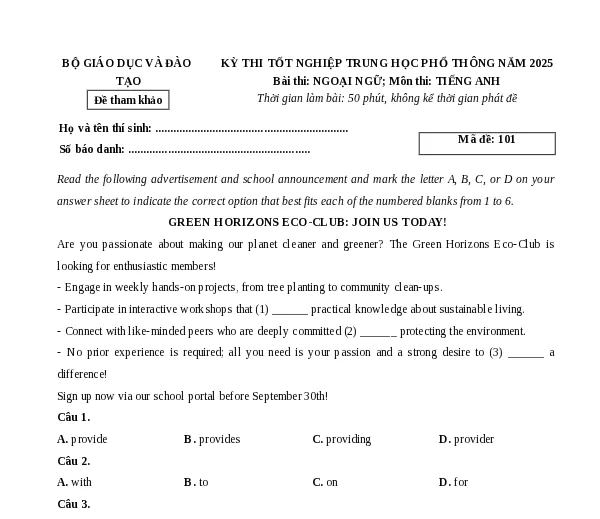
SỞ GIÁO DỤC VÀ ĐÀO TẠO ....................
TRƯỜNG THPT ....................
Đề tham khảo
KỲ THI TỐT NGHIỆP TRUNG HỌC PHỔ THÔNG NĂM 2025
Môn thi: TIẾNG ANH – Lớp 12
Thời gian làm bài: 50 phút, không kể thời gian phát đề
Họ và tên thí sinh: ................................................................ Số báo danh: ............................................................ | Mã đề: 101 |
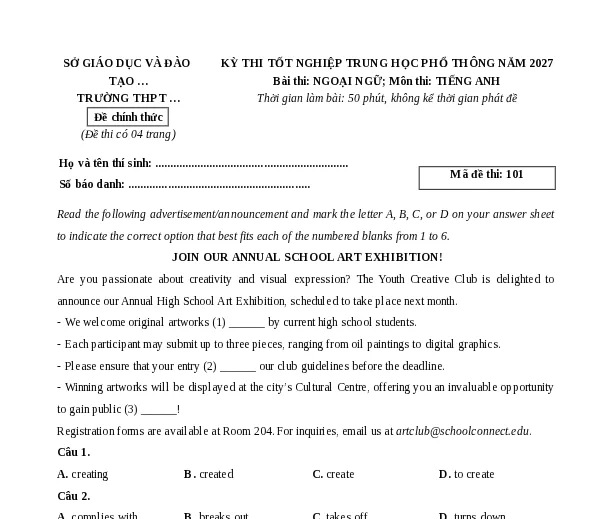
Read the following advertisement/announcement and mark the letter A, B, C, or D on your answer sheet to indicate the correct option that best fits each of the numbered blanks from 1 to 6.
CELEBRATING CULTURAL DIVERSITY FESTIVAL 2025!
Are you eager to broaden your horizons and embrace rich traditions from around the globe? Join us at the International Youth Cultural Exchange!
- Experience traditional customs: Marvel at unique costumes and (1) ______ authentic ethnic dishes prepared by international chefs.
- Engage in meaningful dialogues: Build lasting friendships with people from (2) ______ variety of cultural backgrounds.
- Interactive workshops: Learn traditional crafts and folk dances (3) ______ by local artisans.
- Date & Location: October 25th at the Central Youth Palace. Admission is free for all students!
Câu 1 (0,25 điểm).
A. savor
B. savoring
C. to savor
D. savored
Câu 2 (0,25 điểm).
A. an
B. the
C. a
D. (no article)
Câu 3 (0,25 điểm).
A. which conducted
B. conducted
C. conducting
D. were conducted
ANNOUNCEMENT: "INSPIRING LIFE STORIES" ESSAY CONTEST
The School Youth Union is delighted to launch this year's essay competition entitled "Life Stories We Admire":
- All Grade 12 students are encouraged to write about an extraordinary historical (4) ______ or a contemporary role model whose perseverance has left a deep impression on them.
- Submissions must be original and clearly explain how that person successfully overcame severe hardships to (5) ______ their lifelong dreams.
- The deadline for entries is November 15th, 2025.
- Should you have any inquiries, please do not hesitate to get in (6) ______ with your English club coordinators.
Câu 4 (0,25 điểm).
A. character
B. figure
C. identity
D. form
Câu 5 (0,25 điểm).
A. pursue
B. demand
C. abandon
D. relieve
Câu 6 (0,25 điểm).
A. sight
B. track
C. touch
D. hand
Read the following leaflet and mark the letter A, B, C, or D on your answer sheet to indicate the correct option that best fits each of the numbered blanks from 7 to 12.
NAVIGATING A MULTICULTURAL WORLD: ESSENTIAL TIPS FOR TEENS
Living in an interconnected world offers tremendous opportunities, but adapting to unfamiliar cultural environments can sometimes be challenging. Here is how you can thrive:
- Respect Differences: Keep in mind that cultural traditions (7) ______ vastly across regions. Being open-minded prevents you from forming biased opinions or stereotypes.
- Overcome Language Barriers: Misunderstandings frequently (8) ______ when people communicate in a second language. Always listen attentively before making assumptions.
- Preserve Your Heritage: While adapting to modern trends, do not neglect your native roots. You can easily (9) ______ your national identity by taking pride in your mother tongue and traditional festivities.
- Gain (10) ______ Knowledge: Try to read extensively about world history and international affairs. The more you explore, (11) ______ tolerant you will become.
- Seek Guidance: Whenever you feel disoriented or overwhelmed by cultural shock, remember that (12) ______ experienced mentors are always available to help you adapt smoothly.
Câu 7 (0,25 điểm).
A. vary
B. variety
C. various
D. variously
Câu 8 (0,25 điểm).
A. look up
B. come about
C. give off
D. take after
Câu 9 (0,25 điểm).
A. eliminate
B. distort
C. maintain
D. decline
Câu 10 (0,25 điểm).
A. many
B. every
C. much
D. few
Câu 11 (0,25 điểm).
A. the more
B. more
C. the most
D. as much
Câu 12 (0,25 điểm).
A. whose
B. whom
C. which
D. who
Mark the letter A, B, C, or D on your answer sheet to indicate the correct arrangement of the sentences to make a meaningful exchange or text in each of the following questions from 13 to 17.
Câu 13 (0,25 điểm).
a. Mark: "That sounds awesome! Did you have a chance to try any traditional dishes?"
b. Lan: "We attended the ASEAN Food and Culture Fair downtown yesterday."
c. Lan: "Yes, we enjoyed Malaysian spicy noodles and watched a wonderful Thai folk dance."
A. b – a – c
B. a – c – b
C. b – c – a
D. c – a – b
Câu 14 (0,25 điểm).
a. Nam: "I'm reading a biography of General Vo Nguyen Giap. His military genius and humble life truly inspire me."
b. Nam: "Definitely. He devoted his entire youth to defending our nation's freedom."
c. Mai: "What book are you reading so attentively, Nam?"
d. Mai: "I agree. He was admired not only in Vietnam but also by historians worldwide."
e. Nam: "Yes, reading about his life motivates me to study harder and serve our community."
A. c – d – a – b – e
B. c – a – d – b – e
C. a – c – d – b – e
D. c – a – b – d – e
Câu 15 (0,25 điểm).
Dear Kevin,
a. Hearing about your recent exchange trip to Singapore made me really excited.
b. If you have some free time this weekend, let's grab a coffee so you can share more photos and stories.
c. I have always wanted to know how students from distinct cultural backgrounds collaborate at school.
d. I hope you are settling in well after returning home from your travels.
e. Besides, I am preparing for a presentation on multicultural societies and your firsthand insights would be invaluable.
Warm regards,
Minh
A. d – a – c – e – b
B. a – d – c – b – e
C. d – c – a – e – b
D. a – c – d – e – b
Câu 16 (0,25 điểm).
a. Gradually, she mastered Braille and learned to communicate effectively with the outside world.
b. Helen Keller lost both her sight and hearing at a very young age due to a severe illness.
c. Her remarkable life story remains an enduring testament to human willpower and perseverance.
d. Despite these profound obstacles, she never surrendered to despair and found a dedicated tutor, Anne Sullivan.
e. Eventually, she graduated with honors from college and became a renowned author and humanitarian advocate.
A. b – d – a – e – c
B. b – a – d – e – c
C. d – b – a – e – c
D. b – d – e – a – c
Câu 17 (0,25 điểm).
a. For instance, international cuisine and global fashion have become integral parts of daily urban life.
b. In conclusion, experiencing multiple cultures enriches our perspectives and fosters global harmony.
c. Today, rapid globalization has brought diverse traditions and customs into close contact.
d. However, this exposure also requires individuals to practice mutual respect and intercultural understanding.
e. As people interact across national borders, they learn to appreciate cultural uniqueness rather than judge it.
A. c – a – e – d – b
B. c – d – a – e – b
C. a – c – d – e – b
D. c – a – d – e – b
Read the following passage and mark the letter A, B, C, or D on your answer sheet to indicate the correct option that best fits each of the numbered blanks from 18 to 22.
Throughout human history, remarkable figures have dedicated their lives to making the world a fairer and more peaceful place. Nelson Mandela, who led the struggle against apartheid in South Africa, (18) ______. Despite spending twenty-seven years in prison under harsh conditions, (19) ______. Instead, he firmly believed that hatred could only be defeated through reconciliation, forgiveness, and quality education.
After his release in 1990, Mandela worked tirelessly to negotiate an end to minority rule, (20) ______. In 1994, he became the first democratic president of South Africa, representing a nation characterized by vast racial and cultural diversity. (21) ______. His legacy demonstrates that an individual armed with determination, compassion, and resilience can overcome seemingly insurmountable barriers. Today, his visionary ideals continue to guide young generations (22) ______.
Câu 18 (0,25 điểm).
A. is widely regarded as one of the most revered leaders of modern times
B. which is widely regarded as one of the most revered leaders of modern times
C. whose leadership was widely regarded as modern times
D. being widely regarded as one of the most revered leaders of modern times
Câu 19 (0,25 điểm).
A. seeking revenge against his oppressors was his ultimate goal
B. he refused to become bitter or harbor thoughts of vengeance
C. having refused to become bitter or harbor thoughts of vengeance
D. his oppressors were not forgiven by him in any circumstances
Câu 20 (0,25 điểm).
A. which earned him the Nobel Peace Prize in 1993
B. and earning the Nobel Peace Prize in 1993 for him
C. who earned him the Nobel Peace Prize in 1993
D. that he was awarded the Nobel Peace Prize in 1993
Câu 21 (0,25 điểm).
A. Believing that all citizens deserved equal rights, a peaceful transition was established
B. By uniting people of different ethnicities, he built what came to be known as the "Rainbow Nation"
C. Having united people of different ethnicities, the "Rainbow Nation" was built by him
D. In order to unite people of different ethnicities, economic reforms were rapidly executed
Câu 22 (0,25 điểm).
A. who strive to promote equality and mutual understanding
B. whom strive to promote equality and mutual understanding
C. whose effort strives to promote equality and mutual understanding
D. what strive to promote equality and mutual understanding
Read the following passage and mark the letter A, B, C, or D on your answer sheet to indicate the correct answer to each of the questions from 23 to 30.
In an era of unprecedented globalization, societies across the planet are becoming progressively multicultural. Immigration, international commerce, and digital connectivity have enabled individuals from widely contrasting cultural backgrounds to live, work, and study side by side. While some critics express apprehension that cross-border contact may erode national heritage, evidence suggests that cultural diversity yields immense social and economic dividends when managed with mutual respect.
One undeniable advantage of a multicultural society is the surge of creativity and innovation it stimulates. When individuals with varied life experiences collaborate, they bring distinct perspectives to problem-solving. In business, multinational teams are frequently acknowledged to be more adaptable and inventive than homogeneous ones. Different approaches to challenges foster out-of-the-box thinking, which is indispensable in today's knowledge-based economy. Furthermore, everyday life is substantially enriched: people have direct access to a tapestry of international cuisines, artistic expressions, and philosophical viewpoints.
Nevertheless, living harmoniously in a diverse society is not without friction. Cultural misunderstandings often arise from deep-seated prejudices, communication differences, or stereotyping. When dominant groups expect minorities to assimilate entirely and abandon their ancestral traditions, social cohesion is severely compromised. True integration, by contrast, does not demand that immigrants discard their cultural identities; rather, it encourages them to embrace civic values while celebrating their unique heritage.
To nurture intercultural harmony, educational institutions play an indispensable role. Schools must integrate cultural competence into their curricula, teaching students not merely to tolerate differences, but to actively appreciate them. When young people cultivate empathy and open-mindedness, they are far better equipped to dismantle discriminatory barriers. Ultimately, a multicultural world should not be envisioned as a melting pot where distinct colors vanish, but rather as a vibrant mosaic in which every individual piece retains its brilliance while contributing to a magnificent collective picture.
Câu 23 (0,25 điểm). Which of the following is the best title for the passage?
A. The Decline of National Identities in the Modern Era
B. Navigating the Benefits and Challenges of a Multicultural Society
C. The Inevitable Rise of Global Migration and Commerce
D. Why Assimilation is Crucial for Economic Development
Câu 24 (0,25 điểm). According to paragraph 1, what has contributed to societies becoming increasingly multicultural?
A. Strict national immigration quotas and protectionism
B. Immigration, international business, and digital connectedness
C. The total disappearance of traditional lifestyles
D. Mutual suspicion among distinct ethnic communities
Câu 25 (0,25 điểm). The word homogeneous in paragraph 2 is closest in meaning to ______.
A. diverse
B. uniform
C. innovative
D. complex
Câu 26 (0,25 điểm). The word them in paragraph 3 refers to ______.
A. cultural misunderstandings
B. ancestral traditions
C. dominant groups
D. immigrants
Câu 27 (0,25 điểm). The word indispensable in paragraph 4 is opposite in meaning to ______.
A. essential
B. unnecessary
C. significant
D. mandatory
Câu 28 (0,25 điểm). Which of the following is NOT true according to the passage?
A. Multinational teams often demonstrate greater adaptability in solving problems.
B. True integration requires minorities to give up their ancestral customs completely.
C. Misunderstandings in diverse societies can stem from stereotyping and prejudice.
D. Education plays a vital part in teaching young generations to value diversity.
Câu 29 (0,25 điểm). Which of the following can be inferred from the passage?
A. Cultural friction can be minimized if young people are equipped with empathy and intercultural competence.
B. Homogeneous societies consistently achieve higher economic growth than multicultural ones.
C. Digital connectivity will eventually eliminate all linguistic and cultural distinctions.
D. Schools should prioritize economic skills over teaching intercultural respect.
Câu 30 (0,25 điểm). The author compares a multicultural society to a "mosaic" in paragraph 4 to emphasize that ______.
A. individual cultural identities should blend together until they disappear
B. each culture should preserve its distinct identity while enriching the whole community
C. cultural diversity inevitably creates fragile and easily broken social structures
D. minority groups must conform to the customs of the dominant majority
Read the following passage and mark the letter A, B, C, or D on your answer sheet to indicate the correct answer to each of the questions from 31 to 40.
Throughout the history of science, few figures have embodied perseverance and devotion to humanity as profoundly as Marie Curie. Born Maria Skłodowska in Warsaw, Poland, in 1867, she confronted enormous obstacles from an early age. At that time, Poland was under foreign occupation, and women were strictly barred from attending higher education institutions. [I] Refusing to abandon her intellectual ambitions, she joined the clandestine "Flying University," an underground educational movement that offered Polish youths clandestine instruction in science and national history.
To finance her dream of studying at the prestigious Sorbonne in Paris, Marie worked for several years as a governess, selflessly sending part of her modest earnings to support her sister's medical studies. [II] When she finally relocated to France in 1891, she lived in an unheated attic, enduring severe poverty and subsisting on little more than bread and tea. Nevertheless, her burning passion for physics and mathematics never waned. Her uncompromising dedication allowed her to graduate at the top of her class in physics and second in mathematics.
In Paris, she met and married Pierre Curie, a brilliant French physicist who shared her altruistic devotion to scientific inquiry. Together, working in a dilapidated, poorly ventilated wooden shed, the couple embarked on pioneering research into uranium rays. [III] Through painstaking physical labor, processing tons of pitchblende ore by hand, they isolated two previously unknown radioactive elements: polonium, which Marie named after her beloved homeland, and radium. Their groundbreaking discoveries revolutionized modern physics and paved the way for modern oncology.
In 1903, Marie Curie became the first woman to be awarded the Nobel Prize in Physics, sharing it with Pierre Curie and Henri Becquerel. Following Pierre's tragic death in a street accident in 1906, she assumed his professorship at the Sorbonne, becoming the first female professor in the university's illustrious history. In 1911, she achieved another unprecedented milestone by winning a second Nobel Prize, this time in Chemistry, making her the first person ever to win Nobel Prizes in two distinct scientific fields. [IV] During World War I, she further exemplified her humanitarian spirit by developing mobile radiography units, affectionately known as "petites Curies," which assisted military surgeons in treating more than one million wounded soldiers. Her life remains a shining beacon of self-sacrifice, intellectual brilliance, and resilience.
Câu 31 (0,25 điểm). Where in paragraph 1 does the following sentence best fit?
"This underground network served as a sanctuary for ambitious minds eager to pursue knowledge despite political repression."
A. [I]
B. [II]
C. [III]
D. [IV]
Câu 32 (0,25 điểm). The word clandestine in paragraph 1 is closest in meaning to ______.
A. secret
B. official
C. prestigious
D. ordinary
Câu 33 (0,25 điểm). According to paragraph 1, Marie Curie was unable to attend regular universities in Poland because ______.
A. she lacked interest in scientific disciplines
B. her family prohibited her from living away from home
C. women were legally excluded from higher education
D. she failed the rigorous entrance examinations
Câu 34 (0,25 điểm). The word dilapidated in paragraph 3 is closest in meaning to ______.
A. luxurious
B. spacious
C. run-down
D. modern
Câu 35 (0,25 điểm). The word it in paragraph 4 refers to ______.
A. the Nobel Prize in Physics
B. the Sorbonne
C. radioactivity
D. modern oncology
Câu 36 (0,25 điểm). Why did Marie Curie name one of the newly discovered chemical elements "polonium"?
A. To honor the French institution that sponsored her lab.
B. To express her profound love and respect for her native country.
C. To acknowledge the financial support provided by Polish youths.
D. To commemorate the battlefield where she treated wounded soldiers.
Câu 37 (0,25 điểm). Which of the following is NOT mentioned in the passage about Marie Curie's achievements?
A. Becoming the first female professor at the Sorbonne.
B. Winning two Nobel Prizes in two separate scientific domains.
C. Establishing the world's first commercial pharmaceutical factory.
D. Operating mobile X-ray units to assist wounded soldiers during wartime.
Câu 38 (0,25 điểm). Which of the following best paraphrases the underlined sentence in paragraph 4?
"During World War I, she further exemplified her humanitarian spirit by developing mobile radiography units, affectionately known as 'petites Curies,' which assisted military surgeons in treating more than one million wounded soldiers."
A. Her compassionate character was demonstrated during World War I when her mobile X-ray vehicles helped doctors treat over a million injured troops.
B. She was forced by military surgeons to operate radiography vehicles named "petites Curies" during World War I to save wounded soldiers.
C. Military doctors during World War I invented mobile X-ray machines to honor Marie Curie's extraordinary humanitarian efforts on the battlefield.
D. Although she assisted a million wounded soldiers in World War I, her mobile radiography units were criticized by military surgeons.
Câu 39 (0,25 điểm). Which of the following can be inferred about Marie and Pierre Curie from paragraph 3?
A. They prioritised personal wealth and scientific fame over medical breakthroughs.
B. They were willing to endure harsh working conditions to advance scientific knowledge.
C. They conducted their experiments with state-of-the-art laboratory equipment provided by France.
D. Their research was initially rejected by the international medical community.
Câu 40 (0,25 điểm). Which of the following best summarizes the passage?
A. Marie Curie's discovery of polonium and radium brought her immense financial prosperity and political influence in Paris.
B. Marie Curie overcame immense political, social, and financial hardships to become a pioneering scientist and a dedicated humanitarian.
C. The collaboration between French and Polish universities during World War I revolutionized medical treatments on the front lines.
D. Despite experiencing severe poverty in Poland, Marie Curie chose to dedicate her entire career to teaching math in France.
--------- HẾT ---------
Thí sinh không được sử dụng tài liệu. Cán bộ coi thi không giải thích gì thêm.
ĐÁP ÁN VÀ HƯỚNG DẪN GIẢI CHI TIẾT
BẢNG ĐÁP ÁN
Câu | Đ/A | Câu | Đ/A | Câu | Đ/A | Câu | Đ/A |
|---|---|---|---|---|---|---|---|
1 | A | 11 | A | 21 | B | 31 | A |
2 | C | 12 | D | 22 | A | 32 | A |
3 | B | 13 | A | 23 | B | 33 | C |
4 | B | 14 | B | 24 | B | 34 | C |
5 | A | 15 | A | 25 | B | 35 | A |
6 | C | 16 | A | 26 | D | 36 | B |
7 | A | 17 | D | 27 | B | 37 | C |
8 | B | 18 | A | 28 | B | 38 | A |
9 | C | 19 | B | 29 | A | 39 | B |
10 | C | 20 | A | 30 | B | 40 | B |
HƯỚNG DẪN GIẢI CHI TIẾT
Câu 1. Đáp án A
- Kiến thức: Cấu trúc song hành với động từ nguyên thể (Parallel structure).
- Giải thích: Phía trước có "Marvel at unique costumes and (1) ______ authentic ethnic dishes", liên từ and nối hai động từ nguyên mẫu cùng phụ thuộc vào câu mệnh lệnh thức (Marvel at ... and savor ...).
- Chọn A. savor (thưởng thức).
Câu 2. Đáp án C
- Kiến thức: Mạo từ (Articles) / Cụm từ cố định (Collocation).
- Giải thích: Cụm từ cố định "a variety of + N (số nhiều)" mang nghĩa là nhiều, đa dạng các thứ gì.
- Chọn C. a.
Câu 3. Đáp án B
- Kiến thức: Rút gọn mệnh đề quan hệ (Reduced relative clause).
- Giải thích: Mệnh đề gốc mang nghĩa bị động: "folk dances which were conducted by local artisans". Khi rút gọn mệnh đề quan hệ dạng bị động, ta dùng quá khứ phân từ ().
- Chọn B. conducted.
Câu 4. Đáp án B
- Kiến thức: Từ vựng (Vocabulary - Unit 1).
- Giải thích: Cụm từ "historical figure" mang nghĩa là "nhân vật lịch sử". Các từ còn lại: character (nhân vật trong tác phẩm hư cấu/tính cách), identity (danh tính/bản sắc), form (hình thức).
- Chọn B. figure.
Câu 5. Đáp án A
- Kiến thức: Cụm từ vựng (Collocation).
- Giải thích: Cụm "pursue one's dream" có nghĩa là "theo đuổi ước mơ". Các từ khác không hợp nghĩa: demand (đòi hỏi), abandon (từ bỏ), relieve (làm dịu đi).
- Chọn A. pursue.
Câu 6. Đáp án C
- Kiến thức: Thành ngữ / Cụm từ cố định (Idioms & Collocations).
- Giải thích: Cụm "get in touch with somebody" có nghĩa là "liên lạc với ai".
- Chọn C. touch.
Câu 7. Đáp án A
- Kiến thức: Từ loại (Word form).
- Giải thích: Sau chủ ngữ "cultural traditions" cần một động từ chính chia ở hiện tại đơn (chủ ngữ số nhiều). vary (v) = thay đổi, khác nhau; variety (n); various (adj); variously (adv).
- Chọn A. vary.
Câu 8. Đáp án B
- Kiến thức: Cụm động từ (Phrasal verbs).
- Giải thích: come about = xảy ra, xuất hiện (= happen/occur). Các đáp án khác: look up (tra cứu), give off (phát ra mùi/nhiệt), take after (giống ai). Ngữ cảnh: Hiểu lầm thường xảy ra khi người ta giao tiếp bằng ngôn ngữ thứ hai.
- Chọn B. come about.
Câu 9. Đáp án C
- Kiến thức: Từ vựng (Unit 2 - Cultural identity).
- Giải thích: maintain/preserve one's identity = duy trì, giữ gìn bản sắc. Các từ khác: eliminate (loại bỏ), distort (bóp méo), decline (suy giảm/từ chối).
- Chọn C. maintain.
Câu 10. Đáp án C
- Kiến thức: Lượng từ (Quantifiers).
- Giải thích: Danh từ "knowledge" là danh từ không đếm được, do đó ta dùng lượng từ much. Many và few đi với danh từ đếm được số nhiều; every đi với danh từ đếm được số ít.
- Chọn C. much.
Câu 11. Đáp án A
- Kiến thức: So sánh kép (Double comparison: The more ..., the more ...).
- Giải thích: Cấu trúc: The + comparative ..., the + comparative ... (Càng ... thì càng ...). Phía trước có "The more you explore", vế sau cần "the more + adj": "the more tolerant you will become".
- Chọn A. the more.
Câu 12. Đáp án D
- Kiến thức: Đại từ quan hệ (Relative pronouns).
- Giải thích: Thay thế cho danh từ chỉ người đóng vai trò chủ ngữ "experienced mentors" (những người cố vấn giàu kinh nghiệm) và trước động từ "are available", ta dùng đại từ quan hệ who.
- Chọn D. who.
Câu 13. Đáp án A
- Kiến thức: Sắp xếp đoạn hội thoại (Conversation arrangement).
- Giải thích:
- b mở đầu: Lan kể về sự kiện đã tham gia (We attended the ASEAN Food and Culture Fair downtown yesterday.)
- a tiếp nối: Mark bày tỏ sự thích thú và hỏi về món ăn (That sounds awesome! Did you have a chance to try any traditional dishes?)
- c phản hồi: Lan trả lời về món ăn và điệu múa truyền thống (Yes, we enjoyed Malaysian spicy noodles...).
- Thứ tự đúng: b – a – c.
Câu 14. Đáp án B
- Kiến thức: Sắp xếp đoạn hội thoại (Conversation arrangement).
- Giải thích:
- c mở đầu: Mai hỏi Nam đang đọc cuốn sách gì (What book are you reading so attentively, Nam?)
- a phản hồi: Nam giới thiệu cuốn tiểu sử Đại tướng Võ Nguyên Giáp (I'm reading a biography of General Vo Nguyen Giap...)
- d tiếp lời: Mai tán thành và nêu tầm vóc quốc tế của Đại tướng (I agree. He was admired not only in Vietnam...)
- b củng cố: Nam khẳng định sự cống hiến trọn đời của Đại tướng (Definitely. He devoted his entire youth...)
- e kết luận: Nam chia sẻ bài học bản thân rút ra từ cuốn sách (Yes, reading about his life motivates me...).
- Thứ tự đúng: c – a – d – b – e.
Câu 15. Đáp án A
- Kiến thức: Sắp xếp thư từ cá nhân (Letter arrangement).
- Giải thích:
- d mở đầu thư bằng lời thăm hỏi lịch sự: I hope you are settling in well...
- a nêu cảm xúc khi nghe tin về chuyến đi: Hearing about your recent exchange trip...
- c bày tỏ sự quan tâm về đời sống văn hóa học đường: I have always wanted to know how students from distinct cultural backgrounds collaborate...
- e bổ sung lý do cần thông tin cho bài thuyết trình: Besides, I am preparing for a presentation...
- b hẹn gặp gỡ cuối tuần: If you have some free time this weekend, let's grab a coffee...
- Thứ tự đúng: d – a – c – e – b.
Câu 16. Đáp án A
- Kiến thức: Sắp xếp đoạn văn tiểu sử (Biography paragraph arrangement).
- Giải thích:
- b giới thiệu bối cảnh đầu đời và biến cố: Helen Keller mất thị lực và thính lực do bạo bệnh từ nhỏ.
- d tinh thần vượt khó và người đồng hành: Bất chấp trở ngại, bà tìm được cô gia sư Anne Sullivan.
- a tiến trình rèn luyện: Dần dần bà học chữ nổi Braille và học cách giao tiếp.
- e thành tựu lớn: Tốt nghiệp đại học xuất sắc và trở thành nhà văn, nhà hoạt động nhân đạo.
- c tổng kết ý nghĩa cuộc đời: Cuộc đời bà là minh chứng sống cho ý chí phi thường của con người.
- Thứ tự đúng: b – d – a – e – c.
Câu 17. Đáp án D
- Kiến thức: Sắp xếp đoạn văn nghị luận (Expository paragraph arrangement).
- Giải thích:
- c câu chủ đề giới thiệu hiện tượng toàn cầu hóa mang các nền văn hóa lại gần nhau.
- a đưa ra dẫn chứng cụ thể trong đời sống đô thị (For instance, international cuisine...).
- d nêu mặt đối lập/thách thức: Tiếp xúc văn hóa đòi hỏi sự tôn trọng lẫn nhau (However, this exposure also requires...).
- e kết quả tích cực của sự tương tác: Mọi người học cách trân trọng nét độc đáo thay vì phán xét.
- b câu kết luận (In conclusion, experiencing multiple cultures enriches...).
- Thứ tự đúng: c – a – d – e – b.
Câu 18. Đáp án A
- Kiến thức: Cấu trúc câu (Mệnh đề chính hoàn chỉnh).
- Giải thích: Chủ ngữ là "Nelson Mandela", mệnh đề quan hệ xen vào là "who led the struggle against apartheid in South Africa". Câu cần vị ngữ chính chia thì hiện tại đơn ở thể bị động: "is widely regarded as one of the most revered leaders of modern times".
- Chọn A.
Câu 19. Đáp án B
- Kiến thức: Sự hòa hợp chủ ngữ trong câu có trạng từ/mệnh đề rút gọn (Participle clause / Subject coherence).
- Giải thích: Vế trước là cụm giới từ chỉ hành động của người: "Despite spending twenty-seven years in prison under harsh conditions". Chủ ngữ của mệnh đề chính phải là chính Nelson Mandela (he). Phương án B tạo câu hoàn chỉnh: "he refused to become bitter or harbor thoughts of vengeance".
- Chọn B.
Câu 20. Đáp án A
- Kiến thức: Đại từ quan hệ thay cho cả mệnh đề đứng trước (Relative pronoun which).
- Giải thích: Việc đàm phán chấm dứt chế độ thiểu số cầm quyền đã mang lại cho ông giải Nobel Hòa bình năm 1993. Ta dùng đại từ quan hệ , which để thay thế cho toàn bộ sự việc ở mệnh đề trước.
- Chọn A.
Câu 21. Đáp án B
- Kiến thức: Mệnh đề phân từ và nghĩa câu (Cohesion and coherence).
- Giải thích: Nelson Mandela đoàn kết mọi người từ các sắc tộc khác nhau để kiến tạo nên "Quốc gia Cầu vồng" (Rainbow Nation). Câu B có chủ ngữ he phù hợp với mạch kể ở câu trước và vị ngữ ở câu sau (His legacy demonstrates...).
- Chọn B.
Câu 22. Đáp án A
- Kiến thức: Mệnh đề quan hệ xác định (Defining relative clause).
- Giải thích: Cụm từ bổ nghĩa cho "young generations" (thế hệ trẻ - chỉ người) làm chủ ngữ của mệnh đề quan hệ cần dùng đại từ quan hệ who + động từ số nhiều (strive).
- Chọn A.
Câu 23. Đáp án B
- Kiến thức: Đọc hiểu - Tiêu đề phù hợp nhất (Best title).
- Giải thích: Bài viết thảo luận về cả những lợi ích (sự sáng tạo, đổi mới, phong phú đời sống) lẫn thách thức (định kiến, hiểu lầm, cách thức hòa nhập) của một xã hội đa văn hóa. Do đó, tiêu đề thích hợp nhất là "Định hướng những lợi ích và thách thức của một xã hội đa văn hóa".
- Chọn B.
Câu 24. Đáp án B
- Kiến thức: Đọc hiểu - Tìm thông tin chi tiết (Factual question).
- Dẫn chứng: Đoạn 1: "Immigration, international commerce, and digital connectivity have enabled individuals from widely contrasting cultural backgrounds to live, work, and study side by side."
- Chọn B.
Câu 25. Đáp án B
- Kiến thức: Đọc hiểu - Từ đồng nghĩa (Vocabulary in context).
- Giải thích: Từ homogeneous có nghĩa là "đồng nhất, thuần nhất", đối lập với multinational/diverse. Từ đồng nghĩa là uniform (đồng đều, cùng một kiểu/loại).
- Chọn B.
Câu 26. Đáp án D
- Kiến thức: Đọc hiểu - Đại từ quy chiếu (Reference).
- Dẫn chứng: Đoạn 3: "True integration, by contrast, does not demand that immigrants discard their cultural identities; rather, it encourages them to embrace civic values..." -> them quy chiếu đến immigrants.
- Chọn D.
Câu 27. Đáp án B
- Kiến thức: Đọc hiểu - Từ trái nghĩa (Antonym).
- Giải thích: indispensable có nghĩa là "không thể thiếu, thiết yếu" (= essential). Do đó, từ trái nghĩa là unnecessary (không cần thiết).
- Chọn B.
Câu 28. Đáp án B
- Kiến thức: Đọc hiểu - Xác định thông tin SAI (Negative fact).
- Dẫn chứng: Đoạn 3 nêu rõ: "True integration, by contrast, does not demand that immigrants discard their cultural identities..." (Hội nhập thực sự không đòi hỏi người nhập cư phải từ bỏ bản sắc văn hóa của họ). Do đó, câu B nói "phải từ bỏ hoàn toàn phong tục của tổ tiên" là SAI.
- Chọn B.
Câu 29. Đáp án A
- Kiến thức: Đọc hiểu - Suy luận (Inference).
- Dẫn chứng: Đoạn 4: "When young people cultivate empathy and open-mindedness, they are far better equipped to dismantle discriminatory barriers." -> Có thể suy ra xích mích văn hóa có thể giảm thiểu khi giới trẻ được trang bị sự thấu cảm và năng lực giao lưu văn hóa.
- Chọn A.
Câu 30. Đáp án B
- Kiến thức: Đọc hiểu - Ý đồ tác giả / Hình ảnh ẩn dụ (Author's purpose).
- Dẫn chứng: Đoạn 4: "...not envisioned as a melting pot where distinct colors vanish, but rather as a vibrant mosaic in which every individual piece retains its brilliance while contributing to a magnificent collective picture." -> Ẩn dụ bức tranh khảm "mosaic" nhằm nhấn mạnh mỗi nền văn hóa vừa giữ gìn được nét độc đáo của mình, vừa làm phong phú cho toàn thể cộng đồng.
- Chọn B.
Câu 31. Đáp án A
- Kiến thức: Đọc hiểu - Chèn câu vào vị trí thích hợp (Sentence insertion).
- Giải thích: Câu cần chèn: "This underground network served as a sanctuary for ambitious minds eager to pursue knowledge despite political repression." (Mạng lưới ngầm này đóng vai trò như nơi trú ẩn cho những tâm hồn khao khát tri thức bất chấp sự đàn áp chính trị). Cụm "This underground network" liên kết trực tiếp với "the clandestine 'Flying University', an underground educational movement" xuất hiện ngay trước vị trí [I].
- Chọn A.
Câu 32. Đáp án A
- Kiến thức: Đọc hiểu - Từ đồng nghĩa (Vocabulary).
- Giải thích: clandestine (adj) = giấu giếm, bí mật, ngầm (= secret).
- Chọn A.
Câu 33. Đáp án C
- Kiến thức: Đọc hiểu - Thông tin chi tiết (Factual question).
- Dẫn chứng: Đoạn 1: "...women were strictly barred from attending higher education institutions." (Phụ nữ bị cấm theo học tại các cơ sở giáo dục đại học).
- Chọn C.
Câu 34. Đáp án C
- Kiến thức: Đọc hiểu - Từ đồng nghĩa (Vocabulary).
- Giải thích: dilapidated (adj) = đổ nát, xiêu vẹo, tồi tàn (= run-down).
- Chọn C.
Câu 35. Đáp án A
- Kiến thức: Đọc hiểu - Đại từ quy chiếu (Reference).
- Dẫn chứng: Đoạn 4: "In 1903, Marie Curie became the first woman to be awarded the Nobel Prize in Physics, sharing it with Pierre Curie and Henri Becquerel." -> it thay thế cho the Nobel Prize in Physics.
- Chọn A.
Câu 36. Đáp án B
- Kiến thức: Đọc hiểu - Chi tiết nguyên nhân (Cause and effect).
- Dẫn chứng: Đoạn 3: "...they isolated two previously unknown radioactive elements: polonium, which Marie named after her beloved homeland..." (Bà đặt tên polonium theo tên quê hương Ba Lan yêu dấu - Poland).
- Chọn B.
Câu 37. Đáp án C
- Kiến thức: Đọc hiểu - Thông tin không được đề cập (Not mentioned).
- Dẫn chứng:
- Phương án A được nhắc tới ở đoạn 4: "becoming the first female professor in the university's illustrious history".
- Phương án B được nhắc tới ở đoạn 4: "winning a second Nobel Prize, this time in Chemistry... in two distinct scientific fields".
- Phương án D được nhắc tới ở đoạn 4: "developing mobile radiography units... which assisted military surgeons in treating more than one million wounded soldiers".
- Phương án C không có trong bài (bà không thành lập nhà máy dược phẩm thương mại nào).
- Chọn C.
Câu 38. Đáp án A
- Kiến thức: Đọc hiểu - Diễn giải câu (Paraphrasing).
- Giải thích: Câu gốc: "Trong Thế chiến I, bà tiếp tục thể hiện tinh thần nhân đạo bằng việc phát triển các thiết bị chụp X-quang di động, được gọi thân mật là 'những chiếc xe Curie nhỏ', giúp các bác sĩ quân y chữa trị cho hơn một triệu binh lính bị thương." Câu A diễn đạt lại chính xác và đầy đủ nghĩa nhất: "Her compassionate character was demonstrated during World War I when her mobile X-ray vehicles helped doctors treat over a million injured troops."
- Chọn A.
Câu 39. Đáp án B
- Kiến thức: Đọc hiểu - Suy luận từ chi tiết (Inference).
- Dẫn chứng: Đoạn 3: "Together, working in a dilapidated, poorly ventilated wooden shed, the couple embarked on pioneering research into uranium rays. Through painstaking physical labor, processing tons of pitchblende ore by hand..." -> Hai vợ chồng làm việc trong căn lán gỗ dột nát, lao động thể chất cực nhọc để phục vụ nghiên cứu. Điều này cho thấy họ sẵn sàng chịu đựng hoàn cảnh khắc nghiệt để phát triển tri thức khoa học.
- Chọn B.
Câu 40. Đáp án B
- Kiến thức: Đọc hiểu - Tóm tắt toàn văn (Summary).
- Giải thích: Toàn bộ bài đọc mô tả hành trình phi thường của Marie Curie từ khi vượt qua nghèo khó, rào cản xã hội và chính trị tại Ba Lan để theo đuổi khoa học, đến những thành tựu cống hiến vĩ đại (hai giải Nobel) và tinh thần nhân đạo cứu người trong chiến tranh. Do đó, câu tóm tắt chính xác nhất là: "Marie Curie đã vượt qua vô vàn gian khó về chính trị, xã hội và tài chính để trở thành một nhà khoa học tiên phong và một nhà hoạt động nhân đạo tận tụy."
- Chọn B.