TEST 5
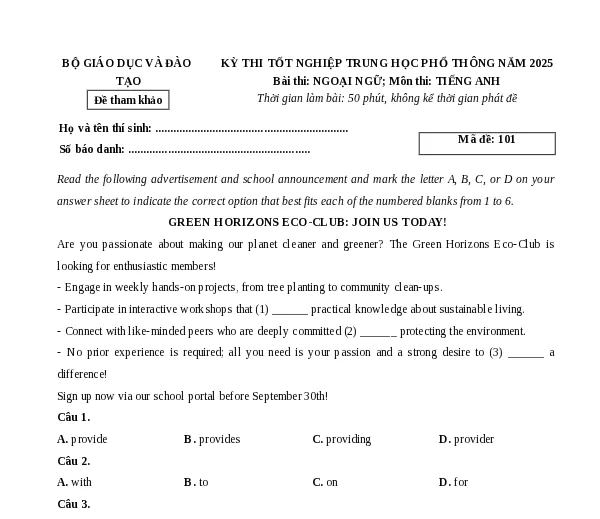
Đề tham khảo
KỲ THI TỐT NGHIỆP TRUNG HỌC PHỔ THÔNG NĂM 2025
Môn thi: TIẾNG ANH – Lớp 12
Thời gian làm bài: 50 phút, không kể thời gian phát đề
Họ và tên thí sinh: ................................................................... Số báo danh: ........................
Read the following advertisement and mark the letter A, B, C or D on your answer sheet to indicate the option that best fits each of the numbered blanks from 1 to 6.
Humanitarian Imprints: Inspiring Stories Shaping 2025
Be Inspired. Take Action. Make Change.
- Do you want to discover how ordinary people create extraordinary change in difficult global situations? The global (1)______ conference will showcase amazing success stories from around the world. Join us for this life-changing experience!
- Our passionate (2)______ need your generous support to continue their vital mission abroad.
- Meet brave volunteers (3)______ communities recover from devastating natural disasters throughout developing countries. Our organization sends essential supplies (4)______ affected populations during emergencies.
- Let's (5)______ it, we all have the power to change someone's life for the better every single day. We invite you to join our growing movement and start (6)______ a meaningful difference in local communities today!
❖ When: May 20-22, 2025
❖ Where: Central Exhibition Hall
❖ Time: 9:00 AM - 7:00 PM
❖ Entry: Free admission
❖ Contact us: [email protected] | 555-789-0123
Together, we can build a better world!
Question 1.
A. human
B. humanize
C. humanitarian
D. humanitarianly
Question 2.
A. international relief workers
B. relief workers international
C. workers international relief
D. international workers relief
Question 3.
A. which helped
B. helping
C. was helped
D. helped
Question 4.
A. for
B. about
C. with
D. to
Question 5.
A. admit
B. accept
C. face
D. confront
Question 6.
A. to make
B. making
C. to making
D. make
Read the following leaflet and mark the letter A, B, C or D on your answer sheet to indicate the option that best fits each of the numbered blanks from 7 to 12.
DISCOVER THE SMART GREEN HOME – THE FUTURE IS HERE
Save Energy, Save Money, Save the Planet!
- Our smart homes use less energy than (7)______ on the market today. Smart technology helps you (8)______ renewable energy sources easily!
- The (9)______ of solar panels takes only two days. (10)______ saving money, you will help protect our environment.
- The (11)______ of our smart systems is proven by thousands of happy customers. A (12)______ of our customers save up to 40% on energy costs!
❖ SPECIAL OFFER THIS MONTH: Free consultation and home assessment!
❖ CONTACT US:
- Phone: 555-123-4567
- Email: [email protected]
- Website: www.smartgreenhome.com
- Visit our showroom: 123 Green Street, Eco City
Make your home smart today for a better tomorrow!
Question 7.
A. others
B. another
C. the others
D. other
Question 8.
A. draw on
B. turn to
C. set up
D. tap into
Question 9.
A. assembly
B. mounting
C. integration
D. installation
Question 10.
A. In spite of
B. In addition to
C. On account of
D. By virtue of
Question 11.
A. reliability
B. efficiency
C. performance
D. effectiveness
Question 12.
A. few
B. plenty
C. most
D. lot
Mark the letter A, B, C or D on your answer sheet to indicate the best arrangement of utterances or sentences to make a meaningful exchange or text in each of the following questions from 13 to 17.
Question 13.
a. Nina: Sure! Here you are. Do you need a pencil too?
b. Liam: No, thank you. I have a new pencil in my bag.
c. Liam: Can I borrow your eraser, please?
A. a-c-b
B. b-a-c
C. c-a-b
D. a-b-c
Question 14.
a. Tuan: That sounds fun, but I don't know much about plants or trees.
b. Maya: We will get a good grade, and our teacher will be very happy!
c. Maya: I have a science project, and I need to make a poster about plants.
d. Maya: I can show you my book, and we can work together on the project.
e. Tuan: Thank you for your help, and I can bring my colored pencils tomorrow.
A. c-a-d-e-b
B. c-e-b-a-d
C. c-d-a-c-b
D. d-c-e-a-b
Question 15.
Dear Sam,
a. If you visit next month, you can see how Mrs. Johnson uses the app when she needs her medicine delivered to her home.
b. Although technology can be difficult for some seniors, they are learning quickly because our interface is very simple.
c. Since we started this project, I feel that we are truly building bridges between modern technology and the people who need it most.
d. I am writing because our new app is helping many elderly people who need assistance with shopping.
e. When we designed this system, we didn't know that it would change so many lives in our community.
Yours sincerely,
LK
A. e-d-a-b-c
B. d-c-b-a-c
C. c-b-e-d-a
D. a-b-e-d-c
Question 16.
a. If we continue to put sustainability at the center of our recovery plans, we will have stronger economies that can last for a long time without damaging nature.
b. When businesses use clean energy like solar power, they can save money while they help the environment.
c. Cities that plant more trees and build bike lanes are becoming healthier places where people enjoy living and working.
d. Many countries are planning new ways to grow their economies because the old ways hurt our planet too much.
e. Although some people think green jobs are expensive, studies show that they create more work opportunities than traditional industries.
A. e-d-c-b-a
B. d-b-e-c-a
C. c-b-e-d-a
D. b-d-c-e-a
Question 17.
a. When educational videos are available in different languages, children from all countries can learn subjects that were not possible for them before.
b. Many teachers are using the internet to share free lessons, which help students who cannot afford expensive books or schools.
c. Libraries that offer computers and free wifi are becoming special places where anyone can access information even if they don't have technology at home.
d. If we continue to make knowledge available to everyone, we will build a world where all people have the chance to learn and grow no matter how much money they have.
e. Although traditional schools are important, online platforms are creating new opportunities for people who live in remote areas where good teachers are hard to find.
A. b-e-c-a-d
B. b-c-d-e-a
C. b-a-e-c-d
D. b-d-a-e-c
Read the following passage about Generations Z and Alpha: Born Multicultural Citizens and mark the letter A, B, C or D on your answer sheet to indicate the option that best fits each of the numbered blanks from 18 to 22.
Generation Z, born between 1997 and 2012, has grown up in a world (18)______. These young people use smartphones and computers every day to talk with friends from different parts of the world. If they had been born 30 years earlier, they would not have had these opportunities to experience global connections. They are learning about different cultures, languages, and traditions not just from books but through real online friendships.
Generation Alpha, which includes children born after 2013, is even more connected. The toys that Generation Alpha plays with often teach them about global issues while they have fun. Many schools (19)______. These young students, who come from diverse backgrounds, are creating a new kind of society where differences are celebrated.
(20)______. Generation Z students participate in exchange programs and travel more than previous generations did. (21)______, sharing their daily lives and learning from each other. The world that these generations are creating will be more inclusive and understanding. Traditional borders are becoming less important while cultural exchange is valued more highly. Generation Z and Alpha children, (22)______, will likely become adults who solve problems together across cultural lines. The future looks promising with these multicultural citizens leading the way.
Question 18.
A. where technology connects people across countries and cultures
B. ancient traditions protected people against modern influences
C. when formal education taught people beyond textbooks and schools
D. parents restrict access through digital safety controls
Question 19.
A. are now warning these teenagers about digital dangers which corrupt their values
B. are now teaching these children to be global citizens who respect all cultures
C. having restricted these students from websites where cultures mix freely
D. are now preparing these children for national tests whom eliminate cultural topics
Question 20.
A. Educators limit access to foreign materials and promote only traditional language skills
B. Schools discourage students from exploring global cultures and focus on local identity
C. Teachers emphasize national achievements and minimize the value of multicultural education
D. Parents are encouraging their children to learn languages and understand international perspectives
Question 21.
A. Technology makes it possible for them to maintain friendships across borders
B. Technology creates barriers preventing teenagers from understanding foreign cultures
C. Regulations restrict online interactions between students from different countries
D. Schools discourage digital connections that expose children to global perspectives
Question 22.
A. growing up fearing cultural differences greatly
B. having grown up with diversity as normal
C. having isolated themselves from foreign influences
D. rejecting traditions outside their comfort zone
Read the following passage about How Failures Led to Breakthroughs and mark the letter A, B, C or D on your answer sheet to indicate the best answer to each of the following questions from 23 to 30.
Many important discoveries happened because of mistakes and unexpected accidents. Alexander Fleming found penicillin when he left his laboratory messy before going on holiday. After vacation, he saw mold growing on his experiment plate. Fleming noticed this mold killed bacteria around it very effectively. This fortunate accident later saved millions of lives around the world. Scientists call finding valuable things by chance "serendipity," which happens often in research.
The Post-it Note began as a mistake that seemed useless at first. In 1968, Spencer Silver tried making a strong glue for 3M company but created a weak one instead that didn't stick permanently. Nobody knew what to do with this disappointing result for several years. Then his colleague Arthur Fry realized this "failure" could make perfect bookmarks that wouldn't damage pages when removed. This weak adhesive eventually became one of the most popular office products worldwide, changing how people work.
In cooking, many favorite foods came from kitchen errors and quick substitutions. Ruth Wakefield invented chocolate chip cookies when she ran out of baker's chocolate and used broken pieces of semi-sweet chocolate instead. She thought they would melt completely in the dough, but they kept their shape during baking. Potato chips were created when chef George Crum made extremely thin potatoes to annoy a customer who repeatedly complained about thick fries. Surprisingly, the customer loved them and ordered more!
These fascinating stories teach us that mistakes can lead to new opportunities and unexpected innovations. Thomas Edison said about his many failed light bulb attempts, "I haven't failed. I've just found 10,000 ways that don't work." This positive attitude shows we should see errors as valuable learning chances. Smart people don't fear making mistakes in their work; they fear missing opportunities to learn from them and discover something amazing.
Question 23. Which of the following inventions is NOT mentioned as resulting from a mistake?
A. Penicillin
B. Microwave oven
C. Post-it Notes
D. Chocolate chip cookies
Question 24. The word "fortunate" in paragraph 1 is OPPOSITE in meaning to ______.
A. deliberate
B. detrimental
C. calamitous
D. insignificant
Question 25. The word "permanently" in paragraph 2 could be best replaced by ______.
A. forcefully
B. quickly
C. lastingly
D. completely
Question 26. The word "their" in paragraph 3 refers to ______.
A. Ruth Wakefield's recipes
B. The chocolate chip cookies
C. The kitchen errors
D. The broken pieces of semi-sweet chocolate
Question 27. Which of the following best paraphrases the underlined sentence in paragraph 4?
A. These compelling examples demonstrate how errors can transform into positive discoveries and unforeseen creative breakthroughs.
B. These interesting narratives illustrate that careful planning always results in successful outcomes and strategic developments.
C. These historical anecdotes prove that scientific research requires deliberate methods to achieve revolutionary technological advances.
D. These remarkable accounts suggest that random accidents should be avoided to ensure consistent progress in professional endeavors.
Question 28. Which of the following is TRUE according to the passage?
A. Spencer Silver deliberately created a weak adhesive to develop bookmarks that could be easily removed from pages without damage.
B. Thomas Edison considered his repeated light bulb failures as evidence that innovation requires avoiding mistakes at all costs.
C. Alexander Fleming was actively searching for antibacterial compounds when he discovered that mold could destroy bacteria colonies.
D. Ruth Wakefield used broken pieces of semi-sweet chocolate when she ran out of baker's chocolate, creating chocolate chip cookies.
Question 29. In which paragraph does the writer mention that a failed attempt to create strong glue led to a useful product?
A. Paragraph 1
B. Paragraph 2
C. Paragraph 3
D. Paragraph 4
Question 30. In which paragraph does the writer mention how Thomas Edison viewed his failures?
A. Paragraph 4
B. Paragraph 3
C. Paragraph 2
D. Paragraph 1
Read the following passage about A Vision of a Harmonious Multicultural Society and mark the letter A, B, C or D on your answer sheet to indicate the best answer to each of the following questions from 31 to 40.
By 2050, our world will have undergone remarkable transformations in how different cultures coexist. The walls that once divided nations are vanishing into thin air as global citizens embrace diversity like never before. Technology will serve as the great equalizer, with translation devices making language barriers a thing of the past. In urban centers worldwide, neighborhoods will showcase architectural influences from multiple cultures, creating spaces where everyone feels at home regardless of their background. Public spaces will feature gardens with plants from different continents, symbolic of how various cultures can thrive together in one environment.
[I] Education systems will prioritize cultural literacy alongside traditional subjects. [II] Schools will teach world history from multiple perspectives rather than through a single cultural lens. [III] Students will routinely participate in virtual exchange programs, allowing them to form friendships with peers around the world without leaving their classrooms. [IV] Government policies will recognize that a harmonious multicultural society requires institutional support, with resources allocated to community centers where cultural exchange happens organically through shared meals, festivals, and collaborative art projects.
Economic systems will evolve to value diverse approaches to business and innovation. Companies will actively seek employees from varied backgrounds, recognizing that diverse teams create more innovative solutions. Traditional knowledge from indigenous communities will be respected and incorporated into sustainable development practices. The entertainment industry will produce content that authentically represents multiple cultures, moving beyond stereotypes to show the complexity within each tradition. Digital platforms will help preserve endangered languages and cultural practices through accessible archives and learning tools.
The greatest achievement of this harmonious world will be a new understanding of human identity. People will identify with multiple cultural traditions simultaneously without feeling conflicted about their loyalties. Holidays from various traditions will be celebrated collectively, creating new hybrid celebrations that honor multiple heritages. The concept of "us versus them" will gradually fade as people recognize shared values across different traditions. While challenges will remain, the dominant attitude will be one of curiosity rather than fear when encountering differences.
Question 31: The phrase "vanishing into thin air" in paragraph 1 could be best replaced by ______.
A. breaking down
B. looking up
C. fading away
D. standing out
Question 32: Where in paragraph 2 does the following sentence best fit?
These experiences will foster deep cross-cultural understanding from an early age.
A. [I]
B. [II]
C. [III]
D. [IV]
Question 33: Which of the following is NOT mentioned as a feature of the world in 2050?
A. Translation devices that eliminate language barriers
B. Urban architecture influenced by multiple cultures
C. A single global government overseeing international relations
D. Digital platforms preserving endangered languages and cultural practices
Question 34: The word "their" in paragraph 1 refers to ______.
A. urban centers
B. neighborhoods
C. multiple cultures
D. everyone
Question 35: Which of the following best summarises paragraph 3?
A. Economic institutions will prioritize technological innovation while entertainment media will primarily focus on preserving traditional cultural expressions through dedicated digital archives.
B. Business systems will value diversity in workforce and practices while various industries will authentically represent, respect, and preserve different cultural perspectives and traditions.
C. Corporate structures will require multicultural training for employees while indigenous communities will gain control over entertainment production to prevent stereotypical representations.
D. Global companies will implement standardized business approaches while digital platforms will gradually replace traditional cultural practices with more universally accessible alternatives.
Question 36: The word "complexity" in paragraph 3 is OPPOSITE in meaning to ______.
A. simplicity
B. intricacy
C. sophistication
D. elaboration
Question 37: Which of the following best paraphrases the underlined sentence in paragraph 4?
A. The primary benefit of cultural integration will be improved economic conditions through enhanced technological cooperation.
B. The ultimate goal of multicultural education will be academic excellence that prepares students for global competition.
C. The most significant outcome of this balanced society will be a transformed perception of individual and collective selfhood.
D. The central feature of future communities will be architectural designs that incorporate elements from diverse traditions.
Question 38: Which of the following is TRUE according to the passage?
A. All nations will adopt a single universal language as translation technology renders other languages obsolete for daily use.
B. Students will participate in virtual exchange programs that allow international friendships without leaving their classrooms.
C. Indigenous communities will gain exclusive control over how their cultural knowledge is used in sustainable development.
D. Government policies will mandate that citizens participate in multicultural festivals to ensure social harmony is maintained.
Question 39: Which of the following can be inferred from the passage?
A. Traditional cultural practices will gradually disappear as hybrid celebrations become the dominant form of cultural expression.
B. Government institutions will require citizens to participate in mandatory cultural exchange programs to eliminate prejudice.
C. Some cultural divisions that exist today will persist in 2050 despite significant progress toward multicultural harmony.
D. Translation technology will eventually eliminate the need for humans to learn multiple languages in educational settings.
Question 40: Which of the following best summarises the passage?
A. By 2050, the world will embrace cultural diversity across education, economics, entertainment, and social systems, fostering multicultural harmony where people identify with multiple traditions while maintaining curiosity about differences.
B. By 2050, technology will eliminate cultural differences as translation devices make language barriers obsolete, creating a standardized global society where traditional cultural identities are replaced by a single universal culture.
C. By 2050, indigenous communities will lead global cultural preservation efforts through digital archives while economic institutions prioritize traditional knowledge over technological innovation in sustainable development practices.
D. By 2050, architectural designs will incorporate multicultural elements in urban centers while government policies focus primarily on creating community spaces where citizens can engage in mandated cultural exchange programs.
--------- HẾT ---------