BỘ GIÁO DỤC VÀ ĐÀO TẠO
ĐỀ THAM KHẢO
Đề chính thức
KỲ THI TỐT NGHIỆP TRUNG HỌC PHỔ THÔNG
Bài thi: NGOẠI NGỮ; Môn thi: TIẾNG ANH
Thời gian làm bài: 50 phút, không kể thời gian phát đề
Họ và tên thí sinh: ................................................................ Số báo danh: ............................................................ | Mã đề thi: 402 |
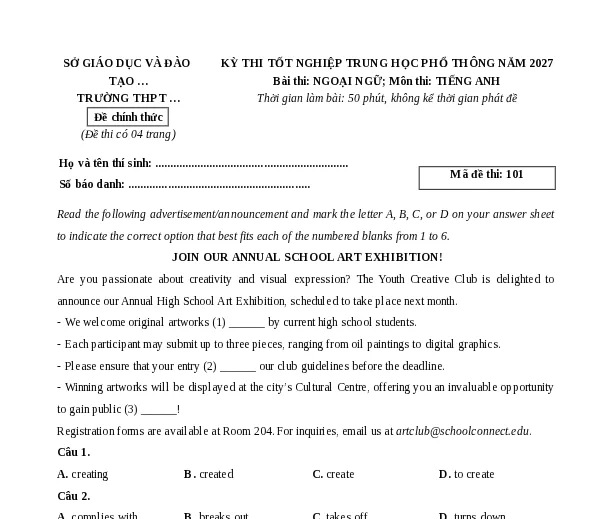
Read the following advertisement/announcement and mark the letter A, B, C, or D on your answer sheet to indicate the correct option that best fits each of the numbered blanks from 1 to 6.
WORKSHOP: NAVIGATING TEEN TRENDS & "AURA" CULTURE
Are you constantly worried about losing your "cool" in front of peers? Do you know how the pursuit of social currency can influence your mental health? Join our interactive session designed for high school students!
- Understand the slang: Explore why teenagers are obsessed with gaining or losing "aura points" through daily actions (1) ______ school.
- Boost genuine self-esteem: Learn effective strategies to build authentic confidence instead of relying (2) ______ superficial digital validation.
- Engage with experts: Meet our guest psychologists who will help you address modern social pressures and (3) ______ your real potential.
Time: 8:30 AM – 11:30 AM, Sunday, November 10
Venue: Youth Cultural Center, Hall B
Registration: Free admission! Sign up at youthmentalhealth.org before Friday.
Câu 1.
A. at
B. of
C. with
D. from
Câu 2.
A. at
B. for
C. on
D. to
Câu 3.
A. develop
B. developing
C. developer
D. developmental
SCHOOL ANNOUNCEMENT: DIGITAL DETOX WEEK
The School Youth Union is pleased to announce our upcoming campus campaign entitled "Log Off, Level Up":
- Due to the growing prevalence of mindless scrolling on short-form video platforms, many students are suffering from reduced attention spans and mental (4) ______.
- Students are strongly encouraged to limit non-academic screen time throughout the week and take part in various offline sports activities.
- Each homeroom class is required to submit their collective screen-time reduction report by Friday afternoon. The class that demonstrates the most (5) ______ improvement will receive a special merit certificate.
- Please contact your class monitor for further (6) ______ regarding daily challenges and group discussions.
Câu 4.
A. strength
B. fatigue
C. health
D. clarity
Câu 5.
A. remarkable
B. remarkably
C. remark
D. remarking
Câu 6.
A. documents
B. facts
C. instructions
D. details
Read the following leaflet and mark the letter A, B, C, or D on your answer sheet to indicate the correct option that best fits each of the numbered blanks from 7 to 12.
THE "BRAIN-ROT" TRAP: UNDERSTANDING SHORT-FORM CONTENT ADDICTION
Short-form videos such as TikTok Reels and YouTube Shorts have transformed adolescent entertainment. However, excessive consumption can lead to cognitive decline, popularly termed "brain-rot".
How does it affect your brain?
- Dopamine overload: Continuous exposure to 15-second clips trains your brain to crave constant stimulation, causing ordinary tasks to appear tedious and (7) ______.
- Fragmented focus: Spending hours on algorithmic feeds makes (8) ______ students struggle with sustained academic reading and deep comprehension.
- Peer comparison: Virtual trends like "Aura Battles" can (9) ______ unhealthy rivalries, where teenagers constantly score each other based on superficial attitudes.
Practical steps to reclaim your focus:
- (10) ______ notifications for entertainment apps during study sessions to minimize distractions.
- Try to (11) ______ your phone use gradually by setting a strict daily limit of 30 minutes on video apps.
- Engage in reading physical books and exercising (12) ______ you can rebuild neuroplasticity and prolonged focus.
Câu 7.
A. uninteresting
B. uninterestingly
C. interesting
D. interest
Câu 8.
A. much
B. many
C. little
D. each
Câu 9.
A. bring about
B. take off
C. look after
D. run into
Câu 10.
A. Turn down
B. Turn off
C. Look up
D. Give up
Câu 11.
A. cut down on
B. make up for
C. put up with
D. get on with
Câu 12.
A. although
B. so that
C. in case
D. whereas
Mark the letter A, B, C, or D on your answer sheet to indicate the best arrangement of utterances or sentences to make a meaningful exchange or text in each of the following questions from 13 to 17.
Câu 13.
a. Mark: "Did you see Kevin's clumsy fall during the PE class yesterday? People on the class chat said he lost 5,000 aura points!"
b. Mark: "I know, but it is just playful teasing. Everyone treats aura like an imaginary video game score."
c. Lan: "Honestly, that slang is getting out of hand. Assigning arbitrary points to someone's embarrassment might hurt their feelings."
A. a – c – b
B. c – a – b
C. a – b – c
D. b – c – a
Câu 14.
a. Teacher: "Have you noticed how difficult it has become for students to sit through a forty-minute lecture without checking their smartphones?"
b. Teacher: "Exactly. The rapid pacing of Reels is diminishing their tolerance for slower, deep learning processes."
c. Counselor: "Indeed. Many of them complain that their brains feel foggy, which is a textbook symptom of cognitive exhaustion from micro-videos."
A. a – b – c
B. a – c – b
C. c – a – b
D. b – a – c
Câu 15.
Dear Minh,
a. That constant stream of 15-second jokes and memes seems hilarious at first, but it literally ruined my ability to finish reading a chapter of history.
b. If you find yourself in the same situation, let's do a weekend digital detox together!
c. I am writing to share an alarming habit I recently discovered about my online screen time.
d. Over the past three weeks, I spent more than three hours each night binge-watching TikTok Reels under the pretext of relaxing.
e. As a result, my exam preparation suffered severely, and I felt mentally drained every single morning.
Warm regards,
Nam
A. c – d – a – e – b
B. c – a – d – b – e
C. d – a – e – c – b
D. a – d – c – e – b
Câu 16.
a. In contemporary youth culture, the term "aura" has evolved from a spiritual essence into a measure of charisma and coolness.
b. However, when students excessively measure self-worth against internet standards, genuine interpersonal relationships begin to deteriorate.
c. Consequently, educators recommend fostering authentic personal values rather than chasing ephemeral internet prestige.
d. Whenever an individual performs an impressive deed, peers playfully award them hundreds of aura points.
e. Conversely, committing a social blunder or acting awkward can lead to a humorous deduction of points.
A. a – d – e – b – c
B. a – b – d – e – c
C. d – e – a – b – c
D. a – d – b – e – c
Câu 17.
a. The sensation termed "brain-rot" refers to the perceived mental sluggishness caused by consuming low-effort, rapid-fire online content.
b. Over time, individuals who succumb to this pattern find sustained mental concentration increasingly challenging.
c. The algorithmic loop delivers instant gratifications that discourage any form of critical thinking.
d. To counter this phenomenon, youth must cultivate active media literacy and schedule screen-free cognitive pastimes.
e. It primarily originates from endless scrolling through short videos specifically engineered to capture attention.
A. a – e – c – b – d
B. a – c – e – b – d
C. e – a – c – b – d
D. a – b – c – e – d
Read the following passage and mark the letter A, B, C, or D on your answer sheet to indicate the correct option that best fits each of the numbered blanks from 18 to 22.
The concept of "Aura Farming" has swept across high school campuses worldwide, defining the way modern adolescents perceive social status. Originating in gaming communities and popularized through viral TikTok trends, "aura" refers to an intangible presence of charisma, confidence, and coolness. Teenagers humorously maintain an imaginary ledger where their daily actions either gain or lose them points. (18) ______, the psychological underpinnings of this phenomenon warrant closer scrutiny.
On one hand, the trend fosters camaraderie and humorous bonding among peers. (19) ______, teenagers use the scoring system as a lighthearted commentary on everyday interactions. For instance, holding the door for an elderly person might earn someone "plus 1,000 aura", whereas tripping over a backpack in the cafeteria results in "minus 5,000 aura". In this sense, the metric functions as a communal language that (20) ______.
On the other hand, psychologists warn that excessive preoccupation with aura can easily morph into toxic perfectionism. High school is inherently a transitional phase characterized by trial, error, and social awkwardness. (21) ______, they may develop an irrational fear of making natural mistakes or displaying vulnerability. Furthermore, the commercialization of this trend has prompted content creators to stage absurd public spectacles to gain digital notoriety, (22) ______. Therefore, while the aura lexicon offers harmless fun on the surface, teenagers must understand that authentic self-worth cannot be quantified by algorithmic validation.
Câu 18.
A. Although many educators regard this fad as mere harmless schoolyard banter
B. Because many educators regard this fad as mere harmless schoolyard banter
C. When many educators regarded this fad as mere harmless schoolyard banter
D. Despite many educators regarding this fad as mere harmless schoolyard banter had occurred
Câu 19.
A. Rather than taking social blunders too seriously
B. Having taken social blunders too seriously
C. In order to take social blunders too seriously
D. With a view to taking social blunders too seriously
Câu 20.
A. which reinforces mutual acceptance and humorous resilience
B. reinforced mutual acceptance and humorous resilience
C. reinforcing mutual acceptance and humorous resilience
D. whose reinforcement of mutual acceptance and humorous resilience
Câu 21.
A. If adolescents constantly evaluate their conduct through the lens of point deduction
B. Unless adolescents constantly evaluate their conduct through the lens of point deduction
C. Should adolescents constantly evaluated their conduct through the lens of point deduction
D. Were adolescents constantly evaluate their conduct through the lens of point deduction
Câu 22.
A. which ultimately distorts real-world interpersonal values
B. that ultimately distorted real-world interpersonal values
C. what ultimately distorts real-world interpersonal values
D. where it ultimately distorts real-world interpersonal values
Read the following passage and mark the letter A, B, C, or D on your answer sheet to indicate the correct answer to each of the questions from 23 to 30.
In recent years, the explosion of short-form video formats across social media platforms has given rise to the colloquial term "brain-rot". High school students, in particular, frequently use the expression to describe the dull, sluggish mental haze that follows prolonged sessions of watching auto-playing vertical clips. While the phrase is often uttered half-jokingly, cognitive scientists and developmental psychologists are uncovering real neurological shifts behind this phenomenon.
The architecture of short-form media platforms is engineered to maximize user retention through variable rewards. When an individual scrolls past an uninteresting video to encounter an amusing or shocking clip, the brain releases a micro-dose of dopamine. This neurotransmitter reinforces the habit loop, training the mind to anticipate immediate gratification every few seconds. Unlike reading a novel or solving a geometry puzzle, which requires deliberate, effortful attention, micro-video consumption demands virtually no cognitive exertion. Over time, the neurological pathways associated with sustained concentration begin to weaken from underuse, a phenomenon neuroscientists term "use it or lose it".
The academic repercussions of this behavioral pattern are increasingly evident in classrooms. Teachers report a marked decline in students' capacity to digest long-form reading passages, retain detailed lecture notes, or engage in prolonged analytical debates. A student accustomed to 10-second sensory punches naturally perceives a 45-minute lesson as agonizingly slow. They often experience restlessness and mental wandering, confusing their shortened attention spans with organic attention deficit disorders. Furthermore, high schoolers frequently binge-watch these clips late at night, disrupting rapid eye movement (REM) sleep, which is essential for memory consolidation and emotional regulation.
Mitigating the adverse impact of digital overstimulation does not necessitate a complete rejection of modern technology. Instead, experts advocate intentional media consumption. Setting designated "tech-free" intervals during homework hours allows the prefrontal cortex to recover. Engaging in deep, non-digital pursuits such as playing a musical instrument, participating in team sports, or reading print literature can gradually restore cognitive fortitude. By recognizing that their attention is a precious commodity rather than an endless playground for algorithms, adolescents can safeguard their intellectual vitality.
Câu 23. Which of the following is the best title for the passage?
A. The Evolution of Social Media Platforms in the 21st Century
B. Unpacking "Brain-Rot": How Short-Form Videos Shape Adolescent Minds
C. The Clinical Treatment for Attention Deficit Disorders in Teens
D. Why High School Students Prefer Online Learning over Traditional Lectures
Câu 24. According to paragraph 2, short-form video platforms keep users engaged mainly by ______.
A. charging minimal fees for premium educational content
B. triggering intermittent dopamine surges via rapid, unpredictable rewards
C. requiring active mental problem-solving from viewers
D. replacing ordinary video clips with complex scientific lectures
Câu 25. The phrase "a phenomenon" in paragraph 2 refers to ______.
A. the deliberate effort required to solve complex geometry puzzles
B. the weakening of cognitive pathways associated with prolonged concentration
C. the architectural design of modern mobile devices
D. the constant release of neurotransmitters during physical exercise
Câu 26. The word "They" in paragraph 3 refers to ______.
A. classrooms
B. teachers
C. reading passages
D. students
Câu 27. The word "fortitude" in paragraph 4 is closest in meaning to ______.
A. confusion
B. strength
C. weakness
D. curiosity
Câu 28. Which of the following is NOT mentioned in paragraph 3 as an adverse effect of excessive micro-video watching?
A. Impaired ability to retain information from classroom lectures
B. Sleep disruptions that hinder memory consolidation
C. Increased vulnerability to severe physical vision impairments
D. Restlessness and a false perception of attention disorders
Câu 29. The word "deliberate" in paragraph 2 is closest in meaning to ______.
A. intentional
B. accidental
C. reckless
D. hasty
Câu 30. Which of the following can be inferred from the final paragraph?
A. Complete avoidance of digital devices is the only way to reverse cognitive decline.
B. Adolescents are helpless against algorithms and cannot rebuild their attention span.
C. Deliberate offline engagement helps counteract the fragmentation of focus.
D. Reading print literature yields fewer cognitive benefits than digital text.
Read the following passage and mark the letter A, B, C, or D on your answer sheet to indicate the correct answer to each of the questions from 31 to 40.
Across secondary schools and digital platforms, an intriguing social dynamic known as the "Aura Battle" has captured the imagination of Generation Z. Derived from the internet concept where personal coolness and gravitas are scored numerically, these battles involve adolescents competitively evaluating their peers' behaviors. An impressive comeback in conversation, an effortlessly stylish outfit, or a clutch play in a basketball match instantly earns a participant thousands of points. Conversely, social awkwardness, stuttering during a presentation, or an ill-timed joke results in public, performative deductions. While many dismiss this trend as harmless satirical play, its sociological implications reflect a profound shift in how youth negotiate identity and belonging.
[I] Historically, adolescent subcultures have always established informal hierarchies based on athletic prowess, fashion trends, or academic achievement. [II] What distinguishes the current phenomenon, however, is the gamification of social life. By translating subtle, nuanced human interactions into quantifiable scores, Aura Battles mirror the mechanics of role-playing video games and algorithmic feeds. [III] In an era characterized by hyper-connectivity and academic uncertainty, reducing the bewildering complexity of real-world socialization into explicit, numerical rules offers teens a seductive illusion of control. [IV]
Nonetheless, sociologists point out that this hyper-vigilance carries considerable psychological liabilities. In environments where every social interaction is scrutinized for aura losses, adolescents can succumb to paralyzing self-consciousness. Teenagers naturally need safe spaces to experiment with their identity, make missteps, and display vulnerability without the dread of reputational devaluation. When school hallways become arenas of continuous performance, authenticity is sacrificed in favor of calculated nonchalance. Students begin curating their public demeanor to avoid losing social points, effectively repressing sincere emotional expression.
Moreover, the digital amplification of Aura Battles has blurred the boundary between harmless teasing and insidious cyberbullying. When point deductions move from lighthearted face-to-face banter to viral comment sections, individuals can be subjected to collective ostracism. A recorded video of a student fumbling an answer in class can be shared across platforms, accumulating hundreds of mockery comments detailing their supposed "negative aura". The permanence and global reach of digital media transform ephemeral high school embarrassments into persistent digital scars.
Ultimately, navigating the aura landscape requires critical awareness from both students and educators. Rather than moralizing against internet slang, schools should foster environments where empathy and genuine resilience are valued over superficial swagger. Teenagers must be empowered to recognize that authentic human dignity is rooted in integrity, kindness, and character—attributes that can never be measured by arbitrary numbers on an online scorecard.
Câu 31. Where in paragraph 2 does the following sentence best fit?
This quantification provides adolescents with a clear, albeit superficial, framework to evaluate their standing within the peer group.
A. [I]
B. [II]
C. [III]
D. [IV]
Câu 32. According to paragraph 1, what happens when a student stumbles or acts awkwardly in front of peers?
A. They are immediately expelled from peer discussion forums.
B. They suffer public, performative deductions of imaginary aura points.
C. They are awarded extra points for their authentic vulnerability.
D. Their peers help them rehearse their presentation skills.
Câu 33. The word "seductive" in paragraph 2 is closest in meaning to ______.
A. attractive
B. repulsive
C. dangerous
D. monotonous
Câu 34. The word "paralyzing" in paragraph 3 most nearly means ______.
A. invigorating
B. debilitating
C. encouraging
D. trivial
Câu 35. The word "their" in paragraph 4 refers to ______.
A. comment sections
B. platforms
C. platforms' users
D. a student
Câu 36. Which of the following best paraphrases the underlined sentence in paragraph 3?
"When school hallways become arenas of continuous performance, authenticity is sacrificed in favor of calculated nonchalance."
A. Students prefer staying authentic even when they have to perform continuously in school hallways.
B. If social life at school requires non-stop acting, genuine behavior gives way to deliberate indifference.
C. School corridors provide ideal stages where students can show both their real self and casual indifference.
D. Calculating one's social performance in hallways encourages students to show deeper emotional sincerity.
Câu 37. Which of the following is TRUE according to the passage?
A. Adolescent peer groups in the past never established informal social hierarchies.
B. Aura Battles completely eliminate the risk of online harassment and cyberbullying.
C. Translating human socialization into numbers reflects the gamification of youth culture.
D. Educators are advised to eradicate all internet slang through strict disciplinary bans.
Câu 38. Which of the following best summarizes paragraph 4?
A. The technical mechanics of recording short videos in high school classrooms.
B. How online aura competitions escalate from gentle jokes into widespread digital cruelty.
C. The financial profits made by social media platforms through viral student videos.
D. Why teenagers enjoy sharing their academic failures with global audiences.
Câu 39. Which of the following can be inferred from the passage?
A. The quest for high "aura" encourages teenagers to display their true emotions freely.
B. True self-respect and maturity cannot be captured by arbitrary social metrics.
C. Modern teenagers prefer gaming simulations because academic life is devoid of challenges.
D. Teachers should adopt the aura scoring system to grade students' classroom participation.
Câu 40. Which of the following best reflects the author's attitude toward the "Aura Battle" phenomenon?
A. Wholly enthusiastic and supportive
B. Dismissive and indifferent
C. Objective, analytical, and cautious
D. Aggressive and confrontational
--------- HẾT ---------
KỲ THI TỐT NGHIỆP THPT
HƯỚNG DẪN CHẤM
BÀI THI: TIẾNG ANH (MÃ ĐỀ 402)
Môn thi: TIẾNG ANH – LỚP 12
Thời gian làm bài: 50 phút
ĐÁP ÁN VÀ HƯỚNG DẪN GIẢI CHI TIẾT
BẢNG ĐÁP ÁN (0,25 ĐIỂM / CÂU)
Câu | Đ/A | Câu | Đ/A | Câu | Đ/A | Câu | Đ/A | Câu | Đ/A | Câu | Đ/A | Câu | Đ/A | Câu | Đ/A |
|---|---|---|---|---|---|---|---|---|---|---|---|---|---|---|---|
1 | A | 6 | D | 11 | A | 16 | A | 21 | A | 26 | D | 31 | D | 36 | B |
2 | C | 7 | A | 12 | B | 17 | A | 22 | A | 27 | B | 32 | B | 37 | C |
3 | A | 8 | B | 13 | A | 18 | A | 23 | B | 28 | C | 33 | A | 38 | B |
4 | B | 9 | A | 14 | B | 19 | A | 24 | B | 29 | A | 34 | B | 39 | B |
5 | A | 10 | B | 15 | A | 20 | A | 25 | B | 30 | C | 35 | D | 40 | C |
GIẢI THÍCH CHI TIẾT
Câu | Kỹ năng / Kiến thức | Đáp án & Giải thích chi tiết |
|---|---|---|
1 | Giới từ | A. at school (tại trường học). |
2 | Giới từ đi với động từ | C. Cấu trúc: rely on something (dựa dẫm, phụ thuộc vào cái gì). |
3 | Từ loại | A. Cấu trúc song hành sau liên từ and: help you address ... and develop (động từ nguyên mẫu). |
4 | Từ vựng | B. mental fatigue (sự mệt mỏi/kiệt sức về mặt tinh thần). |
5 | Từ loại | A. Cần một tính từ bổ nghĩa cho danh từ improvement -> remarkable (đáng kể). |
6 | Từ vựng | D. further details (thông tin chi tiết hơn). |
7 | Từ vựng / Từ loại | A. Cấu trúc song hành với tedious (tẻ nhạt) -> uninteresting (không thú vị, nhàm chán). |
8 | Lượng từ | B. Danh từ số nhiều đếm được students đi với many. (much và little đi với danh từ không đếm được). |
9 | Cụm động từ (Phrasal verb) | A. bring about (gây ra, mang lại). take off (cất cánh/thành công), look after (chăm sóc), run into (tình cờ gặp). |
10 | Cụm động từ | B. turn off notifications (tắt thông báo trên ứng dụng). |
11 | Cụm động từ | A. cut down on (cắt giảm). make up for (đền bù), put up with (chịu đựng), get on with (hòa thuận). |
12 | Liên từ | B. so that (+ mệnh đề chỉ mục đích: để mà). |
13 | Sắp xếp hội thoại | A. a (Mark mở đầu bằng sự việc cụ thể) -> c (Lan phản đối trào lưu trừ điểm thái quá) -> b (Mark giải thích thêm rằng chỉ là đùa vui). |
14 | Sắp xếp hội thoại | B. a (Giáo viên đặt vấn đề về khả năng tập trung) -> c (Chuyên viên tâm lý đồng tình và nêu triệu chứng) -> b (Giáo viên chốt nguyên nhân từ nhịp độ nhanh của Reels). |
15 | Sắp xếp thư từ | A. c (Nêu mục đích viết thư) -> d (Kể chi tiết việc lướt Reels mỗi đêm) -> a (Tác hại ngắn hạn đến việc đọc sách) -> e (Hậu quả thi cử và kiệt sức) -> b (Lời kêu gọi cùng cai nghiện màn hình). |
16 | Sắp xếp đoạn văn | A. a (Định nghĩa khái niệm "aura") -> d (Mặt cộng điểm khi làm việc tốt) -> e (Mặt đối lập: trừ điểm khi vụng về) -> b (Cảnh báo hệ lụy khi quá để tâm) -> c (Kết luận, lời khuyên của chuyên gia). |
17 | Sắp xếp đoạn văn | A. a (Giới thiệu định nghĩa hiện tượng "brain-rot") -> e (Nguồn gốc từ việc cuộn video ngắn) -> c (Cơ chế thuật toán gây nghiện) -> b (Hậu quả lâu dài tới sự tập trung) -> d (Giải pháp khắc phục). |
18 | Mệnh đề nhượng bộ | A. Although many educators regard this fad as mere harmless schoolyard banter (Mặc dù nhiều nhà giáo dục coi trào lưu này chỉ là lời trêu đùa vô hại...). |
19 | Cụm giới từ liên kết | A. Rather than taking social blunders too seriously (Thay vì nghiêm trọng hóa các lỗi ngớ ngẩn thường ngày...). |
20 | Mệnh đề quan hệ | A. which reinforces... (Đại từ quan hệ which thay cho a communal language và làm chủ ngữ cho động từ reinforces). |
21 | Câu điều kiện loại 1 | A. If adolescents constantly evaluate their conduct through the lens of point deduction, they may develop... |
22 | Mệnh đề quan hệ bổ nghĩa cả câu | A. which ultimately distorts real-world interpersonal values (sử dụng which phẩy để bổ nghĩa cho cả hành động phía trước). |
23 | Đọc hiểu 1: Tiêu đề | B. "Unpacking 'Brain-Rot': How Short-Form Videos Shape Adolescent Minds" bao quát trọn vẹn toàn bộ bài đọc về nguyên nhân, cơ chế và tác động. |
24 | Đọc hiểu 1: Chi tiết | B. Thông tin ở đoạn 2: "When an individual scrolls... the brain releases a micro-dose of dopamine. This neurotransmitter reinforces the habit loop, training the mind to anticipate immediate gratification...". |
25 | Đọc hiểu 1: Quy chiếu | B. Câu liền trước: "Over time, the neurological pathways associated with sustained concentration begin to weaken from underuse, a phenomenon neuroscientists term...". |
26 | Đọc hiểu 1: Quy chiếu | D. "They" thay thế cho danh từ số nhiều "students" ở các câu trước trong đoạn 3. |
27 | Đọc hiểu 1: Từ đồng nghĩa | B. fortitude = strength (sức mạnh, sự bền bỉ tinh thần). |
28 | Đọc hiểu 1: Chi tiết | C. Trong đoạn 3 không hề đề cập đến "severe physical vision impairments" (tật khúc xạ/thị lực nghiêm trọng). |
29 | Đọc hiểu 1: Từ đồng nghĩa | A. deliberate = intentional (có chủ đích, có ý thức). |
30 | Đọc hiểu 1: Suy luận | C. Đoạn cuối nêu rõ việc tham gia các hoạt động ngoại tuyến chuyên sâu (thể thao, nhạc cụ, sách in) giúp khôi phục khả năng tập trung. |
31 | Đọc hiểu 2: Chèn câu | D. Câu cần chèn giải thích cho việc hệ thống hóa thành điểm số ("This quantification") mang lại khung đánh giá rõ ràng, đặt ngay sau vị trí [IV] - nối tiếp câu bàn về việc đơn giản hóa các tương tác xã hội thành các quy tắc số học. |
32 | Đọc hiểu 2: Chi tiết | B. Thông tin ở đoạn 1: "...social awkwardness, stuttering during a presentation... results in public, performative deductions." |
33 | Đọc hiểu 2: Từ đồng nghĩa | A. seductive trong ngữ cảnh này mang nghĩa lôi cuốn, hấp dẫn (attractive). |
34 | Đọc hiểu 2: Từ đồng nghĩa | B. paralyzing = debilitating (làm tê liệt, gây suy nhược, kiệt quệ). |
35 | Đọc hiểu 2: Quy chiếu | D. "their supposed negative aura" quy chiếu đến đối tượng học sinh bị quay video chê bai ở câu trước: "A recorded video of a student fumbling an answer in class...". |
36 | Đọc hiểu 2: Paraphrase | B. Câu gốc diễn đạt: khi hành lang trường trở thành sàn diễn không ngừng nghỉ, tính chân thực bị đánh đổi lấy sự thờ ơ có tính toán -> Khớp hoàn toàn với B. |
37 | Đọc hiểu 2: Chi tiết đúng | C. Đoạn 2 nêu rõ: "What distinguishes the current phenomenon, however, is the gamification of social life." |
38 | Đọc hiểu 2: Tóm tắt đoạn | B. Đoạn 4 tập trung vào sự leo thang từ những lời trêu đùa vô hại thành các vụ bắt nạt trên không gian mạng và tẩy chay tập thể. |
39 | Đọc hiểu 2: Suy luận | B. Đoạn kết khẳng định phẩm giá và giá trị con người bắt nguồn từ nhân cách chứ không thể đong đếm bằng những điểm số ảo. |
40 | Đọc hiểu 2: Thái độ tác giả | C. Tác giả giữ góc nhìn khách quan, phân tích đa chiều về mặt tích cực lẫn mặt rủi ro tâm lý và đưa ra lời khuyên thận trọng (Objective, analytical, and cautious). |