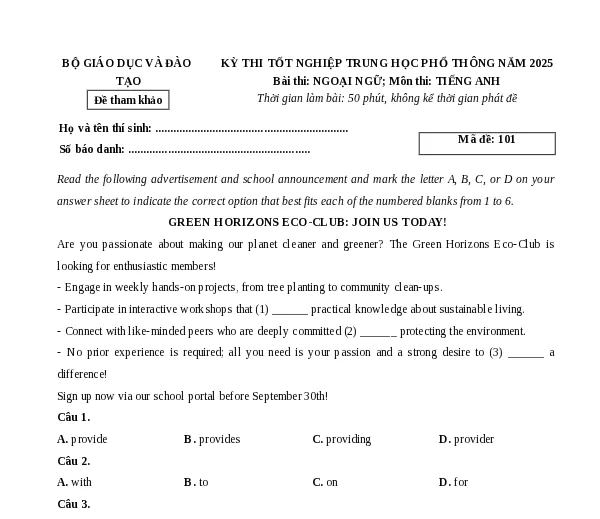
BỘ GIÁO DỤC VÀ ĐÀO TẠO
ĐỀ ÔN TẬP CHUẨN HOÁ
Đề tham khảo
KỲ THI TỐT NGHIỆP TRUNG HỌC PHỔ THÔNG NĂM 2025
Bài thi: NGOẠI NGỮ; Môn thi: TIẾNG ANH
Thời gian làm bài: 50 phút, không kể thời gian phát đề
Họ và tên thí sinh: ................................................................ Số báo danh: ............................................................ | Mã đề: 101 |
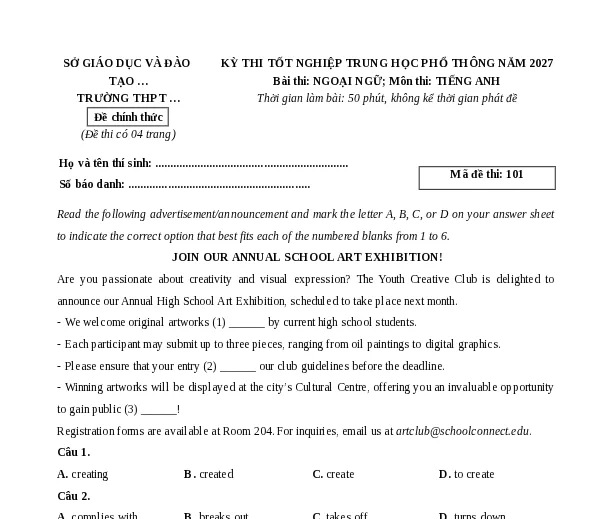
Read the following advertisement/announcement and mark the letter A, B, C, or D on your answer sheet to indicate the correct option that best fits each of the numbered blanks from 1 to 6.
DISCOVER THE FREEDOM OF HOMESCHOOLING!
Are you looking for an educational path that adapts to your child’s unique rhythm?
- Flexible Curriculum: Tailor lessons to your child’s passions and learning style with our (1) ______ digital resources.
- Accredited Guidance: Qualified tutors are always available to help parents navigate complex subjects with (2) ______.
- Global Community: Join thousands of families sharing experiences, field trips, and cooperative group projects.
Give your child the gift of a personalized education today! Visit our website at www.futureminds-homeschool.org to sign (3) ______ for a free consultation.
Câu 1 (0,25 điểm).
A. comprehensively
B. comprehend
C. comprehensive
D. comprehension
Câu 2 (0,25 điểm).
A. ease
B. easily
C. easy
D. easiness
Câu 3 (0,25 điểm).
A. in
B. up
C. on
D. off
ANNOUNCEMENT: ANNUAL HOMESCHOOL SCIENCE FAIR 2025
The Horizon Homeschool Association is delighted to announce our upcoming Science & Innovation Fair:
- Date & Location: November 20th at the Central Community Pavilion.
- Who Can Join: All homeschooled learners aged 10–18 are cordially invited (4) ______ their scientific investigations.
- Registration Deadline: Please submit your project abstract before October 31st to secure your display booth.
- Support: Mentors will be assigned to each participant to ensure their displays (5) ______ with international safety standards.
Take this opportunity to exhibit your creativity and (6) ______ valuable feedback from academic judges!
Câu 4 (0,25 điểm).
A. showcase
B. to showcase
C. showcasing
D. showcased
Câu 5 (0,25 điểm).
A. conform
B. comply
C. adhere
D. abide
Câu 6 (0,25 điểm).
A. gain
B. win
C. pay
D. earn
Read the following leaflet and mark the letter A, B, C, or D on your answer sheet to indicate the correct option that best fits each of the numbered blanks from 7 to 12.
A PARENT’S ESSENTIAL GUIDE TO HOMESCHOOLING
Thinking about taking charge of your child's schooling? Here are several key insights to help you make a seamless transition:
- Understand Your State Regulations: Before withdrawing your child from formal schooling, thoroughly inspect the legal requirements in your jurisdiction. (7) ______ parents assume the guidelines are identical across regions, but local laws can differ substantially.
- Curate Meaningful Resources: Instead of purchasing every workbook on the market, focus on finding high-quality materials. There is (8) ______ point in overwhelming young learners with excessive worksheets when experiential learning yields greater results.
- Foster Peer Interaction: A common concern is socialization. You should (9) ______ extracurricular clubs, local sports leagues, and homeschool cooperatives to keep your child actively connected with peers.
- Establish a Balanced Routine: Maintain a structured yet adaptable timetable. Children thrive on predictability; (10) ______, rigidity may defeat the inherent advantages of home education.
- Overcome Initial Hurdles: It is normal to feel overwhelmed during the first semester. Don't hesitate to (11) ______ experienced homeschooling parents for guidance and emotional encouragement.
- Focus on the Journey: Homeschooling is not merely an academic arrangement; it is an enriching (12) ______ that strengthens family bonds while nurturing lifelong curiosity.
Câu 7 (0,25 điểm).
A. Much
B. Many
C. Every
D. Another
Câu 8 (0,25 điểm).
A. little
B. few
C. several
D. many
Câu 9 (0,25 điểm).
A. look into
B. turn down
C. make up
D. break in
Câu 10 (0,25 điểm).
A. therefore
B. however
C. moreover
D. consequently
Câu 11 (0,25 điểm).
A. reach out to
B. cut down on
C. put up with
D. keep up with
Câu 12 (0,25 điểm).
A. venture
B. assignment
C. competition
D. barrier
Mark the letter A, B, C, or D on your answer sheet to indicate the correct arrangement of the sentences to make a meaningful exchange or text in each of the following questions from 13 to 17.
Câu 13 (0,25 điểm).
a. Mark: "I have actually noticed that he learns much faster when we tailor the pace to his specific needs."
b. Sarah: "How is your son doing now that you have transitioned to homeschooling?"
c. Sarah: "That sounds promising! But don't you worry about him missing out on social interactions?"
A. b – a – c
B. a – c – b
C. c – a – b
D. b – c – a
Câu 14 (0,25 điểm).
a. Linda: "We joined a local homeschool cooperative where kids collaborate on science projects twice a week."
b. Kevin: "That’s a brilliant way to bridge the gap between academic flexibility and teamwork!"
c. Kevin: "I've always wondered how homeschooled teenagers develop their collaborative skills."
d. Linda: "In fact, they also organize sports events and public speaking workshops every weekend."
A. c – a – d – b
B. a – c – b – d
C. c – b – a – d
D. a – d – c – b
Câu 15 (0,25 điểm).
Dear Mrs. Henderson,
a. We are writing to formally notify the school administration of our decision to homeschool our daughter, Clara Watson, starting next semester.
b. We wish to express our heartfelt gratitude to the faculty members for their dedicated support throughout her time here.
c. Please let us know the administrative procedures required to complete her formal withdrawal file.
d. Over the past months, we have designed an individualized learning program that best accommodates her unique health conditions and passions.
Sincerely,
David and Mary Watson
A. a – d – b – c
B. d – a – c – b
C. b – a – d – c
D. a – b – d – c
Câu 16 (0,25 điểm).
a. First, parents have the autonomy to adjust instructional speed, spending extra time on challenging subjects while accelerating in areas of strength.
b. Homeschooling offers distinct advantages that traditional classroom settings often struggle to replicate.
c. Finally, this customized approach fosters a lifelong enthusiasm for learning rather than a fixation on standardized test scores.
d. In addition, the safe and nurturing domestic environment significantly diminishes issues related to peer pressure and school bullying.
e. As a consequence of these benefits, a growing number of families across the globe are embracing home-based education.
A. b – a – d – c – e
B. b – d – a – e – c
C. a – b – d – c – e
D. b – a – c – d – e
Câu 17 (0,25 điểm).
a. Despite these promising outcomes, critics frequently cite the heavy financial and time commitments imposed on parents.
b. In recent decades, the homeschooling movement has shifted from a marginal subculture into a widely respected educational alternative.
c. Consequently, deciding to homeschool requires a thorough evaluation of family resources, personal dedication, and educational goals.
d. Studies reveal that homeschooled pupils consistently achieve above-average results on collegiate aptitude examinations.
e. Furthermore, technological advancements and online platforms have enriched home curricula beyond expectations.
A. b – d – e – a – c
B. b – a – d – e – c
C. d – e – b – a – c
D. b – e – d – c – a
Read the following passage and mark the letter A, B, C, or D on your answer sheet to indicate the correct option that best fits each of the numbered blanks from 18 to 22.
The practice of educating children at home has experienced exponential growth in recent years, stimulated by technological innovations and evolving pedagogical philosophies. Proponents of homeschooling maintain that traditional schools, (18) ______, often fail to ignite genuine intellectual curiosity. In contrast, home-based education permits families to craft individualized learning trajectories (19) ______.
One of the most compelling arguments for homeschooling is the elimination of unnecessary academic stress. In conventional classrooms, pupils are continually measured against standardized benchmarks, (20) ______. Homeschooled children, on the other hand, advance at their own pace, mastering fundamental concepts before proceeding to advanced materials.
Furthermore, modern digital infrastructure has entirely transformed the homeschooling landscape. Online educational platforms offer interactive courses, virtual laboratory experiments, and global discussion forums, (21) ______. While critics often question whether homeschooled students receive adequate social exposure, participation in sports leagues, community volunteering, and local cooperative classes ensures that (22) ______. Consequently, homeschooling has firmly established itself as a robust, forward-looking alternative to institutional instruction.
Câu 18 (0,25 điểm).
A. which frequently prioritize rote memorization and rigid disciplinary codes
B. that frequently prioritize rote memorization and rigid disciplinary codes
C. where rote memorization and rigid disciplinary codes frequently prioritizing
D. having frequently prioritized rote memorization and rigid disciplinary codes
Câu 19 (0,25 điểm).
A. aligning with each child's intrinsic talents and emotional readiness
B. which aligns each child's intrinsic talents with emotional readiness
C. whose intrinsic talents align with each child's emotional readiness
D. to have aligned each child's intrinsic talents and emotional readiness
Câu 20 (0,25 điểm).
A. which can engender acute anxiety and demoralize struggling learners
B. what can engender acute anxiety and demoralize struggling learners
C. having engendered acute anxiety and demoralizing struggling learners
D. this can engender acute anxiety and demoralize struggling learners
Câu 21 (0,25 điểm).
A. allowing home educators to access resources once reserved exclusively for elite schools
B. which allows home educators accessing resources once reserved exclusively for elite schools
C. allowed home educators to access resources once reserved exclusively for elite schools
D. to allow home educators accessing resources once reserved exclusively for elite schools
Câu 22 (0,25 điểm).
A. they develop well-rounded interpersonal skills alongside their academic competencies
B. their well-rounded interpersonal skills developing alongside academic competencies
C. they develop academic competencies without any interpersonal skills
D. well-rounded interpersonal skills being developed alongside their academic competencies
Read the following passage and mark the letter A, B, C, or D on your answer sheet to indicate the correct answer to each of the questions from 23 to 30.
The decision to educate children at home represents a profound paradigm shift in contemporary education. Traditionally regarded as an unconventional choice favored primarily by rural families or religious communities, homeschooling has rapidly entered the mainstream. Today, families from diverse socioeconomic and cultural backgrounds are choosing this path, motivated by a desire to provide a safer, more nurturing, and academically rigorous environment tailored to their children's distinct dispositions.
One primary catalyst for this shift is the widespread dissatisfaction with institutional schooling. Many parents observe that overcrowded classrooms and standardized curricula stifle individual creativity. In conventional schools, teachers are inevitably compelled to teach to the middle, meaning that academically gifted pupils often languish in boredom, while struggling students fall hopelessly behind. Homeschooling eliminates this structural dilemma by allowing education to be custom-tailored. A child who excels in mathematics can advance several grade levels ahead, while simultaneously taking extra time to cultivate reading comprehension skills without feeling stigmatized.
Another notable advantage lies in the flexibility of schedule and pedagogy. Free from the confines of rigid bell schedules and mandatory homework drills, homeschooling families can embrace experiential learning. Everyday occurrences—such as preparing a meal, managing a household budget, or cultivating a garden—become hands-on lessons in chemistry, arithmetic, and biology. Furthermore, families can embark on educational travel during off-peak seasons, transforming museums, national parks, and historical monuments into living classrooms.
Nevertheless, the journey is not devoid of challenges. Parents who undertake home education must shoulder enormous responsibilities. They often sacrifice a second household income, assuming the taxing roles of primary instructor, mentor, and curriculum planner. Furthermore, ensuring consistent academic progress demands immense discipline, patience, and resourcefulness. Despite these demanding hurdles, the growing availability of local homeschool cooperatives and specialized online academies has democratized the practice, rendering home education a viable, enriching choice for millions worldwide.
Câu 23 (0,25 điểm). Which of the following best serves as the title for the passage?
A. The Financial Pitfalls and Academic Hardships of Home Instruction
B. The Evolution and Everyday Realities of Modern Homeschooling
C. Why Traditional Classrooms Are Becoming Entirely Obsolete
D. Legal Regulations Surrounding Contemporary Home Education
Câu 24 (0,25 điểm). According to paragraph 1, homeschooling in the past was largely perceived as ______.
A. an exclusive privilege reserved for affluent urban families
B. a compulsory method for children with severe physical disabilities
C. an unconventional practice pursued by specific demographic groups
D. a mainstream trend promoted by national educational ministries
Câu 25 (0,25 điểm). The phrase "teach to the middle" in paragraph 2 mostly means ______.
A. focusing instruction on pupils of average academic abilities
B. seating students physically in the center of the lecture hall
C. dividing the curriculum equally between theoretical and practical arts
D. giving preferential treatment exclusively to underperforming learners
Câu 26 (0,25 điểm). The word "stifles" (implied in the phrase stifle individual creativity) in paragraph 2 is closest in meaning to ______.
A. suppresses
B. fosters
C. evaluates
D. illuminates
Câu 27 (0,25 điểm). The word "They" in paragraph 4 refers to ______.
A. Challenges
B. Parents
C. Responsibilities
D. Classrooms
Câu 28 (0,25 điểm). Which of the following is NOT mentioned in paragraph 3 as an example of experiential learning?
A. Managing domestic expenses
B. Planting and maintaining a garden
C. Preparing family meals
D. Participating in standardized testing drills
Câu 29 (0,25 điểm). The word "viable" in paragraph 4 is closest in meaning to ______.
A. feasible
B. questionable
C. compulsory
D. temporary
Câu 30 (0,25 điểm). Which of the following can be inferred from the passage?
A. Homeschooling requires parents to have formal university degrees in pedagogy.
B. External collaborative networks play a significant role in easing parental burdens.
C. Homeschooled students universally outperform their public school peers in all subjects.
D. Financial sacrifice is the single reason why most families abandon home education.
Read the following passage and mark the letter A, B, C, or D on your answer sheet to indicate the correct answer to each of the questions from 31 to 40.
The debate surrounding home education has escalated in tandem with its worldwide surge in popularity. While advocates laud its bespoke nature, skeptics continuously question whether the domestic setting can truly replicate the social and civic benefits of institutional schooling. Critics frequently hypothesize that sheltering children from the socio-cultural diversity of public schools risks producing insular individuals who are ill-equipped to navigate pluralistic societies. [I] However, an expanding body of empirical research is challenging these long-held assumptions.
Sociological inquiries into homeschooling outcomes indicate that socialization in traditional schools is not inherently superior; rather, it is often characterized by artificial peer-group segregation. In a standard classroom, children interact almost exclusively with peers born within the exact same twelve-month window. [II] By contrast, homeschooled children regularly engage with individuals across diverse age demographics—ranging from toddlers at community co-ops to elderly citizens during civic volunteer endeavors. Consequently, these learners frequently exhibit higher levels of social maturity, self-esteem, and conversational poise when interacting with adults and younger peers alike.
Furthermore, the academic efficacy of home education has been documented extensively. Longitudinal research conducted by educational institutes reveals that homeschooled pupils consistently score between the 80th and 90th percentiles on standardized achievement tests, irrespective of their parents' formal educational background or family income levels. [III] This remarkable resilience suggests that the efficacy of education depends less on elaborate institutional facilities than on the adult-to-child ratio and the quality of focused, individualized engagement. [IV]
Nonetheless, treating homeschooling as a universal panacea would be dangerously shortsighted. Successful home education presupposes substantial parental competence, sustained economic stability, and unwavering dedication. When parents lack basic pedagogical skills or fail to provide a stimulating learning environment, educational neglect can transpire undetected behind closed doors. Furthermore, public schools fulfill indispensable societal functions that transcend scholastic instruction: they serve as vital social safety nets, providing subsidized meals, psychological counseling, and specialized interventions for marginalized demographics. Therefore, while homeschooling undoubtedly represents a liberating and academically rigorous alternative for well-resourced families, maintaining and reforming robust public school systems remains an existential prerequisite for social equity.
Câu 31 (0,25 điểm). Which of the following best summarizes the main idea of the passage?
A. Homeschooling yields superior academic and social results, rendering public schooling obsolete.
B. Despite distinct academic and developmental benefits, homeschooling is not a universal substitute for public education.
C. Public schools remain the only reliable institution capable of fostering civic engagement among youth.
D. The high economic cost of homeschooling prevents it from becoming an effective educational method.
Câu 32 (0,25 điểm). The word "insular" in paragraph 1 is closest in meaning to ______.
A. narrow-minded
B. open-hearted
C. sophisticated
D. extroverted
Câu 33 (0,25 điểm). According to paragraph 2, traditional school socialization is characterized by ______.
A. interactions across varied age demographics
B. artificial confinement to peers of the same age
C. constant involvement in civic volunteer initiatives
D. superior preparation for adult workplace dynamics
Câu 34 (0,25 điểm). The word "efficacy" in paragraph 3 is closest in meaning to ______.
A. complexity
B. effectiveness
C. deficiency
D. popularity
Câu 35 (0,25 điểm). According to paragraph 3, what primary factor accounts for the strong academic performance of homeschooled children?
A. Access to luxurious laboratory equipment at home
B. The elevated income and academic degrees of their parents
C. Low adult-to-child ratio and tailored engagement
D. Elimination of all standardized testing requirements
Câu 36 (0,25 điểm). The word "panacea" in paragraph 4 is closest in meaning to ______.
A. cure-all
B. obstacle
C. illusion
D. dilemma
Câu 37 (0,25 điểm). Which of the following is NOT mentioned in paragraph 4 as a crucial function fulfilled by public schools?
A. Offering subsidized meals for students in need
B. Delivering psychological counseling services
C. Offering specialized support for marginalized demographics
D. Guaranteeing admission to prestigious universities
Câu 38 (0,25 điểm). Which of the following best paraphrases the underlined sentence in paragraph 4: "Therefore, while homeschooling undoubtedly represents a liberating and academically rigorous alternative for well-resourced families, maintaining and reforming robust public school systems remains an existential prerequisite for social equity."?
A. Even though capable families benefit from homeschooling, strong public schools are vital for preserving societal fairness.
B. Families should invest heavily in public schools instead of wasting economic resources on homeschooling alternatives.
C. Social equity can only be achieved when homeschooling is prohibited and public schools receive full government funding.
D. Although public schooling is academically superior, well-resourced parents prefer the liberating nature of home instruction.
Câu 39 (0,25 điểm). Where does the following sentence best fit in the passage?
"Such cross-generational interaction dispels the stereotype that home-educated youth are socially awkward."
A. [I]
B. [II]
C. [III]
D. [IV]
Câu 40 (0,25 điểm). Which of the following can be most reasonably inferred from the passage?
A. Governments should mandate homeschooling for all gifted students across the country.
B. Without institutional checks, home education carries inherent risks of unmonitored academic negligence.
C. Public schools cause severe long-term psychological harm to nearly all enrolled children.
D. Parents with limited financial means invariably achieve poor results when homeschooling.
--------- HẾT ---------
Thí sinh không được sử dụng tài liệu. Cán bộ coi thi không giải thích gì thêm.
HƯỚNG DẪN CHẤM VÀ ĐÁP ÁN CHI TIẾT
BẢNG ĐÁP ÁN THAM KHẢO (40 CÂU - MỖI CÂU 0,25 ĐIỂM)
Câu | Đáp án | Câu | Đáp án | Câu | Đáp án | Câu | Đáp án |
|---|---|---|---|---|---|---|---|
1 | C | 11 | A | 21 | A | 31 | B |
2 | A | 12 | A | 22 | A | 32 | A |
3 | B | 13 | A | 23 | B | 33 | B |
4 | B | 14 | A | 24 | C | 34 | B |
5 | B | 15 | A | 25 | A | 35 | C |
6 | A | 16 | A | 26 | A | 36 | A |
7 | B | 17 | A | 27 | B | 37 | D |
8 | A | 18 | A | 28 | D | 38 | A |
9 | A | 19 | A | 29 | A | 39 | B |
10 | B | 20 | A | 30 | B | 40 | B |
GIẢI THÍCH CHI TIẾT
Câu | Kỹ năng / Kiến thức | Giải thích chi tiết |
|---|---|---|
1 | Từ loại (Word form) | Trước danh từ "digital resources" cần một tính từ bổ nghĩa. "Comprehensive" (toàn diện, sâu rộng) là tính từ phù hợp về cả ngữ pháp và ngữ nghĩa. |
2 | Cụm cố định (Collocation) | Cụm giới từ "with ease" có nghĩa là "một cách dễ dàng, thuận lợi". Ease ở đây là danh từ đứng sau giới từ "with". |
3 | Cụm động từ (Phrasal verb) | Cụm "sign up for something" có nghĩa là đăng ký tham gia một dịch vụ, khóa học hoặc buổi tư vấn. |
4 | Dạng động từ (Verb form) | Cấu trúc câu bị động lịch sự: "be cordially invited + to V" (được trân trọng kính mời làm gì). Do đó chọn "to showcase". |
5 | Giới từ đi kèm (Prepositions) | Động từ "comply" đi với giới từ "with" mang nghĩa tuân thủ (comply with safety standards). Trong khi đó: conform to/with, adhere to, abide by. |
6 | Kết hợp từ (Collocation) | Đi với danh từ "feedback" (ý kiến phản hồi), ta dùng động từ "gain" hoặc "receive" (gain valuable feedback: thu nhận phản hồi giá trị). |
7 | Lượng từ (Quantifiers) | "Parents" là danh từ đếm được số nhiều nên đi cùng lượng từ "Many". "Much" đi với không đếm được; "Every" và "Another" đi với số ít. |
8 | Cấu trúc "There is little point in..." | Thành ngữ "There is little/no point in doing something" nghĩa là chẳng có ích lợi gì khi làm việc gì. Dùng "little" vì "point" không đếm được. |
9 | Cụm động từ (Phrasal verb) | "Look into" mang nghĩa tìm hiểu, nghiên cứu kỹ lưỡng (tìm hiểu các câu lạc bộ ngoại khóa). Turn down: từ chối; make up: bịa đặt/trang điểm; break in: đột nhập. |
10 | Liên từ trạng từ (Connectors) | Vế trước nói về sự cần thiết của tính quy củ (predictability), vế sau chỉ ra mặt trái của sự cứng nhắc (rigidity). Dùng "however" (tuy nhiên) để chỉ sự tương phản. |
11 | Cụm động từ (Phrasal verb) | "Reach out to somebody" nghĩa là chủ động liên hệ, tìm kiếm sự giúp đỡ hoặc sẻ chia. Cut down on: cắt giảm; put up with: chịu đựng; keep up with: bắt kịp. |
12 | Nghĩa của từ (Vocabulary) | "Venture" mang nghĩa một hành trình/chuyến phiêu lưu hoặc trải nghiệm đầy ý nghĩa và thử thách. |
13 | Sắp xếp hội thoại | b mở đầu hỏi thăm tình hình -> a phản hồi tích cực về tiến độ học -> c hỏi tiếp về vấn đề giao tiếp xã hội. Thứ tự: b – a – c. |
14 | Sắp xếp hội thoại | c đưa ra thắc mắc về kỹ năng làm việc nhóm -> a giải thích việc tham gia hợp tác xã -> d bổ sung thêm hoạt động cuối tuần -> b nhận xét khen ngợi. Thứ tự: c – a – d – b. |
15 | Sắp xếp thư từ | a nêu mục đích viết thư (thông báo cho con học tại nhà) -> d giải thích lý do cụ thể -> b gửi lời cảm ơn nhà trường -> c đề nghị hướng dẫn thủ tục rút hồ sơ. Thứ tự: a – d – b – c. |
16 | Sắp xếp đoạn văn | b câu chủ đề giới thiệu ưu điểm -> a ưu điểm thứ nhất (tốc độ học) -> d ưu điểm thứ hai (môi trường an toàn) -> c ưu điểm cuối cùng (tinh thần học tập) -> e kết luận xu hướng. Thứ tự: b – a – d – c – e. |
17 | Sắp xếp đoạn văn | b giới thiệu sự phát triển của phong trào -> d kết quả học tập vượt trội -> e sự hỗ trợ của công nghệ -> a mặt đối lập (áp lực thời gian, tài chính) -> c kết luận cần cân nhắc kỹ. Thứ tự: b – d – e – a – c. |
18 | Mệnh đề quan hệ không xác định | Danh từ "traditional schools" là danh từ xác định số nhiều, cần mệnh đề quan hệ không xác định với đại từ "which" làm chủ ngữ: "which frequently prioritize...". |
19 | Rút gọn mệnh đề quan hệ | Dùng hiện tại phân từ mang nghĩa chủ động "aligning with..." (rút gọn từ which align with...) để bổ nghĩa cho "individualized learning trajectories". |
20 | Mệnh đề quan hệ thay cho cả vế | Dùng đại từ quan hệ ", which can engender..." để thay thế cho toàn bộ sự việc ở mệnh đề phía trước (việc học sinh liên tục bị so sánh với chuẩn điểm số). |
21 | Mệnh đề phân từ chỉ kết quả | Cụm phân từ hiện tại "allowing home educators to access..." đóng vai trò diễn tả kết quả tự nhiên của sự phát triển hạ tầng số. Cấu trúc: allow sb to do sth. |
22 | Mệnh đề danh từ / Ngữ pháp câu | Sau liên từ "that" cần một mệnh đề hoàn chỉnh (S + V): "they develop well-rounded interpersonal skills alongside their academic competencies". |
23 | Tiêu đề bài đọc 1 | Toàn bài đọc 1 giới thiệu sự chuyển dịch từ hình thức ít người biết sang xu hướng phổ biến, cùng những ưu điểm và thách thức thực tế. Tiêu đề B là toàn diện và chính xác nhất. |
24 | Chi tiết bài đọc 1 | Đoạn 1: "...regarded as an unconventional choice favored primarily by rural families or religious communities" -> từng là lựa chọn khác thường của một số nhóm thiểu số. |
25 | Cụm từ theo ngữ cảnh | "Teach to the middle" trong giáo dục chỉ việc giáo viên nhắm bài giảng vào đối tượng học sinh có học lực trung bình để phù hợp với số đông. |
26 | Từ đồng nghĩa | "Stifle" (kìm hãm, bóp nghẹt sự sáng tạo) đồng nghĩa với "suppress" (kìm nén, đàn áp). |
27 | Đại từ quy chiếu | "Parents who undertake home education must shoulder enormous responsibilities. They often sacrifice..." -> "They" thay thế cho "Parents". |
28 | Câu hỏi phủ định | Đoạn 3 liệt kê: nấu ăn (chemistry), quản lý ngân sách (arithmetic), làm vườn (biology). Riêng việc làm bài kiểm tra chuẩn hóa (standardized testing drills) là của trường truyền thống. |
29 | Từ đồng nghĩa | "Viable" (khả thi, có thể thực hiện thành công) đồng nghĩa với "feasible". |
30 | Suy luận từ bài đọc 1 | Đoạn cuối nhắc đến "local homeschool cooperatives" giúp hỗ trợ, chia sẻ trách nhiệm giảng dạy cho phụ huynh, làm cho việc học tại nhà trở nên khả thi hơn. |
31 | Ý chính bài đọc 2 | Bài đọc thảo luận cả ưu điểm thực tế (học thuật, kỹ năng giao tiếp rộng mở) lẫn các rủi ro, kết luận rằng dù tốt cho nhiều gia đình nhưng không thể thay thế trường công lập đối với toàn xã hội. |
32 | Từ đồng nghĩa | "Insular" (thiển cận, hẹp hòi, tách biệt với thế giới bên ngoài) gần nghĩa nhất với "narrow-minded". |
33 | Chi tiết bài đọc 2 | Đoạn 2 nêu rõ: trong trường học truyền thống, trẻ em tương tác gần như hoàn toàn với bạn bè sinh cùng năm (artificial peer-group segregation). |
34 | Từ đồng nghĩa | "Efficacy" (hiệu quả, công hiệu) đồng nghĩa với "effectiveness". |
35 | Chi tiết bài đọc 2 | Đoạn 3: "...depends less on elaborate institutional facilities than on the adult-to-child ratio and the quality of focused, individualized engagement". |
36 | Từ đồng nghĩa | "Panacea" (liều thuốc vạn năng, phương thuốc trị bách bệnh) đồng nghĩa với "cure-all". |
37 | Câu hỏi phủ định | Đoạn 4 nêu các chức năng của trường công: bữa ăn trợ cấp, tư vấn tâm lý, can thiệp chuyên biệt. Không hề đề cập đến việc đảm bảo đỗ đại học danh tiếng. |
38 | Diễn giải câu | Câu gốc khẳng định: dù giáo dục tại nhà rất tốt cho gia đình có điều kiện, nhưng duy trì trường công vẫn là yếu tố sống còn cho công bằng xã hội. Phương án A diễn đạt tương đương. |
39 | Vị trí chèn câu | Câu chèn nói về "Such cross-generational interaction" (sự tương tác đa thế hệ như vậy), liên kết chặt chẽ ngay sau câu mô tả trẻ học tại nhà giao tiếp với cả trẻ nhỏ và người cao tuổi ở vị trí [II]. |
40 | Suy luận từ bài đọc 2 | Đoạn 4 chỉ ra: "When parents lack basic pedagogical skills... educational neglect can transpire undetected behind closed doors" -> mang nguy cơ thiếu hụt/sao nhãng giáo dục nếu thiếu sự kiểm soát. |