KỲ THI TỐT NGHIỆP TRUNG HỌC PHỔ THÔNG NĂM 2026
BÀI THI: NGOẠI NGỮ — MÔN THI: TIẾNG ANH
Đề thi thử
ĐỀ ÔN TẬP PHÁT TRIỂN NĂNG LỰC — ĐỀ SỐ 03
Thời gian làm bài: 50 phút, không kể thời gian phát đề
Họ và tên thí sinh: ................................................................ Số báo danh: ............................................................ | Mã đề: 103 |
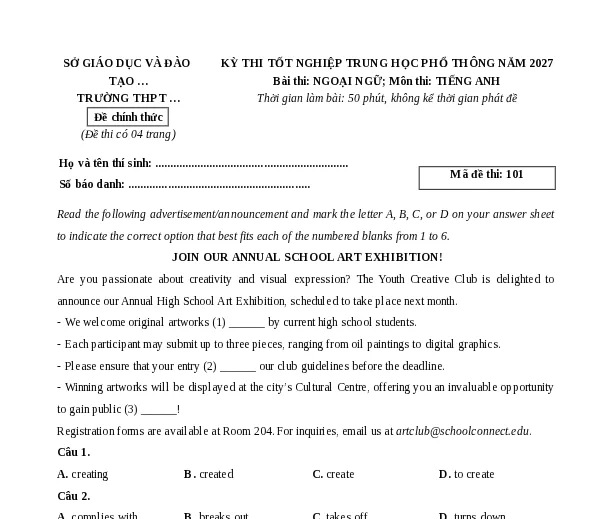
Read the following advertisement / announcement and mark the letter A, B, C, or D on your answer sheet to indicate the correct option that best fits each of the numbered blanks from 1 to 6.
YOUTH PSYCHOLOGY WORKSHOP: EMBRACING THE "LOWKEY" LIFESTYLE
Are you constantly exhausted by the pressure to broadcast every milestone online? Do you wish to protect your mental energy while still (1) ______ strong personal values?
Our workshop, "The Lowkey Teenager: Peace Over Popularity," is exclusively created for high schoolers who want to step back from digital chaos. Participants will:
- Discover how a lowkey mindset helps foster genuine relationships rather than superficial (2) ______.
- Learn practical techniques to stay grounded and resist the urge to compare their lives with online personas.
- Connect with mental health mentors who understand the unique dilemmas (3) ______ today's adolescents.
- Date: Sunday, October 26th
- Venue: Youth Cultural House, Hall B
- Registration fee: Completely free, but seats are limited! Register (4) ______ advance via our website to guarantee your admission.
Câu 1.
A. retaining
B. reserving
C. cultivating
D. consuming
Câu 2.
A. validations
B. validates
C. validly
D. validity
Câu 3.
A. confronting
B. confronted
C. are confronting
D. to confront
ANNOUNCEMENT: SCHOOL FORUM ON DIGITAL CULTURE AND SOCIAL BEHAVIOR
The School Youth Union cordially invites all students to participate in an open panel discussion on contemporary communication habits among Generation Z.
1. Aim of the Forum:
To analyze current behavioral phenomena on social media, especially the tendency among teenagers to "flex" their material possessions or personal triumphs, and how this dynamic impacts peer relations.
2. Key Discussion Points:
- The underlying psychological incentives that prompt youngsters to (5) ______ their luxuries and achievements.
- Constructive ways to build authentic self-esteem without depending on digital admiration.
- Fostering an inclusive campus environment where individual uniqueness is appreciated without prejudice.
3. Student Submissions:
Each class is required to submit at least one presentation slide (6) ______ 5:00 PM this Friday to the organizing committee.
Câu 4.
A. at
B. in
C. on
D. with
Câu 5.
A. show off
B. turn down
C. look after
D. take over
Câu 6.
A. until
B. prior
C. by
D. since
Read the following leaflet and mark the letter A, B, C, or D on your answer sheet to indicate the correct option that best fits each of the numbered blanks from 7 to 12.
NAVIGATING "THE VIBE": HOW GEN Z DEFINES EMOTIONAL HARMONY
For Generation Z, the word "vibe" is not merely slang; it reflects a profound criterion for evaluating their immediate surroundings, interpersonal bonds, and self-expression. Here is (7) ______ closer look at what "vibe" truly signifies:
- Intuitive Resonance: Rather than depending solely on formal titles or academic metrics, teenagers often rely on their intuition to evaluate if a place or person radiates positive energy. A pleasant "vibe" implies psychological safety, acceptance, and an (8) ______ absence of tension.
- Selective Social Circles: Contemporary youth are increasingly intentional about (9) ______ they spend time with. If someone continually disrupts the peaceful atmosphere with toxicity or negativity, young people do not hesitate to step away to safeguard their tranquility.
- Aesthetic Spaces: From cozy coffee shops to personalized study desks, the physical ambiance matters immensely. (10) ______ teenagers find that harmonious aesthetics stimulate their creativity and diminish daily anxiety.
- Authenticity over Pretense: Unlike previous generations that frequently conformed to rigid societal norms, Gen Z cherishes spaces where everyone can be their authentic selves. They naturally gravititate towards experiences that feel (11) ______ and transparent.
Friendly Advice:
Pay attention to your emotional instincts, but also stay open-minded. Do not let quick impressions completely (12) ______ you from understanding diverse viewpoints!
Câu 7.
A. a
B. an
C. the
D. Ø (no article)
Câu 8.
A. apparent
B. apparently
C. apparition
D. appease
Câu 9.
A. which
B. whom
C. whose
D. what
Câu 10.
A. Much
B. Every
C. Many
D. Little
Câu 11.
A. superficial
B. genuine
C. deceptive
D. pretentious
Câu 12.
A. hinder
B. prevent
C. prohibit
D. forbid
Mark the letter A, B, C, or D on your answer sheet to indicate the best arrangement of utterances or sentences to make a meaningful exchange or text in each of the following questions from 13 to 17.
Câu 13.
a. Minh: "I noticed that Nam deleted all his social media highlights and stopped posting about his test scores. Is he doing alright?"
b. Minh: "That actually sounds wonderful. Constantly updating everything must be mentally exhausting."
c. Lan: "He's completely fine! He told me he just wants to adopt a lowkey lifestyle so he can focus on personal growth without unnecessary distractions."
A. a – c – b
B. c – a – b
C. b – a – c
D. a – b – c
Câu 14.
a. Linh: "Have you noticed how everyone keeps talking about whether a place has the 'right vibe' before deciding to hang out?"
b. Phong: "Not necessarily. It's more about how the atmosphere makes you feel—relaxed, safe, and free from judgment."
c. Linh: "So it's basically an intuitive way of prioritizing your mental well-being when choosing social settings?"
d. Phong: "Exactly! When the vibe is wholesome, you can genuinely be yourself without putting on a mask."
e. Linh: "Does that simply mean whether a venue has trendy decoration and soft lighting?"
A. a – e – b – c – d
B. a – b – e – d – c
C. e – b – a – c – d
D. a – c – d – e – b
Câu 15.
Dear An,
a. Hearing you talk about the urge to flex luxury outfits to gain approval from your classmates made me reflect on my own habits.
b. You will eventually realize that people who truly appreciate your friendship care about your character rather than your branded possessions.
c. Why don't we try taking a two-week break from social media together and see how much lighter our minds feel?
d. I used to fall into that exact trap until I discovered the peace of keeping my achievements private.
e. Thanks so much for opening up to me during our conversation yesterday afternoon.
Warm regards,
Huyen
A. e – a – d – b – c
B. a – d – e – b – c
C. e – d – a – c – b
D. a – e – d – c – b
Câu 16.
a. Consequently, those who master this equilibrium enjoy profound emotional stability and build bonds founded on mutual sincerity.
b. In contemporary youth culture, living lowkey does not imply total isolation or social awkwardness.
c. Rather, it represents a deliberate decision to selectively share personal joys while guarding inner tranquility against digital scrutiny.
d. Teenagers who practice this philosophy often direct their spare time toward meaningful hobbies instead of chasing fleeting virtual applause.
e. By doing so, they eliminate the compulsive anxiety to compete with curated highlight reels circulating on the Internet.
A. b – c – d – e – a
B. b – d – c – a – e
C. d – b – c – e – a
D. c – b – d – a – e
Câu 17.
a. Initially, flex culture began as playful self-expression among artists celebrating their hard-won prosperity.
b. However, as algorithmic feeds began rewarding ostentatious displays, many teenagers began equating material display with personal worth.
c. This subtle shift has inadvertently fueled comparison, leaving countless youngsters trapped in cycles of inadequacy.
d. Recognizing this destructive dynamic is the critical first step toward redefining self-esteem in the digital era.
e. Today, what was once lighthearted celebration has morphed into an exhausting contest for social hierarchy.
A. a – e – b – c – d
B. a – b – e – c – d
C. e – a – b – d – c
D. b – a – e – c – d
Read the following passage and mark the letter A, B, C, or D on your answer sheet to indicate the correct option that best fits each of the numbered blanks from 18 to 22.
Among modern adolescents, the concept of "vibe" has transcended casual terminology to become a pivotal mechanism for emotional navigation. Far from being a frivolous buzzword, "vibe" represents the holistic emotional tenor of an interaction or environment, (18) ______. In an era characterized by relentless information overload, young people frequently lack the temporal resources to scrutinize every social cue analytically; thus, emotional resonance serves as an efficient cognitive shorthand.
Psychologists suggest that Generation Z’s preoccupation with vibes is intimately linked to their acute awareness of mental well-being. Unlike older cohorts who were conditioned to endure adverse social environments for the sake of social decorum, (19) ______. When an adolescent remarks that someone’s "vibe is off," they are seldom voicing arbitrary dislike; rather, they are recognizing subtle behavioral discrepancies (20) ______. This acute sensitivity allows teenagers to establish healthy emotional boundaries before potential conflicts materialize.
Furthermore, the pursuit of compatible vibes shapes how young people curate their physical and virtual sanctuaries. Whether decorating a bedroom with ambient lighting or curating thematic music playlists, adolescents proactively design settings (21) ______. By orchestrating their surroundings to evoke calm and creative flow, teenagers actively counter the relentless academic and social pressures of daily life.
Ultimately, the cultural ascendancy of "the vibe" highlights a broader shift toward emotional authenticity. In prioritizing emotional compatibility over superficial affiliations, (22) ______ where empathy, shared values, and psychological security form the cornerstone of everyday life.
Câu 18.
A. which reflects whether participants feel emotionally welcomed and intellectually secure
B. that will reflect whether participants felt emotionally welcomed and intellectually secure
C. reflecting which participants felt emotionally welcomed and intellectually secure
D. of which the reflection allows participants to feel emotionally welcomed and intellectually secure
Câu 19.
A. teenagers today feel obliged to conform to toxic communal standards
B. modern adolescents prioritize psychological security and emotional equilibrium above superficial courtesy
C. superficial courtesy is prioritized over psychological equilibrium by contemporary youth
D. adolescents modernly accept emotional distress in exchange for wider acceptance
Câu 20.
A. that indicate unaddressed insincerity or underlying hostility
B. indicated by unaddressed insincerity or underlying hostility
C. which they indicate unaddressed insincerity or underlying hostility
D. what indicates unaddressed insincerity or underlying hostility
Câu 21.
A. whose purpose is to induce acute sensory overstimulation
B. that nurture a profound sense of grounding and emotional recuperation
C. which aims at eliminating all chances of introspection and relaxation
D. where digital notifications can intrude upon their personal downtime
Câu 22.
A. communities are being fostered by Generation Z with intentional mindfulness
B. intentional communities are fostered by Generation Z’s mindfulness
C. Generation Z is intentionally fostering supportive social ecosystems
D. the intentional fostering of social ecosystems is achieved by Generation Z
Read the following passage and mark the letter A, B, C, or D on your answer sheet to indicate the correct answer to each of the questions from 23 to 30.
In recent years, the slang term "flexing"—which denotes the public exhibition of lavish possessions, physical attractiveness, or personal triumphs—has permeated adolescent discourse globally. While showing off is hardly a novelty in human history, contemporary social media architectures have amplified this impulse exponentially. From unboxing designer goods to broadcasting acceptance letters from elite universities, millions of teenagers participate in daily rituals of digital ostentation. To dismiss this trend as mere narcissism, however, is to overlook the intricate psychosocial factors compelling youth to put their lives on display.
At the heart of flex culture lies the innate human longing for social affirmation. During adolescence, individuals undergo an intense phase of identity construction, during which peer evaluation holds unprecedented weight. Digital platforms capitalize on this developmental vulnerability by quantifying approval through metrics such as likes, views, and comments. When a teenager posts a polished highlight and receives instant applause, their brain experiences a surge of dopamine—a neurotransmitter responsible for pleasure and reinforcement. Over time, virtual validation becomes conflated with self-esteem, propelling youngsters to continually showcase escalating benchmarks of success.
Moreover, flexing frequently serves as a defense mechanism against pervasive feelings of inadequacy. In an intensely competitive world where economic volatility and academic expectations weigh heavily on young shoulders, displaying outward triumph provides a semblance of control. By presenting an image of prosperity, teenagers attempt to signal competence and forestall the vulnerability that comes with admitting personal insecurities. In this sense, flexing is less about hubris and more about constructing a protective facade against social marginalization.
Nevertheless, the chronic compulsion to flex carries profound psychological repercussions. Sociological studies reveal that adolescents who habitually engage in competitive display experience heightened levels of anxiety and chronic dissatisfaction. Because online highlights represent carefully curated distortions rather than holistic reality, participants inevitably find themselves trapped in exhaustive cycles of upward social comparison. When young people define their intrinsic worth through the lens of external spectacles, they risk alienating genuine companions and eroding their capacity for authentic self-compassion.
(Adapted from Youth Culture and the Digital Self, Cambridge Academic Press)
Câu 23. Which of the following best serves as the title for the passage?
A. The Evolution of Social Media Platforms
B. Unpacking Flex Culture: Motives and Consequences
C. The Downfall of Academic Competition Among Teens
D. How Dopamine Controls Teenage Decision-Making
Câu 24. According to paragraph 1, what sets contemporary flexing apart from historical showing off?
A. The total absence of vanity and pride among modern adolescents.
B. The reliance on material possessions rather than personal skills.
C. The immense amplification facilitated by social media architecture.
D. The restriction of display rituals to elite university applicants.
Câu 25. The word propelling in paragraph 2 is closest in meaning to ______.
A. driving
B. dragging
C. deterring
D. diverting
Câu 26. The word facade in paragraph 3 is opposite in meaning to ______.
A. masquerade
B. disguise
C. exterior
D. reality
Câu 27. The word they in paragraph 4 refers to ______.
A. online highlights
B. external spectacles
C. young people
D. genuine companions
Câu 28. Which of the following is NOT mentioned in paragraph 3 as a reason why teenagers flex?
A. Shielding themselves from feelings of vulnerability.
B. Projecting competence amid fierce social competition.
C. Retaliating aggressively against academic instructors.
D. Establishing a reassuring perception of control.
Câu 29. Which of the following statements is TRUE according to the passage?
A. Dopamine release discourages teenagers from posting achievements online.
B. Peer feedback during adolescence exerts negligible influence on identity formation.
C. Flexing should be solely attributed to inherent adolescent arrogance.
D. Habitual competitive display is linked to heightened anxiety and dissatisfaction.
Câu 30. It can be inferred from the passage that breaking free from the flex cycle requires teenagers to ______.
A. erase all digital traces and live entirely without modern technology
B. anchor their self-worth in internal values rather than external feedback
C. conceal all personal milestones even from their closest family members
D. purchase only understated goods that cannot be recognized by peers
Read the following passage and mark the letter A, B, C, or D on your answer sheet to indicate the correct answer to each of the questions from 31 to 40.
In stark contrast to the conspicuous exhibitionism championed by mainstream influencer culture, an understated yet powerful counter-movement is gaining traction among teenagers: the "lowkey" lifestyle. Derived from African American Vernacular English and popularized across global digital platforms, being "lowkey" originally described experiencing an emotion quietly or holding an opinion discretely. Today, however, the term has evolved into a comprehensive philosophy of life for a growing demographic of Generation Z. [I] Rather than chasing viral notoriety, lowkey teenagers consciously choose to navigate their formative years with intentional privacy and quiet determination.
At its core, adopting a lowkey demeanor is a deliberate act of self-preservation in an era of hyper-visibility. For over a decade, social media users were conditioned to monetize their daily routines, treat their personalities as personal brands, and submit every private triumph to public referendum. [II] This relentless surveillance has culminated in widespread "digital fatigue," a psychological exhaustion induced by the endless performance of perfection. Lowkey adolescents reject this paradigm by practicing radical boundary-setting. They may maintain private accounts accessible only to intimate friends, refrain from broadcasting their academic triumphs, or engage in hobbies without the impulse to produce digital content around them.
Sociologists observe that this retreat into discretion does not signify apathy or social withdrawal; on the contrary, it enables deeper interpersonal intimacy. When the necessity for public validation is dismantled, relationships are no longer commodified as photographic backdrops or algorithmic leverage. [III] Interactions between lowkey peers are characterized by unscripted conversations, mutual trust, and shared presence. By extricating themselves from the competitive arena of who possesses more or achieves faster, these teenagers cultivate an emotional sanctuary where vulnerability is embraced rather than exploited.
Furthermore, the lowkey ethos fosters autonomous personal development. When accomplishments are pursued for intrinsic fulfillment rather than external applause, adolescents cultivate genuine resilience. A student who learns a musical instrument without recording their rehearsals for TikTok derives gratification directly from the learning process itself. [IV] In doing so, they develop what developmental psychologists term "an internal locus of control"—the conviction that one's agency and happiness stem from inner values rather than volatile external accolades.
As society continues to grapple with the mental health repercussions of algorithmic hyper-connectivity, the quiet revolution of lowkey teenagers offers a compelling antidote. By demonstrating that fulfillment does not require an audience, this emerging cohort is quietly redefining success in the twenty-first century.
(Adapted from The Quiet Generation: Privacy and Purpose in the Age of Noise, Oxford University Press)
Câu 31. Where in the passage does the following sentence best fit?
Consequently, individuals felt perpetual anxiety regarding how they were perceived by distant acquaintances.
A. [I]
B. [II]
C. [III]
D. [IV]
Câu 32. What is the primary purpose of the author in the passage?
A. To condemn teenagers for their inability to adapt to modern technological tools.
B. To analyze the lowkey lifestyle as a constructive response to digital hyper-visibility.
C. To trace the linguistic history of African American Vernacular English in schools.
D. To persuade adolescents to abandon all friendships formed on digital platforms.
Câu 33. The word discretely in paragraph 1 is closest in meaning to ______.
A. ostentatiously
B. unobtrusively
C. dramatically
D. recklessly
Câu 34. According to paragraph 2, "digital fatigue" is primarily caused by ______.
A. the exorbitant financial cost of maintaining high-speed Internet connections
B. the technical difficulty of mastering newly released social media algorithms
C. the exhausting obligation to constantly perform and display perfection online
D. the complete absence of privacy regulations on global communication networks
Câu 35. The word commodified in paragraph 3 most nearly means ______.
A. turned into a commercial object
B. elevated to a spiritual level
C. protected from outside harm
D. examined under strict criteria
Câu 36. The word they in paragraph 4 refers to ______.
A. external accolades
B. musical rehearsals
C. lowkey adolescents
D. developmental psychologists
Câu 37. Which of the following is NOT true about lowkey teenagers according to the passage?
A. They completely abandon personal development and show apathy toward real life.
B. They consciously refrain from broadcasting every private milestone to the public.
C. They tend to establish private digital spaces reserved strictly for intimate friends.
D. They derive satisfaction from the process of learning rather than social media praise.
Câu 38. Which of the following best paraphrases the underlined sentence in paragraph 4?
“When accomplishments are pursued for intrinsic fulfillment rather than external applause, adolescents cultivate genuine resilience.”
A. Seeking public approval is the sole method by which young people become mentally tough.
B. True resilience develops when teenagers seek personal satisfaction rather than public praise.
C. Adolescents who ignore inner fulfillment will inevitably master emotional perseverance.
D. External applause motivates teenagers to achieve long-term resilience much faster.
Câu 39. Which of the following can be inferred from the passage?
A. The lowkey trend will soon compel tech corporations to shut down all public social networks.
B. Genuine intimacy flourishes when social interactions are liberated from virtual spectacle.
C. Teenagers who post publicly are incapable of forming any loyal real-world friendships.
D. Practicing a lowkey lifestyle requires adolescents to hide their talents from teachers.
Câu 40. Which of the following best summarizes the overall message of the passage?
A. In a noisy digital culture, choosing privacy and inner purpose provides authentic well-being.
B. The lowkey movement is an ephemeral fad that fails to address the root causes of anxiety.
C. Modern youth must choose between becoming famous influencers or living in total obscurity.
D. Protecting personal privacy on social media requires advanced technical expertise.
--------- HẾT ---------
Thí sinh không được sử dụng tài liệu. Cán bộ coi thi không giải thích gì thêm.
HƯỚNG DẪN CHẤM VÀ ĐÁP ÁN
ĐỀ ÔN THI TỐT NGHIỆP THPT NĂM 2026 — MÔN TIẾNG ANH (ĐỀ SỐ 03)
BẢNG ĐÁP ÁN KHÁCH QUAN (40 CÂU — MỖI CÂU 0,25 ĐIỂM)
Câu | Đ/án | Câu | Đ/án | Câu | Đ/án | Câu | Đ/án |
|---|---|---|---|---|---|---|---|
1 | C | 11 | B | 21 | B | 31 | B |
2 | A | 12 | A | 22 | C | 32 | B |
3 | A | 13 | A | 23 | B | 33 | B |
4 | B | 14 | A | 24 | C | 34 | C |
5 | A | 15 | A | 25 | A | 35 | A |
6 | C | 16 | A | 26 | D | 36 | C |
7 | A | 17 | A | 27 | C | 37 | A |
8 | A | 18 | A | 28 | C | 38 | B |
9 | B | 19 | B | 29 | D | 39 | B |
10 | C | 20 | A | 30 | B | 40 | A |
TÓM TẮT GIẢI THÍCH CHI TIẾT THEO CÂU
Câu | Kỹ năng / Kiến thức kiểm tra | Giải thích ngắn gọn |
|---|---|---|
1 | Từ vựng (Collocation) | Cultivate values: vun đắp, bồi dưỡng các giá trị cá nhân. |
2 | Từ loại (Word formation) | Sau tính từ superficial cần một danh từ số nhiều: validations (sự công nhận, tán thưởng). |
3 | Rút gọn mệnh đề quan hệ | Mệnh đề chủ động dilemmas which confront... rút gọn thành V-ing: confronting. |
4 | Cụm giới từ cố định | in advance: trước (đăng ký trước). |
5 | Cụm động từ (Phrasal verb) | show off: khoe mẽ, phô trương của cải, thành tích (= flex). |
6 | Giới từ thời gian | by 5:00 PM: trước hoặc muộn nhất vào lúc 5 giờ chiều (chỉ hạn chót). |
7 | Mạo từ | Cụm cố định: take a closer look at something. |
8 | Từ loại | Trước danh từ absence cần tính từ bổ nghĩa: apparent (rõ ràng, hiển nhiên). |
9 | Đại từ quan hệ | Giới từ with đi kèm đại từ chỉ người làm tân ngữ: with whom they spend time. |
10 | Lượng từ (Quantifiers) | Many đi với danh từ đếm được số nhiều (teenagers). |
11 | Từ vựng (Từ trái / đồng nghĩa) | genuine: chân thật, chân thành, phù hợp với ngữ cảnh authenticity. |
12 | Cụm động từ / Giới từ | hinder someone from doing something: cản trở ai làm việc gì. |
13 | Sắp xếp đối thoại ngắn | Minh hỏi về Nam (a) -> Lan giải thích Nam chọn lối sống lowkey (c) -> Minh đồng tình (b). |
14 | Sắp xếp hội thoại | Linh nêu hiện tượng "vibe" (a) -> hỏi trang trí phòng (e) -> Phong định nghĩa cảm giác an toàn (b) -> Linh đúc kết (c) -> Phong chốt ý (d). |
15 | Sắp xếp thư từ | Cảm ơn cuộc trò chuyện (e) -> nhắc chuyện bạn muốn flex (a) -> chia sẻ trải nghiệm bản thân (d) -> lời khuyên chân thành (b) -> rủ cai mạng xã hội (c). |
16 | Sắp xếp đoạn văn logic | Giới thiệu lối sống lowkey (b) -> bản chất là giữ bình yên (c) -> hướng tới sở thích cá nhân (d) -> giảm áp lực cạnh tranh (e) -> đúc kết kết quả (a). |
17 | Sắp xếp tiến trình lịch sử | Khởi nguồn của flex (a) -> biến tướng trên mạng (e) -> hệ luỵ đánh đồng giá trị (b) -> dẫn đến so sánh độc hại (c) -> giải pháp thức tỉnh (d). |
18 | Mệnh đề quan hệ không xác định | Dùng which reflects... để bổ nghĩa cho toàn bộ khái niệm vibe và environment. |
19 | Mệnh đề độc lập chỉ đối lập | Vế trước nói về thế hệ trước, vế sau cần chủ ngữ người tương xứng: modern adolescents prioritize.... |
20 | Mệnh đề quan hệ bổ nghĩa danh từ | behavioral discrepancies that indicate... (những dấu hiệu chỉ ra sự thiếu chân thành). |
21 | Mệnh đề quan hệ chỉ mục đích | that nurture a profound sense of grounding and emotional recuperation (tạo cảm giác an yên). |
22 | Rút gọn mệnh đề phân từ | Mệnh đề đầu là In prioritizing... nên chủ ngữ chính phải là người thực hiện hành động: Generation Z is.... |
23 | Đọc hiểu 1 — Tiêu đề | Bài viết giải thích động cơ tâm lý (longing for affirmation, coping mechanism) và tác hại của flex culture. |
24 | Đọc hiểu 1 — Chi tiết | Đoạn 1 nêu: social media architectures have amplified this impulse exponentially. |
25 | Đọc hiểu 1 — Từ vựng | propelling = driving (thúc đẩy, đẩy ai làm gì). |
26 | Đọc hiểu 1 — Từ trái nghĩa | facade (bề ngoài hào nhoáng giả tạo) trái nghĩa với reality (hiện thực). |
27 | Đọc hiểu 1 — Quy chiếu | they ở đoạn 4 thay thế cho young people ở vế trước. |
28 | Đọc hiểu 1 — Chi tiết phủ định | Không có thông tin về việc trả thù hay chống đối giáo viên (retaliating against instructors). |
29 | Đọc hiểu 1 — Thông tin đúng | Đoạn 4: adolescents who habitually engage in competitive display experience heightened levels of anxiety and chronic dissatisfaction. |
30 | Đọc hiểu 1 — Suy luận | Câu cuối đoạn 4 nhấn mạnh rủi ro khi dựa vào cái nhìn bên ngoài -> cần xây dựng giá trị nội tại (internal values). |
31 | Đọc hiểu 2 — Chèn câu | Câu cần chèn mang tính kết quả (Consequently, individuals felt perpetual anxiety...), khớp ngay sau câu nói về sự giám sát không ngừng của mạng xã hội ở vị trí [II]. |
32 | Đọc hiểu 2 — Mục đích tác giả | Toàn bài phân tích lối sống lowkey như một giải pháp tích cực đối phó với sự mệt mỏi kỹ thuật số (digital hyper-visibility). |
33 | Đọc hiểu 2 — Từ đồng nghĩa | discretely (kín đáo, không phô trương) đồng nghĩa với unobtrusively. |
34 | Đọc hiểu 2 — Chi tiết | Đoạn 2 nêu rõ: a psychological exhaustion induced by the endless performance of perfection. |
35 | Đọc hiểu 2 — Từ vựng | commodified = turned into a commercial object (bị biến thành món hàng hóa/công cụ trục lợi). |
36 | Đọc hiểu 2 — Quy chiếu | they ở đoạn 4 quy chiếu cho các bạn trẻ lowkey theo đuổi sở thích (lowkey adolescents). |
37 | Đọc hiểu 2 — Thông tin sai | Đoạn 3 khẳng định: retreat into discretion does not signify apathy or social withdrawal. Phương án A nói họ thờ ơ bỏ bê là sai. |
38 | Đọc hiểu 2 — Diễn giải câu | Câu gốc nhấn mạnh: theo đuổi sự hoàn thiện từ nội tại thay vì vỗ tay bên ngoài sẽ tôi luyện sự bền bỉ -> Khớp với phương án B. |
39 | Đọc hiểu 2 — Suy luận | Đoạn 3: sự thân mật đích thực nảy nở khi các tương tác không bị biến thành màn trình diễn số (liberated from virtual spectacle). |
40 | Đọc hiểu 2 — Tóm tắt văn bản | Thông điệp cốt lõi: giữa một thế giới kỹ thuật số ồn ào, lựa chọn sự riêng tư và mục đích nội tại mang lại hạnh phúc đích thực (A). |