BỘ GIÁO DỤC VÀ ĐÀO TẠO
Đề thi thử số 2
KỲ THI TỐT NGHIỆP TRUNG HỌC PHỔ THÔNG
Môn thi: TIẾNG ANH
Thời gian làm bài: 50 phút, không kể thời gian phát đề
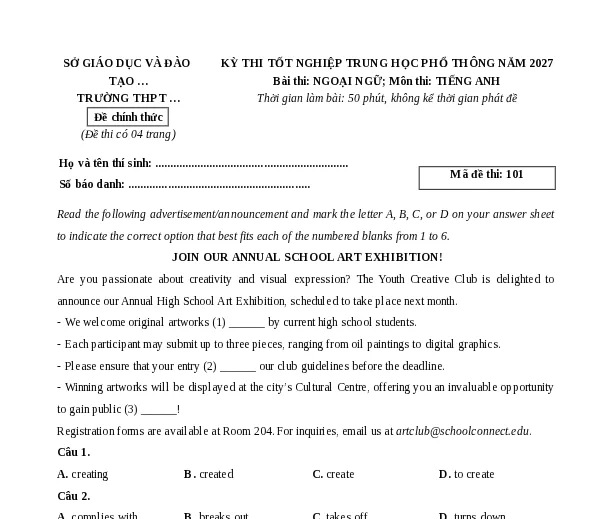
Họ và tên thí sinh: ................................................................ Số báo danh: ............................................................ | Mã đề: 102 |
Read the following advertisement and mark the letter A, B, C or D on your answer sheet to indicate the option that best fits each of the numbered blanks from 1 to 6.
DISCOVER THE CHARM OF HA GIANG LOOP!
Are you looking for an unforgettable adventure this summer? Come and experience the breathtaking beauty of Ha Giang, a province famous (1) ______ its majestic limestone mountains and winding roads. Join our (2) ______ to explore hidden valleys and meet friendly local ethnic communities.
Our package, (3) ______ by experienced travel experts, ensures both safety and authentic cultural experiences. You will have the chance to taste traditional dishes and stay in cozy homestays. Don't forget (4) ______ warm clothes, as the weather in the highlands can change unexpectedly.
To secure your spot, simply (5) ______ a reservation on our official website before June 30th. This journey will surely leave a deep (6) ______ on every traveler who loves nature and exploration!
Question 1.
A. with
B. for
C. at
D. about
Question 2.
A. guided eco-friendly tour
B. eco-friendly tour guided
C. tour guided eco-friendly
D. eco-friendly guided tour
Question 3.
A. designing
B. which designed
C. designed
D. is designed
Question 4.
A. pack
B. packing
C. to pack
D. to packing
Question 5.
A. make
B. take
C. do
D. put
Question 6.
A. impress
B. impression
C. impressive
D. impressively
Read the following leaflet and mark the letter A, B, C or D on your answer sheet to indicate the option that best fits each of the numbered blanks from 7 to 12.
DIGITAL WELLBEING: FINDING BALANCE IN A CONNECTED WORLD
In today's fast-paced digital era, spending too much time on electronic devices can negatively affect both our mental and physical health. Here are some practical tips to help you manage your screen time effectively.
- Track your habits: Many people are unaware of how much time they spend online. Some individuals use smartphones for work, while (7) ______ spend hours scrolling through social media aimlessly.
- Set clear boundaries: Try to (8) ______ notifications during study hours or family meals so that you can stay focused and enjoy real-life conversations.
- Protect your eyes: Looking at a screen for a long (9) ______ of time can cause severe eye strain and headaches. Follow the 20-20-20 rule to give your eyes a break.
- Prioritize sleep: Avoid using digital gadgets (10) ______ going to bed, as the blue light emitted from screens can disrupt your natural sleep cycle.
- Engage in offline hobbies: Spend time on outdoor activities, reading physical books, or pursuing creative (11) ______ that help refresh your mind.
- Be mindful: Consume only a small (12) ______ of entertainment media each day to maintain high productivity and mental clarity.
Question 7.
A. another
B. other
C. others
D. the other
Question 8.
A. turn off
B. put off
C. take off
D. give off
Question 9.
A. stage
B. period
C. phase
D. era
Question 10.
A. prior to
B. regardless of
C. on account of
D. in addition to
Question 11.
A. routines
B. pursuits
C. customs
D. targets
Question 12.
A. number
B. amount
C. plenty
D. variety
Mark the letter A, B, C or D on your answer sheet to indicate the best arrangement of utterances or sentences to make a meaningful exchange or text in each of the following questions from 13 to 17.
Question 13.
a. Lan: Hi Minh! Have you decided which university club you are going to join this semester?
b. Lan: That sounds wonderful! Performing in front of a crowd will definitely boost your confidence.
c. Minh: Yes, I've just signed up for the Acoustic Music Club because I want to improve my guitar skills.
A. a – b – c
B. c – a – b
C. a – c – b
D. b – c – a
Question 14.
a. David: Have you tried using the new AI language tutor app that our teacher recommended?
b. Mai: Not yet. Is it really helpful for practicing English speaking skills?
c. Mai: Really? I'll download it tonight and give it a try.
d. David: Absolutely! It gives instant feedback on your pronunciation and suggests more natural expressions.
e. Mai: Does it cost anything to sign up for an account?
f. David: No, the basic version is completely free for students.
A. a – b – d – e – f – c
B. a – e – f – b – d – c
C. b – a – d – c – e – f
D. a – b – f – e – d – c
Question 15.
Dear Ms. Parker,
a. Furthermore, I would like to know if there are any scholarship opportunities available for international applicants.
b. I am writing to inquire about the undergraduate Graphic Design program at your institution for the upcoming autumn intake.
c. Thank you very much for your time and assistance, and I look forward to hearing from you soon.
d. Could you please send me detailed information regarding the tuition fees and the required portfolio format?
e. Having reviewed your university's website, I am deeply impressed by the modern studio facilities and the experienced faculty.
Yours sincerely,
Nguyen Minh Khang
A. b – d – e – a – c
B. b – e – d – a – c
C. e – b – a – d – c
D. b – a – e – d – c
Question 16.
a. First, keeping a detailed monthly budget allows young adults to track their income and avoid unnecessary impulse purchases.
b. Financial literacy is an essential life skill that helps young people achieve long-term independence and security.
c. In conclusion, developing smart money management habits early in life lays a strong foundation for a stress-free future.
d. In addition to budgeting, setting aside at least ten percent of one's earnings into a savings account provides a safety net for emergencies.
e. Finally, learning how to invest wisely can help individuals grow their wealth gradually over time.
A. b – a – d – e – c
B. a – d – e – b – c
C. b – d – a – e – c
D. b – a – e – d – c
Question 17.
a. Consequently, thousands of commuters now prefer taking the skytrain instead of driving private vehicles into the city center.
b. Over the past decade, the metropolitan area of Greenfield has undergone a dramatic transformation in its public transport network.
c. What used to be a congested network of narrow streets has been complemented by two modern elevated railway lines.
d. This shift has not only reduced travel time during rush hours but also significantly improved urban air quality.
e. In addition, the municipal government has introduced electric buses and expanded dedicated cycling lanes across all districts.
A. b – c – e – a – d
B. b – a – c – e – d
C. c – b – e – a – d
D. b – e – a – c – d
Read the following passage and mark the letter A, B, C or D on your answer sheet to indicate the option that best fits each of the numbered blanks from 18 to 22.
Urban gardening, the practice of growing plants and vegetables in city environments, has gained remarkable popularity in recent years. Faced with limited green spaces and rising food prices, (18) ______. From small apartment balconies to shared community rooftops, unused urban corners are being transformed into vibrant green oases.
One of the greatest advantages of urban gardening is its positive impact on the environment and human wellbeing. Plants grown on rooftops and walls help absorb heat, (19) ______. Moreover, tending to plants after a long day at work allows city dwellers to reconnect with nature and relieve stress. Fresh produce harvested right at home is also free from harmful chemical pesticides and requires no long-distance transportation.
Community gardens, (20) ______, play a vital role in strengthening neighborhood bonds. People from diverse backgrounds gather to share seeds, tools, and gardening experience. (21) ______. Schools in many cities have also integrated rooftop gardens into their science curricula so that students can learn about sustainable agriculture firsthand.
Despite challenges such as limited space and soil pollution, innovative techniques like vertical farming and hydroponics are making urban gardening more accessible than ever. (22) ______, cities around the world can move closer to a greener and more self-sufficient future.
Question 18.
A. many city residents have started cultivating their own fresh produce at home
B. cultivating fresh produce at home has become a mandatory rule for city residents
C. the government has banned residents from buying vegetables at local supermarkets
D. green spaces in rural areas are no longer suitable for traditional farming methods
Question 19.
A. which significantly reduces the urban heat island effect during hot summer months
B. reduced the urban heat island effect significantly during hot summer months
C. that makes the urban heat island effect become much more severe in the summer
D. whose ability to increase the temperature of surrounding buildings in the summer
Question 20.
A. which are managed collectively by local volunteers and neighborhood associations
B. managed collectively by local volunteers and neighborhood associations are very popular
C. that local volunteers and neighborhood associations managing them collectively
D. having managed collectively by local volunteers and neighborhood associations
Question 21.
A. These shared spaces foster a strong sense of belonging and mutual support among residents
B. However, neighbors rarely talk to each other when working in these community gardens
C. Modern cities should demolish all community gardens to build more commercial centers
D. Gardening tools are too expensive for ordinary citizens to purchase on their own
Question 22.
A. By encouraging more households and organizations to adopt these green practices
B. Without the participation of local households and environmental organizations
C. Having discouraged citizens from planting trees and vegetables on their balconies
D. Although urban residents refuse to adopt these modern agricultural techniques
Read the following passage and mark the letter A, B, C or D on your answer sheet to indicate the best answer to each of the following questions from 23 to 30.
THE RISE OF "SILENT WALKING"
In a world where people rarely leave home without wireless earbuds, taking a walk without listening to music, podcasts, or audiobooks may seem unusual. Yet "silent walking"—simply walking outdoors without any digital distractions—has recently become a major wellness trend. Popularized on social media after content creators shared their experiences of walking for thirty minutes in complete silence, the practice encourages individuals to unplug and pay attention to their surroundings.
For years, multitasking during exercise has been the norm. Many people use their daily walk to catch up on news podcasts, learn a foreign language, or make phone calls. While this habit appears productive, neuroscientists warn that constant auditory stimulation prevents the brain from resting. When we continuously feed our minds with information, our nervous system remains in a state of heightened alertness, which can lead to mental fatigue and anxiety over time.
Silent walking offers a powerful antidote to this sensory overload. By stepping outside without headphones, walkers allow their minds to wander freely and process emotions that are normally pushed aside during a busy day. Studies in environmental psychology show that listening to natural sounds—such as birdsong, rustling leaves, or even the rhythm of one's own footsteps—lowers cortisol levels and reduces blood pressure. Furthermore, many creative thinkers, from writers to scientists, report that their best ideas emerge during quiet, uninterrupted walks.
Adopting this habit does not require dramatic lifestyle changes. Experts suggest starting small: leave your phone in your pocket for just ten to fifteen minutes during your morning commute or evening stroll. At first, the absence of background noise may feel uncomfortable, as the mind is accustomed to constant entertainment. However, with regular practice, silent walking can transform an ordinary routine into a restorative mindfulness exercise.
Question 23. Which of the following is NOT mentioned in paragraph 2 as an activity people often do while walking?
A. Listening to news podcasts
B. Learning a foreign language
C. Making phone calls
D. Reading electronic books
Question 24. The word distractions in paragraph 1 is OPPOSITE in meaning to ______.
A. interruptions
B. concentrations
C. disturbances
D. attractions
Question 25. The word sensory in paragraph 3 could be best replaced by ______.
A. related to physical senses
B. caused by financial stress
C. connected with logical thinking
D. resulting from physical injury
Question 26. The word their in paragraph 3 refers to ______.
A. natural sounds
B. environmental psychologists
C. creative thinkers
D. uninterrupted walks
Question 27. Which of the following best paraphrases the underlined sentence in paragraph 4?
A. Initially, walking in silence might seem uneasy because our brains are used to being constantly amused.
B. People who enjoy background noise will never be able to get used to walking in complete silence.
C. The mind always prefers silence to entertainment, so walking without headphones feels natural right away.
D. Constant entertainment makes background noise disappear, helping people feel comfortable from the beginning.
Question 28. Which of the following is TRUE according to the passage?
A. Listening to podcasts while walking helps the nervous system relax more deeply than walking in silence.
B. Natural sounds like birdsong can help decrease stress hormones and blood pressure in walkers.
C. Silent walking requires participants to hike in remote forests for at least two hours every day.
D. Content creators on social media strongly advised people against walking without headphones.
Question 29. In which paragraph does the writer mention the physiological benefits of listening to nature?
A. Paragraph 1
B. Paragraph 2
C. Paragraph 3
D. Paragraph 4
Question 30. In which paragraph does the writer give practical advice on how to begin silent walking?
A. Paragraph 1
B. Paragraph 2
C. Paragraph 3
D. Paragraph 4
Read the following passage and mark the letter A, B, C or D on your answer sheet to indicate the best answer to each of the following questions from 31 to 40.
PRESERVING INDIGENOUS LANGUAGES IN THE DIGITAL AGE
[I] Across the globe, linguistic diversity is disappearing at an alarming rate. [II] According to UNESCO, out of approximately 7,000 languages spoken today, nearly half are in danger of falling silent by the end of this century. [III] When an indigenous language vanishes, humanity loses far more than a system of grammar and vocabulary; it loses a unique repository of ecological knowledge, oral history, and cultural identity accumulated over centuries. [IV]
Historically, the decline of minority languages was driven by colonization, urbanization, and assimilation policies. Today, globalization and the dominance of a few major languages on the internet have accelerated this process. Young people in indigenous communities often feel pressured to abandon their ancestral mother tongue in favor of global languages like English, Spanish, or Mandarin to secure better educational and career prospects. As a result, intergenerational transmission—the natural process of parents passing a language down to their children—is breaking down in many regions.
Paradoxically, the very digital technologies that once threatened minority languages are now being harnessed to save them. Linguists, software engineers, and indigenous activists are collaborating to build digital archives, mobile learning apps, and online dictionaries. In New Zealand, for instance, interactive apps and podcasts have played a major role in inspiring younger generations to learn Te Reo Māori. Similarly, artificial intelligence is being trained to transcribe and translate rare languages that have primarily oral traditions, ensuring that elders' stories are recorded before they are lost forever.
However, technology alone cannot guarantee the survival of an endangered language. An app can teach vocabulary, but a language only truly lives when it is spoken in homes, markets, and community gatherings. Furthermore, many remote indigenous groups lack reliable internet access or the funding needed to develop digital tools, a gap often referred to as the "digital divide." Without strong governmental support, bilingual education in schools, and pride within the community itself, digital preservation risks turning living languages into mere museum artifacts. Ultimately, technology should serve as a bridge that empowers communities to keep their linguistic heritage vibrant in everyday life.
Question 31. Where in paragraph 1 does the following sentence best fit?
On average, one indigenous language ceases to be spoken every two weeks.
A. [I]
B. [II]
C. [III]
D. [IV]
Question 32. The phrase mother tongue in paragraph 2 could be best replaced by ______.
A. native language
B. foreign dialect
C. official document
D. modern slang
Question 33. The word them in paragraph 3 refers to ______.
A. digital technologies
B. minority languages
C. career prospects
D. assimilation policies
Question 34. According to paragraph 2, why do many young indigenous people stop speaking their ancestral language?
A. They believe speaking widely used languages will give them better opportunities in study and work.
B. Their parents strictly forbid them from learning traditional vocabulary and cultural history at home.
C. Global languages have much simpler grammar rules than indigenous languages.
D. The internet has completely blocked the use of all minority languages on social media platforms.
Question 35. Which of the following best summarizes paragraph 3?
A. Digital tools and artificial intelligence are being effectively used to document and revitalize endangered languages.
B. The government of New Zealand has replaced English with Te Reo Māori in all software engineering courses.
C. Artificial intelligence has proven incapable of translating languages that do not have a written alphabet.
D. Mobile apps are the main reason why elders in indigenous communities refuse to tell traditional stories.
Question 36. The word vibrant in paragraph 4 is OPPOSITE in meaning to ______.
A. dynamic
B. lifeless
C. thriving
D. energetic
Question 37. Which of the following is TRUE according to the passage?
A. UNESCO estimates that all 7,000 languages spoken today will survive until the next century.
B. The extinction of an indigenous language also means the loss of valuable cultural and ecological knowledge.
C. Every remote indigenous community in the world now has high-speed internet and sufficient funding.
D. Recording a language in an online dictionary is enough to keep it alive without anyone speaking it.
Question 38. Which of the following best paraphrases the underlined sentence in paragraph 4?
A. Digital tools by themselves are insufficient to ensure that a threatened language will continue to exist.
B. Endangered languages can only be saved if we stop using modern technology altogether.
C. Technology is the sole factor that determines whether a minority language will survive or disappear.
D. Once a language is uploaded to a technological platform, its long-term survival is completely assured.
Question 39. Which of the following can be inferred from the passage?
A. Preserving endangered languages requires a combination of technological innovation and active daily use within communities.
B. Young people in New Zealand are no longer interested in using smartphones or listening to podcasts.
C. Languages without a written form cannot be recorded or preserved by any modern technological means.
D. Globalization has had only positive effects on the preservation of indigenous cultures worldwide.
Question 40. Which of the following best summarizes the passage?
A. Although globalization threatens thousands of indigenous languages with extinction, digital technology—when combined with community effort and institutional support—offers promising ways to revitalize them.
B. Because nearly half of the world's languages are disappearing, governments should encourage all citizens to speak a single global language to promote international communication.
C. Artificial intelligence and mobile applications have completely solved the problem of language extinction, making traditional bilingual education in schools unnecessary.
D. Indigenous languages are vanishing solely due to the lack of internet access in rural areas, so providing free smartphones is the only solution needed.
--------- THE END ---------
Thí sinh không được sử dụng tài liệu. Giám thị không giải thích gì thêm.
BỘ GIÁO DỤC VÀ ĐÀO TẠO
Hướng dẫn chấm
KỲ THI TỐT NGHIỆP TRUNG HỌC PHỔ THÔNG
Môn thi: TIẾNG ANH – Đề số 2 (Mã đề 102)
ĐÁP ÁN VÀ HƯỚNG DẪN GIẢI CHI TIẾT
A. BẢNG ĐÁP ÁN TRẮC NGHIỆM (40 câu × 0,25 điểm = 10,0 điểm)
Câu | Đáp án | Câu | Đáp án | Câu | Đáp án | Câu | Đáp án |
|---|---|---|---|---|---|---|---|
1 | B | 11 | B | 21 | A | 31 | C |
2 | D | 12 | B | 22 | A | 32 | A |
3 | C | 13 | C | 23 | D | 33 | B |
4 | C | 14 | A | 24 | B | 34 | A |
5 | A | 15 | B | 25 | A | 35 | A |
6 | B | 16 | A | 26 | C | 36 | B |
7 | C | 17 | A | 27 | A | 37 | B |
8 | A | 18 | A | 28 | B | 38 | A |
9 | B | 19 | A | 29 | C | 39 | A |
10 | A | 20 | A | 30 | D | 40 | A |
B. LỜI GIẢI CHI TIẾT
Câu | Đáp án | Giải thích chi tiết | Điểm |
|---|---|---|---|
1 | B | Cụm tính từ famous for something: nổi tiếng về điều gì (nổi tiếng với những dãy núi đá vôi hùng vĩ). | 0,25 |
2 | D | Trật tự tính từ trước danh từ: Opinion/Quality (eco-friendly – thân thiện với môi trường) + Purpose/Participle (guided – có hướng dẫn viên) + Noun (tour) → eco-friendly guided tour. | 0,25 |
3 | C | Rút gọn mệnh đề quan hệ dạng bị động: Our package, which is designed by... → designed (Gói du lịch của chúng tôi, được thiết kế bởi các chuyên gia...). | 0,25 |
4 | C | Cấu trúc don't forget + to V: đừng quên phải làm gì (nhắc nhở một việc cần làm). to pack (mang theo/đóng gói đồ). | 0,25 |
5 | A | Cụm từ cố định (collocation) make a reservation: đặt chỗ trước. | 0,25 |
6 | B | Sau tính từ deep cần một danh từ: impression (sự ấn tượng). Cụm leave a deep impression on somebody: để lại ấn tượng sâu sắc cho ai. | 0,25 |
7 | C | Cấu trúc tương phản Some individuals... while others...: Một số người... trong khi những người khác... (others = other people, đóng vai trò đại từ làm chủ ngữ). | 0,25 |
8 | A | Cụm động từ: turn off (tắt thông báo); put off (trì hoãn); take off (cất cánh/cởi đồ); give off (tỏa ra mùi/ánh sáng). | 0,25 |
9 | B | Cụm từ for a long period of time: trong một khoảng thời gian dài. | 0,25 |
10 | A | Giới từ ghép: prior to (= before: trước khi đi ngủ); regardless of (bất kể); on account of (bởi vì); in addition to (bên cạnh). | 0,25 |
11 | B | Từ vựng: creative pursuits (những hoạt động theo đuổi mang tính sáng tạo/sở thích lành mạnh); routines (thói quen lặp lại); customs (phong tục); targets (mục tiêu). | 0,25 |
12 | B | Lượng từ đi với danh từ không đếm được (entertainment media): a small amount of (một lượng nhỏ). | 0,25 |
13 | C | Trật tự hội thoại 3 lượt: a (Lan hỏi Minh đã chọn câu lạc bộ nào chưa) → c (Minh trả lời đã đăng ký CLB Âm nhạc Acoustic) → b (Lan khen ngợi và khích lệ). | 0,25 |
14 | A | Trật tự hội thoại 6 lượt: a (David hỏi Mai đã thử ứng dụng AI chưa) → b (Mai trả lời chưa và hỏi có hữu ích không) → d (David giải thích lợi ích) → e (Mai hỏi về chi phí) → f (David nói bản cơ bản miễn phí) → c (Mai quyết định tải về). | 0,25 |
15 | B | Trật tự bức thư hỏi thông tin: b (Nêu lý do viết thư hỏi về ngành Thiết kế đồ họa) → e (Bày tỏ ấn tượng sau khi xem website trường) → d (Hỏi chi tiết về học phí và hồ sơ năng lực) → a (Hỏi thêm về cơ hội học bổng) → c (Lời cảm ơn cuối thư). | 0,25 |
16 | A | Đoạn văn về kỹ năng tài chính: b (Câu chủ đề về tầm quan trọng của hiểu biết tài chính) → a (Ý thứ nhất: First, lập ngân sách hàng tháng) → d (Ý bổ sung: In addition to budgeting, tiết kiệm 10%) → e (Ý cuối: Finally, học cách đầu tư) → c (Câu kết luận: In conclusion). | 0,25 |
17 | A | Đoạn văn về giao thông đô thị: b (Câu mở đầu giới thiệu sự thay đổi mạng lưới giao thông ở Greenfield) → c (Chi tiết sự thay đổi: xây 2 tuyến đường sắt trên cao) → e (Bổ sung thêm xe buýt điện và làn xe đạp) → a (Kết quả: người dân chuyển sang đi tàu trên cao) → d (Tác động tích cực của sự chuyển dịch này: This shift...). | 0,25 |
18 | A | Sau cụm phân từ Faced with limited green spaces and rising food prices (Đối mặt với không gian xanh hạn chế và giá thực phẩm tăng), chủ ngữ của mệnh đề chính phải chỉ người: many city residents have started cultivating their own fresh produce at home. | 0,25 |
19 | A | Cần mệnh đề quan hệ nối tiếp bổ nghĩa cho cả mệnh đề trước đó: which significantly reduces the urban heat island effect during hot summer months (điều này làm giảm đáng kể hiệu ứng đảo nhiệt đô thị). | 0,25 |
20 | A | Giữa hai dấu phẩy sau chủ ngữ Community gardens cần mệnh đề quan hệ không xác định: which are managed collectively by local volunteers and neighborhood associations. | 0,25 |
21 | A | Câu trước nói về việc mọi người tụ họp chia sẻ hạt giống, dụng cụ và kinh nghiệm; câu tiếp theo nêu tác dụng gắn kết: These shared spaces foster a strong sense of belonging and mutual support among residents. | 0,25 |
22 | A | Cần cụm trạng ngữ chỉ cách thức phù hợp ngữ cảnh tích cực của câu kết: By encouraging more households and organizations to adopt these green practices (Bằng cách khuyến khích nhiều hộ gia đình và tổ chức áp dụng các phương thức xanh này). | 0,25 |
23 | D | Thông tin ở đoạn 2: "Many people use their daily walk to catch up on news podcasts, learn a foreign language, or make phone calls." Chỉ có Reading electronic books (Đọc sách điện tử) không được đề cập. | 0,25 |
24 | B | distractions (những thứ gây xao nhãng/phân tâm) trái nghĩa với concentrations (sự tập trung). | 0,25 |
25 | A | sensory có nghĩa là thuộc về giác quan (related to physical senses). Sensory overload: sự quá tải về giác quan. | 0,25 |
26 | C | Thông tin ở đoạn 3: "Furthermore, many creative thinkers, from writers to scientists, report that their best ideas emerge during quiet, uninterrupted walks." Từ their quy chiếu cho creative thinkers. | 0,25 |
27 | A | Câu gạch chân: "Ban đầu, sự vắng bóng của âm thanh nền có thể gây cảm giác không thoải mái, vì tâm trí đã quen với việc giải trí liên tục." Tương đương với A: Initially, walking in silence might seem uneasy because our brains are used to being constantly amused. | 0,25 |
28 | B | Thông tin ở đoạn 3: "Studies in environmental psychology show that listening to natural sounds—such as birdsong...—lowers cortisol levels and reduces blood pressure." (Tiếng thiên nhiên như tiếng chim hót giúp giảm hormone căng thẳng cortisol và hạ huyết áp). | 0,25 |
29 | C | Lợi ích sinh lý (giảm cortisol, hạ huyết áp) của việc lắng nghe âm thanh tự nhiên được nêu ở Đoạn 3. | 0,25 |
30 | D | Lời khuyên thực tế để bắt đầu thói quen đi bộ im lặng (starting small: leave your phone in your pocket for just ten to fifteen minutes...) nằm ở Đoạn 4. | 0,25 |
31 | C | Câu cần chèn nêu số liệu cụ thể (trung bình cứ hai tuần lại có một ngôn ngữ bản địa biến mất), bổ sung trực tiếp cho số liệu của UNESCO ở câu trước [III] và dẫn dắt sang câu sau [III] (When an indigenous language vanishes...). | 0,25 |
32 | A | mother tongue (tiếng mẹ đẻ) đồng nghĩa với native language (ngôn ngữ bản xứ). | 0,25 |
33 | B | Câu đầu đoạn 3: "...the very digital technologies that once threatened minority languages are now being harnessed to save them." Từ them thay thế cho minority languages. | 0,25 |
34 | A | Thông tin ở đoạn 2: "Young people in indigenous communities often feel pressured to abandon their ancestral mother tongue in favor of global languages... to secure better educational and career prospects." | 0,25 |
35 | A | Đoạn 3 tập trung vào việc công nghệ số (ứng dụng di động, từ điển trực tuyến, AI) đang được ứng dụng để lưu trữ và hồi sinh các ngôn ngữ có nguy cơ tuyệt chủng (A). | 0,25 |
36 | B | vibrant (sống động, đầy sức sống) trái nghĩa với lifeless (không còn sức sống, chết). | 0,25 |
37 | B | Thông tin ở đoạn 1: "When an indigenous language vanishes, humanity loses far more than a system of grammar and vocabulary; it loses a unique repository of ecological knowledge, oral history, and cultural identity..." | 0,25 |
38 | A | Câu gạch chân: "Một mình công nghệ không thể đảm bảo sự sống còn của một ngôn ngữ đang bị đe dọa." Tương đương với A: Digital tools by themselves are insufficient to ensure that a threatened language will continue to exist. | 0,25 |
39 | A | Từ đoạn 3 và đoạn 4 có thể suy ra: để bảo tồn ngôn ngữ bản địa thành công cần kết hợp cả công nghệ hiện đại lẫn việc sử dụng thực tế hằng ngày trong cộng đồng và sự hỗ trợ của chính quyền (A). | 0,25 |
40 | A | Tóm tắt toàn bài: Dù toàn cầu hóa đe dọa làm biến mất hàng ngàn ngôn ngữ bản địa, công nghệ số — khi kết hợp với nỗ lực của cộng đồng và sự hỗ trợ từ các tổ chức/chính phủ — mang lại hướng đi đầy triển vọng để hồi sinh chúng (A). | 0,25 |