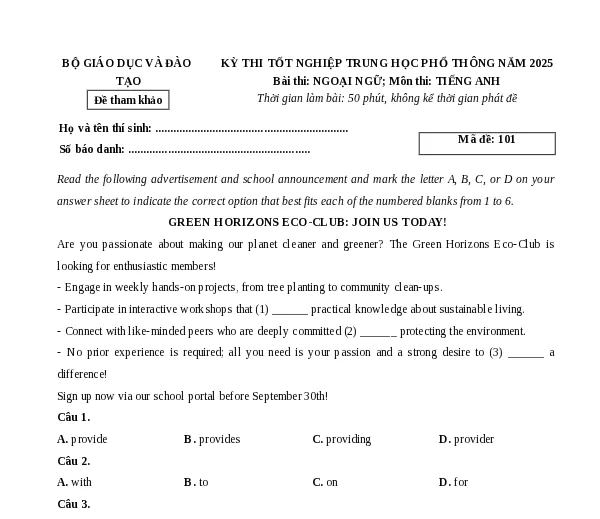
BỘ GIÁO DỤC VÀ ĐÀO TẠO
ĐỀ THI THAM KHẢO KỲ THI TỐT NGHIỆP THPT
Đề chính thức
BÀI THI: NGOẠI NGỮ; MÔN THI: TIẾNG ANH
ĐỀ SỐ 06 – NĂM HỌC 2025 – 2026
Thời gian làm bài: 50 phút, không kể thời gian phát đề
Họ và tên thí sinh: ................................................................ Số báo danh: ............................................................ | Mã đề: 106 |
Mark the letter A, B, C, or D on your answer sheet to indicate the correct option that best fits each of the numbered blanks from 1 to 6.
HUMANITARIAN CRISIS IN SUDAN: URGENT RELIEF APPEAL
The persistent El Niño phenomenon has triggered catastrophic climatic disruptions across East Africa. In Sudan, extreme droughts followed by flash floods have claimed the lives of hundreds of children and left millions facing acute hunger.
- Immediate action needed: The ongoing food shortage has put vulnerable infants at severe risk of (1) ______ malnutrition.
- Relief efforts: Aid agencies are striving to distribute emergency rations; however, continuous conflict and damaged roads severely (2) ______ delivery operations.
- Health hazards: Stagnant water and contaminated wells have resulted in a rapid (3) ______ of waterborne diseases.
- Call for solidarity: We earnestly call on the international community to (4) ______ vital financial support.
- Contact details: For donations and further information, please visit our official portal or contact our regional (5) ______ directly.
- Commitment: Every contribution, no matter how modest, can (6) ______ a profound difference to suffering families.
Câu 1.
A. lethal
B. lethally
C. lethality
D. lethalize
Câu 2.
A. promote
B. accelerate
C. hinder
D. facilitate
Câu 3.
A. outbreak
B. breakthrough
C. breakdown
D. breakout
Câu 4.
A. hold back
B. come forward with
C. look down on
D. run out of
Câu 5.
A. representative
B. representation
C. represent
D. representational
Câu 6.
A. do
B. take
C. make
D. give
Mark the letter A, B, C, or D on your answer sheet to indicate the correct option that best fits each of the numbered blanks from 7 to 12.
CLIMATE RESILIENCE: SAFEGUARDING OUR FOOD FUTURE
A recent report by climate experts highlights that our global agricultural networks remain remarkably fragile in the face of cyclical weather anomalies like El Niño. Here are critical measures being taken to build long-term resilience:
- Crop Diversification: Farmers are strongly encouraged to cultivate drought-resistant seed varieties. This approach ensures that (7) ______ single climatic hazard can completely wipe out an entire seasonal harvest.
- Water Management: Cutting-edge drip irrigation technologies help preserve water reserves (8) ______ the soil retains optimal moisture during prolonged dry spells.
- Policy Support: The UK Climate Ministry has warned that industrialized nations must assist developing countries in coping (9) ______ sudden supply disruptions.
- Early Warning Systems: Modern meteorological satellites provide farmers with (10) ______ predictive data, allowing timely sowing and harvesting.
- Financial Safety Nets: Micro-insurance schemes offer smallholders financial compensation, helping them quickly bounce (11) ______ after devastating droughts.
- Community Action: Sustainable agricultural practices must be adopted (12) ______ local scales to protect fragile rural ecosystems.
Câu 7.
A. no
B. every
C. many
D. another
Câu 8.
A. so that
B. although
C. in case of
D. because of
Câu 9.
A. to
B. with
C. on
D. about
Câu 10.
A. accurate
B. ambiguous
C. suspicious
D. deceptive
Câu 11.
A. off
B. back
C. down
D. over
Câu 12.
A. in
B. at
C. on
D. by
Mark the letter A, B, C, or D on your answer sheet to indicate the correct arrangement of the sentences to make a meaningful exchange or text in each of the following questions from 13 to 17.
Câu 13.
a. Mark: "Yes, I did. It warned that crop failures linked to El Niño could trigger widespread food inflation worldwide."
b. Mark: "Definitely. If governments don't invest in sustainable agriculture now, low-income households will suffer the most."
c. Sarah: "Did you catch the UK climate minister's speech on global food security this morning?"
d. Sarah: "That is terrifying. It seems our modern supply chains are far more fragile than we previously assumed."
A. c – a – d – b
B. c – d – a – b
C. a – c – d – b
D. d – c – a – b
Câu 14.
a. David: "That sounds alarming! What exactly causes this phenomenon?"
b. David: "I see. Does that mean we should expect more unpredictable storms and heatwaves this summer?"
c. Emma: "Scientists say that a strong El Niño event has officially developed in the Pacific Ocean."
d. Emma: "It happens when sea surface temperatures in the central and eastern Pacific become unusually warm, which disrupts global atmospheric circulation."
e. Emma: "Precisely, and meteorologists have already advised local authorities to prepare emergency measures."
A. c – d – a – b – e
B. c – a – d – b – e
C. a – c – d – e – b
D. c – b – a – d – e
Câu 15.
Dear Citizens,
a. Over the past few months, the intensifying El Niño pattern has severely depleted our regional reservoirs.
b. Therefore, we urge all households to implement water-saving techniques, such as repairing leaky pipes and limiting lawn watering.
c. Consequently, the municipal water authority must enforce mandatory consumption limits starting next Monday.
d. We sincerely appreciate your cooperation and civic responsibility during this critical climate emergency.
e. Unless collective conservation efforts are made immediately, emergency water rationing will become unavoidable.
Sincerely,
City Water Board
A. a – c – b – e – d
B. a – b – c – e – d
C. c – a – b – e – d
D. b – a – c – d – e
Câu 16.
a. Historically, super El Niño events have unleashed unprecedented humanitarian catastrophes across multiple continents.
b. In the late 19th century, for instance, synchronized crop failures induced by severe climatic shifts resulted in widespread famines that claimed tens of millions of lives.
c. Today, however, our sophisticated meteorological tools and global logistics networks provide us with the means to avert such catastrophic outcomes.
d. Understanding these historical events demonstrates that climate anomalies are not merely environmental curiosities, but potent threats to human civilization.
e. By establishing pre-emptive food reserves and drought insurance, modern societies can build effective shields against nature's volatility.
A. a – b – d – c – e
B. a – d – b – e – c
C. b – a – d – c – e
D. d – a – b – c – e
Câu 17.
a. In conflict-torn nations like Sudan, the destructive consequences of El Niño are exacerbated to an unprecedented degree.
b. As soaring temperatures scorch staple crops, existing humanitarian aid pipelines are overwhelmed by the sheer surge in malnutrition cases.
c. Compounding the crisis, damaged transportation links prevent essential medicine and dietary supplements from reaching remote clinics.
d. As a result, hundreds of innocent children have succumbed to preventable illnesses and extreme starvation.
e. Without an immediate ceasefire and unimpeded humanitarian corridors, the casualty toll will inevitably continue to escalate.
A. a – b – c – d – e
B. a – c – b – d – e
C. b – a – c – d – e
D. a – d – b – c – e
Mark the letter A, B, C, or D on your answer sheet to indicate the correct option that best fits each of the numbered blanks from 18 to 22.
The global food system is an intricate web of production, logistics, and retail that feeds over eight billion people. However, (18) ______. When an El Niño event occurs, the warming waters of the equatorial Pacific Ocean disrupt trade winds and trigger a cascade of extreme weather anomalies across the globe. Some agricultural regions experience unrelenting downpours and floods, (19) ______.
Major commodity crops such as rice, wheat, soy, and sugar cane are exceptionally sensitive to these abrupt meteorological swings. When primary producing countries experience simultaneous harvest contractions, (20) ______. The UK climate minister recently warned that industrialized nations are mistaken if they believe their wealth can completely shield them from these global shocks. In an interconnected economy, domestic supermarket prices quickly reflect crop failures occurring thousands of miles away.
To safeguard global food supplies against future climate variability, governments must fundamentally transform how agricultural commodities are produced and managed. First, international organizations need to create coordinated buffer stocks of vital grains (21) ______. Furthermore, investments must be channeled into regenerative farming techniques and drought-resilient genetic crops, (22) ______. Only through such proactive collaboration can the world hope to insulate vulnerable populations from recurring climate shocks.
Câu 18.
A. which is becoming increasingly fragile due to the destabilizing forces of cyclical weather phenomena
B. this interconnected system remains exceedingly vulnerable to the destabilizing forces of climate anomalies
C. having been severely threatened by unexpected environmental changes throughout history
D. that modern technologies have largely failed to protect against severe oceanic fluctuations
Câu 19.
A. whereas other critical agricultural basins are subjected to debilitating droughts
B. because dry weather conditions are observed throughout every hemisphere
C. so that farmers can harvest higher yields during the summer months
D. despite having received substantial amounts of precipitation in recent years
Câu 20.
A. international market prices inevitably surge, triggering acute food insecurity among lower-income nations
B. which causes local market traders to reduce food prices to stimulate consumer purchasing power
C. while global food reserves are rapidly replenished by non-agricultural businesses
D. leading to an unexpected surplus of essential grain supplies across developing economies
Câu 21.
A. so as to prevent speculation and stabilize market volatility during severe shortages
B. in order that farmers are prevented from selling their harvested produce abroad
C. although national governments are unwilling to allocate capital to food storage
D. because international grain markets rarely experience significant price swings
Câu 22.
A. that require extensive chemical inputs and huge quantities of fresh water
B. which are capable of thriving under fluctuating thermal and hydrologic regimes
C. whose yields are notoriously unpredictable under normal weather conditions
D. where traditional cultivation methods have completely replaced modern science
Read the following passage and mark the letter A, B, C, or D on your answer sheet to indicate the correct answer to each of the questions from 23 to 30.
The vulnerability of modern food architecture to climate shocks has emerged as one of the most pressing geopolitical concerns of the 21st century. Recently, the UK climate minister issued a stark warning: our global food system is dangerously ill-prepared to withstand the intensifying impacts of El Niño. While historical occurrences of this natural climate pattern have routinely perturbed regional weather, their collision with human-induced global warming threatens to unleash systemic disruption across the entire food supply chain.
The mechanics of this disruption are deceptively simple yet devastatingly pervasive. Key breadbasket regions across Southeast Asia, Southern Africa, and Latin America often bear the brunt of El Niño's erratic behavior. In countries like Vietnam and Thailand, severe dry spells shrivel paddy fields, depleting the global rice export quota. Meanwhile, heavy rains in South America can saturate fields, delaying the harvesting of soybeans and maize while degrading soil quality. Because our contemporary food apparatus operates on lean, "just-in-time" supply chains with minimal storage reserves, even a localized agricultural deficit reverberates internationally, sending commodity prices soaring.
Crucially, the repercussions of food inflation are never distributed equitably. While households in affluent nations may absorb supermarket price hikes by adjusting discretionary spending, families in developing countries spend upwards of fifty to sixty percent of their income on staple sustenance. For them, a ten percent increase in the cost of grain or cooking oil is not an inconvenience; it is a direct slide into poverty and chronic undernutrition.
Addressing this structural fragility demands more than reactive emergency aid. Experts urge a comprehensive overhaul of agricultural infrastructure. This includes scaling up investment in decentralized grain storage, deploying AI-driven meteorological forecasting for smallholders, and shifting subsidies away from water-intensive monocultures toward indigenous, climate-tolerant crops. Without sustained institutional commitments to these reforms, every major El Niño cycle will continue to extract a catastrophic toll on global human well-being.
Câu 23. Which of the following best serves as the title for the passage?
A. The Historical Origins of El Niño in the Pacific Ocean
B. Global Food Architecture Under Threat from Climate Volatility
C. Technological Breakthroughs in Modern Agricultural Machinery
D. Discretionary Spending Habits in Wealthy Industrialized Nations
Câu 24. The word perturbed in paragraph 1 is closest in meaning to ______.
A. stabilized
B. disturbed
C. examined
D. eliminated
Câu 25. According to paragraph 2, what happens to global food markets when primary agricultural regions suffer crop deficits?
A. Commodity prices surge because supply chains operate on minimal inventory reserves.
B. Wealthy nations immediately donate their domestic grain stocks to overseas markets.
C. Farmers in South America switch entirely to producing drought-resistant crops.
D. International trade routes are permanently closed to prevent food speculation.
Câu 26. The word them in paragraph 3 refers to ______.
A. households in affluent nations
B. families in developing countries
C. discretionary spending habits
D. modern food supply chains
Câu 27. The word overhaul in paragraph 4 is closest in meaning to ______.
A. complete restructuring
B. slight postponement
C. temporary cancellation
D. formal celebration
Câu 28. Which of the following is NOT stated in the passage as a proposed solution to food system fragility?
A. Expanding decentralized grain storage facilities.
B. Providing AI-driven meteorological forecasts to smallholder farmers.
C. Phasing out financial subsidies for water-intensive monocultures.
D. Imposing strict legal bans on all international grain exports.
Câu 29. Which of the following can be inferred from the passage?
A. Climate shocks exacerbate socioeconomic inequalities between rich and poor nations.
B. Just-in-time supply chains have proven to be the most resilient model during climate crises.
C. El Niño is an artificial meteorological event caused exclusively by modern carbon emissions.
D. Wealthy nations are completely insulated from the financial consequences of crop failures.
Câu 30. Which of the following best summarizes the main idea of paragraph 4?
A. Long-term systemic reforms are essential to fortify agricultural systems against El Niño.
B. Financial aid remains the sole viable tool for preventing famines in developing economies.
C. Traditional monoculture farming is the most cost-effective method to feed growing populations.
D. Meteorological forecasting has failed to provide reliable guidance to smallholder farmers.
Read the following passage and mark the letter A, B, C, or D on your answer sheet to indicate the correct answer to each of the questions from 31 to 40.
In the late nineteenth century, the world bore witness to one of the deadliest climate-induced tragedies in recorded human history. Between 1876 and 1878, an unprecedented "super El Niño" unleashed devastating, synchronized droughts across British-ruled India, northern China, northeastern Brazil, and parts of Africa. [I] Deprived of the annual monsoons, agricultural yields collapsed on a continental scale. Famines ensued, compounded by lethal epidemics of cholera and malaria, resulting in an estimated death toll exceeding thirty million people. [II] While the meteorological anomaly was natural, contemporary historians point out that the sheer magnitude of mortality was profoundly man-made. Imperial administrations insisted on exporting grain to international markets even as local populations starved, refusing to provide adequate relief under rigid laissez-faire economic dogmas.
Fast forward to the present era, and the phenomenon of El Niño remains an immensely powerful planetary force. [III] Driven by coupled ocean-atmosphere interactions in the tropical Pacific, a strong El Niño redistributes rainfall patterns globally, often drenching normally arid zones while parching lush rainforests. However, the vital question confronting modern civilization is not whether El Niño will strike again, but whether we possess the collective capacity to avoid a repeat of past devastation. [IV]
Fortunately, our scientific understanding and technological capabilities have advanced exponentially since the Victorian era. Today, a constellation of ocean buoys, deep-sea sensors, and Earth observation satellites can detect the nascent thermal signatures of an emerging El Niño months before atmospheric shifts materialize. This foresight affords governments a critical window of opportunity to implement anticipatory humanitarian action. Instead of deploying emergency relief after crops have already withered and children have fallen into acute wasting, aid agencies can disburse emergency cash grants to smallholders in advance, enabling them to purchase fodder, drought-tolerant seeds, or alternative water-harvesting tools.
Nonetheless, technology alone cannot serve as a panacea. The harrowing humanitarian situation in countries such as Sudan reminds us that climate shocks do not occur in an institutional vacuum. In Sudan, an El Niño-driven drought combined with intense military conflict has killed hundreds of vulnerable children, paralyzed agrarian livelihoods, and displaced millions of civilians. In such contexts, early warnings are virtually useless if frontline aid workers are denied humanitarian access and supply corridors are blockaded.
To definitively banish the specter of past famines, the international community must marry cutting-edge predictive science with proactive governance and political determination. Vulnerable states require debt relief and targeted climate adaptation financing to build resilient physical infrastructure, such as desalination plants, expansive irrigation networks, and decentralized food reserves. Furthermore, the global trade architecture must establish binding protocols to prevent panic-driven export bans during climate emergencies. The lethal famines of the 1870s stand as a grim historical indictment of negligence and fatalism; whether future El Niño events write a similar tragedy depends entirely on the choices we make today.
Câu 31. Where in the passage does the following sentence best fit?
"Consequently, vast swathes of fertile land were transformed into desolate dust bowls within mere months."
A. [I]
B. [II]
C. [III]
D. [IV]
Câu 32. The word ensued in paragraph 1 is closest in meaning to ______.
A. followed
B. vanished
C. delayed
D. improved
Câu 33. According to paragraph 1, what intensified the tragic mortality rate during the 1876–1878 famines?
A. The total absence of shipping vessels capable of transporting grain across oceans.
B. Imperial policies that continued food exports and withheld relief due to strict economic dogmas.
C. A simultaneous global ice age that rendered all agricultural land permanently infertile.
D. The complete refusal of farmers to plant crops despite favorable weather conditions.
Câu 34. The word nascent in paragraph 3 is closest in meaning to ______.
A. developing
B. permanent
C. decaying
D. invisible
Câu 35. The word them in paragraph 3 refers to ______.
A. satellites
B. smallholders
C. emergency cash grants
D. atmospheric shifts
Câu 36. Which of the following best paraphrases the underlined sentence in paragraph 4?
"Nonetheless, technology alone cannot serve as a panacea."
A. However, technological tools by themselves are incapable of solving all aspects of the crisis.
B. Therefore, technological developments should be completely discarded in humanitarian operations.
C. Nevertheless, relying on advanced machinery has always eliminated every environmental disaster.
D. On the contrary, technology is universally recognized as the sole remedy for climate challenges.
Câu 37. According to paragraph 4, why was early meteorological warning largely ineffective in Sudan?
A. Aid workers lacked access and transportation corridors were blocked by armed conflict.
B. The local population refused to accept international weather forecasts.
C. Modern ocean buoys and satellites failed to detect the warming of the Pacific.
D. Meteorological institutions failed to translate warnings into local languages.
Câu 38. Which of the following is NOT mentioned in paragraph 5 as an essential measure to prevent future famines?
A. Providing targeted climate adaptation financing to vulnerable countries.
B. Constructing resilient physical infrastructure such as irrigation networks.
C. Implementing binding trade protocols to prevent panic-driven export bans.
D. Permanently replacing all smallholder farms with multinational corporations.
Câu 39. Which of the following can be inferred from the passage as a whole?
A. Humanitarian catastrophes triggered by climate extremes are heavily shaped by human governance and policy.
B. Atmospheric scientists believe that El Niño events can be completely eradicated through cloud seeding.
C. Developing countries no longer require external financial assistance to survive prolonged droughts.
D. The famines of the 1870s were entirely inevitable and could not have been mitigated by human intervention.
Câu 40. Which of the following best summarizes the main message of the entire text?
A. Although El Niño is a recurring natural hazard, catastrophic human consequences can be prevented by pairing modern predictive science with proactive political and humanitarian action.
B. The Victorian famines proved that free-market capitalism is the most effective mechanism for distributing grain during severe droughts.
C. Advances in satellite technology have rendered human decision-making obsolete in preventing famine.
D. Political instability in developing nations makes all climate adaptation efforts completely futile.
--------- HẾT ---------
Họ và tên thí sinh: ................................................ Số báo danh: ........................
HƯỚNG DẪN CHẤM VÀ ĐÁP ÁN CHI TIẾT
ĐỀ THI THỬ TỐT NGHIỆP THPT SỐ 06 – MÔN TIẾNG ANH
A. BẢNG ĐÁP ÁN
Câu | Đ/án | Câu | Đ/án | Câu | Đ/án | Câu | Đ/án |
|---|---|---|---|---|---|---|---|
1 | A | 11 | B | 21 | A | 31 | A |
2 | C | 12 | B | 22 | B | 32 | A |
3 | A | 13 | A | 23 | B | 33 | B |
4 | B | 14 | B | 24 | B | 34 | A |
5 | A | 15 | A | 25 | A | 35 | B |
6 | C | 16 | A | 26 | B | 36 | A |
7 | A | 17 | A | 27 | A | 37 | A |
8 | A | 18 | B | 28 | D | 38 | D |
9 | B | 19 | A | 29 | A | 39 | A |
10 | A | 20 | A | 30 | A | 40 | A |
(Mỗi câu trả lời đúng được 0,25 điểm. Tổng điểm toàn bài: 10,0 điểm).
B. LỜI GIẢI CHI TIẾT VÀ CĂN CỨ KHOA HỌC
Câu | Đáp án | Giải thích chi tiết và Căn cứ |
|---|---|---|
1 | A | Kiến thức về từ loại: Trước danh từ "malnutrition" (suy dinh dưỡng) cần một tính từ bổ nghĩa. "Lethal" (adj) mang nghĩa gây chết người, chí mạng. Cụm từ "lethal malnutrition" nghĩa là suy dinh dưỡng nặng có nguy cơ tử vong cao. |
2 | C | Kiến thức về từ vựng: Xét ngữ cảnh "conflict and damaged roads" (xung đột và đường sá hư hỏng), động từ mang nghĩa tiêu cực là "hinder" (cản trở, gây khó khăn cho việc vận chuyển cứu trợ). Các từ khác: promote (thúc đẩy), accelerate (tăng tốc), facilitate (tạo điều kiện). |
3 | A | Cụm từ cố định (Collocation): "Outbreak of diseases" có nghĩa là sự bùng phát dịch bệnh. Các từ còn lại: breakthrough (đột phá), breakdown (sự hỏng hóc/suy sụp), breakout (vượt ngục/trốn thoát). |
4 | B | Cụm động từ (Phrasal verb): "Come forward with something" có nghĩa là xung phong, chủ động đưa ra/đóng góp (hỗ trợ tài chính). Các từ khác: hold back (kìm nén/giữ lại), look down on (khinh thường), run out of (hết sạch). |
5 | A | Kiến thức về từ loại: Sau tính từ "regional" cần một danh từ chỉ người đảm nhiệm liên lạc: "representative" (đại diện, người đại diện). Representation (sự đại diện), represent (động từ). |
6 | C | Cụm từ cố định (Collocation): "Make a difference" là thành ngữ có nghĩa là tạo nên sự khác biệt, mang lại điều tích cực. Không dùng do/take/give a difference. |
7 | A | Lượng từ / Từ hạn định: Cấu trúc phủ định với "no + singular noun" mang nghĩa không một... nào: "ensures that no single climatic hazard can completely wipe out..." (đảm bảo không một mối nguy khí hậu đơn lẻ nào có thể xóa sổ hoàn toàn vụ mùa). |
8 | A | Liên từ chỉ mục đích: "So that + clause" (để mà) dùng để chỉ mục đích lưu giữ độ ẩm tối ưu trong đất. In case of và because of đi với cụm danh từ. |
9 | B | Giới từ đi với động từ: "Cope with something" có nghĩa là đương đầu, đối phó với điều gì (sự gián đoạn nguồn cung). |
10 | A | Kiến thức về từ vựng: "Accurate predictive data" (dữ liệu dự báo chính xác). Các từ mang nghĩa tiêu cực không phù hợp: ambiguous (mơ hồ), suspicious (khả nghi), deceptive (lừa dối). |
11 | B | Cụm động từ: "Bounce back" có nghĩa là phục hồi nhanh chóng sau biến cố/khó khăn. |
12 | B | Cụm giới từ: Đi với danh từ "scales" dùng giới từ "at": "at local scales" (ở quy mô địa phương). |
13 | A | Sắp xếp đoạn hội thoại: c mở đầu bằng câu hỏi về bài phát biểu của bộ trưởng khí hậu -> a trả lời "Yes, I did" và tóm tắt nội dung -> d bày tỏ sự lo lắng trước tính dễ tổn thương của chuỗi cung ứng -> b tán đồng ("Definitely") và nhấn mạnh giải pháp. Thứ tự: c – a – d – b. |
14 | B | Sắp xếp đoạn hội thoại: c thông báo về hiện tượng El Niño -> a hỏi nguyên nhân -> d giải thích cơ chế nước biển ấm lên -> b hỏi về hậu quả sắp tới -> e khẳng định và nhắc nhở biện pháp ứng phó. Thứ tự: c – a – d – b – e. |
15 | A | Sắp xếp thư thông báo: a nêu thực trạng El Niño làm cạn hồ chứa nước -> c đưa ra hệ quả trực tiếp là áp dụng hạn mức sử dụng từ thứ Hai -> b kêu gọi thực hiện các biện pháp tiết kiệm cụ thể -> e cảnh báo hậu quả nếu không hợp tác -> d lời cảm ơn kết thư. Thứ tự: a – c – b – e – d. |
16 | A | Sắp xếp đoạn văn: a giới thiệu thảm họa El Niño trong lịch sử -> b đưa dẫn chứng vụ đói cuối thế kỷ 19 -> d rút ra nhận định lịch sử về nguy cơ khí hậu -> c chuyển ý sang năng lực hiện đại ("Today, however...") -> e kết luận về các giải pháp bảo vệ chủ động. Thứ tự: a – b – d – c – e. |
17 | A | Sắp xếp đoạn văn: a mở đầu về tác động khốc liệt của El Niño ở Sudan -> b phân tích hạn hán làm mất mùa và quá tải cứu trợ -> c bổ sung nguyên nhân giao thông bị phá hủy ("Compounding the crisis...") -> d nêu hậu quả đau lòng là hàng trăm trẻ em tử vong -> e kết luận về sự cần thiết của lệnh ngừng bắn. Thứ tự: a – b – c – d – e. |
18 | B | Điền câu vào văn bản: Sau "However," cần một mệnh đề chính hoàn chỉnh phản đề lại sự rộng lớn của hệ thống lương thực. Câu B cung cấp chủ ngữ "this interconnected system" và vị ngữ rõ ràng, hòa hợp nghĩa với câu tiếp theo về El Niño. |
19 | A | Mệnh đề đối lập: Vế trước mô tả mưa lớn ngập lụt ("downpours and floods"), nên vế sau dùng liên từ "whereas" để đối lập với hạn hán làm suy kiệt các vựa lúa khác ("whereas other critical agricultural basins are subjected to debilitating droughts"). |
20 | A | Mệnh đề kết quả: Khi các quốc gia sản xuất chính bị mất mùa đồng loạt, giá thị trường quốc tế tất yếu sẽ tăng vọt ("prices inevitably surge"), gây mất an ninh lương thực cho các nước thu nhập thấp. |
21 | A | Cụm từ chỉ mục đích: Việc lập kho dự trữ lương thực điều phối nhằm mục đích ngăn chặn đầu cơ và ổn định biến động giá ("so as to prevent speculation and stabilize market volatility"). |
22 | B | Mệnh đề quan hệ: Đại từ "which" thay thế cho "regenerative farming techniques and drought-resilient genetic crops", bổ nghĩa rằng chúng có khả năng phát triển tốt trong điều kiện nhiệt độ và thủy văn biến động. |
23 | B | Tiêu đề bài đọc: Đoạn văn tập trung phân tích sự mỏng manh của hệ thống lương thực toàn cầu trước các cú sốc khí hậu (El Niño) và các giải pháp cấp bách. Tiêu đề B phản ánh chuẩn xác nhất nội dung bao quát. |
24 | B | Từ đồng nghĩa trong ngữ cảnh: "Perturbed" nghĩa là làm xáo trộn, gây nhiễu loạn, đồng nghĩa với "disturbed". Stabilized (ổn định hóa), examined (khảo sát), eliminated (loại bỏ). |
25 | A | Thông tin chi tiết: Căn cứ câu cuối đoạn 2: "Because our contemporary food apparatus operates on lean, 'just-in-time' supply chains with minimal storage reserves, even a localized agricultural deficit reverberates internationally, sending commodity prices soaring." |
26 | B | Quy chiếu đại từ: Đoạn 3 so sánh: "families in developing countries spend upwards of fifty to sixty percent of their income on staple sustenance. For them, a ten percent increase in the cost of grain... is a direct slide into poverty". Do đó "them" chỉ "families in developing countries". |
27 | A | Từ đồng nghĩa: "Overhaul" có nghĩa là sự cải tổ toàn diện, tái cấu trúc (complete restructuring). |
28 | D | Câu hỏi phủ định (NOT): Đoạn 4 liệt kê: mở rộng kho lương thực phân tán (A), áp dụng dự báo thời tiết AI (B), chuyển dịch trợ cấp khỏi độc canh ngốn nước (C). Bài viết KHÔNG hề đề xuất cấm hoàn toàn xuất khẩu ngũ cốc (D). |
29 | A | Suy luận: Đoạn 3 chỉ ra các nước giàu có thể chịu đựng lạm phát thực phẩm, trong khi người nghèo ở nước đang phát triển bị đẩy vào nạn đói. Điều này suy ra cú sốc khí hậu khoét sâu thêm bất bình đẳng kinh tế - xã hội giữa các quốc gia. |
30 | A | Tóm tắt đoạn văn: Đoạn 4 khẳng định việc giải quyết vấn đề đòi hỏi nhiều hơn là cứu trợ khẩn cấp, mà cần cải cách cơ sở hạ tầng nông nghiệp lâu dài, có hệ thống. |
31 | A | Chèn câu vào văn bản: Câu cần chèn "Consequently, vast swathes of fertile land were transformed into desolate dust bowls within mere months" giải thích hệ quả trực tiếp của việc "Deprived of the annual monsoons" (Mất gió mùa hàng năm) ở vị trí [I]. |
32 | A | Từ đồng nghĩa: "Ensuing" / "ensued" mang nghĩa xảy ra sau đó, theo sau (followed as a result). |
33 | B | Thông tin chi tiết: Căn cứ câu cuối đoạn 1: "Imperial administrations insisted on exporting grain to international markets even as local populations starved, refusing to provide adequate relief under rigid laissez-faire economic dogmas." |
34 | A | Từ đồng nghĩa: "Nascent" có nghĩa là mới xuất hiện, đang hình thành/phát triển (developing/emerging). |
35 | B | Quy chiếu đại từ: Căn cứ đoạn 3: "...disburse emergency cash grants to smallholders in advance, enabling them to purchase fodder, drought-tolerant seeds...". "Them" chỉ các nông hộ nhỏ (smallholders). |
36 | A | Diễn giải câu (Paraphrase): "technology alone cannot serve as a panacea" = công nghệ đơn thuần không thể là phương thuốc vạn năng chữa bách bệnh. Tương đương với phương án A: công nghệ không thể tự mình giải quyết mọi khía cạnh của cuộc khủng hoảng. |
37 | A | Thông tin chi tiết: Căn cứ câu cuối đoạn 4: "...early warnings are virtually useless if frontline aid workers are denied humanitarian access and supply corridors are blockaded." |
38 | D | Câu hỏi tìm ý không có trong bài: Đoạn 5 nhắc tới tài trợ thích ứng (A), xây dựng hạ tầng thủy lợi và kho lương thực (B), quy tắc thương mại chống cấm xuất khẩu (C). Hoàn toàn không đề cập việc thay thế nông hộ bằng tập đoàn đa quốc gia (D). |
39 | A | Suy luận toàn bài: Bài đọc xuyên suốt nhấn mạnh rằng thảm họa nhân đạo do khí hậu bắt nguồn từ cả hiện tượng tự nhiên lẫn chính sách quản trị của con người (như chính sách bóc lột thời thuộc địa hay xung đột quân sự cản trở cứu trợ ở Sudan). |
40 | A | Chủ đề chính toàn bài: Dù El Niño là thiên tai tuần hoàn, việc kết hợp khoa học dự báo tiên tiến với hành động chính trị và nhân đạo chủ động có thể ngăn chặn thảm họa tái diễn trong tương lai. |