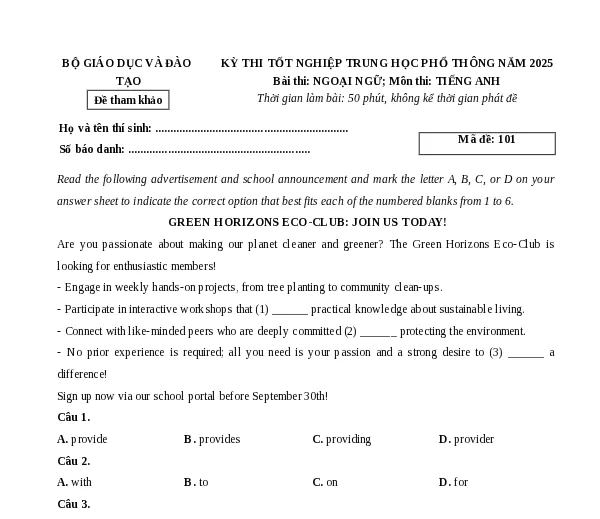
BỘ GIÁO DỤC VÀ ĐÀO TẠO
Đề tham khảo
(Đề thi có 03 trang)
KỲ THI TỐT NGHIỆP TRUNG HỌC PHỔ THÔNG
Bài thi: NGOẠI NGỮ; Môn thi: TIẾNG ANH
Thời gian làm bài: 50 phút, không kể thời gian phát đề
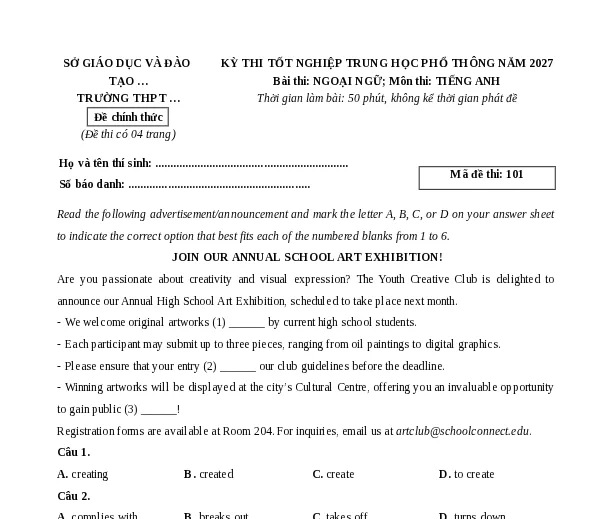
Read the following advertisement and mark the letter A, B, C or D on your answer sheet to indicate the option that best fits each of the numbered blanks from 1 to 6.
Living Green, Living Beautiful: Pioneers of the Sustainable Era
- Environmentally revolutionary thinking reshapes our future dramatically. (1)______ transforms urban landscapes effortlessly.
- Products (2)______ from recycled materials help preserve our natural resources. We offer customers exceptional value (3)______ their eco-conscious investments.
- Out of the (4)______, nature provides perfect solutions to our most complex problems. Our mission involves transforming how people interact with their environment.
- Discover the art of conscious living with our Terra Nova collection. Where others see limitations, we envision possibilities—turning yesterday's waste into tomorrow's treasures.
- Join the movement that's redefining (5)______ through planetary stewardship. Because when you choose our products, you're not just making a purchase—you're casting a vote for the world you wish (6)______.
Question 1:
A. Bamboo cutting-edge architecture
B. Cutting-edge bamboo architecture
C. Architecture cutting-edge bamboo
D. Cutting-edge architecture bamboo
Question 2:
A. was made
B. made
C. making
D. which made
Question 3:
A. for
B. to
C. with
D. at
Question 4:
A. green
B. red
C. purple
D. blue
Question 5:
A. prosper
B. prosperous
C. prosperity
D. prosperously
Question 6:
A. to see
B. seeing
C. to seeing
D. see
Read the following leaflet and mark the letter A, B, C or D on your answer sheet to indicate the option that best fits each of the numbered blanks from 7 to 12.
Beyond Borders: Your Invitation to Tomorrow's World
- Join us for an extraordinary global conference where visionaries from around the world gather to share ideas!
- Five countries will present their innovations first, while (7)______ will showcase their projects on the second day. We encourage participants to (8)______ global trends before attending the conference.
- The conference provides an (9)______ for meaningful connections between diverse communities. (10)______ geographical distances, we can create a unified global community.
- Your participation will contribute to the (11)______ of international cooperation. We welcome (12)______ of innovative ideas from all participants.
- Event Details:
- Date: September 15-17, 2023
- Location: International Convention Center
- Registration: www.beyondborders2023.com
- Don't miss this chance to be part of a global movement shaping our collective future!
- Register today and step into tomorrow's world.
Question 7:
A. another
B. other
C. others
D. the others
Question 8:
A. come up with
B. brush up on
C. look down on
D. cut back on
Question 9:
A. arrangement
B. establishment
C. opportunity
D. infrastructure
Question 10:
A. On account of
B. In advance of
C. In spite of
D. As compared with
Question 11:
A. advancement
B. development
C. enhancement
D. progression
Question 12:
A. a lot
B. some
C. a number
D. plenty
Mark the letter A, B, C or D on your answer sheet to indicate the best arrangement of utterances or sentences to make a meaningful exchange or text in each of the following questions from 13 to 17.
Question 13:
a. Tom: I was inside because I had to look after my little brother, and he wanted to play video games all day.
b. Sarah: Don't worry about missing it since I took plenty of photos, and I can show them to you when we meet tomorrow.
c. Sarah: Hey Tom, Did you see the rainbow outside, or were you inside all afternoon?
A. a-b-c
B. c-a-b
C. b-c-a
D. a-c-b
Question 14:
a. Lisa: I like this park because it has many beautiful flowers, and the trees are very tall.
b. Mike: Me too, but I think the playground is the best part, and my little sister loves the swings.
c. Lisa: We can sit on that bench over there, or we can walk around the lake if you want.
d. Mike: I'm a bit tired, so I prefer to sit down, and we can watch the ducks on the water.
e. Lisa: That sounds good, and I have some bread in my bag, so we can feed the ducks too.
A. a-b-c-d-e
B. a-e-b-c-d
C. d-a-c-b-e
D. c-d-e-b-a
Question 15:
Dear Sam,
a. When I listen to this music, which combines piano and electronic beats, I feel very happy.
b. If you have time this weekend, we can listen to these songs together at my house.
c. My teacher, who knows a lot about music, says that modern songs don't follow old rules.
d. I am writing because I want to tell you about the new music that I found online.
e. Although it sounds strange, I really like it when the songs mix different styles together.
Your friend,
LK
A. c-a-e-d-b
B. e-b-a-d-c
C. d-e-c-a-b
D. a-e-c-d-b
Question 16:
a. Although rivers look clean, they sometimes have chemicals that come from farms where farmers grow food.
b. Pollution is a big problem that affects many places where people live.
c. People who live near busy roads get more pollution because many cars drive past their homes all day.
d. When factories make things, they often release smoke that goes into the air which we breathe every day.
e. If we want to stay healthy, we should learn about the pollution in our area so that we can protect ourselves.
A. c-a-d-b-e
B. a-b-d-c-e
C. a-b-c-d-e
D. b-d-c-a-e
Question 17:
a. Some workers who have meetings online must find quiet places where babies cannot make noise.
b. If you work from home, you should make a schedule that helps you know when to work and when to spend time with family.
c. When parents work on computers, their children who want to play sometimes come into the room.
d. Many people now work from home where they can see their families all day.
e. Although working from home is nice, it can be hard because work time and family time mix together.
A. d-b-a-e-c
B. d-c-e-a-b
C. d-e-c-a-b
D. d-a-b-c-e
Read the following passage about When World Cultures Converge and mark the letter A, B, C or D on your answer sheet to indicate the option that best fits each of the numbered blanks from 18 to 22.
Street festivals have become increasingly popular in recent years, and by 2025, they will have transformed into global cultural celebrations. These colorful events bring together people from different backgrounds who share their unique traditions through food, music, and art. In many cities around the world, (18)______.
The organizers of these festivals, (19)______, deserve special recognition for their efforts. Not only do they coordinate hundreds of vendors and performers, but they also ensure everyone's safety. If the weather had been better last summer, the Bangkok Street Festival would have attracted even more visitors from neighboring countries. The food stalls at these festivals offer delicious dishes; (20)______.
Traditional dances are performed by skilled artists; furthermore, visitors are often invited to join in and learn the basic steps. Having seen the positive impact of these festivals on tourism and local economies, (21)______. The decorations for next year's festival are being designed by international artists who specialize in sustainable materials.
Children especially enjoy these cultural gatherings where they can learn about different countries while having fun. (22)______; virtual reality booths allow visitors to experience faraway places without leaving the festival grounds.
Question 18:
A. museums are opened to visitors which display traditional costumes from participating countries
B. restaurants are decorated with flags who represent different cultural traditions at the event
C. having prepared special menus, local chefs can introduce foreign cuisines to attendees
D. streets are closed to traffic so that festival-goers can enjoy performances and activities
Question 19:
A. who work tirelessly throughout the year
B. worked hardly since last month
C. which will organize next summer events
D. had completed previous festivals
Question 20:
A. however, they restrict access to certain dishes from specific regions
B. therefore, they charge extra fees for sampling international recipes
C. moreover, they provide a taste of authentic cuisine from around the world
D. meanwhile, they limit portions to prevent waste of expensive ingredients
Question 21:
A. seeing potential protests, city officials often cancel international cultural festivals
B. many city governments now provide financial support for these cultural events
C. having banned street vendors, local authorities restrict access to cultural displays
D. worried about security issues, police departments limit attendance at these gatherings
Question 22:
A. Religion is often causing conflicts during international cultural gatherings
B. Politics has always dominated discussions at these cultural exchanges
C. Security is frequently preventing foreigners from joining local activities
D. Technology is also playing an important role in modern street festivals
Read the following passage about From Multicultural Classrooms to Responsible Global Citizens and mark the letter A, B, C or D on your answer sheet to indicate the best answer to each of the following questions from 23 to 30.
In today's interconnected world, multicultural classrooms have become increasingly common in educational institutions worldwide. These diverse environments, where students from different backgrounds study together, provide unique opportunities for cultural exchange. Teachers must adapt their methods to accommodate various learning styles and perspectives. Moreover, they need to create inclusive spaces where all students feel valued regardless of origins. This approach helps young learners develop empathy and appreciation for cultural differences from an early age.
The transition from multicultural education to global citizenship requires deliberate effort from educators and students. Schools organize international events, exchange programs, and projects to foster cross-cultural communication skills. These activities enable students to work with peers from different backgrounds while tackling global challenges. Additionally, incorporating global issues into the curriculum helps students understand the interconnectedness of our world. By engaging with real-world problems, students develop critical thinking abilities and become more socially conscious.
Technology plays a vital role in connecting multicultural classrooms to the wider world. Digital platforms facilitate virtual exchanges between schools, allowing students to interact with diverse peers they might never meet. These collaborations break down geographical barriers and expose learners to different perspectives on global issues. Access to international resources enables students to explore various cultures independently. However, educators must guide students in evaluating online information to avoid reinforcing stereotypes about other cultures.
The ultimate goal of multicultural education is to nurture responsible global citizens who can navigate our diverse world with respect. When students graduate, they carry valuable skills that prepare them for international workplaces and communities. Research indicates that individuals with multicultural experiences demonstrate greater creativity and problem-solving capabilities. Most importantly, these global citizens contribute to creating a more peaceful world by challenging prejudice and promoting inclusive practices. This transformation represents one of education's most significant contributions to society.
Question 23: Which of the following is NOT mentioned as a benefit of multicultural education?
A. Development of empathy
B. Enhanced creativity
C. Improved academic performance
D. Better problem-solving capabilities
Question 24: The word “unique” in paragraph 1 is OPPOSITE in meaning to ______.
A. common
B. special
C. unusual
D. distinctive
Question 25: The word “tackling” in paragraph 2 could be best replaced by ______.
A. avoiding
B. addressing
C. creating
D. discussing
Question 26: The word “they” in paragraph 3 refers to ______.
A. digital platforms
B. virtual exchanges
C. students
D. schools
Question 27: Which of the following best paraphrases the underlined sentence in paragraph 4?
A. Multicultural learning aims to develop respectful individuals who can effectively function in our global society.
B. The primary purpose of global education is creating students who appreciate cultural diversity in modern times.
C. Educational diversity teaches young people to respect differences while traveling across various countries.
D. Schools with international focus help students learn about cultures to improve their future job prospects.
Question 28: Which of the following is TRUE according to the passage?
A. All educational institutions have fully implemented multicultural teaching approaches in their classrooms.
B. Students with multicultural experiences develop enhanced creativity and problem-solving abilities.
C. Technology is the primary factor that determines the success of global citizenship education programs.
D. Virtual exchanges have completely replaced traditional in-person international learning experiences.
Question 29: In which paragraph does the writer mention the benefits of diverse learning environments for developing cultural awareness?
A. Paragraph 4
B. Paragraph 3
C. Paragraph 2
D. Paragraph 1
Question 30: In which paragraph does the writer mention how technology connects students across cultural boundaries?
A. Paragraph 1
B. Paragraph 2
C. Paragraph 3
D. Paragraph 4
Read the following passage about the Ancient Wisdom for Modern Sustainability and mark the letter A, B, C or D on your answer sheet to indicate the best answer to each of the following questions from 31 to 40.
Indigenous knowledge systems have stood the test of time, offering valuable insights for addressing environmental challenges. For centuries, indigenous communities have known which way the wind blows when it comes to maintaining balance with nature, developing sustainable practices rooted in cultural traditions. These approaches to agriculture, resource management, and conservation reflect understanding of local ecosystems. Unlike modern scientific methods that isolate variables, indigenous knowledge takes a holistic view, recognizing the interconnectedness of living beings. This integrated perspective offers valuable lessons for sustainability efforts seeking to repair our damaged relationship with nature.
The practical applications of indigenous knowledge in sustainability are increasingly recognized by scientists worldwide. [I] Traditional farming techniques, such as intercropping and natural pest management, provide alternatives to chemical agriculture. [II] Indigenous fire management practices in Australia and North America have proven effective in preventing wildfires. [III] Additionally, traditional medicinal knowledge has contributed to pharmaceutical developments, with 25% of modern medicines derived from plants used by indigenous healers. [IV]
Integrating indigenous wisdom with modern science presents opportunities and challenges. When respectfully incorporated, traditional knowledge can enhance research by providing insights developed over generations. Indigenous weather prediction methods often complement meteorological data in climate adaptation. However, this integration must avoid appropriation and ensure communities maintain control over their intellectual heritage. Collaborative research models that recognize indigenous peoples as equal partners are essential. These partnerships must acknowledge spiritual dimensions embedded in indigenous knowledge systems, which conventional science typically overlooks.
The future of sustainable development depends on bridging indigenous wisdom with modern innovation. Educational institutions are beginning to incorporate indigenous perspectives into environmental curricula, teaching students to value diverse knowledge. International organizations increasingly recognize indigenous rights to land as fundamental to cultural and environmental protection. By honoring indigenous knowledge while addressing modern challenges, we can develop resilient sustainability solutions. This balanced approach represents our hope for creating a future where human activities support rather than undermine natural systems upon which life depends.
Question 31: The phrase “way the wind blows” in paragraph 1 could be best replaced by ______.
A. figured out
B. tuned in
C. picked up
D. caught on
Question 32: The word “our” in paragraph 1 refers to ______.
A. indigenous communities only
B. scientists and researchers
C. sustainability experts
D. humanity as a whole
Question 33: Where in paragraph 2 does the following sentence best fit?
Despite this value, indigenous knowledge faces threats from globalization and deforestation, making preservation an urgent priority.
A. [I]
B. [II]
C. [III]
D. [IV]
Question 34: Which of the following is NOT mentioned as an application of indigenous knowledge?
A. Traditional farming techniques like intercropping
B. Fire management practices in Australia and North America
C. Urban planning and architecture design
D. Weather prediction methods for climate adaptation
Question 35: Which of the following best summarises paragraph 3?
A. Indigenous knowledge systems contain spiritual elements that modern science fails to recognize, creating barriers to effective integration despite potential benefits in climate research.
B. Successful integration of indigenous wisdom with scientific methods requires equal partnerships that respect cultural ownership while acknowledging both practical and spiritual dimensions.
C. Weather prediction techniques from indigenous communities provide valuable data for climate adaptation, though scientists must overcome challenges in methodology to utilize them effectively.
D. Traditional knowledge enhances scientific research through generational insights, but researchers must develop new frameworks to translate indigenous concepts into measurable variables.
Question 36: The word “appropriation” in paragraph 3 is OPPOSITE in meaning to ______.
A. adaptation
B. borrowing
C. theft
D. recognition
Question 37: Which of the following best paraphrases the underlined sentence in paragraph 4?
A. Sustainable progress requires combining traditional knowledge with contemporary technological advancements to create effective solutions.
B. Modern innovation must be guided by indigenous wisdom if we hope to achieve any meaningful sustainable development in coming decades.
C. Indigenous communities and modern scientists should collaborate equally to address environmental challenges facing our shared future.
D. Future generations will benefit most when ancient practices are updated with scientific methods to improve their effectiveness.
Question 38: Which of the following is TRUE according to the passage?
A. Indigenous knowledge systems are being rapidly integrated into mainstream education with widespread acceptance across all scientific disciplines.
B. Traditional medicinal practices have contributed to approximately twenty-five percent of modern pharmaceutical developments derived from plant sources.
C. The spiritual dimensions of indigenous knowledge are readily accepted by conventional scientists as they complement existing meteorological research methods.
D. Collaborative research models between indigenous communities and scientists have eliminated concerns about intellectual property appropriation globally.
Question 39: Which of the following can be inferred from the passage?
A. Modern scientific approaches have largely failed to produce sustainable solutions due to their fundamental methodological limitations in addressing complex ecosystems.
B. Educational institutions worldwide are rapidly replacing traditional scientific curricula with indigenous knowledge systems to address environmental challenges.
C. Indigenous communities have historically maintained more sustainable relationships with natural environments than societies relying on conventional scientific methods.
D. International organizations primarily support indigenous land rights to preserve medicinal plants that could yield profitable pharmaceutical developments.
Question 40: Which of the following best summarises the passage?
A. Indigenous wisdom complements scientific approaches to sustainability when respectfully integrated, offering holistic solutions to environmental challenges through balanced partnerships.
B. Traditional ecological practices developed by indigenous communities provide valuable insights for environmental protection that should be preserved through international policy and education.
C. Educational institutions must incorporate indigenous perspectives into environmental curricula to address the fundamental flaws in conventional scientific methodologies and research.
D. Indigenous knowledge systems offer sustainable alternatives to modern agriculture and medicine, though they face extinction due to globalization and deforestation despite their proven effectiveness.
--------- HẾT ---------
Họ và tên thí sinh: ................................................................ Số báo danh: ........................