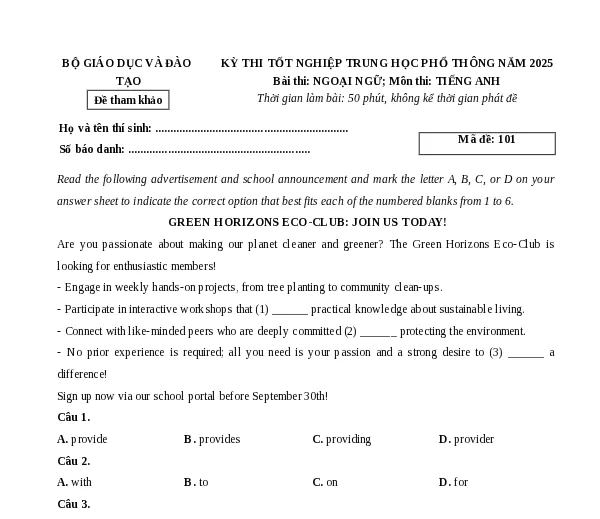
BỘ GIÁO DỤC VÀ ĐÀO TẠO
Đề chính thức
KỲ THI TỐT NGHIỆP TRUNG HỌC PHỔ THÔNG NĂM 2025
Môn thi: TIẾNG ANH
Thời gian làm bài: 50 phút, không kể thời gian phát đề
Họ và tên thí sinh: ................................................................ Số báo danh: ............................................................ | Mã đề: 101 |
ĐỀ SỐ 01 - TEST 1 (UNIT 1 + UNIT 2)
Read the following advertisement and announcement and mark the letter A, B, C or D on your answer sheet to indicate the correct option that best fits each of the numbered blanks from 1 to 6.
CELEBRATING CULTURAL DIVERSITY FESTIVAL
Join us for an exciting weekend to celebrate multicultural traditions and connect with our global community!
- Date & Time: Saturday, October 18th, from 9:00 a.m. to 6:00 p.m.
- Venue: Youth Cultural House, District 1.
- Immerse yourself in (1) ______ vibrant atmosphere of international cuisine, traditional costumes, and folk music.
- Discover how people from diverse backgrounds maintain their cultural (2) ______ while integrating into modern society.
- Don't miss the cooking workshop where you can learn to prepare authentic dishes and bond (3) ______ fellow food enthusiasts.
Admission is free! Register before Wednesday at: www.culturalfest2025.org.
Câu 1 (0,25 điểm).
A. a
B. the
C. an
D. Ø (no article)
Câu 2 (0,25 điểm).
A. identity
B. account
C. biography
D. barrier
Câu 3 (0,25 điểm).
A. at
B. to
C. over
D. for
ANNOUNCEMENT: GUEST TALK ON INSPIRING HISTORICAL FIGURES
The School History Club is pleased to announce an upcoming talk show on great leaders and cultural bridge-builders:
- Speaker: Dr. Le Manh Cuong (Faculty of History and Cultural Studies).
- Topic: From National Struggle to Global Cultural Exchange.
- Students will have an opportunity to listen to (4) ______ accounts of heroes who devoted their entire lives to liberating their nation.
- The speaker will also share how these leaders embraced foreign languages and international traditions during their (5) ______ abroad.
- All attendees (6) ______ to arrive at Room 402 at least 15 minutes before the talk commences.
For further information, please contact the club president via [email protected].
Câu 4 (0,25 điểm).
A. inspire
B. inspiration
C. inspiring
D. inspirationally
Câu 5 (0,25 điểm).
A. youth
B. marriage
C. death
D. genius
Câu 6 (0,25 điểm).
A. were requiring
B. require
C. are required
D. required
Read the following leaflet and mark the letter A, B, C or D on your answer sheet to indicate the option that best fits each of the numbered blanks from 7 to 12.
LIVING IN A MULTICULTURAL SOCIETY: EMBRACING DIFFERENCES
Living in a diverse community offers wonderful opportunities to broaden our worldview and learn from different lifestyles. Here is how you can thrive in a multicultural environment:
- Appreciate Culinary Diversity: Food is one of the easiest ways to explore a new culture. Trying ethnic specialties helps you develop (7) ______ deeper respect for culinary heritage.
- Respect Local Customs and Taboos: When interacting with neighbours from different ethnic backgrounds, remember that body language and gestures may carry different meanings. Making an effort to understand these customs helps overcome cultural (8) ______.
- Active Listening and Open-mindedness: You do not have to give up your own cultural roots; (9) ______, understanding others allows you to appreciate your own heritage more deeply.
- Community Volunteering: Join local events and help (10) ______ charitable projects. People often bond quickly when they work together toward a common cause.
- Learn from Life Stories: Read (11) ______ of visionary leaders who dedicated their youth to promoting international peace and mutual understanding.
- Continuous Learning: Always show kindness and remain devoted (12) ______ harmony and equality in your daily interactions.
Câu 7 (0,25 điểm).
A. the
B. a
C. an
D. Ø (no article)
Câu 8 (0,25 điểm).
A. barriers
B. accounts
C. geniuses
D. phonographs
Câu 9 (0,25 điểm).
A. otherwise
B. therefore
C. however
D. instead
Câu 10 (0,25 điểm).
A. drop out
B. carry out
C. pass away
D. resign from
Câu 11 (0,25 điểm).
A. biographies
B. biological
C. biographers
D. biographically
Câu 12 (0,25 điểm).
A. foster
B. to fostering
C. to foster
D. for fostering
Mark the letter A, B, C or D on your answer sheet to indicate the best arrangement of utterances or sentences to make a cohesive and coherent exchange or text in each of the following questions from 13 to 17.
Câu 13 (0,25 điểm).
a. Phong: I am reading a biography of General Vo Nguyen Giap, one of the greatest military geniuses in history.
b. Phong: It really inspired me because he showed incredible determination and strategic vision during the resistance war.
c. Nam: What book are you reading in the library, Phong?
A. c - a - b
B. a - b - c
C. c - b - a
D. b - c - a
Câu 14 (0,25 điểm).
a. Lan: Have you decided which traditional dish you will prepare for the International Culture Day?
b. Minh: Yes, my group is making Italian pasta and Vietnamese spring rolls to represent a blend of culinary cultures.
c. Lan: That sounds delicious! Mixing different gastronomic traditions is a great way to celebrate diversity.
d. Minh: Exactly, and we also prepared a poster explaining the cultural meaning behind each ingredient.
e. Lan: Wonderful! I am sure everyone will visit your stall to taste the food and learn something new.
A. a - b - c - d - e
B. b - a - c - d - e
C. a - c - b - e - d
D. c - a - b - d - e
Câu 15 (0,25 điểm).
a. Dear Minh, I am writing to invite you to our school's upcoming Multicultural Fair this Saturday morning.
b. There will be various booths representing cuisines, folk games, and traditional costumes from over ten countries.
c. In addition, our class is presenting a short play about famous historical figures who built bridges between Eastern and Western cultures.
d. Please let me know if you can make it by Friday so that I can arrange our guest badges.
e. Warm regards, Thu Trang.
A. a - b - c - d - e
B. b - a - c - d - e
C. a - c - b - e - d
D. a - d - b - c - e
Câu 16 (0,25 điểm).
a. When he grew up, he left his homeland to travel across different continents, working various jobs to support himself.
b. During these formative years abroad, he mastered several foreign languages and studied diverse political systems.
c. President Ho Chi Minh was born in 1890 in Nghe An province into a patriotic Confucian family.
d. This vast multicultural knowledge enabled him to find the right path toward national liberation and global cooperation.
e. Today, he is widely remembered not only as a national hero but also as a great man of culture.
A. c - a - b - d - e
B. c - b - a - d - e
C. a - c - b - e - d
D. e - c - a - b - d
Câu 17 (0,25 điểm).
a. First, exposure to different cultures through food, music, and art helps people break stereotypes and foster empathy.
b. In our increasingly interconnected world, cultural diversity brings numerous benefits to local communities.
c. Consequently, multicultural societies tend to be more innovative because individuals from various backgrounds contribute unique perspectives.
d. Second, living alongside people from various cultural heritages enriches community life and encourages mutual tolerance.
e. In conclusion, embracing diversity is vital for building a harmonious, forward-thinking global society.
A. b - a - d - c - e
B. b - c - a - d - e
C. a - d - b - c - e
D. b - d - a - e - c
Read the following passage and mark the letter A, B, C or D on your answer sheet to indicate the option that best fits each of the numbered blanks from 18 to 22.
Doctor Alexandre Yersin was a Swiss-born French physician and bacteriologist who devoted most of his adult life to scientific research and humanitarian work in Viet Nam. In 1894, (18) ______, Yersin successfully identified the bacterium responsible for the bubonic plague, which was one of the most remarkable medical breakthroughs of the era. Instead of seeking wealth or prestige in European academies, he chose to settle down in Nha Trang, (19) ______.
During his decades in Viet Nam, Yersin demonstrated exceptional respect for the local population and their lifestyle. (20) ______, he was also introducing innovative agricultural practices, such as the cultivation of rubber and quinine trees. Local villagers deeply admired Yersin because he provided free medical treatment to the poor and constantly showed genuine compassion. (21) ______. His modest residence on Hon Ba mountain and his laboratory remain historical sites, (22) ______. Yersin's inspiring life story proves that true greatness lies in selfless dedication to humanity regardless of national borders.
Câu 18 (0,25 điểm).
A. while he was conducting investigations in Hong Kong
B. when he has conducted investigations in Hong Kong
C. having been investigated in Hong Kong
D. although he investigated in Hong Kong
Câu 19 (0,25 điểm).
A. where he established a laboratory and bonded with the local fishing community
B. which he established a laboratory and bonded with the local fishing community
C. that he was establishing a laboratory with the local fishing community
D. when a laboratory was establishing by him for the local fishing community
Câu 20 (0,25 điểm).
A. While he was doing duty as a medical researcher
B. Because he was defeated by the enemy
C. Although he dropped out of school at an early age
D. As he had resigned his post in Nha Trang
Câu 21 (0,25 điểm).
A. When he passed away in 1943, thousands of local residents mourned his loss and accompanied his funeral procession
B. Although he was passing away in 1943, many people were mourning his loss
C. In 1943 he was passing away while people accompanied his funeral procession
D. Until he passed away in 1943, no local residents knew about his medical achievements
Câu 22 (0,25 điểm).
A. which continue to attract visitors interested in history and science
B. who continue to attract visitors interested in history and science
C. attracted many visitors who are interesting in history and science
D. that attracts visitors interested in history and science
Read the following passage and mark the letter A, B, C or D on your answer sheet to indicate the best answer to each of the following questions from 23 to 30.
Culture is often described as the lens through which we view and understand the world. When people from distinct backgrounds interact, they exchange not only goods and services but also customs, beliefs, and values. In today’s interconnected globe, this phenomenon has created multicultural societies in almost every metropolitan area. While cultural exchange enriches social life, navigating diverse customs requires sensitivity, curiosity, and mutual respect.
One of the most noticeable aspects of a multicultural community is culinary fusion. When immigrants move to a new country, they bring traditional recipes, spices, and cooking techniques from their homeland. Over time, these culinary practices blend with local ingredients to create entirely new gastronomic experiences. For example, the famous Vietnamese bánh mì represents a harmonious fusion of French baguettes and traditional Vietnamese meats, pickled vegetables, and herbs. Food acts as an inviting ambassador, allowing individuals to bond over meals and appreciate foreign traditions without verbal explanations.
However, living in a diverse environment is not without difficulties. Cultural misunderstandings often arise from non-verbal communication, such as eye contact, physical distance, and hand gestures. In some cultures, maintaining direct eye contact is perceived as a sign of honesty and confidence, whereas in others, it may be regarded as confrontational or disrespectful. Similarly, certain social etiquette rules, such as punctuality or gift-giving customs, vary widely. When people assume that their own cultural norms are universal, prejudice and conflict can occur.
To foster genuine intercultural harmony, education plays a vital role. Schools and community centers must encourage young people to examine historical accounts of cultural interaction, engage in open dialogue, and challenge stereotypes. When individuals learn to appreciate cultural diversity rather than fear difference, they can maintain their own cultural identity while thriving in a globalized society.
Câu 23 (0,25 điểm). Which of the following can be the best title for the passage?
A. The Decline of Traditional Cuisine in Modern Cities
B. Navigating Multicultural Diversity: Benefits, Challenges, and Harmony
C. Why Non-Verbal Communication Leads to Social Conflicts
D. The History of French Influence on Vietnamese Food
Câu 24 (0,25 điểm). The phrase bond over in paragraph 2 is closest in meaning to ______.
A. argue about
B. connect through
C. resign from
D. carry out
Câu 25 (0,25 điểm). According to paragraph 2, Vietnamese bánh mì is mentioned as an example of ______.
A. an ancient dish that avoided any foreign influence
B. a culinary fusion between French ingredients and Vietnamese flavors
C. a recipe that replaced all traditional Vietnamese meals
D. a luxury food reserved only for diplomatic banquets
Câu 26 (0,25 điểm). The word it in paragraph 3 refers to ______.
A. honesty
B. confidence
C. direct eye contact
D. physical distance
Câu 27 (0,25 điểm). According to paragraph 3, what can cause cultural misunderstandings in diverse environments?
A. The total lack of international trade and global media
B. Differences in non-verbal communication and the assumption that one's norms are universal
C. The refusal of immigrants to learn foreign cooking techniques
D. The strict prohibition of gift-giving in modern workplaces
Câu 28 (0,25 điểm). The word harmony in paragraph 4 is closest in meaning to ______.
A. disagreement
B. peaceful agreement
C. military rule
D. economic competition
Câu 29 (0,25 điểm). Which of the following is NOT true according to the passage?
A. Culinary fusion happens when traditional recipes blend with local ingredients.
B. Eye contact is interpreted in the exact same manner across all world cultures.
C. Food can serve as an ambassador that brings people closer together.
D. Education plays an essential role in combating stereotypes and building harmony.
Câu 30 (0,25 điểm). Which of the following can be inferred from the passage?
A. Cultural assimilation requires people to completely abandon their native heritage.
B. A society that embraces diversity is more likely to develop empathy and mutual understanding.
C. Non-verbal communication is much more important than verbal language in diplomacy.
D. Immigrants rarely preserve their authentic cooking traditions when living abroad.
Read the following passage and mark the letter A, B, C or D on your answer sheet to indicate the best answer to each of the following questions from 31 to 40.
Throughout human history, remarkable figures have emerged whose lives not only shaped their nations but also left an indelible imprint on international understanding. Among these visionary individuals, President Ho Chi Minh stands out as a prominent leader whose life story embodied the synthesis of national devotion and profound intercultural awareness. [I] His journey reveals how openness to foreign cultures can enrich one's patriotism and empower a nation's quest for freedom.
Born in 1890 during the French colonial period, Nguyen Sinh Cung (who later adopted the name Ho Chi Minh) grew up witnessing the immense suffering of his compatriots. Recognizing that traditional resistance movements had stalled, he made a fateful decision in 1911 to board the ship Amiral Latouche-Tréville at Nha Rong Wharf. [II] Unlike many scholars of his era who looked only to neighboring Asian nations, he chose to travel directly to the West to understand the sources of modern civilization, governance, and technology.
During his three decades abroad, Ho Chi Minh lived and worked in France, the United Kingdom, the United States, the Soviet Union, and China. He took on various demanding manual jobs, from a kitchen helper and snow sweeper to a photo retoucher. While he was working tirelessly to earn a living, he devoted his nights to reading, writing, and engaging in intellectual debates. He quickly realized that ill-informed perceptions between peoples often stemmed from ignorance and prejudice. Consequently, he learned multiple languages, including French, English, Russian, and Chinese, allowing him to communicate directly with working-class citizens and international scholars alike. [III]
Ho Chi Minh's worldview was distinctly multicultural. He did not reject Western culture; rather, he absorbed its progressive values, such as liberty, equality, and fraternity, while fiercely criticizing colonial exploitation. In his writings and diplomatic missions, he demonstrated that loving one's country does not mean isolating oneself from the world. [IV] When he proclaimed the independence of the Democratic Republic of Viet Nam in 1945, he quoted both the American Declaration of Independence and the French Declaration of the Rights of Man and of the Citizen, highlighting universal human aspirations.
Today, UNESCO honours Ho Chi Minh as a National Hero of Viet Nam and a Great Man of Culture. His life teaches modern generations that cultural identity is not static; it grows stronger when exposed to the diverse wisdom of humanity. In a globalized 21st century fraught with division, his legacy serves as an inspiring reminder that empathy, lifelong learning, and respect for diversity are the true foundations of enduring peace.
Câu 31 (0,25 điểm). Which of the following can be the best title for the passage?
A. Ho Chi Minh: A Journey of Patriotism and Global Cultural Synthesis
B. The Practical Challenges of Manual Labor in 20th Century Europe
C. A Detailed Examination of the French Colonial Administration
D. Why Traditional Resistance Movements in Viet Nam Failed
Câu 32 (0,25 điểm). According to paragraph 2, what distinguished Ho Chi Minh's decision in 1911 from other scholars of his time?
A. He decided to settle permanently in an isolated village in Central Viet Nam.
B. He chose to travel directly to Western countries to explore their civilization and governance.
C. He rejected all modern technology in favor of traditional Confucianism.
D. He immediately launched an armed conflict without studying foreign political systems.
Câu 33 (0,25 điểm). The word ill-informed in paragraph 3 is closest in meaning to ______.
A. well-educated
B. completely accurate
C. based on incorrect knowledge
D. highly ambitious
Câu 34 (0,25 điểm). The word its in paragraph 4 refers to ______.
A. Western culture
B. multicultural worldview
C. traditional resistance
D. colonial exploitation
Câu 35 (0,25 điểm). Which of the following is NOT mentioned in paragraph 3 as a job Ho Chi Minh did while living abroad?
A. A kitchen helper
B. A snow sweeper
C. A photo retoucher
D. A military general
Câu 36 (0,25 điểm). Where does the following sentence best fit in the passage?
He believed that genuine international solidarity could only be built on mutual understanding and shared human dignity.
A. [I]
B. [II]
C. [III]
D. [IV]
Câu 37 (0,25 điểm). The word static in paragraph 5 is closest in meaning to ______.
A. unchanging
B. energetic
C. expanding
D. temporary
Câu 38 (0,25 điểm). Which of the following best paraphrases the author's statement in paragraph 4 regarding the Declaration of Independence in 1945?
A. Ho Chi Minh invented new political ideas without referring to any existing international documents.
B. By quoting American and French historical documents, Ho Chi Minh linked Viet Nam's struggle to universal human values.
C. Ho Chi Minh criticized American and French philosophies for failing to address Asian rights.
D. The 1945 Declaration of Independence focused exclusively on national borders and ignored global philosophies.
Câu 39 (0,25 điểm). Which of the following best summarises paragraph 3?
A. Living abroad was easy and comfortable for Ho Chi Minh because he was supported by wealthy European patrons.
B. Ho Chi Minh worked diverse manual jobs and mastered foreign languages to overcome prejudice and connect with people internationally.
C. Ho Chi Minh spent three decades abroad solely focusing on painting and photography rather than politics.
D. Language barriers prevented Ho Chi Minh from communicating with working-class people in Europe.
Câu 40 (0,25 điểm). What can be inferred from the final paragraph?
A. Cultural exchange inevitably weakens a nation's unique traditions and values.
B. Studying the life stories of visionary figures provides valuable insights for resolving modern global challenges.
C. UNESCO only honours historical leaders who won major military battles.
D. International integration is incompatible with the preservation of cultural heritage.
--------- HẾT ---------
Thí sinh không được sử dụng tài liệu. Giám thị không giải thích gì thêm.
HƯỚNG DẪN CHẤM VÀ ĐÁP ÁN CHI TIẾT — ĐỀ SỐ 01 (MÃ ĐỀ 101)
BẢNG ĐÁP ÁN
Câu | Đ/a | Câu | Đ/a | Câu | Đ/a | Câu | Đ/a |
|---|---|---|---|---|---|---|---|
1 | B | 11 | A | 21 | A | 31 | A |
2 | A | 12 | B | 22 | A | 32 | B |
3 | C | 13 | A | 23 | B | 33 | C |
4 | C | 14 | A | 24 | B | 34 | A |
5 | A | 15 | A | 25 | B | 35 | D |
6 | C | 16 | A | 26 | C | 36 | C |
7 | B | 17 | A | 27 | B | 37 | A |
8 | A | 18 | A | 28 | B | 38 | B |
9 | D | 19 | A | 29 | B | 39 | B |
10 | B | 20 | A | 30 | B | 40 | B |
LỜI GIẢI CHI TIẾT
Câu 1. Chọn B.
- Căn cứ ngữ pháp về mạo từ (Unit 2): Cụm "the vibrant atmosphere of..." đã được xác định bởi cụm giới từ chỉ nơi chốn/tính chất đi kèm đằng sau, dùng mạo từ xác định the.
Câu 2. Chọn A.
- Căn cứ từ vựng (Unit 2): Collocation cultural identity (bản sắc văn hóa). Các từ khác: account (bản ghi chép/lời kể), biography (tiểu sử), barrier (rào cản).
Câu 3. Chọn C.
- Căn cứ cụm động từ (Unit 1): bond over something (kết thân, gắn kết thông qua việc gì).
Câu 4. Chọn C.
- Căn cứ từ loại: Trước danh từ accounts cần một tính từ bổ nghĩa mang nghĩa chủ động: inspiring accounts (những câu chuyện/bản ghi chép truyền cảm hứng).
Câu 5. Chọn A.
- Căn cứ ngữ cảnh và từ vựng Unit 1: youth (thời thanh niên/tuổi trẻ). Cụm "during their youth abroad" (trong thời thanh niên ở nước ngoài).
Câu 6. Chọn C.
- Căn cứ ngữ pháp: Chủ ngữ "All attendees" (tất cả người tham dự) là đối tượng chịu tác động của hành động yêu cầu, chia bị động hiện tại đơn: are required to V.
Câu 7. Chọn B.
- Căn cứ mạo từ: Cụm develop a deeper respect for... (hình thành sự tôn trọng sâu sắc hơn đối với...), dùng mạo từ không xác định a trước danh từ đếm được số ít có tính từ bắt đầu bằng phụ âm.
Câu 8. Chọn A.
- Căn cứ từ vựng Unit 2: cultural barriers (các rào cản văn hóa). Động từ overcome cultural barriers nghĩa là vượt qua rào cản văn hóa.
Câu 9. Chọn D.
- Căn cứ liên từ liên kết: Câu trước nêu "You do not have to give up your own cultural roots" (Bạn không cần từ bỏ gốc gác văn hóa của mình); vế sau dùng instead (thay vào đó) để chỉ sự lựa chọn bổ sung hợp lý.
Câu 10. Chọn B.
- Căn cứ cụm động từ (Unit 1): carry out (tiến hành, thực hiện một dự án/kế hoạch).
Câu 11. Chọn A.
- Căn cứ từ loại: Sau động từ read cần một danh từ số nhiều: biographies (các cuốn tiểu sử).
Câu 12. Chọn B.
- Căn cứ cấu trúc: devoted to + V-ing/Noun (tận tụy, cống hiến cho việc gì) devoted to fostering harmony.
Câu 13. Chọn A.
- Hội thoại bắt đầu bằng câu hỏi của Nam (c: "Bạn đang đọc cuốn sách gì thế, Phong?") Phong trả lời giới thiệu sách (a) Phong nói thêm về cảm nhận truyền cảm hứng của cuốn sách (b). Thứ tự: c - a - b.
Câu 14. Chọn A.
- Mở đầu bằng lời hỏi món ăn chuẩn bị cho ngày hội văn hóa (a) Minh trả lời các món kết hợp Ý và Việt (b) Lan khen ngợi ý tưởng ẩm thực đa văn hóa (c) Minh đồng tình và nói thêm về poster giới thiệu (d) Lan kết luận hào hứng (e). Thứ tự: a - b - c - d - e.
Câu 15. Chọn A.
- Bức thư mời bạn đi hội chợ văn hóa: Lời chào và lời mời trực tiếp (a) Giới thiệu các gian hàng (b) Bổ sung hoạt động biểu diễn kịch về danh nhân văn hóa (c) Lời dặn hồi âm trước thứ Sáu (d) Lời chào tạm biệt (e). Thứ tự: a - b - c - d - e.
Câu 16. Chọn A.
- Đoạn tiểu sử danh nhân theo trình tự thời gian: Giới thiệu năm sinh, quê quán, gia đình của Bác Hồ (c) Lớn lên rời quê hương bôn ba các châu lục (a) Thời gian học tập, làm việc, tích lũy tri thức văn hóa - chính trị ở nước ngoài (b) Tác dụng của vốn hiểu biết đa văn hóa đối với con đường cứu nước (d) Đánh giá, ghi nhận của hậu thế ngày nay (e). Thứ tự: c - a - b - d - e.
Câu 17. Chọn A.
- Đoạn văn nghị luận về lợi ích của đa dạng văn hóa: Câu chủ đề giới thiệu vai trò của sự đa dạng (b) Luận điểm thứ nhất: ẩm thực, âm nhạc, nghệ thuật phá vỡ định kiến (a) Luận điểm thứ hai: sống cùng nhiều nền văn hóa bồi đắp lòng bao dung (d) Hệ quả: thúc đẩy tư duy đổi mới, sáng tạo (c) Kết bài khẳng định tầm quan trọng của hòa hợp (e). Thứ tự: b - a - d - c - e.
Câu 18. Chọn A.
- Căn cứ thì quá khứ tiếp diễn kết hợp quá khứ đơn: Hành động đang diễn ra tại Hồng Kông năm 1894 (while he was conducting investigations in Hong Kong) thì hành động bất chợt xen vào là tìm ra vi khuẩn gây bệnh dịch hạch (Yersin successfully identified...).
Câu 19. Chọn A.
- Căn cứ đại từ quan hệ: Thay thế cho địa danh Nha Trang làm trạng từ chỉ nơi chốn, dùng where + mệnh đề S-V: where he established a laboratory and bonded with the local fishing community.
Câu 20. Chọn A.
- Căn cứ sự phối hợp thì: While he was doing duty as a medical researcher... diễn tả hành động đang thực thi nhiệm vụ nghiên cứu y khoa song song với việc giới thiệu cây cao su, cây canh-ki-na.
Câu 21. Chọn A.
- Căn cứ ngữ cảnh: Kể về sự kiện bác sĩ Yersin qua đời năm 1943 trong quá khứ đơn: When he passed away in 1943, thousands of local residents mourned his loss and accompanied his funeral procession.
Câu 22. Chọn A.
- Căn cứ mệnh đề quan hệ không xác định: Thay thế cho cụm danh từ chỉ vật His modest residence on Hon Ba mountain and his laboratory, dùng which continue to attract...
Câu 23. Chọn B.
- Tiêu đề bao quát toàn bài: "Navigating Multicultural Diversity: Benefits, Challenges, and Harmony" (Định hướng sự đa dạng đa văn hóa: Lợi ích, thách thức và sự hòa hợp). Đoạn 1 nêu định nghĩa, Đoạn 2 nêu lợi ích (ẩm thực), Đoạn 3 nêu thách thức (giao tiếp phi ngôn ngữ, định kiến), Đoạn 4 nêu giải pháp giáo dục hướng tới hòa hợp.
Câu 24. Chọn B.
- Cụm từ bond over có nghĩa là connect through (gắn kết, kết thân qua cái gì).
Câu 25. Chọn B.
- Thông tin ở đoạn 2: "the famous Vietnamese bánh mì represents a harmonious fusion of French baguettes and traditional Vietnamese meats, pickled vegetables, and herbs."
Câu 26. Chọn C.
- Thông tin ở đoạn 3: "...maintaining direct eye contact is perceived as a sign of honesty and confidence, whereas in others, it may be regarded as confrontational..." "it" thay thế cho "direct eye contact".
Câu 27. Chọn B.
- Căn cứ đoạn 3: "Cultural misunderstandings often arise from non-verbal communication, such as eye contact, physical distance, and hand gestures... When people assume that their own cultural norms are universal, prejudice and conflict can occur."
Câu 28. Chọn B.
- Từ harmony (sự hòa hợp, đồng thuận) đồng nghĩa với peaceful agreement.
Câu 29. Chọn B.
- Phương án B sai vì đoạn 3 chỉ rõ giao tiếp bằng mắt được hiểu rất khác nhau ở các nền văn hóa: "In some cultures, maintaining direct eye contact is perceived as a sign of honesty... whereas in others, it may be regarded as confrontational or disrespectful."
Câu 30. Chọn B.
- Suy luận từ đoạn 1 & 4: Một xã hội cởi mở tiếp nhận sự đa dạng văn hóa sẽ thúc đẩy sự thấu hiểu, đồng cảm và loại bỏ định kiến.
Câu 31. Chọn A.
- Tiêu đề phù hợp nhất: "Ho Chi Minh: A Journey of Patriotism and Global Cultural Synthesis" (Hồ Chí Minh: Hành trình lòng yêu nước và sự giao thoa văn hóa toàn cầu).
Câu 32. Chọn B.
- Dẫn chứng đoạn 2: "Unlike many scholars of his era who looked only to neighboring Asian nations, he chose to travel directly to the West to understand the sources of modern civilization, governance, and technology."
Câu 33. Chọn C.
- Từ ill-informed (thiếu thông tin, hiểu biết sai lệch) = based on incorrect knowledge.
Câu 34. Chọn A.
- Dẫn chứng đoạn 4: "He did not reject Western culture; rather, he absorbed its progressive values..." "its" quy chiếu tới "Western culture".
Câu 35. Chọn D.
- Đoạn 3 nhắc đến các công việc: kitchen helper (phụ bếp), snow sweeper (quét tuyết), photo retoucher (rửa ảnh). Công việc military general (vị tướng quân đội) không được nhắc đến trong đoạn này.
Câu 36. Chọn C.
- Câu cần điền: "He believed that genuine international solidarity could only be built on mutual understanding and shared human dignity." Câu này giải thích và bổ trợ hoàn hảo cho ý cuối đoạn 3 nói về việc Người học nhiều ngoại ngữ để giao tiếp trực tiếp với người lao động và trí thức quốc tế nhằm vượt qua rào cản định kiến. Vị trí phù hợp nhất là [III].
Câu 37. Chọn A.
- Từ static (tĩnh tại, bất biến) đồng nghĩa với unchanging.
Câu 38. Chọn B.
- Ý diễn giải đúng nhất: Việc trích dẫn Tuyên ngôn Độc lập của Mỹ và Tuyên ngôn Nhân quyền của Pháp đã gắn kết cuộc đấu tranh giải phóng dân tộc của Việt Nam với các giá trị nhân văn phổ quát của nhân loại.
Câu 39. Chọn B.
- Tóm tắt đoạn 3: Bác Hồ làm nhiều công việc lao động chân tay vất vả và nỗ lực học nhiều ngoại ngữ để vượt qua định kiến, kết nối với nhân dân các nước trên thế giới.
Câu 40. Chọn B.
- Suy luận từ đoạn cuối: "In a globalized 21st century fraught with division, his legacy serves as an inspiring reminder that empathy, lifelong learning, and respect for diversity are the true foundations of enduring peace." Việc nghiên cứu cuộc đời của các vĩ nhân đem lại bài học quý giá để giải quyết các vấn đề đương đại.
BỘ GIÁO DỤC VÀ ĐÀO TẠO
Đề chính thức
KỲ THI TỐT NGHIỆP TRUNG HỌC PHỔ THÔNG NĂM 2025
Môn thi: TIẾNG ANH
Thời gian làm bài: 50 phút, không kể thời gian phát đề
Họ và tên thí sinh: ................................................................ Số báo danh: ............................................................ | Mã đề: 102 |
ĐỀ SỐ 02 - TEST 2 (UNIT 1 + UNIT 2)
Read the following advertisement and announcement and mark the letter A, B, C or D on your answer sheet to indicate the correct option that best fits each of the numbered blanks from 1 to 6.
INTERNATIONAL YOUTH CULTURAL CAMP 2025
Are you eager to experience multicultural lifestyles and build lifelong international friendships?
- Duration: July 15th – July 20th, 2025.
- Location: Da Nang International Youth Center.
- Campers will have (1) ______ unique opportunity to showcase their national identity through traditional costumes, dances, and musical performances.
- Engage in interactive discussions to break cultural (2) ______ and discover universal human values.
- Participate in community service projects and bond (3) ______ youth ambassadors from more than twenty nations.
Early-bird registration closes on May 30th. Sign up now at: www.youthculturalcamp.org!
Câu 1 (0,25 điểm).
A. a
B. an
C. the
D. Ø (no article)
Câu 2 (0,25 điểm).
A. accounts
B. barriers
C. geniuses
D. phonographs
Câu 3 (0,25 điểm).
A. over
B. with
C. into
D. for
ANNOUNCEMENT: BIOGRAPHY WRITING COMPETITION
The School English Department announces the annual creative writing contest:
- Theme: Inspiring Life Stories That Changed the World.
- Participants are invited to submit an original biography of a historical figure, scientist, or artist whose (4) ______ devotion contributed to humanity.
- Entries should clearly recount the individual’s childhood, major achievements, and how they overcame (5) ______ challenges.
- All submissions (6) ______ to the organizing board before 5:00 p.m. on November 10th.
Valuable book vouchers and certificates await the most impressive writers!
Câu 4 (0,25 điểm).
A. dedicated
B. dedicate
C. dedication
D. dedicatively
Câu 5 (0,25 điểm).
A. wealthy
B. lengthy
C. accessible
D. severe
Câu 6 (0,25 điểm).
A. must send
B. must be sent
C. were sending
D. have sent
Read the following leaflet and mark the letter A, B, C or D on your answer sheet to indicate the option that best fits each of the numbered blanks from 7 to 12.
MASTERING CROSS-CULTURAL COMMUNICATION
In our modern globalized world, interacting with people from diverse ethnic origins is an everyday experience. Here are practical tips to become a respectful global citizen:
- Show Genuine Respect: Every culture possesses its own historical values and customs. Always approach differences with an open mind rather than expressing (7) ______ hasty criticism.
- Understand Non-verbal Signals: Gestures, facial expressions, and personal space vary significantly across cultures. Being aware of these subtle signals helps prevent misunderstandings in (8) ______ multicultural setting.
- Learn Common Greetings: Making an effort to speak even a few words in (9) ______ language of your foreign acquaintances demonstrates goodwill and cultural sensitivity.
- Embrace Shared Experiences: Shared activities such as enjoying ethnic meals or playing sports enable people to (10) ______ common interests easily.
- Learn from Visionary Thinkers: Throughout history, peace activists and humanitarian leaders (11) ______ their lifetimes to fostering racial harmony and mutual tolerance.
- Overcome Prejudices: Stereotypes limit our worldview; (12) ______, continuous learning and direct cultural engagement will broaden our horizons.
Câu 7 (0,25 điểm).
A. a
B. an
C. the
D. Ø (no article)
Câu 8 (0,25 điểm).
A. a
B. the
C. an
D. Ø (no article)
Câu 9 (0,25 điểm).
A. a
B. the
C. an
D. Ø (no article)
Câu 10 (0,25 điểm).
A. bond over
B. pass away
C. drop out
D. resign from
Câu 11 (0,25 điểm).
A. were devoting
B. devoted
C. have devoted
D. devote
Câu 12 (0,25 điểm).
A. however
B. therefore
C. otherwise
D. instead
Mark the letter A, B, C or D on your answer sheet to indicate the best arrangement of utterances or sentences to make a cohesive and coherent exchange or text in each of the following questions from 13 to 17.
Câu 13 (0,25 điểm).
a. Mai: She was an outstanding battlefield surgeon who sacrificed her life while doing her medical duty.
b. Mai: I have just finished reading the war diary of Dr. Dang Thuy Tram.
c. Huy: Really? What made her life story so inspiring to you?
A. b - c - a
B. c - a - b
C. a - c - b
D. b - a - c
Câu 14 (0,25 điểm).
a. David: I was quite confused because back home, arriving exactly on time is considered essential etiquette.
b. David: Linh, why did several guests arrive twenty minutes after the designated time at the dinner party last night?
c. Linh: In our culture, arriving slightly late for an informal dinner is quite common and allows the host time to prepare.
d. Linh: I understand your surprise! Cultural expectations regarding punctuality can vary greatly between countries.
e. David: That is fascinating. It shows how important it is to learn local customs to avoid misunderstandings.
A. b - c - a - d - e
B. b - a - c - d - e
C. a - b - c - d - e
D. c - b - a - d - e
Câu 15 (0,25 điểm).
a. Dear Alex, I hope you are having a wonderful school year.
b. I am writing to tell you about our school's Cultural Heritage Week, which will take place next month.
c. Students from different grades will prepare exhibits about ethnic costumes, indigenous music, and traditional recipes.
d. Since you have always been passionate about world cultures, I thought you might want to join our online discussion forum.
e. Let me know your thoughts soon! Best wishes, Hoang.
A. a - b - c - d - e
B. b - a - c - d - e
C. a - c - b - e - d
D. a - d - b - c - e
Câu 16 (0,25 điểm).
a. In 1891, she moved to Paris to study mathematics and physics at the Sorbonne despite facing severe poverty.
b. Marie Curie was born Maria Sklodowska in 1867 in Warsaw, Poland.
c. Her groundbreaking research on radioactivity eventually earned her two Nobel Prizes in two different scientific fields.
d. While she was working tirelessly in a poorly equipped shed, she and her husband discovered polonium and radium.
e. Today, her determination and selfless dedication to science continue to inspire aspiring scholars worldwide.
A. b - a - d - c - e
B. b - c - a - d - e
C. a - b - d - c - e
D. b - d - a - c - e
Câu 17 (0,25 điểm).
a. When individuals from diverse cultural traditions coexist, they introduce new ideas, unique cuisines, and vibrant art forms.
b. However, cultural integration also presents challenges, such as language barriers and potential stereotypes.
c. In the contemporary world, multiculturalism has become a defining characteristic of modern global cities.
d. Therefore, promoting intercultural education and mutual respect is essential for maintaining social cohesion.
e. Ultimately, when differences are celebrated rather than feared, the entire society becomes more resilient and innovative.
A. c - a - b - d - e
B. a - c - b - d - e
C. c - b - a - e - d
D. b - c - a - d - e
Read the following passage and mark the letter A, B, C or D on your answer sheet to indicate the option that best fits each of the numbered blanks from 18 to 22.
Doctor Dang Thuy Tram was a young Vietnamese surgeon who volunteered to serve on the front lines during the resistance war against the United States. In 1966, (18) ______, she chose to leave her peaceful family in Ha Noi and journey along the Truong Son trail to Quang Ngai province. There, she took charge of a makeshift field hospital, (19) ______.
Despite the constant threat of bombs and acute shortages of essential medicine, Thuy Tram worked tirelessly to comfort the wounded. (20) ______, she was also recording her deepest personal emotions, hopes, and anxieties in a small diary. Her poetic reflections revealed not only an unwavering dedication to her nation (21) ______. In June 1970, while she was defending her hospital and protecting injured comrades, she was killed by enemy soldiers at the young age of twenty-seven. Decades later, her diary was returned to her mother by an American veteran, (22) ______. Her courageous sacrifice remains a timeless symbol of youthful idealism, compassion, and patriotism.
Câu 18 (0,25 điểm).
A. after graduating from Ha Noi Medical University
B. while she was graduating from Ha Noi Medical University
C. having graduated to Ha Noi Medical University
D. despite she graduated from Ha Noi Medical University
Câu 19 (0,25 điểm).
A. which treated injured soldiers under extremely dangerous conditions
B. where she treated injured soldiers under extremely dangerous conditions
C. that she was treating injured soldiers under extremely dangerous conditions
D. when treating injured soldiers under extremely dangerous conditions
Câu 20 (0,25 điểm).
A. While she was performing complex surgeries in the jungle
B. Because she dropped out of medical school
C. When she resigned from her post in the hospital
D. Although she defeated the enemy army single-handedly
Câu 21 (0,25 điểm).
A. but also a profound love for humanity that transcended hatred
B. and also a profound love for humanity transcended hatred
C. so a profound love for humanity was transcending hatred
D. or a profound love for humanity that was transcended hatred
Câu 22 (0,25 điểm).
A. touching the hearts of millions of readers across the world
B. who touched the hearts of millions of readers across the world
C. was touching the hearts of millions of readers across the world
D. which were touched the hearts of millions of readers across the world
Read the following passage and mark the letter A, B, C or D on your answer sheet to indicate the best answer to each of the following questions from 23 to 30.
Nelson Mandela is widely revered as one of the most transformative leaders in modern history. Born in 1918 in the village of Mvezo, South Africa, he grew up in a society strictly divided by apartheid—an official system of racial segregation and discrimination that enforced white minority rule. Mandela dedicated his entire youth and adult life to dismantling this oppressive regime and establishing a democratic, multicultural South Africa.
As a young lawyer, Mandela joined the African National Congress (ANC) and spearheaded peaceful protests against racist laws. However, as state-sponsored repression intensified, he realized that non-violent resistance alone could not protect his people. In 1962, he was arrested by government authorities and later sentenced to life imprisonment during the famous Rivonia Trial. For twenty-seven years, Mandela was held in prison, primarily on the desolate Robben Island. In spite of harsh physical labor and emotional deprivation, he refused to let bitterness cloud his judgment. Instead, he studied the language and history of his oppressors, seeking to understand their psychological fears so that he could negotiate effectively in the future.
When Mandela was finally released in 1990 amid mounting international pressure and domestic defiance, the world watched with bated breath. Rather than seeking vengeance against those who had mistreated him, he preached national reconciliation and forgiveness. He famously urged his supporters to cast their weapons into the sea and work together with fellow South Africans of all racial and ethnic origins. In 1994, South Africa held its first fully democratic election, and Mandela was inaugurated as the country's first Black president.
During his presidency, Mandela championed the concept of the "Rainbow Nation," a metaphor describing the harmonious coexistence of diverse cultural, racial, and linguistic groups. He demonstrated that true strength stems from embracing multicultural diversity rather than imposing uniformity. By using sports, culture, and constitutional safeguards to bridge historical divisions, Mandela earned the admiration of the global community. His inspiring legacy remains a beacon of hope for any nation struggling to overcome division and prejudice.
Câu 23 (0,25 điểm). Which of the following can be the best title for the passage?
A. Nelson Mandela: Overcoming Oppression to Build a Rainbow Nation
B. The History of Robben Island as a Tourist Attraction
C. Why Armed Resistance Is Necessary in Modern Politics
D. The Economic Policies of South Africa in the 1990s
Câu 24 (0,25 điểm). According to paragraph 1, what was apartheid in South Africa?
A. An educational programme encouraging multicultural student exchanges
B. An official system of racial segregation and minority discrimination
C. A traditional African festival celebrating seasonal harvest
D. An international economic treaty between African nations
Câu 25 (0,25 điểm). The word seeking in paragraph 2 is closest in meaning to ______.
A. refusing
B. trying
C. resigning
D. avoiding
Câu 26 (0,25 điểm). The word him in paragraph 3 refers to ______.
A. an American veteran
B. an oppressor
C. Nelson Mandela
D. a voter
Câu 27 (0,25 điểm). What did Mandela do while imprisoned on Robben Island, according to paragraph 2?
A. He organized violent attacks against prison guards.
B. He gave up all hopes of political leadership.
C. He studied the language and history of his oppressors.
D. He wrote a full-length blockbuster film script.
Câu 28 (0,25 điểm). Which of the following best paraphrases the idea that Mandela preached national reconciliation and forgiveness upon his release?
A. He demanded that former oppressors be punished severely.
B. He encouraged citizens to resolve past conflicts peacefully rather than seek revenge.
C. He insisted that only his political allies should hold public offices.
D. He advised his people to forget all aspects of their traditional culture.
Câu 29 (0,25 điểm). Which of the following is NOT true according to the passage?
A. Mandela spent twenty-seven years in prison before his release in 1990.
B. Mandela promoted the idea of South Africa as a harmonious "Rainbow Nation."
C. Mandela became the first Black president of South Africa in 1994.
D. Mandela encouraged his supporters to seek violent revenge against their enemies.
Câu 30 (0,25 điểm). Which of the following can be inferred from the passage?
A. Effective leadership requires empathy, understanding opposing perspectives, and moral courage.
B. Imprisonment always destroys an individual's capacity to lead.
C. Multicultural societies cannot succeed without completely erasing racial differences.
D. International pressure was the only factor that brought an end to apartheid.
Read the following passage and mark the letter A, B, C or D on your answer sheet to indicate the best answer to each of the following questions from 31 to 40.
In the era of rapid globalization, societies around the globe are becoming increasingly multicultural. Millions of people migrate across borders each year for employment, education, and security, creating diverse communities in which distinct languages, religions, and traditions intersect. [I] While this cultural melting pot has enriched daily life through culinary innovation, artistic collaboration, and diverse perspectives, it has also sparked complex debates concerning cultural assimilation and the preservation of indigenous heritage.
Historically, the concept of the "melting pot" suggested that immigrant groups should gradually abandon their distinctive cultural practices and assimilate into the dominant culture of the host nation. [II] Proponents argued that this uniformity was necessary for social stability and national unity. However, contemporary sociologists increasingly favor the metaphor of a "salad bowl" or "cultural mosaic." In this model, different cultural groups retain their unique identities, customs, and languages while contributing harmoniously to the broader society. Rather than viewing cultural differences as a source of division, the mosaic perspective celebrates diversity as a dynamic resource that fosters creativity and innovation.
Nevertheless, managing a multicultural society presents significant practical challenges. Language barriers can impede newly arrived immigrants from accessing healthcare, legal counsel, and employment opportunities. [III] Furthermore, deep-seated cultural differences regarding social etiquette, family roles, and civic norms can sometimes generate friction between newcomers and host communities. When economic resources become scarce, politicians may exploit these cultural differences, turning minority groups into scapegoats for broader systemic problems. Consequently, social fragmentation and prejudice can undermine social cohesion.
To cultivate a genuinely inclusive multicultural environment, governments and civil society must implement proactive measures. Educational institutions play an indispensable role by integrating multicultural literature and world history into school curricula, allowing young people to develop empathy and critical thinking. [IV] Moreover, community dialogue programs should be established to encourage open conversations between different ethnic groups. As visionary leaders throughout history have demonstrated, a nation’s greatness is not defined by how strictly it enforces conformity, but by how generously it welcomes diversity while safeguarding fundamental human rights.
Câu 31 (0,25 điểm). Which of the following can be the best title for the passage?
A. The Economic Cost of International Migration
B. From Melting Pot to Cultural Mosaic: Navigating Multicultural Societies
C. Why Traditional Cultures Inevitably Disappear in Modern Cities
D. The History of Immigration Policies in North America
Câu 32 (0,25 điểm). According to paragraph 2, what is the main principle of the "cultural mosaic" model?
A. Immigrants must abandon their native language to achieve social status.
B. Different cultural groups preserve their unique identities while coexisting harmoniously.
C. The host country adopts all customs of incoming minorities without exception.
D. All citizens are required to follow identical religious traditions.
Câu 33 (0,25 điểm). The word friction in paragraph 3 is closest in meaning to ______.
A. conflict
B. harmony
C. innovation
D. agreement
Câu 34 (0,25 điểm). The word scapegoats in paragraph 3 refers to people who are ______.
A. praised for exceptional economic achievements
B. blamed unfairly for problems caused by others
C. elected to lead international cultural organizations
D. trained to become professional diplomats
Câu 35 (0,25 điểm). The word it in paragraph 4 refers to ______.
A. a nation's greatness
B. conformity
C. diversity
D. civil society
Câu 36 (0,25 điểm). Where does the following sentence best fit in the passage?
Such intercultural encounters challenge long-held assumptions and invite citizens to reflect on their own worldview.
A. [I]
B. [II]
C. [III]
D. [IV]
Câu 37 (0,25 điểm). According to paragraph 3, which of the following is NOT mentioned as a difficulty in multicultural societies?
A. Language barriers hindering access to essential public services
B. Friction caused by contrasting social etiquette and norms
C. Strict laws that prohibit international trade between nations
D. Politicians exploiting cultural differences during economic hardships
Câu 38 (0,25 điểm). Which of the following best paraphrases the author's argument regarding education in paragraph 4?
A. Schools should eliminate history classes to reduce academic pressure on students.
B. By teaching diverse cultures and history, schools help students build empathy and open-mindedness.
C. Educational institutions should force immigrant children to study only local literature.
D. Only international schools are capable of fostering cross-cultural understanding.
Câu 39 (0,25 điểm). Which of the following can be inferred from the passage?
A. Complete cultural assimilation is the only guaranteed route to national prosperity.
B. A healthy multicultural society balances respect for distinct identities with shared civic values.
C. Economic prosperity automatically eliminates all cultural misunderstandings.
D. Indigenous cultures cannot survive when people migrate to metropolitan areas.
Câu 40 (0,25 điểm). Which of the following best summarises the final paragraph?
A. Governments should avoid interfering in cultural matters and let communities segregate naturally.
B. Building an inclusive society requires proactive educational initiatives, civic dialogue, and protection of human rights.
C. Future multicultural policies should focus entirely on economic incentives for large corporations.
D. Historical leaders rarely cared about ethnic harmony and cultural diversity.
--------- HẾT ---------
Thí sinh không được sử dụng tài liệu. Giám thị không giải thích gì thêm.
HƯỚNG DẪN CHẤM VÀ ĐÁP ÁN CHI TIẾT — ĐỀ SỐ 02 (MÃ ĐỀ 102)
BẢNG ĐÁP ÁN
Câu | Đ/a | Câu | Đ/a | Câu | Đ/a | Câu | Đ/a |
|---|---|---|---|---|---|---|---|
1 | A | 11 | B | 21 | A | 31 | B |
2 | B | 12 | D | 22 | A | 32 | B |
3 | B | 13 | A | 23 | A | 33 | A |
4 | A | 14 | A | 24 | B | 34 | B |
5 | D | 15 | A | 25 | B | 35 | A |
6 | B | 16 | A | 26 | C | 36 | A |
7 | D | 17 | A | 27 | C | 37 | C |
8 | A | 18 | A | 28 | B | 38 | B |
9 | B | 19 | B | 29 | D | 39 | B |
10 | A | 20 | A | 30 | A | 40 | B |
LỜI GIẢI CHI TIẾT
Câu 1. Chọn A.
- Căn cứ mạo từ: Từ unique bắt đầu bằng âm bán nguyên âm /j/ (/ˈjuːniːk/), do đó ta dùng mạo từ bất định a: have a unique opportunity.
Câu 2. Chọn B.
- Căn cứ từ vựng (Unit 2): Collocation break cultural barriers (phá vỡ rào cản văn hóa).
Câu 3. Chọn B.
- Căn cứ cụm động từ (Unit 1): bond with somebody (gắn kết, kết thân với ai). Cụm bond with youth ambassadors (kết thân với các đại sứ thanh niên).
Câu 4. Chọn A.
- Căn cứ từ loại: Trước danh từ devotion cần một tính từ bổ nghĩa: dedicated devotion (sự cống hiến tận tụy).
Câu 5. Chọn D.
- Căn cứ từ vựng Unit 1: severe challenges (những thử thách khốc liệt/nghiêm trọng). Các từ khác: wealthy (giàu có), lengthy (dài dòng), accessible (có thể tiếp cận).
Câu 6. Chọn B.
- Căn cứ ngữ pháp: Chủ ngữ "All submissions" (tất cả bài dự thi) chỉ vật, cần chia ở thể bị động với động từ khuyết thiếu: must be sent (phải được gửi).
Câu 7. Chọn D.
- Căn cứ mạo từ: criticism là danh từ không đếm được mang nghĩa chung chung, trước nó là tính từ hasty dùng zero article (Ø).
Câu 8. Chọn A.
- Căn cứ mạo từ: in a multicultural setting (trong một môi trường/bối cảnh đa văn hóa), danh từ đếm được số ít chưa xác định.
Câu 9. Chọn B.
- Căn cứ mạo từ: Cụm "the language of your foreign acquaintances" đã được xác định bởi cụm giới từ "of your foreign acquaintances" dùng mạo từ the.
Câu 10. Chọn A.
- Căn cứ cụm từ (Unit 1): bond over common interests (kết thân, gắn kết qua những sở thích chung).
Câu 11. Chọn B.
- Căn cứ thì của động từ: Ngữ cảnh lịch sử kể về các nhà lãnh đạo trong quá khứ (Throughout history, peace activists and humanitarian leaders...) dùng quá khứ đơn devoted.
Câu 12. Chọn D.
- Căn cứ liên từ liên kết ý: Câu trước nêu "Định kiến giới hạn tầm nhìn của chúng ta"; câu sau dùng instead (thay vào đó) để đưa ra hành động tích cực: "thay vào đó, việc học hỏi liên tục và tiếp xúc văn hóa trực tiếp sẽ mở rộng tầm nhìn của chúng ta."
Câu 13. Chọn A.
- Trật tự hội thoại: Mai thông báo vừa đọc xong cuốn nhật ký thời chiến của bác sĩ Đặng Thùy Trâm (b) Huy hỏi lý do tại sao câu chuyện lại truyền cảm hứng (c) Mai giải thích về sự hy sinh và lòng dũng cảm của nữ bác sĩ (a). Thứ tự: b - c - a.
Câu 14. Chọn A.
- Trật tự hội thoại: David hỏi về lý do khách đến muộn 20 phút (b) Linh giải thích về thói quen văn hóa trong các bữa ăn thân mật (c) David chia sẻ sự bối rối vì ở nước mình đúng giờ là phép lịch sự cơ bản (a) Linh đồng cảm về sự khác biệt văn hóa về giờ giấc (d) David kết luận về tầm quan trọng của việc hiểu phong tục địa phương (e). Thứ tự: b - c - a - d - e.
Câu 15. Chọn A.
- Bức thư giới thiệu Tuần lễ Di sản Văn hóa: Lời chào mở đầu (a) Giới thiệu mục đích viết thư về sự kiện (b) Chi tiết về các gian hàng và triển lãm (c) Lời mời Alex tham gia diễn đàn thảo luận trực tuyến (d) Lời kết và chào tạm biệt (e). Thứ tự: a - b - c - d - e.
Câu 16. Chọn A.
- Trật tự tiểu sử Marie Curie theo trình tự thời gian: Giới thiệu tên, năm sinh, nơi sinh (b) Sang Paris học tập tại Sorbonne năm 1891 dù nghèo khó (a) Quá trình nghiên cứu gian khổ tìm ra polonium và radium (d) Thành tựu giành hai giải Nobel (c) Ảnh hưởng và bài học truyền cảm hứng cho hậu thế ngày nay (e). Thứ tự: b - a - d - c - e.
Câu 17. Chọn A.
- Trật tự đoạn văn nghị luận: Giới thiệu bối cảnh xã hội đa văn hóa ở các đô thị hiện đại (c) Nêu lợi ích của sự đa dạng về ẩm thực, nghệ thuật, ý tưởng (a) Nêu mặt trái, thách thức về rào cản ngôn ngữ và định kiến (b) Đưa ra giải pháp giáo dục đa văn hóa (d) Kết luận khẳng định giá trị của việc tôn trọng sự khác biệt (e). Thứ tự: c - a - b - d - e.
Câu 18. Chọn A.
- Căn cứ rút gọn mệnh đề trạng ngữ đồng chủ ngữ: After graduating from Ha Noi Medical University (Sau khi tốt nghiệp Đại học Y Hà Nội, cô chọn rời gia đình...).
Câu 19. Chọn B.
- Căn cứ đại từ quan hệ: Thay thế cho a makeshift field hospital (một bệnh viện dã chiến) làm nơi chốn nơi bác sĩ Trâm điều trị thương binh, dùng trạng từ quan hệ where + S + V.
Câu 20. Chọn A.
- Căn cứ thì quá khứ tiếp diễn kết hợp quá khứ đơn: While she was performing complex surgeries in the jungle, she was also recording... (Trong khi cô đang thực hiện các ca phẫu thuật phức tạp nơi rừng sâu, cô cũng ghi lại những tâm sự...).
Câu 21. Chọn A.
- Căn cứ cấu trúc song hành: not only... but also... (không những... mà còn...). Sau not only là cụm danh từ an unwavering dedication..., do đó sau but also cũng phải là cụm danh từ tương ứng: a profound love for humanity that transcended hatred.
Câu 22. Chọn A.
- Căn cứ rút gọn mệnh đề quan hệ dạng hiện tại phân từ mang nghĩa chủ động bổ nghĩa cho cả sự việc: touching the hearts of millions of readers across the world (chạm tới trái tim của hàng triệu độc giả trên toàn thế giới).
Câu 23. Chọn A.
- Tiêu đề bao quát toàn bài: "Nelson Mandela: Overcoming Oppression to Build a Rainbow Nation" (Nelson Mandela: Vượt qua áp bức để xây dựng Quốc gia Cầu vồng).
Câu 24. Chọn B.
- Dẫn chứng đoạn 1: "...apartheid—an official system of racial segregation and discrimination that enforced white minority rule."
Câu 25. Chọn B.
- Từ seeking (tìm kiếm, cố gắng) đồng nghĩa với trying.
Câu 26. Chọn C.
- Dẫn chứng đoạn 3: "Rather than seeking vengeance against those who had mistreated him, he preached national reconciliation..." "him" quy chiếu tới Nelson Mandela.
Câu 27. Chọn C.
- Dẫn chứng đoạn 2: "Instead, he studied the language and history of his oppressors, seeking to understand their psychological fears so that he could negotiate effectively in the future."
Câu 28. Chọn B.
- Ý diễn giải đúng nhất của cụm "preached national reconciliation and forgiveness" (kêu gọi sự hòa giải và tha thứ dân tộc) là khuyến khích người dân giải quyết xung đột trong hòa bình thay vì tìm cách trả thù.
Câu 29. Chọn D.
- Phương án D sai vì đoạn 3 chỉ rõ Mandela không hề kêu gọi trả thù: "He famously urged his supporters to cast their weapons into the sea and work together with fellow South Africans of all racial and ethnic origins."
Câu 30. Chọn A.
- Suy luận từ toàn bài: Tấm gương của Mandela chứng minh rằng lãnh đạo kiệt xuất đòi hỏi sự đồng cảm, khả năng thấu hiểu đối phương và lòng dũng cảm đạo đức vượt qua hận thù.
Câu 31. Chọn B.
- Tiêu đề phù hợp nhất: "From Melting Pot to Cultural Mosaic: Navigating Multicultural Societies" (Từ Nồi nấu chảy đến Bức tranh khảm văn hóa: Định hướng xã hội đa văn hóa).
Câu 32. Chọn B.
- Dẫn chứng đoạn 2: "In this model, different cultural groups retain their unique identities, customs, and languages while contributing harmoniously to the broader society."
Câu 33. Chọn A.
- Từ friction (sự va chạm, xung đột) đồng nghĩa với conflict.
Câu 34. Chọn B.
- Từ scapegoats (những kẻ giơ đầu chịu báng / vật tế thần) là những người bị đổ lỗi bất công cho sai lầm của người khác (blamed unfairly for problems caused by others).
Câu 35. Chọn A.
- Dẫn chứng đoạn 4: "...a nation’s greatness is not defined by how strictly it enforces conformity, but by how generously it welcomes diversity..." "it" thay thế cho "a nation's greatness".
Câu 36. Chọn A.
- Câu cần điền: "Such intercultural encounters challenge long-held assumptions and invite citizens to reflect on their own worldview." (Những cuộc tiếp xúc liên văn hóa như vậy thách thức các giả định lâu nay và thúc đẩy công dân suy ngẫm về thế giới quan của chính mình). Vị trí [I] đứng ngay sau câu mô tả sự giao thoa của ngôn ngữ, tôn giáo, truyền thống ở đoạn 1 là hoàn toàn logic.
Câu 37. Chọn C.
- Đoạn 3 nhắc đến: rào cản ngôn ngữ (A), va chạm về quy chuẩn xã hội (B), chính trị gia lợi dụng khác biệt (D). Chi tiết "Luật lệ cấm thương mại quốc tế" (C) không hề được nhắc tới.
Câu 38. Chọn B.
- Dẫn chứng đoạn 4: "Educational institutions play an indispensable role by integrating multicultural literature and world history into school curricula, allowing young people to develop empathy and critical thinking." B là phương án diễn giải chính xác.
Câu 39. Chọn B.
- Suy luận từ đoạn 2 và đoạn 4: Một xã hội đa văn hóa lành mạnh và tiến bộ là nơi cân bằng giữa việc tôn trọng bản sắc riêng biệt và duy trì các giá trị công dân chung.
Câu 40. Chọn B.
- Tóm tắt đoạn cuối: Việc xây dựng một xã hội hòa nhập đòi hỏi các biện pháp chủ động về giáo dục, đối thoại cộng đồng và bảo vệ nhân quyền phổ quát.