UBND PHƯỜNG GIẢNG VÕ | KIỂM TRA GIỮA HỌC KỲ I |
|---|
Họ và tên: .............................................................................................. Lớp: ............... Mã đề 000
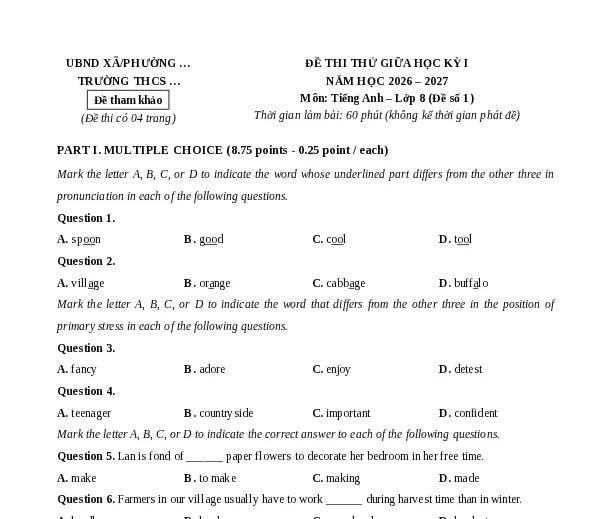
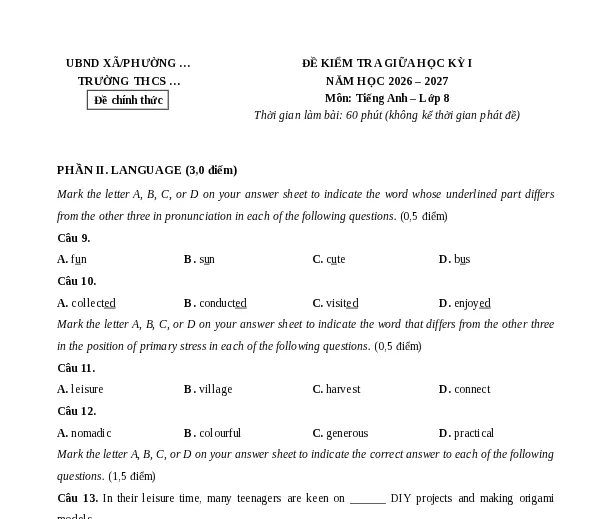
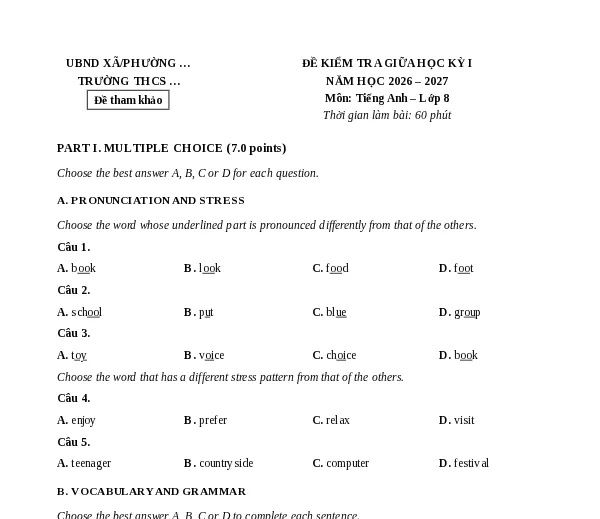
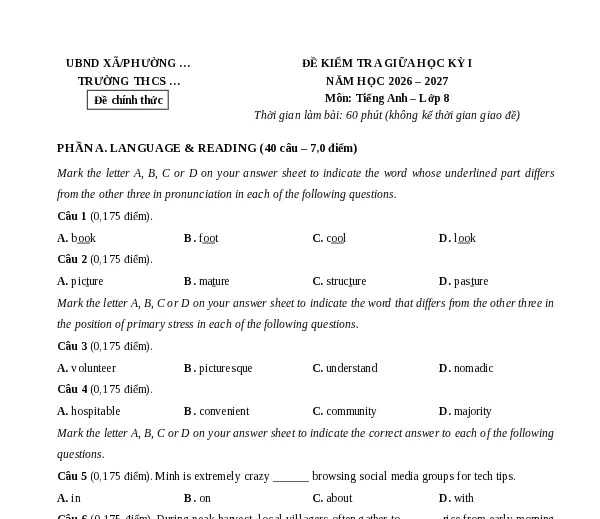
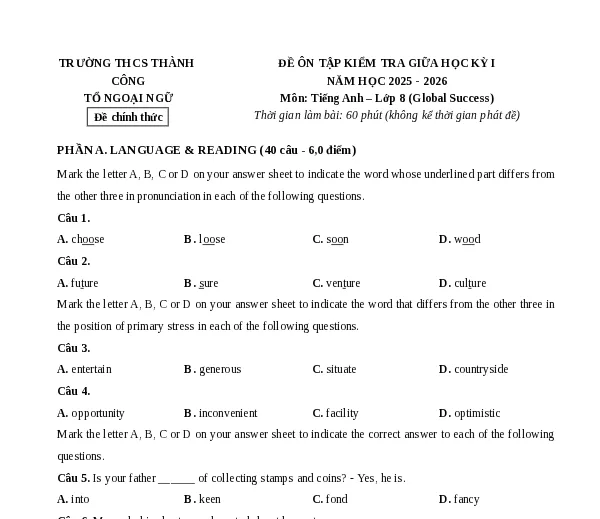
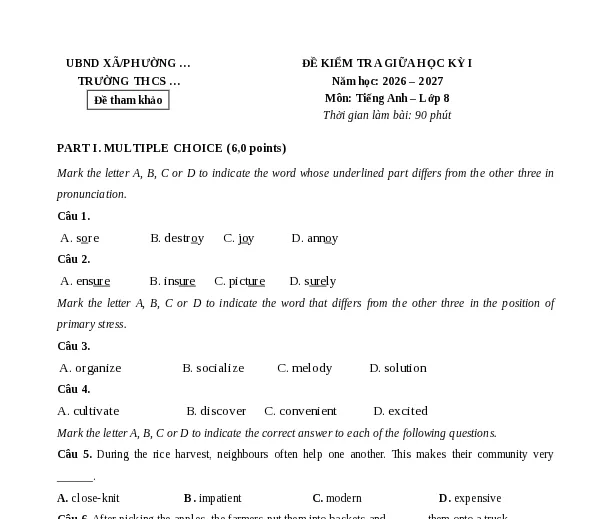
Mark the letter A, B, C, or D on your answer sheet to indicate the word whose underlined part differs from the other three in pronunciation in each of the following questions.
Question 1. A. cook B. foot C. look D. tooth
Question 2. A. avoid B. noise C. choice D. choir
Mark the letter A, B, C, or D on your answer sheet to indicate the word that differs from the other three in the position of primary stress in each of the following questions.
Question 3. A. message B. mistake C. cartoon D. discuss
Question 4. A. picturesque B. recipe C. otherwise D. cultivate
Mark the letter A, B, C, or D on your answer sheet to indicate the correct answer to each of the following questions.
Question 5. Lan is not really keen on sports; instead, she prefers ______ origami animals ______ computer games.
A. to fold – to play B. folding – to playing C. folding – than playing D. to fold – to playing
Question 6. Life in the countryside is peaceful and quiet; ______, life in the city is often noisy and crowded.
A. therefore B. otherwise C. however D. consequently
Question 7. Thanks to modern machinery, local farmers can now plough their fields ______ than they did in the past.
A. more effectively B. much effectively C. as effective D. more effective
Question 8. Today's teenagers often experience peer pressure ______ their classmates at school.
A. from B. by C. with D. of
Question 9. During harvest time, the villagers work together to ______ the freshly harvested rice onto the back of the trucks.
A. collect B. load C. herd D. unload
Question 10. Phong and Nam are talking while walking home after school.
– Nam: “Would you like to come over to my house and play chess this Sunday afternoon?”
– Phong: “____________________”
A. I'm sorry, but I can't invite you to my house.
B. Yes, please. Pass me the board.
C. That sounds great, but I have to visit my grandparents.
D. You're welcome. It's my pleasure.
Read the following health tips and mark the letter A, B, C, or D on your answer sheet to indicate the correct option that best fits each of the numbered blanks from 11 to 14.
YOUTH HEALTH & WELLNESS CLUB |
|---|
Are you feeling overloaded with homework and deadlines? Don't worry! |
|---|
Question 11. A. prioritize B. combine C. delay D. focus
Question 12. A. briefly B. brief C. brevity D. briefing
Question 13. A. before B. while C. despite D. instead of
Question 14. A. emotion B. emotionally C. emotional D. emotionless
Mark the letter A, B, C, or D on your answer sheet to indicate the correct answer to each of the following questions from 15 to 16.
Question 15. Put the sentences (a–c) in the correct order, then fill in the blank to make a logical text.
Last weekend, my family decided to leave the noisy city behind and spend the weekend in my hometown village.
a. After helping the local farmers harvest rice in the afternoon, we enjoyed a delicious dinner made with fresh local ingredients.
b. Early in the morning, my cousins and I rode our bicycles near the river and enjoyed the cool breeze.
c. We arrived there late on Friday evening and went straight to bed to rest after the long journey.
A. c – b – a B. b – a – c C. a – b – c D. c – a – b
Question 16. Choose the sentence that can end the text most appropriately.
A. The long journey on Friday evening made everyone feel tired and sleepy.
B. However, working in the fields under the hot sun made me feel tired and thirsty.
C. Later that evening, we sat in the garden and enjoyed the cool air, feeling happy and relaxed.
D. Therefore, I still prefer city life with its modern shops and large cinemas.
Mark the letter A, B, C, or D on your answer sheet to indicate the correct option that best fits each of the numbered blanks from 17 to 21.
Life in the countryside offers many advantages, especially for growing children. People live closer to nature and enjoy (17) ______ air than people in cities. Villagers are usually very (18) ______ and always ready to help their neighbours. Children can play in wide open spaces and ride their bikes (19) ______ because there is usually less traffic.
However, rural life also has several (20) ______. Entertainment facilities such as cinemas and amusement parks are rare. Public transport is limited, so many people travel by motorbike or bicycle. (21) ______, many families still choose rural life because it helps them escape noise and build strong relationships with their neighbours.
Question 17. A. the most polluted B. fresher C. the freshest D. more polluted
Question 18. A. hospitable B. impatient C. careless D. self-aware
Question 19. A. safety B. safely C. safe D. unsafely
Question 20. A. rewards B. benefits C. drawbacks D. improvements
Question 21.
A. Despite these challenges B. In spite those problems
C. Although the troubles there D. Because of such difficulties
Mark the letter A, B, C, or D on your answer sheet to indicate the sentence that is best written from the given cues in each of the following questions.
Question 22. It / necessary / students / balance / study / time / leisure / activities.
A. It is necessary for students to balance their study time and leisure activities.
B. It is necessary for students balancing their study time and leisure activities.
C. It is necessary that students to balance their study time and leisure activities.
D. It is necessary of students to balance their study time and leisure activities.
Question 23. Nam / be / keen / surf / net / because / he / find / it / relax.
A. Nam is keen on surfing the net because he finds it relaxed.
B. Nam is keen on surf the net because he finds it relaxing.
C. Nam is keen on surfing the net because he finds it relaxing.
D. Nam is keen of surfing the net because he finds it relaxed.Mark the letter A, B, C, or D to indicate the sentence that is closest in meaning to each of the following questions.
Question 24. Although many teenagers experience peer pressure, they rarely discuss it with their parents.
A. Many teenagers experience peer pressure, but they rarely discuss it with their parents.
B. Many teenagers experience peer pressure; therefore, they rarely discuss it with their parents.
C. Teenagers will discuss peer pressure with their parents although they experience it.
D. Unless teenagers experience peer pressure, they rarely discuss it with their parents.
Question 25. If you don't manage your time carefully, you won't finish your project on time.
A. You should manage your time carefully, so you won't finish your project on time.
B. Manage your time carefully; otherwise, you won't finish your project on time.
C. You manage your time carefully; however, you will finish your project on time.
D. Although you manage your time carefully, you won't finish your project on time.
Read the following notice or message and mark the letter A, B, C, or D on your answer sheet to indicate the correct answer to each of the following questions.
Question 26. What does the notice say?
COMMUNITY YOUTH CLUB NOTICE |
|---|
A. You cannot join the activity if you bring drinking water.
B. The club will provide shoes and water for all participants.
C. Members need to prepare appropriate footwear and drinking water.
D. The tree-planting activity takes place every Sunday morning.
Question 27. What does the message say?
Hi Lucy, |
|---|
A. Sarah is inviting Lucy to attend a crafts workshop.
B. Sarah is praising Lucy for her class presentation.
C. Sarah is asking Lucy how she made the pottery models.
D. Sarah is asking the teacher to grade Lucy's project.
Read the following passage and mark the letter A, B, C, or D on your answer sheet to indicate the correct answer to each of the following questions from 28 to 32.
Leisure time plays an important role in teenagers’ physical and mental development. In recent years, digital technology has changed the way many teenagers spend their free time. While some still enjoy playing football, riding bicycles, or helping with family chores, others spend much of their leisure time browsing social media, watching online videos, and playing video games.
Although digital activities provide entertainment and help teenagers stay connected with friends, spending excessive time in front of screens can have negative effects. It may lead to poor sleep quality, eye strain, and difficulty concentrating on schoolwork. In addition, a lack of outdoor exercise can contribute to health problems such as obesity and low energy levels.
To maintain a balanced lifestyle, teenagers should combine online activities with offline pastimes. Creative hobbies such as painting, cooking, and playing musical instruments allow them to develop new skills and express themselves. Meanwhile, outdoor sports and volunteer work in the local community give teenagers opportunities to interact with others, improve their communication skills, and reduce stress. By choosing a variety of activities, young people can enjoy their free time while taking care of their health and personal development.
Question 28. What is the main purpose of the passage?
A. To describe popular forms of entertainment among teenagers
B. To discuss changes in teen leisure habits, their effects and the need for balance
C. To compare online entertainment with outdoor activities for teenagers
D. To discuss the negative effects of technology on school performance
Question 29. The word “excessive” in paragraph 2 is CLOSEST in meaning to ______.
A. too much B. reasonable C. unhealthy D. very little
Question 30. How do outdoor activities help teenagers, according to the passage?
A. By helping them avoid family chores completely
B. By giving them more time to complete school assignments
C. By providing chances to socialise and communicate with others
D. By teaching them how to repair digital devices
Question 31. The word “reduce” in paragraph 3 is OPPOSITE in meaning to ______.
A. decrease B. increase C. maintain D. control
Question 32. According to the passage, which of the following is NOT TRUE?
A. Creative interests like cooking and painting help teenagers learn new skills.
B. Lack of outdoor exercise can result in health problems like obesity.
C. Teenagers should completely stop using the Internet to protect their health.
D. Digital activities can help teenagers stay connected with their friends.
Four phrases/sentences have been removed from the text below. For each question, mark the letter A, B, C, or D on your answer sheet to indicate the correct option that best fits each of the numbered blanks from 33 to 36.
Teenagers today face numerous pressures from school, friends, and family. (33) ______. First and foremost, you should learn how to manage your time properly. Make a daily study plan to avoid feeling overwhelmed before exams. Second, (34) ______. Setting realistic targets will keep you motivated without feeling like a failure. Third, talk to someone when you are feeling stressed or anxious. (35) ______. Finally, (36) ______. These healthy habits contribute to a healthy body and a relaxed mind.
A. Sharing your feelings with parents, teachers, or close friends can help you find solutions
B. avoid setting expectations that are too high for yourself.
C. don’t forget to engage in regular physical exercise and get enough sleep every night
D. However, there are effective strategies you can follow to manage this stress
Question 33. ______ Question 34. ______ Question 35. ______ Question 36. ______
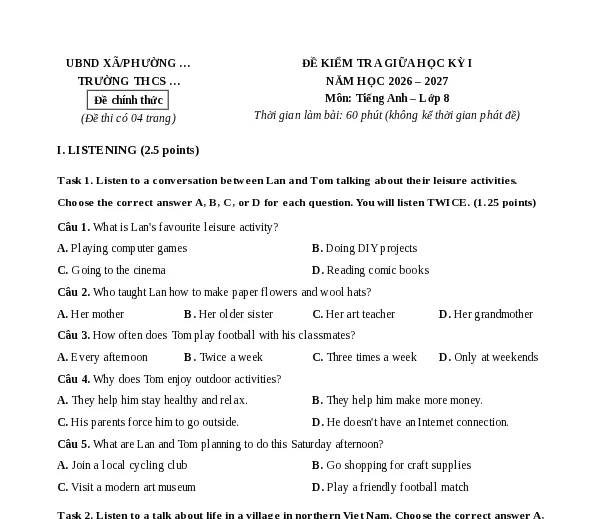
Listen to Anna talking about her trip to the countryside and decide if each of the following statements is True or False. You will listen TWICE.
Question 37. Anna spent three days in the village.
A. True | B. False |
|---|
Question 38. Anna’s family travelled to the village by motorcycle to avoid traffic jams.
A. True | B. False |
|---|
Question 39. Her family played with kites in the afternoon on the second day.
A. True | B. False |
|---|
Question 40. Anna and her sister had a hard-working day on the field.
A. True | B. False |
|---|
----- THE END -----
ĐÁP ÁN VÀ LỜI CHI TIẾT
BẢNG ĐÁP ÁN NHANH
Câu | Đáp án | Câu | Đáp án | Câu | Đáp án | Câu | Đáp án |
|---|---|---|---|---|---|---|---|
1 | D | 11 | A | 21 | A | 31 | B |
2 | D | 12 | B | 22 | A | 32 | C |
3 | A | 13 | A | 23 | C* | 33 | D |
4 | A | 14 | C | 24 | A | 34 | B |
5 | B | 15 | A | 25 | B | 35 | A |
6 | C | 16 | C | 26 | C | 36 | C |
7 | A | 17 | B | 27 | B | 37 | — |
8 | A | 18 | A | 28 | B | 38 | — |
9 | B | 19 | B | 29 | A | 39 | — |
10 | C | 20 | C | 30 | C | 40 | — |
Dấu *: Câu 23 được trả lời theo đề đã hiệu đính. Ký hiệu —: cần nghe audio gốc.
I. NGỮ ÂM VÀ TRỌNG ÂM
Câu 1. Đáp án D — D. tooth
Giải thích: Ba từ cook /kʊk/, foot /fʊt/ và look /lʊk/ có phần gạch chân “oo” đọc là /ʊ/ (âm u ngắn). Tooth /tuːθ/ có “oo” đọc là /uː/ (âm u dài). Vì vậy tooth phát âm khác.
Ghi nhớ: Đừng cho rằng chữ “oo” luôn đọc giống nhau: so sánh book /bʊk/ và food /fuːd/.
Câu 2. Đáp án D — D. choir
Giải thích: Avoid /əˈvɔɪd/, noise /nɔɪz/ và choice /tʃɔɪs/ đều có “oi” đọc là /ɔɪ/. Choir /ˈkwaɪə(r)/ lại có “oi” đọc thành /aɪ/. Chọn D.
Ghi nhớ: “Choir” nghĩa là dàn hợp xướng; cách viết và cách phát âm khá đặc biệt.
Câu 3. Đáp án A — A. message
Giải thích: Message /ˈmesɪdʒ/ nhấn trọng âm âm tiết 1. Mistake /mɪˈsteɪk/, cartoon /kɑːˈtuːn/ và discuss /dɪˈskʌs/ nhấn trọng âm âm tiết 2. Vì vậy chọn A.
Ghi nhớ: Chú ý ký hiệu ˈ đứng ngay trước âm tiết được nhấn.
Câu 4. Đáp án A — A. picturesque
Giải thích: Picturesque /ˌpɪktʃəˈresk/ có trọng âm chính ở âm tiết 3. Recipe /ˈresəpi/, otherwise /ˈʌðəwaɪz/, cultivate /ˈkʌltɪveɪt/ đều nhấn âm tiết 1. Chọn A.
Ghi nhớ: Picturesque nghĩa là đẹp như tranh, thường dùng khi mô tả phong cảnh.
II. TỪ VỰNG, NGỮ PHÁP VÀ GIAO TIẾP
Câu 5. Đáp án B — B. folding – to playing
Giải thích: Cấu trúc “prefer + V-ing + to + V-ing” diễn tả thích làm việc này hơn làm việc kia. Câu đầy đủ: “She prefers folding origami animals to playing computer games.” (Cô ấy thích gấp hình origami hơn chơi trò chơi điện tử.)
Ghi nhớ: Chữ “to” ở đây là giới từ, vì thế phía sau dùng playing, không dùng play.
Câu 6. Đáp án C — C. however
Giải thích: Vế đầu mô tả nông thôn yên bình; vế sau mô tả thành phố ồn ào, đông đúc. Hai vế tương phản nên dùng however (tuy nhiên). Therefore/consequently chỉ kết quả, còn otherwise thường mang nghĩa “nếu không thì”.
Ghi nhớ: Dấu chấm phẩy trước however và dấu phẩy sau however là cách viết phù hợp.
Câu 7. Đáp án A — A. more effectively
Giải thích: “Plough their fields” là cụm động từ, nên cần trạng từ effectively để bổ nghĩa cho động từ plough. Vì có than, dùng so sánh hơn: more effectively than. Nghĩa: cày ruộng hiệu quả hơn trước.
Ghi nhớ: Effective là tính từ, effectively là trạng từ. “Much effectively” không phải cách tạo so sánh hơn đúng.
Câu 8. Đáp án A — A. from
Giải thích: Cụm từ tự nhiên là “experience peer pressure from somebody” (chịu áp lực đồng trang lứa từ ai đó). Các bạn cùng lớp là nguồn tạo áp lực nên chọn from.
Ghi nhớ: Peer pressure = áp lực từ bạn bè hoặc người cùng lứa tuổi.
Câu 9. Đáp án B — B. load
Giải thích: “Load something onto something” nghĩa là chất/xếp hàng lên phương tiện. Người dân chất lúa mới gặt lên phía sau xe tải, nên dùng load. Unload có nghĩa là dỡ xuống, ngược ý của câu.
Ghi nhớ: “Freshly harvested rice” = lúa vừa thu hoạch.
Câu 10. Đáp án C — C. That sounds great, but I have to visit my grandparents.
Giải thích: Nam đưa ra lời mời tới nhà chơi cờ vào chiều Chủ nhật. Phong từ chối lịch sự bằng cách khen lời mời (“That sounds great”) rồi nêu lý do bận đi thăm ông bà. Do đó C phù hợp nhất.
Ghi nhớ: Các lựa chọn A, B, D không đáp lại đúng lời mời trong tình huống này.
III. ĐỌC THÔNG BÁO: HỌC TẬP VÀ SỨC KHỎE
Câu 11. Đáp án A — A. prioritize
Giải thích: Đọc dấu hiệu “so that the most urgent ones are done first” (để các bài khẩn cấp nhất được làm trước): cần sắp xếp việc theo mức độ ưu tiên, tức prioritize assignments. Chọn A.
Ghi nhớ: Prioritize = ưu tiên, sắp xếp theo thứ tự quan trọng/khẩn cấp.
Câu 12. Đáp án B — B. brief
Giải thích: Chỗ trống đứng trước danh từ break nên cần tính từ. “Take a brief break” = nghỉ giải lao ngắn. Briefly là trạng từ; brevity và briefing là danh từ.
Ghi nhớ: Công thức: a + adjective + singular noun (a brief break).
Câu 13. Đáp án A — A. before
Giải thích: Muốn tập trung sâu khi ôn bài thì nên tắt thông báo mạng xã hội trước khi bắt đầu ôn: “turn off ... before starting your revision”. Before + V-ing là cấu trúc đúng.
Ghi nhớ: Despite + noun/V-ing chỉ sự nhượng bộ nên không hợp nghĩa; instead of nghĩa là thay vì.
Câu 14. Đáp án C — C. emotional
Giải thích: Cần tính từ đứng trước support: “seek emotional support” (tìm kiếm sự hỗ trợ về mặt tinh thần). Emotion là danh từ; emotionally là trạng từ; emotionless mang nghĩa thiếu cảm xúc.
Ghi nhớ: Cụm “seek emotional support from ...” rất hay gặp trong chủ đề sức khỏe tinh thần.
IV. SẮP XẾP CÂU VÀ VIẾT CÂU KẾT
Câu 15. Đáp án A — A. c – b – a
Giải thích: Trình tự thời gian: (c) đến làng vào tối thứ Sáu rồi nghỉ ngơi → (b) sáng hôm sau đạp xe quanh sông → (a) buổi chiều giúp gặt lúa, sau đó ăn tối. Các trạng ngữ late on Friday evening, early in the morning, in the afternoon giúp sắp xếp chính xác.
Ghi nhớ: Khi làm câu sắp xếp, tìm các từ chỉ trình tự thời gian trước.
Câu 16. Đáp án C — C. Later that evening, we sat in the garden and enjoyed the cool air, feeling happy and relaxed.
Giải thích: Sau câu (a) kể về bữa tối, câu C tiếp tục “Later that evening” (tối hôm ấy) và khép lại chuyến đi bằng cảm xúc vui vẻ, thư giãn. Các đáp án khác hoặc lặp lại chi tiết cũ, hoặc phá vỡ kết thúc tích cực.
Ghi nhớ: Một câu kết tốt cần nối mạch thời gian và thống nhất nội dung cả đoạn.
V. ĐỌC ĐIỀN TỪ: CUỘC SỐNG NÔNG THÔN
Câu 17. Đáp án B — B. fresher
Giải thích: Câu có “than people in cities” nên cần hình thức so sánh hơn. “Fresher air” = không khí trong lành hơn, phù hợp lợi ích của nông thôn. “More polluted” tuy là so sánh hơn nhưng trái nghĩa với thông điệp đoạn.
Ghi nhớ: Fresh → fresher → the freshest.
Câu 18. Đáp án A — A. hospitable
Giải thích: Vế sau “always ready to help their neighbours” (luôn sẵn lòng giúp hàng xóm) mô tả người dân hiếu khách và thân thiện, tương ứng hospitable. Impatient = thiếu kiên nhẫn; careless = bất cẩn.
Ghi nhớ: Hospitable /ˈhɒspɪtəbl/ = hiếu khách.
Câu 19. Đáp án B — B. safely
Giải thích: Từ cần điền bổ nghĩa cho động từ ride: “ride their bikes safely” (đạp xe an toàn). Safely là trạng từ; safe là tính từ, safety là danh từ. Giao thông thưa nên đi xe an toàn hơn.
Ghi nhớ: Động từ \+ trạng từ chỉ cách thức: drive carefully, walk slowly, ride safely.
Câu 20. Đáp án C — C. drawbacks
Giải thích: Từ “However” mở đầu phần nói về điểm bất lợi: ít rạp chiếu phim, công viên và phương tiện công cộng. Drawbacks nghĩa là nhược điểm, đúng nội dung. Benefits/rewards/improvements đều hướng tới điều tích cực.
Ghi nhớ: Lợi ích = advantages/benefits; bất lợi = drawbacks/disadvantages.
Câu 21. Đáp án A — A. Despite these challenges
Giải thích: Đoạn vừa nói các khó khăn của nông thôn, nhưng nhiều gia đình vẫn chọn sống ở đó. “Despite these challenges, ...” (Mặc dù có các thách thức ấy, ...) diễn tả nhượng bộ và theo sau là một cụm danh từ.
Ghi nhớ: In spite phải đi với of: “in spite of those problems”; phương án B thiếu “of”.
VI. VIẾT CÂU VÀ VIẾT LẠI CÂU
Câu 22. Đáp án A — A. It is necessary for students to balance their study time and leisure activities.
Giải thích: Cấu trúc chuẩn: “It is + adjective + for somebody + to V”. Vì vậy: It is necessary for students to balance ... (Học sinh cần cân bằng thời gian học và hoạt động giải trí).
Ghi nhớ: Không dùng “for students balancing” hoặc “that students to balance”.
Câu 23. Đáp án C — C. Nam is keen on surfing the net because he finds it relaxing.
Giải thích: “Be keen on + V-ing”: keen on surfing. “Find + object + adjective”: finds it relaxing (thấy việc đó thư giãn). Relaxing mô tả hoạt động; relaxed mô tả cảm giác của con người.
Ghi nhớ: LƯU Ý BIÊN TẬP: đáp án B của ảnh gốc “he finds it is relaxing” cũng có thể hiểu là “he finds (that) it is relaxing”, nên chưa loại trừ tuyệt đối. Trong bản đề hiệu đính, B đã được thay để chỉ C là đúng.
Câu 24. Đáp án A — A. Many teenagers experience peer pressure, but they rarely discuss it with their parents.
Giải thích: Although (= mặc dù) tạo quan hệ tương phản giữa hai mệnh đề. Khi đổi sang hai mệnh đề nối bằng but, ý nghĩa được giữ nguyên. Therefore lại diễn tả kết quả, không tương đương although.
Ghi nhớ: Mẫu: Although S + V, S + V. = S + V, but S + V.
Câu 25. Đáp án B — B. Manage your time carefully; otherwise, you won’t finish your project on time.
Giải thích: Câu gốc: Nếu không quản lý thời gian cẩn thận, bạn sẽ không hoàn thành dự án đúng hạn. “Manage ...; otherwise, ...” nghĩa là “Hãy quản lý ...; nếu không thì ...”, giữ nguyên điều kiện và kết quả.
Ghi nhớ: Otherwise ≈ if not; không được đổi thành so hoặc however vì làm sai quan hệ nghĩa.
VII. ĐỌC HIỂU THÔNG BÁO VÀ TIN NHẮN
Câu 26. Đáp án C — C. Members need to prepare appropriate footwear and drinking water.
Giải thích: Thông báo quy định thành viên tham gia trồng cây vào thứ Bảy phải mang giày thể thao và bình nước riêng. C diễn đạt đúng hai yêu cầu ấy. Thông báo không nói Chủ nhật và không nói câu lạc bộ cung cấp giày/nước.
Ghi nhớ: Must = bắt buộc; bring their own water bottles = tự mang bình nước.
Câu 27. Đáp án B — B. Sarah is praising Lucy for her class presentation.
Giải thích: Sarah viết bài thuyết trình của Lucy “was fantastic” và thầy cô cùng mọi người rất thích sản phẩm gốm. Đây là lời khen (praising), không phải lời mời hay yêu cầu.
Ghi nhớ: Praise somebody for something = khen ai về việc gì.
VIII. ĐỌC HIỂU: LEISURE TIME
Câu 28. Đáp án B — B. To discuss changes in teen leisure habits, their effects and the need for balance.
Giải thích: Bài gồm ba ý: cách sử dụng thời gian rảnh thay đổi do công nghệ; mặt lợi và tác hại của hoạt động số; cần cân bằng hoạt động trực tuyến và ngoại tuyến. B bao quát đủ toàn bài, còn A, C, D chỉ nêu một phần.
Ghi nhớ: Với câu hỏi main purpose/main idea, không chọn đáp án quá hẹp so với toàn bài.
Câu 29. Đáp án A — A. too much
Giải thích: Excessive time = quá nhiều thời gian, vượt mức hợp lý. Vì vậy “too much” gần nghĩa nhất. Reasonable = hợp lý; very little = quá ít; unhealthy = không lành mạnh (không phải nghĩa trực tiếp).
Ghi nhớ: Excessive (adj) = more than is necessary, normal or acceptable.
Câu 30. Đáp án C — C. By providing chances to socialise and communicate with others.
Giải thích: Đoạn cuối cho biết thể thao ngoài trời và tình nguyện giúp người trẻ interact with others và improve their communication skills. Đáp án C diễn đạt lại chính xác ý này.
Ghi nhớ: Interact with others = tương tác với người khác; socialise = giao lưu.
Câu 31. Đáp án B — B. increase
Giải thích: Reduce = làm giảm; từ trái nghĩa là increase = làm tăng. Decrease đồng nghĩa với reduce nên không đúng yêu cầu OPPOSITE.
Ghi nhớ: Đọc kỹ yêu cầu CLOSEST hay OPPOSITE trước khi chọn từ.
Câu 32. Đáp án C — C. Teenagers should completely stop using the Internet to protect their health.
Giải thích: Bài khuyên kết hợp hoạt động online và offline, không hề yêu cầu ngừng hẳn Internet. Do đó C là thông tin KHÔNG ĐÚNG. Các ý A, B, D đều xuất hiện trực tiếp trong bài.
Ghi nhớ: NOT TRUE yêu cầu chọn nhận định không phù hợp với bài, không phải nhận định đúng.
IX. ĐIỀN CÂU VÀO ĐOẠN VĂN
Câu 33. Đáp án D — D. However, there are effective strategies you can follow to manage this stress
Giải thích: Câu trước nói teen đối mặt nhiều áp lực; câu D chuyển ý: tuy nhiên vẫn có những chiến lược kiểm soát căng thẳng. Sau đó văn bản bắt đầu liệt kê First and foremost, Second, Third, Finally.
Ghi nhớ: However đánh dấu sự chuyển từ vấn đề sang giải pháp.
Câu 34. Đáp án B — B. avoid setting expectations that are too high for yourself.
Giải thích: Ngay sau chỗ trống là “Setting realistic targets will keep you motivated ...”. Vì thế lời khuyên thứ hai là tránh đặt kỳ vọng quá cao, rồi đặt mục tiêu thực tế. B nối ý rất chặt.
Ghi nhớ: Avoid + V-ing: avoid setting. Không dùng avoid to set.
Câu 35. Đáp án A — A. Sharing your feelings with parents, teachers, or close friends can help you find solutions
Giải thích: Câu trước khuyên nói chuyện với ai đó khi căng thẳng. Câu A giải thích việc chia sẻ với phụ huynh, thầy cô hoặc bạn bè có thể giúp tìm ra giải pháp. Đây là quan hệ lời khuyên → lợi ích.
Ghi nhớ: Sharing là danh động từ làm chủ ngữ; “sharing your feelings” = chia sẻ cảm xúc.
Câu 36. Đáp án C — C. don’t forget to engage in regular physical exercise and get enough sleep every night
Giải thích: Từ “Finally” giới thiệu lời khuyên cuối cùng. C đề cập tập thể dục đều đặn và ngủ đủ giấc; câu kết “These healthy habits contribute to a healthy body and a relaxed mind” xác nhận điều đó.
Ghi nhớ: Engage in = tham gia/thực hiện; get enough sleep = ngủ đủ giấc.
X. PHẦN NGHE: CÂU 37–40