PHÒNG GIÁO DỤC VÀ ĐÀO TẠO …
TRƯỜNG THCS …
Đề chính thức
ĐỀ KIỂM TRA ĐỊNH KÌ HỌC KỲ I
Môn: Tiếng Anh – Lớp 8 (Đề số 5)
Thời gian làm bài: 60 phút (không kể thời gian phát đề)
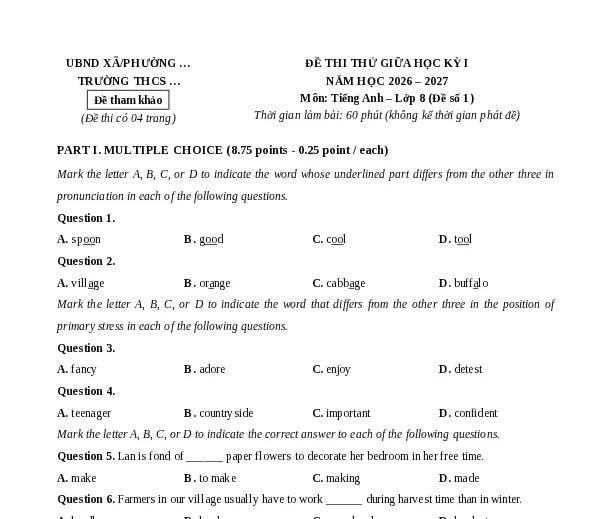
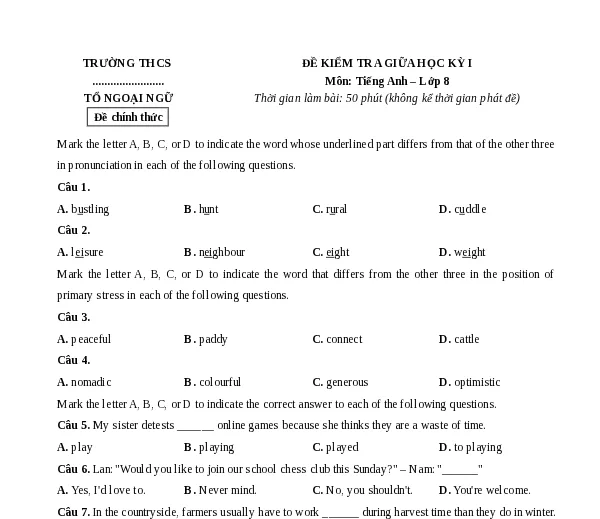
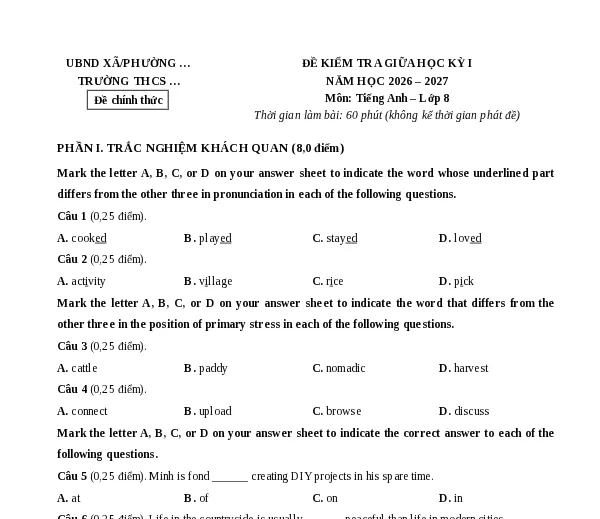
PART I. PHONETICS
Mark the letter A, B, C, or D to indicate the word whose underlined part differs from the other three in pronunciation in each of the following questions.
Câu 1.
A. harvest
B. cattle
C. paddy
D. factory
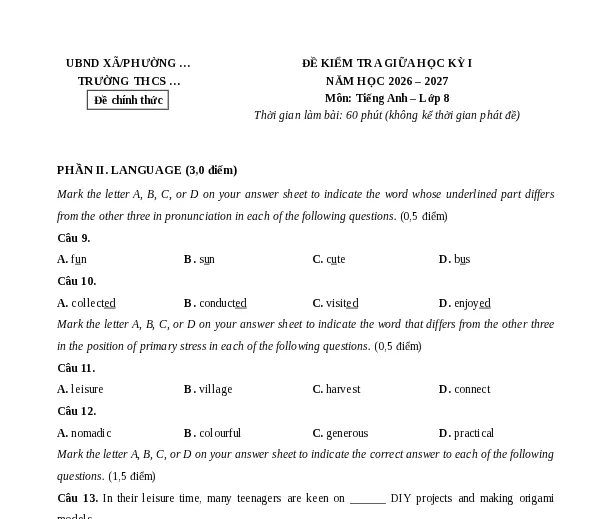
Câu 2.
A. visited
B. collected
C. crafted
D. ploughed
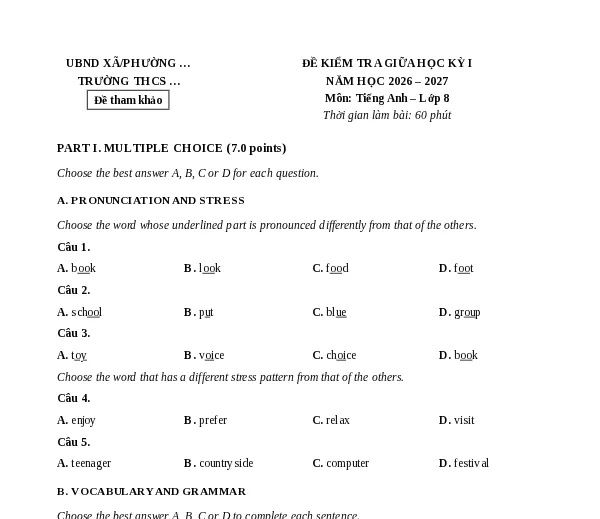
Mark the letter A, B, C, or D to indicate the word that differs from the other three in the position of primary stress in each of the following questions.
Câu 3.
A. pasture
B. nomadic
C. terraced
D. poultry
Câu 4.
A. concentrate
B. satisfy
C. communal
D. recognize
PART II. LEXICO – GRAMMAR & EVERYDAY ENGLISH
Mark the letter A, B, C, or D to indicate the correct answer to each of the following questions.
Câu 5. Many teenagers are crazy ______ browsing social media platforms every evening.
A. on
B. about
C. with
D. for
Câu 6. In the countryside, children usually run ______ and freely than city kids because there is more open space.
A. faster
B. more fast
C. fastly
D. more faster
Câu 7. The Tay ethnic group lives mostly in ______ northern mountainous provinces of Viet Nam.
A. a
B. an
C. the
D.
Câu 8. My brother adores ______ origami in his spare time; it helps him develop patience.
A. folding
B. to fold
C. fold
D. folded
Câu 9. Nam worked extremely hard; ______, he achieved top marks in the mid-term examination.
A. however
B. otherwise
C. therefore
D. although
Câu 10. During the rice harvest season, farmers have to work much ______ than usual.
A. harder
B. hardly
C. more hard
D. more hardly
Câu 11. The Gong festival in the Central Highlands is recognized by UNESCO ______ an intangible cultural heritage.
A. like
B. as
C. to
D. for
Câu 12. Teenagers often face severe peer ______ when trying to fit in with their classmates.
A. pressure
B. press
C. stressful
D. depression
Câu 13. You shouldn't spend too much time in front of digital screens, ______ your eyes may get hurt.
A. but
B. so
C. or
D. and
Câu 14. The Cham and Khmer people have their own distinctive festivals, ______?
A. don't they
B. do they
C. haven't they
D. are they
Mark the letter A, B, C, or D to indicate the most suitable response to complete each of the following exchanges.
Câu 15. Mai and Lan are talking about leisure activities.
– Mai: "Why don't we join the school's traditional arts club this weekend?"
– Lan: "______"
A. You're welcome.
B. That sounds great! Let's do that.
C. No, thanks. I'm full.
D. Congratulations on your success!
Câu 16. Tom is visiting Phong's village during the harvest season.
– Tom: "Thank you very much for showing me how to herd buffaloes today!"
– Phong: "______"
A. It's my pleasure.
B. Not at all, I'm busy.
C. I don't think so.
D. You must be joking.
PART III. SIGNS AND NOTICES
Mark the letter A, B, C, or D to indicate the correct meaning of each sign or notice.
Câu 17. What does this sign mean?
CAUTION: LIVESTOCK CROSSING
A. Drivers must speed up to avoid farm animals.
B. Farm animals are strictly prohibited from crossing this road.
C. Drivers must slow down because domestic animals may cross the road.
D. Only cattle and poultry are allowed to travel on this road.
Câu 18. What does this notice in the computer room say?
LIBRARY NOTICE
Computers are reserved for study and research only.
Playing online games is strictly prohibited.
A. Students can play games after finishing their research.
B. Students are not allowed to play games on these computers.
C. You must pay a fee before using computers for study.
D. All computers are out of order today.
PART IV. CLOZE READING
Read the following passage and mark the letter A, B, C, or D to indicate the correct word or phrase that best fits each of the numbered blanks from 19 to 23.
The lifestyle of ethnic minority groups in the northern mountainous regions of Viet Nam is closely associated with nature. Most ethnic groups, such as the Hmong, Dao, and Tay, cultivate rice on breathtaking (19) ______ fields built on steep hillsides. These unique fields not only prevent soil erosion but also supply food for the entire community.
In addition to farming, villagers are skillful at traditional handicrafts. Women spend their leisure time weaving colorful cloth and (20) ______ patterns on garments, whereas men build sturdy stilt houses from wood and bamboo. Stilt houses are elevated on posts to protect residents (21) ______ dangerous wild animals and dampness from the ground.
Community life in these villages is extremely cohesive. People always help one (22) ______ during busy harvest times or when building a new communal house. (23) ______ modern amenities have gradually entered these remote areas, local people still proudly maintain their unique traditions and spiritual values.
Câu 19.
A. flooded
B. terraced
C. flat
D. curved
Câu 20.
A. embroidering
B. painting
C. knitting
D. drawing
Câu 21.
A. about
B. from
C. on
D. of
Câu 22.
A. other
B. another
C. others
D. each
Câu 23.
A. Despite
B. Because
C. Although
D. However
PART V. READING COMPREHENSION
Read the following passage and mark the letter A, B, C, or D to indicate the correct answer to each of the questions from 24 to 28.
In recent years, the growing popularity of smartphones and social media has transformed how teenagers spend their free time. While previous generations spent hours playing sports outdoors, riding bicycles, or chatting face-to-face with friends in the neighborhood, today's adolescents frequently prefer digital recreation.
According to recent surveys, the average teenager spends between four and six hours daily looking at electronic screens. Many young people enjoy playing multiplayer games, streaming music videos, and browsing platforms like TikTok or Instagram. These online activities offer immediate entertainment and enable adolescents to stay connected with peers regardless of geographical distance. Furthermore, social forums allow teenagers to exchange study tips and discover hobbies that may not be available locally.
However, excessive screen time also triggers considerable concerns among parents and educators. Sedentary lifestyles contribute to obesity and poor posture, while late-night phone usage disrupts natural sleeping patterns, leading to tiredness and poor academic performance at school. In addition, constant exposure to curated photos of others can create unrealistic expectations and cause mental health issues such as anxiety and low self-esteem.
To maintain a healthy balance, specialists advise teenagers to set clear limits on daily device usage. Engaging in physical exercise, picking up a creative hobby like painting or cooking, and organizing family gatherings are practical ways to disconnect from virtual reality and enhance real-world connections.
Câu 24. What is the best title for the passage?
A. The Decline of Traditional Outdoor Games
B. Teenagers and Screen Time: Benefits and Drawbacks
C. How Social Media Platforms Earn Their Profits
D. Why Adolescents Refuse to Communicate with Parents
Câu 25. The word "sedentary" in paragraph 3 is closest in meaning to ______.
A. physically inactive
B. highly energetic
C. extremely dangerous
D. socially acceptable
Câu 26. According to paragraph 2, digital leisure activities enable teenagers to ______.
A. eliminate all academic pressure at school
B. replace regular classroom study completely
C. connect with friends despite geographical distance
D. improve their eyesight and physical stamina
Câu 27. The word "they" in paragraph 2 refers to ______.
A. study tips
B. online activities
C. multiplayer games
D. teenagers
Câu 28. Which of the following is NOT mentioned as a solution to reduce excessive screen time?
A. Doing regular physical exercise
B. Participating in creative pastimes like painting
C. Taking part in family gatherings
D. Deleting all social media accounts permanently
PART VI. WRITING / SENTENCE TRANSFORMATION & REARRANGEMENT
Mark the letter A, B, C, or D to indicate the correct arrangement of the words/phrases to make a meaningful sentence in each of the following questions.
Câu 29.
1. prefers / 2. in her free time / 3. making DIY crafts / 4. browsing the internet / 5. to / 6. My sister
A. 6 – 1 – 3 – 5 – 4 – 2
B. 6 – 1 – 4 – 5 – 3 – 2
C. 2 – 6 – 1 – 5 – 3 – 4
D. 6 – 3 – 1 – 5 – 4 – 2
Câu 30.
1. during the harvest festival / 2. colourful costumes / 3. put on / 4. Ethnic minority girls / 5. to perform folk dances
A. 4 – 3 – 2 – 5 – 1
B. 4 – 3 – 5 – 2 – 1
C. 1 – 4 – 2 – 3 – 5
D. 4 – 2 – 3 – 5 – 1
Câu 31.
1. more slowly / 2. city dwellers / 3. than / 4. Country people / 5. live / 6. often
A. 4 – 6 – 5 – 1 – 3 – 2
B. 4 – 5 – 6 – 1 – 3 – 2
C. 2 – 6 – 5 – 1 – 3 – 4
D. 4 – 6 – 1 – 5 – 3 – 2
Câu 32.
1. because of / 2. suffered from / 3. peer pressure / 4. He / 5. severe anxiety
A. 4 – 2 – 1 – 3 – 5
B. 4 – 2 – 5 – 1 – 3
C. 4 – 5 – 2 – 1 – 3
D. 1 – 3 – 4 – 5 – 2
Mark the letter A, B, C, or D to indicate the sentence that is closest in meaning to each of the following questions.
Câu 33. Peter drives more carefully than John does.
A. John drives more carelessly than Peter does.
B. John drives as carefully as Peter does.
C. Peter drives less carefully than John does.
D. John drives more carefully than Peter does.
Câu 34. My sister is really keen on cooking traditional dishes.
A. My sister detests cooking traditional dishes.
B. My sister takes great interest in cooking traditional dishes.
C. Cooking traditional dishes is boring to my sister.
D. My sister is terrible at cooking traditional dishes.
Câu 35. Although it was raining heavily, the villagers continued to harvest the rice crops.
A. Because of the heavy rain, the villagers stopped harvesting the rice crops.
B. Despite the heavy rain, the villagers went on harvesting the rice crops.
C. The villagers harvested the rice crops, so it began to rain heavily.
D. It was raining heavily, but the villagers didn't want to harvest the rice crops.
Câu 36. Study diligently, or you will fail the upcoming entrance exam.
A. If you study diligently, you will fail the upcoming entrance exam.
B. Unless you study diligently, you will pass the upcoming entrance exam.
C. If you don't study diligently, you will fail the upcoming entrance exam.
D. Because you study diligently, you won't pass the upcoming entrance exam.
Mark the letter A, B, C, or D to indicate the sentence that best combines each pair of sentences.
Câu 37. Lan checked her assignment very thoroughly. She still made a few punctuation errors.
A. Lan checked her assignment very thoroughly, so she still made a few punctuation errors.
B. Although Lan checked her assignment very thoroughly, she still made a few punctuation errors.
C. Lan checked her assignment very thoroughly because she still made a few punctuation errors.
D. Lan checked her assignment very thoroughly; otherwise, she made a few punctuation errors.
Câu 38. You spend too much time on TikTok. You cannot focus on your homework.
A. If you don't spend too much time on TikTok, you cannot focus on your homework.
B. If you spend less time on TikTok, you can focus better on your homework.
C. You spend too much time on TikTok because you focus on your homework.
D. You spend too much time on TikTok, however you focus on your homework.
Câu 39. The communal house is large. All the villagers can gather inside during community meetings.
A. The communal house is so large that all the villagers can gather inside during community meetings.
B. The communal house is too large for all the villagers to gather inside during community meetings.
C. The communal house is large enough, but no villagers can gather inside during community meetings.
D. The communal house is not large enough for all the villagers to gather inside.
Câu 40. The cattle were grazing on the pasture. The shepherd was playing a bamboo flute.
A. The cattle were grazing on the pasture while the shepherd was playing a bamboo flute.
B. The cattle were grazing on the pasture before the shepherd played a bamboo flute.
C. The cattle were grazing on the pasture because the shepherd was playing a bamboo flute.
D. The cattle grazed on the pasture after the shepherd has played a bamboo flute.
--------- HẾT ---------
Họ và tên thí sinh: ................................................................ Số báo danh: ........................
PHÒNG GIÁO DỤC VÀ ĐÀO TẠO …
TRƯỜNG THCS …
Hướng dẫn chấm chính thức
ĐÁP ÁN VÀ HƯỚNG DẪN CHẤM
ĐỀ KIỂM TRA ĐỊNH KÌ HỌC KỲ I
Môn: Tiếng Anh – Lớp 8 (Đề số 5)
HƯỚNG DẪN CHẤM VÀ THANG ĐIỂM
A. HƯỚNG DẪN CHUNG
- Đề thi gồm 40 câu hỏi trắc nghiệm khách quan.
- Thang điểm 10,0; mỗi câu trả lời đúng được 0,25 điểm.
B. ĐÁP ÁN VÀ GIẢI THÍCH CHI TIẾT
1. Bảng đáp án
Câu | 1 | 2 | 3 | 4 | 5 | 6 | 7 | 8 | 9 | 10 |
|---|---|---|---|---|---|---|---|---|---|---|
Đáp án | A | D | B | C | B | A | C | A | C | A |
Câu | 11 | 12 | 13 | 14 | 15 | 16 | 17 | 18 | 19 | 20 |
|---|---|---|---|---|---|---|---|---|---|---|
Đáp án | B | A | C | A | B | A | C | B | B | A |
Câu | 21 | 22 | 23 | 24 | 25 | 26 | 27 | 28 | 29 | 30 |
|---|---|---|---|---|---|---|---|---|---|---|
Đáp án | B | B | C | B | A | C | B | D | A | A |
Câu | 31 | 32 | 33 | 34 | 35 | 36 | 37 | 38 | 39 | 40 |
|---|---|---|---|---|---|---|---|---|---|---|
Đáp án | A | B | A | B | B | C | B | B | A | A |
2. Lời giải và giải thích chi tiết từng câu
Câu 1. Đáp án A.
- A. harvest /ˈhɑːvɪst/ (phát âm là /ɑː/)
- B. cattle /ˈkætl/ (phát âm là /æ/)
- C. paddy /ˈpædi/ (phát âm là /æ/)
- D. factory /ˈfæktri/ (phát âm là /æ/)
Phần gạch chân ở phương án A phát âm là /ɑː/, các phương án còn lại phát âm là /æ/.
Câu 2. Đáp án D.
- A. visited /ˈvɪzɪtɪd/ (kết thúc bằng âm /t/ nên phát âm là /ɪd/)
- B. collected /kəˈlektɪd/ (kết thúc bằng âm /t/ nên phát âm là /ɪd/)
- C. crafted /ˈkrɑːftɪd/ (kết thúc bằng âm /t/ nên phát âm là /ɪd/)
- D. ploughed /plaʊd/ (kết thúc bằng nguyên âm đôi /aʊ/ nên phát âm là /d/)
Phương án D phát âm là /d/, ba phương án còn lại phát âm là /ɪd/.
Câu 3. Đáp án B.
- A. pasture /ˈpɑːstʃə(r)/ (trọng âm rơi vào âm tiết thứ nhất)
- B. nomadic /nəʊˈmædɪk/ (hậu tố -ic làm trọng âm rơi vào âm tiết thứ hai)
- C. terraced /ˈterəst/ (trọng âm rơi vào âm tiết thứ nhất)
- D. poultry /ˈpəʊltri/ (trọng âm rơi vào âm tiết thứ nhất)
Phương án B có trọng âm rơi vào âm tiết 2, các từ còn lại rơi vào âm tiết 1.
Câu 4. Đáp án C.
- A. concentrate /ˈkɒnsntreɪt/ (trọng âm rơi vào âm tiết thứ nhất)
- B. satisfy /ˈsætɪsfaɪ/ (trọng âm rơi vào âm tiết thứ nhất)
- C. communal /kəˈmjuːnl/ (trọng âm rơi vào âm tiết thứ hai)
- D. recognize /ˈrekəɡnaɪz/ (trọng âm rơi vào âm tiết thứ nhất)
Phương án C có trọng âm rơi vào âm tiết 2, các từ còn lại rơi vào âm tiết 1.
Câu 5. Đáp án B.
- Cấu trúc cụm tính từ chỉ sự yêu thích: be crazy about something / V-ing (say mê, phát cuồng vì cái gì).
Câu 6. Đáp án A.
- Động từ thường run đi kèm trạng từ. Trạng từ của fast vẫn là fast, dạng so sánh hơn là faster. Không có "more fast" hay "fastly".
Câu 7. Đáp án C.
- Sử dụng mạo từ xác định the trước cụm từ chỉ phương hướng địa lý được xác định: the northern mountainous provinces.
Câu 8. Đáp án A.
- Động từ chỉ sở thích adore + V-ing (rất thích làm gì).
Câu 9. Đáp án C.
- therefore (do đó, vì vậy) dùng để chỉ kết quả; đứng sau dấu chấm phẩy và trước dấu phẩy. Mệnh đề trước nêu nguyên nhân (chăm chỉ), mệnh đề sau nêu kết quả (đạt điểm cao).
Câu 10. Đáp án A.
- Trạng từ của hard là hard, dạng so sánh hơn là harder. Dùng much để bổ nghĩa nhấn mạnh cấp độ so sánh (much harder). hardly mang nghĩa là "hầu như không".
Câu 11. Đáp án B.
- Cụm cấu trúc: be recognized as something (được công nhận là/như là cái gì).
Câu 12. Đáp án A.
- Cụm danh từ: peer pressure (áp lực đồng trang lứa). Sau tính từ peer cần một danh từ.
Câu 13. Đáp án C.
- Liên từ or (hoặc, nếu không thì) dùng để cảnh báo hậu quả tiêu cực nếu làm điều gì.
Câu 14. Đáp án A.
- Câu trần thuật ở thì Hiện tại đơn mang tính khẳng định, chủ ngữ số nhiều (The Cham and Khmer people), động từ thường have Câu hỏi đuôi dùng trợ động từ phủ định: don't they.
Câu 15. Đáp án B.
- Mai đưa ra lời gợi ý: "Why don't we...?" Lan đáp lại lời đồng tình: "That sounds great! Let's do that." (Nghe tuyệt đấy! Cùng làm đi.)
Câu 16. Đáp án A.
- Tom cảm ơn vì được hướng dẫn chăn trâu Phong đáp lại một cách lịch sự: "It's my pleasure." (Rất hân hạnh/Niềm vinh hạnh của tôi).
Câu 17. Đáp án C.
- Biển báo "CAUTION: LIVESTOCK CROSSING" cảnh báo nguy hiểm: gia súc băng qua đường Tài xế cần giảm tốc độ vì động vật nuôi có thể băng qua đường.
Câu 18. Đáp án B.
- Thông báo ghi rõ: "Playing online games is strictly prohibited" (Chơi trò chơi trực tuyến bị nghiêm cấm) Học sinh không được phép chơi game trên các máy tính này.
Câu 19. Đáp án B.
- Cụm từ quen thuộc chỉ ruộng bậc thang: terraced fields.
Câu 20. Đáp án A.
- embroidering patterns (thêu hoa văn/họa tiết trên trang phục). knitting là đan len; painting là vẽ tranh bằng cọ/màu; drawing là vẽ phác thảo.
Câu 21. Đáp án B.
- Cấu trúc: protect somebody/something from something (bảo vệ ai/cái gì khỏi nguy cơ gì).
Câu 22. Đáp án B.
- Cụm đại từ tương hỗ: one another hoặc each other (lẫn nhau). Ở đây có sẵn one nên cần điền another.
Câu 23. Đáp án C.
- Although + clause (Mặc dù...) diễn tả sự tương phản nhượng bộ giữa hai mệnh đề. Despite phải đi với danh từ/V-ing; However đi sau dấu chấm phẩy hoặc đứng đầu câu có dấu phẩy; Because chỉ nguyên nhân.
Câu 24. Đáp án B.
- Tiêu đề phù hợp nhất khái quát toàn bài: "Teenagers and Screen Time: Benefits and Drawbacks" (Thanh thiếu niên và thời gian sử dụng màn hình: Lợi ích và Tác hại). Bài đọc vừa nêu ưu điểm (kết nối bạn bè, tìm hiểu sở thích) vừa nêu mặt trái (ít vận động, béo phì, mất ngủ, lo âu).
Câu 25. Đáp án A.
- Từ "sedentary" mang nghĩa là thụ động, ngồi nhiều một chỗ, ít hoạt động thể chất đồng nghĩa với "physically inactive".
Câu 26. Đáp án C.
- Thông tin ở đoạn 2: "...enable adolescents to stay connected with peers regardless of geographical distance." (cho phép các em kết nối với bạn bè bất chấp khoảng cách địa lý).
Câu 27. Đáp án B.
- Từ "they" ở đoạn 2: "These online activities offer immediate entertainment and enable adolescents to stay connected with peers... Furthermore, social forums allow teenagers to exchange study tips and discover hobbies that may not be available locally." Ở câu này, "These online activities offer... and enable..." "they" quy chiếu đến These online activities.
Câu 28. Đáp án D.
- Đoạn cuối bài nhắc tới: Engaging in physical exercise (phương án A), picking up a creative hobby like painting (phương án B), organizing family gatherings (phương án C). Việc "xóa vĩnh viễn tất cả tài khoản mạng xã hội" (phương án D) không được đề cập (bài chỉ khuyên giới hạn thời gian sử dụng - set clear limits).
Câu 29. Đáp án A.
- Cấu trúc: prefer V-ing to V-ing (thích làm việc này hơn việc kia). Câu đúng: My sister prefers making DIY crafts to browsing the internet in her free time. (6 – 1 – 3 – 5 – 4 – 2).
Câu 30. Đáp án A.
- Trật tự câu: Chủ ngữ + Động từ + Tân ngữ + Mục đích + Thời gian. Câu đúng: Ethnic minority girls put on colourful costumes to perform folk dances during the harvest festival. (4 – 3 – 2 – 5 – 1).
Câu 31. Đáp án A.
- Cấu trúc so sánh hơn của trạng từ với động từ thường: S + Adv of frequency + V + more + adv + than + S2. Câu đúng: Country people often live more slowly than city dwellers. (4 – 6 – 5 – 1 – 3 – 2).
Câu 32. Đáp án B.
- Cấu trúc: S + suffered from + disease/problem + because of + Noun phrase. Câu đúng: He suffered from severe anxiety because of peer pressure. (4 – 2 – 5 – 1 – 3).
Câu 33. Đáp án A.
- Đề bài: "Peter lái xe cẩn thận hơn John." Nghĩa tương đương: "John lái xe bất cẩn hơn Peter." (carefully carelessly).
Câu 34. Đáp án B.
- Đề bài: be keen on V-ing (rất say mê/thích làm gì) đồng nghĩa với take great interest in V-ing (hết sức quan tâm/thích thú với việc gì).
Câu 35. Đáp án B.
- Cấu trúc biến đổi: Although + clause = Despite + Noun phrase. Động từ continued đồng nghĩa với went on. Câu B truyền tải trọn vẹn và chính xác nghĩa.
Câu 36. Đáp án C.
- Câu mệnh lệnh với or: "Hãy học tập chăm chỉ, nếu không bạn sẽ trượt kỳ thi tuyển sinh sắp tới." Viết lại bằng câu điều kiện loại 1: "Nếu bạn không học tập chăm chỉ, bạn sẽ trượt kỳ thi..." (If you don't study diligently, you will fail...).
Câu 37. Đáp án B.
- Hai câu mang nghĩa tương phản nhượng bộ: "Lan kiểm tra bài làm rất kỹ. Cô ấy vẫn mắc một vài lỗi dấu câu." Kết hợp bằng liên từ Although (Mặc dù...).
Câu 38. Đáp án B.
- Mối quan hệ điều kiện: "Dành quá nhiều thời gian xem TikTok không thể tập trung làm bài." "Nếu bạn dành ít thời gian xem TikTok hơn, bạn có thể tập trung vào bài tập tốt hơn."
Câu 39. Đáp án A.
- Cấu trúc kết hợp: S + be + so + adj + that + clause (Quá... đến nỗi mà...). Nhà rông quá rộng lớn đến mức tất cả dân làng đều có thể tụ họp bên trong.
Câu 40. Đáp án A.
- Hai hành động diễn ra song song cùng một lúc trong quá khứ được nối bằng liên từ while (trong khi): Đàn gia súc đang gặm cỏ trên đồng cỏ trong khi người chăn cừu đang thổi sáo trúc.