TRƯỜNG THCS CHUYÊN / CHẤT LƯỢNG CAO
TỔ TIẾNG ANH
Đề tham khảo
TÀI LIỆU ÔN TẬP VÀ ĐỀ KIỂM TRA NÂNG CAO GIỮA HỌC KỲ I
Môn: Tiếng Anh – Lớp 8 (Chương trình Global Success)
Thời gian làm bài: 60 phút (không kể thời gian phát đề)
PHẦN 1. TỔNG HỢP TỪ VỰNG TRỌNG TÂM & BẪY CẤU TRÚC (UNIT 1 - 2 - 3)
1. Bảng từ vựng và cụm từ chọn lọc dễ nhầm lẫn
Từ vựng / Cụm từ | Phiên âm | Từ loại | Nghĩa & Cụm bẫy hay gặp |
|---|---|---|---|
leisure | /ˈleʒə(r)/ | n | thời gian rảnh rỗi (cụm: at one's leisure, leisure pursuit) |
origami | /ˌɒrɪˈɡɑːmi/ | n | nghệ thuật gấp giấy Nhật Bản |
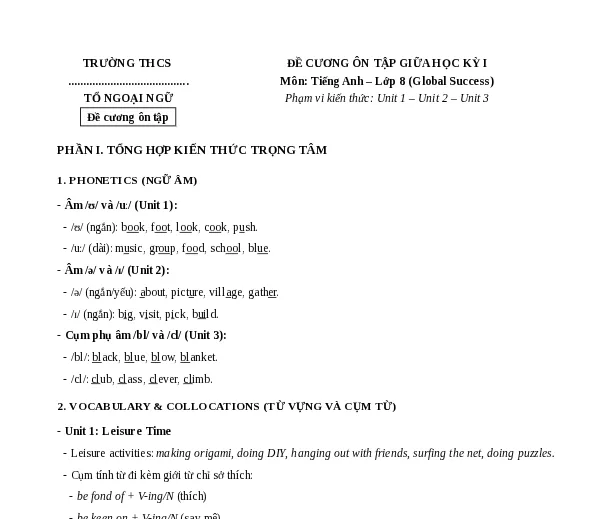
crochet | /ˈkrəʊʃeɪ/ | v, n | đan/móc sợi len (bẫy phát âm đuôi -et đọc là /eɪ/) |
addict | /ˈædɪkt/ | n | người nghiện (bẫy giới từ: be addicted to + V-ing/N) |
harvest | /ˈhɑːvɪst/ | n, v | mùa vụ, thu hoạch (cụm: harvest time, bumper harvest) |
hospitable | /hɒˈspɪtəbl/ | adj | hiếu khách (danh từ: hospitality, trọng âm âm 1 hoặc 2) |
cultivate | /ˈkʌltɪveɪt/ | v | canh tác, trau dồi (khác với civilize) |
pastoral | /ˈpɑːstərəl/ | adj | thuộc đồng quê, mục đồng (pastoral life/scenery) |
nomadic | /nəʊˈmædɪk/ | adj | du mục (nomadic lifestyle) |
forum | /ˈfɔːrəm/ | n | diễn đàn thảo luận |
bully | /ˈbʊli/ | v, n | bắt nạt, kẻ bắt nạt (cyberbullying: bắt nạt qua mạng) |
peer pressure | /ˈpɪə preʃə(r)/ | n | áp lực đồng trang lứa |
mature | /məˈtʃʊə(r)/ | adj, v | trưởng thành, chín chắn (trái nghĩa: immature) |
counsel | /ˈkaʊnsl/ | v, n | tư vấn, lời khuyên (dễ nhầm với council - hội đồng) |
2. Các bẫy ngữ pháp "kinh điển" cần lưu ý
- Bẫy Gerund / To-infinitive:
- Các động từ chỉ sự yêu thích (like, love, enjoy, fancy, adore, detest, mind) thường đi với V-ing. Tuy nhiên: would like / would prefer / would love + to-V.
- Prefer V-ing to V-ing = Would rather V (bare) than V (bare).
- Các cụm giới từ giả động từ: look forward to + V-ing, be used to + V-ing, object to + V-ing.
- Động từ biến đổi nghĩa: stop to-V (dừng lại để làm gì) vs stop V-ing (từ bỏ việc đang làm); try to-V (cố gắng) vs try V-ing (thử nghiệm).
- Bẫy so sánh trạng từ và tính từ:
- Từ có dạng tính từ và trạng từ giống hệt nhau: fast, hard, early, late.
- Hard (chăm chỉ/nỗ lực) khác hoàn toàn hardly (hầu như không - mang nghĩa phủ định).
- Late (muộn) khác lately (gần đây).
- So sánh hơn của badly/bad là worse; của far là farther (khoảng cách vật lý) và further (chiều sâu, thông tin thêm, mức độ trừu tượng).
- Trạng từ tận cùng -ly nhưng biến đổi bất quy tắc: early -> earlier, quickly -> more quickly.
PHẦN 2. ĐỀ KIỂM TRA GIỮA HỌC KỲ I (50 CÂU)
SECTION I. LEXICO-GRAMMAR & PRONUNCIATION TRAPS (20 questions)
Mark the letter A, B, C, or D on your answer sheet to indicate the correct answer to each of the following questions.
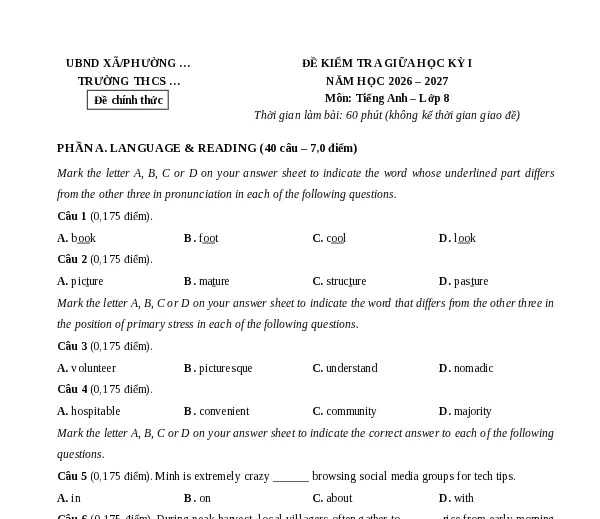
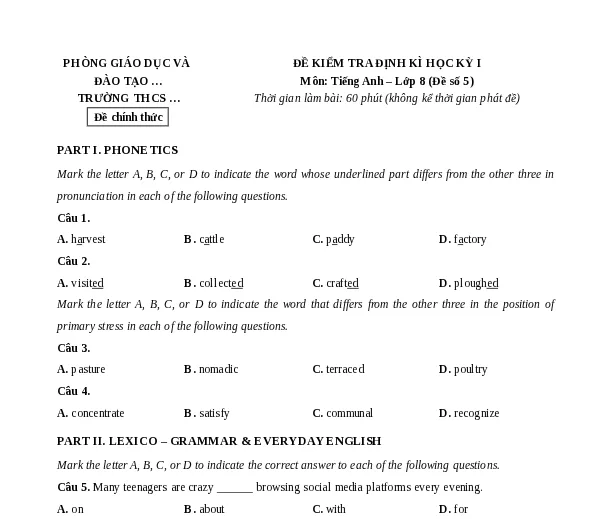
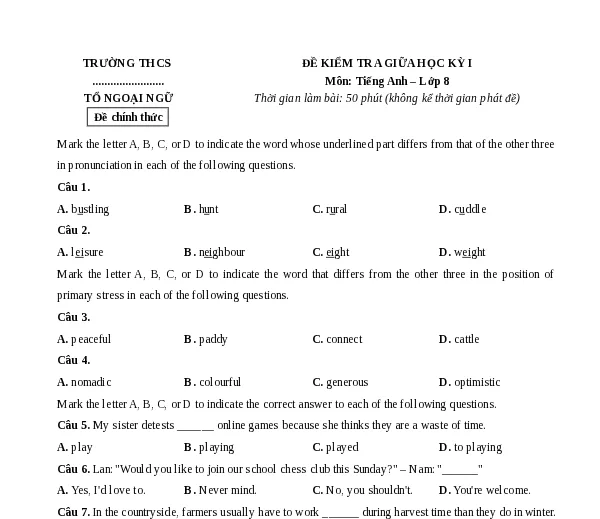
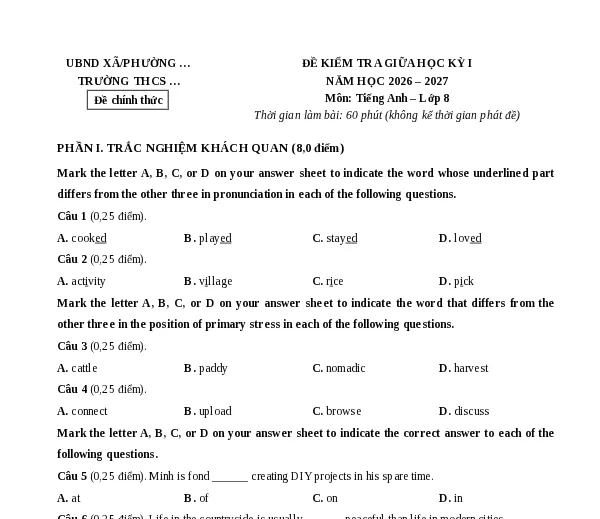
Câu 1. Choose the word whose underlined part is pronounced differently from the others:
A. crochet
B. ballet
C. planet
D. bouchet
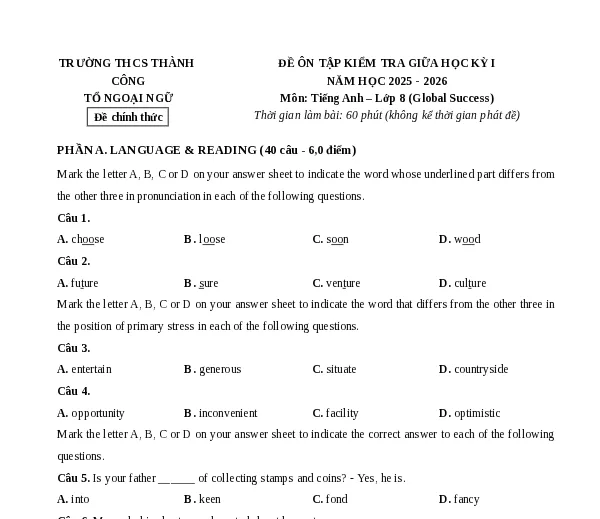
Câu 2. Choose the word which differs from the other three in the position of primary stress:
A. mature
B. nomadic
C. pastoral
D. hospitable
Câu 3. Despite the heavy rain and muddy trails, the local herdsmen managed to round up the cattle much ______ than we had anticipated.
A. more rapidly
B. rapider
C. more rapid
D. most rapidly
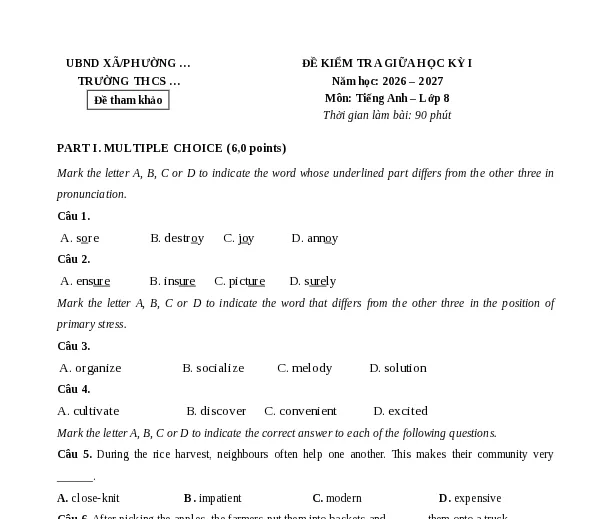
Câu 4. Minh admitted that he was hooked ______ making DIY crafts, but lately he has taken ______ origami instead.
A. in - on
B. on - up
C. with - over
D. to - in
Câu 5. The harvest was ______ poor this autumn that farmers could ______ make both ends meet.
A. such - hard
B. so - hardly
C. very - harder
D. too - hardly
Câu 6. Youngsters who suffer from cyberbullying often find it extremely difficult to ______ up to their parents about their ordeal.
A. bring
B. open
C. look
D. turn
Câu 7. I would rather you ______ so much time surfing social media forums before your midterm examinations.
A. didn't waste
B. not waste
C. don't waste
D. won't waste
Câu 8. The school guidance ______ gave invaluable advice to teenagers dealing with acute anxiety and peer pressure.
A. council
B. counsel
C. counsellor
D. councillor
Câu 9. Living in a mountainous village, ethnic minority children have to travel ______ to school than their urban counterparts.
A. farther
B. further
C. more far
D. father
Câu 10. Susan prefers browsing teen forums to discuss school projects ______ participating in outdoor sports clubs.
A. rather than
B. than
C. to
D. instead
Câu 11. While walking across the vast paddy fields, we stopped ______ the breathtaking sunset behind the distant mountain ranges.
A. admiring
B. to admire
C. admire
D. to admiring
Câu 12. Not only ______ skillfully on the farm, but he also excels in traditional folk games.
A. does he work
B. he works
C. works he
D. he does work
Câu 13. Teenagers are prone to making rash decisions, ______ they are given proper guidance by experienced mentors.
A. unless
B. if
C. provided that
D. as long as
Câu 14. The villagers welcomed the foreign volunteer group with genuine warm ______ and hospitality.
A. hearty
B. heartiness
C. heart
D. heartful
Câu 15. My younger brother used to detest ______ early, but now he is gradually accustomed to ______ before sunrise to herd buffaloes.
A. wake - rise
B. waking - rise
C. waking - rising
D. wake - rising
Câu 16. The newly designed clubhouse offers ______ facilities for leisure pursuits than the dilapidated old youth center.
A. far more better
B. by far better
C. substantially better
D. more well
Câu 17. Lan is extremely stressed out because she cannot ______ with the high expectations from both her parents and teachers.
A. keep pace
B. put up
C. catch out
D. come down
Câu 18. In rural areas, modern machinery has ______ lightened the burden of manual labor for farmers during harvest time.
A. considerately
B. considerable
C. considerably
D. consideration
Câu 19. Neither the village elders nor the local boy ______ willing to reveal the ancient secret of their traditional pottery craft.
A. was
B. were
C. are
D. have been
Câu 20. It is no good ______ teenagers to abandon smartphones when their peers use them constantly for group study.
A. to persuade
B. persuading
C. persuade
D. in persuading
SECTION II. WORD FORMATION (10 questions)
Supply the correct form of the words in brackets to complete each sentence.
Câu 21. Many teenagers experience extreme bouts of [SECURE] ______ because they constantly compare their everyday lives to the polished photos on social media.
Câu 22. The vast green pastures dotted with traditional wooden huts created an [ENCHANT] ______ picturesque rural landscape.
Câu 23. It is universally acknowledged that prolonged computer gaming can lead to severe behavioral [ADDICT] ______.
Câu 24. To prevent school violence, teachers should teach students how to resolve peer conflicts [VIOLENCE] ______.
Câu 25. The local authorities are taking decisive measures to prevent youngsters from falling prey to [BULLY] ______ on virtual networks.
Câu 26. The nomadic people rely predominantly on livestock breeding for their [LIVELY] ______.
Câu 27. Despite their modest background, the villagers displayed an astonishing level of [HOSPITABLE] ______ toward stranded travelers.
Câu 28. Due to poor soil condition, the crop yielded [DISAPPOINT] ______ low amounts of grain this season.
Câu 29. Some teenagers find it difficult to voice their genuine feelings because they fear being [UNDERSTAND] ______ by their peers.
Câu 30. The tranquil atmosphere of the countryside serves as a wonderful [COUNTER] ______ to the hustle and bustle of city life.
SECTION III. GUIDED CLOZE TEST (10 questions)
Read the following passages and mark the letter A, B, C, or D on your answer sheet to indicate the correct word or phrase that best fits each of the numbered blanks.
Passage 1 (Questions 31 – 35): Life in the Steppes
The nomadic lifestyle in the Central Asian steppes has remained largely unchanged for centuries. Unlike settled urbanites who are constantly racing against time, nomads live (31)______ with nature. Their primary occupation revolves around herding horses, cattle, and sheep across vast, unfenced grasslands. During seasonal migrations, they dismantle their circular felt tents, known as yurts, and pack them onto camels (32)______ than ordinary tourists might imagine. However, the youth of nomadic tribes are now facing a severe cultural (33)______. As satellite television and the internet penetrate remote camps, teenagers are increasingly tempted by the conveniences of urban life. Some choose to abandon the harsh steppes to seek higher education, (34)______ others struggle to balance ancestral customs with modernity. It remains uncertain whether this centuries-old heritage can survive (35)______ the relentless tide of technological advancement.
Câu 31.
A. in harmony
B. under pressure
C. on purpose
D. at risk
Câu 32.
A. more expeditiously
B. more expeditious
C. expeditiouslier
D. most expeditiously
Câu 33.
A. puzzle
B. dilemma
C. conflict
D. debate
Câu 34.
A. because
B. while
C. therefore
D. despite
Câu 35.
A. against
B. into
C. towards
D. over
Passage 2 (Questions 36 – 40): The Modern Adolescent Dilemma
In recent years, the psychological well-being of secondary school students has sparked nationwide concern. With academic curricula becoming increasingly demanding, adolescents are compelled to work (36)______ than ever before to secure top rankings. This constant pressure does not originate solely from schools; ambitious parents frequently enroll their offspring in endless evening coaching classes, effectively depriving them (37)______ vital leisure hours. Deprived of recreational activities and adequate sleep, young students can easily fall into states of clinical exhaustion. Furthermore, the ubiquitous presence of social networking sites exacerbates (38)______ comparisons. Teenagers witness curated snippets of their friends’ achievements and begin to feel inadequate. To counter this alarming phenomenon, educational experts urge parents to stop (39)______ excessive expectations on their children and instead cultivate a nurturing home environment where adolescents feel valued (40)______ their academic accomplishments.
Câu 36.
A. hardly
B. harder
C. more hard
D. more hardly
Câu 37.
A. from
B. of
C. with
D. in
Câu 38.
A. toxic
B. fertile
C. nutritious
D. harmless
Câu 39.
A. to impose
B. imposing
C. impose
D. to imposing
Câu 40.
A. irrespective of
B. in view of
C. in case of
D. with respect to
SECTION IV. ERROR IDENTIFICATION (5 questions)
Mark the letter A, B, C, or D on your answer sheet to indicate the underlined part that contains an error in each of the following sentences.
Câu 41. The agricultural experts advised (A) the local farmers to cultivate (B) drought-resistant crops more efficient (C) during the dry season to minimize financial losses (D).
Câu 42. Although (A) living in a remote (B) pastoral hamlet, Nam is much more well-informed (C) about global teenage trends than (D) his city cousins.
Câu 43. Susan admitted (A) that she would prefer (B) surfing the Internet for online study resources rather than (C) to attend (D) supplementary tuition classes.
Câu 44. Due to her (A) severe exam anxiety, Mai could hard (B) recall any formula even though (C) she had revised them thoroughly (D) the night before.
Câu 45. Neither the school counselor nor (A) the homeroom teachers was (B) capable of persuading (C) the rebellious teenager to stop to bully (D) his peers.
SECTION V. SENTENCE TRANSFORMATION (5 questions)
Rewrite each of the following sentences in such a way that it means exactly the same as the original sentence, using the cues provided.
Câu 46. Driving a combine harvester on rough terrain is far more difficult than ploughing fields with water buffaloes.
Ploughing fields with water buffaloes is nowhere ________________________________________
Câu 47. Peter would rather browse craft websites than play online computer games with his classmates.
Peter prefers ____________________________________________________________________
Câu 48. As the harvest season approaches, the countryside folk become increasingly occupied with agricultural chores.
The closer the harvest season _____________________________________________________
Câu 49. John cannot run as quickly as the other boys in his rural village football team.
John runs _______________________________________________________________________
Câu 50. It is completely pointless to compel teenagers to follow hobbies they genuinely detest.
There is no ______________________________________________________________________
--------- HẾT ---------
Họ và tên thí sinh: ............................................................................ Số báo danh: .......................................
TRƯỜNG THCS CHUYÊN / CHẤT LƯỢNG CAO
TỔ TIẾNG ANH
Hướng dẫn chấm chính thức
ĐÁP ÁN VÀ HƯỚNG DẪN GIẢI CHI TIẾT
Môn: Tiếng Anh – Lớp 8 (Chương trình Global Success)
Đề kiểm tra nâng cao Giữa học kỳ I (Thời gian: 60 phút)
HƯỚNG DẪN GIẢI CHI TIẾT & BÌNH LUẬN BẪY NGỮ PHÁP
A. BẢNG ĐÁP ÁN TỔNG HỢP
1. Bảng đáp án trắc nghiệm khách quan (Section I, III, IV)
Câu | 1 | 2 | 3 | 4 | 5 | 6 | 7 | 8 | 9 | 10 |
|---|---|---|---|---|---|---|---|---|---|---|
Đáp án | C | C | A | B | B | B | A | C | A | C |
Câu | 11 | 12 | 13 | 14 | 15 | 16 | 17 | 18 | 19 | 20 |
|---|---|---|---|---|---|---|---|---|---|---|
Đáp án | B | A | A | B | C | C | A | C | A | B |
Câu | 31 | 32 | 33 | 34 | 35 | 36 | 37 | 38 | 39 | 40 |
|---|---|---|---|---|---|---|---|---|---|---|
Đáp án | A | A | B | B | A | B | B | A | B | A |
Câu | 41 | 42 | 43 | 44 | 45 |
|---|---|---|---|---|---|
Đáp án | C | C | B | B | D |
2. Bảng đáp án tự luận (Section II & Section V)
Câu | Đáp án gợi ý | Điểm |
|---|---|---|
Câu 21 | insecurity / insecurities | 0,2 |
Câu 22 | enchantingly | 0,2 |
Câu 23 | addiction / addictions | 0,2 |
Câu 24 | non-violently / nonviolently | 0,2 |
Câu 25 | bullying / cyberbullying | 0,2 |
Câu 26 | livelihood / livelihoods | 0,2 |
Câu 27 | hospitality | 0,2 |
Câu 28 | disappointingly | 0,2 |
Câu 29 | misunderstood | 0,2 |
Câu 30 | counterbalance / counterweight | 0,2 |
Câu 46 | Ploughing fields with water buffaloes is nowhere near as/so difficult as driving a combine harvester on rough terrain. | 0,2 |
Câu 47 | Peter prefers browsing craft websites to playing online computer games with his classmates. | 0,2 |
Câu 48 | The closer the harvest season approaches / gets / comes, the more occupied the countryside folk become with agricultural chores. | 0,2 |
Câu 49 | John runs more slowly than the other boys in his rural village football team. (hoặc: the slowest of/among the boys...) | 0,2 |
Câu 50 | There is no point (in) compelling teenagers to follow hobbies they genuinely detest. | 0,2 |
B. GIẢI THÍCH CHI TIẾT TỪNG CÂU & PHÂN TÍCH BẪY NGỮ PHÁP
SECTION I. LEXICO-GRAMMAR & PRONUNCIATION TRAPS
Câu 1. Đáp án C
- Giải thích:
- crochet phát âm là /ˈkrəʊʃeɪ/ (từ mượn tiếng Pháp, đuôi -et phát âm là /eɪ/).
- ballet phát âm là /ˈbæleɪ/ (đuôi -et phát âm là /eɪ/).
- bouchet / sachet phát âm là /ˈbuːʃeɪ/ hoặc /ˈsæʃeɪ/ (đuôi -et phát âm là /eɪ/).
- planet phát âm là /ˈplænɪt/ (đuôi -et phát âm là /ɪt/).
- Phương án C khác biệt.
Câu 2. Đáp án C
- Giải thích:
- mature /məˈtʃʊə(r)/: trọng âm rơi vào âm tiết thứ 2.
- nomadic /nəʊˈmædɪk/: từ có hậu tố -ic, trọng âm rơi vào âm tiết đứng ngay trước nó âm tiết thứ 2.
- hospitable /hɒˈspɪtəbl/: trọng âm rơi vào âm tiết thứ 2 (hoặc âm tiết thứ 1 trong Anh - Mỹ /ˈhɒspɪtəbl/, tuy nhiên trong hệ chuẩn Anh - Anh thi chuyên thường xét /hɒˈspɪtəbl/ âm 2).
- pastoral /ˈpɑːstərəl/: trọng âm rơi vào âm tiết thứ 1.
- Phương án C có trọng âm rơi vào âm tiết thứ nhất, các từ còn lại rơi vào âm tiết thứ hai.
Câu 3. Đáp án A
- Giải thích: Động từ chính cần bổ nghĩa là cụm động từ round up (tập hợp đàn gia súc), do đó ta phải dùng trạng từ rapidly. So sánh hơn của trạng từ nhiều âm tiết là more rapidly. Cụm much đóng vai trò là phó từ chỉ mức độ dùng để nhấn mạnh so sánh hơn (much + comparative).
- Bẫy: Nhiều học sinh nhầm rapid là tính từ ngắn hoặc quên dùng trạng từ bổ nghĩa cho động từ nên chọn nhầm rapider hoặc more rapid.
Câu 4. Đáp án B
- Giải thích:
- Cụm cố định: be hooked on + V-ing/N (say mê, nghiện điều gì).
- Phrasal verb: take up + hobby/sport (bắt đầu một thói quen, sở thích mới).
- Cặp giới từ chính xác là on - up.
Câu 5. Đáp án B
- Giải thích:
- Vế đầu: Cấu trúc kết quả với tính từ poor: so + adj + that (so poor that = nghèo nàn đến nỗi mà).
- Vế sau: Cụm thành ngữ make both ends meet (giật gấu vá vai, kiếm đủ sống). Cần một trạng từ mang nghĩa phủ định "hầu như không thể": hardly (= almost not).
- Bẫy: Nhầm lẫn giữa hard (chăm chỉ/vất vả) và hardly (hầu như không). Nếu dùng hard thì câu sẽ thành "có thể kiếm sống một cách chăm chỉ", hoàn toàn sai ngữ nghĩa câu.
Câu 6. Đáp án B
- Giải thích: Cụm động từ open up to somebody (about something) mang nghĩa là "mở lòng, giãi bày tâm sự thành thật với ai về điều gì".
- Các phương án khác không phù hợp ngữ cảnh: bring up (nuôi nấng, đề cập), look up to (kính trọng), turn up (xuất hiện, vặn to).
Câu 7. Đáp án A
- Giải thích: Cấu trúc giả định với would rather:
Cấu trúc này dùng để diễn tả mong muốn một người khác làm hoặc không làm điều gì ở hiện tại/tương lai. Dạng phủ định là didn't + V (bare) didn't waste.
Câu 8. Đáp án C
- Giải thích:
- Cần danh từ chỉ người làm chủ ngữ đi cùng tính từ school guidance: guidance counsellor (chuyên viên tư vấn tâm lý học đường).
- Phân biệt: council (hội đồng), councillor (ủy viên hội đồng), counsel (sự tư vấn / lời khuyên - danh từ không đếm được). Động từ phía sau là gave invaluable advice chỉ có counsellor là phù hợp nhất.
Câu 9. Đáp án A
- Giải thích: Khoảng cách từ nhà đến trường là khoảng cách không gian địa lý cụ thể, do đó ta dùng dạng so sánh hơn farther.
- Phân biệt: further thiên về mức độ trừu tượng, thông tin thêm hoặc chiều sâu nghiên cứu (ví dụ: further information, further discussion).
Câu 10. Đáp án C
- Giải thích: Cấu trúc yêu thích:
(thích làm việc gì hơn làm việc gì khác). Không dùng than hay rather than với động từ prefer khi nối hai danh động từ.
Câu 11. Đáp án B
- Giải thích:
- stop to-V: dừng việc đang làm lại ĐỂ làm một việc khác (chỉ mục đích).
- stop V-ing: dừng hẳn/từ bỏ một hành động đang diễn ra.
- Ngữ cảnh: "Khi đang đi bộ qua cánh đồng lúa, chúng tôi dừng lại ĐỂ ngắm nhìn cảnh hoàng hôn tuyệt đẹp" dùng to admire.
Câu 12. Đáp án A
- Giải thích: Đảo ngữ với cụm từ phủ định đứng đầu câu:
Chủ ngữ he ở thì hiện tại đơn mượn trợ động từ does does he work.
Câu 13. Đáp án A
- Giải thích:
- unless = if ... not (trừ khi).
- Nghĩa cả câu: "Thanh thiếu niên rất dễ đưa ra những quyết định bồng bột, nông nổi, trừ khi các em nhận được sự định hướng đúng đắn từ những người hướng dẫn giàu kinh nghiệm."
Câu 14. Đáp án B
- Giải thích: Cấu trúc song hành với liên từ and: hospitality là danh từ, phía trước có tính từ warm, do đó chỗ trống phải là một danh từ: heartiness (sự nhiệt tình, chân tình nồng hậu). Cụm warm heartiness and hospitality là cụm diễn đạt tự nhiên.
Câu 15. Đáp án C
- Giải thích:
- Động từ detest (cực kỳ ghét) bắt buộc đi với V-ing detest waking.
- Cấu trúc quen với việc gì: be/get accustomed to + V-ing accustomed to rising.
Câu 16. Đáp án C
- Giải thích:
- better đã là dạng so sánh hơn của good, không dùng far more better (thừa more).
- more well là sai ngữ pháp.
- by far thường đi với so sánh nhất (by far the best), rất hiếm khi đi trực tiếp với so sánh hơn đứng trước danh từ mà không có the.
- substantially (rất nhiều, đáng kể) là phó từ bổ nghĩa chuẩn mực cho tính từ so sánh hơn: substantially better facilities (cơ sở vật chất tốt hơn đáng kể).
Câu 17. Đáp án A
- Giải thích:
- keep pace with: theo kịp, bắt kịp (tiến độ, kỳ vọng, sự phát triển).
- put up with: chịu đựng ai/cái gì tồi tệ.
- catch out: bắt quả tang, làm ai bối rối.
- come down with: mắc bệnh.
- Ngữ cảnh: Lan kiệt sức vì không thể theo kịp/đáp ứng được kỳ vọng quá cao từ cha mẹ và thầy cô chọn A.
Câu 18. Đáp án C
- Giải thích: Chỗ trống đứng giữa trợ động từ has và quá khứ phân từ lightened, do đó cần một trạng từ bổ nghĩa cho động từ.
- considerably (adv): một cách đáng kể, rất nhiều.
- considerately (adv): một cách chu đáo, ân cần (không phù hợp nghĩa giảm bớt sức nặng công việc).
Câu 19. Đáp án A
- Giải thích: Cấu trúc Neither S1 nor S2 + V: Động từ hòa hợp theo chủ ngữ thứ hai ().
- là the local boy (danh từ số ít), ngữ cảnh kể lại sự việc trong quá khứ dùng động từ số ít ở quá khứ: was.
Câu 20. Đáp án B
- Giải thích: Cấu trúc cố định:
(Thật vô ích / Chẳng ích gì khi làm gì) persuading.
SECTION II. WORD FORMATION
Câu 21. insecurity / insecurities
- Vị trí ngữ pháp: Sau giới từ of cần một danh từ. Bouts of insecurity nghĩa là "những cơn bất an, cảm giác tự ti, không an tâm".
- Biến đổi: Từ gốc SECURE (adj/v) danh từ chỉ cảm xúc tiêu cực là insecurity (hoặc số nhiều insecurities).
Câu 22. enchantingly
- Vị trí ngữ pháp: Đứng trước tính từ picturesque (đẹp như tranh vẽ), cần một trạng từ bổ nghĩa cho tính từ đó.
- Biến đổi: ENCHANT (v) enchanting (adj) enchantingly (adv) mang nghĩa "đẹp một cách mê hoặc, say đắm".
Câu 23. addiction / addictions
- Vị trí ngữ pháp: Sau tính từ behavioral cần một danh từ để tạo thành cụm danh từ behavioral addiction (chứng nghiện hành vi).
- Biến đổi: ADDICT (n/v) addiction (n).
Câu 24. non-violently / nonviolently
- Vị trí ngữ pháp: Đứng sau động từ và tân ngữ resolve peer conflicts (giải quyết mâu thuẫn bạn bè), cần một trạng từ thể cách. Về mặt ý nghĩa, để ngăn chặn bạo lực học đường thì phải giải quyết mâu thuẫn một cách "hòa bình, không dùng bạo lực".
- Biến đổi: VIOLENCE (n) violent (adj) tiền tố phủ định non-violent trạng từ non-violently.
Câu 25. bullying / cyberbullying
- Vị trí ngữ pháp: Sau cụm fall prey to (trở thành nạn nhân của) cần một danh từ chỉ hành vi nguy hại.
- Biến đổi: BULLY (v/n) danh động từ/danh từ chỉ hiện tượng: bullying (hành vi bắt nạt) hoặc cyberbullying (bắt nạt trên mạng ảo do có cụm on virtual networks).
Câu 26. livelihood / livelihoods
- Vị trí ngữ pháp: Sau tính từ sở hữu their cần một danh từ. Cụm từ cố định: depend/rely on something for one's livelihood (dựa vào cái gì để mưu sinh/làm kế sinh nhai).
- Biến đổi: LIVELY (adj) danh từ livelihood.
Câu 27. hospitality
- Vị trí ngữ pháp: Cụm an astonishing level of + N: cần danh từ chỉ phẩm chất tốt đẹp.
- Biến đổi: HOSPITABLE (adj) danh từ hospitality (lòng hiếu khách).
Câu 28. disappointingly
- Vị trí ngữ pháp: Đứng trước tính từ low (thấp) cần một trạng từ bổ nghĩa: disappointingly low (thấp một cách đáng thất vọng).
- Biến đổi: DISAPPOINT (v) disappointing (adj) disappointingly (adv).
Câu 29. misunderstood
- Vị trí ngữ pháp: Cấu trúc bị động sau động từ fear: fear being + V3/ed (sợ bị hiểu lầm).
- Biến đổi: UNDERSTAND tiền tố trái nghĩa mang nghĩa hiểu sai: misunderstand phân từ hai bất quy tắc: misunderstood.
Câu 30. counterbalance / counterweight
- Vị trí ngữ pháp: Sau mạo từ và tính từ a wonderful [COUNTER] ______ to cần một danh từ. Cụm từ mang nghĩa "đối trọng, nhân tố cân bằng lại" cho sự hối hả nơi phố thị.
- Biến đổi: COUNTER (v/adv) danh từ ghép counterbalance hoặc counterweight. Cụm serve as a counterbalance to something là cách dùng từ nâng cao rất phổ biến.
SECTION III. GUIDED CLOZE TEST
Passage 1: Life in the Steppes
- Câu 31. Đáp án A: Cụm từ cố định live in harmony with nature (sống hòa hợp, chan hòa với thiên nhiên). Các cụm khác sai nghĩa: under pressure (chịu áp lực), on purpose (cố ý), at risk (gặp nguy hiểm).
- Câu 32. Đáp án A: Bổ nghĩa cho động từ pack (thu dọn, đóng gói) cần một trạng từ expeditiously (nhanh chóng, khẩn trương). Dạng so sánh hơn của trạng từ dài là more expeditiously.
- Câu 33. Đáp án B: Cụm từ cultural dilemma (thế tiến thoái lưỡng nan về mặt văn hóa), khi thế hệ trẻ đứng giữa việc giữ gìn truyền thống du mục hay đi theo lối sống hiện đại.
- Câu 34. Đáp án B: Liên từ while dùng để nối hai mệnh đề diễn tả hai sự việc tương phản, đối lập nhau trong cùng một thời điểm: "Một số chọn rời thảo nguyên..., trong khi những người khác chật vật cân bằng...".
- Câu 35. Đáp án A: Cụm động từ survive against something (tồn tại, đứng vững trước sức ép/nguy cơ nào đó).
Passage 2: The Modern Adolescent Dilemma
- Câu 36. Đáp án B: Động từ work đi với trạng từ hard (chăm chỉ). Dạng so sánh hơn của hard là harder (không dùng more hard hay hardly).
- Câu 37. Đáp án B: Cấu trúc cố định:
(tước đoạt, lấy đi của ai điều gì).
- Câu 38. Đáp án A: Cụm từ toxic comparisons (những sự so so sánh độc hại, tiêu cực gây tổn thương tâm lý).
- Câu 39. Đáp án B: Cấu trúc stop + V-ing (ngừng hẳn hành động áp đặt kỳ vọng lên con cái).
- Câu 40. Đáp án A: Cụm từ liên kết irrespective of (= regardless of: bất kể, không phân biệt thành tích học tập thế nào).
SECTION IV. ERROR IDENTIFICATION
Câu 41. Đáp án C
- Lỗi sai: more efficient sửa thành more efficiently.
- Giải thích: Cần một trạng từ bổ nghĩa cho động từ hành động cultivate (canh tác cây trồng chịu hạn một cách hiệu quả hơn).
Câu 42. Đáp án C
- Lỗi sai: much more well-informed sửa thành much better-informed.
- Giải thích: Dạng so sánh hơn của tính từ ghép chứa well- (well-informed) được tạo thành bằng cách biến đổi well thành better better-informed. Dùng more well-informed là sai quy tắc cấu tạo so sánh.
Câu 43. Đáp án B
- Lỗi sai: would prefer sửa thành preferred (hoặc cấu trúc prefers).
- Giải thích:
- Would prefer bắt buộc đi với động từ nguyên mẫu có to (would prefer to do sth rather than do sth).
- Đằng sau câu dùng dạng danh động từ surfing, do đó động từ chính phải là preferred (thuộc thì quá khứ lùi thì sau admitted): admitted that she preferred surfing ... to attending. (Trong trường hợp người ra đề giữ rather than, ta nhận diện ngay lỗi sai mấu chốt nằm ở would prefer không thể đi trực tiếp với danh động từ surfing).
Câu 44. Đáp án B
- Lỗi sai: hard sửa thành hardly.
- Giải thích: Hardly là phó từ phủ định mang nghĩa "hầu như không thể nhớ được công thức nào" (could hardly recall). Dùng hard sai hoàn toàn về mặt ngữ nghĩa và vị trí của trạng từ chỉ mức độ trước động từ chính.
Câu 45. Đáp án D
- Lỗi sai: to bully sửa thành bullying.
- Giải thích: Cụm từ stop + V-ing mang nghĩa "dừng/chấm dứt hành vi bắt nạt bạn bè". Nếu dùng stop to-V câu sẽ mang nghĩa vô lý: "dừng lại để bắt đầu bắt nạt bạn".
SECTION V. SENTENCE TRANSFORMATION
Câu 46.
- Đề bài: Driving a combine harvester on rough terrain is far more difficult than ploughing fields with water buffaloes. (Lái máy gặt đập liên hợp trên địa hình gồ ghề khó hơn nhiều so với việc cày ruộng bằng trâu nước.)
- Cấu trúc áp dụng: Chuyển từ so sánh hơn nhiều sang so sánh không bằng với cụm nhấn mạnh nowhere near as/so + adj + as (còn lâu mới bằng / không thể nào bằng được).
- Đáp án: Ploughing fields with water buffaloes is nowhere near as difficult as driving a combine harvester on rough terrain. (chấp nhận dùng "so difficult as")
Câu 47.
- Đề bài: Peter would rather browse craft websites than play online computer games with his classmates.
- Cấu trúc áp dụng:
- Đáp án: Peter prefers browsing craft websites to playing online computer games with his classmates.
Câu 48.
- Đề bài: As the harvest season approaches, the countryside folk become increasingly occupied with agricultural chores.
- Cấu trúc áp dụng: So sánh kép càng... càng... (The comparative..., the comparative...):
- Đáp án: The closer the harvest season approaches (hoặc: comes / gets), the more occupied the countryside folk become with agricultural chores.
Câu 49.
- Đề bài: John cannot run as quickly as the other boys in his rural village football team. (John không thể chạy nhanh bằng các cậu bé khác...)
- Cấu trúc áp dụng: Đổi từ so sánh không bằng sang so sánh hơn với trạng từ trái nghĩa more slowly hoặc so sánh nhất the slowest.
- Đáp án: John runs more slowly than the other boys in his rural village football team.
(Hoặc: John runs the slowest of/among all the boys in his rural village football team.)
Câu 50.
- Đề bài: It is completely pointless to compel teenagers to follow hobbies they genuinely detest.
- Cấu trúc áp dụng:
- Đáp án: There is no point (in) compelling teenagers to follow hobbies they genuinely detest.
--------- HẾT HƯỚNG DẪN CHẤM ---------