PHÒNG GIÁO DỤC VÀ ĐÀO TẠO
KỲ THI CHỌN HỌC SINH GIỎI CẤP HUYỆN
Đề chính thức
ĐỀ THI CHỌN HỌC SINH GIỎI LỚP 8 THCS
Môn: TIẾNG ANH
Thời gian làm bài: 120 phút (không kể thời gian giao đề)
PART I. LISTENING (15.0 points)
Section 1 (Questions 1 – 5)
You will hear a man called Dan Pearman, talking on the radio about Pedal Power, a UK charity which sends bicycles to people in developing countries. Listen and choose the correct letter A, B, or C for each question. You will hear the recording twice.
Question 1. In 1993, Dan Pearman went to Ecuador ______
A. as a tourist guide
B. as part of his studies
C. as voluntary work
Question 2. Dan's neighbour was successful in business because he ______
A. employed carpenters from the area
B. was the most skilled craftsman in the town
C. found it easy to reach customers
Question 3. Dan says the charity relies on ______
A. getting enough bicycles to send regularly
B. finding new areas which need bicycles
C. charging for the bicycles it sends abroad
Question 4. What does Dan say about the town of Rivas?
A. It has received the greatest number of bikes.
B. Its economy has been totally transformed.
C. It has almost as many bikes as Amsterdam.
Question 5. What problem did the charity face in August 2000?
A. It couldn't meet its overheads.
B. It had to delay sending the bikes.
C. It was criticized in the British media.
Section 2 (Questions 6 – 15)
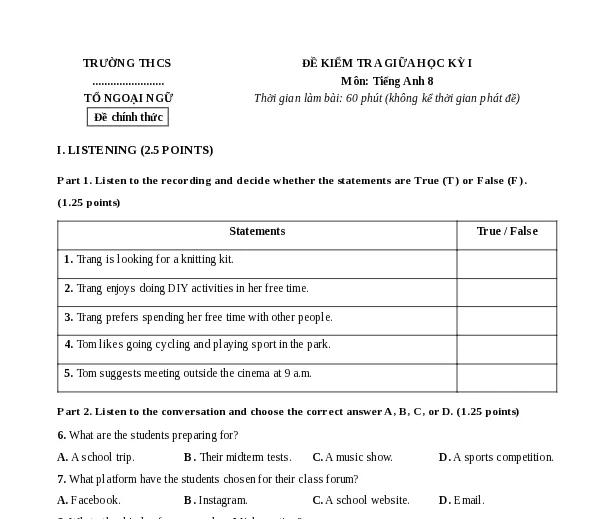
You will hear a conversation between two students, Maddie and John, who are planning a biology experiment. Listen and fill in each blank with ONE WORD ONLY. You will hear the recording twice.
Experiment Planning Form | |
|---|---|
Experimental hypothesis | |
That human activity (6) ______ on crabs at the beach | |
Variables | |
Visitor numbers | overall number of visitors |
Time of day | changes in number of people and (7) ______ level |
(8) ______ rubbish | left by visitors to the beach |
Constants | |
- (9) ______ rubbish | |
- boat pollution | |
Available beaches and usage levels | |
Main town beach | high use |
Beach over the hill | little use |
Sandy Point | no use; (10) ______ |
Experimental methods | |
Count crab holes: | |
- over a set time (11) ______ | |
- in a defined area of sand | |
- the same (12) ______ from the sea | |
Equipment (3 of each) | |
- measuring (13) ______, balls of string, small posts | |
- mobile phones to check that we start and stop at the same time | |
- stop watches for timing | |
- (14) ______ to see at night | |
Observations | |
- Initial time period: one hour / day and night | |
- Total observation period: 20 hours over a (15) ______ |
PART II. PHONETICS (10.0 points)
Section 1 (Questions 16 – 20)
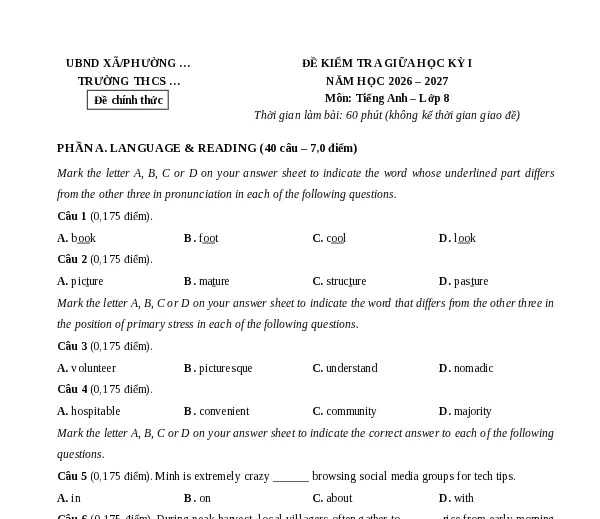
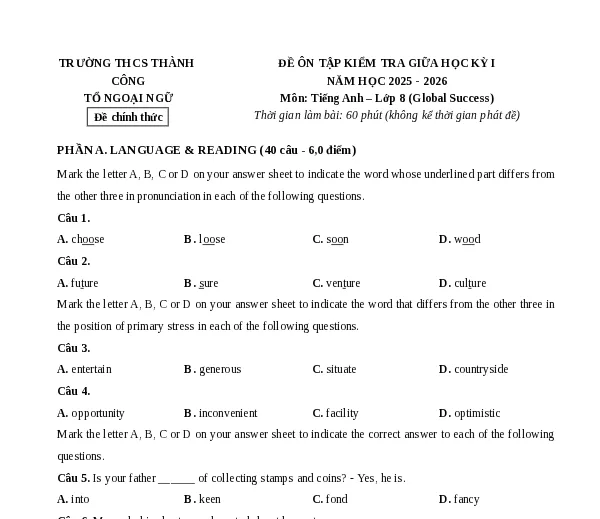
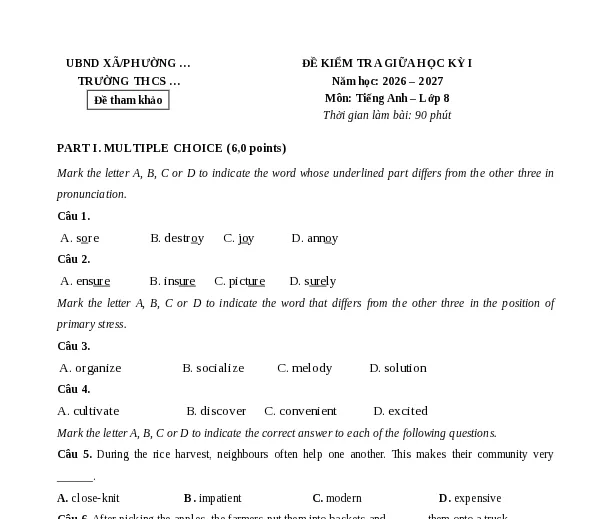
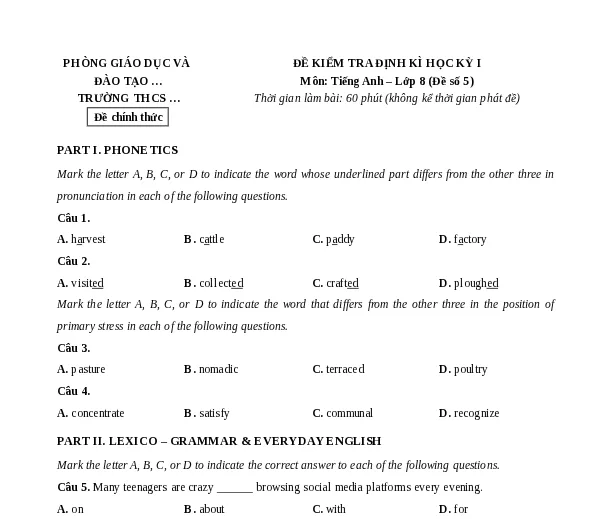
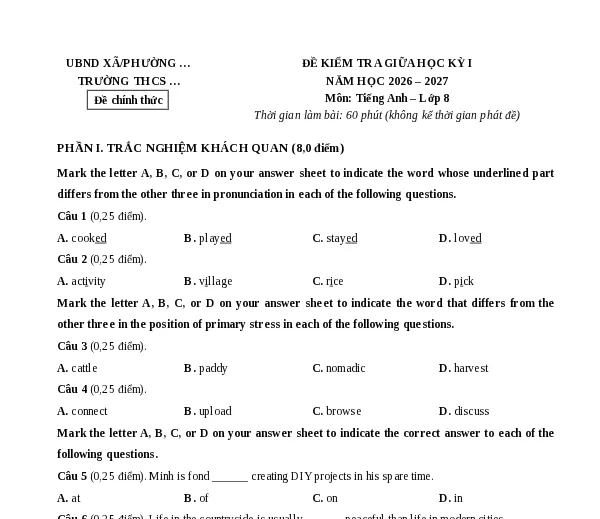
Mark the letter A, B, C, or D on your answer sheet to indicate the word whose underlined part differs from the other three in pronunciation in each of the following questions.
Question 16.
A. break
B. heavy
C. steady
D. head
Question 17.
A. architect
B. chemistry
C. machine
D. school
Question 18.
A. naked
B. crooked
C. hooked
D. wicked
Question 19.
A. laughs
B. coughs
C. breathes
D. drops
Question 20.
A. southern
B. cousin
C. flourish
D. poultry
Section 2 (Questions 21 – 25)
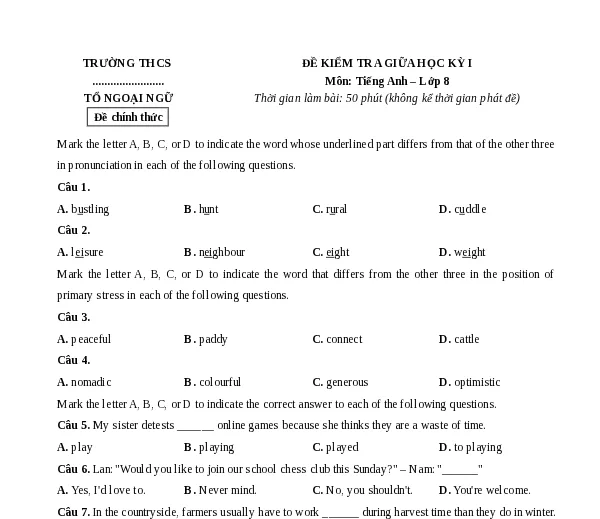
Mark the letter A, B, C, or D on your answer sheet to indicate the word that differs from the other three in the position of primary stress in each of the following questions.
Question 21.
A. scientific
B. energetic
C. atmospheric
D. politics
Question 22.
A. intuition
B. comprehension
C. application
D. television
Question 23.
A. community
B. electricity
C. opportunity
D. curiosity
Question 24.
A. adventurous
B. anonymous
C. simultaneous
D. miraculous
Question 25.
A. biology
B. methodology
C. archaeology
D. technology
PART III. LEXICO-GRAMMAR (25.0 points)
Section 1 (Questions 26 – 35)
Mark the letter A, B, C, or D on your answer sheet to indicate the correct answer to each of the following questions.
Question 26. If he ______ his doctor's advice last month, he ______ so frail now.
A. followed / wouldn't be
B. had followed / wouldn't have been
C. had followed / wouldn't be
D. follows / won't be
Question 27. No sooner ______ home from the voluntary trip ______ it started pouring with rain.
A. had we returned / than
B. we had returned / when
C. did we return / that
D. had we returned / when
Question 28. It is essential that every citizen ______ single-use plastics to protect the marine ecosystem.
A. reduces
B. reduce
C. will reduce
D. reduced
Question 29. You ______ so much fast food for the gathering; nearly half of it was left untouched.
A. didn't need to buy
B. shouldn't buy
C. needn't have bought
D. mustn't have bought
Question 30. The ancient communal house is said ______ by the villagers in the early eighteenth century.
A. to build
B. to have built
C. to be built
D. to have been built
Question 31. ______ he was after a long day of voluntary work, he still helped the villagers clean the canals.
A. Exhausted as
B. In spite of exhausted
C. Although exhaustion
D. As exhausted
Question 32. The robotic device ______ by the eighth-grade students won first prize at the national science fair.
A. designing
B. designed
C. was designed
D. which designed
Question 33. By the time the charity convoy reached the isolated village, the flood victims ______ without clean water for two days.
A. have been
B. were
C. had been
D. would be
Question 34. To maintain a healthy lifestyle, teenagers should ______ sugar intake and ______ outdoor activities.
A. cut down on / take up
B. run out of / put off
C. keep up with / give in
D. come down with / turn down
Question 35. The school environmental club launched a campaign to ______ awareness of sorting household waste.
A. rise
B. raise
C. lift
D. boost
Section 2 (Questions 36 – 39)
Mark the letter A, B, C, or D on your answer sheet to indicate the word(s) CLOSEST in meaning to the underlined word(s) in each of the following questions.
Question 36. Engaging in community service fosters a deep sense of solidarity and empathy among teenagers.
A. loneliness
B. unity
C. hostility
D. competition
Question 37. Excessive screen time may detrimentally impact teenagers' physical health and academic performance.
A. adversely
B. beneficially
C. noticeably
D. marginally
Mark the letter A, B, C, or D on your answer sheet to indicate the word(s) OPPOSITE in meaning to the underlined word(s) in each of the following questions.
Question 38. The local government introduced stringent regulations to curb illegal dumping into the river.
A. strict
B. severe
C. lenient
D. rigorous
Question 39. With rapid technological advancements, smart gadgets have become indispensable to modern learners.
A. essential
B. dispensable
C. innovative
D. vital
Section 3 (Questions 40 – 42)
Read the sentences and find ONE word that can fit appropriately into all three blanks. Write your answers in the spaces provided.
Question 40.
- She decided to ______ for president of the school youth council next term.
- Regular buses to the national nature reserve ______ every thirty minutes.
- In the long ______, switching to green energy will save millions of dollars.
Answer: ............................................................
Question 41.
- Eating a nutritious diet and getting plenty of rest can help ______ your immune system.
- The warm praise from the teacher gave a huge ______ to the student's self-confidence.
- The local council introduced tax incentives to give the economy a much-needed ______.
Answer: ............................................................
Question 42.
- The voluntary health clinic is under the direct ______ of the provincial medical board.
- The courier service makes an extra ______ for delivering parcel shipments on Sundays.
- Don't forget to ______ the battery of your digital camera before the excursion tomorrow.
Answer: ............................................................
Section 4 (Questions 43 – 50)
Give the correct form of the word in brackets to complete each of the following sentences. Write your answers in the spaces provided.
Question 43. It is completely ______ to discharge untreated chemical wastewater directly into lakes. (LEGAL)
Question 44. His sudden decision to abandon the community project was totally ______ to all team members. (EXPLAIN)
Question 45. Leaving young children unattended near swimming pools is reckless and ______. (RESPONSIBLE)
Question 46. Regular physical exercise significantly reduces the risk of many ______ chronic diseases. (PREVENT)
Question 47. The voluntary organization provided ______ relief aid to families devastated by the typhoon. (MEASURE)
Question 48. The arguments presented in favour of the proposed dam project were largely ______ and biased. (CONVINCE)
Question 49. High-speed broadband connections have made global communication ______ efficient. (BELIEVE)
Question 50. The town municipality has devised an ambitious scheme to ______ the municipal library system. (MODERN)
PART IV. READING (25.0 points)
Section 1 (Questions 51 – 58)
Read the following passage and mark the letter A, B, C, or D on your answer sheet to indicate the correct word or phrase that best fits each of the numbered blanks.
In today's fast-paced digital world, leisure time has undergone a significant transformation. A generation ago, adolescents would typically (51) ______ their free time playing outdoors, riding bicycles, or participating in neighborhood team sports. Today, however, portable screens dominate the leisure hours of young individuals. (52) ______ digital gadgets provide instant entertainment and allow teens to connect with peers globally, medical experts express growing concern over the sedentary lifestyle (53) ______ with prolonged screen exposure.
Recent psychological studies suggest that excessive gadget usage is directly correlated with sleep deprivation and increased levels of anxiety. To counteract this alarming trend, many schools and community centers encourage teenagers to (54) ______ active pastimes such as gardening, volunteering, or learning an acoustic musical instrument. Engaging in such tangible pursuits helps restore a healthy psychological (55) ______.
Furthermore, physical activity has a profoundly positive (56) ______ on mood, triggering the release of endorphins that alleviate mental exhaustion. (57) ______ teenagers deliberately allocate dedicated offline intervals each day, they run the risk of alienating themselves from authentic interpersonal interactions. It is therefore critical that parents and educators collaborate to guide adolescents in reaping the genuine (58) ______ of leisure while moderating digital consumption.
Question 51.
A. spend
B. allocate
C. invest
D. consume
Question 52.
A. Despite
B. Although
C. Because
D. Moreover
Question 53.
A. associated
B. attached
C. combined
D. exposed
Question 54.
A. turn down
B. take up
C. make out
D. give up
Question 55.
A. symmetry
B. proportion
C. balance
D. equality
Question 56.
A. impact
B. impression
C. pressure
D. control
Question 57.
A. If
B. Unless
C. While
D. Since
Question 58.
A. merits
B. benefits
C. profits
D. favors
Section 2 (Questions 59 – 65)
Read the passage below and fill each numbered blank with ONE suitable word. Write your answers in the spaces provided.
Community service is increasingly recognized as an essential component of holistic education for young people. When adolescents participate in volunteer projects, (59) ______ as cleaning public beaches, planting trees, or tutoring underprivileged pupils, they acquire valuable practical skills that cannot be gained solely (60) ______ textbooks.
First and foremost, volunteering instills a profound sense (61) ______ civic responsibility. By witnessing firsthand the socioeconomic hardships faced by marginalized communities, teenagers learn to appreciate what they have and cultivate genuine empathy. (62) ______ addition, cooperative community projects afford youngsters the opportunity to work alongside people from diverse backgrounds, (63) ______ enhances their interpersonal and leadership abilities.
Research indicates that students who commit themselves to regular voluntary service tend to perform better academically. This correlation is largely attributable to the self-discipline and time management skills acquired (64) ______ balancing scholastic duties with social commitments. Above all, the intangible satisfaction derived from making a positive difference in other people's lives gives adolescents a clear sense of purpose, steering them away (65) ______ destructive habits and idle screen addictions.
Section 3 (Questions 66 – 75)
Read the following passage and choose the best answer A, B, C, or D for questions 66 – 71, and complete the summary for questions 72 – 75.
Artificial Intelligence (AI) is ushering in an unprecedented revolution across the global healthcare sector. Historically, medical diagnosis relied strictly on the expertise and intuitive deduction of trained clinicians, who meticulously examined patient symptoms and laboratory results. However, with the explosive proliferation of medical big data and advanced machine learning algorithms, computer systems can now process clinical records and radiological imagery at speeds and accuracy levels that frequently surpass human capability.
One of the most consequential breakthroughs lies in early disease detection. In oncology, AI-powered diagnostic tools are capable of analyzing thousands of mammograms or magnetic resonance images within seconds. By detecting minute cellular anomalies long before they become visible to the naked human eye, these algorithms enable physicians to intervene at the incipient stages of cancer, thereby dramatically improving patient survival rates. Furthermore, predictive analytics models are being deployed in emergency intensive care units to forecast acute organ failure hours before clinical manifestations emerge, granting healthcare staff precious time to administer life-saving therapies.
Beyond clinical diagnostics, AI is radically streamlining the pharmaceutical development pipeline. Conventionally, formulating a new therapeutic drug requires more than a decade of laboratory synthesis, clinical trials, and billions of dollars in expenditure. Today, generative AI platforms can simulate chemical molecular interactions virtually, predicting the efficacy and toxicity of experimental compounds with astonishing precision. This computational paradigm reduces the initial drug discovery timeline from several years to just a few months, rendering the production of vaccines and targeted treatments for rare illnesses economically feasible.
Nevertheless, the rapid integration of automated systems into healthcare is not devoid of ethical challenges. Chief among these is the risk of algorithmic bias. Because machine learning models are trained on historical healthcare datasets, they may inadvertently perpetuate demographic discrepancies if those records underrepresent minority populations. Moreover, the question of legal accountability remains contentious: if an AI algorithm misinterprets a scan and recommends an incorrect surgical intervention, who bears moral and legal responsibility—the software developer, the hospital, or the attending physician? Consequently, medical ethicists insist that artificial intelligence should function as an assistive tool to augment human clinicians, rather than completely supplanting their compassionate judgment.
Question 66. Which of the following best expresses the main idea of the passage?
A. The total replacement of medical doctors by advanced automated machines.
B. The transformative role and ethical dilemmas of AI in modern medicine.
C. The financial advantages of pharmaceutical manufacturing using computers.
D. The superior diagnostic accuracy of computer programs compared to doctors.
Question 67. According to paragraph 2, AI tools in oncology assist physicians primarily by ______
A. performing complex cancer surgeries autonomously
B. spotting microscopic abnormalities before human specialists can detect them
C. reducing the overall financial cost of intensive hospital treatments
D. replacing standard radiological imaging with computational simulations
Question 68. The word "incipient" in paragraph 2 is closest in meaning to ______
A. advanced
B. terminal
C. initial
D. chronic
Question 69. The word "they" in paragraph 4 refers to ______
A. historical healthcare datasets
B. machine learning models
C. minority populations
D. ethical challenges
Question 70. According to the passage, which of the following is NOT mentioned as a benefit of AI in healthcare?
A. Forecasting critical organ failure in emergency care units.
B. Accelerating the discovery timeline of novel pharmaceutical drugs.
C. Lowering the economic barrier to producing vaccines for rare diseases.
D. Eliminating all medical malpractice and human surgical errors.
Question 71. What can be inferred from the final paragraph?
A. AI systems are currently dependable enough to operate without human supervision.
B. Human doctors' empathetic and moral judgment remains irreplaceable in medicine.
C. Legal frameworks have already resolved who is responsible for AI errors.
D. Software developers should always be held legally liable for clinical misdiagnoses.
Complete the summary below. Choose NO MORE THAN ONE WORD from the passage for each answer. Write your answers in the spaces provided.
Artificial intelligence is transforming medical practices by evaluating clinical data and scans with exceptional speed. In cancer diagnosis, machine learning detects subtle anomalies at an early stage, which substantially enhances patient (72) ______ rates. In the pharmaceutical industry, algorithms simulate complex molecular interactions, making the creation of new medications both faster and economically (73) ______. Nonetheless, significant ethical concerns persist. Biased datasets can perpetuate existing health (74) ______, while questions regarding legal accountability for mistaken recommendations remain unresolved. Ultimately, AI must serve to (75) ______ human clinicians rather than replace them.
Answer:
Question 72. ............................................................
Question 73. ............................................................
Question 74. ............................................................
Question 75. ............................................................
PART V. WRITING (25.0 points)
Section 1 (Questions 76 – 83)
Finish each of the following sentences in such a way that it means exactly the same as the sentence printed before it. Write your answers in the spaces provided.
Question 76. He didn't follow a balanced diet when he was younger, so he suffers from chronic digestive problems now.
→ If he ..................................................................................................................................
Question 77. The voluntary team had just arrived at the flooded village when the storm intensified.
→ Hardly ..............................................................................................................................
Question 78. I regret not taking part in the school tree-planting campaign last weekend.
→ I wish ................................................................................................................................
Question 79. People believe that practicing mindful meditation daily relieves teenagers' academic stress.
→ Practicing mindful meditation daily ................................................................................
Question 80. Although the weather was harsh and unpredictable, the rescue workers reached the isolated community.
→ Harsh .................................................................................................................................
Question 81. As teenagers spend more time browsing digital social networks, they become more alienated from reality.
→ The more time .................................................................................................................
Question 82. The solar-powered generator which was installed by local engineers last month supplies uninterrupted electricity.
→ Installed .............................................................................................................................
Question 83. It was not necessary for you to bring heavy winter coats because the weather was exceptionally mild.
→ You needn't .......................................................................................................................
Section 2 (Questions 84 – 90)
Complete the second sentence so that it has a similar meaning to the first sentence, using the word given. DO NOT CHANGE THE WORD GIVEN. You must use between THREE and SIX words, including the word given.
Question 84. The student inventor created an ingenious solution to combat plastic contamination in the river. (CAME)
→ The student inventor ............................................................ an ingenious solution to combat plastic contamination in the river.
Question 85. You should not disclose your account credentials to strangers under any circumstances. (NO)
→ Under ............................................................ your account credentials to strangers.
Question 86. You are allowed to participate in the environmental initiative only if you attend all weekly training sessions. (PROVIDED)
→ You can participate in the environmental initiative ............................................................ to all weekly training sessions.
Question 87. It is imperative for teenagers to get at least eight hours of sound sleep every night. (ESSENTIAL)
→ It is ............................................................ at least eight hours of sound sleep every night.
Question 88. Mark used to play mobile games until midnight, but he successfully stopped this unhealthy routine. (HABIT)
→ Mark successfully ............................................................ playing mobile games until midnight.
Question 89. We rarely witness such genuine philanthropic commitment among junior secondary school students. (SELDOM)
→ Seldom ............................................................ such genuine philanthropic commitment among junior secondary school students.
Question 90. Scientists claim that human industrial emissions are responsible for the catastrophic escalation in global temperatures. (ATTRIBUTED)
→ The catastrophic escalation in global temperatures ............................................................ human industrial emissions.
Section 3. Paragraph Writing (10.0 points)
Write a paragraph of about 200 words on the following topic:
Nowadays, many secondary school students experience severe academic stress and anxiety. Propose practical solutions that schools, parents, and students themselves can adopt to alleviate this issue.
--------- HẾT ---------
Họ và tên thí sinh: ................................................................ Số báo danh: ........................
PHÒNG GIÁO DỤC VÀ ĐÀO TẠO
KỲ THI CHỌN HỌC SINH GIỎI CẤP HUYỆN
Hướng dẫn chấm chính thức
HƯỚNG DẪN CHẤM VÀ THANG ĐIỂM
Môn: TIẾNG ANH – LỚP 8
(Gồm 04 trang)
HƯỚNG DẪN CHẤM VÀ THANG ĐIỂM
A. HƯỚNG DẪN CHUNG
- Cán bộ chấm thi chấm đúng theo Hướng dẫn chấm của Ban ra đề.
- Thang điểm toàn bài là 100 điểm.
- Phần trắc nghiệm và câu hỏi ngắn (Questions 1 – 90): Mỗi câu trả lời đúng được 1,0 điểm.
- Phần viết đoạn văn (Section 3 - Writing): Chấm theo khung tiêu chí đánh giá năng lực viết (tổng 10,0 điểm).
- Với các câu tự luận viết lại câu, chấp nhận các phương án đúng ngữ pháp và ngữ nghĩa khác nếu không vi phạm từ gợi ý/từ khóa bắt buộc.
B. TRANSCRIPT PHẦN NGHE (AUDIO SCRIPT)
Part 1 (Questions 1 – 5):
> Presenter: Good morning, and welcome to our weekly charity spotlight. Today we're talking to Dan Pearman, founder of Pedal Power, a UK charity that supplies bicycles to developing countries. Dan, tell us how this all began.
> Dan: Well, back in 1993, I was an undergraduate student taking a degree in sociology, and I had to travel to Ecuador for six months as part of my academic studies. While I was there, I lived in a rural community and noticed how difficult life was without transport. But what really opened my eyes was my neighbour. He was a carpenter, and though he wasn't necessarily the most skilled artisan around, his business thrived because he owned an old bicycle. With it, he found it remarkably easy to travel to surrounding villages and reach potential customers, while others had to stay put. When I returned to Britain, I decided to do something practical.
> Presenter: And so Pedal Power was born! How does the operation run today?
> Dan: We collect unwanted bicycles in the UK, repair them, and ship them abroad. People often think we struggle to find bikes, but in fact our biggest challenge isn't donations—what we truly rely on is finding reliable local partner organisations in new developing areas that genuinely need bicycles and can distribute them fairly.
> Presenter: I see. And where has Pedal Power made the biggest impact so far?
> Dan: In the Nicaraguan town of Rivas, we've delivered thousands of bicycles. In fact, bicycles are now the primary mode of transport there—the local economy has been totally transformed, with small businesses flourishing and clinic visits doubling.
> Presenter: Remarkable! Have there been major setbacks along the way?
> Dan: Sadly, yes. In August 2000, our main storage warehouse in southern England experienced catastrophic flooding right before a major shipment. As a result, we were forced to delay sending the consignment of bikes for nearly four months, which was deeply frustrating. Fortunately, we bounced back, and we've now shipped over 50,000 bikes worldwide.
Part 2 (Questions 6 – 15):
> Maddie: Hi John! Thanks for coming over. We really need to finalise our biology field experiment form before Friday's tutorial.
> John: Sure, Maddie. Let's look at the plan. Our main experimental hypothesis is to investigate the effect that human activity has on crabs at the beach.
> Maddie: Right. Now, regarding variables: visitor numbers will simply be the overall headcount of people on the shore. Then for time of day, we need to track fluctuations in the number of beachgoers as well as the ambient noise level, because loud sounds might drive crabs deeper into their burrows.
> John: Good point. And under variable rubbish, we should record food rubbish left behind by visitors, because scraps attract birds, which prey on crabs.
> Maddie: Exactly. For our experimental constants, we must choose locations that have identical background conditions, such as plastic rubbish washed ashore and boat pollution. Both need to be constant so they don't skew our results.
> John: Now, about the survey sites. We have the main town beach, which has high human use. Then the beach over the hill has little use. And Sandy Point has no human use at all because it's completely protected as a nature reserve. That's a perfect control!
> Maddie: Perfect. For our experimental methods, we'll count active crab holes over a set time interval, say thirty minutes, within a defined sand quadrat, making sure each plot is positioned at the same distance from the sea waterline.
> John: And for equipment? We agreed on three of each item: measuring tapes, balls of string, and wooden posts to mark boundaries. We'll carry mobile phones to coordinate our start and finish times, stopwatches for timing, and we definitely need powerful torches to see at night when ghost crabs emerge.
> Maddie: Got it. Our initial trial observation will last one hour during both day and night. The total project will entail twenty hours of observation conducted over a fortnight.
> John: Excellent. That gives us ten hours each week. Let's submit the form to Dr. Evans!
C. ĐÁP ÁN VÀ THANG ĐIỂM CHI TIẾT
PART I. LISTENING (15.0 điểm - 1,0 điểm/câu)
Câu | 1 | 2 | 3 | 4 | 5 |
|---|---|---|---|---|---|
Đáp án | B | C | B | B | B |
Câu | 6 | 7 | 8 | 9 | 10 |
|---|---|---|---|---|---|
Đáp án | has / impacts | noise | food | plastic | protected |
Câu | 11 | 12 | 13 | 14 | 15 |
|---|---|---|---|---|---|
Đáp án | interval | distance | tapes | torches | fortnight |
PART II. PHONETICS (10.0 điểm - 1,0 điểm/câu)
Câu | 16 | 17 | 18 | 19 | 20 |
|---|---|---|---|---|---|
Đáp án | A | C | C | C | D |
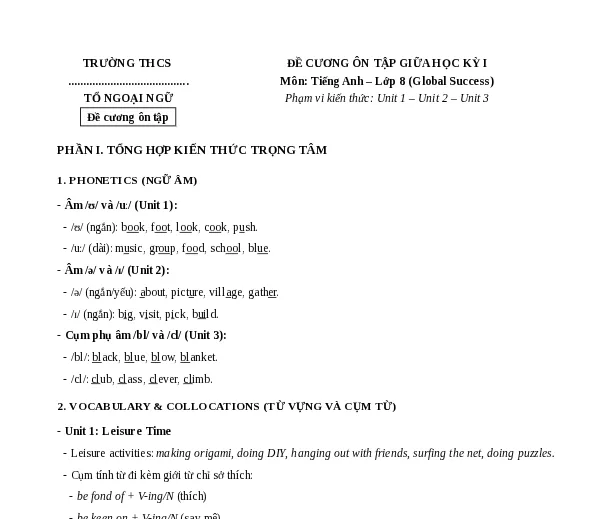
Giải thích ngữ âm:
- Câu 16: A. break /eɪ/; các từ còn lại phát âm là /e/: heavy /ˈhevi/, steady /ˈstedi/, head /hed/.
- Câu 17: C. machine /ʃ/; các từ còn lại phát âm là /k/: architect /ˈɑːkɪtekt/, chemistry /ˈkemɪstri/, school /skuːl/.
- Câu 18: C. hooked /t/; các từ còn lại là tính từ đặc biệt có đuôi -ed phát âm là /ɪd/: naked /ˈneɪkɪd/, crooked /ˈkrʊkɪd/, wicked /ˈwɪkɪd/.
- Câu 19: C. breathes /z/; các từ còn lại kết thúc bằng phụ âm vô thanh /f/, /p/ nên -s phát âm là /s/: laughs /lɑːfs/, coughs /kɒfs/, drops /drɒps/.
- Câu 20: D. poultry /ˈpəʊltri/ có âm /əʊ/; các từ còn lại có nguyên âm /ʌ/: southern /ˈsʌðən/, cousin /ˈkʌzn/, flourish /ˈflʌrɪʃ/.
Câu | 21 | 22 | 23 | 24 | 25 |
|---|---|---|---|---|---|
Đáp án | D | D | A | C | C |
Giải thích trọng âm:
- Câu 21: D. politics /ˈpɒlətɪks/ (trọng âm 1 - trường hợp ngoại lệ với đuôi -ic); các từ còn lại có đuôi -ic trọng âm rơi vào âm tiết liền trước (âm 3): scientific /ˌsaɪənˈtɪfɪk/, energetic /ˌenəˈdʒetɪk/, atmospheric /ˌætməsˈferɪk/.
- Câu 22: D. television /ˈtelɪvɪʒn/ (trọng âm 1); các từ còn lại có đuôi -ion trọng âm rơi vào âm tiết liền trước (âm 3): intuition /ˌɪntjuˈɪʃn/, comprehension /ˌkɒmprɪˈhenʃn/, application /ˌæplɪˈkeɪʃn/.
- Câu 23: A. community /kəˈmjuːnəti/ (trọng âm 2); các từ còn lại có đuôi -ity trọng âm rơi vào âm 3: electricity /ɪˌlekˈtrɪsəti/, opportunity /ˌɒpəˈtjuːnəti/, curiosity /ˌkjʊəriˈɒsəti/.
- Câu 24: C. simultaneous /ˌsɪmlˈteɪniəs/ (trọng âm 3); các từ còn lại trọng âm 2: adventurous /ədˈventʃərəs/, anonymous /əˈnɒnɪməs/, miraculous /mɪˈrækjələs/.
- Câu 25: C. archaeology /ˌɑːkiˈɒlədʒi/ (trọng âm 3); các từ còn lại có đuôi -logy trọng âm rơi vào âm 2: biology /baɪˈɒlədʒi/, methodology /ˌmeθəˈdɒlədʒi/, technology /tekˈnɒlədʒi/.
PART III. LEXICO-GRAMMAR (25.0 điểm - 1,0 điểm/câu)
Câu | 26 | 27 | 28 | 29 | 30 | 31 | 32 | 33 | 34 | 35 |
|---|---|---|---|---|---|---|---|---|---|---|
Đáp án | C | A | B | C | D | A | B | C | A | B |
Câu | 36 | 37 | 38 | 39 | 40 | 41 | 42 |
|---|---|---|---|---|---|---|---|
Đáp án | B | A | C | B | run | boost | charge |
Câu | 43 | 44 | 45 | 46 | 47 | 48 | 49 | 50 |
|---|---|---|---|---|---|---|---|---|
Đáp án | illegal | inexplicable | irresponsible | preventable | immeasurable | unconvincing | unbelievably | modernize |
Giải thích Lexico-Grammar:
- Câu 26: Câu điều kiện hỗn hợp loại 3 và loại 2: Mệnh đề If diễn tả hành động trái thực tế trong quá khứ (last month had followed), mệnh đề chính diễn tả kết quả ở hiện tại (now wouldn't be).
- Câu 27: Cấu trúc đảo ngữ: No sooner + had + S + V3/ed + than + S + V2/ed (Ngay khi... thì...).
- Câu 28: Thể giả định (Subjunctive): It is essential that + S + (should) + V(bare) reduce.
- Câu 29: Needn't have + V3/ed: Lẽ ra không cần phải làm gì nhưng đã lỡ làm (thực tế đã mua nhiều đồ ăn và bị thừa). Didn't need to + V nghĩa là không cần làm và không làm.
- Câu 30: Bị động khách quan với hành động xảy ra trong quá khứ: S + is said + to have been + V3/ed (in the early eighteenth century).
- Câu 31: Mệnh đề nhượng bộ đảo tính từ lên đầu: Adj + as/though + S + be = Although + S + be + Adj.
- Câu 32: Rút gọn mệnh đề quan hệ dạng bị động mang nghĩa bị động: The robotic device (which was) designed by... designed.
- Câu 33: Sự phối thì với By the time + S + V2/ed, S + had + V3/ed (hành động xảy ra trước một mốc trong quá khứ).
- Câu 34: Cụm động từ: cut down on (cắt giảm) và take up (bắt đầu một sở thích/thói quen).
- Câu 35: Cụm cố định: raise awareness of something (nâng cao nhận thức về cái gì).
- Câu 36: solidarity (sự đoàn kết, gắn bó) = unity.
- Câu 37: detrimentally (một cách có hại) = adversely.
- Câu 38: stringent (nghiêm ngặt, chặt chẽ) lenient (khoan dung, nhẹ tay).
- Câu 39: indispensable (không thể thiếu) dispensable (có thể bỏ qua, không thiết yếu).
- Câu 40: run: run for (tranh cử), buses run (xe buýt chạy/hoạt động), in the long run (về lâu về dài).
- Câu 41: boost: boost immune system (tăng cường hệ miễn dịch), give a boost to confidence (thúc đẩy sự tự tin), give the economy a boost (kích thích kinh tế).
- Câu 42: charge: under the charge of (dưới sự quản lý/phụ trách), make a charge (thu phí), charge the battery (sạc pin).
- Câu 43: Tiền tố phủ định il- trước tính từ bắt đầu bằng l: illegal (bất hợp pháp).
- Câu 44: Tiền tố phủ định in- kết hợp hậu tố -able: inexplicable (không thể giải thích nổi).
- Câu 45: Tiền tố phủ định ir- trước tính từ bắt đầu bằng r: irresponsible (vô trách nhiệm).
- Câu 46: preventable (có thể phòng ngừa được) bổ nghĩa cho danh từ chronic diseases.
- Câu 47: Tiền tố phủ định im- trước tính từ bắt đầu bằng m: immeasurable (vô cùng lớn, không đong đếm xiết).
- Câu 48: Tiền tố un- kết hợp tính từ đuôi -ing: unconvincing (không có sức thuyết phục).
- Câu 49: Trạng từ bổ nghĩa cho tính từ efficient: unbelievably (không thể tin được, cực kỳ).
- Câu 50: Động từ hoá với hậu tố -ize: modernize (hiện đại hoá).
PART IV. READING (25.0 điểm - 1,0 điểm/câu)
Câu | 51 | 52 | 53 | 54 | 55 | 56 | 57 | 58 |
|---|---|---|---|---|---|---|---|---|
Đáp án | A | B | A | B | C | A | B | B |
Câu | 59 | 60 | 61 | 62 | 63 | 64 | 65 |
|---|---|---|---|---|---|---|---|
Đáp án | such | from / through | of | In | which | by / while | from |
Câu | 66 | 67 | 68 | 69 | 70 | 71 |
|---|---|---|---|---|---|---|
Đáp án | B | B | C | B | D | B |
Câu | 72 | 73 | 74 | 75 |
|---|---|---|---|---|
Đáp án | survival | feasible | discrepancies | augment |
Dẫn chứng đọc hiểu (Reading Comprehension):
- Câu 66: Đoạn văn thảo luận về sự đột phá của AI trong y tế (chẩn đoán, phát triển thuốc) đồng thời chỉ rõ các rào cản đạo đức (định kiến dữ liệu, trách nhiệm pháp lý) B.
- Câu 67: Dẫn chứng đoạn 2: "By detecting minute cellular anomalies long before they become visible to the naked human eye..." B.
- Câu 68: incipient = initial (giai đoạn chớm nở, ban đầu) C.
- Câu 69: Dẫn chứng đoạn 4: "Because machine learning models are trained on historical healthcare datasets, they may inadvertently perpetuate demographic discrepancies..." they quy chiếu cho machine learning models B.
- Câu 70: Các phương án A, B, C đều được nhắc tới ở đoạn 2 và 3. Phương án D "Eliminating all medical malpractice and human surgical errors" không được đề cập (AI thậm chí còn đối mặt rủi ro chẩn đoán sai) D.
- Câu 71: Đoạn cuối khẳng định AI không nên thay thế lòng trắc ẩn và sự thấu cảm của con người ("rather than completely supplanting their compassionate judgment") B.
- Câu 72 – 75:
- 72: "improving patient survival rates" survival.
- 73: "rendering the production of vaccines... economically feasible" feasible.
- 74: "perpetuate demographic discrepancies" discrepancies.
- 75: "AI should function as an assistive tool to augment human clinicians" augment.
PART V. WRITING (25.0 điểm)
Section 1 (Questions 76 – 83: 8.0 điểm - 1,0 điểm/câu)
Question 76.
→ If he had followed a balanced diet when he was younger, he would not (wouldn't) suffer from chronic digestive problems now.
(Chấp nhận: ... would not be suffering from...)
Question 77.
→ Hardly had the voluntary team arrived at the flooded village when the storm intensified.
Question 78.
→ I wish I had taken part in the school tree-planting campaign last weekend.
(Chấp nhận: I wish I had participated in...)
Question 79.
→ Practicing mindful meditation daily is believed to relieve teenagers' academic stress.
Question 80.
→ Harsh and unpredictable as/though the weather was, the rescue workers reached the isolated community.
Question 81.
→ The more time teenagers spend browsing digital social networks, the more alienated they become (are) from reality.
Question 82.
→ Installed by local engineers last month, the solar-powered generator supplies uninterrupted electricity.
Question 83.
→ You needn't have brought heavy winter coats because the weather was exceptionally mild.
Section 2 (Questions 84 – 90: 7.0 điểm - 1,0 điểm/câu)
Question 84.
→ The student inventor came up with an ingenious solution to combat plastic contamination in the river.
Question 85.
→ Under no circumstances should you disclose your account credentials to strangers.
Question 86.
→ You can participate in the environmental initiative provided that you commit to all weekly training sessions.
(Chấp nhận: provided you commit)
Question 87.
→ It is essential that teenagers (should) get at least eight hours of sound sleep every night.
Question 88.
→ Mark successfully broke the habit of playing mobile games until midnight.
Question 89.
→ Seldom do we witness such genuine philanthropic commitment among junior secondary school students.
Question 90.
→ The catastrophic escalation in global temperatures is attributed to human industrial emissions.
Section 3. Barem chấm bài viết luận Problem - Solution (10.0 điểm)
Tiêu chí | Mô tả chi tiết mức đạt điểm | Điểm |
|---|---|---|
**Nội dung | - Trả lời trực tiếp, đầy đủ yêu cầu của đề: Nêu thực trạng áp lực học tập và đề xuất giải pháp khả thi từ 3 phía (nhà trường, phụ huynh, học sinh). | 3,5 |
**Bố cục và liên kết | - Bố cục chuẩn Problem - Solution: Mở đoạn giới thiệu vấn đề Thân đoạn triển khai 2–3 giải pháp hành động Kết đoạn đúc kết. | 2,5 |
**Vốn từ vựng | - Vốn từ phong phú thuộc chủ đề Education & Mental Health (academic burden, cultivate resilience, excessive expectations, extracurricular pursuits, pastoral care). | 2,0 |
**Ngữ pháp & Chính tả | - Sử dụng linh hoạt các cấu trúc ngữ pháp nâng cao (câu điều kiện, câu bị động, thể giả định, mệnh đề quan hệ rút gọn). | 2,0 |
Bài viết tham khảo (Sample Paragraph - 205 words):
In recent years, the escalating prevalence of academic stress and anxiety among secondary school students has become a pressing educational concern. To alleviate this burden, comprehensive solutions involving educational institutions, families, and students themselves must be implemented synchronously. First and foremost, schools ought to recalibrate their curricula by moderating homework quotas and integrating mindfulness sessions alongside physical education, thereby ensuring that adolescents are not overwhelmed by continuous examinations. Furthermore, establishing dedicated psychological counseling units on campus would provide pupils with safe outlets to seek professional guidance when facing emotional turmoil. On the domestic front, parents must adjust their expectations realistically, refraining from comparing their children with peers or exerting undue pressure regarding test scores; instead, fostering empathetic communication and encouraging well-rounded leisure activities will build a nurturing domestic environment. Crucially, adolescents themselves must cultivate practical self-care habits, such as adhering to disciplined sleep schedules, balancing screen time, and adopting effective time-management strategies like the Pomodoro technique to mitigate procrastination. Ultimately, mitigating academic anxiety requires an empathetic alliance between schools, parents, and learners, fostering an educational ecosystem where mental well-being is valued alongside intellectual achievement.
Lưu ý khi chấm:
- Thí sinh viết dưới 150 từ hoặc quá 260 từ trừ 0,5 điểm tiêu chí Task Achievement.
- Thí sinh làm đúng theo cách diễn đạt khác, đảm bảo ngữ pháp và ngữ nghĩa vẫn cho điểm tối đa.