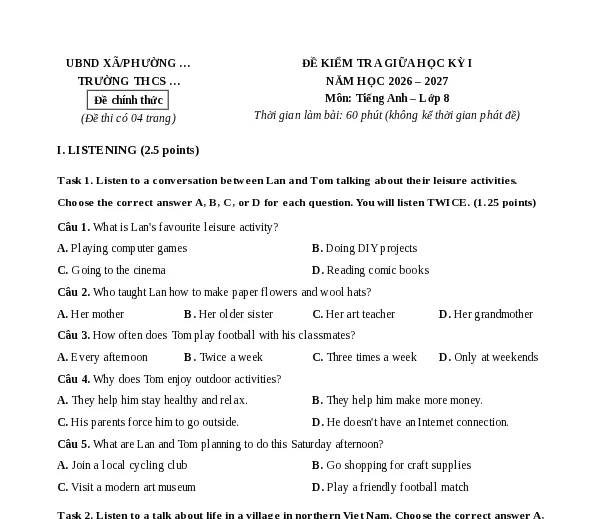
UBND XÃ …
TRƯỜNG THCS …
Đề chính thức
ĐỀ THI CHỌN HỌC SINH GIỎI CẤP TRƯỜNG
Môn: Tiếng Anh – Lớp 8
Năm học 2026 – 2027
Thời gian làm bài: 150 phút (không kể thời gian giao đề)
PART I. PHONETICS (10.0 points)
Section 1: Questions 1 – 5 (5.0 points)
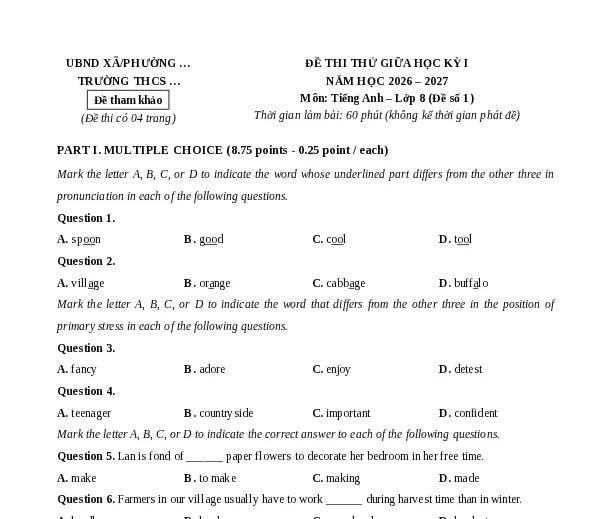
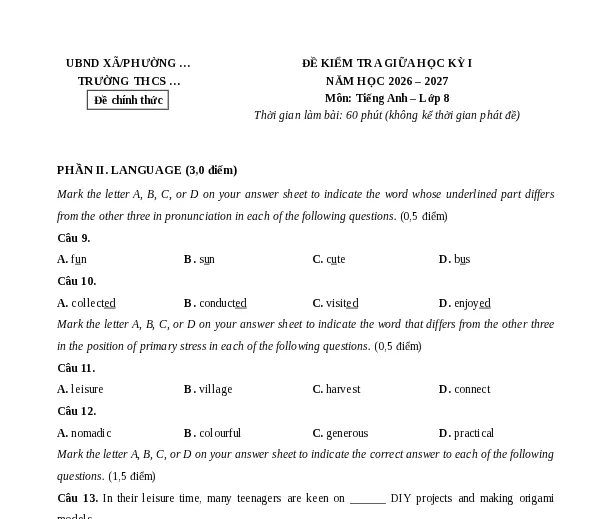
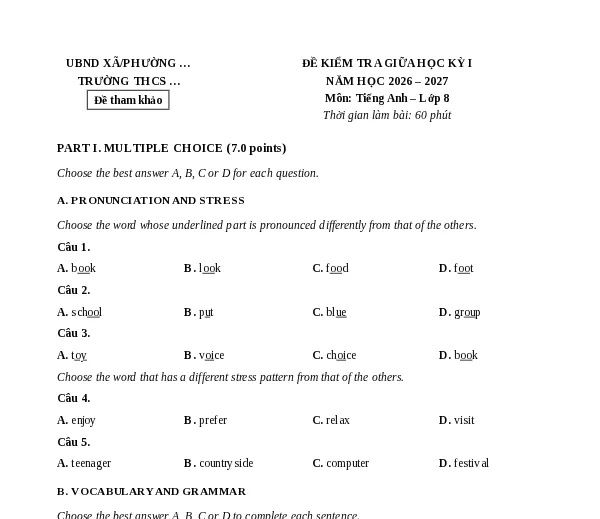
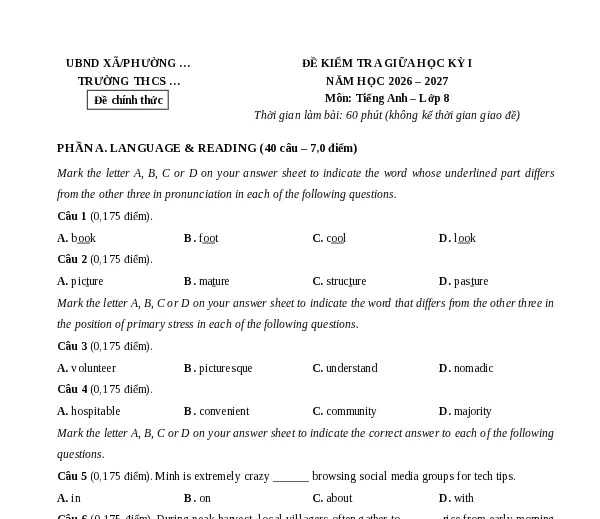
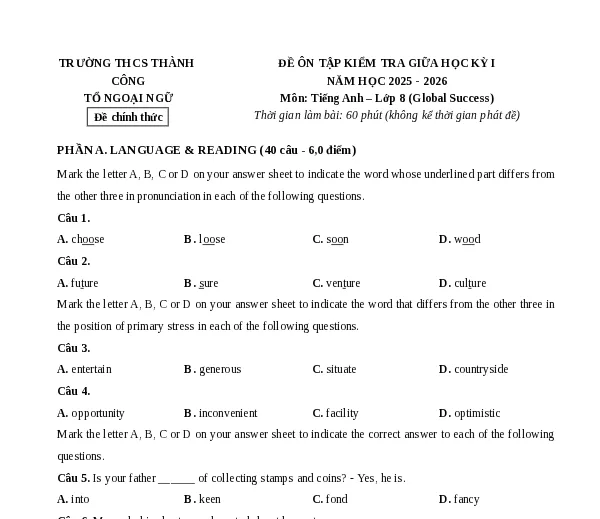
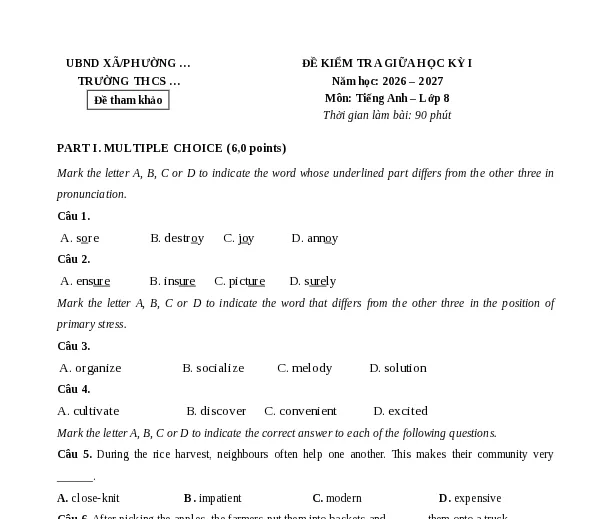
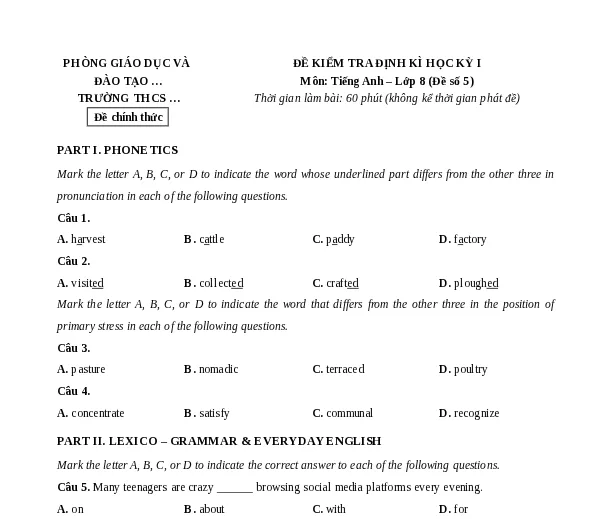
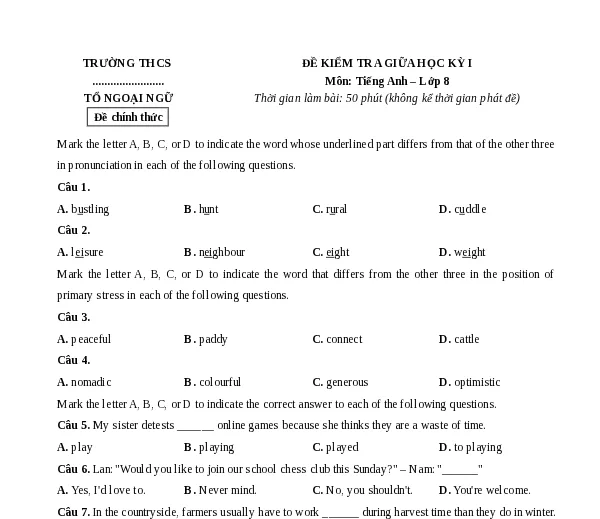
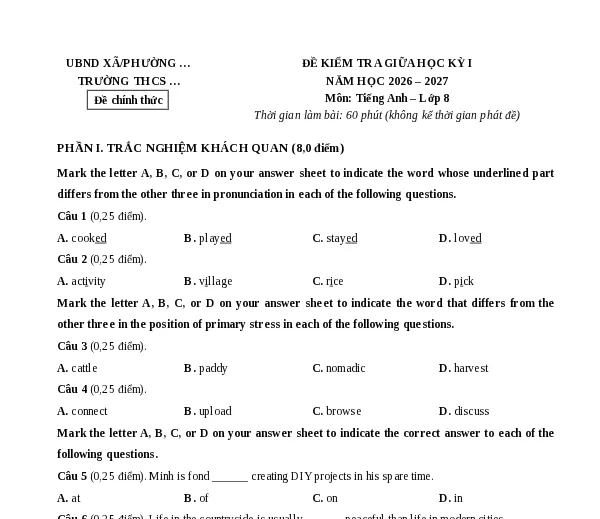
Mark the letter A, B, C, or D to indicate the word whose underlined part differs from the other three in pronunciation in each of the following questions.
Câu 1.
A. bread
B. head
C. great
D. weather
Câu 2.
A. character
B. chemistry
C. mechanic
D. challenge
Câu 3.
A. decided
B. wanted
C. needed
D. recycled
Câu 4.
A. teenagers
B. benefits
C. habits
D. participants
Câu 5.
A. notice
B. progress (n)
C. project (n)
D. motivate
Section 2: Questions 6 – 10 (5.0 points)
Mark the letter A, B, C, or D to indicate the word that differs from the other three in the position of primary stress in each of the following questions.
Câu 6.
A. energetic
B. realistic
C. symbolic
D. scientific
Câu 7.
A. pollution
B. solution
C. devotion
D. atmosphere
Câu 8.
A. security
B. ability
C. diversity
D. memory
Câu 9.
A. dangerous
B. poisonous
C. continuous
D. hazardous
Câu 10.
A. ecology
B. geology
C. archaeology
D. psychology
PART II. LEXICO – GRAMMAR (40.0 points)
Section 1: Questions 11 – 34 (24.0 points)
Mark the letter A, B, C, or D to indicate the correct answer to each of the following questions.
Câu 11. If she ______ the safety instructions more carefully yesterday, she ______ in hospital now.
A. had read / wouldn't be
B. read / wouldn't be
C. had read / wouldn't have been
D. reads / won't be
Câu 12. The coach insisted that every player ______ a medical check-up before the tournament.
A. has
B. have
C. had
D. will have
Câu 13. Hardly ______ the campsite when the storm broke out.
A. had we reached
B. we had reached
C. did we reach
D. we reached
Câu 14. Linh wishes she ______ more attention to the teacher's feedback on her essay last week.
A. paid
B. had paid
C. would pay
D. pays
Câu 15. The laptops ______ to the village school last month are now used by more than two hundred pupils.
A. donating
B. donated
C. which donated
D. were donated
Câu 16. The old pagoda is believed ______ more than three centuries ago.
A. to build
B. to have built
C. to have been built
D. to be building
Câu 17. You ______ so many paper cups for the picnic; we had reusable bottles in the car.
A. needn't buy
B. needn't have bought
C. mustn't have bought
D. didn't need buy
Câu 18. ______ as the volunteers were after the clean-up, they refused to leave before finishing the job.
A. Exhausting
B. Exhausted
C. Exhaust
D. Exhaustion
Câu 19. The more carefully teenagers plan their study schedule, ______ they feel before exams.
A. the less stressed
B. less stressed
C. the least stressed
D. the more stress
Câu 20. To protect the environment, our school has ______ single-use plastic bottles and ______ refillable ones.
A. given up / switched to
B. put off / taken after
C. run out of / looked after
D. brought about / turned down
Câu 21. Students should ______ full advantage of the school library's digital resources.
A. take
B. make
C. get
D. bring
Câu 22. By the time the ambulance arrived, the injured cyclist ______ to the nearest clinic by two passers-by.
A. was taken
B. had been taken
C. has been taken
D. took
Câu 23. Our class visited the recycling plant, ______ we learned how plastic is processed.
A. which
B. that
C. where
D. when
Câu 24. Many teenagers are addicted ______ short videos on social media.
A. to
B. with
C. on
D. for
Câu 25. Not until the documentary ended ______ how serious plastic pollution was.
A. we realised
B. did we realise
C. we did realise
D. realised we
Câu 26. Regular exercise can ______ a significant difference to your mental health.
A. make
B. do
C. take
D. bring
Câu 27. Mark the letter A, B, C, or D to indicate the word CLOSEST in meaning to the underlined word.
Volunteering can greatly enhance teenagers' confidence and communication skills.
A. improve
B. reduce
C. damage
D. ignore
Câu 28. The heavy rain hampered the rescue team's progress through the mountain pass.
A. hindered
B. supported
C. accelerated
D. encouraged
Câu 29. Mark the letter A, B, C, or D to indicate the word OPPOSITE in meaning to the underlined word.
The new policy was praised for being remarkably transparent.
A. clear
B. obscure
C. obvious
D. open
Câu 30. Despite the setback, she remained optimistic about the project's future.
A. hopeful
B. pessimistic
C. confident
D. positive
Câu 31. This is the first time I ______ such a meaningful community project.
A. join
B. joined
C. have joined
D. had joined
Câu 32. The lights are on, so the caretaker ______ still in the building.
A. must be
B. can be
C. should be
D. need be
Câu 33. My brother suggested ______ old clothes to charity instead of throwing them away.
A. to donate
B. donating
C. donate
D. donated
Câu 34. ______ more carefully, the group would not have got lost in the forest.
A. Had they prepared
B. If they prepared
C. Should they prepare
D. They had prepared
Section 2: Questions 35 – 38 (4.0 points)
Find ONE word that can fit appropriately into all three blanks in each group. Write your answers in the spaces provided.
Câu 35.
- The charity walk aims to ______ money for children in flooded areas.
- Students are encouraged to ______ their hands when they want to ask a question.
- The new law will ______ the minimum age for driving to eighteen.
→ ..............................................................
Câu 36.
- It may ______ a long time to recover completely from the injury.
- She decided to ______ part in the tree-planting campaign last weekend.
- The teacher asked us to ______ notes while she was explaining the experiment.
→ ..............................................................
Câu 37.
- The school will ______ a meeting to discuss the new environmental project.
- Could you please ______ the door open for the elderly visitors?
- The new stadium can ______ up to forty thousand spectators.
→ ..............................................................
Câu 38.
- We should ______ more attention to our mental health than to our marks.
- The company has agreed to ______ for the training course.
- It doesn't ______ to argue with someone who never listens.
→ ..............................................................
Section 3: Questions 39 – 50 (12.0 points)
Give the correct form of the word in brackets to complete each of the following sentences. Write your answers in the spaces provided.
Câu 39. The sudden ______ of many rare species is causing serious concern among scientists. (APPEAR)
→ ..............................................................
Câu 40. We need more ______ farming methods in order to protect the soil. (SUSTAIN)
→ ..............................................................
Câu 41. The ______ of fast food among teenagers has risen sharply over the past decade. (CONSUME)
→ ..............................................................
Câu 42. It is ______ to leave the tap running while you are brushing your teeth. (RESPONSIBLE)
→ ..............................................................
Câu 43. More and more families are switching to ______ friendly household products. (ENVIRONMENT)
→ ..............................................................
Câu 44. The ______ among students for the scholarship was extremely intense. (COMPETE)
→ ..............................................................
Câu 45. Her ______ ideas made the whole campaign stand out from the others. (CREATE)
→ ..............................................................
Câu 46. His ______ efforts finally paid off when the project was approved. (PERSIST)
→ ..............................................................
Câu 47. The results were ______ good; nobody had expected such a huge success. (BELIEVE)
→ ..............................................................
Câu 48. Driving without a helmet is extremely ______ for young people. (DANGER)
→ ..............................................................
Câu 49. There was a serious ______ between the two teams about how to share the funding. (AGREE)
→ ..............................................................
Câu 50. The town council plans to ______ the public transport system next year. (MODERN)
→ ..............................................................
PART III. READING (30.0 points)
Section 1: Questions 51 – 60 (10.0 points)
Read the following passage and mark the letter A, B, C, or D to indicate the correct word or phrase that best fits each of the numbered blanks.
Community service has long been recognised as a valuable part of secondary education. When teenagers (51) ______ their free time to helping others, they gain far more than a certificate. (52) ______ academic knowledge can be acquired from textbooks, qualities such as empathy and patience are best developed through real experience.
Volunteering also (53) ______ teenagers a sense of purpose. Young people who feel useful are less likely to (54) ______ to peer pressure or to suffer from low self-esteem. In addition, working alongside people from different backgrounds helps them (55) ______ their communication skills and broaden their horizons.
(56) ______, organising voluntary work requires careful planning. Schools must ensure that activities do not (57) ______ students' study schedules. (58) ______ the workload becomes too heavy, the benefits may well disappear. Experts therefore recommend that community projects be (59) ______ into the curriculum rather than added on top of it. This way, teenagers can (60) ______ the rewards of service without sacrificing their academic progress.
Câu 51.
A. devote
B. spend
C. waste
D. take
Câu 52.
A. Because
B. Although
C. Therefore
D. Moreover
Câu 53.
A. gives
B. provides
C. supplies
D. equips
Câu 54.
A. give in
B. give up
C. give away
D. give off
Câu 55.
A. improve
B. increase
C. enlarge
D. expand
Câu 56.
A. However
B. Moreover
C. Besides
D. Therefore
Câu 57.
A. disrupt
B. distract
C. disturb
D. dissolve
Câu 58.
A. If
B. Unless
C. Although
D. Despite
Câu 59.
A. integrated
B. inserted
C. installed
D. included
Câu 60.
A. reap
B. harvest
C. collect
D. pick
Section 2: Questions 61 – 70 (10.0 points)
Read the passage below and fill each numbered blank with ONE suitable word. Write your answers in the spaces provided.
Peer pressure is one of the strongest forces in a teenager's life. It can push young people to (61) ______ decisions they later regret, but it can also encourage them to do better. The key lies in learning how to respond (62) ______ it.
Research shows that teenagers are far (63) ______ likely to take risks when they are with friends than when they are alone. (64) ______ is because the brain's reward system is especially sensitive to social approval during adolescence. (65) ______ adults often dismiss this as mere immaturity, the urge to fit in is a genuine biological drive.
Parents can help by keeping communication open. Instead of asking (66) ______ their child's friends are, they might ask how those friends make their child feel. Teenagers (67) ______ parents listen without judging are far more likely to seek advice when pressure becomes intense.
Schools also have a role. Programmes aimed (68) ______ teaching refusal skills have been shown to reduce risky behaviour significantly. (69) ______ means of such training, students learn to say no politely but firmly, (70) ______ is a skill they will use for the rest of their lives.
Câu 61. → ..............................................................
Câu 62. → ..............................................................
Câu 63. → ..............................................................
Câu 64. → ..............................................................
Câu 65. → ..............................................................
Câu 66. → ..............................................................
Câu 67. → ..............................................................
Câu 68. → ..............................................................
Câu 69. → ..............................................................
Câu 70. → ..............................................................
Section 3: Questions 71 – 76 (6.0 points)
Read the following passage and mark the letter A, B, C, or D to indicate the correct answer to each of the questions.
In many towns across Europe, a quiet revolution is taking place in community halls and church basements. At so-called "repair cafés", volunteers with toolboxes and sewing machines help visitors fix broken toasters, torn jackets and faulty lamps. The concept began in Amsterdam in 2009 and has since spread to more than thirty countries. Its appeal is partly financial — a repair often costs nothing more than a small donation — but the deeper motive is environmental. Every appliance that is mended rather than discarded keeps valuable metals and plastics out of landfill.
The scale of the problem is enormous. Electronic waste is now the fastest-growing category of household rubbish worldwide, with roughly fifty million tonnes produced annually. Much of this waste contains gold, copper and rare earth elements that are expensive to extract and difficult to recycle safely. Yet manufacturers frequently design products that are sealed shut, glued together, or fitted with batteries that cannot be replaced. Consumers, faced with repair bills that may exceed the price of a new item, usually choose to buy again.
Legislators have begun to respond. Several European countries now require manufacturers to supply spare parts for up to a decade after a product leaves the factory, and to publish repair manuals freely. Campaigners argue that such rules are long overdue, pointing out that extending the life of a smartphone by just one year saves as much carbon dioxide as taking two million cars off the road for the same period.
Critics, however, warn that legislation alone will not change habits. They note that many people simply do not know that repair services exist, or assume that mending is only for those who cannot afford to replace. Repair cafés address this misconception directly: visitors sit beside the volunteer, watch the repair unfold, and often leave with new confidence. As one organiser puts it, "We are not just fixing objects. We are fixing the idea that things are disposable."
Câu 71. Which of the following best serves as the title for the passage?
A. The Rising Cost of Household Appliances
B. Repair Cafés: Mending Objects and Mindsets
C. How Manufacturers Design Modern Gadgets
D. Electronic Waste in Developing Countries
Câu 72. According to paragraph 1, repair cafés ______
A. charge a fixed hourly fee for their services
B. were first set up in the Netherlands
C. are run by large electronics companies
D. only repair clothing and textiles
Câu 73. The word "discarded" in paragraph 1 is closest in meaning to ______
A. thrown away
B. repaired
C. purchased
D. collected
Câu 74. According to paragraph 2, why do many consumers choose to buy new products instead of repairing old ones?
A. New products are always of better quality.
B. Repair bills may be higher than the cost of a new item.
C. Spare parts are never available in shops.
D. They are unaware that products can be repaired.
Câu 75. The word "this" in paragraph 4 refers to ______
A. the belief that repairing is only for people who cannot afford new goods
B. legislation requiring manufacturers to supply spare parts
C. the amount of carbon dioxide saved each year
D. the idea that public habits cannot be changed
Câu 76. Which of the following is NOT mentioned in the passage?
A. Repair cafés first appeared in Amsterdam.
B. Manufacturers sometimes make products difficult to open.
C. Some countries require spare parts to be available for years.
D. Repair cafés have completely eliminated electronic waste in Europe.
Section 4: Questions 77 – 80 (4.0 points)
Complete the summary below. Choose NO MORE THAN TWO WORDS from the passage for each answer. Write your answers in the spaces provided.
Repair cafés, which started in Amsterdam in 2009, offer help with broken household items and have spread to over thirty countries. Their purpose is not only to save money but also to reduce (77) .............................., since electronic rubbish is the fastest-growing type of household waste. Many products are deliberately hard to repair, and consumers often prefer buying new items when repair bills (78) .............................. the price of a new one. Some governments now oblige manufacturers to provide (79) .............................. for many years and to publish repair manuals freely. Campaigners believe that making products last longer would cut (80) .............................. significantly. However, critics insist that changing public attitudes matters as much as changing the law.
Câu 77. → ..............................................................
Câu 78. → ..............................................................
Câu 79. → ..............................................................
Câu 80. → ..............................................................
PART IV. WRITING (20.0 points)
Section 1: Questions 81 – 90 (10.0 points)
Finish each of the following sentences in such a way that it means exactly the same as the sentence printed before it, or complete the second sentence using the word in bold so that it has the same meaning. Do not change the word given.
Câu 81. Because the river was heavily polluted, no fish survived.
→ So heavily ........................................................................................................................
Câu 82. It was the first time I had taken part in a beach clean-up.
→ Never before ....................................................................................................................
Câu 83. Although he was injured, he completed the charity run.
→ Despite ............................................................................................................................
Câu 84. The government should ban single-use plastics immediately.
→ It is high time ................................................................................................................
Câu 85. People say that the new park attracts thousands of visitors every weekend.
→ The new park ................................................................................................................
Câu 86. The film was so boring that we left early. (SUCH)
→ It ......................................................................................................................................
Câu 87. If you don't practise regularly, you won't improve. (UNLESS)
→ ..........................................................................................................................................
Câu 88. I would prefer you not to tell anyone about this. (RATHER)
→ I ........................................................................................................................................
Câu 89. Because of the storm, the trip was cancelled. (OWING)
→ The trip ...........................................................................................................................
Câu 90. He realised the truth only after the meeting had ended. (ONLY)
→ ..........................................................................................................................................
Section 2: Essay Writing (10.0 points)
Many teenagers today spend several hours a day on their phones and very little time on physical activity. Write a paragraph of about 150 – 180 words to propose solutions to this problem. Use specific reasons and relevant examples to support your ideas.
………………………………………………………………………………………………………………………………………………………………………………………………………………………………………………………………………………………………………………………………………………………………………………………………………………………………………………………………………………………………………………………………………………………………………………………………………………………………………………………………………………………………………………………………………………………………………………………………………………………………………………………………………………………………………………………………………………………………………………………………………………………………………………………………
--------- HẾT ---------
Thí sinh không được sử dụng tài liệu. Cán bộ coi thi không giải thích gì thêm.
Họ và tên thí sinh: ................................................ Số báo danh: ........................
UBND XÃ …
TRƯỜNG THCS …
Hướng dẫn chấm
ĐỀ THI CHỌN HỌC SINH GIỎI CẤP TRƯỜNG
Môn: Tiếng Anh – Lớp 8
Năm học 2026 – 2027
HƯỚNG DẪN CHẤM VÀ THANG ĐIỂM
A. HƯỚNG DẠNG CHUNG
- Tổng điểm toàn bài: 100,0 điểm. Phần I: 10,0 điểm; Phần II: 40,0 điểm; Phần III: 30,0 điểm; Phần IV: 20,0 điểm.
- Mỗi câu ngắn (Câu 1 – 90) được 1,0 điểm. Bài luận (Phần IV, Section 2) được 10,0 điểm.
- Học sinh làm theo cách khác, nếu đúng và không làm thay đổi nghĩa, vẫn cho điểm tối đa.
- Phần trả lời ngắn (Câu 35 – 50, 61 – 80, 81 – 90): chỉ chấm khi học sinh viết đúng từ/cấu trúc yêu cầu; sai chính tả hoặc sai dạng từ không cho điểm.
- Câu viết lại (81 – 90): nếu học sinh viết đúng ngữ pháp nhưng sai một chi tiết không làm thay đổi nghĩa so với câu gốc, trừ 0,5 điểm.
- Điểm toàn bài làm tròn đến 0,5 điểm.
B. ĐÁP ÁN VÀ THANG ĐIỂM
Câu | Đáp án | Giải thích chi tiết | Điểm |
|---|---|---|---|
1 | C | great /ɡreɪt/ có /eɪ/; bread /bred/, head /hed/, weather /ˈweðə(r)/ đều có /e/. | 1,0 |
2 | D | challenge /ˈtʃælɪndʒ/ có /tʃ/; character /ˈkærəktə(r)/, chemistry /ˈkemɪstri/, mechanic /məˈkænɪk/ đều có /k/. | 1,0 |
3 | D | recycled /ˌriːˈsaɪkld/ có đuôi -ed đọc /d/ (sau âm hữu thanh /l/); decided, wanted, needed đọc /ɪd/ (sau /d/, /t/). | 1,0 |
4 | A | teenagers /ˈtiːneɪdʒəz/ có đuôi -s đọc /z/ (sau âm hữu thanh); benefits, habits, participants đọc /s/ (sau /t/). | 1,0 |
5 | C | project (n) /ˈprɒdʒekt/ có /ɒ/; notice /ˈnəʊtɪs/, progress (n) /ˈprəʊɡres/, motivate /ˈməʊtɪveɪt/ đều có /əʊ/. | 1,0 |
6 | C | symbolic /sɪmˈbɒlɪk/ trọng âm âm tiết 2; energetic /ˌenəˈdʒetɪk/, realistic /ˌriːəˈlɪstɪk/, scientific /ˌsaɪənˈtɪfɪk/ trọng âm âm tiết 3 (trước hậu tố -ic). | 1,0 |
7 | D | atmosphere /ˈætməsfɪə(r)/ trọng âm âm tiết 1; pollution /pəˈluːʃn/, solution /səˈluːʃn/, devotion /dɪˈvəʊʃn/ trọng âm âm tiết 2 (trước -tion). | 1,0 |
8 | D | memory /ˈmeməri/ trọng âm âm tiết 1; security /sɪˈkjʊərəti/, ability /əˈbɪləti/, diversity /daɪˈvɜːsəti/ trọng âm âm tiết 2 (trước -ity). | 1,0 |
9 | C | continuous /kənˈtɪnjuəs/ trọng âm âm tiết 2; dangerous /ˈdeɪndʒərəs/, poisonous /ˈpɔɪzənəs/, hazardous /ˈhæzədəs/ trọng âm âm tiết 1. | 1,0 |
10 | C | archaeology /ˌɑːkiˈɒlədʒi/ trọng âm âm tiết 3; ecology /iˈkɒlədʒi/, geology /dʒiˈɒlədʒi/, psychology /saɪˈkɒlədʒi/ trọng âm âm tiết 2. | 1,0 |
11 | A | Câu điều kiện hỗn hợp: mệnh đề if dùng quá khứ hoàn thành (had read – giả thiết trái với quá khứ), mệnh đề chính dùng would + V vì kết quả ở hiện tại (now). | 1,0 |
12 | B | Thức giả định sau insist that: S + (should) + V nguyên mẫu → have. | 1,0 |
13 | A | Đảo ngữ với Hardly … when: Hardly + had + S + PII + when + S + V(quá khứ đơn). | 1,0 |
14 | B | wish + quá khứ hoàn thành diễn tả điều ước trái với quá khứ (last week). | 1,0 |
15 | B | Rút gọn mệnh đề quan hệ ở dạng bị động: the laptops which were donated → the laptops donated. | 1,0 |
16 | C | Bị động khách quan: People believe that S + V(quá khứ) → S + is believed + to have been + PII (hành động xảy ra trước). | 1,0 |
17 | B | needn't have + PII: diễn tả việc đã làm nhưng không cần thiết (đã mua nhiều cốc giấy dù có bình dùng lại). | 1,0 |
18 | B | Cấu trúc nhượng bộ đảo tính từ: Adj + as + S + be, với exhausted (tính từ chỉ trạng thái của người). | 1,0 |
19 | A | So sánh kép: The + more + adv/adj + S + V, the + less + adj + S + V → the less stressed. | 1,0 |
20 | A | give up (từ bỏ) + switch to (chuyển sang) hợp nghĩa bảo vệ môi trường. | 1,0 |
21 | A | Collocation take advantage of (tận dụng). | 1,0 |
22 | B | By the time + V(quá khứ đơn), hành động xảy ra trước dùng quá khứ hoàn thành, dạng bị động: had been taken. | 1,0 |
23 | C | where thay cho cụm trạng ngữ chỉ nơi chốn at the recycling plant. | 1,0 |
24 | A | Giới từ đi với tính từ: be addicted to + N/V-ing. | 1,0 |
25 | B | Đảo ngữ với Not until: Not until + mệnh đề + trợ động từ + S + V. | 1,0 |
26 | A | Collocation make a difference to (tạo ra sự khác biệt). | 1,0 |
27 | A | enhance = improve (nâng cao, cải thiện). | 1,0 |
28 | A | hamper = hinder (cản trở). | 1,0 |
29 | B | transparent (minh bạch) >< obscure (mờ mịt, khó hiểu). | 1,0 |
30 | B | optimistic (lạc quan) >< pessimistic (bi quan). | 1,0 |
31 | C | This is the first time + S + have/has + PII. | 1,0 |
32 | A | must + V: suy đoán chắc chắn ở hiện tại dựa trên bằng chứng (đèn vẫn sáng). | 1,0 |
33 | B | suggest + V-ing (đề nghị làm gì). | 1,0 |
34 | A | Đảo ngữ điều kiện loại 3: Had + S + PII, S + would have + PII. | 1,0 |
35 | raise | raise money (gây quỹ) – raise one's hand (giơ tay) – raise the age (nâng độ tuổi). | 1,0 |
36 | take | take a long time (mất nhiều thời gian) – take part in (tham gia) – take notes (ghi chép). | 1,0 |
37 | hold | hold a meeting (tổ chức cuộc họp) – hold the door open (giữ cửa mở) – hold 40,000 spectators (chứa được). | 1,0 |
38 | pay | pay attention to (chú ý) – pay for (trả tiền cho) – it doesn't pay to do sth (không đáng để làm gì). | 1,0 |
39 | disappearance | appear → appearance; thêm tiền tố dis- mang nghĩa phủ định: sự biến mất. | 1,0 |
40 | sustainable | sustain → sustainable (bền vững), hậu tố -able. | 1,0 |
41 | consumption | consume → consumption (sự tiêu thụ), hậu tố -ption. | 1,0 |
42 | irresponsible | responsible → irresponsible (vô trách nhiệm), tiền tố ir- trước /r/. | 1,0 |
43 | environmentally | environment → environmentally (về mặt môi trường), trạng từ bổ nghĩa cho friendly. | 1,0 |
44 | competition | compete → competition (sự cạnh tranh), hậu tố -ition. | 1,0 |
45 | creative | create → creative (sáng tạo), tính từ bổ nghĩa cho ideas. | 1,0 |
46 | persistent | persist → persistent (kiên trì, bền bỉ), hậu tố -ent. | 1,0 |
47 | unbelievably | believe → believable → unbelievably (một cách không thể tin nổi), trạng từ bổ nghĩa cho good. | 1,0 |
48 | dangerous | danger → dangerous (nguy hiểm), hậu tố -ous. | 1,0 |
49 | disagreement | agree → agreement → disagreement (sự bất đồng), tiền tố dis-. | 1,0 |
50 | modernise / modernize | modern → modernise (hiện đại hoá), hậu tố -ise/-ize tạo động từ. | 1,0 |
51 | A | devote sth to V-ing: cống hiến/dành thời gian cho việc gì. spend phải đi với V-ing không có to. | 1,0 |
52 | B | Cần liên từ chỉ nhượng bộ nối hai vế tương phản: kiến thức sách vở ↔ phẩm chất chỉ hình thành qua trải nghiệm. | 1,0 |
53 | A | give sb sth; các động từ còn lại đòi hỏi giới từ with (provide/supply/equip sb with sth). | 1,0 |
54 | A | give in to sth = nhượng bộ, đầu hàng (peer pressure). | 1,0 |
55 | A | improve skills (cải thiện kỹ năng) là kết hợp tự nhiên; increase/enlarge/expand không đi với skills. | 1,0 |
56 | A | However đánh dấu sự chuyển ý sang mặt hạn chế (cần lập kế hoạch cẩn thận). | 1,0 |
57 | A | disrupt a schedule = làm gián đoạn, xáo trộn lịch học. | 1,0 |
58 | A | Câu điều kiện loại 1: If + S + V(hiện tại đơn), S + may + V. | 1,0 |
59 | A | be integrated into the curriculum = được lồng ghép vào chương trình học. | 1,0 |
60 | A | reap the rewards = gặt hái thành quả (collocation cố định). | 1,0 |
61 | make | make decisions (đưa ra quyết định). | 1,0 |
62 | to | respond to sth (phản ứng với điều gì). | 1,0 |
63 | more | far more likely – far bổ nghĩa cho so sánh hơn more likely. | 1,0 |
64 | This | This is because … – This thay cho toàn bộ nhận định ở câu trước. | 1,0 |
65 | Although / Though / While | Liên từ nhượng bộ nối hai vế tương phản (người lớn coi là chưa trưởng thành ↔ đó là nhu cầu sinh học thật sự). | 1,0 |
66 | who | Từ để hỏi về người: asking who their child's friends are. | 1,0 |
67 | whose | Đại từ quan hệ sở hữu: Teenagers whose parents listen without judging. | 1,0 |
68 | at | be aimed at + V-ing (nhằm mục đích làm gì). | 1,0 |
69 | By | By means of = bằng phương tiện, thông qua. | 1,0 |
70 | which | Đại từ quan hệ thay cho cả mệnh đề phía trước trong mệnh đề quan hệ không xác định. | 1,0 |
71 | B | Tiêu đề khái quát cả hai ý của bài: sửa chữa đồ vật (repair) và thay đổi nhận thức (mindsets). | 1,0 |
72 | B | Đoạn 1: "The concept began in Amsterdam in 2009" – Amsterdam thuộc Hà Lan (the Netherlands). | 1,0 |
73 | A | discarded = bị vứt bỏ = thrown away. | 1,0 |
74 | B | Đoạn 2: "faced with repair bills that may exceed the price of a new item, usually choose to buy again". | 1,0 |
75 | A | this misconception quy chiếu tới ngay trước đó: "assume that mending is only for those who cannot afford to replace". | 1,0 |
76 | D | Bài không nói repair cafés đã loại bỏ hoàn toàn rác thải điện tử; A, B, C đều có trong bài. | 1,0 |
77 | electronic waste | Đoạn 2: "Electronic waste is now the fastest-growing category of household rubbish". | 1,0 |
78 | exceed | Đoạn 2: "repair bills that may exceed the price of a new item". | 1,0 |
79 | spare parts | Đoạn 3: "require manufacturers to supply spare parts for up to a decade". | 1,0 |
80 | carbon dioxide | Đoạn 3: "saves as much carbon dioxide as taking two million cars off the road". | 1,0 |
81 | So heavily was the river polluted that no fish survived. | 1,0 | |
82 | Never before had I taken part in a beach clean-up. | 1,0 | |
83 | Despite being injured, he completed the charity run. (hoặc Despite his injury, …) | 1,0 | |
84 | It is high time the government banned single-use plastics. | 1,0 | |
85 | The new park is said to attract thousands of visitors every weekend. | 1,0 | |
86 | It was such a boring film that we left early. | 1,0 | |
87 | Unless you practise regularly, you will not improve. | 1,0 | |
88 | I would rather you did not tell anyone about this. | 1,0 | |
89 | The trip was cancelled owing to the storm. | 1,0 | |
90 | Only after the meeting had ended did he realise the truth. | 1,0 | |
TỔNG PHẦN I – IV (90 câu ngắn) | 90,0 | ||
Biểu điểm bài luận (Câu 91 – Phần IV, Section 2): 10,0 điểm
Tiêu chí | Yêu cầu | Điểm |
|---|---|---|
Nội dung (Task completion) | Nêu được ít nhất 03 giải pháp cụ thể, phù hợp với vấn đề (ví dụ: đặt giới hạn thời gian dùng điện thoại, thay thế bằng hoạt động thể chất, sự phối hợp giữa gia đình và nhà trường); có lí lẽ và ví dụ minh hoạ; thể hiện quan điểm cá nhân rõ ràng. Đúng dung lượng 150 – 180 từ (thiếu/thừa quá 20% trừ 0,5 điểm). | 3,0 |
Bố cục, liên kết (Organization) | Đoạn văn mạch lạc, có câu chủ đề, các ý triển khai theo trình tự hợp lí; dùng hiệu quả từ nối (firstly, moreover, in addition, therefore, in conclusion…). | 2,5 |
Từ vựng – Ngữ pháp (Vocabulary & Grammar) | Sử dụng từ vựng chủ đề Health/Technology/Leisure chính xác, đa dạng; cấu trúc câu phong phú (câu điều kiện, mệnh đề quan hệ, bị động, so sánh…); ít lỗi ngữ pháp, lỗi nặng trừ 0,25/lỗi. | 3,0 |
Chính tả, dấu câu (Spelling & Punctuation) | Viết đúng chính tả, dùng dấu câu và viết hoa đúng quy tắc; chữ viết rõ ràng. | 1,5 |
TỔNG | 10,0 | |
Chấp nhận các cách diễn đạt đúng ngữ pháp khác. Không trừ điểm nếu học sinh trình bày quan điểm cá nhân khác với gợi ý, miễn là lập luận thuyết phục và đúng chủ đề.