TRƯỜNG THCS ........................
TỔ NGOẠI NGỮ
Đề tham khảo
BÀI TẬP ÔN TẬP ĐỊNH KỲ — UNIT 2
Môn: Tiếng Anh – Lớp 8
Thời gian làm bài: 60 phút (không kể thời gian phát đề)
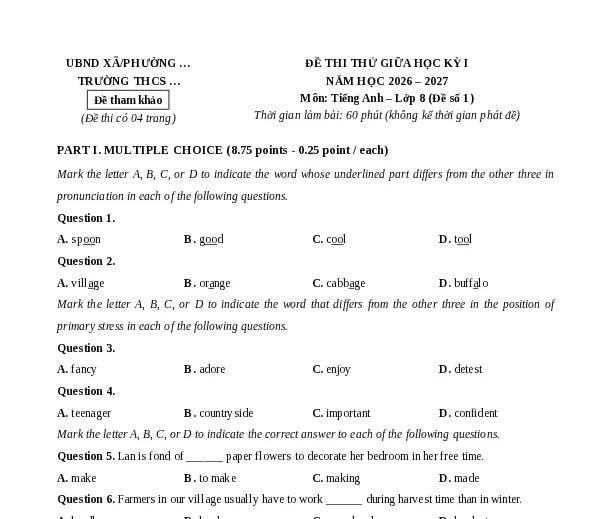
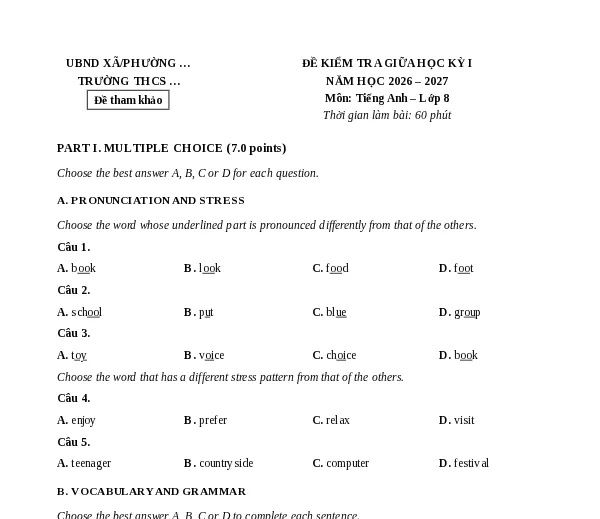
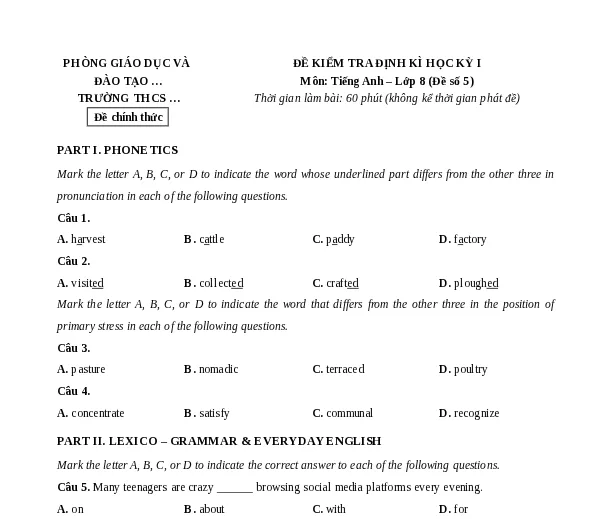
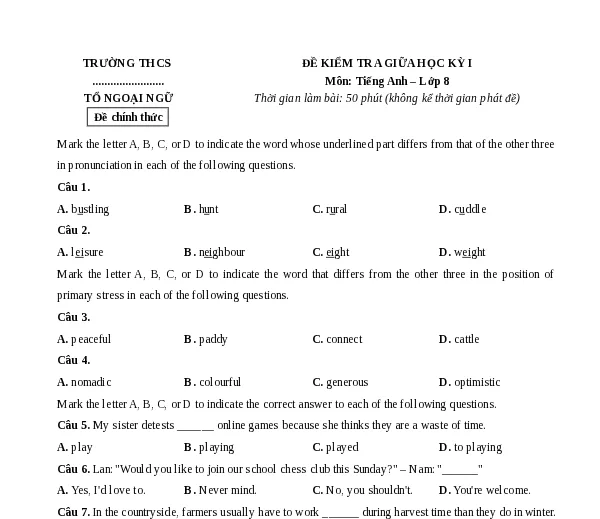
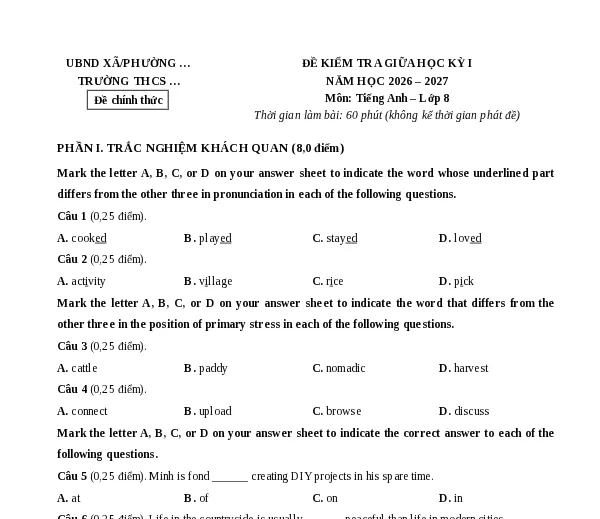
PART I. PRONUNCIATION
Mark the letter A, B, C, or D to indicate the word whose underlined part differs from the other three in pronunciation in each of the following questions.
Câu 1.
A. vast
B. harvest
C. paddy
D. farmer
Câu 2.
A. ploughed
B. herded
C. visited
D. collected
PART II. STRESS
Mark the letter A, B, C, or D to indicate the word that differs from the other three in the position of primary stress in each of the following questions.
Câu 3.
A. cattle
B. canal
C. village
D. orchard
Câu 4.
A. picturesque
B. hospitable
C. fortunate
D. sociable
PART III. VOCABULARY, GRAMMAR AND COMMUNICATION
Mark the letter A, B, C, or D to indicate the correct answer to each of the following questions.
Câu 5. After harvesting rice, farmers often spread it on the ground to ______ it under the sunlight.
A. dry
B. feed
C. milk
D. pick
Câu 6. Nowadays, farmers in my hometown use a ______ to harvest crops and separate grains much faster.
A. lighthouse
B. ferry
C. combine harvester
D. cattle station
Câu 7. A boy was sitting on the back of a water buffalo while ______ the herd along the canal.
A. playing
B. driving
C. herding
D. picking
Câu 8. The ______ includes domestic fowls such as chickens, ducks, turkeys, and geese.
A. poultry
B. cattle
C. crops
D. grains
Câu 9. The sky in the countryside looks ______ and open because there are no high-rise buildings to block the view.
A. dense
B. vast
C. narrow
D. crowded
Câu 10. We helped our uncle ______ the heavy sacks of rice onto the truck to transport them home.
A. unload
B. load
C. produce
D. cultivate
Câu 11. The local villagers are very warm and ______ to visitors from all over the country.
A. hospitable
B. unsociable
C. dull
D. selfish
Câu 12. Children in this village enjoy taking part in ______ games like bamboo dancing and tug of war.
A. modern
B. traditional
C. convenient
D. temporary
Câu 13. My family plans to return to our hometown next weekend to ______ a visit to our grandparents.
A. take
B. make
C. pay
D. give
Câu 14. Living in a ______ area can be inconvenient because public transport is limited and shops are far away.
A. remote
B. central
C. urban
D. modern
Câu 15. Farmers depend ______ on favorable weather conditions for an abundant harvest.
A. hardly
B. heavily
C. quickly
D. carefully
Câu 16. People in my neighborhood always help each other, creating a strong sense of ______.
A. security
B. disconnection
C. community
D. competition
Câu 17. A tractor can plough the field much ______ than an ox.
A. more fast
B. faster
C. fastlier
D. more fastly
Câu 18. In summer, people in the countryside often get up ______ than those living in the city.
A. early
B. more early
C. earlier
D. more earlier
Câu 19. City life usually moves ______ than rural life.
A. faster
B. more fast
C. fastly
D. more fastly
Câu 20. Nam finished the English test ______ than his classmates because he prepared thoroughly.
A. quicklier
B. more quick
C. more quickly
D. quick
Câu 21. You should drive ______ along these narrow soil roads; otherwise, an accident may happen.
A. more carefully
B. more careful
C. carefullier
D. careful
Câu 22. My brother did ______ on the semester examination than he had expected.
A. more badly
B. badder
C. worse
D. worst
Câu 23. Can you speak a little ______? The room is too noisy for me to hear your voice.
A. loud
B. louder
C. more loudly
D. loudlier
Câu 24. She danced ______ than any other contestant in the talent show.
A. more beautiful
B. beautifuller
C. more beautifully
D. beautifully
Câu 25. Last night, Peter stayed up ______ than usual to help his father finish drying the rice grains.
A. more lately
B. later
C. more late
D. late
Câu 26. Does your little sister write ______ than she did last school year?
A. more clearly
B. clearer
C. more clear
D. clearlier
Câu 27. Today the wind is blowing ______ than it did yesterday morning.
A. stronglier
B. more strongly
C. more strong
D. stronger
Câu 28. Although my grandmother lives alone, she gets along ______ with all her neighbors.
A. good
B. well
C. better
D. best
Câu 29. The factory workers are extremely busy ______ the fresh fruit into containers for export.
A. pack
B. packing
C. to pack
D. packed
Câu 30. Lan helped her mother ______ the poultry in the backyard before going to school.
A. feed
B. feeding
C. fed
D. feeds
Câu 31. - Minh: "Which place do you prefer, the bustling city or the quiet countryside?"
- Hoa: "______"
A. Definitely the countryside.
B. Yes, it is very nice.
C. Don't mention it.
D. That's a good idea!
Câu 32. - Tom: "You really did a great job on your school presentation!"
- Mary: "______"
A. You're welcome.
B. Thank you for your compliment.
C. No problem at all.
D. It doesn't matter.
Mark the letter A, B, C, or D to indicate the word(s) CLOSEST in meaning to the underlined word(s) in each of the following questions.
Câu 33. The village is surrounded by picturesque hills and winding green rivers.
A. ugly
B. unattractive
C. scenic
D. terrible
Câu 34. The local people hold a great sense of community and are always ready to support one another.
A. social connection
B. isolation
C. separation
D. loneliness
Mark the letter A, B, C, or D to indicate the word(s) OPPOSITE in meaning to the underlined word(s) in each of the following questions.
Câu 35. She felt very fortunate to spend her summer vacation on a peaceful organic farm.
A. lucky
B. unlucky
C. comfortable
D. happy
Câu 36. The hotel manager was very supportive when our tour group faced transport troubles.
A. helpful
B. encouraging
C. unhelpful
D. friendly
Mark the letter A, B, C, or D to indicate the underlined part that needs correction in each of the following questions.
Câu 37. My brother (A) ran (B) more fastly than all the other (C) runners in (D) the competition yesterday.
A. ran
B. more fastly
C. runners
D. the competition
Câu 38. Life in the countryside (A) is (B) much peaceful, and people (C) live (D) more slowly than in big cities.
A. is
B. much
C. live
D. more slowly
Câu 39. The harvesters (A) use modern machines (B) to separate the golden grains (C) with the rest of (D) the plants.
A. use
B. to separate
C. with
D. the plants
PART IV. CLOZE TEST
Read the following passage and mark the letter A, B, C, or D to indicate the correct word or phrase that best fits each of the numbered blanks from 40 to 44.
Living in the countryside offers people numerous benefits that can hardly be found in metropolitan centers. First of all, the rural atmosphere is much fresher and less polluted because there are fewer vehicles and factories. People can breathe clean air and enjoy green spaces every day. In addition, rural residents usually work at their (40) ______ pace, without feeling the rush and severe pressure of modern deadlines. Neighbors know each other well and are always willing to give a helping hand (41) ______ someone is in trouble.
However, life outside big cities also has several drawbacks. Public facilities such as hospitals, specialized clinics, and large shopping malls are (42) ______ distributed. When people fall seriously ill, they may have to travel a long distance to reach a central hospital. Furthermore, young adults might find life in a village rather (43) ______ because entertainment venues and employment opportunities are limited. In conclusion, the countryside is an ideal destination for those who seek peace and relaxation, while dynamic individuals looking for careers (44) ______ choose to settle in big cities.
Câu 40.
A. own
B. self
C. private
D. lonely
Câu 41.
A. although
B. when
C. because of
D. unless
Câu 42.
A. closely
B. densely
C. sparsely
D. conveniently
Câu 43.
A. dull
B. fascinated
C. thrilling
D. exciting
Câu 44.
A. usually
B. hardly
C. never
D. rarely
PART V. READING COMPREHENSION
Read the following passage and mark the letter A, B, C, or D to indicate the correct answer to each of the questions from 45 to 50.
Harvest time is undoubtedly the busiest yet most exciting period of the year in Vietnamese farming villages. It usually occurs twice a year, during early summer and late autumn. When the golden paddy fields stretch across the horizon, farmers, young and old, prepare their equipment and head out to the fields before sunrise.
Years ago, harvesting was done entirely by manual labor. Farmers used hand sickles to cut the rice stalks, bound them into neat bundles, and transported them back home on wooden carts pulled by oxen or water buffaloes. Families then gathered to thresh the grain by hand, which required tremendous physical strength and took several weeks to complete. Today, modern agriculture has transformed this laborious routine. Combine harvesters move smoothly through the fields, cutting, threshing, and cleaning the grains simultaneously. This mechanized process saves considerable time and allows farmers to finish their harvest in just a few days.
Despite the introduction of modern machines, the warm communal spirit of the harvest season remains unchanged. Neighbors actively assist each other in loading heavy sacks onto trucks and drying the rice in communal courtyards. In the evening, families gather in front of their houses, sharing simple meals made from freshly harvested rice and chatting cheerfully. For children, the post-harvest fields become open playgrounds where they fly colorful kites, play traditional games, and herd livestock in the refreshing breeze.
Câu 45. What is the main idea of the passage?
A. The history of traditional tools in Vietnamese agriculture.
B. Life and activities in Vietnamese farming villages during harvest time.
C. How modern machinery has completely replaced human labor.
D. The entertainment activities of rural children throughout the year.
Câu 46. According to paragraph 1, when does harvest time usually take place?
A. Only once a year during winter.
B. In the middle of spring and early winter.
C. Twice a year, in early summer and late autumn.
D. Every three months whenever crops are ripe.
Câu 47. The word "laborious" in paragraph 2 is closest in meaning to ______.
A. relaxing
B. exhausting
C. effortless
D. interesting
Câu 48. According to paragraph 2, what is an advantage of using combine harvesters?
A. They do not require any fuel or maintenance.
B. They can be pulled easily by water buffaloes.
C. They perform multiple tasks simultaneously and save much time.
D. They make rice grains taste better.
Câu 49. The word "they" in paragraph 3 refers to ______.
A. neighbors
B. children
C. machines
D. paddy fields
Câu 50. Which of the following is NOT true according to the passage?
A. In the past, farmers used hand sickles and oxen to harvest and transport rice.
B. Modern machines have destroyed the sense of community in farming villages.
C. Rice fields after the harvest serve as vast playgrounds for rural children.
D. Neighbors still cooperate and help one another during the harvest period.
--------- HẾT ---------
TRƯỜNG THCS ........................
TỔ NGOẠI NGỮ
HƯỚNG DẪN CHẤM
ĐÁP ÁN BÀI ÔN TẬP UNIT 2 — TIẾNG ANH 8
Năm học: 2024 – 2025
Thang điểm: 10,0 điểm (0,2 điểm / câu)
ĐÁP ÁN VÀ GIẢI THÍCH CHI TIẾT
Câu | Đáp án | Tóm tắt giải thích | Điểm |
|---|---|---|---|
1 | C | Phần gạch chân ở C phát âm là /æ/ (paddy /ˈpædi/), các phương án còn lại phát âm là /ɑː/ (vast /vɑːst/, harvest /ˈhɑːvɪst/, farmer /ˈfɑːmə/). | 0,2 |
2 | A | ploughed đuôi -ed phát âm là /d/ (sau âm hữu thanh /aʊ/), các từ còn lại có tận cùng là /t/, /d/ nên đuôi -ed phát âm là /ɪd/. | 0,2 |
3 | B | canal /kəˈnæl/ trọng âm rơi vào âm tiết thứ 2; các từ còn lại trọng âm rơi vào âm tiết thứ 1 (cattle /ˈkætl/, village /ˈvɪlɪdʒ/, orchard /ˈɔːtʃəd/). | 0,2 |
4 | A | picturesque /ˌpɪktʃəˈresk/ trọng âm rơi vào âm tiết thứ 3; các từ còn lại trọng âm rơi vào âm tiết thứ 1 (hospitable /ˈhɒspɪtəbl/, fortunate /ˈfɔːtʃənət/, sociable /ˈsəʊʃəbl/). | 0,2 |
5 | A | dry (v): phơi khô, sấy khô lúa dưới ánh nắng mặt trời (dry rice under the sunlight). | 0,2 |
6 | C | combine harvester (n): máy gặt đập liên hợp dùng gặt và tách hạt lúa. | 0,2 |
7 | C | Cụm từ: herd cattle / herd buffaloes (chăn dắt trâu bò). | 0,2 |
8 | A | poultry (n): gia cầm (gà, vịt, ngan, ngỗng). Cattle là gia súc (bò, trâu). | 0,2 |
9 | B | vast (adj): rộng lớn, bao la (the sky looks vast and open). | 0,2 |
10 | B | Cụm từ: load sth onto sth (chất, bốc hàng hóa lên xe) >< unload (dỡ xuống). | 0,2 |
11 | A | hospitable (adj): hiếu khách, niềm nở đón tiếp khách. | 0,2 |
12 | B | traditional games: các trò chơi dân gian, truyền thống (múa sạp, kéo co). | 0,2 |
13 | C | Cụm cố định: pay a visit to sb = visit sb (đến thăm ai). | 0,2 |
14 | A | remote area: khu vực hẻo lánh, vùng sâu vùng xa. | 0,2 |
15 | B | Cụm cố định: depend heavily on (phụ thuộc nhiều vào thời tiết). | 0,2 |
16 | C | Cụm danh từ: sense of community (ý thức cộng đồng, tình làng nghĩa xóm). | 0,2 |
17 | B | fast vừa là tính từ vừa là trạng từ ngắn; dạng so sánh hơn là faster. | 0,2 |
18 | C | early là trạng từ kết thúc bằng -y; chuyển sang so sánh hơn đổi -y thành -i rồi thêm -er (earlier). | 0,2 |
19 | A | fast là trạng từ ngắn đặc biệt; so sánh hơn là faster than. | 0,2 |
20 | C | quickly là trạng từ dài (2 âm tiết kết thúc -ly); so sánh hơn dùng more quickly than. | 0,2 |
21 | A | Bổ nghĩa cho động từ drive cần trạng từ carefully; so sánh hơn dùng more carefully. | 0,2 |
22 | C | badly là trạng từ bất quy tắc; dạng so sánh hơn là worse. | 0,2 |
23 | B | Cụm thành ngữ khẩu ngữ: speak louder (nói to hơn). | 0,2 |
24 | C | Bổ nghĩa cho động từ dance cần trạng từ beautifully; so sánh hơn là more beautifully. | 0,2 |
25 | B | late là trạng từ ngắn (tránh nhầm với lately mang nghĩa "gần đây"); so sánh hơn là later. | 0,2 |
26 | A | Bổ nghĩa cho động từ write dùng trạng từ clearly; so sánh hơn là more clearly. | 0,2 |
27 | B | Bổ nghĩa cho động từ blow dùng trạng từ strongly; so sánh hơn là more strongly. | 0,2 |
28 | B | Cụm thành ngữ: get along well with someone (hòa thuận, có mối quan hệ tốt với ai). | 0,2 |
29 | B | Cấu trúc: be busy + V-ing (đang bận rộn làm việc gì). | 0,2 |
30 | A | Cấu trúc: help sb (to) do sth (giúp ai làm việc gì). | 0,2 |
31 | A | Lời đáp trực tiếp lựa chọn giữa thành thị và nông thôn: Definitely the countryside (Chắc chắn là nông thôn rồi). | 0,2 |
32 | B | Đáp lại một lời khen ngợi (compliment): Thank you for your compliment. | 0,2 |
33 | C | picturesque (đẹp như tranh vẽ, hữu tình) đồng nghĩa với scenic / beautiful. | 0,2 |
34 | A | sense of community (sự gắn kết cộng đồng) đồng nghĩa với social connection. | 0,2 |
35 | B | fortunate (may mắn) có từ trái nghĩa là unlucky (bất hạnh, không may mắn). | 0,2 |
36 | C | supportive (đem lại sự giúp đỡ, hỗ trợ) trái nghĩa với unhelpful (không giúp ích gì). | 0,2 |
37 | B | more fastly sửa thành faster vì fast là trạng từ ngắn không thêm -ly. | 0,2 |
38 | B | much sửa thành more (more peaceful so sánh hơn của tính từ dài). | 0,2 |
39 | C | with sửa thành from vì cấu trúc chuẩn là: separate something from something. | 0,2 |
40 | A | Cụm từ: at one's own pace (theo nhịp điệu riêng của chính mình). | 0,2 |
41 | B | Liên từ chỉ thời gian: when someone is in trouble (khi có ai gặp khó khăn). | 0,2 |
42 | C | sparsely distributed: phân bố thưa thớt, rải rác. | 0,2 |
43 | A | dull (adj): tẻ nhạt, buồn chán vì thiếu các dịch vụ giải trí. | 0,2 |
44 | A | Trạng từ tần suất usually (thường chọn định cư ở các thành phố lớn). | 0,2 |
45 | B | Bài đọc miêu tả tổng thể không khí, công việc và đời sống của làng quê Việt Nam vào mùa gặt. | 0,2 |
46 | C | Dẫn chứng đoạn 1: "It usually occurs twice a year, during early summer and late autumn." | 0,2 |
47 | B | laborious (vất vả, nặng nhọc, tốn nhiều công sức) gần nghĩa nhất với exhausting. | 0,2 |
48 | C | Dẫn chứng đoạn 2: "cutting, threshing, and cleaning the grains simultaneously... saves considerable time..." | 0,2 |
49 | B | "For children, the post-harvest fields become open playgrounds where they fly colorful kites..." -> they thay cho children. | 0,2 |
50 | B | Dẫn chứng đoạn 3: "the warm communal spirit of the harvest season remains unchanged" -> câu B sai vì máy móc không làm mất đi tình làng nghĩa xóm. | 0,2 |
TỔNG | 10,0 | ||